Rifa Tamanna Rabita
21 MGT 074
Department of Management Studies
University of Barishal
My Presentation Topic:
Chapter: 03
E-Business Infrastructure
What is e-business?
E-business is any kind of business that share information with the help
of internet.
E-business infrastructure :
It refers to the combination of servers and client computers in a
organization . It is a methods for publishing data and documents access
through e-business application.
Internet technology :
The group of technologies that allow users to access information and communication over the
world wide web.
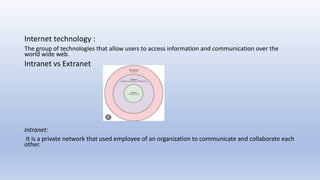
Intranet vs Extranet
Intranet:
It is a private network that used employee of an organization to communicate and collaborate each
other.
Extranet:
It also a private network similar to intranet. It used by outsiders of an
organization. Here outsider means suppliers,customers etc.
Welcome to my presentation ID: 21 MGT 075
Web technology
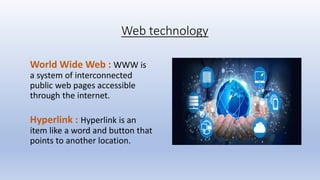
World Wide Web : WWW is
a system of interconnected
public web pages accessible
through the internet.
Hyperlink : Hyperlink is an
item like a word and button that
points to another location.
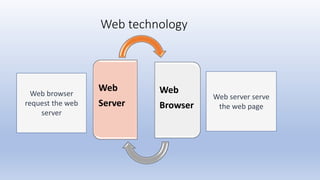
Web technology
Web
Server
Web
Browser
Web browser
request the web
server
Web server serve
the web page
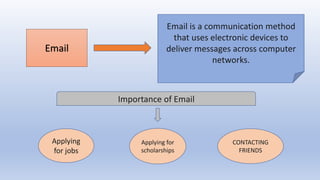
Email
Email is a communication method
that uses electronic devices to
deliver messages across computer
networks.
Importance of Email
Applying
for jobs
Applying for
scholarships
CONTACTING
FRIENDS
MD. Sabbir
21 MGT 076
Department of Management Studies
University of Barishal
My Presentation Topic:
Chapter: 03
E-Business Infrastructure
What is Internet?
The internet is a vast network that connects computers all over the world. Through the internet people
can share information and communicate from any where with an internet connection.
Internet standards
Internet standards are created and published by the internet engineering task force. They allow
interoperation of hardware and software from different sources which allow internets to function.
What is Network?
A network consists of two or more computers that are linked in order to share resources, exchange
files, or allow electronic communication.
Network Standards
Network standards are a type of internet standard which defines rules for data communication in
networking technologies and processes.
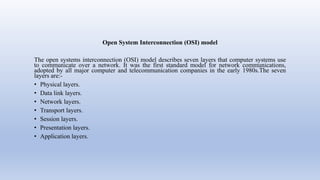
Open System Interconnection (OSI) model
The open systems interconnection (OSI) model describes seven layers that computer systems use
to communicate over a network. It was the first standard model for network communications,
adopted by all major computer and telecommunication companies in the early 1980s.The seven
layers are:-
• Physical layers.
• Data link layers.
• Network layers.
• Transport layers.
• Session layers.
• Presentation layers.
• Application layers.
Internet protocol (IP)
The internet protocol is a network layer protocol that moves data between host computers.
The unique numerical address of a computer is called IP address.
Web address
Web address refers to particular pages on a web server which is hosted by a company or organization.
The technical name for web address is uniform (or universal) resource locator (URL).
Domain Name
The domain name refers to the name of the web server. The process of reserving a unique web
address that can be used to refer to the company web site.
Cybersquatting
The term cybersquatting refers to the unauthorized registration and use of internet domain names that
are identical or similar to trademarks, service marks, company names or personal names.
Content
The information, graphics and interactive elements that make up the web pages of a site are
collectively referred to as content.
HTML
A standard web-page presentation format used to define the text layout of web pages. Standard
html codes use to specify the content and characteristics of the documents.
Sajjad Ahamed Piyash
21 MGT 077
Department of Management Studies
University of Barishal
My Presentation Topic:
Chapter: 03
E-Business Infrastructure
Semantic Web:
The Semantic Web is an extension of the World Wide Web that aims to make web content more
machine-readable and interpretable by computers. The idea behind the Semantic Web is to
encode information on web pages in a way that allows software agents to understand the meaning
of the data, enabling them to process and use the information more intelligently.
Agents:
In the context of computing and technology, "agents" refer to autonomous software entities that
can perform tasks or make decisions on behalf of users or other systems. These agents are
designed to act independently, often with a specific purpose, and can interact with their
environment to achieve their objectives. Agents are a fundamental concept in the field of artificial
intelligence (AI) and distributed systems. There are various types of agents, each with distinct
characteristics and functionalities.
Wild:
The term "web service wild" doesn't have a standard or widely recognized meaning in the context
of web services or technology. It is possible that the phrase was used in a specific context or
conversation, but without further context or clarification, it's challenging to provide a specific
explanation.
Key Benefits Of Using Semantic Web Technologies:
Using semantic web technologies offers several key benefits, which aim to enhance the
interoperability, understandability, and utilization of data on the web. Here are some of the main
advantages:
1. Interoperability.
2. Meaningful Data Integration.
3. Improved Search and Discovery.
4. Data Sharing and Reuse.
5. Knowledge Representation and Reasoning.
6. Domain-Specific Applications.
7. Data Quality and Consistency.
8. Future-Proofing Data.
Some Example of Semantic Web Technologies:
1. Micro Formats.
2. GIF (Graphics Interchange Format).
3. JPEG (Joint Photographic Experts Group).
4. PNG (Portable Network Graphics).
5. Internet governance.
6. The Internet Society (ISOC).
Rashme chakma
Roll : 21 MGT 078
Topic : Managing hardware and systems software infrastructure
,Enterprise resource paining and, Web services
Managing hardware and systems software
infrastructure:
• Infrastructure management is the management of both technical and
operational components—including hardware, software, policies,
processes, data, facilities and equipment—for business effectiveness. It
may be divided into systems management, network management and
storage management.
Layer 2-systems software
Layer3-Transport or network
Layer4-Storage
-
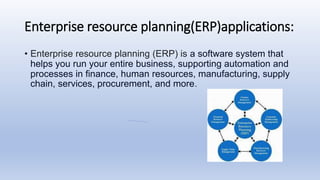
Enterprise resource planning(ERP)applications:
• Enterprise resource planning (ERP) is a software system that
helps you run your entire business, supporting automation and
processes in finance, human resources, manufacturing, supply
chain, services, procurement, and more.
Web services saas and service-oriented
architecture:
• Web services or software as a services refers to a highly significant
model for managing software and data within the e-business age .
Sadia Afrin Tisa
20 MGT 076
Department of Management Studies
University of Barishal
My Presentation Topic:
Chapter: 03
E-Business Infrastructure
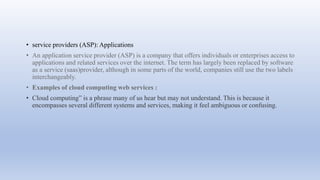
• service providers (ASP): Applications
• An application service provider (ASP) is a company that offers individuals or enterprises access to
applications and related services over the internet. The term has largely been replaced by software
as a service (saas)provider, although in some parts of the world, companies still use the two labels
interchangeably.
• Examples of cloud computing web services :
• Cloud computing” is a phrase many of us hear but may not understand. This is because it
encompasses several different systems and services, making it feel ambiguous or confusing.
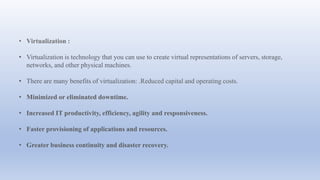
• Virtualization :
• Virtualization is technology that you can use to create virtual representations of servers, storage,
networks, and other physical machines.
• There are many benefits of virtualization: .Reduced capital and operating costs.
• Minimized or eliminated downtime.
• Increased IT productivity, efficiency, agility and responsiveness.
• Faster provisioning of applications and resources.
• Greater business continuity and disaster recovery.
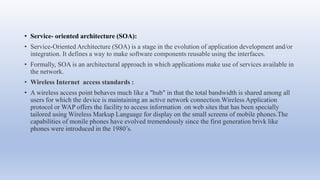
• Service- oriented architecture (SOA):
• Service-Oriented Architecture (SOA) is a stage in the evolution of application development and/or
integration. It defines a way to make software components reusable using the interfaces.
• Formally, SOA is an architectural approach in which applications make use of services available in
the network.
• Wireless Internet access standards :
• A wireless access point behaves much like a "hub" in that the total bandwidth is shared among all
users for which the device is maintaining an active network connection.Wireless Application
protocol or WAP offers the facility to access information on web sites that has been specially
tailored using Wireless Markup Language for display on the small screens of mobile phones.The
capabilities of monile phones have evolved tremendously since the first generation brivk like
phones were introduced in the 1980’s.
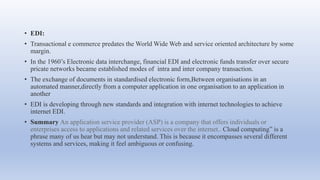
• EDI:
• Transactional e commerce predates the World Wide Web and service oriented architecture by some
margin.
• In the 1960’s Electronic data interchange, financial EDI and electronic funds transfer over secure
pricate networks became established modes of intra and inter company transaction.
• The exchange of documents in standardised electronic form,Between organisations in an
automated manner,directly from a computer application in one organisation to an application in
another
• EDI is developing through new standards and integration with internet technologies to achieve
internet EDI.
• Summary An application service provider (ASP) is a company that offers individuals or
enterprises access to applications and related services over the internet.. Cloud computing” is a
phrase many of us hear but may not understand. This is because it encompasses several different
systems and services, making it feel ambiguous or confusing.
• Web mail readers
• Google maps,Gmail and Google Analytics
• Virtualization is technology that you can use to create virtual representations of servers, storage,
networks, and other physical machines. Service-Oriented Architecture (SOA) is a stage in the
evolution of application development and/or integration. It defines a way to make software
components reusable using the interfaces.
• A wireless access point behaves much like a "hub" in that the total bandwidth is shared among all
users for which the device is maintaining an active network connection.Wireless. Transactional e
commerce predates the World Wide Web and service oriented architecture by some margin.
• In the 1960’s Electronic data interchange, financial EDI and electronic funds transfer over secure
pricate networks became established modes of intra and inter company transaction.

Group- 12.pptx

  • 1.
    Rifa Tamanna Rabita 21MGT 074 Department of Management Studies University of Barishal My Presentation Topic: Chapter: 03 E-Business Infrastructure
  • 2.
    What is e-business? E-businessis any kind of business that share information with the help of internet. E-business infrastructure : It refers to the combination of servers and client computers in a organization . It is a methods for publishing data and documents access through e-business application.
  • 3.
    Internet technology : Thegroup of technologies that allow users to access information and communication over the world wide web. Intranet vs Extranet Intranet: It is a private network that used employee of an organization to communicate and collaborate each other.
  • 4.
    Extranet: It also aprivate network similar to intranet. It used by outsiders of an organization. Here outsider means suppliers,customers etc.
  • 5.
    Welcome to mypresentation ID: 21 MGT 075
  • 6.
    Web technology World WideWeb : WWW is a system of interconnected public web pages accessible through the internet. Hyperlink : Hyperlink is an item like a word and button that points to another location.
  • 7.
    Web technology Web Server Web Browser Web browser requestthe web server Web server serve the web page
  • 8.
    Email Email is acommunication method that uses electronic devices to deliver messages across computer networks. Importance of Email Applying for jobs Applying for scholarships CONTACTING FRIENDS
  • 9.
    MD. Sabbir 21 MGT076 Department of Management Studies University of Barishal My Presentation Topic: Chapter: 03 E-Business Infrastructure
  • 10.
    What is Internet? Theinternet is a vast network that connects computers all over the world. Through the internet people can share information and communicate from any where with an internet connection. Internet standards Internet standards are created and published by the internet engineering task force. They allow interoperation of hardware and software from different sources which allow internets to function. What is Network? A network consists of two or more computers that are linked in order to share resources, exchange files, or allow electronic communication. Network Standards Network standards are a type of internet standard which defines rules for data communication in networking technologies and processes.
  • 11.
    Open System Interconnection(OSI) model The open systems interconnection (OSI) model describes seven layers that computer systems use to communicate over a network. It was the first standard model for network communications, adopted by all major computer and telecommunication companies in the early 1980s.The seven layers are:- • Physical layers. • Data link layers. • Network layers. • Transport layers. • Session layers. • Presentation layers. • Application layers.
  • 12.
    Internet protocol (IP) Theinternet protocol is a network layer protocol that moves data between host computers. The unique numerical address of a computer is called IP address. Web address Web address refers to particular pages on a web server which is hosted by a company or organization. The technical name for web address is uniform (or universal) resource locator (URL). Domain Name The domain name refers to the name of the web server. The process of reserving a unique web address that can be used to refer to the company web site.
  • 13.
    Cybersquatting The term cybersquattingrefers to the unauthorized registration and use of internet domain names that are identical or similar to trademarks, service marks, company names or personal names. Content The information, graphics and interactive elements that make up the web pages of a site are collectively referred to as content.
  • 14.
    HTML A standard web-pagepresentation format used to define the text layout of web pages. Standard html codes use to specify the content and characteristics of the documents.
  • 15.
    Sajjad Ahamed Piyash 21MGT 077 Department of Management Studies University of Barishal My Presentation Topic: Chapter: 03 E-Business Infrastructure
  • 16.
    Semantic Web: The SemanticWeb is an extension of the World Wide Web that aims to make web content more machine-readable and interpretable by computers. The idea behind the Semantic Web is to encode information on web pages in a way that allows software agents to understand the meaning of the data, enabling them to process and use the information more intelligently. Agents: In the context of computing and technology, "agents" refer to autonomous software entities that can perform tasks or make decisions on behalf of users or other systems. These agents are designed to act independently, often with a specific purpose, and can interact with their environment to achieve their objectives. Agents are a fundamental concept in the field of artificial intelligence (AI) and distributed systems. There are various types of agents, each with distinct characteristics and functionalities.
  • 17.
    Wild: The term "webservice wild" doesn't have a standard or widely recognized meaning in the context of web services or technology. It is possible that the phrase was used in a specific context or conversation, but without further context or clarification, it's challenging to provide a specific explanation. Key Benefits Of Using Semantic Web Technologies: Using semantic web technologies offers several key benefits, which aim to enhance the interoperability, understandability, and utilization of data on the web. Here are some of the main advantages: 1. Interoperability. 2. Meaningful Data Integration. 3. Improved Search and Discovery. 4. Data Sharing and Reuse. 5. Knowledge Representation and Reasoning. 6. Domain-Specific Applications. 7. Data Quality and Consistency. 8. Future-Proofing Data.
  • 18.
    Some Example ofSemantic Web Technologies: 1. Micro Formats. 2. GIF (Graphics Interchange Format). 3. JPEG (Joint Photographic Experts Group). 4. PNG (Portable Network Graphics). 5. Internet governance. 6. The Internet Society (ISOC).
  • 19.
    Rashme chakma Roll :21 MGT 078 Topic : Managing hardware and systems software infrastructure ,Enterprise resource paining and, Web services
  • 20.
    Managing hardware andsystems software infrastructure: • Infrastructure management is the management of both technical and operational components—including hardware, software, policies, processes, data, facilities and equipment—for business effectiveness. It may be divided into systems management, network management and storage management. Layer 2-systems software Layer3-Transport or network Layer4-Storage -
  • 21.
    Enterprise resource planning(ERP)applications: •Enterprise resource planning (ERP) is a software system that helps you run your entire business, supporting automation and processes in finance, human resources, manufacturing, supply chain, services, procurement, and more.
  • 22.
    Web services saasand service-oriented architecture: • Web services or software as a services refers to a highly significant model for managing software and data within the e-business age .
  • 23.
    Sadia Afrin Tisa 20MGT 076 Department of Management Studies University of Barishal My Presentation Topic: Chapter: 03 E-Business Infrastructure
  • 24.
    • service providers(ASP): Applications • An application service provider (ASP) is a company that offers individuals or enterprises access to applications and related services over the internet. The term has largely been replaced by software as a service (saas)provider, although in some parts of the world, companies still use the two labels interchangeably. • Examples of cloud computing web services : • Cloud computing” is a phrase many of us hear but may not understand. This is because it encompasses several different systems and services, making it feel ambiguous or confusing.
  • 25.
    • Virtualization : •Virtualization is technology that you can use to create virtual representations of servers, storage, networks, and other physical machines. • There are many benefits of virtualization: .Reduced capital and operating costs. • Minimized or eliminated downtime. • Increased IT productivity, efficiency, agility and responsiveness. • Faster provisioning of applications and resources. • Greater business continuity and disaster recovery.
  • 26.
    • Service- orientedarchitecture (SOA): • Service-Oriented Architecture (SOA) is a stage in the evolution of application development and/or integration. It defines a way to make software components reusable using the interfaces. • Formally, SOA is an architectural approach in which applications make use of services available in the network. • Wireless Internet access standards : • A wireless access point behaves much like a "hub" in that the total bandwidth is shared among all users for which the device is maintaining an active network connection.Wireless Application protocol or WAP offers the facility to access information on web sites that has been specially tailored using Wireless Markup Language for display on the small screens of mobile phones.The capabilities of monile phones have evolved tremendously since the first generation brivk like phones were introduced in the 1980’s.
  • 27.
    • EDI: • Transactionale commerce predates the World Wide Web and service oriented architecture by some margin. • In the 1960’s Electronic data interchange, financial EDI and electronic funds transfer over secure pricate networks became established modes of intra and inter company transaction. • The exchange of documents in standardised electronic form,Between organisations in an automated manner,directly from a computer application in one organisation to an application in another • EDI is developing through new standards and integration with internet technologies to achieve internet EDI. • Summary An application service provider (ASP) is a company that offers individuals or enterprises access to applications and related services over the internet.. Cloud computing” is a phrase many of us hear but may not understand. This is because it encompasses several different systems and services, making it feel ambiguous or confusing.
  • 28.
    • Web mailreaders • Google maps,Gmail and Google Analytics • Virtualization is technology that you can use to create virtual representations of servers, storage, networks, and other physical machines. Service-Oriented Architecture (SOA) is a stage in the evolution of application development and/or integration. It defines a way to make software components reusable using the interfaces. • A wireless access point behaves much like a "hub" in that the total bandwidth is shared among all users for which the device is maintaining an active network connection.Wireless. Transactional e commerce predates the World Wide Web and service oriented architecture by some margin. • In the 1960’s Electronic data interchange, financial EDI and electronic funds transfer over secure pricate networks became established modes of intra and inter company transaction.