Challenges And Solutions In The South Pacific
MBA-423 HRM Group 5 November 2013
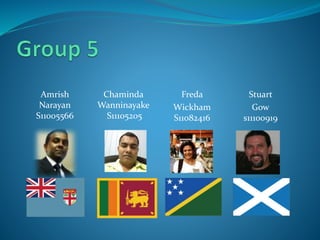
Amrish
Narayan
S11005566
Chaminda
Wanninayake
S11105205
Freda
Wickham
S11082416
Stuart
Gow
s11100919
Scope
 Diversity in the Workplace
 Benefits of Diversity
 Challenges in PICs
 Management of Diversity
 Recommendations
 Solutions
What IS it?
Definition
Diversity is defined as
a difference or
unlikeness
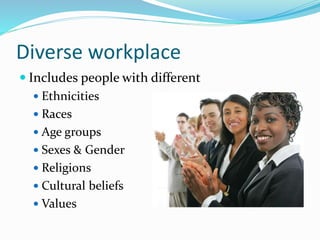
Diverse workplace
 Includes people with different
 Ethnicities
 Races
 Age groups
 Sexes & Gender
 Religions
 Cultural beliefs
 Values
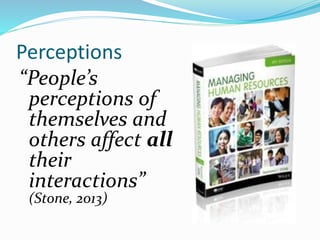
Perceptions
“People’s
perceptions of
themselves and
others affect all
their
interactions”
(Stone, 2013)
Diversity will increase soon...
Successful
organisations
= proactive
Address
Diversity
NOW!
Better Suited to Global
Diverse Workforces
better understand:
 Legal
 Political
 Social
 Economic
 Cultural environments
More importantly:
They gain
competitive
advantage from
this
understanding!
Can You Risk it?
“If you embrace diversity, you
risk workplace conflict, but if
you avoid diversity, you risk
loss of competitiveness”
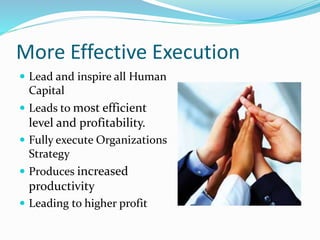
More Effective Execution
 Lead and inspire all Human
Capital
 Leads to most efficient
level and profitability.
 Fully execute Organizations
Strategy
 Produces increased
productivity
 Leading to higher profit
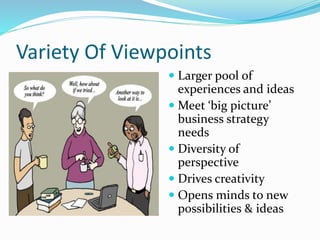
Variety Of Viewpoints
 Larger pool of
experiences and ideas
 Meet ‘big picture’
business strategy
needs
 Diversity of
perspective
 Drives creativity
 Opens minds to new
possibilities & ideas
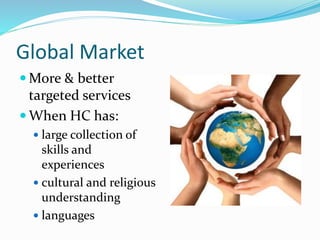
Global Market
 More & better
targeted services
 When HC has:
 large collection of
skills and
experiences
 cultural and religious
understanding
 languages
Challenges in the South Pacific
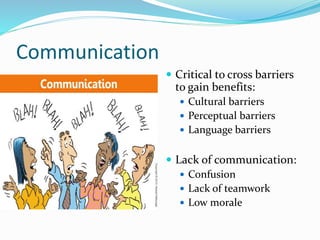
Communication
 Critical to cross barriers
to gain benefits:
 Cultural barriers
 Perceptual barriers
 Language barriers
 Lack of communication:
 Confusion
 Lack of teamwork
 Low morale
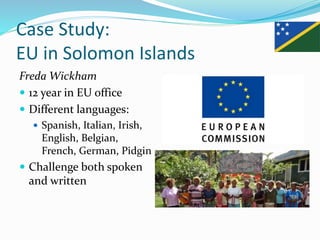
Case Study:
EU in Solomon Islands
Freda Wickham
 12 year in EU office
 Different languages:
 Spanish, Italian, Irish,
English, Belgian,
French, German, Pidgin
 Challenge both spoken
and written
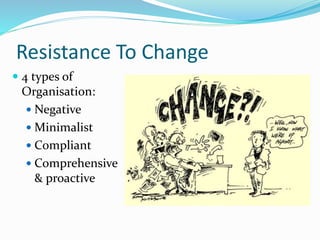
Resistance To Change
 4 types of
Organisation:
 Negative
 Minimalist
 Compliant
 Comprehensive
& proactive
Implementation Into Workplace Policies
 Getting into Policies a
challenge
 Maximise the effects of
diversity in the
workplace
 After a assessment
 After research
 MOVE SLOWLY!
 Build custom strategy
FNU Values On Diversity
“Diversity And
Inclusiveness: The
University Practices
Diversity And
Inclusiveness In Its
Campus Learning And
Living And Fosters A
Community And
Collegiate Spirit Among
Staff And Students.”
 Policies:
 Equal Employment Policy
 Recruitment Policy
 Discrimination And
Harassment Policy
 Workplace Bullying Policy
 Drugs, Alcohol And Kava
Policy
 Whistleblower Protection
Policy
Fiji
Solomon Islands
LEGAL ASPECTS OF WORKPLACE DIVERSITY
Fiji Legislation
Employment Relations Promulgation 2007 (ERP)
 Part 9 — Equal
Employment
Opportunities
 Move to Good Faith
 Employers to remove all
instances and mentions
 Great opportunity now!
“ethnic origin, colour, place
of origin, gender, sexual
orientation, birth, primary
language, economic status,
age, disability, HIV/AIDS
status, social class, marital
status (including living in
a relationship in the
nature of a marriage),
employment status, family
status, opinion, religion or
belief.”
Fiji National University EEO Policy
“The ultimate outcome of our policy
(EEO) shall be changes in attitudes to
an organisational culture which values
a diverse workforce. This will include an
appreciation and understanding of
different blends of values, cultures,
ethnicity and genders.”
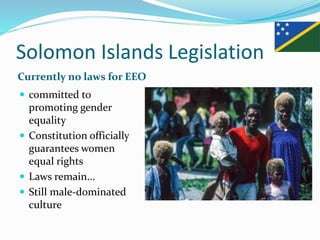
Solomon Islands Legislation
Currently no laws for EEO
 committed to
promoting gender
equality
 Constitution officially
guarantees women
equal rights
 Laws remain...
 Still male-dominated
culture
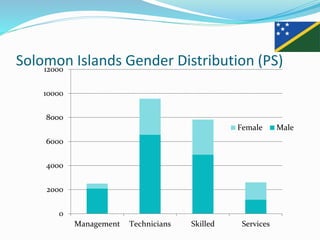
Solomon Islands Gender Distribution (PS)
0
2000
4000
6000
8000
10000
12000
Management Technicians Skilled Services
Female Male
Diversity management
“A process of management,
particularly HRM, underpinned by a
set of values which recognise
differences between people as
strengths for management.”
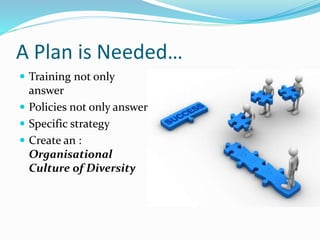
A Plan is Needed…
 Training not only
answer
 Policies not only answer
 Specific strategy
 Create an :
Organisational
Culture of Diversity
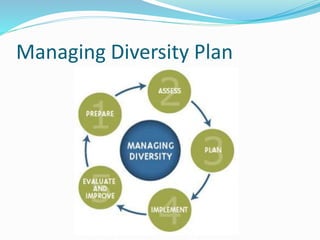
Managing Diversity Plan
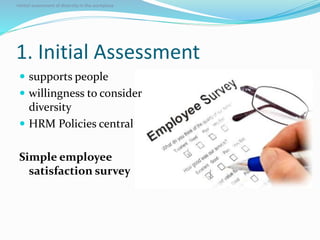
1. Initial Assessment
 supports people
 willingness to consider
diversity
 HRM Policies central
Simple employee
satisfaction survey
•Initial assessment of diversity in the workplace
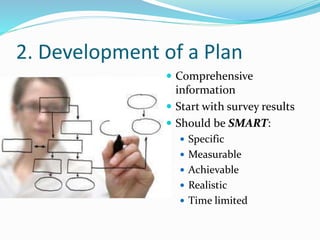
2. Development of a Plan
 Comprehensive
information
 Start with survey results
 Should be SMART:
 Specific
 Measurable
 Achievable
 Realistic
 Time limited
3. Implementing the Plan
 Personal commitment of
all executive &
managerial teams
 Incorporate diversity
policies into every
department
 Many resources
4. HRM Leads & Tracks the Change
HRM lead agency
Lead the change
Once established:
tracked
measured
5. Advocate to Board & to Employees
 Policy not in isolation
 Needs top-level
support
 Needs Operational
Management
support
 Needs full workforce
support
Diversity
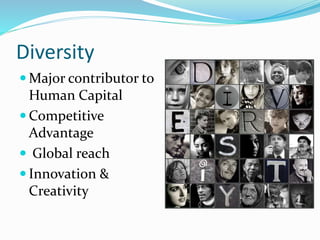
 Major contributor to
Human Capital
 Competitive
Advantage
 Global reach
 Innovation &
Creativity
Recommendations
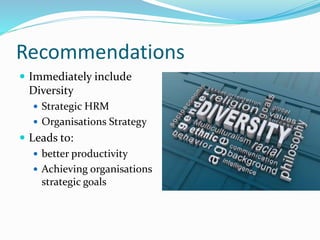
 Immediately include
Diversity
 Strategic HRM
 Organisations Strategy
 Leads to:
 better productivity
 Achieving organisations
strategic goals
Recommendations
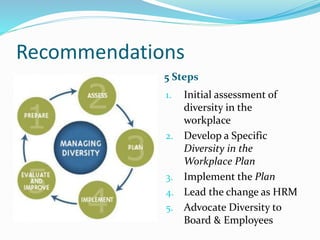
5 Steps
1. Initial assessment of
diversity in the
workplace
2. Develop a Specific
Diversity in the
Workplace Plan
3. Implement the Plan
4. Lead the change as HRM
5. Advocate Diversity to
Board & Employees
References
 Course/ Student Study Guide, MBA 423 HRM, Prof.
Dr. K C. Patrick Low , (PhD (UniSA) & Chartered
Marketer)
 Managing Human Resources; 4th edition; Raymond
J. Stone (2013); John Wiley & Sons Australia Ltd;
Sydney
 Fiji National University OHS Policy, 2013
 FNU OH&S Modules I and II, LINK
 YouTube videos
Amrish
Narayan
S11005566
Chaminda
Wanninayake
S11105205
Freda
Wickham
S11082416
Stuart
Gow
s11100919
Challenges And Solutions In The South Pacific
MBA-423 HRM Group 5 November 2013

Diversity in the Workplace - MBA 423 Human Resource Management

  • 1.
    Challenges And SolutionsIn The South Pacific MBA-423 HRM Group 5 November 2013
  • 2.
  • 3.
    Scope  Diversity inthe Workplace  Benefits of Diversity  Challenges in PICs  Management of Diversity  Recommendations  Solutions
  • 4.
  • 5.
    Definition Diversity is definedas a difference or unlikeness
  • 6.
    Diverse workplace  Includespeople with different  Ethnicities  Races  Age groups  Sexes & Gender  Religions  Cultural beliefs  Values
  • 7.
    Perceptions “People’s perceptions of themselves and othersaffect all their interactions” (Stone, 2013)
  • 8.
    Diversity will increasesoon... Successful organisations = proactive Address Diversity NOW!
  • 10.
    Better Suited toGlobal Diverse Workforces better understand:  Legal  Political  Social  Economic  Cultural environments More importantly: They gain competitive advantage from this understanding!
  • 11.
    Can You Riskit? “If you embrace diversity, you risk workplace conflict, but if you avoid diversity, you risk loss of competitiveness”
  • 13.
    More Effective Execution Lead and inspire all Human Capital  Leads to most efficient level and profitability.  Fully execute Organizations Strategy  Produces increased productivity  Leading to higher profit
  • 14.
    Variety Of Viewpoints Larger pool of experiences and ideas  Meet ‘big picture’ business strategy needs  Diversity of perspective  Drives creativity  Opens minds to new possibilities & ideas
  • 15.
    Global Market  More& better targeted services  When HC has:  large collection of skills and experiences  cultural and religious understanding  languages
  • 16.
    Challenges in theSouth Pacific
  • 17.
    Communication  Critical tocross barriers to gain benefits:  Cultural barriers  Perceptual barriers  Language barriers  Lack of communication:  Confusion  Lack of teamwork  Low morale
  • 18.
    Case Study: EU inSolomon Islands Freda Wickham  12 year in EU office  Different languages:  Spanish, Italian, Irish, English, Belgian, French, German, Pidgin  Challenge both spoken and written
  • 19.
    Resistance To Change 4 types of Organisation:  Negative  Minimalist  Compliant  Comprehensive & proactive
  • 20.
    Implementation Into WorkplacePolicies  Getting into Policies a challenge  Maximise the effects of diversity in the workplace  After a assessment  After research  MOVE SLOWLY!  Build custom strategy
  • 21.
    FNU Values OnDiversity “Diversity And Inclusiveness: The University Practices Diversity And Inclusiveness In Its Campus Learning And Living And Fosters A Community And Collegiate Spirit Among Staff And Students.”  Policies:  Equal Employment Policy  Recruitment Policy  Discrimination And Harassment Policy  Workplace Bullying Policy  Drugs, Alcohol And Kava Policy  Whistleblower Protection Policy
  • 22.
    Fiji Solomon Islands LEGAL ASPECTSOF WORKPLACE DIVERSITY
  • 23.
    Fiji Legislation Employment RelationsPromulgation 2007 (ERP)  Part 9 — Equal Employment Opportunities  Move to Good Faith  Employers to remove all instances and mentions  Great opportunity now! “ethnic origin, colour, place of origin, gender, sexual orientation, birth, primary language, economic status, age, disability, HIV/AIDS status, social class, marital status (including living in a relationship in the nature of a marriage), employment status, family status, opinion, religion or belief.”
  • 24.
    Fiji National UniversityEEO Policy “The ultimate outcome of our policy (EEO) shall be changes in attitudes to an organisational culture which values a diverse workforce. This will include an appreciation and understanding of different blends of values, cultures, ethnicity and genders.”
  • 25.
    Solomon Islands Legislation Currentlyno laws for EEO  committed to promoting gender equality  Constitution officially guarantees women equal rights  Laws remain...  Still male-dominated culture
  • 26.
    Solomon Islands GenderDistribution (PS) 0 2000 4000 6000 8000 10000 12000 Management Technicians Skilled Services Female Male
  • 28.
    Diversity management “A processof management, particularly HRM, underpinned by a set of values which recognise differences between people as strengths for management.”
  • 29.
    A Plan isNeeded…  Training not only answer  Policies not only answer  Specific strategy  Create an : Organisational Culture of Diversity
  • 30.
  • 31.
    1. Initial Assessment supports people  willingness to consider diversity  HRM Policies central Simple employee satisfaction survey •Initial assessment of diversity in the workplace
  • 32.
    2. Development ofa Plan  Comprehensive information  Start with survey results  Should be SMART:  Specific  Measurable  Achievable  Realistic  Time limited
  • 33.
    3. Implementing thePlan  Personal commitment of all executive & managerial teams  Incorporate diversity policies into every department  Many resources
  • 34.
    4. HRM Leads& Tracks the Change HRM lead agency Lead the change Once established: tracked measured
  • 35.
    5. Advocate toBoard & to Employees  Policy not in isolation  Needs top-level support  Needs Operational Management support  Needs full workforce support
  • 37.
    Diversity  Major contributorto Human Capital  Competitive Advantage  Global reach  Innovation & Creativity
  • 38.
    Recommendations  Immediately include Diversity Strategic HRM  Organisations Strategy  Leads to:  better productivity  Achieving organisations strategic goals
  • 39.
    Recommendations 5 Steps 1. Initialassessment of diversity in the workplace 2. Develop a Specific Diversity in the Workplace Plan 3. Implement the Plan 4. Lead the change as HRM 5. Advocate Diversity to Board & Employees
  • 41.
    References  Course/ StudentStudy Guide, MBA 423 HRM, Prof. Dr. K C. Patrick Low , (PhD (UniSA) & Chartered Marketer)  Managing Human Resources; 4th edition; Raymond J. Stone (2013); John Wiley & Sons Australia Ltd; Sydney  Fiji National University OHS Policy, 2013  FNU OH&S Modules I and II, LINK  YouTube videos
  • 42.
  • 43.
    Challenges And SolutionsIn The South Pacific MBA-423 HRM Group 5 November 2013

Editor's Notes

  • #2 STUART Welcome!
  • #3 We are Group 5 Our Team tonight is: Amrish Stuart Chaminda Freda
  • #4 We’ll quickly run through the Case Study and the important points then address the discussion questions individually
  • #7 A diverse workplace will include people from different ethnicities, races , age groups and sexes who will have dissimilar cultural beliefs and values.
  • #9 Diversity will increase significantly in the future. The most successful organisations will recognise the need for immediate proactive action and will be ready and willing to spend resources on managing diversity in the workplace now.
  • #11 legal, political, social, economic, and cultural environments and gain competitive advantage from this understanding Successfully managing diversity leads to a more satisfied, more committed, better performing workforce and a high potential for better financial performance for the organisation It is without doubt agreed that diversity is a recognised source of creativity, innovation in, and organisation that provides a strong base for competitive advantage
  • #14 More Effective Execution Organisations that embrace diversity in their workplace lead and inspire all of their Human Capital to perform at their most efficient level and profitability. The organisation’s strategies can then be fully executed; this produces higher profit from increased productivity.
  • #15 Variety Of Viewpoints Diverse HC who feel comfortable communicating different points of view provide a much larger pool of experiences and ideas. The organisation can use that larger pool to meet ‘big picture’ business strategy needs and the needs of customers more effectively. Diversity of perspective is one of the major hallmarks of a strong organisation. Curious, respectful dissent and active discussion drives creativity and open minds to new possibilities and ideas. Concerned dissent is not chaos – it can rock the boat without sinking the ship. It is important that an organisations public voice be united of course, but the organisations internal dialogue must include a huge variety of ideas and viewpoints.
  • #16 Global Market An organisation can provide more and better targeted services to customers in the global marketplace when its Human Capital has a large collection of skills and experiences such as cultural and religious understanding or languages, to draw upon.
  • #18 Communication For diversity programs to be successful in the long term and to provide the benefits, then the cultural, perceptual and language barriers need to be overcome as first step. Ineffective communication of the organisation’s key objectives will result in confusion, lack of teamwork, and low morale amongst the employees and teams
  • #19 European Union Delegation In Solomon Islands
  • #20  There are always employees and indeed managers who will refuse to change or accept that the cultural and social environment of the workplace is changing. All organisations should strive for the “comprehensive and proactive”, and work up from a negative start step by step. Many start as the “negative” and this includes a large amount of resistance to the change required. The Pacific Island Countries are not different, as developing nations normally start very much on the back foot, and have massive resistance to this. They figure that they have ‘other problems’ to solve before addressing diversity, without realising that diversity can be the solution to many of their perceived problems.
  • #21 Implementation Into Workplace Policies Actually getting the concept of diversity into the organisation’s policies can be one of the biggest challenge to all diversity advocates in HRM. After reviewing the results of employee assessments and organisation research data, HRM must slowly build and implement a customised diversity strategy to maximise the effects of diversity in the workplace for the organisation
  • #22  Fnu Values On Diversity: “Diversity And Inclusiveness: The University Practices Diversity And Inclusiveness In Its Campus Learning And Living And Fosters A Community And Collegiate Spirit Among Staff And Students.” Excerpt From Fnu Annual Report 2012 FNU Strategic Plan To Support The Diversity And Inclusiveness Values Of The University, There Are Strategic Objectives Aligned To This In The Universities Strategic Plan. These Are Further Supported By The Following Policies Of The University: Reference: FNU HR Policy Resistance To Change
  • #23 Legal Aspects Of Workplace Diversity
  • #24 Part 9 — Equal Employment Opportunities (Eeo) The prohibited grounds of discrimination 75. For the purposes of this Part, the prohibited grounds for discrimination whether direct or indirect are actual or supposed personal characteristics or circumstances, including: ethnic origin, colour, place of origin, gender, sexual orientation, birth, primary language, economic status, age, disability, HIV/AIDS status, social class, marital status (including living in a relationship in the nature of a marriage), employment status, family status, opinion, religion or belief. Solomon Islands Legislation
  • #25 Fiji national university EEO policy “The ultimate outcome of our policy (EEO) shall be changes in attitudes to an organisational culture which values a diverse workforce. This will include an appreciation and understanding of different blends of values, cultures, ethnicity and genders.” (Fiji national university (fnu, 2013)
  • #26  Solomon Islands Legislation There are no specific laws in the Solomon Islands on equal opportunity for women and men, on equal pay, or that address sexual discrimination or sexual. (Hedditch & Manuel, 2010) Solomon Islands National Policy On Gender Equality And Women’s Development. (Govt of Solomon Islands, 2010) Although the Solomon Islands Government states that it is committed to promoting gender equality in its development policy frameworks, the country still performs very poorly on gender equality – ranking only 129 out of 177 countries on the Gender and Development Index (GDI) (Wallace, 2000). Solomon Islands women operate their businesses in a male-dominated culture. They have minimal representation in decision making (with no female members of Parliament for example).
  • #27 Gender Distribution In The Public Service, Solomon Islands Government Notes: Date of Data: 1999 (has not been updated since) 30% of women form the Public Service, of which 60% of them are in Junior positions. Overall women hold only 6% of Senior Public Service positions 5 women are in Permanent Secretary positions, that is out of 25 positions (20% ) 3 women are in Under Secretary positions, that is out of 20 positions (15%) Currently only 1 woman is represented in Parliament , out of 50 seats. Solomon Islands National Policy On Gender Equality And Women’s Development. (Govt of Solomon Islands, 2010)
  • #29 Diversity management: “A process of management, particularly HRM, underpinned by a set of values which recognise differences between people as strengths for management.”
  • #31 Like mopst implementation plans this should look familiar
  • #32 Initial assessment of diversity in the workplace Assessing diversity management: supports people in the workplace building a shared future together (for an all inclusive workplace). requires a willingness to consider diversity not as an abstract theory or dictated rule, but as a good way of life. places HRM policies and practices at the centre of a organisation’s diverse workforce. Diversity management is about developing new and better organisations that value difference.
  • #33 Development of a Plan
  • #34 Implementing the Diversity in the Workplace Plan The total personal commitment of all executive and managerial teams in all departments is a complete necessity. All managers within the organisation must incorporate diversity policies into every department of the organisation. All attitudes toward diversity will start at the top and filter down through the ranks. Management participation and cooperation is required at every stage to create an organisational culture conducive to the success of the organisation’s Diversity in the Workplace Plan. Many resources are available to HRM to assist ion implementing diversity in the workplace from consultants, to workbooks, through to simply looking online for solutions to tailor to their needs. ILO (International Labour Organization (ILO), 2013) is a good reference source, and has many training programs freely available such as the The Training Package on Work and Family.
  • #35 Lead and track the Change as HRM HRM is the lead agency within any organisation to lead the change in Diversity in the Workplace. They have the best opportunities for changing Human Capital to achieve the goals and aims. Once established, a diversity plan and program should be tracked and measured, so it is clear where programs are making progress and where they are falling short. Even though financial and headcount resources have been reduced as a result of economic constraints, because Diversity goals are aligned with the overall business goals, Diversity initiatives have a greater impact than before and are seen as a company priority.
  • #36 Advocate Diversity both to Board and to Employees
  • #40 Complete an initial assessment of diversity in the workplace (Appendix 1) Develop a Specific Diversity in the Workplace Plan Implement the Diversity in the Workplace Plan Lead the change as HRM Advocate Diversity both to Board and to Employees
  • #43 We are Group 5 Our Team tonight is: Amrish Stuart Chaminda Freda
  • #44 STUART Welcome!