Skills-Based Measurements (SBMs) 
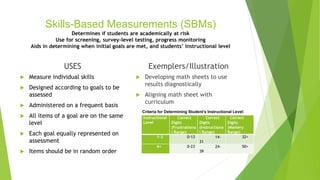
Determines if students are academically at risk 
Use for screening, survey-level testing, progress monitoring 
Aids in determining when initial goals are met, and students’ instructional level 
USES 
 Measure individual skills 
 Designed according to goals to be 
assessed 
 Administered on a frequent basis 
 All items of a goal are on the same 
level 
 Each goal equally represented on 
assessment 
 Items should be in random order 
Exemplers/Illustration 
 Developing math sheets to use 
results diagnostically 
 Aligning math sheet with 
curriculum 
Criteria for Determining Student’s Instructional Level: 
Instructional 
Level 
Correct 
Digits 
(Frustrationa 
l Range) 
Correct 
Digits 
(Instructiona 
l Range) 
Correct 
Digits 
(Mastery 
Range) 
1-3 0-13 14- 
31 
32+ 
4+ 0-23 24- 
39 
50+
Skills-Based 
Measurements 
Terry Cooper 
Shirley Friar 
Katrina Mitchell
Purpose 
 Skills-Based Measurements (SBMs) is a very adequate way to determine if 
students are not matriculating as they should academically, or if they are at 
risk of academic failure (Hosp, Hosp, & Howell, 2007). SBMs’ screening 
capabilities enable the teacher to determine which students are in need of 
further assistance. Progress-monitoring aids in determining when initial goals 
have been met and the student can move on to new goals. It also helps in 
determining if student instruction should be modified (Hosp et al., 2007). As a 
part of SBMs, survey level testing can be used to determine the students’ 
instructional level, as well as, narrow down the testing needed to determine 
students’ level of performance (Hosp et al.).
How Used 
 As its name infers, Skill-Based Measurements measure individual skills. To design a series of 
SBM”s, the first objective to be met is to identify the set of goals to be assessed over the 
period of time to be assessed. Although a shorter time frame could be chosen, typically the 
whole year would be the time frame assessed. After the goals have been determined, items 
need to be created to assess the goals. When these items are created a specific set of 
criterion should be used. All items for a particular goal should be of the same difficulty. Each 
goal should be equally represented on the assessment as well. The order for the items should 
be random from the student’s point of view. This means that the order should not be the 
same as the oreder in which the content was or is to be taught. The complexity of each 
assessment item should also not be used to determine the order. Finally, each item should be 
linked and cross-referenced to the goal or skill being assessed so that information is available 
for instructional purposes (Hosp, Hosp, & Howell, 2007). 
 Directions for the assessment would typically tell students that if they did know a particular 
item that they could skip it and go on to the next item. These assessments should be 
administered on a frequent basis such as weekly or bi-weekly and tracked over the entire 
assessment period so that improvement can be tracked (Hosp, Hosp, & Howell, 2007).
Exemplars of Use 
 When developing math sheets, it is prudent to plan so that the results can be 
used in a diagnostic way. The authors give examples of aligning the math 
sheet with their curriculum. The sheets were set up into five columns and 
five rows, giving a total of 25 problems. Each of those five skills were put on a 
diagonal. As the sheet is scored the authors looked to see if there was a 
pattern of the student missing problems within a diagonal. These patterns 
should not be considered reliable evidence of that student’s deficit in the 
specific skills, but should be considered as hypotheses to test with more in-depth 
measures or evidence of skills that need to be taught or reviewed 
(Hosp, Hosp, Howell 2007).
Illustration 
 Math CBM is a content area where survey-level assessment (SLA) has been 
used. The procedures are similar except while SLA for reading uses GOMs 
(ORF CBM is the task used). Math CBM uses SBMs. So rather than testing 
forward or backward through a curriculum to find an instructional level, SLA 
for math is done slightly differently. The first step is to administer three 
sheets at the appropriate curriculum level (generally the student’s grade 
level). Record the scores and grade level in the “Mixed Math” table in the 
SLA Math sheet. Find the median correct digits (CD) and compare that score 
to the performance criteria. If the student’s performance is in the 
instructional range, great; if it is in the frustrational range the teacher should 
administer single-skill sheets that correspond to the skills included in the 
mixed-math sheets just administered. If sheets have been set up to provide 
preliminary diagnostic information, the teacher will have an idea of which 
skills to focus on (Hosp, Hosp, Howell 2007)
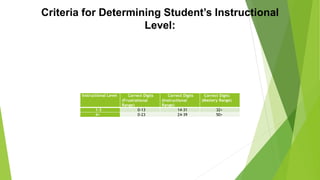
Criteria for Determining Student’s Instructional 
Level: 
Instructional Level Correct Digits 
(Frustrational 
Range) 
Correct Digits 
(Instructional 
Range) 
Correct Digits 
(Mastery Range) 
1-3 0-13 14-31 32+ 
4+ 0-23 24-39 50+

Group 3 skills based measurements

  • 1.
    Skills-Based Measurements (SBMs) Determines if students are academically at risk Use for screening, survey-level testing, progress monitoring Aids in determining when initial goals are met, and students’ instructional level USES  Measure individual skills  Designed according to goals to be assessed  Administered on a frequent basis  All items of a goal are on the same level  Each goal equally represented on assessment  Items should be in random order Exemplers/Illustration  Developing math sheets to use results diagnostically  Aligning math sheet with curriculum Criteria for Determining Student’s Instructional Level: Instructional Level Correct Digits (Frustrationa l Range) Correct Digits (Instructiona l Range) Correct Digits (Mastery Range) 1-3 0-13 14- 31 32+ 4+ 0-23 24- 39 50+
  • 2.
    Skills-Based Measurements TerryCooper Shirley Friar Katrina Mitchell
  • 3.
    Purpose  Skills-BasedMeasurements (SBMs) is a very adequate way to determine if students are not matriculating as they should academically, or if they are at risk of academic failure (Hosp, Hosp, & Howell, 2007). SBMs’ screening capabilities enable the teacher to determine which students are in need of further assistance. Progress-monitoring aids in determining when initial goals have been met and the student can move on to new goals. It also helps in determining if student instruction should be modified (Hosp et al., 2007). As a part of SBMs, survey level testing can be used to determine the students’ instructional level, as well as, narrow down the testing needed to determine students’ level of performance (Hosp et al.).
  • 4.
    How Used As its name infers, Skill-Based Measurements measure individual skills. To design a series of SBM”s, the first objective to be met is to identify the set of goals to be assessed over the period of time to be assessed. Although a shorter time frame could be chosen, typically the whole year would be the time frame assessed. After the goals have been determined, items need to be created to assess the goals. When these items are created a specific set of criterion should be used. All items for a particular goal should be of the same difficulty. Each goal should be equally represented on the assessment as well. The order for the items should be random from the student’s point of view. This means that the order should not be the same as the oreder in which the content was or is to be taught. The complexity of each assessment item should also not be used to determine the order. Finally, each item should be linked and cross-referenced to the goal or skill being assessed so that information is available for instructional purposes (Hosp, Hosp, & Howell, 2007).  Directions for the assessment would typically tell students that if they did know a particular item that they could skip it and go on to the next item. These assessments should be administered on a frequent basis such as weekly or bi-weekly and tracked over the entire assessment period so that improvement can be tracked (Hosp, Hosp, & Howell, 2007).
  • 5.
    Exemplars of Use  When developing math sheets, it is prudent to plan so that the results can be used in a diagnostic way. The authors give examples of aligning the math sheet with their curriculum. The sheets were set up into five columns and five rows, giving a total of 25 problems. Each of those five skills were put on a diagonal. As the sheet is scored the authors looked to see if there was a pattern of the student missing problems within a diagonal. These patterns should not be considered reliable evidence of that student’s deficit in the specific skills, but should be considered as hypotheses to test with more in-depth measures or evidence of skills that need to be taught or reviewed (Hosp, Hosp, Howell 2007).
  • 6.
    Illustration  MathCBM is a content area where survey-level assessment (SLA) has been used. The procedures are similar except while SLA for reading uses GOMs (ORF CBM is the task used). Math CBM uses SBMs. So rather than testing forward or backward through a curriculum to find an instructional level, SLA for math is done slightly differently. The first step is to administer three sheets at the appropriate curriculum level (generally the student’s grade level). Record the scores and grade level in the “Mixed Math” table in the SLA Math sheet. Find the median correct digits (CD) and compare that score to the performance criteria. If the student’s performance is in the instructional range, great; if it is in the frustrational range the teacher should administer single-skill sheets that correspond to the skills included in the mixed-math sheets just administered. If sheets have been set up to provide preliminary diagnostic information, the teacher will have an idea of which skills to focus on (Hosp, Hosp, Howell 2007)
  • 7.
    Criteria for DeterminingStudent’s Instructional Level: Instructional Level Correct Digits (Frustrational Range) Correct Digits (Instructional Range) Correct Digits (Mastery Range) 1-3 0-13 14-31 32+ 4+ 0-23 24-39 50+