LIFELONG LEARNING
GROUP 2: Nguyen Mai Linh
Le Hoang Mai
Nguyen Le Quynh
WARM-UP
01
WHAT IS THE VIDEO ABOUT?
Work in pairs. Discuss the following questions
1. Have you ever thought about continuing your studies after
finishing high school?
 Yes, I’ve thought a lot about continuing my education after high school. I
believe learning is essential for personal growth and for reaching my goals in the
future.
2. If yes, how will you continue your learning?
 To continue my learning, I would enroll in a university or college to study a
subject that aligns with my interests and career aspirations. Additionally, I’d
pursue self-directed learning through online courses, workshops, or hands-on
experiences like internships. Lifelong learning is vital in today’s fast-changing
world, so I’d stay open to new knowledge and skills.
VOCABULARY
02
LIFELONG
Synonyms:
Enduring, Long -
standing, Unending
/
ˈlaɪflɒŋ/
To think about something
and try to decide what is
true, what will happen,
what you should do, etc.
WONDER
/
ˈwʌndə(r)/
Uncle Ho was i________ed
in China in 1942.
IMPRISON
/ɪm
ˈprɪzn/
mprison
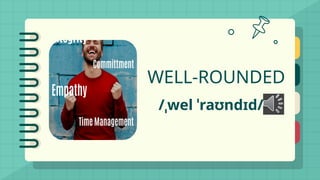
/ˌwel ˈraʊndɪd/
WELL-ROUNDED
__________: often teaches valuable
lessons that shape our character.
/ˈhɑːdʃɪp/
HARSHIP
A. Hardship
C. Difficult
B. Happy
D. Sorrow
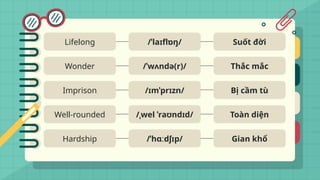
Hardship
Lifelong
Wonder
Imprison
Well-rounded
Hardship
/ˈlaɪflɒŋ/
/ˈwʌndə(r)/
/ɪmˈprɪzn/
/ˌwel ˈraʊndɪd/
/ˈhɑːdʃɪp/
Suốt đời
Thắc mắc
Bị cầm tù
Toàn diện
Gian khổ
PRACTICE
03
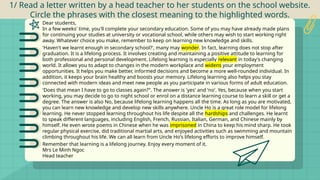
1/ Read a letter written by a head teacher to her students on the school website.
Circle the phrases with the closest meaning to the highlighted words.
Dear students,
In a few weeks' time, you'll complete your secondary education. Some of you may have already made plans
for continuing your studies at university or vocational school, while others may wish to start working right
away. Whatever choice you make, remember to keep on learning new knowledge and skills.
'Haven't we learnt enough in secondary school?', many may wonder. In fact, learning does not stop after
graduation. It is a lifelong process. It involves creating and maintaining a positive attitude to learning for
both professional and personal development. Lifelong learning is especially relevant in today's changing
world. It allows you to adapt to changes in the modern workplace and widens your employment
opportunities. It helps you make better, informed decisions and become a more well-rounded individual. In
addition, it keeps your brain healthy and boosts your memory. Lifelong learning also helps you stay
connected with modern ideas and meet new people as you participate in various forms of adult education.
'Does that mean I have to go to classes again?". The answer is 'yes' and 'no'. Yes, because when you start
working, you may decide to go to night school or enrol on a distance learning course to learn a skill or get a
degree. The answer is also No, because lifelong learning happens all the time. As long as you are motivated,
you can learn new knowledge and develop new skills anywhere. Uncle Ho is a great role model for lifelong
learning. He never stopped learning throughout his life despite all the hardships and challenges. He learnt
to speak different languages, including English, French, Russian, Italian, German, and Chinese mainly by
himself. He even wrote poems in Chinese when he was imprisoned in China to keep his mind sharp. He took
regular physical exercise, did traditional martial arts, and enjoyed activities such as swimming and mountain
climbing throughout his life. We can all learn from Uncle Ho's lifelong efforts to improve himself.
Remember that learning is a lifelong journey. Enjoy every moment of it.
Mrs Le Minh Ngoc
Head teacher
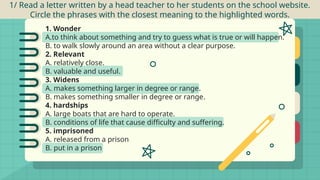
1/ Read a letter written by a head teacher to her students on the school website.
Circle the phrases with the closest meaning to the highlighted words.
1. Wonder
A.to think about something and try to guess what is true or will happen.
B. to walk slowly around an area without a clear purpose.
2. Relevant
A. relatively close.
B. valuable and useful.
3. Widens
A. makes something larger in degree or range.
B. makes something smaller in degree or range.
4. hardships
A. large boats that are hard to operate.
B. conditions of life that cause difficulty and suffering.
5. imprisoned
A. released from a prison
B. put in a prison
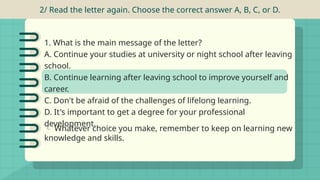
2/ Read the letter again. Choose the correct answer A, B, C, or D.
 Whatever choice you make, remember to keep on learning new
knowledge and skills.
1. What is the main message of the letter?
A. Continue your studies at university or night school after leaving
school.
B. Continue learning after leaving school to improve yourself and
career.
C. Don't be afraid of the challenges of lifelong learning.
D. It's important to get a degree for your professional
development.
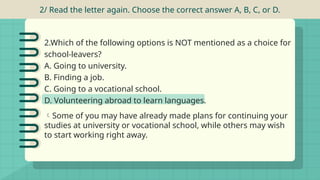
2/ Read the letter again. Choose the correct answer A, B, C, or D.
2.Which of the following options is NOT mentioned as a choice for
school-leavers?
A. Going to university.
B. Finding a job.
C. Going to a vocational school.
D. Volunteering abroad to learn languages.
Some of you may have already made plans for continuing your
studies at university or vocational school, while others may wish
to start working right away.
2/ Read the letter again. Choose the correct answer A, B, C, or D.
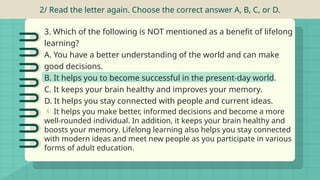
 It helps you make better, informed decisions and become a more
well-rounded individual. In addition, it keeps your brain healthy and
boosts your memory. Lifelong learning also helps you stay connected
with modern ideas and meet new people as you participate in various
forms of adult education.
3. Which of the following is NOT mentioned as a benefit of lifelong
learning?
A. You have a better understanding of the world and can make
good decisions.
B. It helps you to become successful in the present-day world.
C. It keeps your brain healthy and improves your memory.
D. It helps you stay connected with people and current ideas.
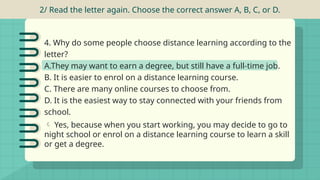
4. Why do some people choose distance learning according to the
letter?
A.They may want to earn a degree, but still have a full-time job.
B. It is easier to enrol on a distance learning course.
C. There are many online courses to choose from.
D. It is the easiest way to stay connected with your friends from
school.
2/ Read the letter again. Choose the correct answer A, B, C, or D.
 Yes, because when you start working, you may decide to go to
night school or enrol on a distance learning course to learn a skill
or get a degree.
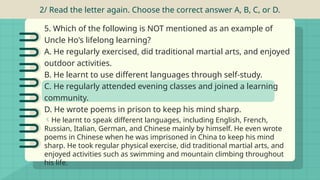
5. Which of the following is NOT mentioned as an example of
Uncle Ho's lifelong learning?
A. He regularly exercised, did traditional martial arts, and enjoyed
outdoor activities.
B. He learnt to use different languages through self-study.
C. He regularly attended evening classes and joined a learning
community.
D. He wrote poems in prison to keep his mind sharp.
2/ Read the letter again. Choose the correct answer A, B, C, or D.
He learnt to speak different languages, including English, French,
Russian, Italian, German, and Chinese mainly by himself. He even wrote
poems in Chinese when he was imprisoned in China to keep his mind
sharp. He took regular physical exercise, did traditional martial arts, and
enjoyed activities such as swimming and mountain climbing throughout
his life.
GAME
04
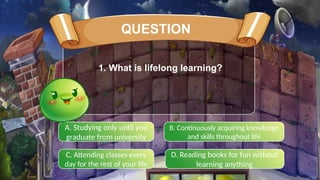
A. Studying only until you
graduate from university
B. Continuously acquiring knowledge
and skills throughout life
C. Attending classes every
day for the rest of your life
D. Reading books for fun without
learning anything
QUESTION
1. What is lifelong learning?
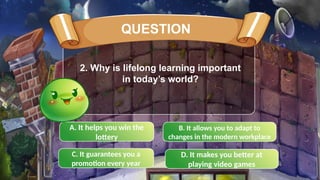
A. It helps you win the
lottery
C. It guarantees you a
promotion every year
B. It allows you to adapt to
changes in the modern workplace
D. It makes you better at
playing video games
2. Why is lifelong learning important
in today’s world?
QUESTION
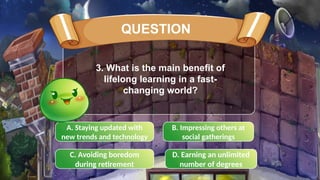
A. Staying updated with
new trends and technology
B. Impressing others at
social gatherings
C. Avoiding boredom
during retirement
D. Earning an unlimited
number of degrees
3. What is the main benefit of
lifelong learning in a fast-
changing world?
QUESTION
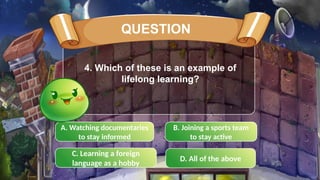
A. Watching documentaries
to stay informed
B. Joining a sports team
to stay active
D. All of the above
C. Learning a foreign
language as a hobby
4. Which of these is an example of
lifelong learning?
QUESTION
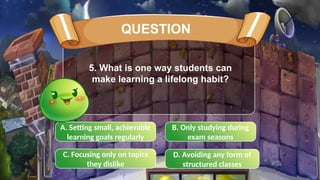
C. Focusing only on topics
they dislike
B. Only studying during
exam seasons
A. Setting small, achievable
learning goals regularly
D. Avoiding any form of
structured classes
5. What is one way students can
make learning a lifelong habit?
QUESTION
THANKS!

GROUP 2 UNIT 10 READING life long learning

  • 1.
    LIFELONG LEARNING GROUP 2:Nguyen Mai Linh Le Hoang Mai Nguyen Le Quynh
  • 2.
  • 3.
    WHAT IS THEVIDEO ABOUT?
  • 4.
    Work in pairs.Discuss the following questions 1. Have you ever thought about continuing your studies after finishing high school?  Yes, I’ve thought a lot about continuing my education after high school. I believe learning is essential for personal growth and for reaching my goals in the future. 2. If yes, how will you continue your learning?  To continue my learning, I would enroll in a university or college to study a subject that aligns with my interests and career aspirations. Additionally, I’d pursue self-directed learning through online courses, workshops, or hands-on experiences like internships. Lifelong learning is vital in today’s fast-changing world, so I’d stay open to new knowledge and skills.
  • 5.
  • 6.
  • 7.
    To think aboutsomething and try to decide what is true, what will happen, what you should do, etc. WONDER / ˈwʌndə(r)/
  • 8.
    Uncle Ho wasi________ed in China in 1942. IMPRISON /ɪm ˈprɪzn/ mprison
  • 9.
  • 10.
    __________: often teachesvaluable lessons that shape our character. /ˈhɑːdʃɪp/ HARSHIP A. Hardship C. Difficult B. Happy D. Sorrow Hardship
  • 11.
  • 12.
  • 13.
    1/ Read aletter written by a head teacher to her students on the school website. Circle the phrases with the closest meaning to the highlighted words. Dear students, In a few weeks' time, you'll complete your secondary education. Some of you may have already made plans for continuing your studies at university or vocational school, while others may wish to start working right away. Whatever choice you make, remember to keep on learning new knowledge and skills. 'Haven't we learnt enough in secondary school?', many may wonder. In fact, learning does not stop after graduation. It is a lifelong process. It involves creating and maintaining a positive attitude to learning for both professional and personal development. Lifelong learning is especially relevant in today's changing world. It allows you to adapt to changes in the modern workplace and widens your employment opportunities. It helps you make better, informed decisions and become a more well-rounded individual. In addition, it keeps your brain healthy and boosts your memory. Lifelong learning also helps you stay connected with modern ideas and meet new people as you participate in various forms of adult education. 'Does that mean I have to go to classes again?". The answer is 'yes' and 'no'. Yes, because when you start working, you may decide to go to night school or enrol on a distance learning course to learn a skill or get a degree. The answer is also No, because lifelong learning happens all the time. As long as you are motivated, you can learn new knowledge and develop new skills anywhere. Uncle Ho is a great role model for lifelong learning. He never stopped learning throughout his life despite all the hardships and challenges. He learnt to speak different languages, including English, French, Russian, Italian, German, and Chinese mainly by himself. He even wrote poems in Chinese when he was imprisoned in China to keep his mind sharp. He took regular physical exercise, did traditional martial arts, and enjoyed activities such as swimming and mountain climbing throughout his life. We can all learn from Uncle Ho's lifelong efforts to improve himself. Remember that learning is a lifelong journey. Enjoy every moment of it. Mrs Le Minh Ngoc Head teacher
  • 14.
    1/ Read aletter written by a head teacher to her students on the school website. Circle the phrases with the closest meaning to the highlighted words. 1. Wonder A.to think about something and try to guess what is true or will happen. B. to walk slowly around an area without a clear purpose. 2. Relevant A. relatively close. B. valuable and useful. 3. Widens A. makes something larger in degree or range. B. makes something smaller in degree or range. 4. hardships A. large boats that are hard to operate. B. conditions of life that cause difficulty and suffering. 5. imprisoned A. released from a prison B. put in a prison
  • 15.
    2/ Read theletter again. Choose the correct answer A, B, C, or D.  Whatever choice you make, remember to keep on learning new knowledge and skills. 1. What is the main message of the letter? A. Continue your studies at university or night school after leaving school. B. Continue learning after leaving school to improve yourself and career. C. Don't be afraid of the challenges of lifelong learning. D. It's important to get a degree for your professional development.
  • 16.
    2/ Read theletter again. Choose the correct answer A, B, C, or D. 2.Which of the following options is NOT mentioned as a choice for school-leavers? A. Going to university. B. Finding a job. C. Going to a vocational school. D. Volunteering abroad to learn languages. Some of you may have already made plans for continuing your studies at university or vocational school, while others may wish to start working right away.
  • 17.
    2/ Read theletter again. Choose the correct answer A, B, C, or D.  It helps you make better, informed decisions and become a more well-rounded individual. In addition, it keeps your brain healthy and boosts your memory. Lifelong learning also helps you stay connected with modern ideas and meet new people as you participate in various forms of adult education. 3. Which of the following is NOT mentioned as a benefit of lifelong learning? A. You have a better understanding of the world and can make good decisions. B. It helps you to become successful in the present-day world. C. It keeps your brain healthy and improves your memory. D. It helps you stay connected with people and current ideas.
  • 18.
    4. Why dosome people choose distance learning according to the letter? A.They may want to earn a degree, but still have a full-time job. B. It is easier to enrol on a distance learning course. C. There are many online courses to choose from. D. It is the easiest way to stay connected with your friends from school. 2/ Read the letter again. Choose the correct answer A, B, C, or D.  Yes, because when you start working, you may decide to go to night school or enrol on a distance learning course to learn a skill or get a degree.
  • 19.
    5. Which ofthe following is NOT mentioned as an example of Uncle Ho's lifelong learning? A. He regularly exercised, did traditional martial arts, and enjoyed outdoor activities. B. He learnt to use different languages through self-study. C. He regularly attended evening classes and joined a learning community. D. He wrote poems in prison to keep his mind sharp. 2/ Read the letter again. Choose the correct answer A, B, C, or D. He learnt to speak different languages, including English, French, Russian, Italian, German, and Chinese mainly by himself. He even wrote poems in Chinese when he was imprisoned in China to keep his mind sharp. He took regular physical exercise, did traditional martial arts, and enjoyed activities such as swimming and mountain climbing throughout his life.
  • 20.
  • 23.
    A. Studying onlyuntil you graduate from university B. Continuously acquiring knowledge and skills throughout life C. Attending classes every day for the rest of your life D. Reading books for fun without learning anything QUESTION 1. What is lifelong learning?
  • 24.
    A. It helpsyou win the lottery C. It guarantees you a promotion every year B. It allows you to adapt to changes in the modern workplace D. It makes you better at playing video games 2. Why is lifelong learning important in today’s world? QUESTION
  • 25.
    A. Staying updatedwith new trends and technology B. Impressing others at social gatherings C. Avoiding boredom during retirement D. Earning an unlimited number of degrees 3. What is the main benefit of lifelong learning in a fast- changing world? QUESTION
  • 26.
    A. Watching documentaries tostay informed B. Joining a sports team to stay active D. All of the above C. Learning a foreign language as a hobby 4. Which of these is an example of lifelong learning? QUESTION
  • 27.
    C. Focusing onlyon topics they dislike B. Only studying during exam seasons A. Setting small, achievable learning goals regularly D. Avoiding any form of structured classes 5. What is one way students can make learning a lifelong habit? QUESTION
  • 28.

Editor's Notes

  • #3 Thông điệp Phim gửi gắm thông điệp rằng không có con đường nào là duy nhất sau khi tốt nghiệp cấp 3. Quan trọng là hiểu rõ bản thân, đam mê và mục tiêu cá nhân để đưa ra lựa chọn phù hợp. Phim khuyến khích người xem lắng nghe chính mình và can đảm theo đuổi con đường riêng. There is no single correct path after high school. What matters most is understanding yourself—your passions, strengths, and goals—and choosing the path that aligns with who you are. Be brave, trust your journey, and don’t be afraid to go your own way.