CGIAR Research Program on Roots,
Tubers and Bananas:
Overview
GCP-GRM
27 September, 2013
A collaboration of:
+ a wide spectrum research-for-development
stakeholders & partners
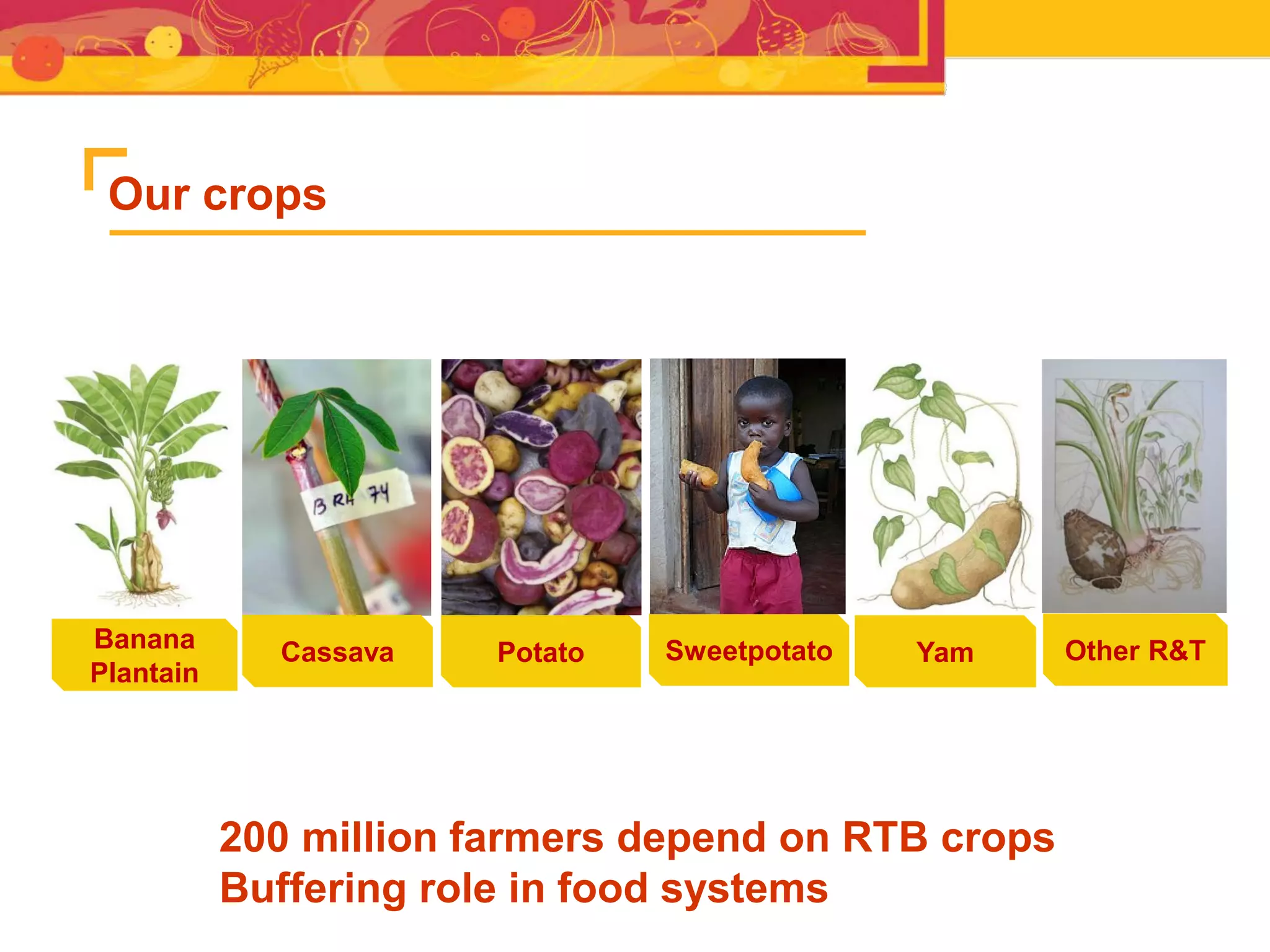
Banana
Plantain
Cassava Potato Sweetpotato Yam Other R&T
Our crops
200 million farmers depend on RTB crops
Buffering role in food systems
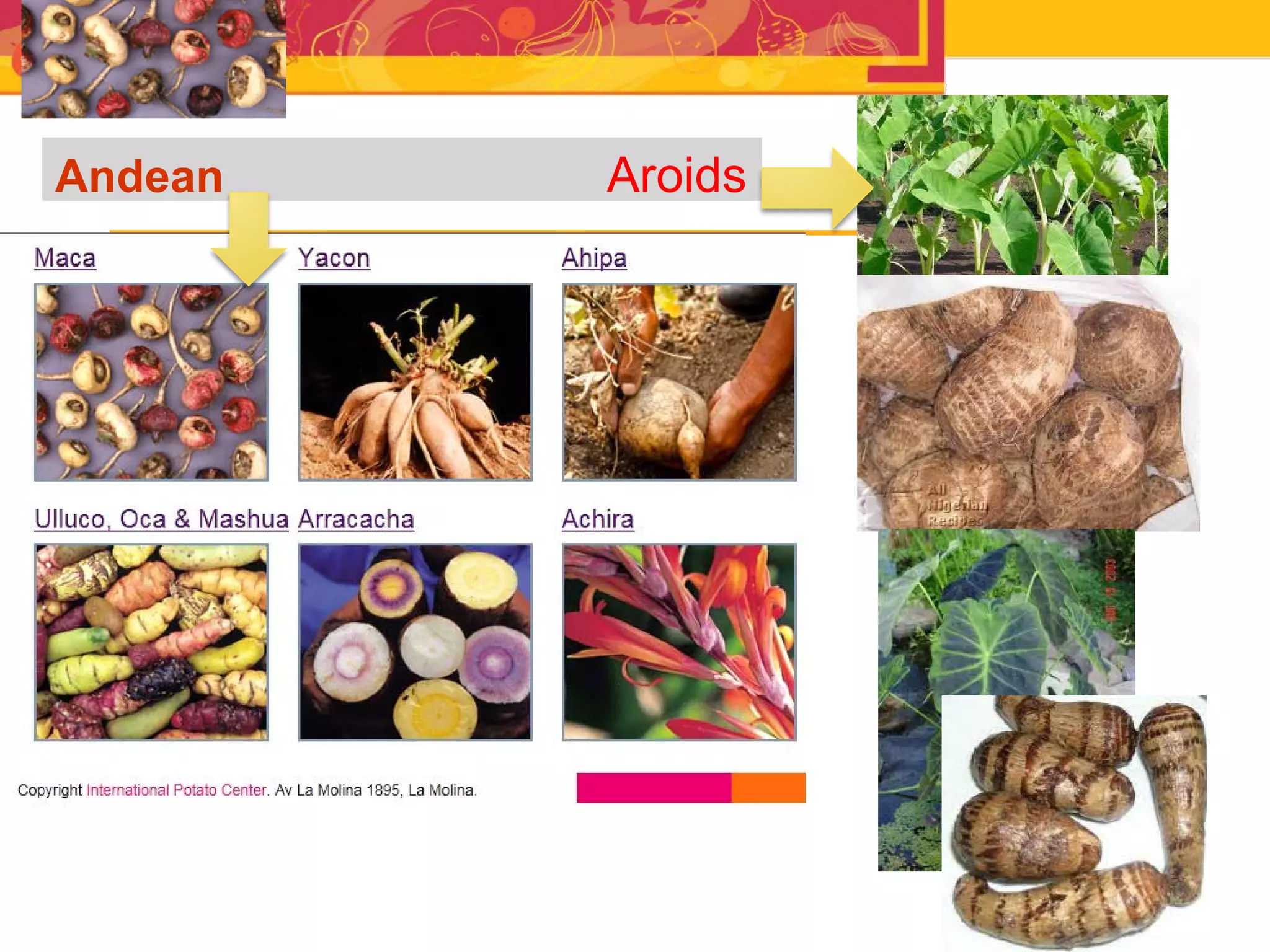
Andean Aroids
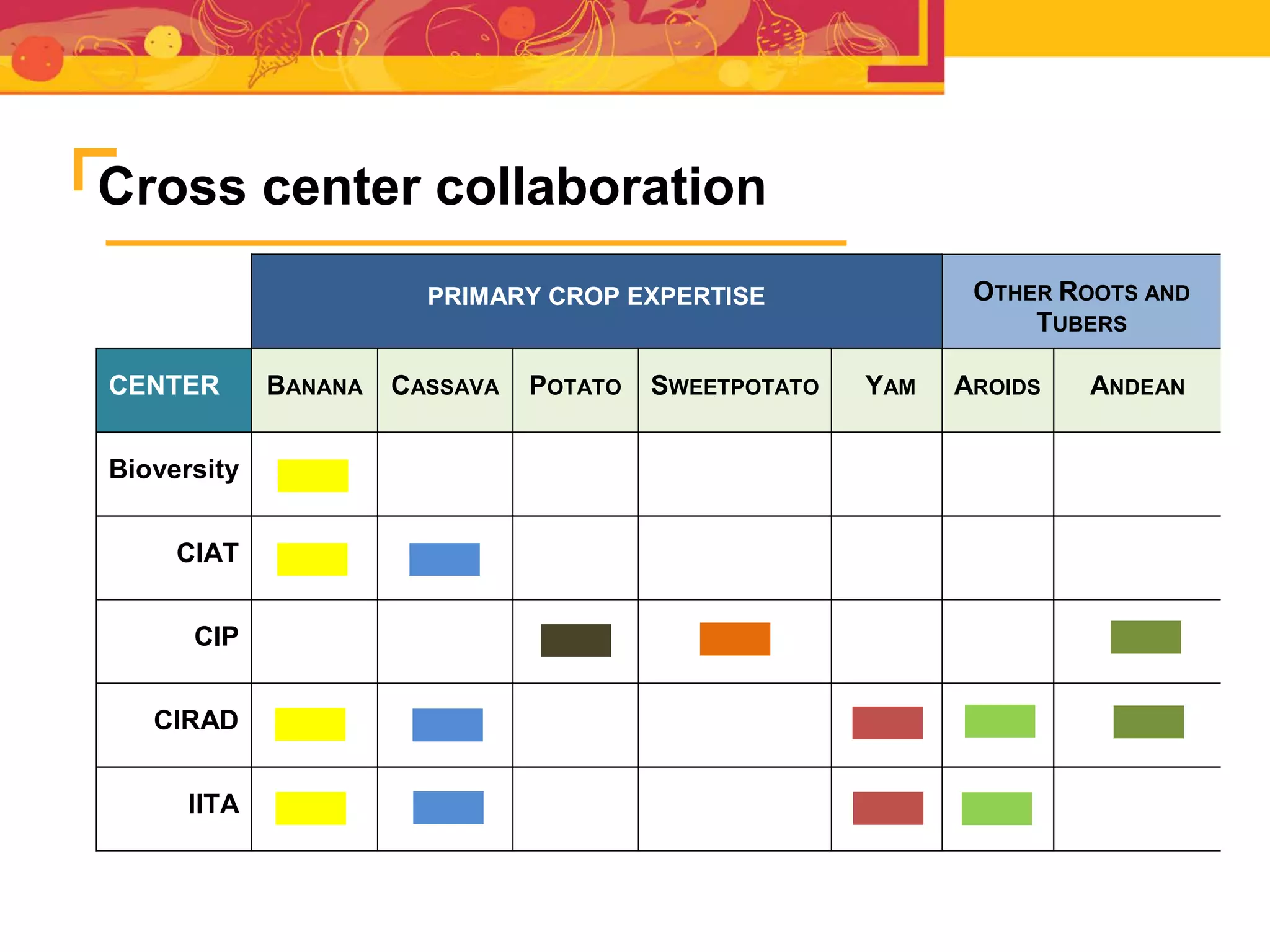
Cross center collaboration
PRIMARY CROP EXPERTISE OTHER ROOTS AND
TUBERS
CENTER BANANA CASSAVA POTATO SWEETPOTATO YAM AROIDS ANDEAN
Bioversity
CIAT
CIP
CIRAD
IITA
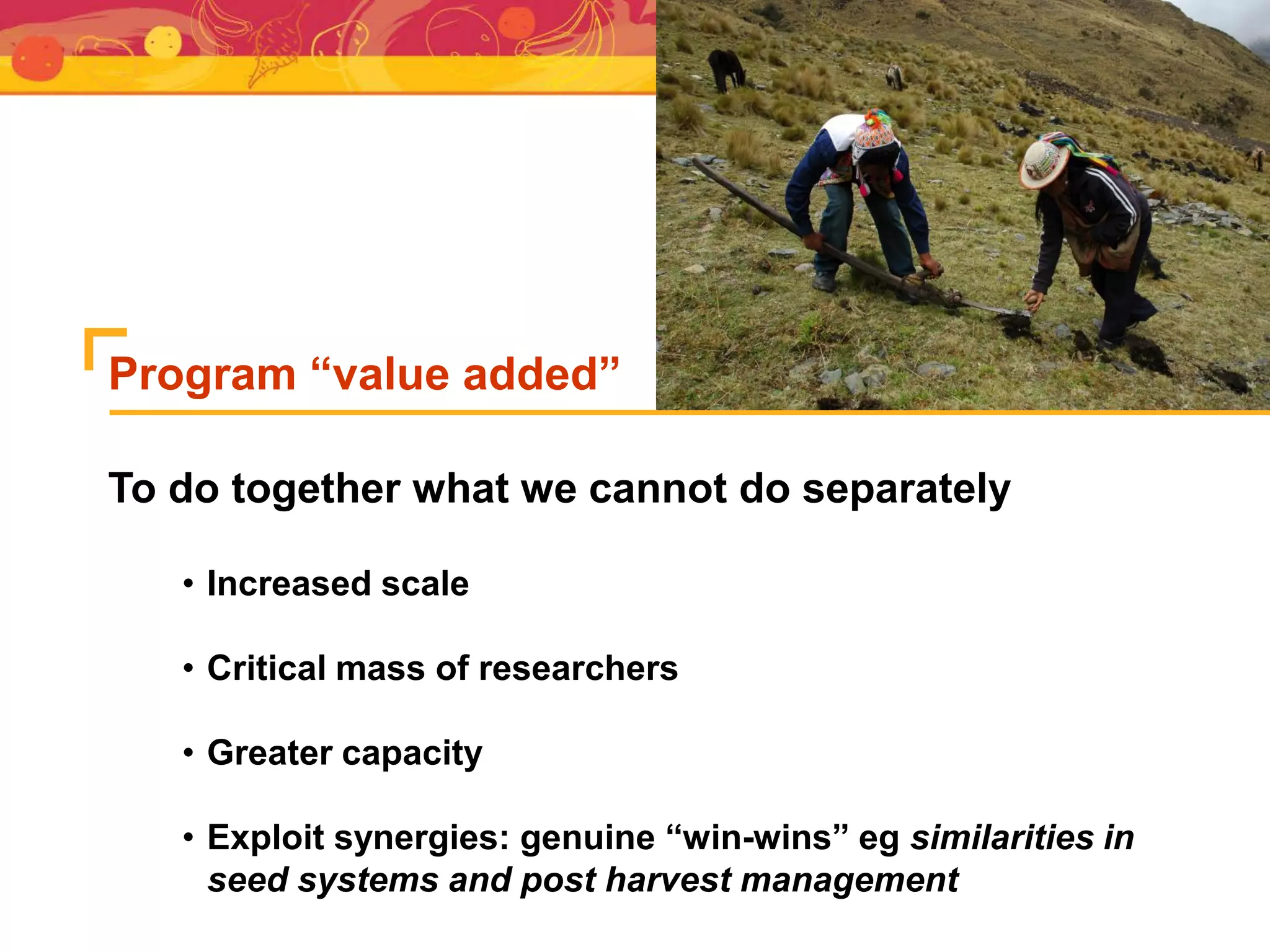
• Increased scale
• Critical mass of researchers
• Greater capacity
• Exploit synergies: genuine “win-wins” eg similarities in
seed systems and post harvest management
To do together what we cannot do separately
Program “value added”
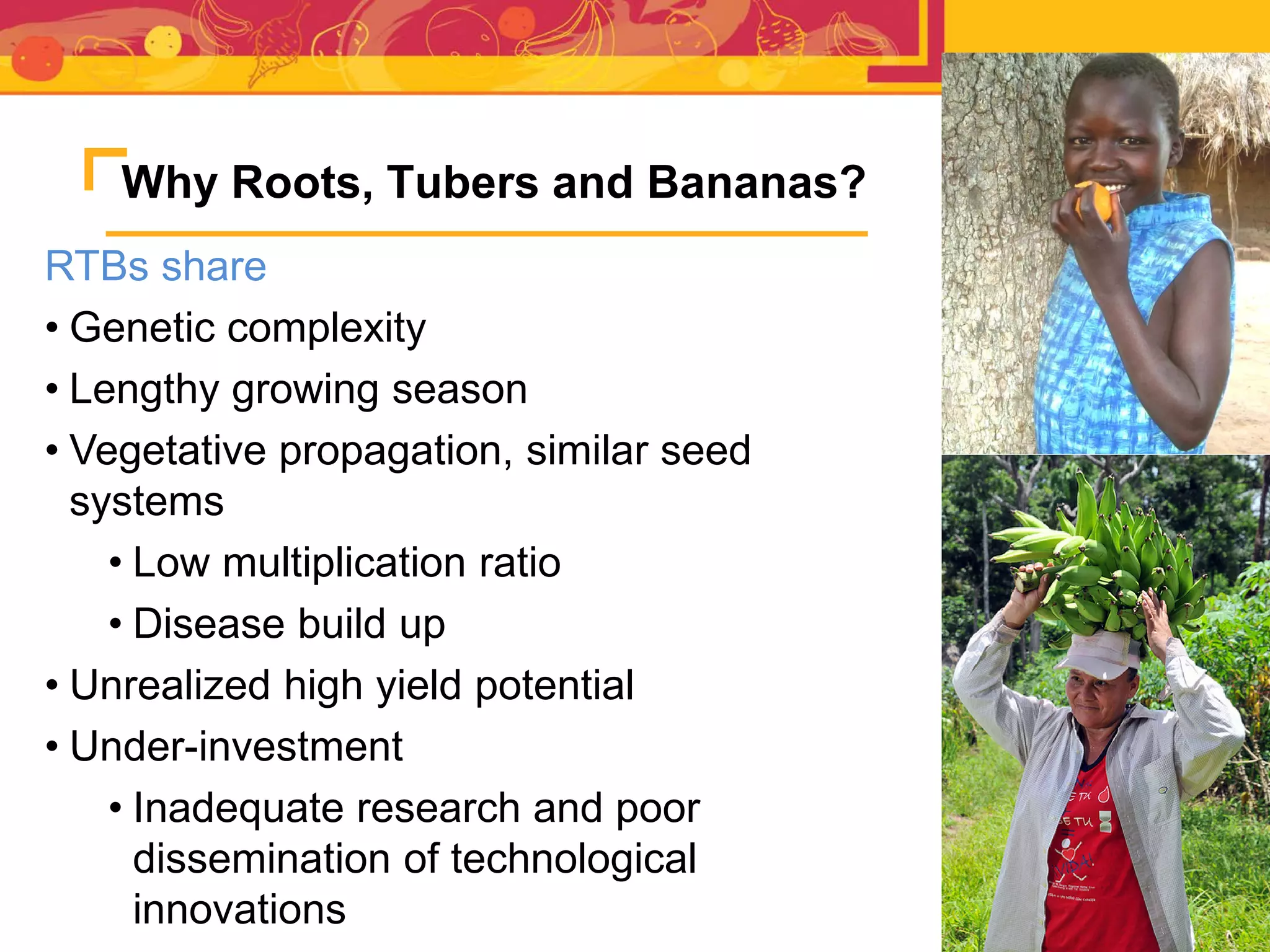
RTBs share
• Genetic complexity
• Lengthy growing season
• Vegetative propagation, similar seed
systems
• Low multiplication ratio
• Disease build up
• Unrealized high yield potential
• Under-investment
• Inadequate research and poor
dissemination of technological
innovations
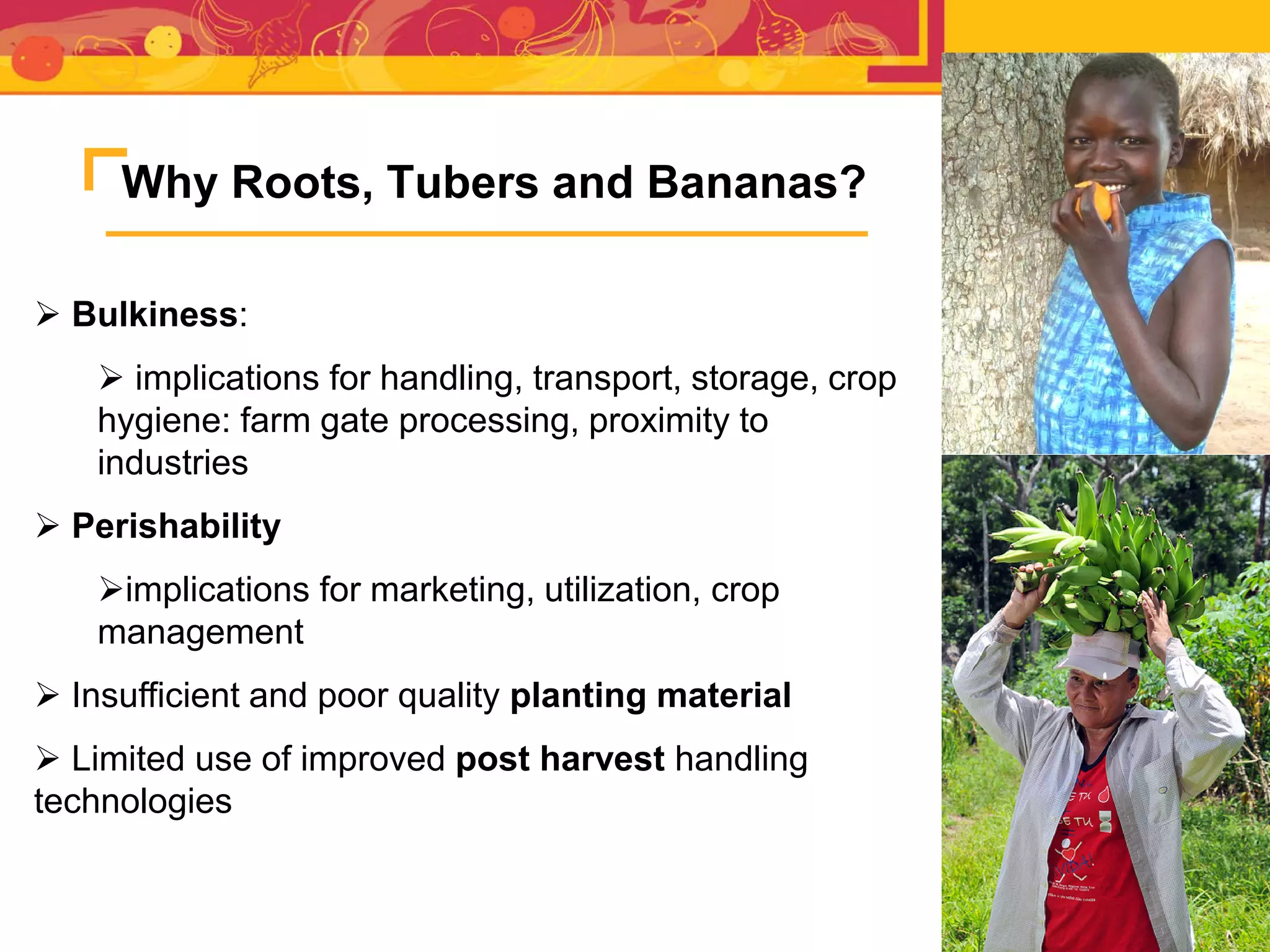
Why Roots, Tubers and Bananas?
 Bulkiness:
 implications for handling, transport, storage, crop
hygiene: farm gate processing, proximity to
industries
 Perishability
implications for marketing, utilization, crop
management
 Insufficient and poor quality planting material
 Limited use of improved post harvest handling
technologies
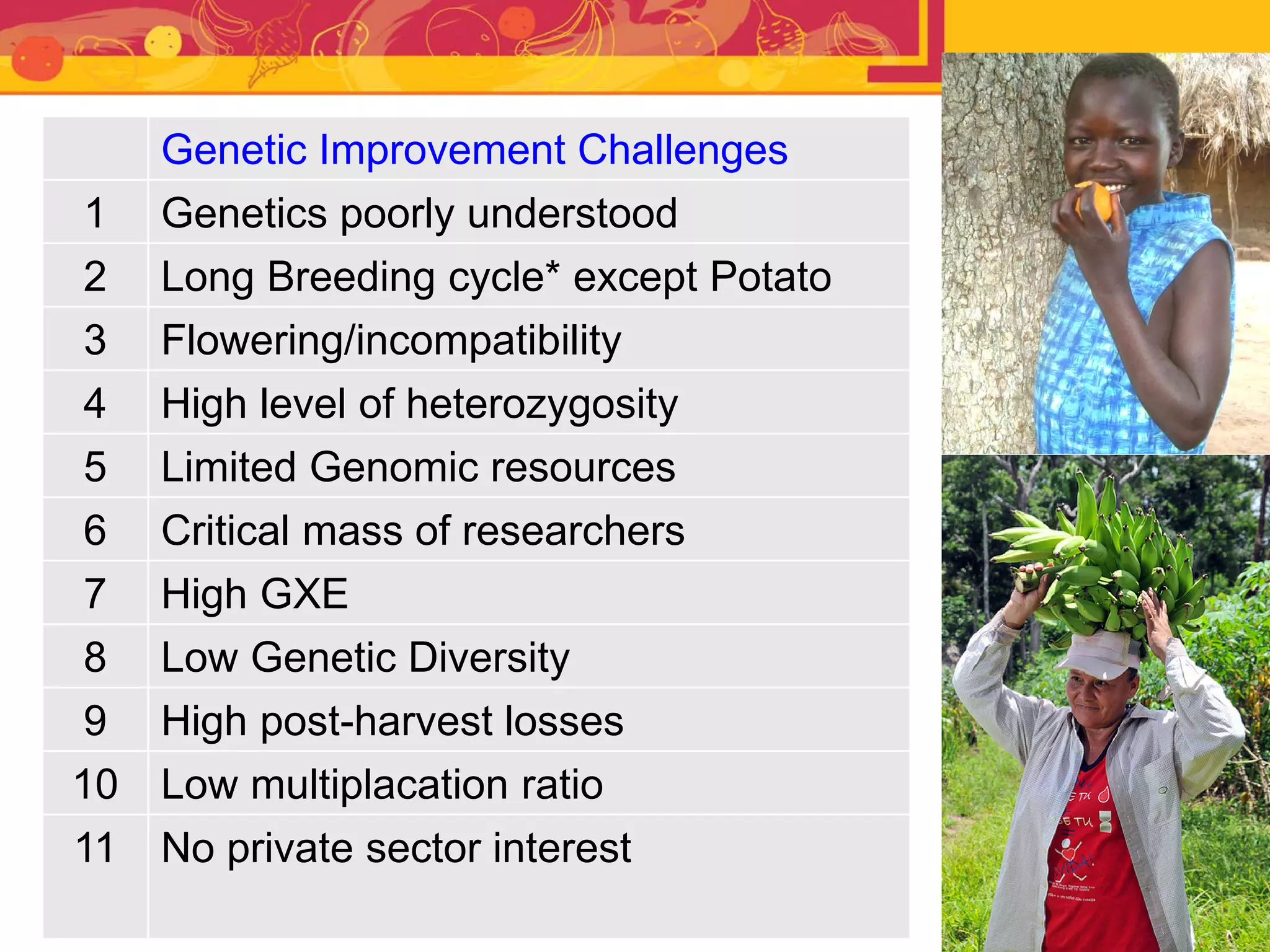
Genetic Improvement Challenges
1 Genetics poorly understood
2 Long Breeding cycle* except Potato
3 Flowering/incompatibility
4 High level of heterozygosity
5 Limited Genomic resources
6 Critical mass of researchers
7 High GXE
8 Low Genetic Diversity
9 High post-harvest losses
10 Low multiplacation ratio
11 No private sector interest
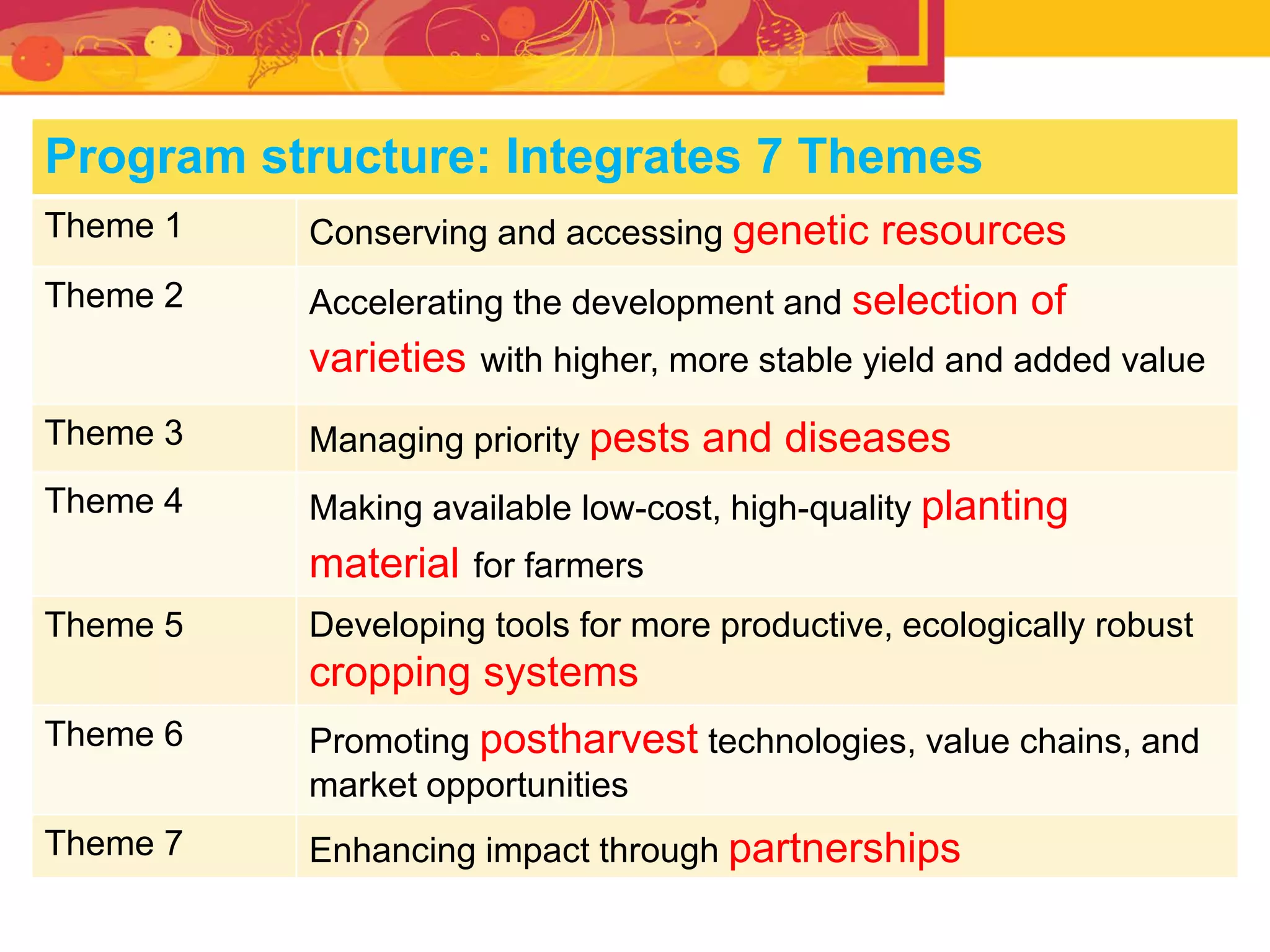
Program structure: Integrates 7 Themes
Theme 1 Conserving and accessing genetic resources
Theme 2 Accelerating the development and selection of
varieties with higher, more stable yield and added value
Theme 3 Managing priority pests and diseases
Theme 4 Making available low-cost, high-quality planting
material for farmers
Theme 5 Developing tools for more productive, ecologically robust
cropping systems
Theme 6 Promoting postharvest technologies, value chains, and
market opportunities
Theme 7 Enhancing impact through partnerships
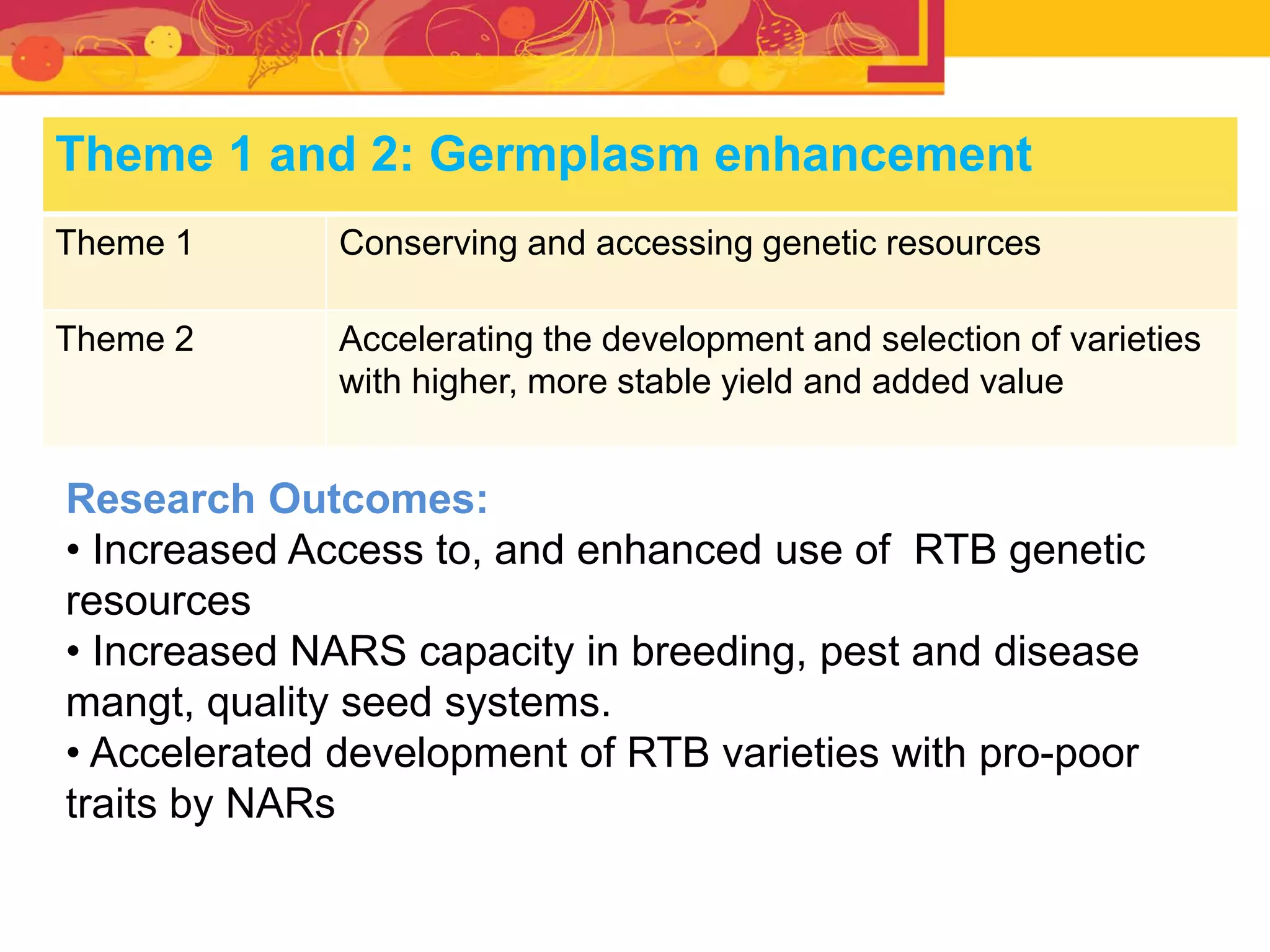
Theme 1 and 2: Germplasm enhancement
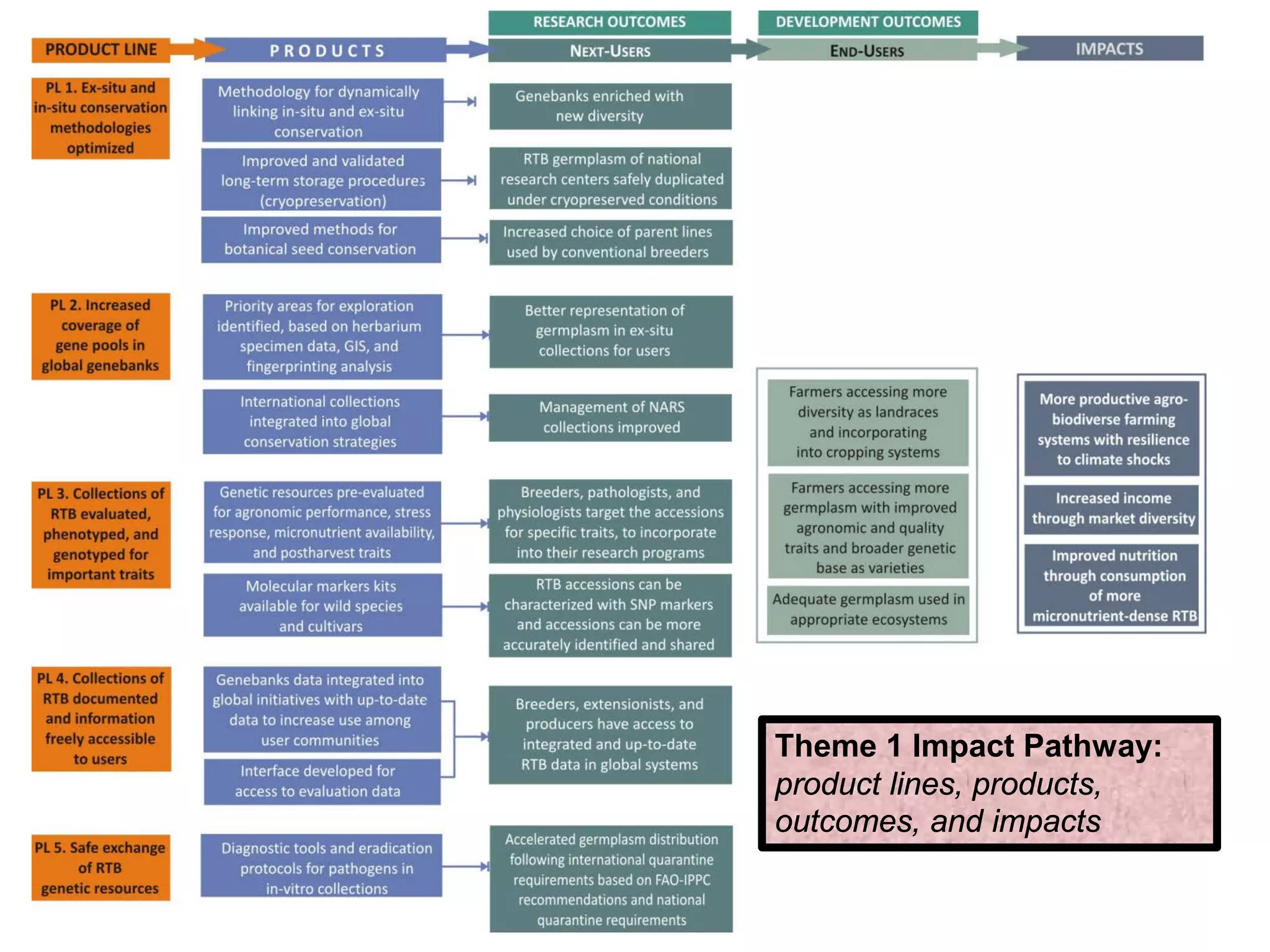
Theme 1 Conserving and accessing genetic resources
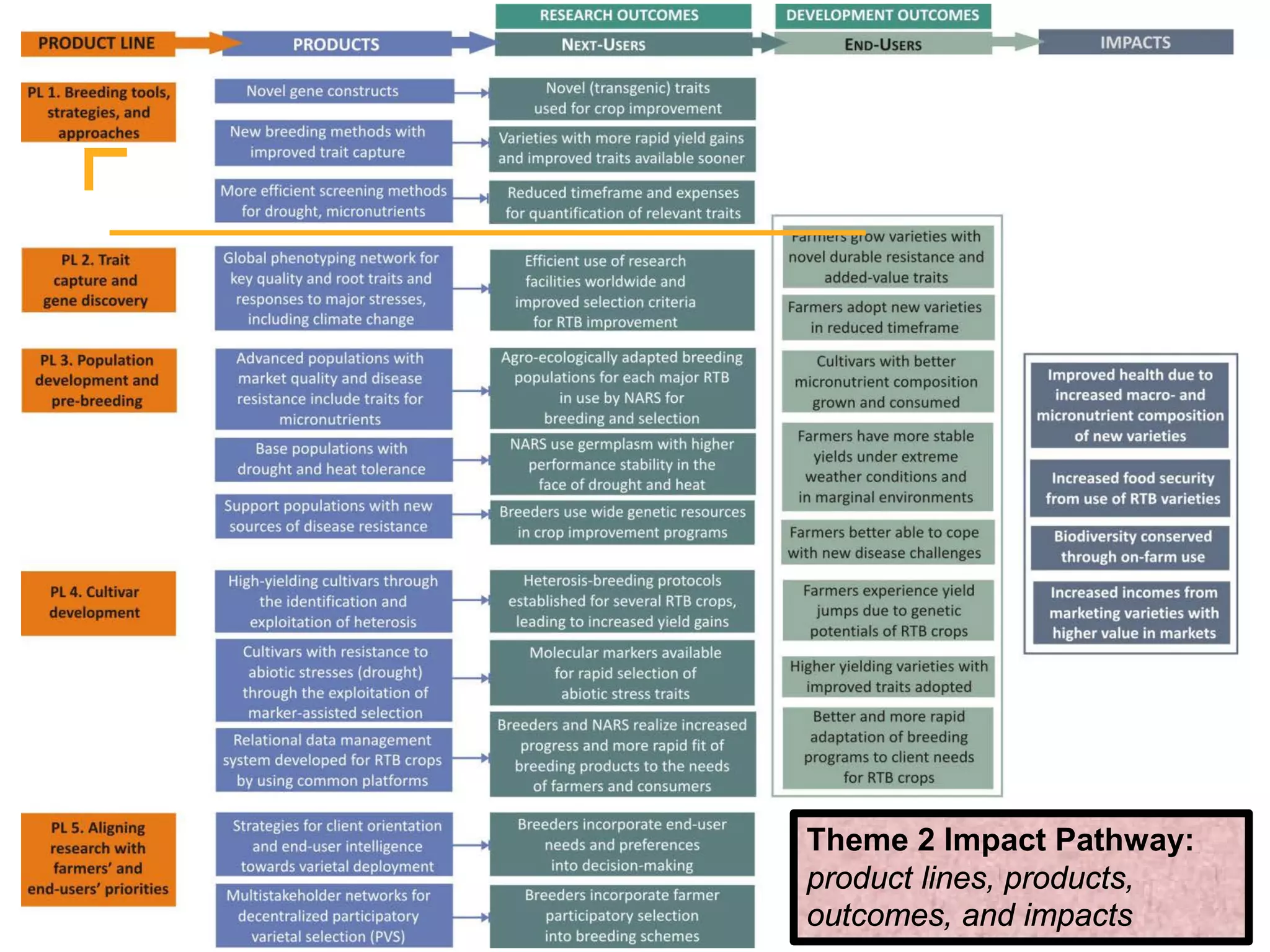
Theme 2 Accelerating the development and selection of varieties
with higher, more stable yield and added value
Research Outcomes:
• Increased Access to, and enhanced use of RTB genetic
resources
• Increased NARS capacity in breeding, pest and disease
mangt, quality seed systems.
• Accelerated development of RTB varieties with pro-poor
traits by NARs
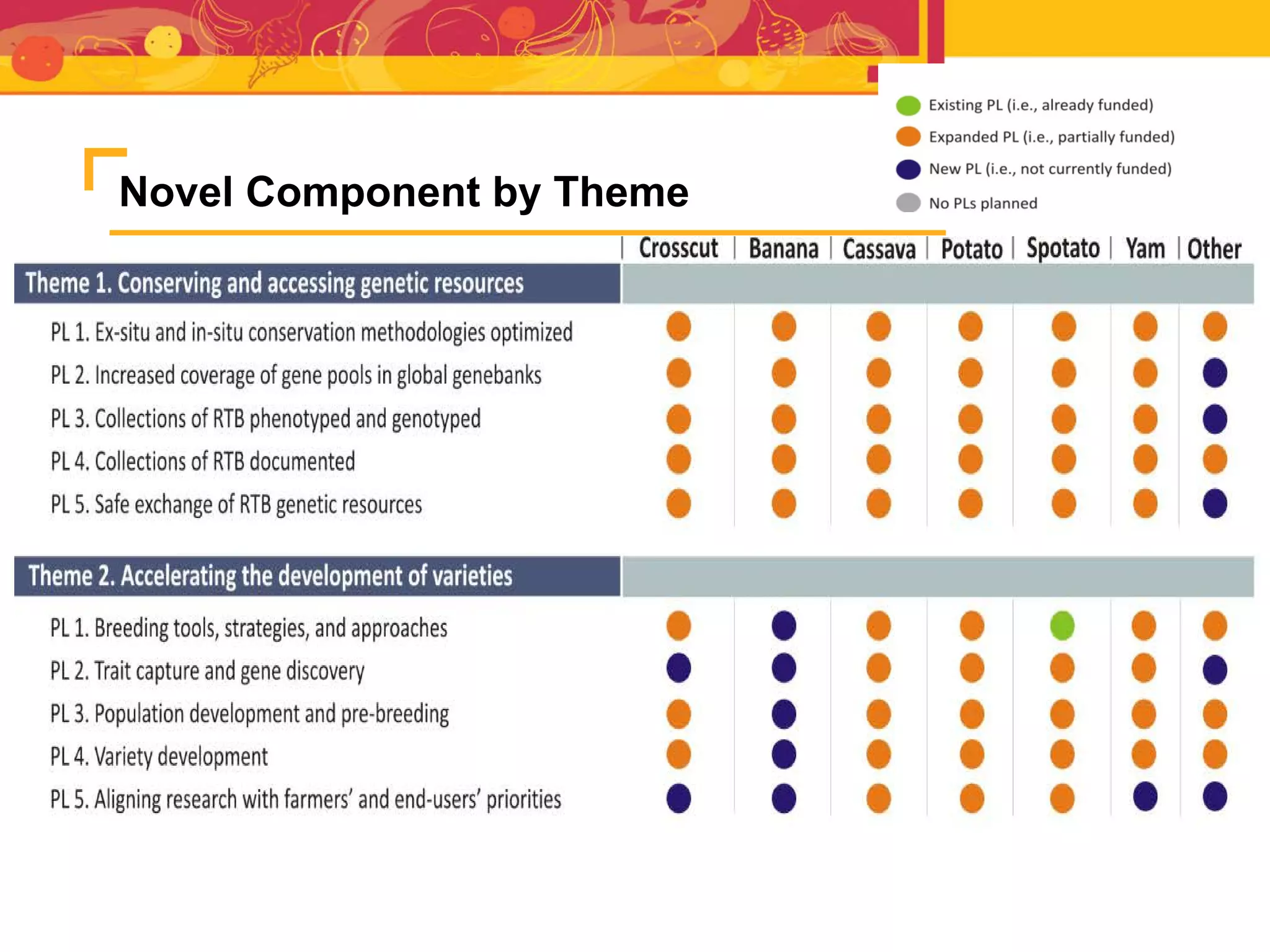
Novel Component by Theme
Theme 1 Impact Pathway:
product lines, products,
outcomes, and impacts
Theme 2 Impact Pathway:
product lines, products,
outcomes, and impacts
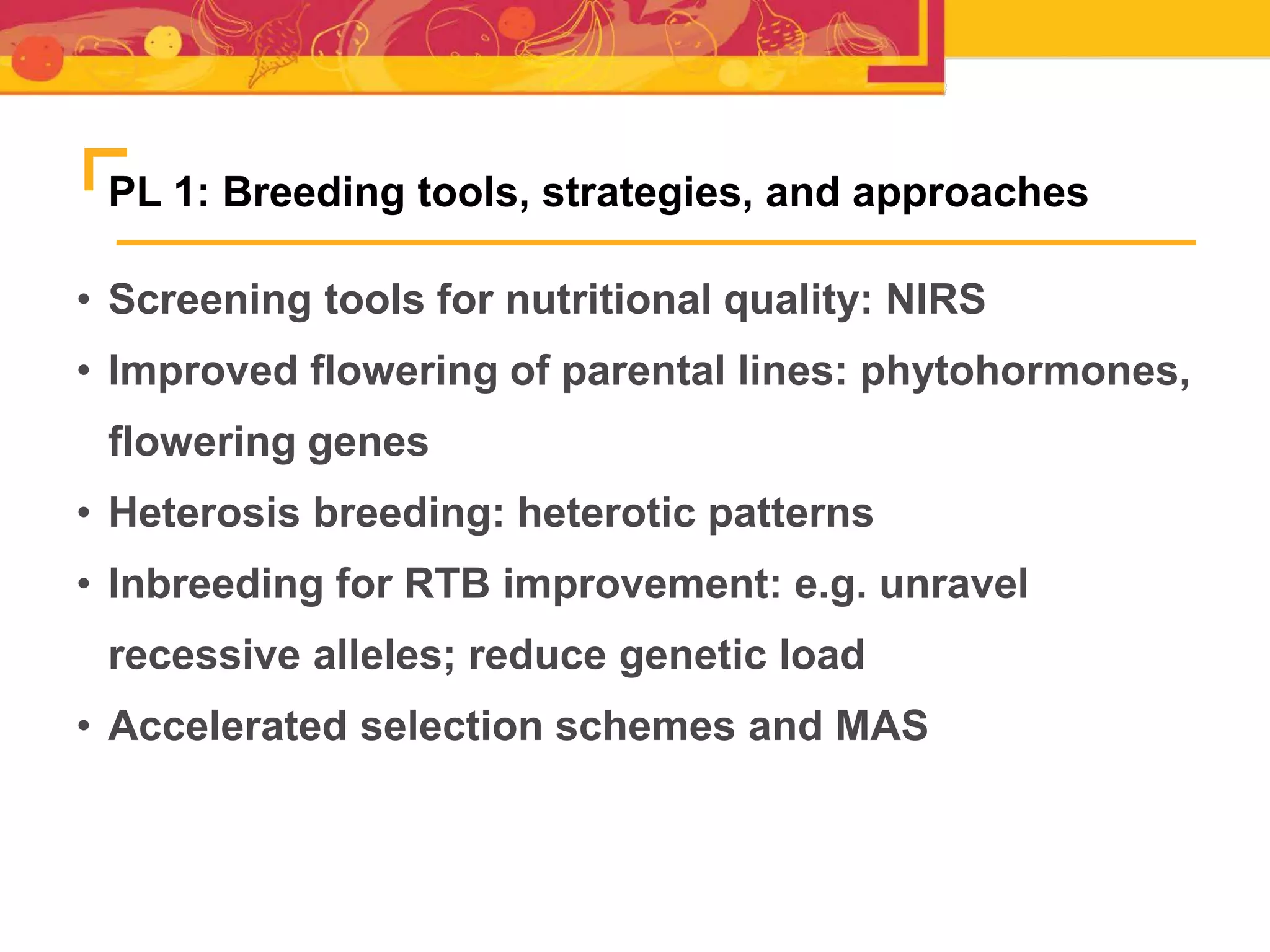
PL 1: Breeding tools, strategies, and approaches
• Screening tools for nutritional quality: NIRS
• Improved flowering of parental lines: phytohormones,
flowering genes
• Heterosis breeding: heterotic patterns
• Inbreeding for RTB improvement: e.g. unravel
recessive alleles; reduce genetic load
• Accelerated selection schemes and MAS
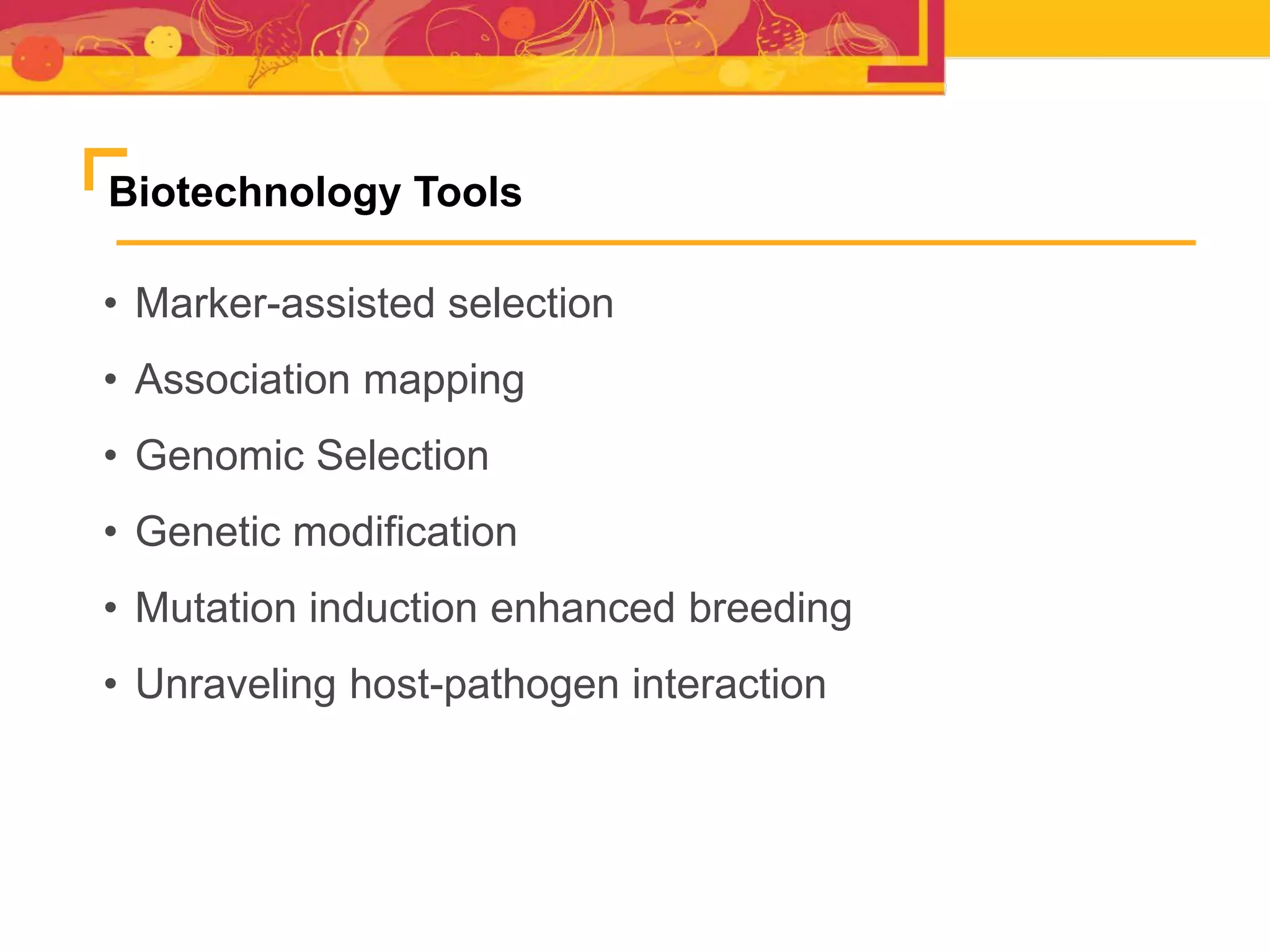
Biotechnology Tools
• Marker-assisted selection
• Association mapping
• Genomic Selection
• Genetic modification
• Mutation induction enhanced breeding
• Unraveling host-pathogen interaction
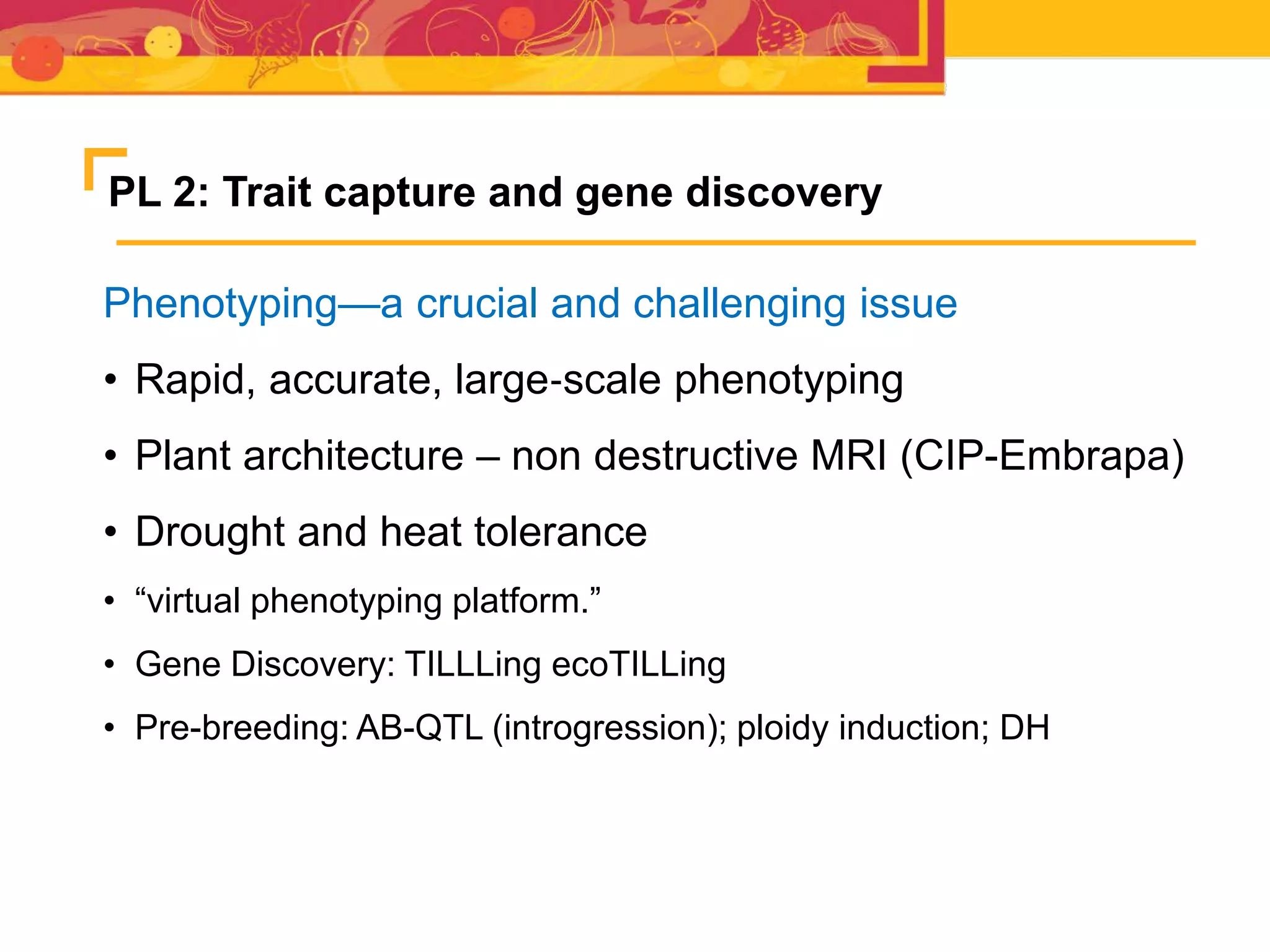
PL 2: Trait capture and gene discovery
Phenotyping—a crucial and challenging issue
• Rapid, accurate, large‐scale phenotyping
• Plant architecture – non destructive MRI (CIP-Embrapa)
• Drought and heat tolerance
• “virtual phenotyping platform.”
• Gene Discovery: TILLLing ecoTILLing
• Pre-breeding: AB-QTL (introgression); ploidy induction; DH
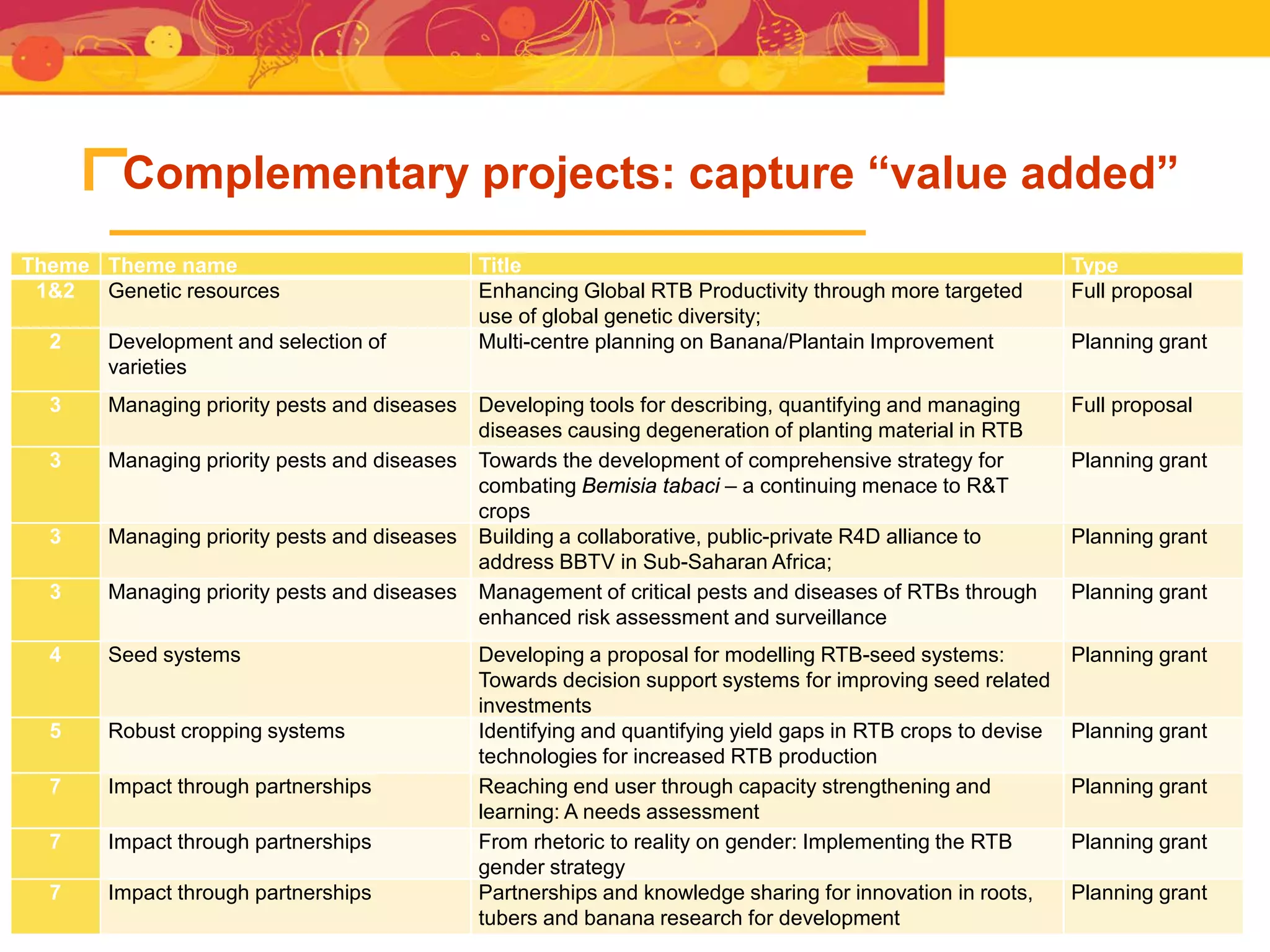
Complementary projects: capture “value added”
Theme Theme name Title Type
1&2 Genetic resources Enhancing Global RTB Productivity through more targeted
use of global genetic diversity;
Full proposal
2 Development and selection of
varieties
Multi-centre planning on Banana/Plantain Improvement Planning grant
3 Managing priority pests and diseases Developing tools for describing, quantifying and managing
diseases causing degeneration of planting material in RTB
Full proposal
3 Managing priority pests and diseases Towards the development of comprehensive strategy for
combating Bemisia tabaci – a continuing menace to R&T
crops
Planning grant
3 Managing priority pests and diseases Building a collaborative, public-private R4D alliance to
address BBTV in Sub-Saharan Africa;
Planning grant
3 Managing priority pests and diseases Management of critical pests and diseases of RTBs through
enhanced risk assessment and surveillance
Planning grant
4 Seed systems Developing a proposal for modelling RTB-seed systems:
Towards decision support systems for improving seed related
investments
Planning grant
5 Robust cropping systems Identifying and quantifying yield gaps in RTB crops to devise
technologies for increased RTB production
Planning grant
7 Impact through partnerships Reaching end user through capacity strengthening and
learning: A needs assessment
Planning grant
7 Impact through partnerships From rhetoric to reality on gender: Implementing the RTB
gender strategy
Planning grant
7 Impact through partnerships Partnerships and knowledge sharing for innovation in roots,
tubers and banana research for development
Planning grant
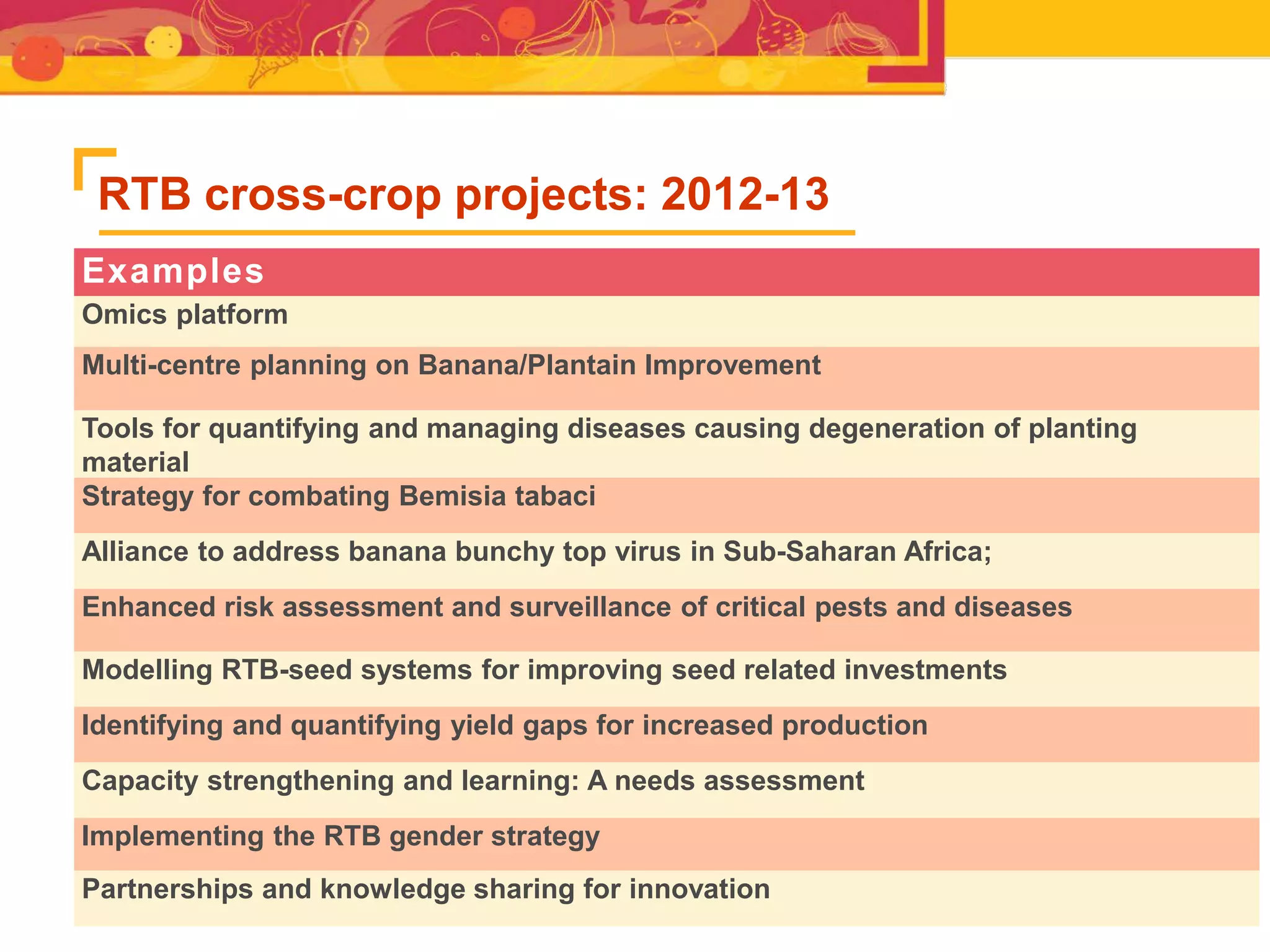
RTB cross-crop projects: 2012-13
Examples
Omics platform
Multi-centre planning on Banana/Plantain Improvement
Tools for quantifying and managing diseases causing degeneration of planting
material
Strategy for combating Bemisia tabaci
Alliance to address banana bunchy top virus in Sub-Saharan Africa;
Enhanced risk assessment and surveillance of critical pests and diseases
Modelling RTB-seed systems for improving seed related investments
Identifying and quantifying yield gaps for increased production
Capacity strengthening and learning: A needs assessment
Implementing the RTB gender strategy
Partnerships and knowledge sharing for innovation
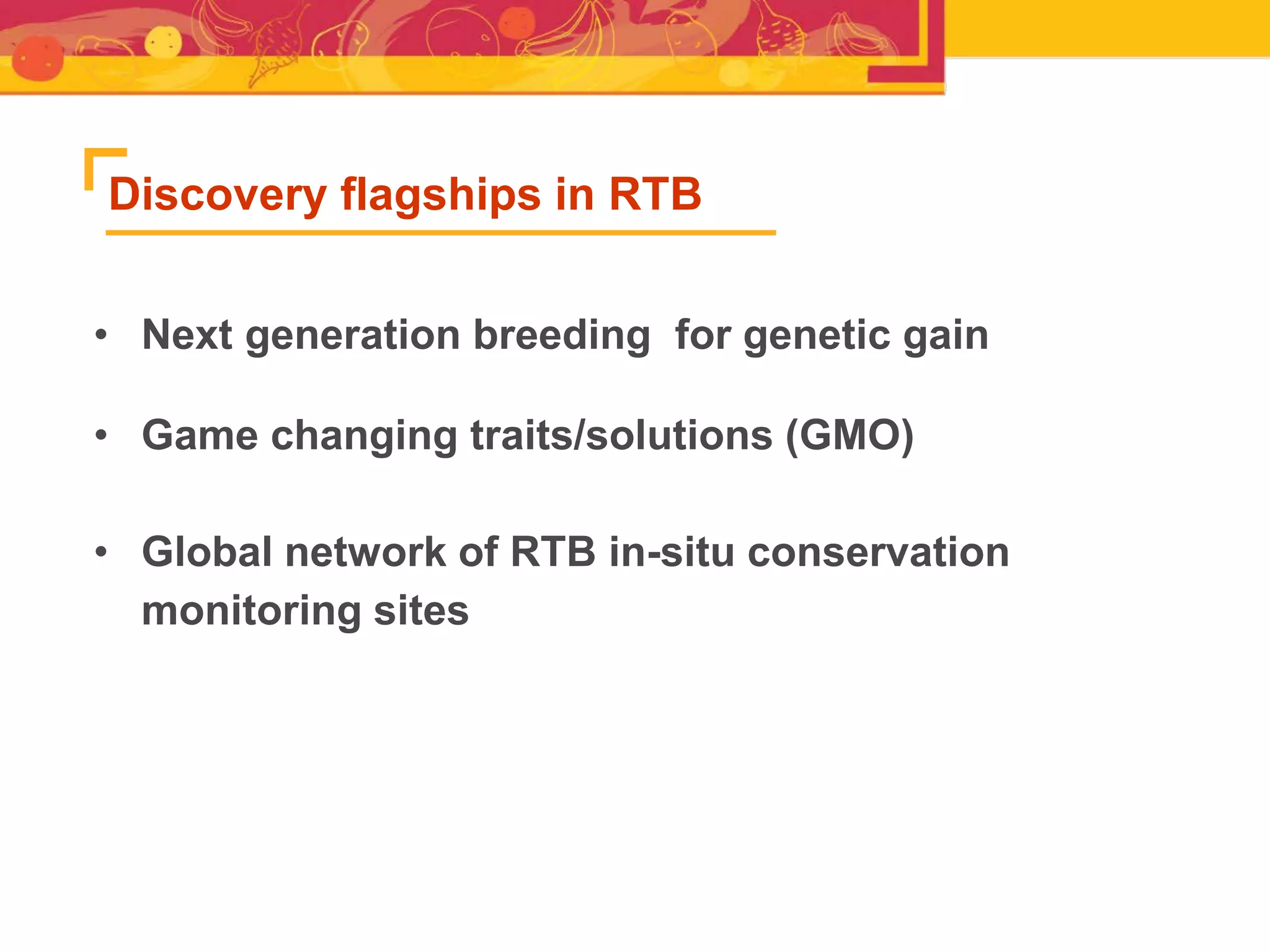
• Next generation breeding for genetic gain
• Game changing traits/solutions (GMO)
• Global network of RTB in-situ conservation
monitoring sites
Discovery flagships in RTB
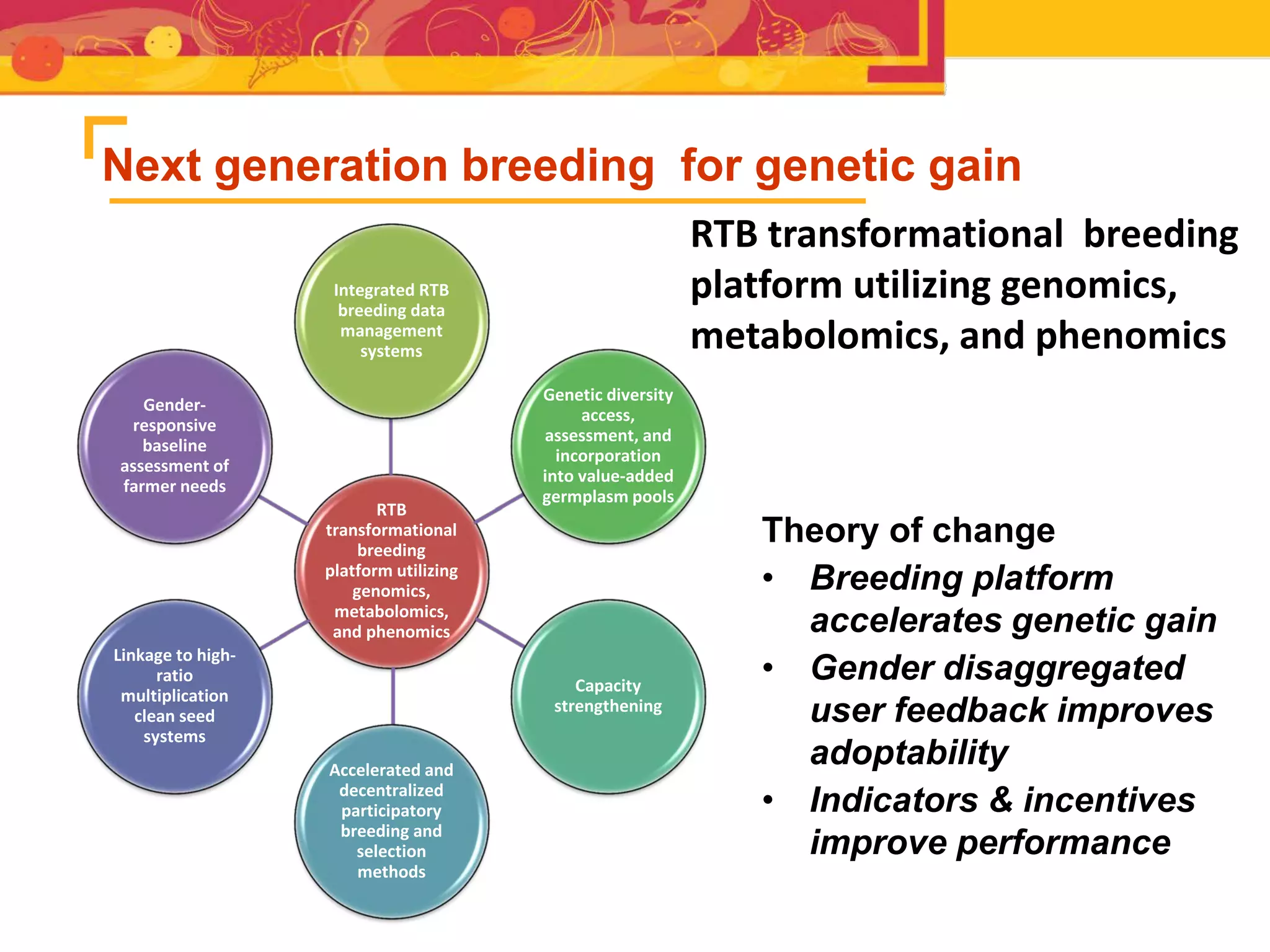
Next generation breeding for genetic gain
RTB
transformational
breeding
platform utilizing
genomics,
metabolomics,
and phenomics
Integrated RTB
breeding data
management
systems
Genetic diversity
access,
assessment, and
incorporation
into value-added
germplasm pools
Capacity
strengthening
Accelerated and
decentralized
participatory
breeding and
selection
methods
Linkage to high-
ratio
multiplication
clean seed
systems
Gender-
responsive
baseline
assessment of
farmer needs
Theory of change
• Breeding platform
accelerates genetic gain
• Gender disaggregated
user feedback improves
adoptability
• Indicators & incentives
improve performance
RTB transformational breeding
platform utilizing genomics,
metabolomics, and phenomics
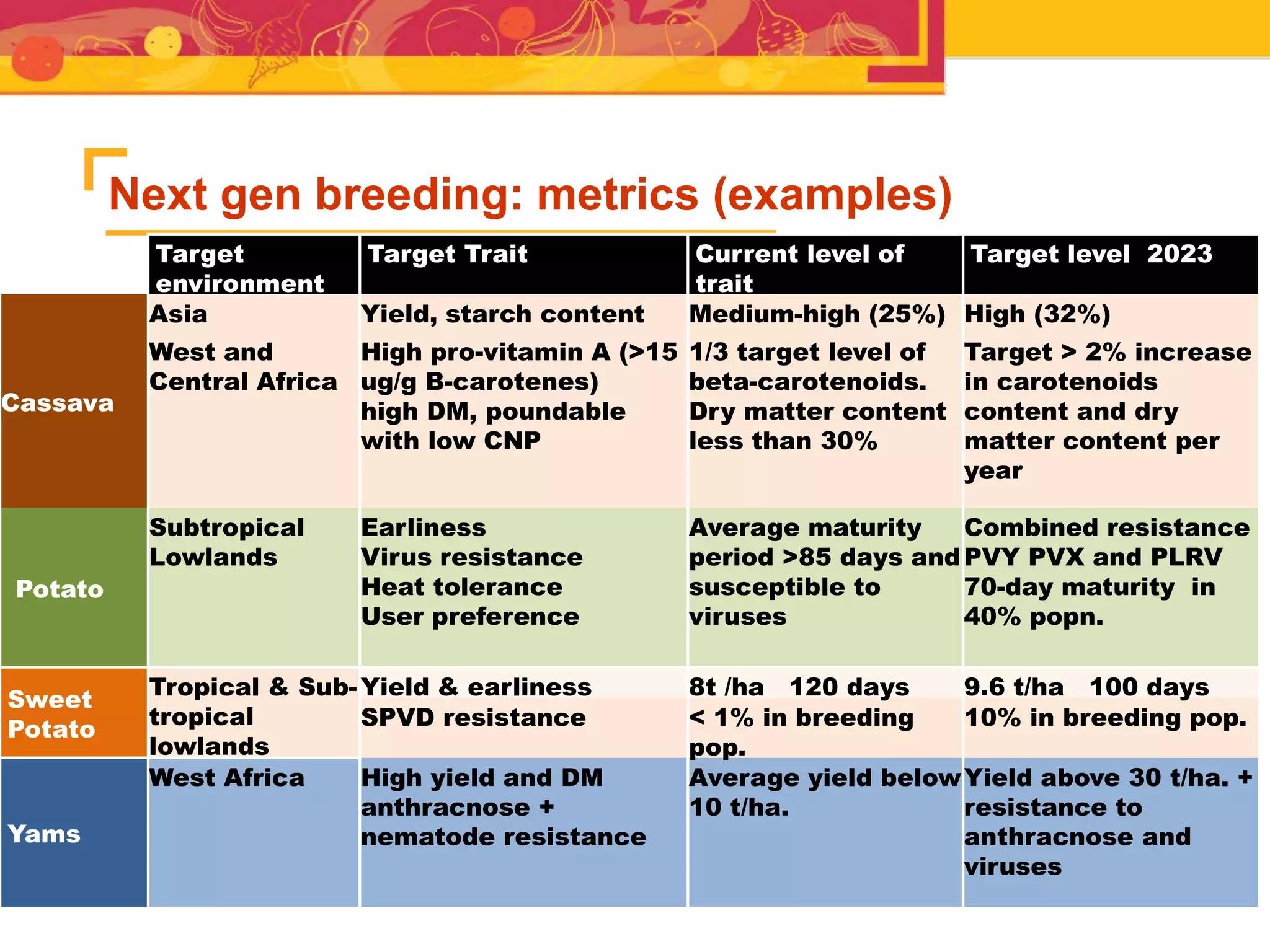
Next gen breeding: metrics (examples)
Target
environment
Target Trait Current level of
trait
Target level 2023
Cassava
Asia Yield, starch content Medium-high (25%) High (32%)
West and
Central Africa
High pro-vitamin A (>15
ug/g B-carotenes)
high DM, poundable
with low CNP
1/3 target level of
beta-carotenoids.
Dry matter content
less than 30%
Target > 2% increase
in carotenoids
content and dry
matter content per
year
Potato
Subtropical
Lowlands
Earliness
Virus resistance
Heat tolerance
User preference
Average maturity
period >85 days and
susceptible to
viruses
Combined resistance
PVY PVX and PLRV
70-day maturity in
40% popn.
Sweet
Potato
Tropical & Sub-
tropical
lowlands
Yield & earliness 8t /ha 120 days 9.6 t/ha 100 days
SPVD resistance < 1% in breeding
pop.
10% in breeding pop.
Yams
West Africa High yield and DM
anthracnose +
nematode resistance
Average yield below
10 t/ha.
Yield above 30 t/ha. +
resistance to
anthracnose and
viruses
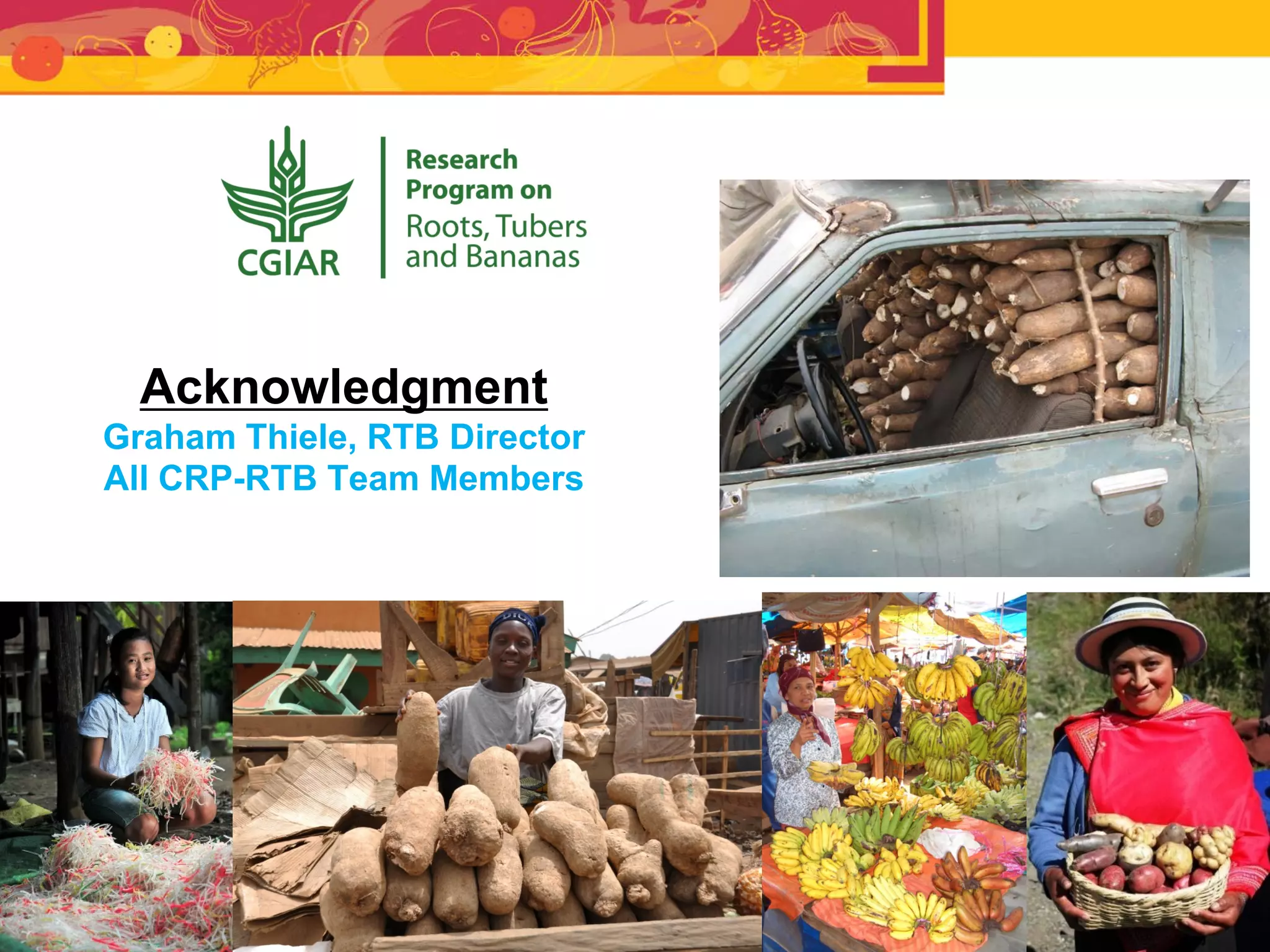
Acknowledgment
Graham Thiele, RTB Director
All CRP-RTB Team Members
Thank You

GRM 2013: CGIAR Research Program on Roots, Tubers and Bananas – M Gedil

  • 1.
    CGIAR Research Programon Roots, Tubers and Bananas: Overview GCP-GRM 27 September, 2013
  • 2.
    A collaboration of: +a wide spectrum research-for-development stakeholders & partners
  • 3.
    Banana Plantain Cassava Potato SweetpotatoYam Other R&T Our crops 200 million farmers depend on RTB crops Buffering role in food systems
  • 4.
  • 5.
    Cross center collaboration PRIMARYCROP EXPERTISE OTHER ROOTS AND TUBERS CENTER BANANA CASSAVA POTATO SWEETPOTATO YAM AROIDS ANDEAN Bioversity CIAT CIP CIRAD IITA
  • 6.
    • Increased scale •Critical mass of researchers • Greater capacity • Exploit synergies: genuine “win-wins” eg similarities in seed systems and post harvest management To do together what we cannot do separately Program “value added”
  • 7.
    RTBs share • Geneticcomplexity • Lengthy growing season • Vegetative propagation, similar seed systems • Low multiplication ratio • Disease build up • Unrealized high yield potential • Under-investment • Inadequate research and poor dissemination of technological innovations Why Roots, Tubers and Bananas?
  • 8.
    Why Roots, Tubersand Bananas?  Bulkiness:  implications for handling, transport, storage, crop hygiene: farm gate processing, proximity to industries  Perishability implications for marketing, utilization, crop management  Insufficient and poor quality planting material  Limited use of improved post harvest handling technologies
  • 9.
    Genetic Improvement Challenges 1Genetics poorly understood 2 Long Breeding cycle* except Potato 3 Flowering/incompatibility 4 High level of heterozygosity 5 Limited Genomic resources 6 Critical mass of researchers 7 High GXE 8 Low Genetic Diversity 9 High post-harvest losses 10 Low multiplacation ratio 11 No private sector interest
  • 10.
    Program structure: Integrates7 Themes Theme 1 Conserving and accessing genetic resources Theme 2 Accelerating the development and selection of varieties with higher, more stable yield and added value Theme 3 Managing priority pests and diseases Theme 4 Making available low-cost, high-quality planting material for farmers Theme 5 Developing tools for more productive, ecologically robust cropping systems Theme 6 Promoting postharvest technologies, value chains, and market opportunities Theme 7 Enhancing impact through partnerships
  • 11.
    Theme 1 and2: Germplasm enhancement Theme 1 Conserving and accessing genetic resources Theme 2 Accelerating the development and selection of varieties with higher, more stable yield and added value Research Outcomes: • Increased Access to, and enhanced use of RTB genetic resources • Increased NARS capacity in breeding, pest and disease mangt, quality seed systems. • Accelerated development of RTB varieties with pro-poor traits by NARs
  • 12.
  • 13.
    Theme 1 ImpactPathway: product lines, products, outcomes, and impacts
  • 14.
    Theme 2 ImpactPathway: product lines, products, outcomes, and impacts
  • 15.
    PL 1: Breedingtools, strategies, and approaches • Screening tools for nutritional quality: NIRS • Improved flowering of parental lines: phytohormones, flowering genes • Heterosis breeding: heterotic patterns • Inbreeding for RTB improvement: e.g. unravel recessive alleles; reduce genetic load • Accelerated selection schemes and MAS
  • 16.
    Biotechnology Tools • Marker-assistedselection • Association mapping • Genomic Selection • Genetic modification • Mutation induction enhanced breeding • Unraveling host-pathogen interaction
  • 17.
    PL 2: Traitcapture and gene discovery Phenotyping—a crucial and challenging issue • Rapid, accurate, large‐scale phenotyping • Plant architecture – non destructive MRI (CIP-Embrapa) • Drought and heat tolerance • “virtual phenotyping platform.” • Gene Discovery: TILLLing ecoTILLing • Pre-breeding: AB-QTL (introgression); ploidy induction; DH
  • 18.
    Complementary projects: capture“value added” Theme Theme name Title Type 1&2 Genetic resources Enhancing Global RTB Productivity through more targeted use of global genetic diversity; Full proposal 2 Development and selection of varieties Multi-centre planning on Banana/Plantain Improvement Planning grant 3 Managing priority pests and diseases Developing tools for describing, quantifying and managing diseases causing degeneration of planting material in RTB Full proposal 3 Managing priority pests and diseases Towards the development of comprehensive strategy for combating Bemisia tabaci – a continuing menace to R&T crops Planning grant 3 Managing priority pests and diseases Building a collaborative, public-private R4D alliance to address BBTV in Sub-Saharan Africa; Planning grant 3 Managing priority pests and diseases Management of critical pests and diseases of RTBs through enhanced risk assessment and surveillance Planning grant 4 Seed systems Developing a proposal for modelling RTB-seed systems: Towards decision support systems for improving seed related investments Planning grant 5 Robust cropping systems Identifying and quantifying yield gaps in RTB crops to devise technologies for increased RTB production Planning grant 7 Impact through partnerships Reaching end user through capacity strengthening and learning: A needs assessment Planning grant 7 Impact through partnerships From rhetoric to reality on gender: Implementing the RTB gender strategy Planning grant 7 Impact through partnerships Partnerships and knowledge sharing for innovation in roots, tubers and banana research for development Planning grant
  • 19.
    RTB cross-crop projects:2012-13 Examples Omics platform Multi-centre planning on Banana/Plantain Improvement Tools for quantifying and managing diseases causing degeneration of planting material Strategy for combating Bemisia tabaci Alliance to address banana bunchy top virus in Sub-Saharan Africa; Enhanced risk assessment and surveillance of critical pests and diseases Modelling RTB-seed systems for improving seed related investments Identifying and quantifying yield gaps for increased production Capacity strengthening and learning: A needs assessment Implementing the RTB gender strategy Partnerships and knowledge sharing for innovation
  • 20.
    • Next generationbreeding for genetic gain • Game changing traits/solutions (GMO) • Global network of RTB in-situ conservation monitoring sites Discovery flagships in RTB
  • 21.
    Next generation breedingfor genetic gain RTB transformational breeding platform utilizing genomics, metabolomics, and phenomics Integrated RTB breeding data management systems Genetic diversity access, assessment, and incorporation into value-added germplasm pools Capacity strengthening Accelerated and decentralized participatory breeding and selection methods Linkage to high- ratio multiplication clean seed systems Gender- responsive baseline assessment of farmer needs Theory of change • Breeding platform accelerates genetic gain • Gender disaggregated user feedback improves adoptability • Indicators & incentives improve performance RTB transformational breeding platform utilizing genomics, metabolomics, and phenomics
  • 22.
    Next gen breeding:metrics (examples) Target environment Target Trait Current level of trait Target level 2023 Cassava Asia Yield, starch content Medium-high (25%) High (32%) West and Central Africa High pro-vitamin A (>15 ug/g B-carotenes) high DM, poundable with low CNP 1/3 target level of beta-carotenoids. Dry matter content less than 30% Target > 2% increase in carotenoids content and dry matter content per year Potato Subtropical Lowlands Earliness Virus resistance Heat tolerance User preference Average maturity period >85 days and susceptible to viruses Combined resistance PVY PVX and PLRV 70-day maturity in 40% popn. Sweet Potato Tropical & Sub- tropical lowlands Yield & earliness 8t /ha 120 days 9.6 t/ha 100 days SPVD resistance < 1% in breeding pop. 10% in breeding pop. Yams West Africa High yield and DM anthracnose + nematode resistance Average yield below 10 t/ha. Yield above 30 t/ha. + resistance to anthracnose and viruses
  • 23.
    Acknowledgment Graham Thiele, RTBDirector All CRP-RTB Team Members
  • 24.

Editor's Notes

  • #4 RTBs are among the top 10 most commonly consumed food staples and provide one of the cheapest sources of energy and vital nutrients.RTBs can survive periods of neglect, allow flexibility in planting time, and favor over‐ or underground maintenance and piecemeal harvesting, RTB play a vital role in filling hungry periods caused by seasonal shortages or natural and man‐made disasters.
  • #5 In addition to the five major food crops, these minor crops also play very important role locally as food, cassh, and medicinal crops.Andean RT are grown in S. America whereas Aroids such as cocoyam and taro are common in Africa.Note:The Andean root and tuber crops (ARTC) (achira, ahipa, arracacha, maca, mashua, mauka, oca, ulluco, yacón) play a major role in Andean potato‐based farming systems. They have a wide range and mix of desirable characteristics: high‐vitamin, micronutrient, and starch content; high yields; and medicinal properties.The aroids, Colocasia spp. and Xanthosoma spp., are important food crops in the tropics (12.2 MT), especially in Africa (76%). Taro (Colocasia spp.) and cocoyam/tannia (Xanthosoma spp.) were domesticated independently in southeastern Asia and tropical America, respectively. Cocoyam and taro are important traditional crops, playing a vital role for women in family food supply and income generation.
  • #12 Each Theme has 3-5 product lines (PL)
  • #13 Each Theme has 3-5 product lines (PL)
  • #14 Each Theme has 3-5 product lines (PL)
  • #17 As an illustration, Product line 1 of Theme 2.3. The use of more inbred progenitors might offer advantages such as more efficient exploitation of heterosis; the possibility of implementing backcross schemes; and a very effective way to reduce genetic load (undesirable alleles) and identify useful recessive traits4. However, production of inbred germplasm in RTB is difficult. Therefore, different approaches ranging from the more conventional use of anther, ovule, or microspore culture or wide crosses and the new “centromere alternative” (Ravi and Chan 2010) will be investigated for RTB. An S locus inhibitor gene (denoted Sli) identified in diploid wild potatospecies (Phumichai et al. 2005)5. The successes in the accelerated breeding schemes can be enhanced by complementary use of rapid propagation techniques to increase the number of plants at early stages, participatory selection at local and regional levels, and effective manipulation of tuber dormancy in the case of yams.