Staff Confidentiality Training
     Staff and patient rights
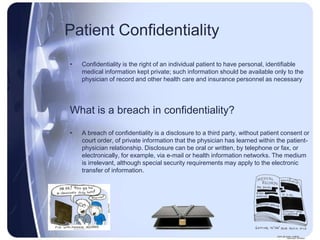
Patient Confidentiality
•   Confidentiality is the right of an individual patient to have personal, identifiable
    medical information kept private; such information should be available only to the
    physician of record and other health care and insurance personnel as necessary


What is a breach in confidentiality?

•   A breach of confidentiality is a disclosure to a third party, without patient consent or
    court order, of private information that the physician has learned within the patient-
    physician relationship. Disclosure can be oral or written, by telephone or fax, or
    electronically, for example, via e-mail or health information networks. The medium
    is irrelevant, although special security requirements may apply to the electronic
    transfer of information.
Confidentiality

Who can breach a patient’s confidentiality?

•   Anyone can. A provider, nurse, secretary, records technician, anyone with access
    to the medical records of the patient

•   Evan talking about a patient’s conditions to someone away from the office is a
    violation of that patient's rights and confidentiality, if they have not given expressed
    consent to discuss their medical status
HIPAA
•   HIPAA is the Health Insurance Portability and Accountability Act of 1996 (HIPAA)

•   The HIPAA Privacy Rule provides protections for personal health information held
    by covered entities and gives patients an array of rights with respect to that
    information.

•   The HIPAA Privacy Rule provides federal protections for personal health
    information held by covered entities and gives patients an array of rights with
    respect to that information. At the same time, the Privacy Rule is balanced so that it
    permits the disclosure of personal health information needed for patient care and
    other important purposes.
HIPAA Violations
•   It is important to be aware of the different terms of the HIPAA because failure to
    comply with any can lead to criminal and civil penalties.


•   There are 4 main types of HIPAA violations:

     –   Willful neglect, which is at the same time not corrected
     –   Due to willful neglect, but is corrected appropriately within the period required
         by law
     –   Not due to willful neglect, but due to reasonable cause
     –   Due to ignorance, in which the individual unknowingly violated any of the
         terms of the HIPAA
HIPAA Violation Penalties
•   Minimal penalties for the different types of HIPAA violations vary.

•   For instance , if an individual willfully neglected a law and there is no appropriate
    correction with in the stated period by the law, the minimum is $50,000 for every
    violation made. For this kind of offense, the yearly maximum of $1.5 million is
    implemented.

•   If an individual willfully neglected the law but appropriately corrected within the
    required period, the minimum penalty is $10,000 for every violation, with the annual
    maximum for repeat violation set at $250,000

•   If there is reasonable cause for a violation instead of willful neglect, the maximum
    penalty for every violation is $1,000, with the annual maximum for repeat violations
    set at $10,000

•   Violations resulting from ignorance, the minimum penalty is only $100 for each
    violation. The annual maximum for repeat violations is $25,000
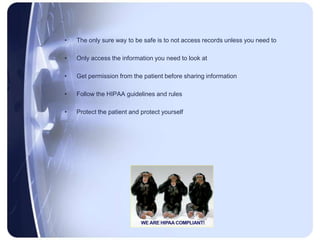
•   The only sure way to be safe is to not access records unless you need to

•   Only access the information you need to look at

•   Get permission from the patient before sharing information

•   Follow the HIPAA guidelines and rules

•   Protect the patient and protect yourself
References
•   Health Information Privacy (2012). US Department of Health and Human Services. Retrieved 15
    February 2012 from: http://www.hhs.gov/ocr/privacy/hipaa/understanding/srsummary.html

•   HIPAA Violations (nd). HIPAA Violations. Retrieved 15 Feb 2012 from:
    http://www.hipaaviolations.org/

•   Martin, JN., Loerch-Strumolo, A. (2012). Healthline, The Gale Group. Retrieved 15 Feb 2012
    from: http://www.healthline.com/galecontent/patient-confidentiality

•   Patient Confidentiality (2012). American Medical Association. Retrieved 15 Feb 2012 from:
    http://www.ama-assn.org/ama/pub/physician-resources/legal-topics/patient-physician-
    relationship-topics/patient-confidentiality.page

Staff_confidentiality_training_TeresaStewart

  • 1.
    Staff Confidentiality Training Staff and patient rights
  • 2.
    Patient Confidentiality • Confidentiality is the right of an individual patient to have personal, identifiable medical information kept private; such information should be available only to the physician of record and other health care and insurance personnel as necessary What is a breach in confidentiality? • A breach of confidentiality is a disclosure to a third party, without patient consent or court order, of private information that the physician has learned within the patient- physician relationship. Disclosure can be oral or written, by telephone or fax, or electronically, for example, via e-mail or health information networks. The medium is irrelevant, although special security requirements may apply to the electronic transfer of information.
  • 3.
    Confidentiality Who can breacha patient’s confidentiality? • Anyone can. A provider, nurse, secretary, records technician, anyone with access to the medical records of the patient • Evan talking about a patient’s conditions to someone away from the office is a violation of that patient's rights and confidentiality, if they have not given expressed consent to discuss their medical status
  • 4.
    HIPAA • HIPAA is the Health Insurance Portability and Accountability Act of 1996 (HIPAA) • The HIPAA Privacy Rule provides protections for personal health information held by covered entities and gives patients an array of rights with respect to that information. • The HIPAA Privacy Rule provides federal protections for personal health information held by covered entities and gives patients an array of rights with respect to that information. At the same time, the Privacy Rule is balanced so that it permits the disclosure of personal health information needed for patient care and other important purposes.
  • 5.
    HIPAA Violations • It is important to be aware of the different terms of the HIPAA because failure to comply with any can lead to criminal and civil penalties. • There are 4 main types of HIPAA violations: – Willful neglect, which is at the same time not corrected – Due to willful neglect, but is corrected appropriately within the period required by law – Not due to willful neglect, but due to reasonable cause – Due to ignorance, in which the individual unknowingly violated any of the terms of the HIPAA
  • 6.
    HIPAA Violation Penalties • Minimal penalties for the different types of HIPAA violations vary. • For instance , if an individual willfully neglected a law and there is no appropriate correction with in the stated period by the law, the minimum is $50,000 for every violation made. For this kind of offense, the yearly maximum of $1.5 million is implemented. • If an individual willfully neglected the law but appropriately corrected within the required period, the minimum penalty is $10,000 for every violation, with the annual maximum for repeat violation set at $250,000 • If there is reasonable cause for a violation instead of willful neglect, the maximum penalty for every violation is $1,000, with the annual maximum for repeat violations set at $10,000 • Violations resulting from ignorance, the minimum penalty is only $100 for each violation. The annual maximum for repeat violations is $25,000
  • 7.
    The only sure way to be safe is to not access records unless you need to • Only access the information you need to look at • Get permission from the patient before sharing information • Follow the HIPAA guidelines and rules • Protect the patient and protect yourself
  • 8.
    References • Health Information Privacy (2012). US Department of Health and Human Services. Retrieved 15 February 2012 from: http://www.hhs.gov/ocr/privacy/hipaa/understanding/srsummary.html • HIPAA Violations (nd). HIPAA Violations. Retrieved 15 Feb 2012 from: http://www.hipaaviolations.org/ • Martin, JN., Loerch-Strumolo, A. (2012). Healthline, The Gale Group. Retrieved 15 Feb 2012 from: http://www.healthline.com/galecontent/patient-confidentiality • Patient Confidentiality (2012). American Medical Association. Retrieved 15 Feb 2012 from: http://www.ama-assn.org/ama/pub/physician-resources/legal-topics/patient-physician- relationship-topics/patient-confidentiality.page