
THE INCREASING IMPORTANCE OF
BRANDS AND GLOBAL REACH
Greg Ballard, Warner Bros. Games
07.02.14
ABOUT WARNER BROS. GAMES
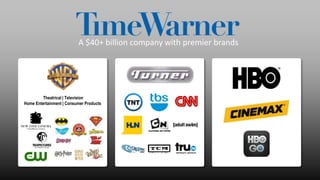
A $40+ billion company with premier brands
Theatrical | Television
Home Entertainment | Consumer Products
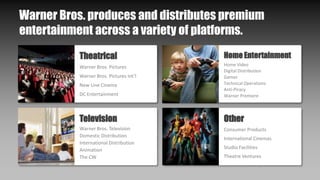
Warner Bros. produces and distributes premium
entertainment across a variety of platforms.
Theatrical
Warner Bros. Pictures
Warner Bros. Pictures Int’l
New Line Cinema
DC Entertainment
Television
Warner Bros. Television
Domestic Distribution
International Distribution
Animation
The CW
Home Entertainment
Home Video
Digital Distribution
Games
Technical Operations
Anti-Piracy
Warner Premiere
Other
Consumer Products
International Cinemas
Studio Facilities
Theatre Ventures
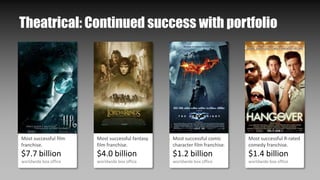
Most successful film
franchise.
$7.7 billion
worldwide box office
Most successful fantasy
film franchise.
$4.0 billion
worldwide box office
Most successful comic
character film franchise.
$1.2 billion
worldwide box office
Most successful R-rated
comedy franchise.
$1.4 billion
worldwide box office
Theatrical: Continued success with portfolio
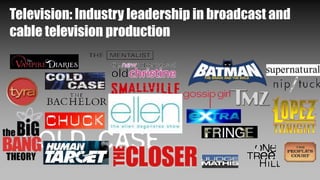
Television: Industry leadership in broadcast and
cable television production
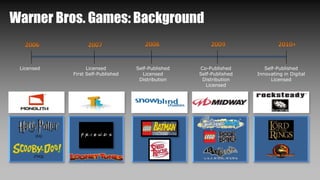
Licensed Licensed
First Self-Published
Self-Published
Licensed
Distribution
Co-Published
Self-Published
Distribution
Licensed
Self-Published
Innovating in Digital
Licensed
(EA)
(THQ)
Warner Bros. Games: Background
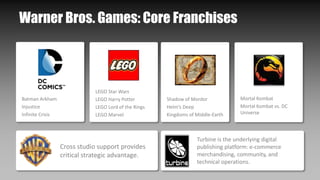
Cross studio support provides
critical strategic advantage.
Turbine is the underlying digital
publishing platform: e-commerce
merchandising, community, and
technical operations.
Warner Bros. Games: Core Franchises
Batman Arkham
Injustice
Infinite Crisis
LEGO Star Wars
LEGO Harry Potter
LEGO Lord of the Rings
LEGO Marvel
Shadow of Mordor
Helm’s Deep
Kingdoms of Middle-Earth
Mortal Kombat
Mortal Kombat vs. DC
Universe
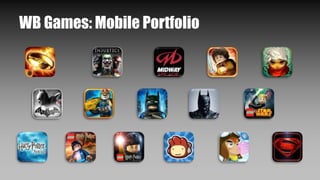
WB Games: Mobile Portfolio
Sizzle Reel
WHY DID WARNER BROS. COME TO
THIS CONFERENCE?
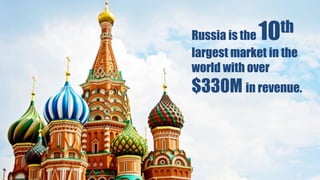
Russia is the 10th
largest market in the
world with over
$330M in revenue.
At 125%
YOY growth,
Russia is the
4th fastest
growing market
behind Korea,
China and Japan.
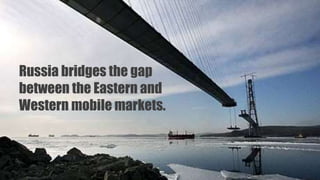
Russia bridges the gap
between the Eastern and
Western mobile markets.
HOW DO WE SEE THE MOBILE GAMES
MARKET TODAY?
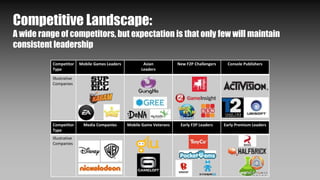
Competitor
Type
Media Companies Mobile Game Veterans Early F2P Leaders Early Premium Leaders
Illustrative
Companies
Competitive Landscape:
A wide range of competitors, but expectation is that only few will maintain
consistent leadership
Competitor
Type
Mobile Games Leaders Asian
Leaders
New F2P Challengers Console Publishers
Illustrative
Companies
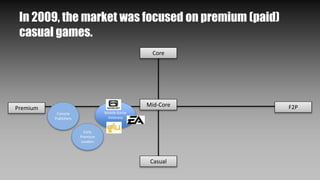
In 2009, the market was focused on premium (paid)
casual games.
Casual
Premium F2PMid-Core
Console
Publishers
Early
Premium
Leaders
Mobile Game
Veterans
Core
Casual
Premium F2PMid-Core
Console
Publishers
Early
Premium
Leaders
Mobile Game
Veterans
Core
Media
Companies
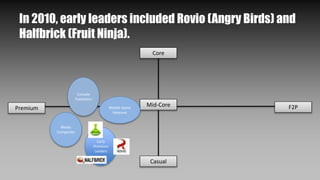
In 2010, early leaders included Rovio (Angry Birds) and
Halfbrick (Fruit Ninja).
Casual
Premium F2PMid-Core
Console
Publishers
Early
Premium
Leaders
Mobile Game
Veterans
Core
Media
Companies
Early F2P
Leaders
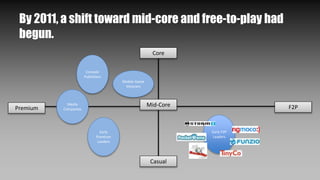
By 2011, a shift toward mid-core and free-to-play had
begun.
Casual
Premium F2PMid-Core
Console
Publishers
Early
Premium
Leaders
Mobile Game
Veterans
Core
Media
Companies
Early F2P
Leaders
New F2P
Challengers
Asian
Leaders
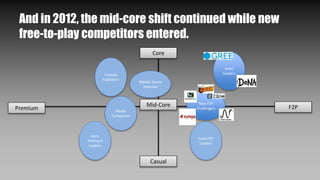
And in 2012, the mid-core shift continued while new
free-to-play competitors entered.
Casual
Premium F2PMid-Core
Console
Publishers
Early
Premium
Leaders
Mobile Game
Veterans
Core
Media
Companies
Early F2P
Leaders
New F2P
Challengers
Asian
Leaders
Mobile
Games
Leaders
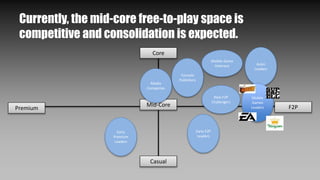
Currently, the mid-core free-to-play space is
competitive and consolidation is expected.
Core
Casual
Premium F2PMid-Core
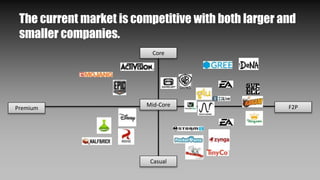
The current market is competitive with both larger and
smaller companies.
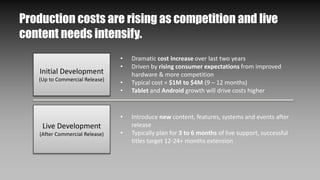
Initial Development
(Up to Commercial Release)
Live Development
(After Commercial Release)
• Dramatic cost increase over last two years
• Driven by rising consumer expectations from improved
hardware & more competition
• Typical cost = $1M to $4M (9 – 12 months)
• Tablet and Android growth will drive costs higher
• Introduce new content, features, systems and events after
release
• Typically plan for 3 to 6 months of live support, successful
titles target 12-24+ months extension
Production costs are rising as competition and live
content needs intensify.
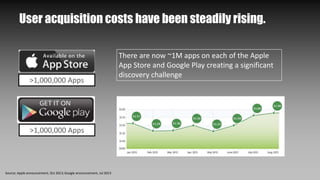
>1,000,000 Apps
>1,000,000 Apps
There are now ~1M apps on each of the Apple
App Store and Google Play creating a significant
discovery challenge
Source; Apple announcement, Oct 2013; Google announcement, Jul 2013
User acquisition costs have been steadily rising.
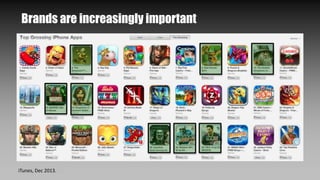
Brands are increasingly important
iTunes, Dec 2013.
Accelerate Western Development Capability
Date Target Acquirer Value
Oct 15,
2013
$3B
May 2,
2012
$210M
Oct 12,
2010
$400M
Accelerate Mobile Development Capability
Date Target Acquirer Value
Oct 1,
2012
$468M
Mar 21,
2012
$180M
Jan 31,
2014
$527M
Add Scale
Date Target Acquirer Value
Jan 15,
2013
N/A
Aug 2,
2011
N/A
Aug 2,
2011
N/A
Fortify Genre (e.g. Card Battle) Strength
Date Target Acquirer Value
Nov 7,
2012
$460M
Oct 24,
2012
$173M
Source: Digi-Capital: Global Games Investment Review 2013
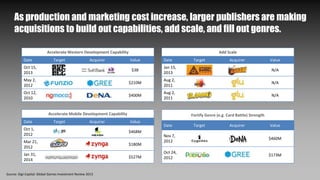
As production and marketing cost increase, larger publishers are making
acquisitions to build out capabilities, add scale, and fill out genres.
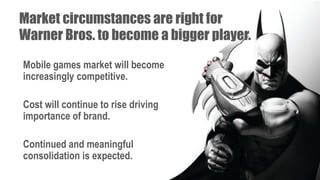
Market circumstances are right for
Warner Bros. to become a bigger player.
Mobile games market will become
increasingly competitive.
Cost will continue to rise driving
importance of brand.
Continued and meaningful
consolidation is expected.
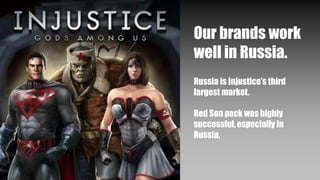
Russia is Injustice’s third
largest market.
Red Son pack was highly
successful, especially in
Russia.
Our brands work
well in Russia.
While Injustice has been
successful, there is more Warner
Bros. can do in Russia by
partnering with leading local
developers.

Greg Ballard, Warner Bros.