Indonesia after 2014:
Democratization and Social Transformation -
Can Indonesia Develop an
Innovation-led economy?
An Overview of Challenges and Opportunities
Greg Barton
Herb Feith Professor for the Study of Indonesia
Monash University
ICID, Den Haag, 13 Sept 2013
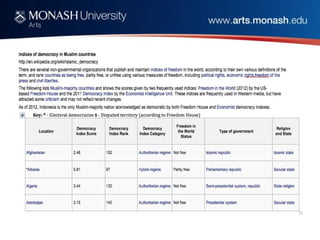
1. Democratic Transition
• Successful democratic transition
• Political and social stability
• Disillusionment with political parties and leaders
• Support for the democratic republic
• Indonesia and Turkey represent the most
successful Muslim majority nations
Indonesia: flawed but free
2. Economic takeoff
• Indonesia has returned to the economic takeoff
that was interrupted by the 1997 financial crisis
– Indonesia’s takeoff is reinforced by the rise of
Asia and the other large emerging markets
• The current level of political stability and
openness is substantially better than the 1990s
– Regime change no longer looms on the horizon
Joining the BRICs and the E7
• Indonesia is now increasingly recognized as a
key nation in the emerging second tier of rapidly
developing large nations
• joining the likes of Turkey and Mexico
• in the wake of the original BRIC group (Brazil,
Russia, India, and China) of first tier emerging
nations.
• The E7 – as Price Waterhouse Coopers refers to
this group - Brazil, Russia, India, and China +
Indonesia, Turkey and Mexico
A present reality
• This is a present reality not merely a long-term
projection.
• Over the next seven years Indonesia is on track
to overtake Spain, Canada and Italy to become
the world's 11th largest economy in 2020 (in
PPP terms)
– just behind South Korea
– Indonesia is currently ranked 15th.
2010 v 2020
Stable Growth
Stable Growth
McKinsey Global Institute – Sep 2012
A decade of stable growth
3. The E7 and the Rise of Asia
• Indonesia’s economic takeoff is linked to the
general rise of Asia
– In particular, the rise of China and India
– China and India are key because of the absolute
size of their economies
• Together with China and India, Indonesia joins
the other large emerging markets of Russia,
Brazil, Turkey, Mexico: the Emerging Seven (E7)
Asia’s rise is Indonesia’s rise
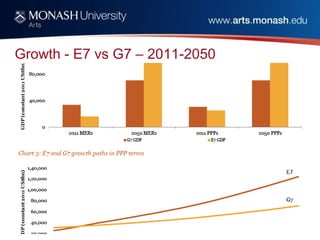
Global growth (PPP)
World Economic Expansion
Growth - E7 vs G7 – 2011-2050
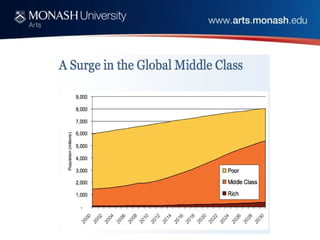
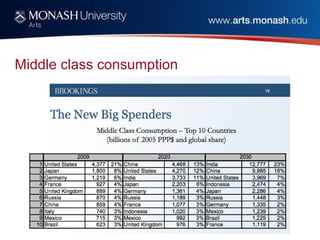
4. Era of the Middle Class
• The rapid rise of the E7 is accompanied by
sharp reductions in poverty
• Most people in Indonesia are poor but over the
next decade the majority of people will move out
of poverty
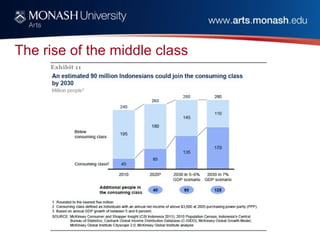
• New entrants to the ‘middle class’/’consuming
class’ will still have modest incomes
• By 2030 around 2/3 of all people in Indonesia
(135-180m out of 280m) will be middle class
• By 2030 around 2/3 of all middle class people
will be living in Asia
Asia’s rising middle class
Middle class consumption
The rise of the middle class
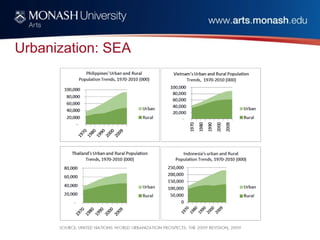
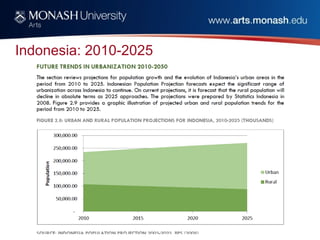
5. Urbanization
• 2013 - 53% of Indonesians live in cities
– 2030 more than 70% will live in cities
• 2013 – 74% of GDP generated in cities
– 2030 – 86% of GDP generated in cities
– Jakarta will remain constant at 20%
– but midsize cities (2-10m) will contribute 25% of
GDP in 2030
– Small cities (0.15 – 2m) contribute 31% of GDP
growing to 38% in 2030
• Indonesia (and the Philippines) are more
urbanized than the rest of Asia
E7 - Urbanisation
The rise of the cities
Urbanization: China, India
Urbanization: SEA
Indonesia: 2010-2025
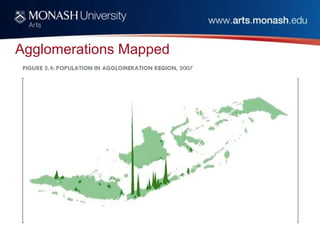
Agglomerations Mapped
Economic Density
Agglomerations: Java, Sumatra
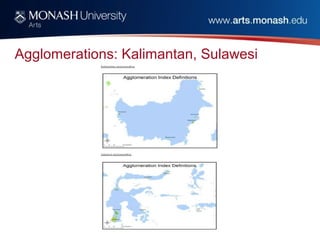
Agglomerations: Kalimantan, Sulawesi
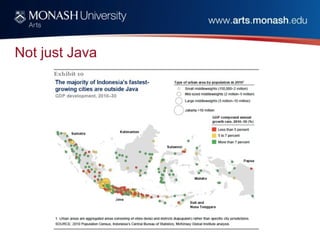
Not just Java
6. Labour Force
• Indonesia has a population of 252 million growing
at 0.99% per annum
– By 2030 Indonesia’s population will plateau at 280
– By 2030 the work force will grow by 40m
• Indonesia has a relatively youthful population
with a median age of 28.9 years
– 60% are 30 years or young
– Only 7.6% of the population is 65 years or older
• Indonesian wages are substantially lower than
wages in China
Growth in Wages – China - Indonesia
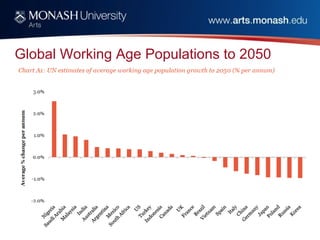
Global Working Age Populations to 2050
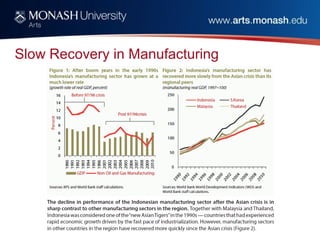
7. Manufacturing
• Manufacturing plummeted after the 97/98 crisis
• Manufacturing growth remains stunted
• There are signs of growth, including outside Java
– particularly in new areas
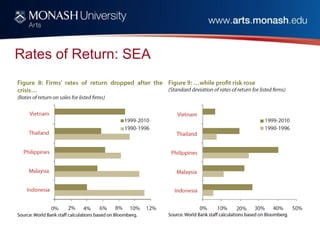
• Rates of return remain low and profit risk high
• Indonesia is missing middle-sized firms
• Indonesia has great potential that remains
partially unrealized
Slow Recovery in Manufacturing
New Manufacturers
Growth Outside Java
Rates of Return: SEA
Manufacturing: The Missing Middle
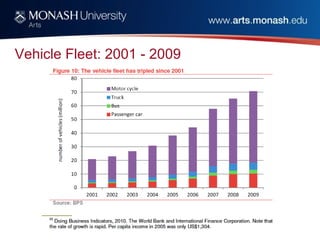
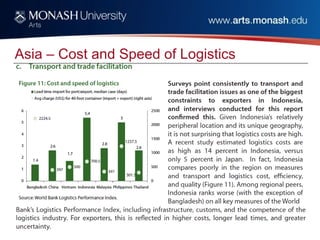
8. Infrastructure and FDI
• Whilst Indonesia’s economic performance has
been impressive growth is still lower than it
could and should be
• Foreign Direct Invest stopped for a decade after
the 97/98 Economic Crisis – it remains too low
• Investment is held back by lack of ease in doing
business
• Growth continues to held back by poor
infrastructure – particularly logistics & transport
• Internet use remains below par
E7 – Ease of Doing Business
Emerging 7 – FDI - 2002-2011
Asia: road density
Vehicle Fleet: 2001 - 2009
Asia – Cost and Speed of Logistics
SEA: travel times and expressways
Central government expenditure on roads
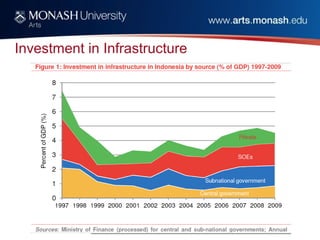
Infrastructure investment
Investment in Infrastructure
Asia compared: infrastructure
Highway Quality
SEA – Internet Usage
Global Social Network Usage
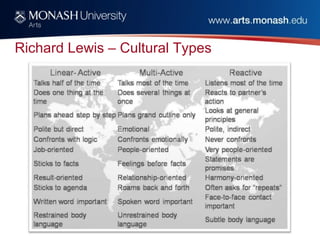
9. Culture
- Culture strongly influences thought and behaviour
- Education – formal and informal – shapes the
expression and influence of culture
- Indonesian culture is both plural and distinctive
- Optimizing innovation requires attention to culture
and education
Richard Lewis – Cultural Types
Richard Lewis
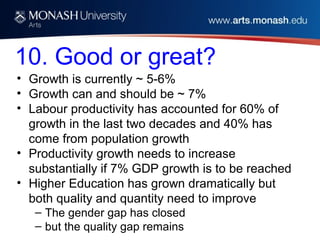
10. Good or great?
• Growth is currently ~ 5-6%
• Growth can and should be ~ 7%
• Labour productivity has accounted for 60% of
growth in the last two decades and 40% has
come from population growth
• Productivity growth needs to increase
substantially if 7% GDP growth is to be reached
• Higher Education has grown dramatically but
both quality and quantity need to improve
– The gender gap has closed
– but the quality gap remains
Higher Education Enrollments: 1970-99
Higher Ed – Closing Gender Gap – 93-05
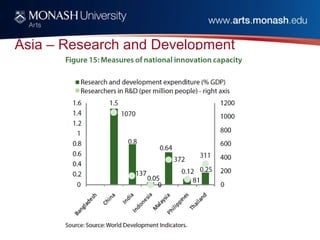
Asia – Research and Development
Conclusion
• Indonesia’s political and social stability represents a
great asset and must be safeguarded
• Growth stable but damage from 97/98 crisis remains
• Indonesia is part of the E7 – for better or worse
• Growth of the middle class is key
• Urbanization presents challenges and opportunities
• Demographics present a limited window of opportunity
• Manufacturing needs to innovate and grow
• Infrastructure needs massive investment
• The development of human capital is the key to going
from good to great

Indonesia After 2014 by Greg Barton

  • 1.
    Indonesia after 2014: Democratizationand Social Transformation - Can Indonesia Develop an Innovation-led economy? An Overview of Challenges and Opportunities Greg Barton Herb Feith Professor for the Study of Indonesia Monash University ICID, Den Haag, 13 Sept 2013
  • 2.
    1. Democratic Transition •Successful democratic transition • Political and social stability • Disillusionment with political parties and leaders • Support for the democratic republic • Indonesia and Turkey represent the most successful Muslim majority nations
  • 7.
  • 10.
    2. Economic takeoff •Indonesia has returned to the economic takeoff that was interrupted by the 1997 financial crisis – Indonesia’s takeoff is reinforced by the rise of Asia and the other large emerging markets • The current level of political stability and openness is substantially better than the 1990s – Regime change no longer looms on the horizon
  • 11.
    Joining the BRICsand the E7 • Indonesia is now increasingly recognized as a key nation in the emerging second tier of rapidly developing large nations • joining the likes of Turkey and Mexico • in the wake of the original BRIC group (Brazil, Russia, India, and China) of first tier emerging nations. • The E7 – as Price Waterhouse Coopers refers to this group - Brazil, Russia, India, and China + Indonesia, Turkey and Mexico
  • 12.
    A present reality •This is a present reality not merely a long-term projection. • Over the next seven years Indonesia is on track to overtake Spain, Canada and Italy to become the world's 11th largest economy in 2020 (in PPP terms) – just behind South Korea – Indonesia is currently ranked 15th.
  • 13.
  • 14.
  • 15.
  • 16.
  • 19.
    A decade ofstable growth
  • 20.
    3. The E7and the Rise of Asia • Indonesia’s economic takeoff is linked to the general rise of Asia – In particular, the rise of China and India – China and India are key because of the absolute size of their economies • Together with China and India, Indonesia joins the other large emerging markets of Russia, Brazil, Turkey, Mexico: the Emerging Seven (E7)
  • 21.
    Asia’s rise isIndonesia’s rise
  • 22.
  • 23.
  • 24.
    Growth - E7vs G7 – 2011-2050
  • 26.
    4. Era ofthe Middle Class • The rapid rise of the E7 is accompanied by sharp reductions in poverty • Most people in Indonesia are poor but over the next decade the majority of people will move out of poverty • New entrants to the ‘middle class’/’consuming class’ will still have modest incomes • By 2030 around 2/3 of all people in Indonesia (135-180m out of 280m) will be middle class • By 2030 around 2/3 of all middle class people will be living in Asia
  • 28.
  • 29.
  • 30.
    The rise ofthe middle class
  • 31.
    5. Urbanization • 2013- 53% of Indonesians live in cities – 2030 more than 70% will live in cities • 2013 – 74% of GDP generated in cities – 2030 – 86% of GDP generated in cities – Jakarta will remain constant at 20% – but midsize cities (2-10m) will contribute 25% of GDP in 2030 – Small cities (0.15 – 2m) contribute 31% of GDP growing to 38% in 2030 • Indonesia (and the Philippines) are more urbanized than the rest of Asia
  • 32.
  • 33.
    The rise ofthe cities
  • 34.
  • 35.
  • 36.
  • 37.
  • 38.
  • 39.
  • 40.
  • 41.
  • 42.
    6. Labour Force •Indonesia has a population of 252 million growing at 0.99% per annum – By 2030 Indonesia’s population will plateau at 280 – By 2030 the work force will grow by 40m • Indonesia has a relatively youthful population with a median age of 28.9 years – 60% are 30 years or young – Only 7.6% of the population is 65 years or older • Indonesian wages are substantially lower than wages in China
  • 43.
    Growth in Wages– China - Indonesia
  • 44.
    Global Working AgePopulations to 2050
  • 45.
    7. Manufacturing • Manufacturingplummeted after the 97/98 crisis • Manufacturing growth remains stunted • There are signs of growth, including outside Java – particularly in new areas • Rates of return remain low and profit risk high • Indonesia is missing middle-sized firms • Indonesia has great potential that remains partially unrealized
  • 46.
    Slow Recovery inManufacturing
  • 47.
  • 48.
  • 49.
  • 50.
  • 51.
    8. Infrastructure andFDI • Whilst Indonesia’s economic performance has been impressive growth is still lower than it could and should be • Foreign Direct Invest stopped for a decade after the 97/98 Economic Crisis – it remains too low • Investment is held back by lack of ease in doing business • Growth continues to held back by poor infrastructure – particularly logistics & transport • Internet use remains below par
  • 52.
    E7 – Easeof Doing Business
  • 53.
    Emerging 7 –FDI - 2002-2011
  • 54.
  • 55.
  • 56.
    Asia – Costand Speed of Logistics
  • 57.
    SEA: travel timesand expressways
  • 58.
  • 59.
  • 60.
  • 61.
  • 62.
  • 63.
  • 64.
  • 65.
    9. Culture - Culturestrongly influences thought and behaviour - Education – formal and informal – shapes the expression and influence of culture - Indonesian culture is both plural and distinctive - Optimizing innovation requires attention to culture and education
  • 66.
    Richard Lewis –Cultural Types
  • 67.
    Richard Lewis –Cultural Types
  • 68.
  • 69.
    10. Good orgreat? • Growth is currently ~ 5-6% • Growth can and should be ~ 7% • Labour productivity has accounted for 60% of growth in the last two decades and 40% has come from population growth • Productivity growth needs to increase substantially if 7% GDP growth is to be reached • Higher Education has grown dramatically but both quality and quantity need to improve – The gender gap has closed – but the quality gap remains
  • 71.
  • 72.
    Higher Ed –Closing Gender Gap – 93-05
  • 73.
    Asia – Researchand Development
  • 74.
    Conclusion • Indonesia’s politicaland social stability represents a great asset and must be safeguarded • Growth stable but damage from 97/98 crisis remains • Indonesia is part of the E7 – for better or worse • Growth of the middle class is key • Urbanization presents challenges and opportunities • Demographics present a limited window of opportunity • Manufacturing needs to innovate and grow • Infrastructure needs massive investment • The development of human capital is the key to going from good to great