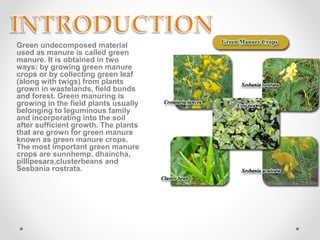
Green undecomposed material
used as manure is called green
manure. It is obtained in two
ways: by growing green manure
crops or by collecting green leaf
(along with twigs) from plants
grown in wastelands, field bunds
and forest. Green manuring is
growing in the field plants usually
belonging to leguminous family
and incorporating into the soil
after sufficient growth. The plants
that are grown for green manure
known as green manure crops.
The most important green manure
crops are sunnhemp, dhaincha,
pillipesara,clusterbeans and
Sesbania rostrata.
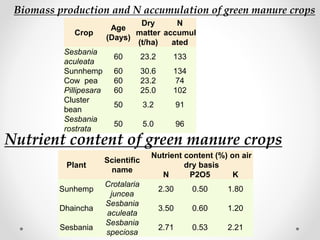
Crop
Age
(Days)
Dry
matter
(t/ha)
N
accumul
ated
Sesbania
aculeata
60 23.2 133
Sunnhemp 60 30.6 134
Cow pea 60 23.2 74
Pillipesara 60 25.0 102
Cluster
bean
50 3.2 91
Sesbania
rostrata
50 5.0 96
Plant
Scientific
name
Nutrient content (%) on air
dry basis
N P2O5 K
Sunhemp
Crotalaria
juncea
2.30 0.50 1.80
Dhaincha
Sesbania
aculeata
3.50 0.60 1.20
Sesbania
Sesbania
speciosa
2.71 0.53 2.21
Biomass production and N accumulation of green manure crops
Nutrient content of green manure crops
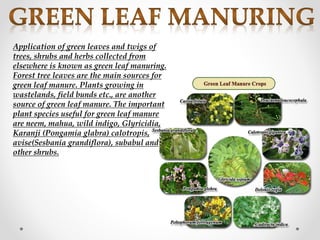
Application of green leaves and twigs of
trees, shrubs and herbs collected from
elsewhere is known as green leaf manuring.
Forest tree leaves are the main sources for
green leaf manure. Plants growing in
wastelands, field bunds etc., are another
source of green leaf manure. The important
plant species useful for green leaf manure
are neem, mahua, wild indigo, Glyricidia,
Karanji (Pongamia glabra) calotropis,
avise(Sesbania grandiflora), subabul and
other shrubs.
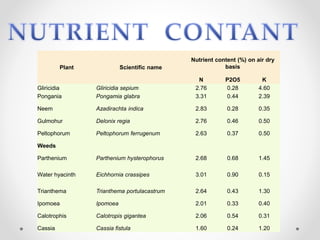
Plant Scientific name
Nutrient content (%) on air dry
basis
N P2O5 K
Gliricidia Gliricidia sepium 2.76 0.28 4.60
Pongania Pongamia glabra 3.31 0.44 2.39
Neem Azadirachta indica 2.83 0.28 0.35
Gulmohur Delonix regia 2.76 0.46 0.50
Peltophorum Peltophorum ferrugenum 2.63 0.37 0.50
Weeds
Parthenium Parthenium hysterophorus 2.68 0.68 1.45
Water hyacinth Eichhornia crassipes 3.01 0.90 0.15
Trianthema Trianthema portulacastrum 2.64 0.43 1.30
Ipomoea Ipomoea 2.01 0.33 0.40
Calotrophis Calotropis gigantea 2.06 0.54 0.31
Cassia Cassia fistula 1.60 0.24 1.20
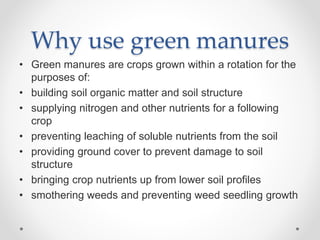
Why use green manures
• Green manures are crops grown within a rotation for the
purposes of:
• building soil organic matter and soil structure
• supplying nitrogen and other nutrients for a following
crop
• preventing leaching of soluble nutrients from the soil
• providing ground cover to prevent damage to soil
structure
• bringing crop nutrients up from lower soil profiles
• smothering weeds and preventing weed seedling growth
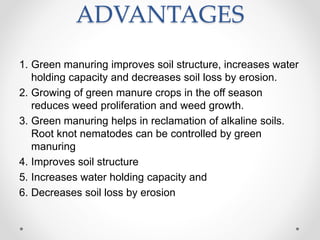
ADVANTAGES
1. Green manuring improves soil structure, increases water
holding capacity and decreases soil loss by erosion.
2. Growing of green manure crops in the off season
reduces weed proliferation and weed growth.
3. Green manuring helps in reclamation of alkaline soils.
Root knot nematodes can be controlled by green
manuring
4. Improves soil structure
5. Increases water holding capacity and
6. Decreases soil loss by erosion

Green manuring

  • 2.
    Green undecomposed material usedas manure is called green manure. It is obtained in two ways: by growing green manure crops or by collecting green leaf (along with twigs) from plants grown in wastelands, field bunds and forest. Green manuring is growing in the field plants usually belonging to leguminous family and incorporating into the soil after sufficient growth. The plants that are grown for green manure known as green manure crops. The most important green manure crops are sunnhemp, dhaincha, pillipesara,clusterbeans and Sesbania rostrata.
  • 3.
    Crop Age (Days) Dry matter (t/ha) N accumul ated Sesbania aculeata 60 23.2 133 Sunnhemp60 30.6 134 Cow pea 60 23.2 74 Pillipesara 60 25.0 102 Cluster bean 50 3.2 91 Sesbania rostrata 50 5.0 96 Plant Scientific name Nutrient content (%) on air dry basis N P2O5 K Sunhemp Crotalaria juncea 2.30 0.50 1.80 Dhaincha Sesbania aculeata 3.50 0.60 1.20 Sesbania Sesbania speciosa 2.71 0.53 2.21 Biomass production and N accumulation of green manure crops Nutrient content of green manure crops
  • 4.
    Application of greenleaves and twigs of trees, shrubs and herbs collected from elsewhere is known as green leaf manuring. Forest tree leaves are the main sources for green leaf manure. Plants growing in wastelands, field bunds etc., are another source of green leaf manure. The important plant species useful for green leaf manure are neem, mahua, wild indigo, Glyricidia, Karanji (Pongamia glabra) calotropis, avise(Sesbania grandiflora), subabul and other shrubs.
  • 5.
    Plant Scientific name Nutrientcontent (%) on air dry basis N P2O5 K Gliricidia Gliricidia sepium 2.76 0.28 4.60 Pongania Pongamia glabra 3.31 0.44 2.39 Neem Azadirachta indica 2.83 0.28 0.35 Gulmohur Delonix regia 2.76 0.46 0.50 Peltophorum Peltophorum ferrugenum 2.63 0.37 0.50 Weeds Parthenium Parthenium hysterophorus 2.68 0.68 1.45 Water hyacinth Eichhornia crassipes 3.01 0.90 0.15 Trianthema Trianthema portulacastrum 2.64 0.43 1.30 Ipomoea Ipomoea 2.01 0.33 0.40 Calotrophis Calotropis gigantea 2.06 0.54 0.31 Cassia Cassia fistula 1.60 0.24 1.20
  • 6.
    Why use greenmanures • Green manures are crops grown within a rotation for the purposes of: • building soil organic matter and soil structure • supplying nitrogen and other nutrients for a following crop • preventing leaching of soluble nutrients from the soil • providing ground cover to prevent damage to soil structure • bringing crop nutrients up from lower soil profiles • smothering weeds and preventing weed seedling growth
  • 7.
    ADVANTAGES 1. Green manuringimproves soil structure, increases water holding capacity and decreases soil loss by erosion. 2. Growing of green manure crops in the off season reduces weed proliferation and weed growth. 3. Green manuring helps in reclamation of alkaline soils. Root knot nematodes can be controlled by green manuring 4. Improves soil structure 5. Increases water holding capacity and 6. Decreases soil loss by erosion