Srujan Research and Planning Foundation
Urban Design I Urban Planning I Regional Planning I Environmental
Planning I Township Planning I Green Building Certification and EIA
Green Campus
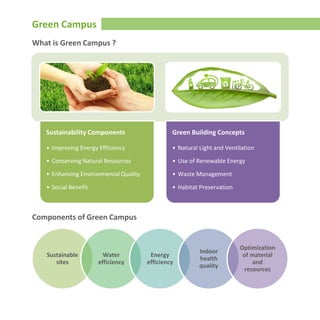
Green Campus
Sustainability Components
• Improving Energy Efficiency
• Conserving Natural Resources
• Enhancing Environmental Quality
• Social Benefit
Green Building Concepts
• Natural Light and Ventilation
• Use of Renewable Energy
• Waste Management
• Habitat Preservation
Sustainable
sites
Water
efficiency
Energy
efficiency
Indoor
health
quality
Optimization
of material
and
resources
What is Green Campus ?
Components of Green Campus
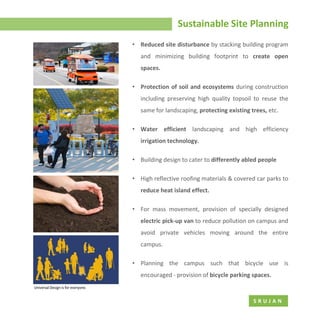
Sustainable Site Planning
S R U J A N
• Reduced site disturbance by stacking building program
and minimizing building footprint to create open
spaces.
• Protection of soil and ecosystems during construction
including preserving high quality topsoil to reuse the
same for landscaping, protecting existing trees, etc.
• Water efficient landscaping and high efficiency
irrigation technology.
• Building design to cater to differently abled people
• High reflective roofing materials & covered car parks to
reduce heat island effect.
• For mass movement, provision of specially designed
electric pick-up van to reduce pollution on campus and
avoid private vehicles moving around the entire
campus.
• Planning the campus such that bicycle use is
encouraged - provision of bicycle parking spaces.
Aspects of planning Green Campus
Preservation of Greenery:
To minimize disturbance to existing vegetation,
so as to reduce long-term environmental
impacts.
1
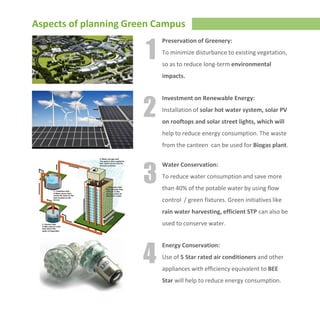
Investment on Renewable Energy:
Installation of solar hot water system, solar PV
on rooftops and solar street lights, which will
help to reduce energy consumption. The waste
from the canteen can be used for Biogas plant.
2
Water Conservation:
To reduce water consumption and save more
than 40% of the potable water by using flow
control / green fixtures. Green initiatives like
rain water harvesting, efficient STP can also be
used to conserve water.
3
Energy Conservation:
Use of 5 Star rated air conditioners and other
appliances with efficiency equivalent to BEE
Star will help to reduce energy consumption.
4
Aspects of planning Green Campus
S R U J A N
Waste water treatment plant can be used to
produce recycled water, which can be used for
flushing and landscaping purposes.
5
Natural Light and Ventilation:
In the pre-design stage, orientation of the
building based on wind flow, sun movement can
help the building to perform better naturally.
7
Eco-friendly products:
Use of eco-friendly interior materials to reduce
adverse health impacts for building occupants.
8
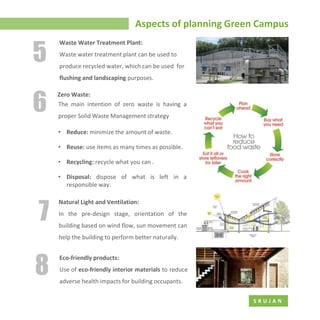
6 The main intention of zero waste is having a
proper Solid Waste Management strategy
• Reduce: minimize the amount of waste.
• Reuse: use items as many times as possible.
• Recycling: recycle what you can .
• Disposal: dispose of what is left in a
responsible way.
Zero Waste:
Waste Water Treatment Plant:
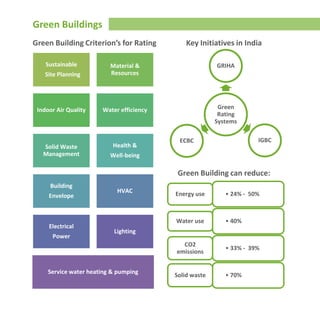
Green Buildings
Sustainable
Site Planning
Material &
Resources
Indoor Air Quality Water efficiency
Solid Waste
Management
Health &
Well-being
Building
Envelope
HVAC
Electrical
Power
Lighting
Service water heating & pumping
Green
Rating
Systems
GRIHA
IGBCECBC
• 24% - 50%Energy use
• 40%Water use
• 33% - 39%
CO2
emissions
• 70%Solid waste
Green Building Criterion’s for Rating
Green Building can reduce:
Key Initiatives in India
S R U J A N
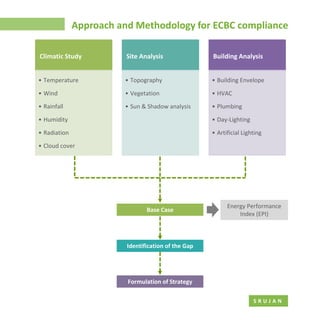
Approach and Methodology for ECBC compliance
Climatic Study
• Temperature
• Wind
• Rainfall
• Humidity
• Radiation
• Cloud cover
Site Analysis
• Topography
• Vegetation
• Sun & Shadow analysis
Building Analysis
• Building Envelope
• HVAC
• Plumbing
• Day-Lighting
• Artificial Lighting
Base Case
Identification of the Gap
Formulation of Strategy
Energy Performance
Index (EPI)
Srujan Research and Planning Foundation
CIN: U74900PN2015NPL155355
Corporate Office: ‘Pushkaraj, 9 Shri Gokul Society,
Near Mhatre Bridge, Navi Peth, Pune- 411 030
Tel: 91-20-65333394
Registered Office: Sharada Center, 11/1 Erandawane,
Off Karve Road, Pune- 411 004
Tel: 91-20-25450157
Web: www.srujanfoundation.com Email: marketing@srujanfoundation.com

Green campus indicators

  • 1.
    Srujan Research andPlanning Foundation Urban Design I Urban Planning I Regional Planning I Environmental Planning I Township Planning I Green Building Certification and EIA Green Campus
  • 2.
    Green Campus Sustainability Components •Improving Energy Efficiency • Conserving Natural Resources • Enhancing Environmental Quality • Social Benefit Green Building Concepts • Natural Light and Ventilation • Use of Renewable Energy • Waste Management • Habitat Preservation Sustainable sites Water efficiency Energy efficiency Indoor health quality Optimization of material and resources What is Green Campus ? Components of Green Campus
  • 3.
    Sustainable Site Planning SR U J A N • Reduced site disturbance by stacking building program and minimizing building footprint to create open spaces. • Protection of soil and ecosystems during construction including preserving high quality topsoil to reuse the same for landscaping, protecting existing trees, etc. • Water efficient landscaping and high efficiency irrigation technology. • Building design to cater to differently abled people • High reflective roofing materials & covered car parks to reduce heat island effect. • For mass movement, provision of specially designed electric pick-up van to reduce pollution on campus and avoid private vehicles moving around the entire campus. • Planning the campus such that bicycle use is encouraged - provision of bicycle parking spaces.
  • 4.
    Aspects of planningGreen Campus Preservation of Greenery: To minimize disturbance to existing vegetation, so as to reduce long-term environmental impacts. 1 Investment on Renewable Energy: Installation of solar hot water system, solar PV on rooftops and solar street lights, which will help to reduce energy consumption. The waste from the canteen can be used for Biogas plant. 2 Water Conservation: To reduce water consumption and save more than 40% of the potable water by using flow control / green fixtures. Green initiatives like rain water harvesting, efficient STP can also be used to conserve water. 3 Energy Conservation: Use of 5 Star rated air conditioners and other appliances with efficiency equivalent to BEE Star will help to reduce energy consumption. 4
  • 5.
    Aspects of planningGreen Campus S R U J A N Waste water treatment plant can be used to produce recycled water, which can be used for flushing and landscaping purposes. 5 Natural Light and Ventilation: In the pre-design stage, orientation of the building based on wind flow, sun movement can help the building to perform better naturally. 7 Eco-friendly products: Use of eco-friendly interior materials to reduce adverse health impacts for building occupants. 8 6 The main intention of zero waste is having a proper Solid Waste Management strategy • Reduce: minimize the amount of waste. • Reuse: use items as many times as possible. • Recycling: recycle what you can . • Disposal: dispose of what is left in a responsible way. Zero Waste: Waste Water Treatment Plant:
  • 6.
    Green Buildings Sustainable Site Planning Material& Resources Indoor Air Quality Water efficiency Solid Waste Management Health & Well-being Building Envelope HVAC Electrical Power Lighting Service water heating & pumping Green Rating Systems GRIHA IGBCECBC • 24% - 50%Energy use • 40%Water use • 33% - 39% CO2 emissions • 70%Solid waste Green Building Criterion’s for Rating Green Building can reduce: Key Initiatives in India
  • 7.
    S R UJ A N Approach and Methodology for ECBC compliance Climatic Study • Temperature • Wind • Rainfall • Humidity • Radiation • Cloud cover Site Analysis • Topography • Vegetation • Sun & Shadow analysis Building Analysis • Building Envelope • HVAC • Plumbing • Day-Lighting • Artificial Lighting Base Case Identification of the Gap Formulation of Strategy Energy Performance Index (EPI)
  • 8.
    Srujan Research andPlanning Foundation CIN: U74900PN2015NPL155355 Corporate Office: ‘Pushkaraj, 9 Shri Gokul Society, Near Mhatre Bridge, Navi Peth, Pune- 411 030 Tel: 91-20-65333394 Registered Office: Sharada Center, 11/1 Erandawane, Off Karve Road, Pune- 411 004 Tel: 91-20-25450157 Web: www.srujanfoundation.com Email: marketing@srujanfoundation.com