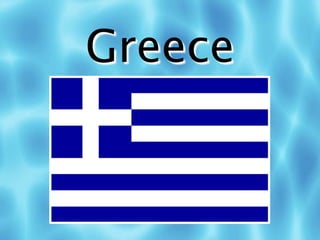
Greece
Place
Place
Place
Place
 The Greek mainland is on the southern tip of

 the (1) BALKAN PENINSULA.
Place
 The Greek mainland is on the southern tip of

 the (1) BALKAN PENINSULA.
 It is bordered by the (2) AEGEAN SEA in the

 east and the Ionian Sea in the west.
Place
 The Greek mainland is on the southern tip of

 the (1) BALKAN PENINSULA.
 It is bordered by the (2) AEGEAN SEA in the

 east and the Ionian Sea in the west.
 There are (3) 2,000 islands around the

 mainland; only about 170 are inhabited.
Place
 The Greek mainland is on the southern tip of

 the (1) BALKAN PENINSULA.
 It is bordered by the (2) AEGEAN SEA in the

 east and the Ionian Sea in the west.
 There are (3) 2,000 islands around the

 mainland; only about 170 are inhabited.
 The largest island is (4) CRETE.
Ancient History
Ancient History
 Ancient Greece, or Classical Europe,
 flourished from 800-400 BC.
Ancient History
 Ancient Greece, or Classical Europe,
 flourished from 800-400 BC.
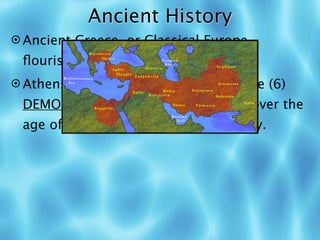
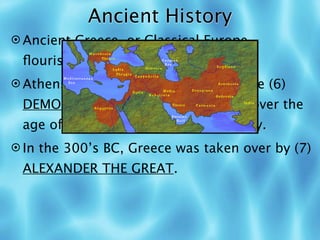
 Athens was a (5) POLIS and it is where (6)
 DEMOCRACY started: all free males over the
 age of 20 could vote and speak freely.
Ancient History
 Ancient Greece, or Classical Europe,
 flourished from 800-400 BC.
 Athens was a (5) POLIS and it is where (6)
 DEMOCRACY started: all free males over the
 age of 20 could vote and speak freely.
Ancient History
 Ancient Greece, or Classical Europe,
 flourished from 800-400 BC.
 Athens was a (5) POLIS and it is where (6)
 DEMOCRACY started: all free males over the
 age of 20 could vote and speak freely.
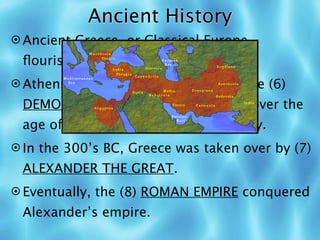
 In the 300’s BC, Greece was taken over by (7)
 ALEXANDER THE GREAT.
Ancient History
 Ancient Greece, or Classical Europe,
 flourished from 800-400 BC.
 Athens was a (5) POLIS and it is where (6)
 DEMOCRACY started: all free males over the
 age of 20 could vote and speak freely.
 In the 300’s BC, Greece was taken over by (7)
 ALEXANDER THE GREAT.
 Eventually, the (8) ROMAN EMPIRE conquered
 Alexander’s empire.
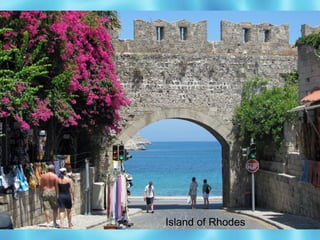
Island of Rhodes
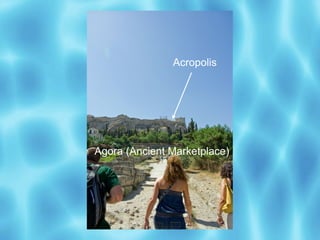
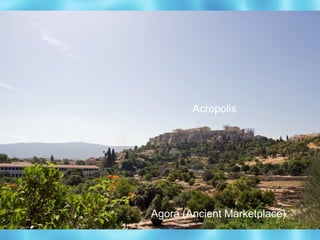
Acropolis


Agora (Ancient Marketplace)
Acropolis


Agora (Ancient Marketplace)
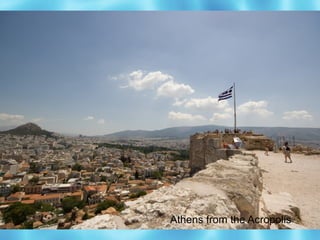
Athens from the Acropolis
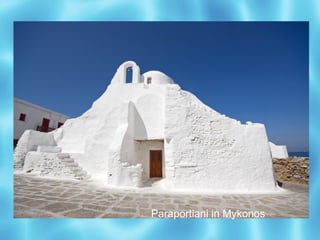
Paraportiani in Mykonos
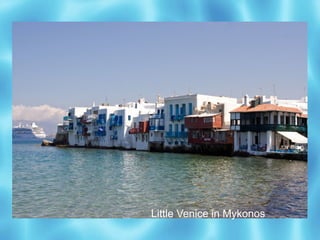
Little Venice in Mykonos
Land
Land
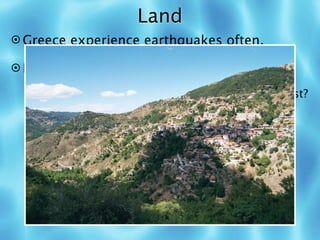
 Greece experience earthquakes often.
Land
 Greece experience earthquakes often.

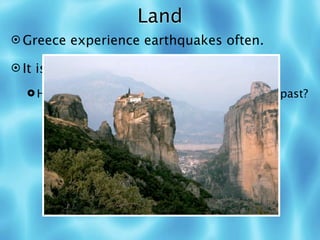
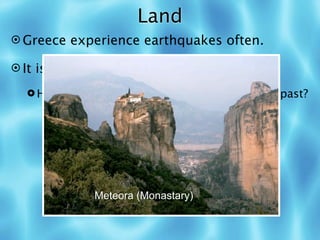
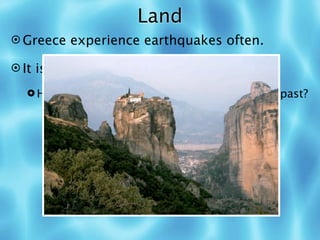
 It is very (9) MOUNTAINOUS.
Land
 Greece experience earthquakes often.

 It is very (9) MOUNTAINOUS.

   How did this impact how people lived in the past?
Land
 Greece experience earthquakes often.

 It is very (9) MOUNTAINOUS.

   How did this impact how people lived in the past?
Land
 Greece experience earthquakes often.

 It is very (9) MOUNTAINOUS.

   How did this impact how people lived in the past?
Land
 Greece experience earthquakes often.

 It is very (9) MOUNTAINOUS.

   How did this impact how people lived in the past?
Land
 Greece experience earthquakes often.

 It is very (9) MOUNTAINOUS.

   How did this impact how people lived in the past?


              Meteora (Monastary)
Land
 Greece experience earthquakes often.

 It is very (9) MOUNTAINOUS.

   How did this impact how people lived in the past?
Land
 Greece experience earthquakes often.

 It is very (9) MOUNTAINOUS.

   How did this impact how people lived in the past?
Land
 Greece experience earthquakes often.

 It is very (9) MOUNTAINOUS.

   How did this impact how people lived in the past?

 It has poor, stony soil.
Land
 Greece experience earthquakes often.

 It is very (9) MOUNTAINOUS.

   How did this impact how people lived in the past?

 It has poor, stony soil.

 No part of Greece is further than (10) 85

  miles from the sea.
Land
 Greece experience earthquakes often.

 It is very (9) MOUNTAINOUS.

   How did this impact how people lived in the past?

 It has poor, stony soil.

 No part of Greece is further than (10) 85

  miles from the sea.
   What does this mean for the economy?
Economy
Economy
 Greece belongs to the (11) EUROPEAN
 UNION.
Economy
 Greece belongs to the (11) EUROPEAN
  UNION.
 Greece is one of the least (12)
  INDUSTRIALIZED countries in Europe.
Economy
 Greece belongs to the (11) EUROPEAN
  UNION.
 Greece is one of the least (12)
  INDUSTRIALIZED countries in Europe.
 People in the highlands must (13) GRAZE
  sheep and goats.
Economy
 Greece belongs to the (11) EUROPEAN
  UNION.
 Greece is one of the least (12)
  INDUSTRIALIZED countries in Europe.
 People in the highlands must (13) GRAZE
  sheep and goats.
 They import food, fuels, and manufactured
  goods.
Economy
 Greece belongs to the (11) EUROPEAN
  UNION.
 Greece is one of the least (12)
  INDUSTRIALIZED countries in Europe.
 People in the highlands must (13) GRAZE
  sheep and goats.
 They import food, fuels, and manufactured
  goods.
Economy
 Greece belongs to the (11) EUROPEAN
  UNION.
 Greece is one of the least (12)
  INDUSTRIALIZED countries in Europe.
 People in the highlands must (13) GRAZE
  sheep and goats.
 They import food, fuels, and manufactured
  goods.
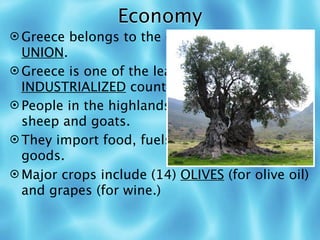
 Major crops include (14) OLIVES (for olive oil)
  and grapes (for wine.)
Economy
 Greece belongs to the (11) EUROPEAN
  UNION.
 Greece is one of the least (12)
  INDUSTRIALIZED countries in Europe.
 People in the highlands must (13) GRAZE
  sheep and goats.
 They import food, fuels, and manufactured
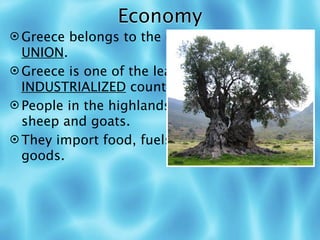
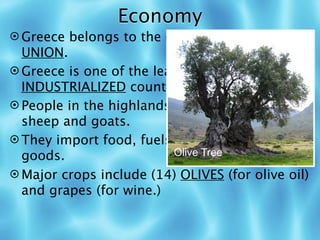
  goods.                  Olive Tree

 Major crops include (14) OLIVES (for olive oil)
  and grapes (for wine.)
Economy
 Greece belongs to the (11) EUROPEAN
  UNION.
 Greece is one of the least (12)
  INDUSTRIALIZED countries in Europe.
 People in the highlands must (13) GRAZE
  sheep and goats.
 They import food, fuels, and manufactured
  goods.                  Olive Tree

 Major crops include (14) OLIVES (for olive oil)
  and grapes (for wine.)
Economy
 Greece belongs to the (11) EUROPEAN
  UNION.
 Greece is one of the least (12)
  INDUSTRIALIZED countries in Europe.
 People in the highlands must (13) GRAZE
  sheep and goats.
 They import food, fuels, and manufactured
  goods.                  Olive Tree

 Major crops include (14) OLIVES (for olive oil)
  and grapes (for wine.)
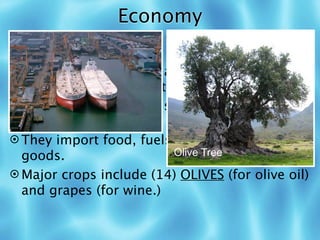
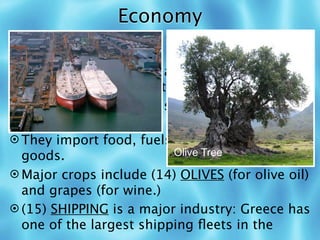
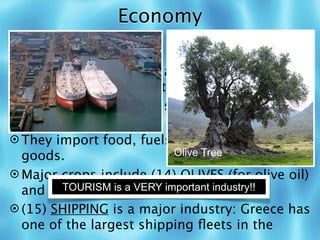
 (15) SHIPPING is a major industry: Greece has
  one of the largest shipping fleets in the
Economy
 Greece belongs to the (11) EUROPEAN
  UNION.
 Greece is one of the least (12)
  INDUSTRIALIZED countries in Europe.
 People in the highlands must (13) GRAZE
  sheep and goats.
 They import food, fuels, and manufactured
  goods.                   Olive Tree

 Major crops include (14) OLIVES (for olive oil)
  and grapes (for wine.) important industry!!
        TOURISM is a VERY

 (15) SHIPPING is a major industry: Greece has
  one of the largest shipping fleets in the
Government
Government
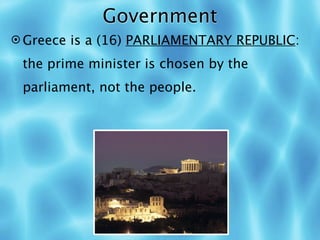
 Greece is a (16) PARLIAMENTARY REPUBLIC:

 the prime minister is chosen by the
 parliament, not the people.
Government
 Greece is a (16) PARLIAMENTARY REPUBLIC:

 the prime minister is chosen by the
 parliament, not the people.
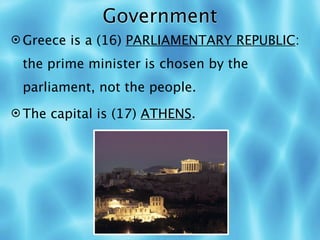
 The capital is (17) ATHENS.
People
People
 More than (18) 95% of people are Greek

 Orthodox. Easter is their most important
 holiday.
People
 More than (18) 95% of people are Greek

 Orthodox. Easter is their most important
 holiday.
 About (19) 60% of people live in urban areas.
People
 More than (18) 95% of people are Greek

 Orthodox. Easter is their most important
 holiday.
 About (19) 60% of people live in urban areas.
 There are about (20) 11 million people in

 Greece.
People
 More than (18) 95% of people are Greek

 Orthodox. Easter is their most important
 holiday.
 About (19) 60% of people live in urban areas.
 There are about (20) 11 million people in

 Greece.
 Traditional foods include lamb, fish, feta

 cheese, and olives.

Greece

  • 1.
  • 2.
  • 3.
  • 4.
  • 5.
    Place  The Greekmainland is on the southern tip of the (1) BALKAN PENINSULA.
  • 6.
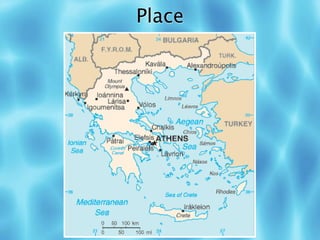
    Place  The Greekmainland is on the southern tip of the (1) BALKAN PENINSULA.  It is bordered by the (2) AEGEAN SEA in the east and the Ionian Sea in the west.
  • 7.
    Place  The Greekmainland is on the southern tip of the (1) BALKAN PENINSULA.  It is bordered by the (2) AEGEAN SEA in the east and the Ionian Sea in the west.  There are (3) 2,000 islands around the mainland; only about 170 are inhabited.
  • 8.
    Place  The Greekmainland is on the southern tip of the (1) BALKAN PENINSULA.  It is bordered by the (2) AEGEAN SEA in the east and the Ionian Sea in the west.  There are (3) 2,000 islands around the mainland; only about 170 are inhabited.  The largest island is (4) CRETE.
  • 9.
  • 10.
    Ancient History  AncientGreece, or Classical Europe, flourished from 800-400 BC.
  • 11.
    Ancient History  AncientGreece, or Classical Europe, flourished from 800-400 BC.  Athens was a (5) POLIS and it is where (6) DEMOCRACY started: all free males over the age of 20 could vote and speak freely.
  • 12.
    Ancient History  AncientGreece, or Classical Europe, flourished from 800-400 BC.  Athens was a (5) POLIS and it is where (6) DEMOCRACY started: all free males over the age of 20 could vote and speak freely.
  • 13.
    Ancient History  AncientGreece, or Classical Europe, flourished from 800-400 BC.  Athens was a (5) POLIS and it is where (6) DEMOCRACY started: all free males over the age of 20 could vote and speak freely.  In the 300’s BC, Greece was taken over by (7) ALEXANDER THE GREAT.
  • 14.
    Ancient History  AncientGreece, or Classical Europe, flourished from 800-400 BC.  Athens was a (5) POLIS and it is where (6) DEMOCRACY started: all free males over the age of 20 could vote and speak freely.  In the 300’s BC, Greece was taken over by (7) ALEXANDER THE GREAT.  Eventually, the (8) ROMAN EMPIRE conquered Alexander’s empire.
  • 15.
  • 16.
  • 17.
  • 18.
    Athens from theAcropolis
  • 19.
  • 20.
  • 21.
  • 22.
    Land  Greece experienceearthquakes often.
  • 23.
    Land  Greece experienceearthquakes often.  It is very (9) MOUNTAINOUS.
  • 24.
    Land  Greece experienceearthquakes often.  It is very (9) MOUNTAINOUS.  How did this impact how people lived in the past?
  • 25.
    Land  Greece experienceearthquakes often.  It is very (9) MOUNTAINOUS.  How did this impact how people lived in the past?
  • 26.
    Land  Greece experienceearthquakes often.  It is very (9) MOUNTAINOUS.  How did this impact how people lived in the past?
  • 27.
    Land  Greece experienceearthquakes often.  It is very (9) MOUNTAINOUS.  How did this impact how people lived in the past?
  • 28.
    Land  Greece experienceearthquakes often.  It is very (9) MOUNTAINOUS.  How did this impact how people lived in the past? Meteora (Monastary)
  • 29.
    Land  Greece experienceearthquakes often.  It is very (9) MOUNTAINOUS.  How did this impact how people lived in the past?
  • 30.
    Land  Greece experienceearthquakes often.  It is very (9) MOUNTAINOUS.  How did this impact how people lived in the past?
  • 31.
    Land  Greece experienceearthquakes often.  It is very (9) MOUNTAINOUS.  How did this impact how people lived in the past?  It has poor, stony soil.
  • 32.
    Land  Greece experienceearthquakes often.  It is very (9) MOUNTAINOUS.  How did this impact how people lived in the past?  It has poor, stony soil.  No part of Greece is further than (10) 85 miles from the sea.
  • 33.
    Land  Greece experienceearthquakes often.  It is very (9) MOUNTAINOUS.  How did this impact how people lived in the past?  It has poor, stony soil.  No part of Greece is further than (10) 85 miles from the sea.  What does this mean for the economy?
  • 34.
  • 35.
    Economy  Greece belongsto the (11) EUROPEAN UNION.
  • 36.
    Economy  Greece belongsto the (11) EUROPEAN UNION.  Greece is one of the least (12) INDUSTRIALIZED countries in Europe.
  • 37.
    Economy  Greece belongsto the (11) EUROPEAN UNION.  Greece is one of the least (12) INDUSTRIALIZED countries in Europe.  People in the highlands must (13) GRAZE sheep and goats.
  • 38.
    Economy  Greece belongsto the (11) EUROPEAN UNION.  Greece is one of the least (12) INDUSTRIALIZED countries in Europe.  People in the highlands must (13) GRAZE sheep and goats.  They import food, fuels, and manufactured goods.
  • 39.
    Economy  Greece belongsto the (11) EUROPEAN UNION.  Greece is one of the least (12) INDUSTRIALIZED countries in Europe.  People in the highlands must (13) GRAZE sheep and goats.  They import food, fuels, and manufactured goods.
  • 40.
    Economy  Greece belongsto the (11) EUROPEAN UNION.  Greece is one of the least (12) INDUSTRIALIZED countries in Europe.  People in the highlands must (13) GRAZE sheep and goats.  They import food, fuels, and manufactured goods.  Major crops include (14) OLIVES (for olive oil) and grapes (for wine.)
  • 41.
    Economy  Greece belongsto the (11) EUROPEAN UNION.  Greece is one of the least (12) INDUSTRIALIZED countries in Europe.  People in the highlands must (13) GRAZE sheep and goats.  They import food, fuels, and manufactured goods. Olive Tree  Major crops include (14) OLIVES (for olive oil) and grapes (for wine.)
  • 42.
    Economy  Greece belongsto the (11) EUROPEAN UNION.  Greece is one of the least (12) INDUSTRIALIZED countries in Europe.  People in the highlands must (13) GRAZE sheep and goats.  They import food, fuels, and manufactured goods. Olive Tree  Major crops include (14) OLIVES (for olive oil) and grapes (for wine.)
  • 43.
    Economy  Greece belongsto the (11) EUROPEAN UNION.  Greece is one of the least (12) INDUSTRIALIZED countries in Europe.  People in the highlands must (13) GRAZE sheep and goats.  They import food, fuels, and manufactured goods. Olive Tree  Major crops include (14) OLIVES (for olive oil) and grapes (for wine.)  (15) SHIPPING is a major industry: Greece has one of the largest shipping fleets in the
  • 44.
    Economy  Greece belongsto the (11) EUROPEAN UNION.  Greece is one of the least (12) INDUSTRIALIZED countries in Europe.  People in the highlands must (13) GRAZE sheep and goats.  They import food, fuels, and manufactured goods. Olive Tree  Major crops include (14) OLIVES (for olive oil) and grapes (for wine.) important industry!! TOURISM is a VERY  (15) SHIPPING is a major industry: Greece has one of the largest shipping fleets in the
  • 45.
  • 46.
    Government  Greece isa (16) PARLIAMENTARY REPUBLIC: the prime minister is chosen by the parliament, not the people.
  • 47.
    Government  Greece isa (16) PARLIAMENTARY REPUBLIC: the prime minister is chosen by the parliament, not the people.  The capital is (17) ATHENS.
  • 48.
  • 49.
    People  More than(18) 95% of people are Greek Orthodox. Easter is their most important holiday.
  • 50.
    People  More than(18) 95% of people are Greek Orthodox. Easter is their most important holiday.  About (19) 60% of people live in urban areas.
  • 51.
    People  More than(18) 95% of people are Greek Orthodox. Easter is their most important holiday.  About (19) 60% of people live in urban areas.  There are about (20) 11 million people in Greece.
  • 52.
    People  More than(18) 95% of people are Greek Orthodox. Easter is their most important holiday.  About (19) 60% of people live in urban areas.  There are about (20) 11 million people in Greece.  Traditional foods include lamb, fish, feta cheese, and olives.
Editor's Notes