Great Expectations or Failed 
Aspirations? 
Findings from 10 years 
of Young Lives 
Virginia Morrow 
Senior Research Officer, Deputy Director, Young Lives 
Freie Universität, Berlin, 3 December 2014
YOUNG LIVES LONGITUDINAL DESIGN 
YOUNG LIVES STUDY 
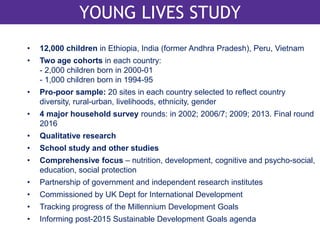
• 12,000 children in Ethiopia, India (former Andhra Pradesh), Peru, Vietnam 
• Two age cohorts in each country: 
- 2,000 children born in 2000-01 
- 1,000 children born in 1994-95 
• Pro-poor sample: 20 sites in each country selected to reflect country 
diversity, rural-urban, livelihoods, ethnicity, gender 
• 4 major household survey rounds: in 2002; 2006/7; 2009; 2013. Final round 
2016 
• Qualitative research 
• School study and other studies 
• Comprehensive focus – nutrition, development, cognitive and psycho-social, 
education, social protection 
• Partnership of government and independent research institutes 
• Commissioned by UK Dept for International Development 
• Tracking progress of the Millennium Development Goals 
• Informing post-2015 Sustainable Development Goals agenda
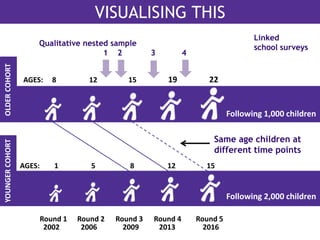
VISUALISING THIS 
Same age children at 
different time points 
Qualitative nested sample 
1 2 3 4 
AGES: 1 5 8 12 15 
YOUNGER COHORT 
Following 2,000 children 
OLDER COHORT 
Following 1,000 children 
AGES: 8 12 15 19 22 
Round 1 Round 2 Round 3 Round 4 Round 5 
2002 2006 2009 2013 2016 
Linked 
school surveys
QualitativQeU reAsLeIaTArcThIVE RESEARCH 
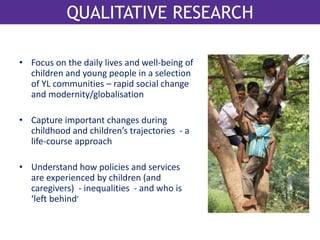
• Focus on the daily lives and well-being of 
children and young people in a selection 
of YL communities – rapid social change 
and modernity/globalisation 
• Capture important changes during 
childhood and children’s trajectories - a 
life-course approach 
• Understand how policies and services 
are experienced by children (and 
caregivers) - inequalities - and who is 
‘left behind’
QualitativQeU reAsLeIaTArcThIVE RESEARCH 
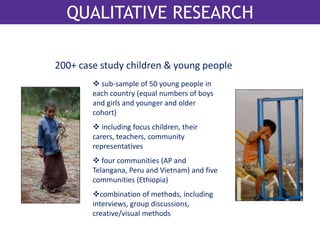
200+ case study children & young people 
 sub-sample of 50 young people in 
each country (equal numbers of boys 
and girls and younger and older 
cohort) 
 including focus children, their 
carers, teachers, community 
representatives 
 four communities (AP and 
Telangana, Peru and Vietnam) and five 
communities (Ethiopia) 
combination of methods, including 
interviews, group discussions, 
creative/visual methods
TEN YEARS IN CHILDREN’S LIVES 
• Economies of all four countries grew rapidly in the first decade of the 21st 
century 
• Growth was accompanied by infrastructural improvements and increased 
service access (associated with the MDGs) e.g. 
- primary school enrolment = near universal across the sample in 3 of our 
countries and rapidly increasing in Ethiopia 
- in Peru access to safe water increased by 50% between 2002 and 2009 
- internet access is now widespread in Vietnam 
- increased external investment, road & communications infrastructure in Ethiopia 
Social protection: 
– MGNREGA, India; Juntos, Peru; PSNP, Ethiopia 
– Health insurance in Vietnam, Peru and in India; Health Extension Workers in 
Ethiopia
ASPIRATIONS ARE HIGH 
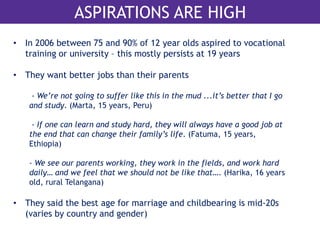
• In 2006 between 75 and 90% of 12 year olds aspired to vocational 
training or university – this mostly persists at 19 years 
• They want better jobs than their parents 
- We’re not going to suffer like this in the mud ...it’s better that I go 
and study. (Marta, 15 years, Peru) 
- If one can learn and study hard, they will always have a good job at 
the end that can change their family’s life. (Fatuma, 15 years, 
Ethiopia) 
- We see our parents working, they work in the fields, and work hard 
daily… and we feel that we should not be like that…. (Harika, 16 years 
old, rural Telangana) 
• They said the best age for marriage and childbearing is mid-20s 
(varies by country and gender)
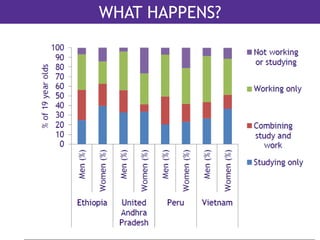
WHAT HAPPENS?
WHAT WERE THEY DOING AT AGE 19? 
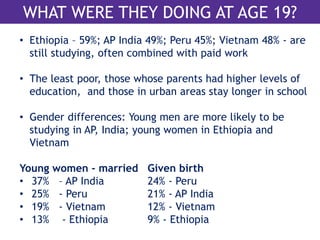
• Ethiopia – 59%; AP India 49%; Peru 45%; Vietnam 48% - are 
still studying, often combined with paid work 
• The least poor, those whose parents had higher levels of 
education, and those in urban areas stay longer in school 
• Gender differences: Young men are more likely to be 
studying in AP, India; young women in Ethiopia and 
Vietnam 
Young women - married Given birth 
• 37% – AP India 24% - Peru 
• 25% - Peru 21% - AP India 
• 19% - Vietnam 12% - Vietnam 
• 13% - Ethiopia 9% - Ethiopia
WHOSE VALUES? QUALITATIVE RESEARCH 
• Emphasis on school enrolment in MDGS 
• ‘Successful and unsuccessful transitions’ 
• ‘Left behind’ in development – individualised 
• Burden of expectation placed on children 
• How is this experienced by children, and how 
do they manage demands on their time? 
• How do they value different dimensions of 
their lives?
HARIKA IN POOMPUHAR, IN RURAL TELANGANA 
• 2007 - Her father had injured his leg and could not work 
• Harika was involved in cotton pollination work and going to 
school 
• Found it difficult to manage both: “if I go to the fields I won’t get 
an education” 
• Wanted to become a teacher 
• In 2008, had received a scholarship of Rs 6,000/- per year, 
payable conditional on completing school 
• Was responsible for some aspects of farm work 
• In 2010 – at College, aspiring to be a doctor: “You will have a 
better life if you study… you will get better jobs… you will get an 
educated husband.”
RANADEEP 
• In 2007 was missing school to work, but was optimistic 
• 2008 - wanting to migrate, open a shop. Wanted to 
continue his schooling, but complained about working 
• 2010 had failed Grade 10: “I will be a waste” 
• Can’t ask his family for support: “I know they are 
struggling”; crop failure because of drought; 
indebtedness 
• Wants to support his mother/family 
• 2013 – had returned to college
SANTHI, IN PATNA, REMOTE TRIBAL AP 
• Father a teacher; the family moved to a town to 
access better quality schooling 
• 2007 and 2008, Santhi wanted to be a doctor 
• Was doing well at school, but during Grade 10, fell 
behind due to ill health 
• 2010, was in Intermediate College, studying Maths 
• Indebted to her parents, and feels pressure: “I am 
frightened whether I will reach the expectations for 
the support they gave me. … the only way to repay 
their support is to study well and score good marks 
and achieve a good position in society about which 
my parents feel proud and be happy without any 
worries” 
• Refused to discuss the possibility of marriage
YASWANTH 
• Father died when he was in Grade 1 aged about 6: 
“Mother struggled, worked hard and took care of me and 
my sister” 
• In 2007, helping his mother at home, fetching water, 
firewood, buying provisions 
• Mother had high hopes for him for a ‘small job’ so he can 
take care of her in the future 
• 2010 – struggling at school, fearful he would not complete 
Grade 10: “I feel I want to study, but I can’t… the lessons 
are hard to understand” 
• Debts worry him and his mother 
• Will look for “anything that will earn me and my mother 
enough to lead a happy life… we must have the capacity 
to earn”
DISCUSSION 
• Sense of obligation to parents – family values, especially 
boys who want to care for parents/mothers 
• Whether through achievement in school, or work 
• Patriarchal conventions means that girls will leave 
family of origin 
• But affect boys too – wanting to marry a girl ‘less 
educated’ than themselves 
• Circumstances constrain children’s capacity to study but 
they risk blaming themselves or being blamed for 
‘failure’ 
• Becoming a farmer is not valued as an aspiration 
• All sit uneasily with dominant approaches to youth and 
adolescence in international policy discourses
UN CRC @ 25: ‘AN UNFINISHED AGENDA’ 
• Progress achieved though holistic approach to child 
development: child survival and enrolment in school 
• BUT widespread inequities affecting the poorest and most 
vulnerable children = a global issue 
• ‘Need to reduce implementation gap between principles and 
rights enshrined in UN CRC and actual living conditions of the 
most marginalised and excluded girls and boys’ 
• ‘Many children find themselves living with multiple risks and 
multiple hazards … action must be on the basis of mappings of 
vulnerability that reflects these complexities’
REFERENCES 
REFERENCES 
Jo Boyden (2013) ‘“We’re not going to suffer like this in the mud”: Educational Aspirations, 
Social Mobility and Independent Child Migration among Populations Living in Poverty’, 
Compare 43.4: 580-600. 
Jo Boyden and Michael Bourdillon (eds) (2012) Childhood Poverty, Multidisciplinary 
Approaches. Basingstoke: Palgrave Macmillan. 
Jo Boyden and Michael Bourdillon (eds) (2014) Growing Up in Poverty: Findings from Young 
Lives, Basingstoke: Palgrave Macmillan. 
Gina Crivello (2011) ‘Becoming Somebody: Youth Transitions through Education and Migration 
in Peru’, Journal of Youth Studies 14.4: 395-411. 
Gina Crivello, Virginia Morrow and Emma Wilson (2013) Young Lives Longitudinal Qualitative 
Research: A Guide for Researchers, Technical Note 26, Oxford: Young Lives. 
Paul Dornan and Kirrily Pells (2014) From Infancy to Adolescence: Growing Up in Poverty: 
Preliminary findings from Round 4 of Young Lives, Oxford: Young Lives. 
Virginia Morrow (2013) ‘Whose Values? Young People’s Aspirations and Experiences of 
Schooling in Andhra Pradesh, India’, Children & Society 27.4: 258-269. 
UN Secretary-General (2014) Status of the Convention on the Rights of the Child, New York: 
United Nations.
ACKNOWLEDGEMENTS & THANK YOU 
THANKS TO… 
Young Lives children, parents/caregivers as well as 
community leaders, teachers, health workers and 
others in communities 
Fieldworkers, data-managers, survey enumerators 
and supervisors, principal investigators and country 
directors in each country 
Oxford team 
Funders: DFID, DGIS, IrishAid, Oak Foundation, 
Bernard Van Leer Foundation.
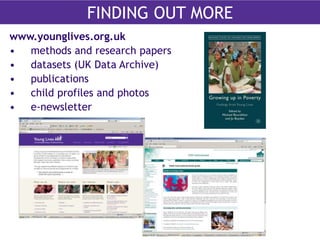
FINDING OUT MORE… 
FINDING OUT MORE 
www.younglives.org.uk 
• methods and research papers 
• datasets (UK Data Archive) 
• publications 
• child profiles and photos 
• e-newsletter

Great expectations or failed aspirations

  • 1.
    Great Expectations orFailed Aspirations? Findings from 10 years of Young Lives Virginia Morrow Senior Research Officer, Deputy Director, Young Lives Freie Universität, Berlin, 3 December 2014
  • 2.
    YOUNG LIVES LONGITUDINALDESIGN YOUNG LIVES STUDY • 12,000 children in Ethiopia, India (former Andhra Pradesh), Peru, Vietnam • Two age cohorts in each country: - 2,000 children born in 2000-01 - 1,000 children born in 1994-95 • Pro-poor sample: 20 sites in each country selected to reflect country diversity, rural-urban, livelihoods, ethnicity, gender • 4 major household survey rounds: in 2002; 2006/7; 2009; 2013. Final round 2016 • Qualitative research • School study and other studies • Comprehensive focus – nutrition, development, cognitive and psycho-social, education, social protection • Partnership of government and independent research institutes • Commissioned by UK Dept for International Development • Tracking progress of the Millennium Development Goals • Informing post-2015 Sustainable Development Goals agenda
  • 3.
    VISUALISING THIS Sameage children at different time points Qualitative nested sample 1 2 3 4 AGES: 1 5 8 12 15 YOUNGER COHORT Following 2,000 children OLDER COHORT Following 1,000 children AGES: 8 12 15 19 22 Round 1 Round 2 Round 3 Round 4 Round 5 2002 2006 2009 2013 2016 Linked school surveys
  • 4.
    QualitativQeU reAsLeIaTArcThIVE RESEARCH • Focus on the daily lives and well-being of children and young people in a selection of YL communities – rapid social change and modernity/globalisation • Capture important changes during childhood and children’s trajectories - a life-course approach • Understand how policies and services are experienced by children (and caregivers) - inequalities - and who is ‘left behind’
  • 5.
    QualitativQeU reAsLeIaTArcThIVE RESEARCH 200+ case study children & young people  sub-sample of 50 young people in each country (equal numbers of boys and girls and younger and older cohort)  including focus children, their carers, teachers, community representatives  four communities (AP and Telangana, Peru and Vietnam) and five communities (Ethiopia) combination of methods, including interviews, group discussions, creative/visual methods
  • 6.
    TEN YEARS INCHILDREN’S LIVES • Economies of all four countries grew rapidly in the first decade of the 21st century • Growth was accompanied by infrastructural improvements and increased service access (associated with the MDGs) e.g. - primary school enrolment = near universal across the sample in 3 of our countries and rapidly increasing in Ethiopia - in Peru access to safe water increased by 50% between 2002 and 2009 - internet access is now widespread in Vietnam - increased external investment, road & communications infrastructure in Ethiopia Social protection: – MGNREGA, India; Juntos, Peru; PSNP, Ethiopia – Health insurance in Vietnam, Peru and in India; Health Extension Workers in Ethiopia
  • 7.
    ASPIRATIONS ARE HIGH • In 2006 between 75 and 90% of 12 year olds aspired to vocational training or university – this mostly persists at 19 years • They want better jobs than their parents - We’re not going to suffer like this in the mud ...it’s better that I go and study. (Marta, 15 years, Peru) - If one can learn and study hard, they will always have a good job at the end that can change their family’s life. (Fatuma, 15 years, Ethiopia) - We see our parents working, they work in the fields, and work hard daily… and we feel that we should not be like that…. (Harika, 16 years old, rural Telangana) • They said the best age for marriage and childbearing is mid-20s (varies by country and gender)
  • 8.
  • 9.
    WHAT WERE THEYDOING AT AGE 19? • Ethiopia – 59%; AP India 49%; Peru 45%; Vietnam 48% - are still studying, often combined with paid work • The least poor, those whose parents had higher levels of education, and those in urban areas stay longer in school • Gender differences: Young men are more likely to be studying in AP, India; young women in Ethiopia and Vietnam Young women - married Given birth • 37% – AP India 24% - Peru • 25% - Peru 21% - AP India • 19% - Vietnam 12% - Vietnam • 13% - Ethiopia 9% - Ethiopia
  • 10.
    WHOSE VALUES? QUALITATIVERESEARCH • Emphasis on school enrolment in MDGS • ‘Successful and unsuccessful transitions’ • ‘Left behind’ in development – individualised • Burden of expectation placed on children • How is this experienced by children, and how do they manage demands on their time? • How do they value different dimensions of their lives?
  • 11.
    HARIKA IN POOMPUHAR,IN RURAL TELANGANA • 2007 - Her father had injured his leg and could not work • Harika was involved in cotton pollination work and going to school • Found it difficult to manage both: “if I go to the fields I won’t get an education” • Wanted to become a teacher • In 2008, had received a scholarship of Rs 6,000/- per year, payable conditional on completing school • Was responsible for some aspects of farm work • In 2010 – at College, aspiring to be a doctor: “You will have a better life if you study… you will get better jobs… you will get an educated husband.”
  • 12.
    RANADEEP • In2007 was missing school to work, but was optimistic • 2008 - wanting to migrate, open a shop. Wanted to continue his schooling, but complained about working • 2010 had failed Grade 10: “I will be a waste” • Can’t ask his family for support: “I know they are struggling”; crop failure because of drought; indebtedness • Wants to support his mother/family • 2013 – had returned to college
  • 13.
    SANTHI, IN PATNA,REMOTE TRIBAL AP • Father a teacher; the family moved to a town to access better quality schooling • 2007 and 2008, Santhi wanted to be a doctor • Was doing well at school, but during Grade 10, fell behind due to ill health • 2010, was in Intermediate College, studying Maths • Indebted to her parents, and feels pressure: “I am frightened whether I will reach the expectations for the support they gave me. … the only way to repay their support is to study well and score good marks and achieve a good position in society about which my parents feel proud and be happy without any worries” • Refused to discuss the possibility of marriage
  • 14.
    YASWANTH • Fatherdied when he was in Grade 1 aged about 6: “Mother struggled, worked hard and took care of me and my sister” • In 2007, helping his mother at home, fetching water, firewood, buying provisions • Mother had high hopes for him for a ‘small job’ so he can take care of her in the future • 2010 – struggling at school, fearful he would not complete Grade 10: “I feel I want to study, but I can’t… the lessons are hard to understand” • Debts worry him and his mother • Will look for “anything that will earn me and my mother enough to lead a happy life… we must have the capacity to earn”
  • 15.
    DISCUSSION • Senseof obligation to parents – family values, especially boys who want to care for parents/mothers • Whether through achievement in school, or work • Patriarchal conventions means that girls will leave family of origin • But affect boys too – wanting to marry a girl ‘less educated’ than themselves • Circumstances constrain children’s capacity to study but they risk blaming themselves or being blamed for ‘failure’ • Becoming a farmer is not valued as an aspiration • All sit uneasily with dominant approaches to youth and adolescence in international policy discourses
  • 16.
    UN CRC @25: ‘AN UNFINISHED AGENDA’ • Progress achieved though holistic approach to child development: child survival and enrolment in school • BUT widespread inequities affecting the poorest and most vulnerable children = a global issue • ‘Need to reduce implementation gap between principles and rights enshrined in UN CRC and actual living conditions of the most marginalised and excluded girls and boys’ • ‘Many children find themselves living with multiple risks and multiple hazards … action must be on the basis of mappings of vulnerability that reflects these complexities’
  • 17.
    REFERENCES REFERENCES JoBoyden (2013) ‘“We’re not going to suffer like this in the mud”: Educational Aspirations, Social Mobility and Independent Child Migration among Populations Living in Poverty’, Compare 43.4: 580-600. Jo Boyden and Michael Bourdillon (eds) (2012) Childhood Poverty, Multidisciplinary Approaches. Basingstoke: Palgrave Macmillan. Jo Boyden and Michael Bourdillon (eds) (2014) Growing Up in Poverty: Findings from Young Lives, Basingstoke: Palgrave Macmillan. Gina Crivello (2011) ‘Becoming Somebody: Youth Transitions through Education and Migration in Peru’, Journal of Youth Studies 14.4: 395-411. Gina Crivello, Virginia Morrow and Emma Wilson (2013) Young Lives Longitudinal Qualitative Research: A Guide for Researchers, Technical Note 26, Oxford: Young Lives. Paul Dornan and Kirrily Pells (2014) From Infancy to Adolescence: Growing Up in Poverty: Preliminary findings from Round 4 of Young Lives, Oxford: Young Lives. Virginia Morrow (2013) ‘Whose Values? Young People’s Aspirations and Experiences of Schooling in Andhra Pradesh, India’, Children & Society 27.4: 258-269. UN Secretary-General (2014) Status of the Convention on the Rights of the Child, New York: United Nations.
  • 18.
    ACKNOWLEDGEMENTS & THANKYOU THANKS TO… Young Lives children, parents/caregivers as well as community leaders, teachers, health workers and others in communities Fieldworkers, data-managers, survey enumerators and supervisors, principal investigators and country directors in each country Oxford team Funders: DFID, DGIS, IrishAid, Oak Foundation, Bernard Van Leer Foundation.
  • 19.
    FINDING OUT MORE… FINDING OUT MORE www.younglives.org.uk • methods and research papers • datasets (UK Data Archive) • publications • child profiles and photos • e-newsletter