CLEAN NETWORK PROJECT–
SÃO SEBASTIÃO - SP.
Environmental Biotechnology.
• The use of microorganisms in sanitation is common practice since
the beginning of the development of biological treatment processes
of wastewater and solid waste.
• It is clear that the microbial capacity to metabolize different organic
compounds, natural or reproduced by synthesis, and extracting of
these compounds, its nutritional and energy sources, is what
enabled the employment of these biological agents for sanitary
engineering, as a solution to the problems generated by waste
released into the environment.
• Thus, we can call for environmental biotechnology, sanitary
engineering methods that use microorganisms, or that lead to the
development of microorganisms in a medium, whose purpose is to
obtain a product that provides benefits to humans in their
environment.
I – INTRODUÇÃO
• The improvement of existing technologies or the development of
new processes for the maintenance of environmental quality must
conform to one of the principles formulated by The World
Commission on Environment and Development (Brundtland
Commission, Declaration of Tokyo), summarized below, second
ZEHNDER (1992).
• “Sustainability requires conservation of environmental resources, such as maintaining the
quality of water resources, soil, air and forests; conservation of genetic diversity; and
efficient use of energy, water and natural materials. Improving the efficiency of production
mechanisms, in order to reduce the per capita consumption of natural resources and
stimulate change in technologies and production of non-polluting consumption materials. All
countries are over-invoked prevent environmental pollution through enforcement of
environmental protection laws, promote technologies with low waste generation, and predict
the impact of new technologies, products and wastes”.
Bacteriológical Suplementation
• Bioaugmentation is the supplementation of external natural
occurring microorganisms (fungi, yeasts and bacteria), released
in the collection systems, sewage treatment and to improve the
efficiency of the biological processes of cleaning and sewage
treatment systems.
• Biological additives for the "bioagmentation" consist of blends of
naturally occurring saprofítics bacteria, nonpathogenic to
propitiate a Treatability of wastewater and high suitability for
release and discard the environment and even to reuse.
• The addition of naturally occurring biological additives, i.e. not
handled by genetic engineering, adapted to high degradation rate,
has been shown as one of the most efficient alternatives and,
above all, of the most economical for high rates of degradation of
biological treatment units. Several other segments of the industrial
activities have been successfully employing the use of
"bioaumentação", among these the pulp and paper sector,
refineries, chemical industries and organic synthesis, textile,
breweries, tanneries and, also, for the treatment of domestic
sewage, whether in treatment plants, nets or even septic tanks,
each of these in order to solve the various problems of specific
treatment for each use.
Bacteriológical Suplementation
• As a result, the diversity and competition among individuals present
promote significantly higher rates of degradation of organic matter,
resulting in quality and Treatability gain for the effluent to be
treated, eliminating fat deposits and the exhalation of odorous
gases, high BOD removal, among other advantages.
Bacteriológical Suplementation
• In summary, the program "Bioaugmentation" can be calibrated to
every need of treatment, based on the conditions of the systems in
operation and expected objectives that will guide the prior
Technical Study, that is, diagnosing the existing operating system
and propose the appropriate treatment, quantifying application
places of "bioaugmentation" and the volume of released product on
the basis of variables such as sewer seepage flow, fatty matter,
length of pipe collection and removal, contact time product x
sewage, etc.
II – PROJETO PILOTO SABESP
Caso SÃO SEBASTIÃO SES REGIÃO CENTRAL
• Objective of the project
Check the efficiency of the action of the biological product ECOMIX
in fat degradation in collection systems and sewage clearance in
central San Sebastian, retrieving the nominal capacity of the system
and eliminating the bad odour from decomposition of fat
impregnated in the contact surfaces of the sewer.
II – PROJETO PILOTO SABESP
Caso SÃO SEBASTIÃO SES REGIÃO CENTRAL
• Prior Technical Study
Area of study: Emphasis in central San Sebastian, because it is local with
high concentration of restaurants and hotels, with a history of networks and
wells with large amount of fat sometimes reaching partial or full pipe
clogging. Was also part of the study the arrival of EEE's Santana and
Trawled through the history of bad odor, with care to avoid sewer where
already there was the application of bactericides (chlorine or peroxide).
Points of application and volume of biological product: With the collecting
basins and registrations in conjunction with operational staff of Sabesp,
inspections were made in wells and set the plan for the implementation of
biological product, totaling 35 singularities where the product should be
applied. The basic amount has been set with 20 liters of water for 400
grams of powder Ecomix per point of application. After checks "on the spot"
were defined where there would be a need for enhanced application
(Ecomix gel or 40 liters of the product) seen the amount of fat. This amount
was checked daily according to the evolution of degradation of fatty
elements.
II – PROJETO PILOTO SABESP
Caso SÃO SEBASTIÃO SES REGIÃO CENTRAL
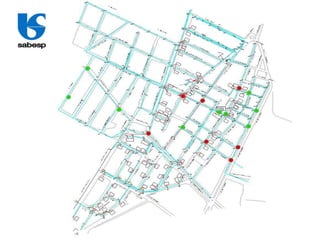
• CADASTRO DE REDES
PLANTA 01 EM ANEXO.
II – PROJETO PILOTO SABESP
Caso SÃO SEBASTIÃO SES REGIÃO CENTRAL
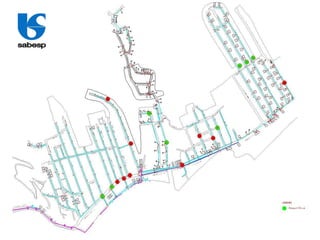
• CADASTRO DE REDES
PLANTA 02 EM ANEXO.
II – PROJETO PILOTO SABESP
Caso SÃO SEBASTIÃO SES REGIÃO CENTRAL
ECOCLÃ provided the products “ECOMIX G" and gave training
for staff directly involved in the project, Sabesp qualifying them
stop the preparation of compound with the dosages necessary
network points to be treated,-10 kg of the product for 500
gallons of water, under direct supervision of our staff. (photo) so
that the microorganisms are activated, the powdered product
must be mixed with water and oxygenated by 2:0,-the maximum
point of activation, to then be released at the point of
application. It was assembled at the headquarters of Sabesp
San Sebastian a "factory" of production, reservoir, paragraphs
composed of water and energy, shelter for the products and
solution mixer.
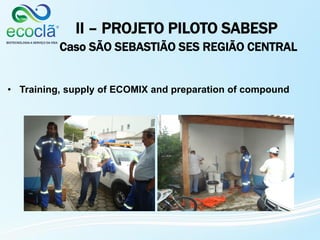
• Training, supply of ECOMIX and preparation of compound
II – PROJETO PILOTO SABESP
Caso SÃO SEBASTIÃO SES REGIÃO CENTRAL
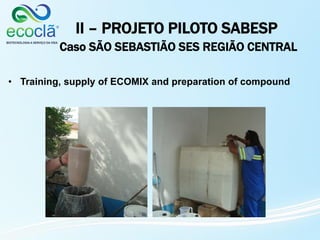
• Training, supply of ECOMIX and preparation of compound
II – PROJETO PILOTO SABESP
Caso SÃO SEBASTIÃO SES REGIÃO CENTRAL
II – PROJETO PILOTO SABESP
Caso SÃO SEBASTIÃO SES REGIÃO CENTRAL
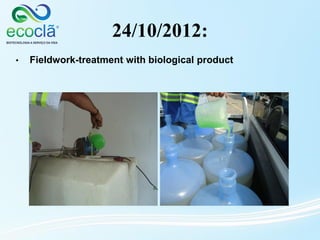
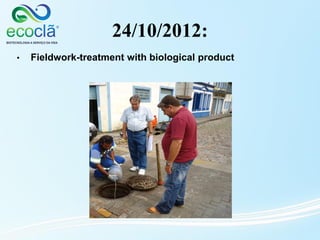
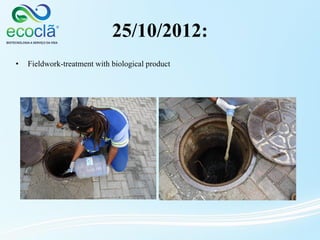
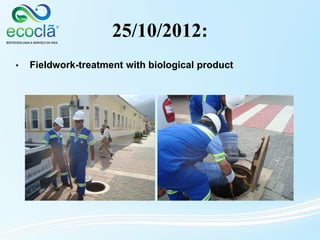
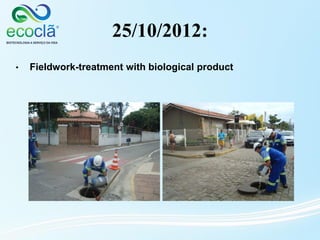
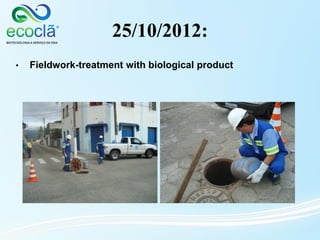
• Fieldwork-treatment with biological product
Once prepared the product was placed in plastic containers with
20 litres volume set to be applied in the places where the
concentration of fat was considered non-critical. In places where
there were visibly more fat concentration, was a definite
strengthening of treatment, which could be increased volumes of
water + Ecomix powder compound (plus 20 litres) or
complementary application of approximately 200 ml of Ecomix G.
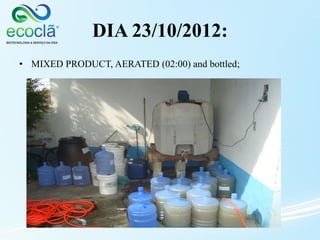
• MIXED PRODUCT, AERATED (02:00) and bottled;
DIA 23/10/2012:
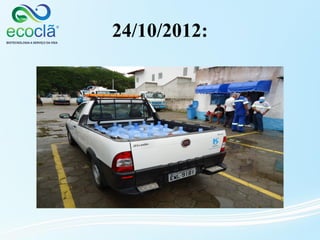
24/10/2012:
II – PROJETO PILOTO SABESP
Caso SÃO SEBASTIÃO SES REGIÃO CENTRAL
• Fieldwork-treatment with biological product
On 23 October began the implementation of the chosen points
and compound listed in 1 to 35. (photos).
Over the 6 days of application was made the monitoring and
registration of the action of microorganisms in the fat in places,
strengthening some points and relieving other.
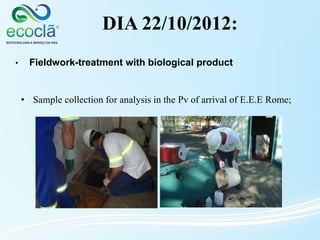
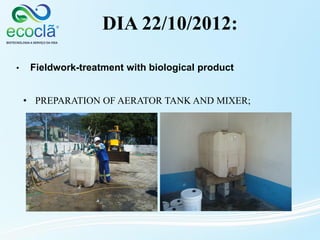
DIA 22/10/2012:
• Sample collection for analysis in the Pv of arrival of E.E.E Rome;
• Fieldwork-treatment with biological product
• PREPARATION OF AERATOR TANK AND MIXER;
• Fieldwork-treatment with biological product
DIA 22/10/2012:
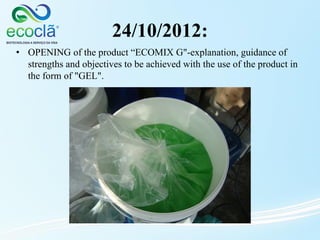
24/10/2012:
• OPENING of the product “ECOMIX G"-explanation, guidance of
strengths and objectives to be achieved with the use of the product in
the form of "GEL".
24/10/2012:
• Fieldwork-treatment with biological product
24/10/2012:
• Fieldwork-treatment with biological product
24/10/2012:
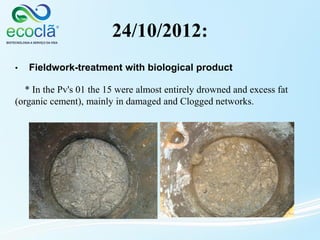
* In the Pv's 01 the 15 were almost entirely drowned and excess fat
(organic cement), mainly in damaged and Clogged networks.
• Fieldwork-treatment with biological product
24/10/2012:
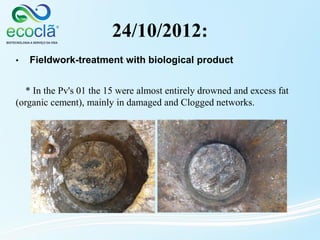
* In the Pv's 01 the 15 were almost entirely drowned and excess fat
(organic cement), mainly in damaged and Clogged networks.
• Fieldwork-treatment with biological product
24/10/2012:
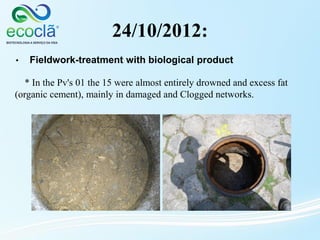
* In the Pv's 01 the 15 were almost entirely drowned and excess fat
(organic cement), mainly in damaged and Clogged networks.
• Fieldwork-treatment with biological product
24/10/2012:
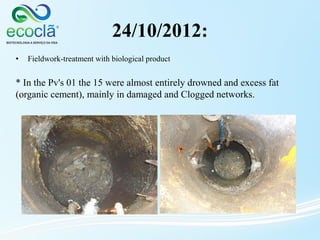
* In the Pv's 01 the 15 were almost entirely drowned and excess fat
(organic cement), mainly in damaged and Clogged networks.
• Fieldwork-treatment with biological product
25/10/2012:
• Fieldwork-treatment with biological product
25/10/2012:
• Fieldwork-treatment with biological product
25/10/2012:
• Fieldwork-treatment with biological product
25/10/2012:
• Fieldwork-treatment with biological product
25/10/2012:
• WOLF HEAD (rain network) EXUDING STRONG ODOR;
* This Work that will use the product “ECOMIX MAX-odour
Sequestrant", but under the responsibility of the municipality of São
Sebastião, SP, Brazil.
• Fieldwork-NOTE.
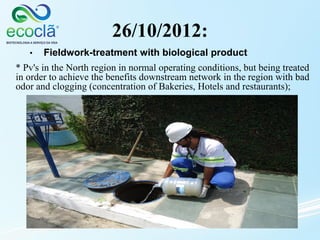
26/10/2012:
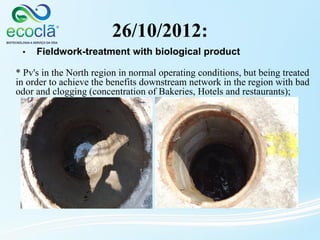
* Pv's in the North region in normal operating conditions, but being treated
in order to achieve the benefits downstream network in the region with bad
odor and clogging (concentration of Bakeries, Hotels and restaurants);
• Fieldwork-treatment with biological product
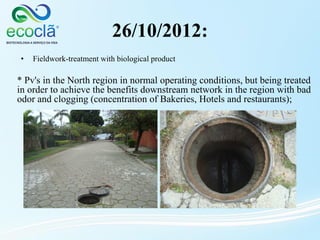
26/10/2012:
* Pv's in the North region in normal operating conditions, but being treated
in order to achieve the benefits downstream network in the region with bad
odor and clogging (concentration of Bakeries, Hotels and restaurants);
• Fieldwork-treatment with biological product
26/10/2012:
* Pv's in the North region in normal operating conditions, but being treated
in order to achieve the benefits downstream network in the region with bad
odor and clogging (concentration of Bakeries, Hotels and restaurants);
• Fieldwork-treatment with biological product
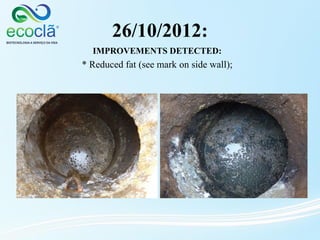
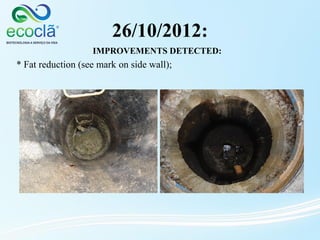
26/10/2012:
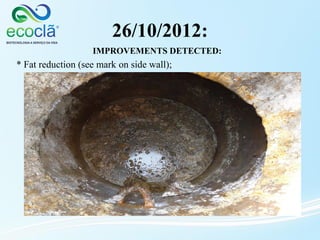
IMPROVEMENTS DETECTED:
* Fat reduction (see mark on side wall);
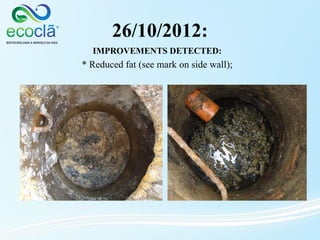
26/10/2012:
IMPROVEMENTS DETECTED:
* Reduced fat (see mark on side wall);
26/10/2012:
IMPROVEMENTS DETECTED:
* Reduced fat (see mark on side wall);
26/10/2012:
IMPROVEMENTS DETECTED:
* Fat reduction (see mark on side wall);
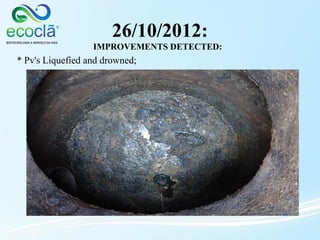
26/10/2012:
IMPROVEMENTS DETECTED:
* Pv's Liquefied and drowned;
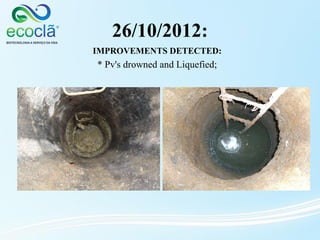
26/10/2012:
IMPROVEMENTS DETECTED:
* Pv's drowned and Liquefied;
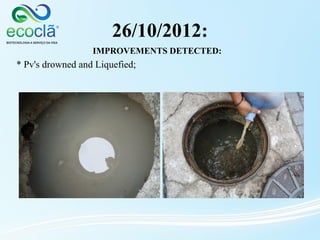
26/10/2012:
IMPROVEMENTS DETECTED:
* Pv's drowned and Liquefied;
II – PROJETO PILOTO SABESP
Caso SÃO SEBASTIÃO SES REGIÃO CENTRAL
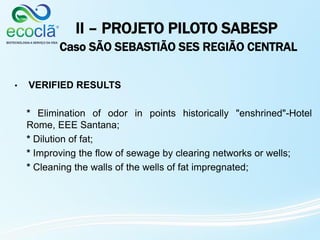
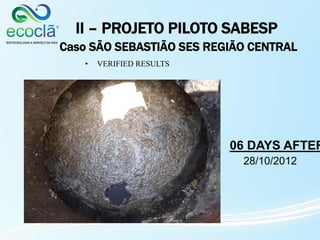
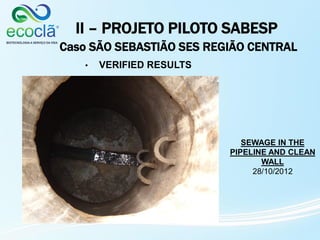
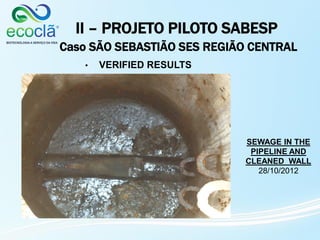
• VERIFIED RESULTS
* Elimination of odor in points historically "enshrined"-Hotel
Rome, EEE Santana;
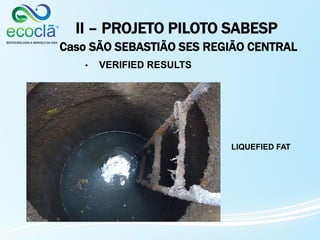
* Dilution of fat;
* Improving the flow of sewage by clearing networks or wells;
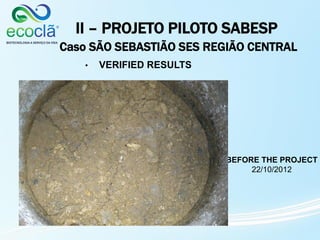
* Cleaning the walls of the wells of fat impregnated;
II – PROJETO PILOTO SABESP
Caso SÃO SEBASTIÃO SES REGIÃO CENTRAL
• VERIFIED RESULTS
LIQUEFIED FAT
II – PROJETO PILOTO SABESP
Caso SÃO SEBASTIÃO SES REGIÃO CENTRAL
• VERIFIED RESULTS
BEFORE THE PROJECT
22/10/2012
II – PROJETO PILOTO SABESP
Caso SÃO SEBASTIÃO SES REGIÃO CENTRAL
• VERIFIED RESULTS
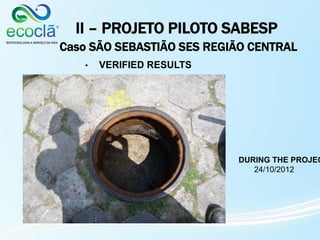
DURING THE PROJEC
24/10/2012
II – PROJETO PILOTO SABESP
Caso SÃO SEBASTIÃO SES REGIÃO CENTRAL
• VERIFIED RESULTS
06 DAYS AFTER
28/10/2012
II – PROJETO PILOTO SABESP
Caso SÃO SEBASTIÃO SES REGIÃO CENTRAL
• VERIFIED RESULTS
SEWAGE IN THE
PIPELINE AND CLEAN
WALL
28/10/2012
II – PROJETO PILOTO SABESP
Caso SÃO SEBASTIÃO SES REGIÃO CENTRAL
• VERIFIED RESULTS
SEWAGE IN THE
PIPELINE AND
CLEANED WALL
28/10/2012
II – PROJETO PILOTO SABESP
Caso SÃO SEBASTIÃO SES REGIÃO CENTRAL
• RECOMMENDATIONS
Mechanical cleaning of removing sand and avoiding the formation
of organic cement;
Retrieve sewage flow in clogged networks (damaged points);
Systematic application of the biological product to prolong the
effect of the benefits verified;
Monitoring of activities by the city of San Sebastian-stormwater
galleries with illegal sewage odor problems.
III – NEXT STEPS
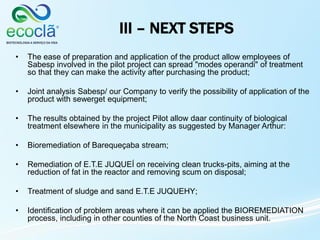
• The ease of preparation and application of the product allow employees of
Sabesp involved in the pilot project can spread "modes operandi" of treatment
so that they can make the activity after purchasing the product;
• Joint analysis Sabesp/ our Company to verify the possibility of application of the
product with sewerget equipment;
• The results obtained by the project Pilot allow daar continuity of biological
treatment elsewhere in the municipality as suggested by Manager Arthur:
• Bioremediation of Barequeçaba stream;
• Remediation of E.T.E JUQUEÍ on receiving clean trucks-pits, aiming at the
reduction of fat in the reactor and removing scum on disposal;
• Treatment of sludge and sand E.T.E JUQUEHY;
• Identification of problem areas where it can be applied the BIOREMEDIATION
process, including in other counties of the North Coast business unit.
FINAL CONSIDERATIONS
We thank the North Coast business unit-São Sebastião, Sector the
opportunity to present the technology developed by ECOCLÃ, for clearing
networks, elimination of fat and bad odor in the city of São Sebastião-SP.
Thanks also to the commitment and dedication of the team involved in the
project, SABESP without what ever we would get the proposed results.
São Sebastião, outubro de 2012.
Fone: 62 – 3954.5520
E-mail: ecocla@ecocla.com.br
Site: www.ecocla.com.br

Grease Treatment - Collecting systems

  • 2.
  • 3.
    Environmental Biotechnology. • Theuse of microorganisms in sanitation is common practice since the beginning of the development of biological treatment processes of wastewater and solid waste. • It is clear that the microbial capacity to metabolize different organic compounds, natural or reproduced by synthesis, and extracting of these compounds, its nutritional and energy sources, is what enabled the employment of these biological agents for sanitary engineering, as a solution to the problems generated by waste released into the environment. • Thus, we can call for environmental biotechnology, sanitary engineering methods that use microorganisms, or that lead to the development of microorganisms in a medium, whose purpose is to obtain a product that provides benefits to humans in their environment. I – INTRODUÇÃO
  • 4.
    • The improvementof existing technologies or the development of new processes for the maintenance of environmental quality must conform to one of the principles formulated by The World Commission on Environment and Development (Brundtland Commission, Declaration of Tokyo), summarized below, second ZEHNDER (1992). • “Sustainability requires conservation of environmental resources, such as maintaining the quality of water resources, soil, air and forests; conservation of genetic diversity; and efficient use of energy, water and natural materials. Improving the efficiency of production mechanisms, in order to reduce the per capita consumption of natural resources and stimulate change in technologies and production of non-polluting consumption materials. All countries are over-invoked prevent environmental pollution through enforcement of environmental protection laws, promote technologies with low waste generation, and predict the impact of new technologies, products and wastes”.
  • 5.
    Bacteriológical Suplementation • Bioaugmentationis the supplementation of external natural occurring microorganisms (fungi, yeasts and bacteria), released in the collection systems, sewage treatment and to improve the efficiency of the biological processes of cleaning and sewage treatment systems. • Biological additives for the "bioagmentation" consist of blends of naturally occurring saprofítics bacteria, nonpathogenic to propitiate a Treatability of wastewater and high suitability for release and discard the environment and even to reuse.
  • 6.
    • The additionof naturally occurring biological additives, i.e. not handled by genetic engineering, adapted to high degradation rate, has been shown as one of the most efficient alternatives and, above all, of the most economical for high rates of degradation of biological treatment units. Several other segments of the industrial activities have been successfully employing the use of "bioaumentação", among these the pulp and paper sector, refineries, chemical industries and organic synthesis, textile, breweries, tanneries and, also, for the treatment of domestic sewage, whether in treatment plants, nets or even septic tanks, each of these in order to solve the various problems of specific treatment for each use. Bacteriológical Suplementation
  • 7.
    Bacteriológical Suplementation • Asa result, the diversity and competition among individuals present promote significantly higher rates of degradation of organic matter, resulting in quality and Treatability gain for the effluent to be treated, eliminating fat deposits and the exhalation of odorous gases, high BOD removal, among other advantages.
  • 8.
    Bacteriológical Suplementation • Insummary, the program "Bioaugmentation" can be calibrated to every need of treatment, based on the conditions of the systems in operation and expected objectives that will guide the prior Technical Study, that is, diagnosing the existing operating system and propose the appropriate treatment, quantifying application places of "bioaugmentation" and the volume of released product on the basis of variables such as sewer seepage flow, fatty matter, length of pipe collection and removal, contact time product x sewage, etc.
  • 9.
    II – PROJETOPILOTO SABESP Caso SÃO SEBASTIÃO SES REGIÃO CENTRAL • Objective of the project Check the efficiency of the action of the biological product ECOMIX in fat degradation in collection systems and sewage clearance in central San Sebastian, retrieving the nominal capacity of the system and eliminating the bad odour from decomposition of fat impregnated in the contact surfaces of the sewer.
  • 10.
    II – PROJETOPILOTO SABESP Caso SÃO SEBASTIÃO SES REGIÃO CENTRAL • Prior Technical Study Area of study: Emphasis in central San Sebastian, because it is local with high concentration of restaurants and hotels, with a history of networks and wells with large amount of fat sometimes reaching partial or full pipe clogging. Was also part of the study the arrival of EEE's Santana and Trawled through the history of bad odor, with care to avoid sewer where already there was the application of bactericides (chlorine or peroxide). Points of application and volume of biological product: With the collecting basins and registrations in conjunction with operational staff of Sabesp, inspections were made in wells and set the plan for the implementation of biological product, totaling 35 singularities where the product should be applied. The basic amount has been set with 20 liters of water for 400 grams of powder Ecomix per point of application. After checks "on the spot" were defined where there would be a need for enhanced application (Ecomix gel or 40 liters of the product) seen the amount of fat. This amount was checked daily according to the evolution of degradation of fatty elements.
  • 11.
    II – PROJETOPILOTO SABESP Caso SÃO SEBASTIÃO SES REGIÃO CENTRAL • CADASTRO DE REDES PLANTA 01 EM ANEXO.
  • 12.
    II – PROJETOPILOTO SABESP Caso SÃO SEBASTIÃO SES REGIÃO CENTRAL • CADASTRO DE REDES PLANTA 02 EM ANEXO.
  • 13.
    II – PROJETOPILOTO SABESP Caso SÃO SEBASTIÃO SES REGIÃO CENTRAL ECOCLÃ provided the products “ECOMIX G" and gave training for staff directly involved in the project, Sabesp qualifying them stop the preparation of compound with the dosages necessary network points to be treated,-10 kg of the product for 500 gallons of water, under direct supervision of our staff. (photo) so that the microorganisms are activated, the powdered product must be mixed with water and oxygenated by 2:0,-the maximum point of activation, to then be released at the point of application. It was assembled at the headquarters of Sabesp San Sebastian a "factory" of production, reservoir, paragraphs composed of water and energy, shelter for the products and solution mixer.
  • 14.
    • Training, supplyof ECOMIX and preparation of compound II – PROJETO PILOTO SABESP Caso SÃO SEBASTIÃO SES REGIÃO CENTRAL
  • 15.
    • Training, supplyof ECOMIX and preparation of compound II – PROJETO PILOTO SABESP Caso SÃO SEBASTIÃO SES REGIÃO CENTRAL
  • 16.
    II – PROJETOPILOTO SABESP Caso SÃO SEBASTIÃO SES REGIÃO CENTRAL • Fieldwork-treatment with biological product Once prepared the product was placed in plastic containers with 20 litres volume set to be applied in the places where the concentration of fat was considered non-critical. In places where there were visibly more fat concentration, was a definite strengthening of treatment, which could be increased volumes of water + Ecomix powder compound (plus 20 litres) or complementary application of approximately 200 ml of Ecomix G.
  • 17.
    • MIXED PRODUCT,AERATED (02:00) and bottled; DIA 23/10/2012:
  • 18.
  • 19.
    II – PROJETOPILOTO SABESP Caso SÃO SEBASTIÃO SES REGIÃO CENTRAL • Fieldwork-treatment with biological product On 23 October began the implementation of the chosen points and compound listed in 1 to 35. (photos). Over the 6 days of application was made the monitoring and registration of the action of microorganisms in the fat in places, strengthening some points and relieving other.
  • 20.
    DIA 22/10/2012: • Samplecollection for analysis in the Pv of arrival of E.E.E Rome; • Fieldwork-treatment with biological product
  • 21.
    • PREPARATION OFAERATOR TANK AND MIXER; • Fieldwork-treatment with biological product DIA 22/10/2012:
  • 22.
    24/10/2012: • OPENING ofthe product “ECOMIX G"-explanation, guidance of strengths and objectives to be achieved with the use of the product in the form of "GEL".
  • 23.
  • 24.
  • 25.
    24/10/2012: * In thePv's 01 the 15 were almost entirely drowned and excess fat (organic cement), mainly in damaged and Clogged networks. • Fieldwork-treatment with biological product
  • 26.
    24/10/2012: * In thePv's 01 the 15 were almost entirely drowned and excess fat (organic cement), mainly in damaged and Clogged networks. • Fieldwork-treatment with biological product
  • 27.
    24/10/2012: * In thePv's 01 the 15 were almost entirely drowned and excess fat (organic cement), mainly in damaged and Clogged networks. • Fieldwork-treatment with biological product
  • 28.
    24/10/2012: * In thePv's 01 the 15 were almost entirely drowned and excess fat (organic cement), mainly in damaged and Clogged networks. • Fieldwork-treatment with biological product
  • 29.
  • 30.
  • 31.
  • 32.
  • 33.
    25/10/2012: • WOLF HEAD(rain network) EXUDING STRONG ODOR; * This Work that will use the product “ECOMIX MAX-odour Sequestrant", but under the responsibility of the municipality of São Sebastião, SP, Brazil. • Fieldwork-NOTE.
  • 34.
    26/10/2012: * Pv's inthe North region in normal operating conditions, but being treated in order to achieve the benefits downstream network in the region with bad odor and clogging (concentration of Bakeries, Hotels and restaurants); • Fieldwork-treatment with biological product
  • 35.
    26/10/2012: * Pv's inthe North region in normal operating conditions, but being treated in order to achieve the benefits downstream network in the region with bad odor and clogging (concentration of Bakeries, Hotels and restaurants); • Fieldwork-treatment with biological product
  • 36.
    26/10/2012: * Pv's inthe North region in normal operating conditions, but being treated in order to achieve the benefits downstream network in the region with bad odor and clogging (concentration of Bakeries, Hotels and restaurants); • Fieldwork-treatment with biological product
  • 37.
    26/10/2012: IMPROVEMENTS DETECTED: * Fatreduction (see mark on side wall);
  • 38.
  • 39.
  • 40.
    26/10/2012: IMPROVEMENTS DETECTED: * Fatreduction (see mark on side wall);
  • 41.
  • 42.
  • 43.
  • 44.
    II – PROJETOPILOTO SABESP Caso SÃO SEBASTIÃO SES REGIÃO CENTRAL • VERIFIED RESULTS * Elimination of odor in points historically "enshrined"-Hotel Rome, EEE Santana; * Dilution of fat; * Improving the flow of sewage by clearing networks or wells; * Cleaning the walls of the wells of fat impregnated;
  • 45.
    II – PROJETOPILOTO SABESP Caso SÃO SEBASTIÃO SES REGIÃO CENTRAL • VERIFIED RESULTS LIQUEFIED FAT
  • 46.
    II – PROJETOPILOTO SABESP Caso SÃO SEBASTIÃO SES REGIÃO CENTRAL • VERIFIED RESULTS BEFORE THE PROJECT 22/10/2012
  • 47.
    II – PROJETOPILOTO SABESP Caso SÃO SEBASTIÃO SES REGIÃO CENTRAL • VERIFIED RESULTS DURING THE PROJEC 24/10/2012
  • 48.
    II – PROJETOPILOTO SABESP Caso SÃO SEBASTIÃO SES REGIÃO CENTRAL • VERIFIED RESULTS 06 DAYS AFTER 28/10/2012
  • 49.
    II – PROJETOPILOTO SABESP Caso SÃO SEBASTIÃO SES REGIÃO CENTRAL • VERIFIED RESULTS SEWAGE IN THE PIPELINE AND CLEAN WALL 28/10/2012
  • 50.
    II – PROJETOPILOTO SABESP Caso SÃO SEBASTIÃO SES REGIÃO CENTRAL • VERIFIED RESULTS SEWAGE IN THE PIPELINE AND CLEANED WALL 28/10/2012
  • 51.
    II – PROJETOPILOTO SABESP Caso SÃO SEBASTIÃO SES REGIÃO CENTRAL • RECOMMENDATIONS Mechanical cleaning of removing sand and avoiding the formation of organic cement; Retrieve sewage flow in clogged networks (damaged points); Systematic application of the biological product to prolong the effect of the benefits verified; Monitoring of activities by the city of San Sebastian-stormwater galleries with illegal sewage odor problems.
  • 52.
    III – NEXTSTEPS • The ease of preparation and application of the product allow employees of Sabesp involved in the pilot project can spread "modes operandi" of treatment so that they can make the activity after purchasing the product; • Joint analysis Sabesp/ our Company to verify the possibility of application of the product with sewerget equipment; • The results obtained by the project Pilot allow daar continuity of biological treatment elsewhere in the municipality as suggested by Manager Arthur: • Bioremediation of Barequeçaba stream; • Remediation of E.T.E JUQUEÍ on receiving clean trucks-pits, aiming at the reduction of fat in the reactor and removing scum on disposal; • Treatment of sludge and sand E.T.E JUQUEHY; • Identification of problem areas where it can be applied the BIOREMEDIATION process, including in other counties of the North Coast business unit.
  • 53.
    FINAL CONSIDERATIONS We thankthe North Coast business unit-São Sebastião, Sector the opportunity to present the technology developed by ECOCLÃ, for clearing networks, elimination of fat and bad odor in the city of São Sebastião-SP. Thanks also to the commitment and dedication of the team involved in the project, SABESP without what ever we would get the proposed results. São Sebastião, outubro de 2012.
  • 54.
    Fone: 62 –3954.5520 E-mail: ecocla@ecocla.com.br Site: www.ecocla.com.br