GRAVITATION
CHAPTER 06
Prepared by: Syeda Fatima Rizvi
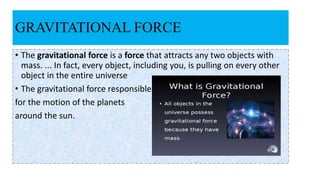
GRAVITATIONAL FORCE
• The gravitational force is a force that attracts any two objects with
mass. ... In fact, every object, including you, is pulling on every other
object in the entire universe
• The gravitational force responsible
for the motion of the planets
around the sun.
GRAVITY OR GRAVITATION
• Gravity, also called gravitation, is a force that exists among all
material objects in the universe. For any two objects or particles
having nonzero mass, the force of gravity tends to attract them
toward each other.
• Gravity is a force of attraction that exists between any two masses,
any two bodies, any two particles. Gravity is not just the attraction
between objects and the Earth. It is an attraction that exists between
all objects, everywhere in the universe.
• Gravity is caused by the mass of an object.
Newton’s Gravitation Law
STATEMENT
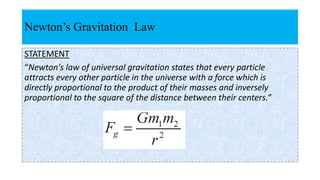
“Newton's law of universal gravitation states that every particle
attracts every other particle in the universe with a force which is
directly proportional to the product of their masses and inversely
proportional to the square of the distance between their centers.”
Acceleration Due to Gravity
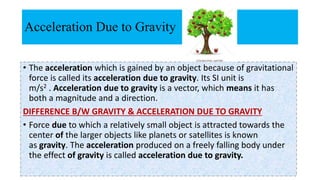
• The acceleration which is gained by an object because of gravitational
force is called its acceleration due to gravity. Its SI unit is
m/s2 . Acceleration due to gravity is a vector, which means it has
both a magnitude and a direction.
DIFFERENCE B/W GRAVITY & ACCELERATION DUE TO GRAVITY
• Force due to which a relatively small object is attracted towards the
center of the larger objects like planets or satellites is known
as gravity. The acceleration produced on a freely falling body under
the effect of gravity is called acceleration due to gravity.
GRAVITATIONAL CONSTANT
• The gravitational constant, called G in physics equations, is an
empirical physical constant. It is used to show the force between two
objects caused by gravity. The gravitational constant appears in
Newton's universal law of gravitation. G is about 6.67408
×10−11 N⋅m2/kg2, and is denoted by letter G.

Gravitation

  • 1.
  • 2.
    GRAVITATIONAL FORCE • Thegravitational force is a force that attracts any two objects with mass. ... In fact, every object, including you, is pulling on every other object in the entire universe • The gravitational force responsible for the motion of the planets around the sun.
  • 3.
    GRAVITY OR GRAVITATION •Gravity, also called gravitation, is a force that exists among all material objects in the universe. For any two objects or particles having nonzero mass, the force of gravity tends to attract them toward each other. • Gravity is a force of attraction that exists between any two masses, any two bodies, any two particles. Gravity is not just the attraction between objects and the Earth. It is an attraction that exists between all objects, everywhere in the universe. • Gravity is caused by the mass of an object.
  • 5.
    Newton’s Gravitation Law STATEMENT “Newton'slaw of universal gravitation states that every particle attracts every other particle in the universe with a force which is directly proportional to the product of their masses and inversely proportional to the square of the distance between their centers.”
  • 6.
    Acceleration Due toGravity • The acceleration which is gained by an object because of gravitational force is called its acceleration due to gravity. Its SI unit is m/s2 . Acceleration due to gravity is a vector, which means it has both a magnitude and a direction. DIFFERENCE B/W GRAVITY & ACCELERATION DUE TO GRAVITY • Force due to which a relatively small object is attracted towards the center of the larger objects like planets or satellites is known as gravity. The acceleration produced on a freely falling body under the effect of gravity is called acceleration due to gravity.
  • 7.
    GRAVITATIONAL CONSTANT • Thegravitational constant, called G in physics equations, is an empirical physical constant. It is used to show the force between two objects caused by gravity. The gravitational constant appears in Newton's universal law of gravitation. G is about 6.67408 ×10⁻¹¹ N⋅m2/kg2, and is denoted by letter G.