Newton's Law of
Universal Gravitation
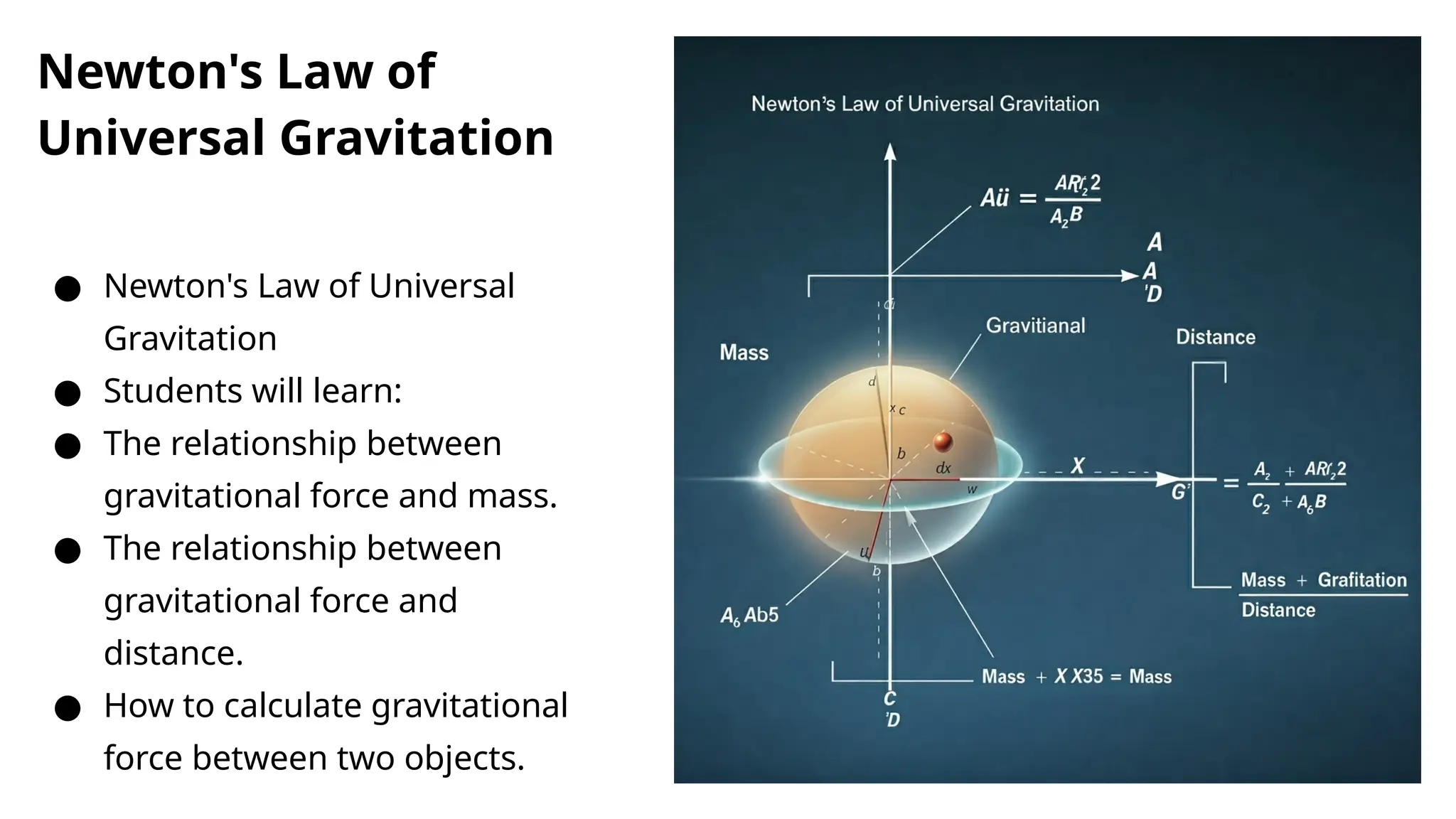
● Newton's Law of Universal
Gravitation
● Students will learn:
● The relationship between
gravitational force and mass.
● The relationship between
gravitational force and
distance.
● How to calculate gravitational
force between two objects.
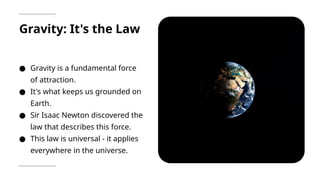
Gravity: It's the Law
● Gravity is a fundamental force
of attraction.
● It's what keeps us grounded on
Earth.
● Sir Isaac Newton discovered the
law that describes this force.
● This law is universal - it applies
everywhere in the universe.
Key Concepts for AP Physics
● Newton's Law of Universal Gravitation: Every particle attracts every
other particle with a force directly proportional to the product of
their masses and inversely proportional to the square of the
distance between their centers.
● Gravitational Constant (G): A fundamental constant representing
the strength of the gravitational force.
● Inverse Square Law: The force of gravity weakens rapidly as the
distance between objects increases.
● Mass and Gravitational Force: The greater the mass of the objects,
the stronger the gravitational force between them.
● Gravitational Field: A region around a massive object where
another object experiences a gravitational force.
● Application: Understanding orbits, tides, and the structure of the
universe.
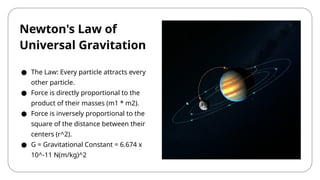
Newton's Law of
Universal Gravitation
● The Law: Every particle attracts every
other particle.
● Force is directly proportional to the
product of their masses (m1 * m2).
● Force is inversely proportional to the
square of the distance between their
centers (r^2).
● G = Gravitational Constant = 6.674 x
10^-11 N(m/kg)^2
The Gravitational
Constant (G)
● G is a fundamental constant
of nature.
● G = 6.674 x 10^-11 N(m/kg)^2
● G is used to calculate the
force of gravity between any
two objects.
● G is a very small number,
reflecting the weakness of
gravity on a human scale.
01
02
03
04
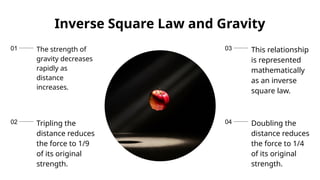
Inverse Square Law and Gravity
The strength of
gravity decreases
rapidly as
distance
increases.
This relationship
is represented
mathematically
as an inverse
square law.
Doubling the
distance reduces
the force to 1/4
of its original
strength.
Tripling the
distance reduces
the force to 1/9
of its original
strength.
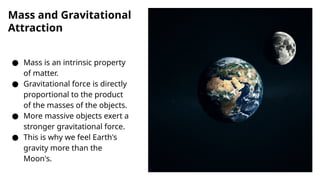
Mass and Gravitational
Attraction
● Mass is an intrinsic property
of matter.
● Gravitational force is directly
proportional to the product
of the masses of the objects.
● More massive objects exert a
stronger gravitational force.
● This is why we feel Earth's
gravity more than the
Moon's.
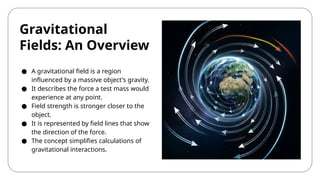
Gravitational
Fields: An Overview
● A gravitational field is a region
influenced by a massive object's gravity.
● It describes the force a test mass would
experience at any point.
● Field strength is stronger closer to the
object.
● It is represented by field lines that show
the direction of the force.
● The concept simplifies calculations of
gravitational interactions.
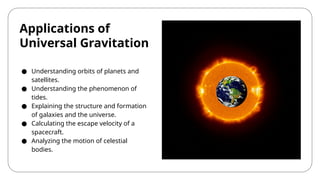
Applications of
Universal Gravitation
● Understanding orbits of planets and
satellites.
● Understanding the phenomenon of
tides.
● Explaining the structure and formation
of galaxies and the universe.
● Calculating the escape velocity of a
spacecraft.
● Analyzing the motion of celestial
bodies.
01
02
03
04
Conclusion:
The Gravity of
the Situation
Gravitational force
is a fundamental
force of attraction.
The force is directly
proportional to the
product of masses.
The force is inversely
proportional to the
square of the distance
between the objects.
Gravitational force
explains the orbits of
planets and satellites,
tides, and the structure
of the universe.
01
02
03
Let's Discuss
Gravity
How does the gravitational constant
(G) relate to the strength of the
gravitational force?
If the distance between two objects
is tripled, how does this affect the
gravitational force between them?
How does the concept of a
gravitational field simplify calculations
of gravitational interactions?

NewtonsLawofUniversalGravitationLessonSlideShowPresentationFREE-1.pptx

  • 1.
    Newton's Law of UniversalGravitation ● Newton's Law of Universal Gravitation ● Students will learn: ● The relationship between gravitational force and mass. ● The relationship between gravitational force and distance. ● How to calculate gravitational force between two objects.
  • 2.
    Gravity: It's theLaw ● Gravity is a fundamental force of attraction. ● It's what keeps us grounded on Earth. ● Sir Isaac Newton discovered the law that describes this force. ● This law is universal - it applies everywhere in the universe.
  • 3.
    Key Concepts forAP Physics ● Newton's Law of Universal Gravitation: Every particle attracts every other particle with a force directly proportional to the product of their masses and inversely proportional to the square of the distance between their centers. ● Gravitational Constant (G): A fundamental constant representing the strength of the gravitational force. ● Inverse Square Law: The force of gravity weakens rapidly as the distance between objects increases. ● Mass and Gravitational Force: The greater the mass of the objects, the stronger the gravitational force between them. ● Gravitational Field: A region around a massive object where another object experiences a gravitational force. ● Application: Understanding orbits, tides, and the structure of the universe.
  • 4.
    Newton's Law of UniversalGravitation ● The Law: Every particle attracts every other particle. ● Force is directly proportional to the product of their masses (m1 * m2). ● Force is inversely proportional to the square of the distance between their centers (r^2). ● G = Gravitational Constant = 6.674 x 10^-11 N(m/kg)^2
  • 5.
    The Gravitational Constant (G) ●G is a fundamental constant of nature. ● G = 6.674 x 10^-11 N(m/kg)^2 ● G is used to calculate the force of gravity between any two objects. ● G is a very small number, reflecting the weakness of gravity on a human scale.
  • 6.
    01 02 03 04 Inverse Square Lawand Gravity The strength of gravity decreases rapidly as distance increases. This relationship is represented mathematically as an inverse square law. Doubling the distance reduces the force to 1/4 of its original strength. Tripling the distance reduces the force to 1/9 of its original strength.
  • 7.
    Mass and Gravitational Attraction ●Mass is an intrinsic property of matter. ● Gravitational force is directly proportional to the product of the masses of the objects. ● More massive objects exert a stronger gravitational force. ● This is why we feel Earth's gravity more than the Moon's.
  • 8.
    Gravitational Fields: An Overview ●A gravitational field is a region influenced by a massive object's gravity. ● It describes the force a test mass would experience at any point. ● Field strength is stronger closer to the object. ● It is represented by field lines that show the direction of the force. ● The concept simplifies calculations of gravitational interactions.
  • 9.
    Applications of Universal Gravitation ●Understanding orbits of planets and satellites. ● Understanding the phenomenon of tides. ● Explaining the structure and formation of galaxies and the universe. ● Calculating the escape velocity of a spacecraft. ● Analyzing the motion of celestial bodies.
  • 10.
    01 02 03 04 Conclusion: The Gravity of theSituation Gravitational force is a fundamental force of attraction. The force is directly proportional to the product of masses. The force is inversely proportional to the square of the distance between the objects. Gravitational force explains the orbits of planets and satellites, tides, and the structure of the universe.
  • 11.
    01 02 03 Let's Discuss Gravity How doesthe gravitational constant (G) relate to the strength of the gravitational force? If the distance between two objects is tripled, how does this affect the gravitational force between them? How does the concept of a gravitational field simplify calculations of gravitational interactions?