A Graph Theoretic Approach for Analysis and Design of Community Wireless Networks Abdelnasser M. Abdelaal and Hesham H. Ali Department of Computer Science College of Information Science and Technology University of Nebraska at Omaha Omaha, NE 68182 {aabdelaal |  hali}@mail.unomaha.edu Amcis2008 Amcis2008
Agenda   Introduction Graph Modeling Proposed Graph Theoretic Model Significance of Research Conclusion Amcis2008
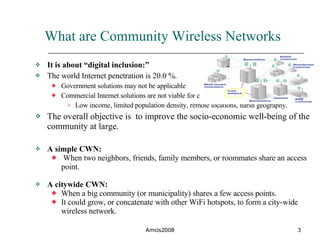
What are Community Wireless Networks It is about “digital inclusion:” The world Internet penetration is 20.0 %.  Government solutions may not be applicable  Commercial Internet solutions are not viable for communities that have:  Low income, limited population density, remote locations, harsh geography. The overall objective is  to improve the socio-economic well-being of the community at large. A simple CWN: When two neighbors, friends, family members, or roommates share an access point. A citywide CWN:  When a big community (or municipality) shares a few access points. It could grow, or concatenate with other WiFi hotspots, to form a city-wide wireless network.  Amcis2008 Amcis2008
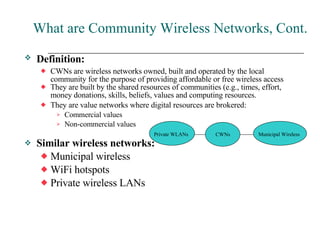
What are Community Wireless Networks, Cont.  Definition:   CWNs are wireless networks owned, built and operated by the local community for the purpose of providing affordable or free wireless access They are built by the shared resources of communities (e.g., times, effort, money donations, skills, beliefs, values and computing resources. They are value networks where digital resources are brokered: Commercial values  Non-commercial values Similar wireless networks: Municipal wireless WiFi hotspots Private wireless LANs  Private WLANs   Municipal Wireless   CWNs
Issues of CWNs Issues of CWNs:   CWNs are complex systems with several social, economic, and technical variables. There is a lack of  theories and general models that describe and analyze these emerging networks  CWNs are mixed with municipal wireless networks, and public WiFi hotspots Literature has been influenced by computer geeks and non academicians. How can we measure the contributions and the benefits of stakeholders  The Objective: Using graph theory to describe and  analyze CWNs and solve related problems. We used a socio-technical approach is used to find the Internet connectivity solution that fits a specific social group   Amcis2008 Amcis2008
Developing a Wireless Network Suitable for a Specific Social Network   Amcis2008 The social graph supported by the CWN The wireless graph that serves the community Will the attributes of the community determine the suitable connectivity solution ?
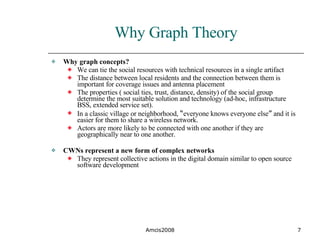
Why Graph Theory Why graph concepts? We can tie the social resources with technical resources in a single artifact The distance between local residents and the connection between them is important for coverage issues and antenna placement The properties ( social ties, trust, distance, density) of the social group determine the most suitable solution and technology (ad-hoc, infrastructure BSS, extended service set). In a classic village or neighborhood,  “ everyone knows everyone else ”  and it is easier for them to share a wireless network.  Actors are more likely to be connected with one another if they are geographically near to one another. CWNs represent a new form of complex networks  They represent collective actions in the digital domain similar to open source software development Amcis2008
What is a Graph? A graph is a mathematical model G(V,E) comprises a set V of vertices and a set E of edges.  The node set could be anything. The set of edges represent ties between nodes.  If there is a tie between a and b, then {a,b}  ⊆  E   : a,b  ∈ V and a≠b}. then we say vertices a and b are adjacent and the edge {a, b} joins them or connects them or is incident on them.  Two edges that share one vertex, such as {a,b} and {b,c} with a≠c, are adjacent to each other. Edges could have weights, the weight of {a,b} is 5.  Vertex {f} is isolated  We have three components  {f}, {h, g}, {a, b, c, d, e}  Amcis2008 Amcis2008 a b c d e f h g 5
What can graphs model? Health Care   Health support systems, spread of diseases Computer Science[  Cost of wiring  computer networks  Analyzing peer-to-peer networks Analyzing online social networks (e.g., emails, blogs, MySpace) Management Science Corporate strategic alliances, organizational hierarchy  Information flows, trade, partnerships  Social Science  Neighboring behavior, community participation, civic engagement Children groups, friendship, high school cliques  Work teams, voluntary associations, social movements Social contacts (kinship, terrorism, crime networks)  Economics and Finance Financial networks Good exchange, market contracts, and trade agreements Many other applications in anthropology, transportation, biology  Amcis2008 Amcis2008 The world is composed of networks
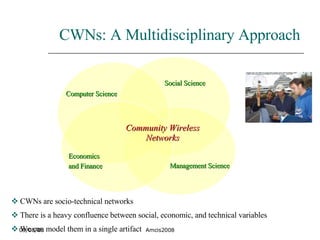
Community Wireless Networks Computer Science   Management Science Social Science Economics and Finance CWNs: A Multidisciplinary Approach CWNs are socio-technical networks  There is a heavy confluence between social, economic, and technical variables  We can model them in a single artifact
Proposed Graph Theoretic Model . Amcis2008 Amcis2008 Outputs  Inputs Volunteerism, donations, partnerships, node hosting, OSS, frequency regulation, social ties and values  CWNs Value proposition, incentives,  management, ownership, pricing, funding, acceptance QoS, security, reliability, node placement, coverage, data rate, signal interference  Tech factors Social   factors Graph theory  Physical capital, social capital and human capital  Variables of  CWNs   Implementation phase Operation phase Educational, commercial, medical, municipal, societal, and personal services Mobility, affordability, time and effort savings, resource sharing Social and economic development
A Graph Theoretic Model for CWNs, cont. Each CWN is composed of a wireless graph ( or network) that serves a social graph The wireless graph: The wireless network is a directed graph Gw = (Vw, Ew) Its nodes are workstations, routers, extenders, etc Its links are the wireless signals These links have attributes such as bit rate, packet delay, packet loss, security, etc  The social graph: The community is represented by a directed graph Gs (Vs, Es),  Its set of nodes Vs represents actors or CWNs Its set of edges  Es represent the social ties and interactions between these stakeholders.  These ties could be kinship, neighborhood, collaboration, friendship, reciprocation, trust, etc. Vs has three categories of actors: beneficiaries, contributors, and isolated nodes. Edges are weighted by the contributions and the benefits of participants.  Benefits include free Internet access, donated PCs, technical expertise, exposure, or spiritual benefits. Contributions include voluntary work or technical skills, donating money or old equipment, hosting a wireless node. The confluence and interaction between these two graphs determine the functionality of CWNs  Amcis2008 Amcis2008
Advantages of this Model    It provides the vocabularies, concepts and the mathematical operations that could be used to label, denote, quantify and measure variables of CWNs; It gives us the ability to prove theories and deduce testable statements related to CWNs as complex networks.  We can determine who are the main actors in the network? Who has control over what flows in the network? We can identify the location with best visibility to install the facilities We can cluster nodes in a way that provides better coverage and higher performance We can identify bottlenecks or central nodes that provide the only connection between different parts of the network. We can measure the flows of tangible (e.g., donations) and intangibles (e.g., trust, social cohesion, influence, knowledge) in the network We can identify isolated nodes It shows the importance of structural properties of communities while developing CWNs
Modeling Stakeholders of CWNs Stakeholders of CWNs: Community members, Volunteers, municipalities, businesses, technology vendors, nonprofit organizations, open source software developers, academic institutions, students, churches, etc. These stakeholders could be classified into beneficiaries, contributors, and isolates.  Their contributions: Donations, partnerships, volunteerism, technical skills, sharing a wireless signal with others. These contributions represent the role of social communities in building and sustaining their own wireless networks Their benefits: Providing free Internet access to bridge the digital divide; Improving the business opportunities in the area; Improving the civic engagement and political participation; Supporting municipal services Obtaining technical expertise Gaining publicity and exposure  Improving the well-being of the community at large. We can use concepts of graph theory to measure their contributions and benefits?   This is important to empower them and engage them in building and maintaining these networks   Amcis2008
Modeling The Omaha Wireless Network   Washington Library  Elmwood Park  UNO Rosenblatt Stadium  Micro-Macro level of analysis We view the Omaha wireless network as a value network  The columns represent benefits and the rows represent contributions of different actors - - 0 0 Access to public places  Municipalities 0 - Access points 0 Access points  Tech. vendors Reputation  Publicity  - Exposure Publicity  community   0 Technical skills  - Reputation  Students  Reputation Publicity Free internet, old PCs, civic engagement Experience , free internet - PKI Municipalities  Vendors Omaha community Students PKI  
Determining Where to Install the Access Point  A central actor is the one that is involved in many ties. The PKI is the graph center We installed access points at PKI because of its high centrality The administration unit is also hosted by PKI because of its high centrality  Amcis2008
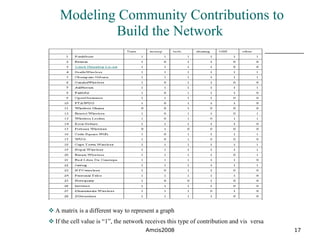
Modeling Community Contributions to Build the Network   Amcis2008 A matrix is a different way to represent a graph If the cell value is “1”, the network receives this type of contribution and vis  versa
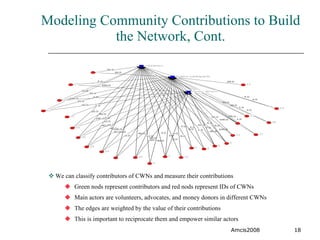
Modeling Community Contributions to Build the Network, Cont. Amcis2008 We can classify contributors of CWNs and measure their contributions Green nods represent contributors and red nods represent IDs of CWNs Main actors are volunteers, advocates, and money donors in different CWNs The edges are weighted by the value of their contributions  This is important to reciprocate them and empower similar actors
Modeling Community Contributions to Build the Network, Cont Amcis2008   time money Tech.support Sharing OSS Other Time 1 0.06 0.46 0.59 0.3 0.22 Money 0.06 1 0.06 0.2 0.28 0.2 tech.support 0.46 0.06 1 0.23 0.3 0.22 Sharing 0.59 0.2 0.23 1 0.13 0.18 develop software 0.3 0.28 0.3 0.13 1 0.46 Other 0.22 0.2 0.22 0.18 0.46 1 The Similarity Matrix between Different Types of Community Contributions
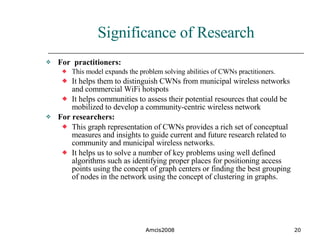
Significance of Research For  practitioners: This model expands the problem solving abilities of CWNs practitioners. It helps them to distinguish CWNs from municipal wireless networks and commercial WiFi hotspots It helps communities to assess their potential resources that could be mobilized to develop a community-centric wireless network  For researchers: This graph representation of CWNs provides a rich set of conceptual measures and insights to guide current and future research related to community and municipal wireless networks. It helps us to solve a number of key problems using well defined algorithms such as identifying proper places for positioning access points using the concept of graph centers or finding the best grouping of nodes in the network using the concept of clustering in graphs.  Amcis2008 Amcis2008
Significance of Research, Cont. The model limitations:  It is difficult to aggregate the tangible and intangible benefits and contributions of CWNs’ actors. It is difficult to include all actors in the study.  CWNs are networks not systems Current and future work:   Addressing the impact of the social variables (e.g., community size, density of the network, and types of used applications) on the technical factors such as signal interference, QoS, throughput, and the optimal network size. Measuring the role of CWNs in generating social capital and human capital.  Measuring the trust in the domain of CWNs The originality   of our research : Modeling CWNs in a single artifact We consider the multidisciplinary nature of CWNs  Economic flows, social networks, and computer networks are interrelated in CWNs  The tangible and intangible contributions and benefits of CWNs stakeholders have measurable economic value Amcis2008 Amcis2008
Conclusion  We view a CWN as two graphs: a social graph and a wireless graph. We used graph concepts to model and attribute CWNs CWNs are value networks where digital resources are brokered among community members The attributes and the interactions between the components of these two graphs determine different aspects of CWNs. This quantitative artifact helps us to study CWNs and measure their related variables  It helps us to decide where to install the access point or router It helps us to classify the stakeholders of CWNs and identify their contributions and benefits.  Future work will focus on measuring the role of CWNs in creating social and human capital  Amcis2008 Amcis2008
www.liewcf.com/.../diy-wifi-antenna.jpg
gtresearchnews.gatech.edu /.../hybrid- network.htm

Graph Theoretic Model for Community Wireless Networks

  • 1.
    A Graph TheoreticApproach for Analysis and Design of Community Wireless Networks Abdelnasser M. Abdelaal and Hesham H. Ali Department of Computer Science College of Information Science and Technology University of Nebraska at Omaha Omaha, NE 68182 {aabdelaal | hali}@mail.unomaha.edu Amcis2008 Amcis2008
  • 2.
    Agenda Introduction Graph Modeling Proposed Graph Theoretic Model Significance of Research Conclusion Amcis2008
  • 3.
    What are CommunityWireless Networks It is about “digital inclusion:” The world Internet penetration is 20.0 %. Government solutions may not be applicable Commercial Internet solutions are not viable for communities that have: Low income, limited population density, remote locations, harsh geography. The overall objective is to improve the socio-economic well-being of the community at large. A simple CWN: When two neighbors, friends, family members, or roommates share an access point. A citywide CWN: When a big community (or municipality) shares a few access points. It could grow, or concatenate with other WiFi hotspots, to form a city-wide wireless network. Amcis2008 Amcis2008
  • 4.
    What are CommunityWireless Networks, Cont. Definition: CWNs are wireless networks owned, built and operated by the local community for the purpose of providing affordable or free wireless access They are built by the shared resources of communities (e.g., times, effort, money donations, skills, beliefs, values and computing resources. They are value networks where digital resources are brokered: Commercial values Non-commercial values Similar wireless networks: Municipal wireless WiFi hotspots Private wireless LANs Private WLANs Municipal Wireless CWNs
  • 5.
    Issues of CWNsIssues of CWNs: CWNs are complex systems with several social, economic, and technical variables. There is a lack of theories and general models that describe and analyze these emerging networks CWNs are mixed with municipal wireless networks, and public WiFi hotspots Literature has been influenced by computer geeks and non academicians. How can we measure the contributions and the benefits of stakeholders The Objective: Using graph theory to describe and analyze CWNs and solve related problems. We used a socio-technical approach is used to find the Internet connectivity solution that fits a specific social group Amcis2008 Amcis2008
  • 6.
    Developing a WirelessNetwork Suitable for a Specific Social Network Amcis2008 The social graph supported by the CWN The wireless graph that serves the community Will the attributes of the community determine the suitable connectivity solution ?
  • 7.
    Why Graph TheoryWhy graph concepts? We can tie the social resources with technical resources in a single artifact The distance between local residents and the connection between them is important for coverage issues and antenna placement The properties ( social ties, trust, distance, density) of the social group determine the most suitable solution and technology (ad-hoc, infrastructure BSS, extended service set). In a classic village or neighborhood, “ everyone knows everyone else ” and it is easier for them to share a wireless network. Actors are more likely to be connected with one another if they are geographically near to one another. CWNs represent a new form of complex networks They represent collective actions in the digital domain similar to open source software development Amcis2008
  • 8.
    What is aGraph? A graph is a mathematical model G(V,E) comprises a set V of vertices and a set E of edges. The node set could be anything. The set of edges represent ties between nodes. If there is a tie between a and b, then {a,b} ⊆ E : a,b ∈ V and a≠b}. then we say vertices a and b are adjacent and the edge {a, b} joins them or connects them or is incident on them. Two edges that share one vertex, such as {a,b} and {b,c} with a≠c, are adjacent to each other. Edges could have weights, the weight of {a,b} is 5. Vertex {f} is isolated We have three components {f}, {h, g}, {a, b, c, d, e} Amcis2008 Amcis2008 a b c d e f h g 5
  • 9.
    What can graphsmodel? Health Care Health support systems, spread of diseases Computer Science[ Cost of wiring computer networks Analyzing peer-to-peer networks Analyzing online social networks (e.g., emails, blogs, MySpace) Management Science Corporate strategic alliances, organizational hierarchy Information flows, trade, partnerships Social Science Neighboring behavior, community participation, civic engagement Children groups, friendship, high school cliques Work teams, voluntary associations, social movements Social contacts (kinship, terrorism, crime networks) Economics and Finance Financial networks Good exchange, market contracts, and trade agreements Many other applications in anthropology, transportation, biology Amcis2008 Amcis2008 The world is composed of networks
  • 10.
    Community Wireless NetworksComputer Science Management Science Social Science Economics and Finance CWNs: A Multidisciplinary Approach CWNs are socio-technical networks There is a heavy confluence between social, economic, and technical variables We can model them in a single artifact
  • 11.
    Proposed Graph TheoreticModel . Amcis2008 Amcis2008 Outputs Inputs Volunteerism, donations, partnerships, node hosting, OSS, frequency regulation, social ties and values CWNs Value proposition, incentives, management, ownership, pricing, funding, acceptance QoS, security, reliability, node placement, coverage, data rate, signal interference Tech factors Social factors Graph theory Physical capital, social capital and human capital Variables of CWNs Implementation phase Operation phase Educational, commercial, medical, municipal, societal, and personal services Mobility, affordability, time and effort savings, resource sharing Social and economic development
  • 12.
    A Graph TheoreticModel for CWNs, cont. Each CWN is composed of a wireless graph ( or network) that serves a social graph The wireless graph: The wireless network is a directed graph Gw = (Vw, Ew) Its nodes are workstations, routers, extenders, etc Its links are the wireless signals These links have attributes such as bit rate, packet delay, packet loss, security, etc The social graph: The community is represented by a directed graph Gs (Vs, Es), Its set of nodes Vs represents actors or CWNs Its set of edges Es represent the social ties and interactions between these stakeholders. These ties could be kinship, neighborhood, collaboration, friendship, reciprocation, trust, etc. Vs has three categories of actors: beneficiaries, contributors, and isolated nodes. Edges are weighted by the contributions and the benefits of participants. Benefits include free Internet access, donated PCs, technical expertise, exposure, or spiritual benefits. Contributions include voluntary work or technical skills, donating money or old equipment, hosting a wireless node. The confluence and interaction between these two graphs determine the functionality of CWNs Amcis2008 Amcis2008
  • 13.
    Advantages of thisModel It provides the vocabularies, concepts and the mathematical operations that could be used to label, denote, quantify and measure variables of CWNs; It gives us the ability to prove theories and deduce testable statements related to CWNs as complex networks. We can determine who are the main actors in the network? Who has control over what flows in the network? We can identify the location with best visibility to install the facilities We can cluster nodes in a way that provides better coverage and higher performance We can identify bottlenecks or central nodes that provide the only connection between different parts of the network. We can measure the flows of tangible (e.g., donations) and intangibles (e.g., trust, social cohesion, influence, knowledge) in the network We can identify isolated nodes It shows the importance of structural properties of communities while developing CWNs
  • 14.
    Modeling Stakeholders ofCWNs Stakeholders of CWNs: Community members, Volunteers, municipalities, businesses, technology vendors, nonprofit organizations, open source software developers, academic institutions, students, churches, etc. These stakeholders could be classified into beneficiaries, contributors, and isolates. Their contributions: Donations, partnerships, volunteerism, technical skills, sharing a wireless signal with others. These contributions represent the role of social communities in building and sustaining their own wireless networks Their benefits: Providing free Internet access to bridge the digital divide; Improving the business opportunities in the area; Improving the civic engagement and political participation; Supporting municipal services Obtaining technical expertise Gaining publicity and exposure Improving the well-being of the community at large. We can use concepts of graph theory to measure their contributions and benefits? This is important to empower them and engage them in building and maintaining these networks Amcis2008
  • 15.
    Modeling The OmahaWireless Network Washington Library Elmwood Park UNO Rosenblatt Stadium Micro-Macro level of analysis We view the Omaha wireless network as a value network The columns represent benefits and the rows represent contributions of different actors - - 0 0 Access to public places Municipalities 0 - Access points 0 Access points Tech. vendors Reputation Publicity - Exposure Publicity community   0 Technical skills - Reputation Students Reputation Publicity Free internet, old PCs, civic engagement Experience , free internet - PKI Municipalities Vendors Omaha community Students PKI  
  • 16.
    Determining Where toInstall the Access Point A central actor is the one that is involved in many ties. The PKI is the graph center We installed access points at PKI because of its high centrality The administration unit is also hosted by PKI because of its high centrality Amcis2008
  • 17.
    Modeling Community Contributionsto Build the Network Amcis2008 A matrix is a different way to represent a graph If the cell value is “1”, the network receives this type of contribution and vis versa
  • 18.
    Modeling Community Contributionsto Build the Network, Cont. Amcis2008 We can classify contributors of CWNs and measure their contributions Green nods represent contributors and red nods represent IDs of CWNs Main actors are volunteers, advocates, and money donors in different CWNs The edges are weighted by the value of their contributions This is important to reciprocate them and empower similar actors
  • 19.
    Modeling Community Contributionsto Build the Network, Cont Amcis2008   time money Tech.support Sharing OSS Other Time 1 0.06 0.46 0.59 0.3 0.22 Money 0.06 1 0.06 0.2 0.28 0.2 tech.support 0.46 0.06 1 0.23 0.3 0.22 Sharing 0.59 0.2 0.23 1 0.13 0.18 develop software 0.3 0.28 0.3 0.13 1 0.46 Other 0.22 0.2 0.22 0.18 0.46 1 The Similarity Matrix between Different Types of Community Contributions
  • 20.
    Significance of ResearchFor practitioners: This model expands the problem solving abilities of CWNs practitioners. It helps them to distinguish CWNs from municipal wireless networks and commercial WiFi hotspots It helps communities to assess their potential resources that could be mobilized to develop a community-centric wireless network For researchers: This graph representation of CWNs provides a rich set of conceptual measures and insights to guide current and future research related to community and municipal wireless networks. It helps us to solve a number of key problems using well defined algorithms such as identifying proper places for positioning access points using the concept of graph centers or finding the best grouping of nodes in the network using the concept of clustering in graphs. Amcis2008 Amcis2008
  • 21.
    Significance of Research,Cont. The model limitations: It is difficult to aggregate the tangible and intangible benefits and contributions of CWNs’ actors. It is difficult to include all actors in the study. CWNs are networks not systems Current and future work: Addressing the impact of the social variables (e.g., community size, density of the network, and types of used applications) on the technical factors such as signal interference, QoS, throughput, and the optimal network size. Measuring the role of CWNs in generating social capital and human capital. Measuring the trust in the domain of CWNs The originality of our research : Modeling CWNs in a single artifact We consider the multidisciplinary nature of CWNs Economic flows, social networks, and computer networks are interrelated in CWNs The tangible and intangible contributions and benefits of CWNs stakeholders have measurable economic value Amcis2008 Amcis2008
  • 22.
    Conclusion Weview a CWN as two graphs: a social graph and a wireless graph. We used graph concepts to model and attribute CWNs CWNs are value networks where digital resources are brokered among community members The attributes and the interactions between the components of these two graphs determine different aspects of CWNs. This quantitative artifact helps us to study CWNs and measure their related variables It helps us to decide where to install the access point or router It helps us to classify the stakeholders of CWNs and identify their contributions and benefits. Future work will focus on measuring the role of CWNs in creating social and human capital Amcis2008 Amcis2008
  • 23.
  • 24.