Click to edit Master title style


                        Mohammad Noori
                     mohammad.noori@gmail.com
International Federation of Engineering Education Societies (IFEES)
                       Global Webinar Series

 Sponsored by Indo-US Collaboration for Engineering Education (IUCEE.Org)
                          December 6, 2011
Changing Role of Engineers and
the Need to Reform Engineering Curriculum
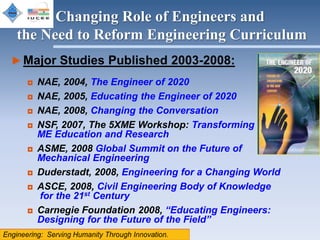
► Major Studies Published 2003-2008:
  ◘   NAE, 2004, The Engineer of 2020
  ◘   NAE, 2005, Educating the Engineer of 2020
  ◘   NAE, 2008, Changing the Conversation
  ◘   NSF, 2007, The 5XME Workshop: Transforming
      ME Education and Research
  ◘   ASME, 2008 Global Summit on the Future of
      Mechanical Engineering
  ◘   Duderstadt, 2008, Engineering for a Changing World
  ◘   ASCE, 2008, Civil Engineering Body of Knowledge
      for the 21st Century
  ◘   Carnegie Foundation 2008, “Educating Engineers:
      Designing for the Future of the Field”
Grand Challenges- Background
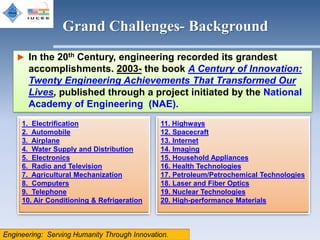
► In the 20th Century, engineering recorded its grandest
  accomplishments. 2003- the book A Century of Innovation:
  Twenty Engineering Achievements That Transformed Our
  Lives, published through a project initiated by the National
  Academy of Engineering (NAE).
 1. Electrification                     11. Highways
 2. Automobile                          12. Spacecraft
 3. Airplane                            13. Internet
 4. Water Supply and Distribution       14. Imaging
 5. Electronics                         15. Household Appliances
 6. Radio and Television                16. Health Technologies
 7. Agricultural Mechanization          17. Petroleum/Petrochemical Technologies
 8. Computers                           18. Laser and Fiber Optics
 9. Telephone                           19. Nuclear Technologies
 10. Air Conditioning & Refrigeration   20. High-performance Materials
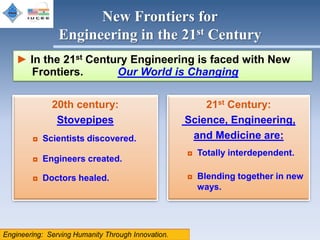
New Frontiers for
        Engineering in the 21st Century
► In the 21st Century Engineering is faced with New
  Frontiers.       Our World is Changing

      20th century:                21st Century:
       Stovepipes              Science, Engineering,
  ◘ Scientists discovered.      and Medicine are:
                               ◘ Totally interdependent.
  ◘ Engineers created.

  ◘ Doctors healed.            ◘ Blending together in new
                                 ways.
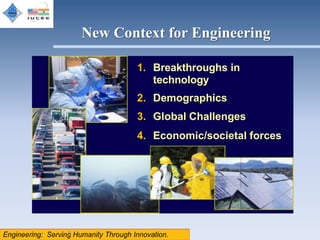
New Context for Engineering

           1. Breakthroughs in
              technology
           2. Demographics
           3. Global Challenges
           4. Economic/societal forces


5
New Context for Engineering
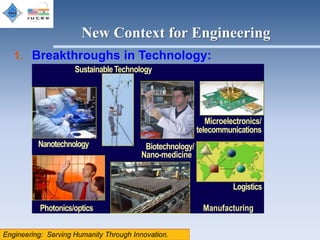
1. Breakthroughs in Technology:
              Sustainable Technology


                                                     Microelectronics/
                                                  telecommunications
   Nanotechnology                Biotechnology/
                                Nano-medicine


                                                             Logistics

    Photonics/optics                                Manufacturing
New Context for Engineering
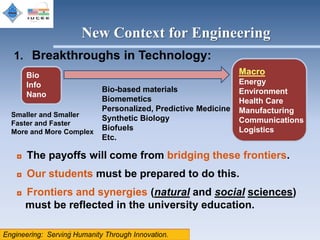
1. Breakthroughs in Technology:
   Bio                                                      Macro
   Info                                                     Energy
                        Bio-based materials                 Environment
   Nano
                        Biomemetics                         Health Care
                        Personalized, Predictive Medicine   Manufacturing
Smaller and Smaller
                        Synthetic Biology                   Communications
Faster and Faster
More and More Complex
                        Biofuels                            Logistics
                        Etc.

 ◘ The payoffs will come from bridging these frontiers.

 ◘ Our students must be prepared to do this.

 ◘ Frontiers and synergies (natural and social sciences)
   must be reflected in the university education.

              7
New Context for Engineering
2. Demographics

Global Challenges are a New Reality
► 8 billion people; a 25% increase since 2000.
► Balance tipped toward urbanization and “Mega Cities”.
    By 2007, for the 1st time, majority of population lived in cities
    By the end of 2010, more than 59 cities with population of
      more than 5 million; 50% increase since 2001
    Challenges: Environmental issues, congestion, delivery
     systems, etc. For instance, in 2007, congestion in American
     populated cities caused: travel 4.2B hours more, and an extra
     2.8B gallons of fuel---a total congestion cost of $87.2B.

            8
New Context for Engineering
2. Demographics

Global Challenges are a New Reality


► Youth “bulge” in underdeveloped nations while
 developed nations age.
► If the world condensed to 100 people:
   ◘ 56 in Asia
   ◘ 7 in Eastern Europe/Russia
   ◘ 16 in Africa
   ◘ 4 in the United States

         9

Grand Challenges Webinar at IFEES-India

  • 1.
    Click to editMaster title style Mohammad Noori mohammad.noori@gmail.com International Federation of Engineering Education Societies (IFEES) Global Webinar Series Sponsored by Indo-US Collaboration for Engineering Education (IUCEE.Org) December 6, 2011
  • 2.
    Changing Role ofEngineers and the Need to Reform Engineering Curriculum ► Major Studies Published 2003-2008: ◘ NAE, 2004, The Engineer of 2020 ◘ NAE, 2005, Educating the Engineer of 2020 ◘ NAE, 2008, Changing the Conversation ◘ NSF, 2007, The 5XME Workshop: Transforming ME Education and Research ◘ ASME, 2008 Global Summit on the Future of Mechanical Engineering ◘ Duderstadt, 2008, Engineering for a Changing World ◘ ASCE, 2008, Civil Engineering Body of Knowledge for the 21st Century ◘ Carnegie Foundation 2008, “Educating Engineers: Designing for the Future of the Field”
  • 3.
    Grand Challenges- Background ►In the 20th Century, engineering recorded its grandest accomplishments. 2003- the book A Century of Innovation: Twenty Engineering Achievements That Transformed Our Lives, published through a project initiated by the National Academy of Engineering (NAE). 1. Electrification 11. Highways 2. Automobile 12. Spacecraft 3. Airplane 13. Internet 4. Water Supply and Distribution 14. Imaging 5. Electronics 15. Household Appliances 6. Radio and Television 16. Health Technologies 7. Agricultural Mechanization 17. Petroleum/Petrochemical Technologies 8. Computers 18. Laser and Fiber Optics 9. Telephone 19. Nuclear Technologies 10. Air Conditioning & Refrigeration 20. High-performance Materials
  • 4.
    New Frontiers for Engineering in the 21st Century ► In the 21st Century Engineering is faced with New Frontiers. Our World is Changing 20th century: 21st Century: Stovepipes Science, Engineering, ◘ Scientists discovered. and Medicine are: ◘ Totally interdependent. ◘ Engineers created. ◘ Doctors healed. ◘ Blending together in new ways.
  • 5.
    New Context forEngineering 1. Breakthroughs in technology 2. Demographics 3. Global Challenges 4. Economic/societal forces 5
  • 6.
    New Context forEngineering 1. Breakthroughs in Technology: Sustainable Technology Microelectronics/ telecommunications Nanotechnology Biotechnology/ Nano-medicine Logistics Photonics/optics Manufacturing
  • 7.
    New Context forEngineering 1. Breakthroughs in Technology: Bio Macro Info Energy Bio-based materials Environment Nano Biomemetics Health Care Personalized, Predictive Medicine Manufacturing Smaller and Smaller Synthetic Biology Communications Faster and Faster More and More Complex Biofuels Logistics Etc. ◘ The payoffs will come from bridging these frontiers. ◘ Our students must be prepared to do this. ◘ Frontiers and synergies (natural and social sciences) must be reflected in the university education. 7
  • 8.
    New Context forEngineering 2. Demographics Global Challenges are a New Reality ► 8 billion people; a 25% increase since 2000. ► Balance tipped toward urbanization and “Mega Cities”.  By 2007, for the 1st time, majority of population lived in cities  By the end of 2010, more than 59 cities with population of more than 5 million; 50% increase since 2001  Challenges: Environmental issues, congestion, delivery systems, etc. For instance, in 2007, congestion in American populated cities caused: travel 4.2B hours more, and an extra 2.8B gallons of fuel---a total congestion cost of $87.2B. 8
  • 9.
    New Context forEngineering 2. Demographics Global Challenges are a New Reality ► Youth “bulge” in underdeveloped nations while developed nations age. ► If the world condensed to 100 people: ◘ 56 in Asia ◘ 7 in Eastern Europe/Russia ◘ 16 in Africa ◘ 4 in the United States 9