GrammarLearningStrategyInventory(GLSI):Anotherlook
377
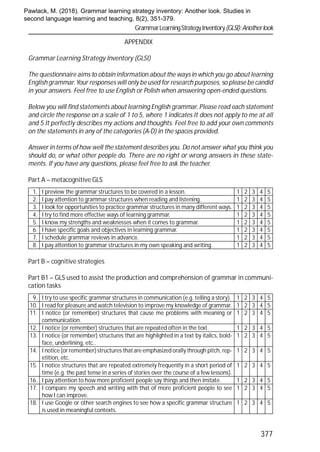
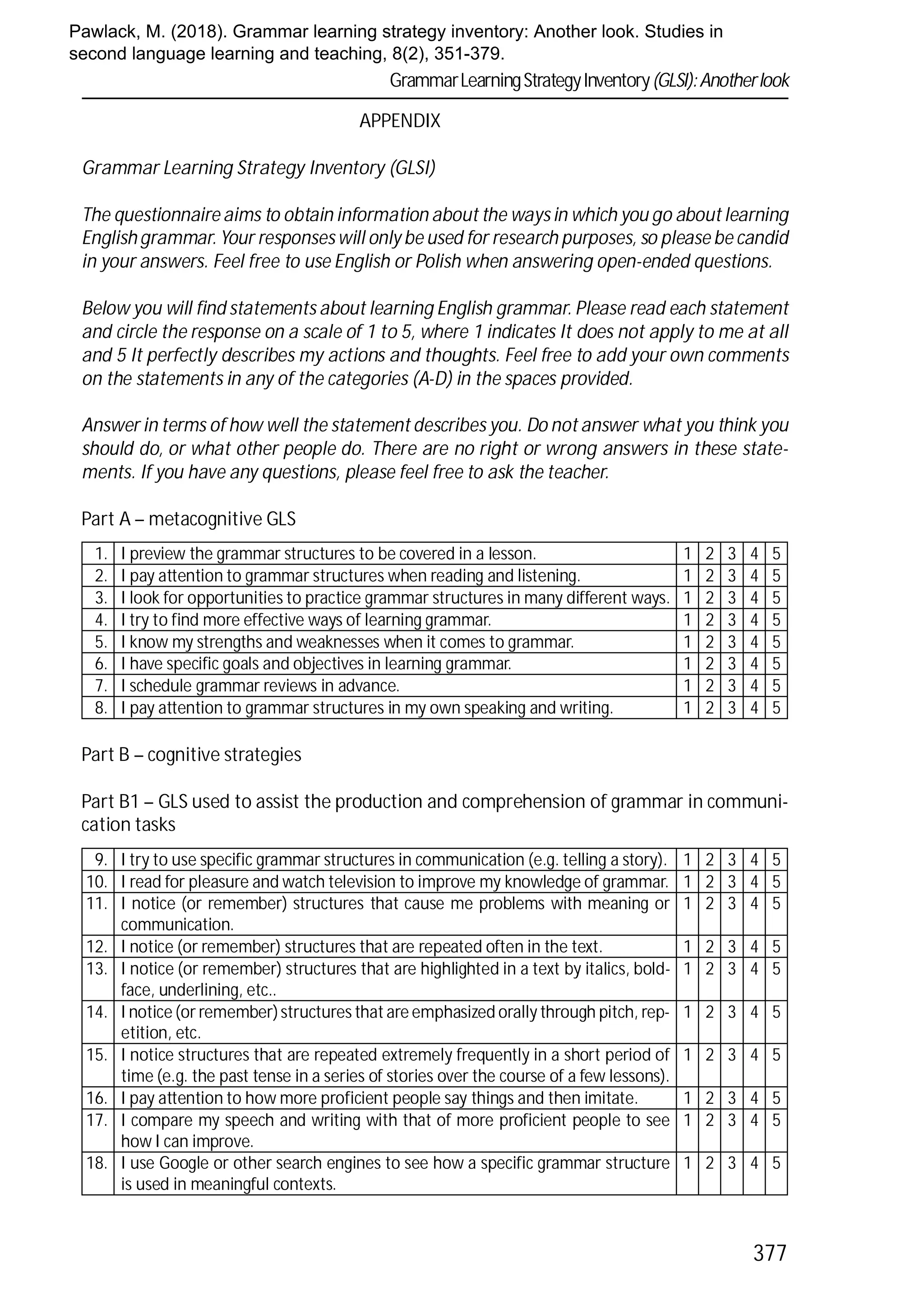
APPENDIX
Grammar Learning Strategy Inventory (GLSI)
The questionnaire aims to obtain information about the ways in which you go about learning
English grammar. Your responseswill only be used for research purposes, so please be candid
in your answers. Feel free to use English or Polish when answering open-ended questions.
Below you will find statements about learning English grammar. Please read each statement
and circle the response on a scale of 1 to 5, where 1 indicates It does not apply to me at all
and 5 It perfectly describes my actions and thoughts. Feel free to add your own comments
on the statements in any of the categories (A-D) in the spaces provided.
Answer in terms of how well the statement describes you. Do not answer what you think you
should do, or what other people do. There are no right or wrong answers in these state-
ments. If you have any questions, please feel free to ask the teacher.
Part A – metacognitive GLS
1. I preview the grammar structures to be covered in a lesson. 1 2 3 4 5
2. I pay attention to grammar structures when reading and listening. 1 2 3 4 5
3. I look for opportunities to practice grammar structures in many different ways. 1 2 3 4 5
4. I try to find more effective ways of learning grammar. 1 2 3 4 5
5. I know my strengths and weaknesses when it comes to grammar. 1 2 3 4 5
6. I have specific goals and objectives in learning grammar. 1 2 3 4 5
7. I schedule grammar reviews in advance. 1 2 3 4 5
8. I pay attention to grammar structures in my own speaking and writing. 1 2 3 4 5
Part B – cognitive strategies
Part B1 – GLS used to assist the production and comprehension of grammar in communi-
cation tasks
9. I try to use specific grammar structures in communication (e.g. telling a story). 1 2 3 4 5
10. I read for pleasure and watch television to improve my knowledge of grammar. 1 2 3 4 5
11. I notice (or remember) structures that cause me problems with meaning or
communication.
1 2 3 4 5
12. I notice (or remember) structures that are repeated often in the text. 1 2 3 4 5
13. I notice (or remember) structures that are highlighted in a text by italics, bold-
face, underlining, etc..
1 2 3 4 5
14. I notice (or remember)structures that are emphasized orally through pitch, rep-
etition, etc.
1 2 3 4 5
15. I notice structures that are repeated extremely frequently in a short period of
time (e.g. the past tense in a series of stories over the course of a few lessons).
1 2 3 4 5
16. I pay attention to how more proficient people say things and then imitate. 1 2 3 4 5
17. I compare my speech and writing with that of more proficient people to see
how I can improve.
1 2 3 4 5
18. I use Google or other search engines to see how a specific grammar structure
is used in meaningful contexts.
1 2 3 4 5
Pawlack, M. (2018). Grammar learning strategy inventory: Another look. Studies in
second language learning and teaching, 8(2), 351-379.
Mirosław Pawlak
378
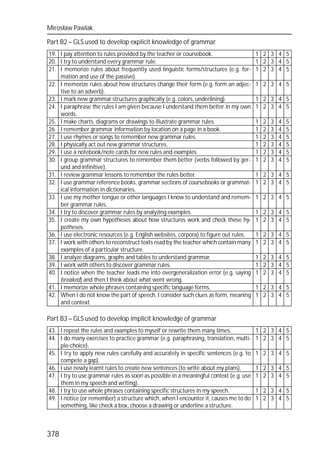
Part B2 – GLS used to develop explicit knowledge of grammar
19. I pay attention to rules provided by the teacher or coursebook. 1 2 3 4 5
20. I try to understand every grammar rule. 1 2 3 4 5
21. I memorize rules about frequently used linguistic forms/structures (e.g. for-
mation and use of the passive).
1 2 3 4 5
22. I memorize rules about how structures change their form (e.g. form an adjec-
tive to an adverb).
1 2 3 4 5
23. I mark new grammar structures graphically (e.g. colors, underlining). 1 2 3 4 5
24. I paraphrase the rules I am given because I understand them better in my own
words.
1 2 3 4 5
25. I make charts, diagrams or drawings to illustrate grammar rules. 1 2 3 4 5
26. I remember grammar information by location on a page in a book. 1 2 3 4 5
27. I use rhymes or songs to remember new grammar rules. 1 2 3 4 5
28. I physically act out new grammar structures. 1 2 3 4 5
29. I use a notebook/note cards for new rules and examples. 1 2 3 4 5
30. I group grammar structures to remember them better (verbs followed by ger-
und and infinitive).
1 2 3 4 5
31. I review grammar lessons to remember the rules better. 1 2 3 4 5
32. I use grammar reference books, grammar sections of coursebooks or grammat-
ical information in dictionaries.
1 2 3 4 5
33. I use my mother tongue or other languages I know to understand and remem-
ber grammar rules.
1 2 3 4 5
34. I try to discover grammar rules by analyzing examples. 1 2 3 4 5
35. I create my own hypotheses about how structures work and check these hy-
potheses.
1 2 3 4 5
36. I use electronic resources (e.g. English websites, corpora) to figure out rules. 1 2 3 4 5
37. I work with others to reconstruct texts read by the teacher which contain many
examples of a particular structure.
1 2 3 4 5
38. I analyze diagrams, graphs and tables to understand grammar. 1 2 3 4 5
39. I work with others to discover grammar rules. 1 2 3 4 5
40. I notice when the teacher leads me into overgeneralization error (e.g. saying
breaked) and then I think about what went wrong.
1 2 3 4 5
41. I memorize whole phrases containing specific language forms. 1 2 3 4 5
42. When I do not know the part of speech, I consider such clues as form, meaning
and context.
1 2 3 4 5
Part B3 – GLS used to develop implicit knowledge of grammar
43. I repeat the rules and examples to myself or rewrite them many times. 1 2 3 4 5
44. I do many exercises to practice grammar (e.g. paraphrasing, translation, multi-
ple-choice).
1 2 3 4 5
45. I try to apply new rules carefully and accurately in specific sentences (e.g. to
compete a gap).
1 2 3 4 5
46. I use newly learnt rules to create new sentences (to write about my plans). 1 2 3 4 5
47. I try to use grammar rules as soon as possible in a meaningful context (e.g. use
them in my speech and writing).
1 2 3 4 5
48. I try to use whole phrases containing specific structures in my speech. 1 2 3 4 5
49. I notice (or remember) a structure which, when I encounter it, causes me to do
something, like check a box, choose a drawing or underline a structure.
1 2 3 4 5
GrammarLearningStrategyInventory(GLSI):Anotherlook
379
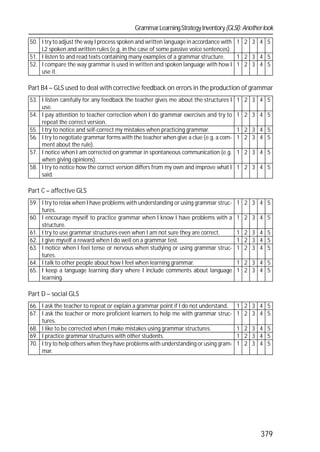
50. I try to adjust the way I process spoken and written language in accordance with
L2 spoken and written rules (e.g. in the case of some passive voice sentences).
1 2 3 4 5
51. I listen to and read texts containing many examples of a grammar structure. 1 2 3 4 5
52. I compare the way grammar is used in written and spoken language with how I
use it.
1 2 3 4 5
Part B4 – GLS used to deal with corrective feedback on errors in the production of grammar
53. I listen carefully for any feedback the teacher gives me about the structures I
use.
1 2 3 4 5
54. I pay attention to teacher correction when I do grammar exercises and try to
repeat the correct version.
1 2 3 4 5
55. I try to notice and self-correct my mistakes when practicing grammar. 1 2 3 4 5
56. I try to negotiate grammar forms with the teacher when give a clue (e.g. a com-
ment about the rule).
1 2 3 4 5
57. I notice when I am corrected on grammar in spontaneous communication (e.g.
when giving opinions).
1 2 3 4 5
58. I try to notice how the correct version differs from my own and improve what I
said.
1 2 3 4 5
Part C – affective GLS
59. I try to relax when I have problems with understanding or using grammar struc-
tures.
1 2 3 4 5
60. I encourage myself to practice grammar when I know I have problems with a
structure.
1 2 3 4 5
61. I try to use grammar structures even when I am not sure they are correct. 1 2 3 4 5
62. I give myself a reward when I do well on a grammar test. 1 2 3 4 5
63. I notice when I feel tense or nervous when studying or using grammar struc-
tures.
1 2 3 4 5
64. I talk to other people about how I feel when learning grammar. 1 2 3 4 5
65. I keep a language learning diary where I include comments about language
learning.
1 2 3 4 5
Part D – social GLS
66. I ask the teacher to repeat or explain a grammar point if I do not understand. 1 2 3 4 5
67. I ask the teacher or more proficient learners to help me with grammar struc-
tures.
1 2 3 4 5
68. I like to be corrected when I make mistakes using grammar structures. 1 2 3 4 5
69. I practice grammar structures with other students. 1 2 3 4 5
70. I try to help others when they have problems with understanding orusing gram-
mar.
1 2 3 4 5

Grammar learning strategy inventory

  • 1.
    GrammarLearningStrategyInventory(GLSI):Anotherlook 377 APPENDIX Grammar Learning StrategyInventory (GLSI) The questionnaire aims to obtain information about the ways in which you go about learning English grammar. Your responseswill only be used for research purposes, so please be candid in your answers. Feel free to use English or Polish when answering open-ended questions. Below you will find statements about learning English grammar. Please read each statement and circle the response on a scale of 1 to 5, where 1 indicates It does not apply to me at all and 5 It perfectly describes my actions and thoughts. Feel free to add your own comments on the statements in any of the categories (A-D) in the spaces provided. Answer in terms of how well the statement describes you. Do not answer what you think you should do, or what other people do. There are no right or wrong answers in these state- ments. If you have any questions, please feel free to ask the teacher. Part A – metacognitive GLS 1. I preview the grammar structures to be covered in a lesson. 1 2 3 4 5 2. I pay attention to grammar structures when reading and listening. 1 2 3 4 5 3. I look for opportunities to practice grammar structures in many different ways. 1 2 3 4 5 4. I try to find more effective ways of learning grammar. 1 2 3 4 5 5. I know my strengths and weaknesses when it comes to grammar. 1 2 3 4 5 6. I have specific goals and objectives in learning grammar. 1 2 3 4 5 7. I schedule grammar reviews in advance. 1 2 3 4 5 8. I pay attention to grammar structures in my own speaking and writing. 1 2 3 4 5 Part B – cognitive strategies Part B1 – GLS used to assist the production and comprehension of grammar in communi- cation tasks 9. I try to use specific grammar structures in communication (e.g. telling a story). 1 2 3 4 5 10. I read for pleasure and watch television to improve my knowledge of grammar. 1 2 3 4 5 11. I notice (or remember) structures that cause me problems with meaning or communication. 1 2 3 4 5 12. I notice (or remember) structures that are repeated often in the text. 1 2 3 4 5 13. I notice (or remember) structures that are highlighted in a text by italics, bold- face, underlining, etc.. 1 2 3 4 5 14. I notice (or remember)structures that are emphasized orally through pitch, rep- etition, etc. 1 2 3 4 5 15. I notice structures that are repeated extremely frequently in a short period of time (e.g. the past tense in a series of stories over the course of a few lessons). 1 2 3 4 5 16. I pay attention to how more proficient people say things and then imitate. 1 2 3 4 5 17. I compare my speech and writing with that of more proficient people to see how I can improve. 1 2 3 4 5 18. I use Google or other search engines to see how a specific grammar structure is used in meaningful contexts. 1 2 3 4 5 Pawlack, M. (2018). Grammar learning strategy inventory: Another look. Studies in second language learning and teaching, 8(2), 351-379.
  • 2.
    Mirosław Pawlak 378 Part B2– GLS used to develop explicit knowledge of grammar 19. I pay attention to rules provided by the teacher or coursebook. 1 2 3 4 5 20. I try to understand every grammar rule. 1 2 3 4 5 21. I memorize rules about frequently used linguistic forms/structures (e.g. for- mation and use of the passive). 1 2 3 4 5 22. I memorize rules about how structures change their form (e.g. form an adjec- tive to an adverb). 1 2 3 4 5 23. I mark new grammar structures graphically (e.g. colors, underlining). 1 2 3 4 5 24. I paraphrase the rules I am given because I understand them better in my own words. 1 2 3 4 5 25. I make charts, diagrams or drawings to illustrate grammar rules. 1 2 3 4 5 26. I remember grammar information by location on a page in a book. 1 2 3 4 5 27. I use rhymes or songs to remember new grammar rules. 1 2 3 4 5 28. I physically act out new grammar structures. 1 2 3 4 5 29. I use a notebook/note cards for new rules and examples. 1 2 3 4 5 30. I group grammar structures to remember them better (verbs followed by ger- und and infinitive). 1 2 3 4 5 31. I review grammar lessons to remember the rules better. 1 2 3 4 5 32. I use grammar reference books, grammar sections of coursebooks or grammat- ical information in dictionaries. 1 2 3 4 5 33. I use my mother tongue or other languages I know to understand and remem- ber grammar rules. 1 2 3 4 5 34. I try to discover grammar rules by analyzing examples. 1 2 3 4 5 35. I create my own hypotheses about how structures work and check these hy- potheses. 1 2 3 4 5 36. I use electronic resources (e.g. English websites, corpora) to figure out rules. 1 2 3 4 5 37. I work with others to reconstruct texts read by the teacher which contain many examples of a particular structure. 1 2 3 4 5 38. I analyze diagrams, graphs and tables to understand grammar. 1 2 3 4 5 39. I work with others to discover grammar rules. 1 2 3 4 5 40. I notice when the teacher leads me into overgeneralization error (e.g. saying breaked) and then I think about what went wrong. 1 2 3 4 5 41. I memorize whole phrases containing specific language forms. 1 2 3 4 5 42. When I do not know the part of speech, I consider such clues as form, meaning and context. 1 2 3 4 5 Part B3 – GLS used to develop implicit knowledge of grammar 43. I repeat the rules and examples to myself or rewrite them many times. 1 2 3 4 5 44. I do many exercises to practice grammar (e.g. paraphrasing, translation, multi- ple-choice). 1 2 3 4 5 45. I try to apply new rules carefully and accurately in specific sentences (e.g. to compete a gap). 1 2 3 4 5 46. I use newly learnt rules to create new sentences (to write about my plans). 1 2 3 4 5 47. I try to use grammar rules as soon as possible in a meaningful context (e.g. use them in my speech and writing). 1 2 3 4 5 48. I try to use whole phrases containing specific structures in my speech. 1 2 3 4 5 49. I notice (or remember) a structure which, when I encounter it, causes me to do something, like check a box, choose a drawing or underline a structure. 1 2 3 4 5
  • 3.
    GrammarLearningStrategyInventory(GLSI):Anotherlook 379 50. I tryto adjust the way I process spoken and written language in accordance with L2 spoken and written rules (e.g. in the case of some passive voice sentences). 1 2 3 4 5 51. I listen to and read texts containing many examples of a grammar structure. 1 2 3 4 5 52. I compare the way grammar is used in written and spoken language with how I use it. 1 2 3 4 5 Part B4 – GLS used to deal with corrective feedback on errors in the production of grammar 53. I listen carefully for any feedback the teacher gives me about the structures I use. 1 2 3 4 5 54. I pay attention to teacher correction when I do grammar exercises and try to repeat the correct version. 1 2 3 4 5 55. I try to notice and self-correct my mistakes when practicing grammar. 1 2 3 4 5 56. I try to negotiate grammar forms with the teacher when give a clue (e.g. a com- ment about the rule). 1 2 3 4 5 57. I notice when I am corrected on grammar in spontaneous communication (e.g. when giving opinions). 1 2 3 4 5 58. I try to notice how the correct version differs from my own and improve what I said. 1 2 3 4 5 Part C – affective GLS 59. I try to relax when I have problems with understanding or using grammar struc- tures. 1 2 3 4 5 60. I encourage myself to practice grammar when I know I have problems with a structure. 1 2 3 4 5 61. I try to use grammar structures even when I am not sure they are correct. 1 2 3 4 5 62. I give myself a reward when I do well on a grammar test. 1 2 3 4 5 63. I notice when I feel tense or nervous when studying or using grammar struc- tures. 1 2 3 4 5 64. I talk to other people about how I feel when learning grammar. 1 2 3 4 5 65. I keep a language learning diary where I include comments about language learning. 1 2 3 4 5 Part D – social GLS 66. I ask the teacher to repeat or explain a grammar point if I do not understand. 1 2 3 4 5 67. I ask the teacher or more proficient learners to help me with grammar struc- tures. 1 2 3 4 5 68. I like to be corrected when I make mistakes using grammar structures. 1 2 3 4 5 69. I practice grammar structures with other students. 1 2 3 4 5 70. I try to help others when they have problems with understanding orusing gram- mar. 1 2 3 4 5