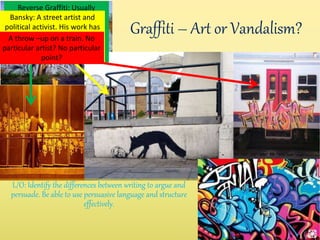
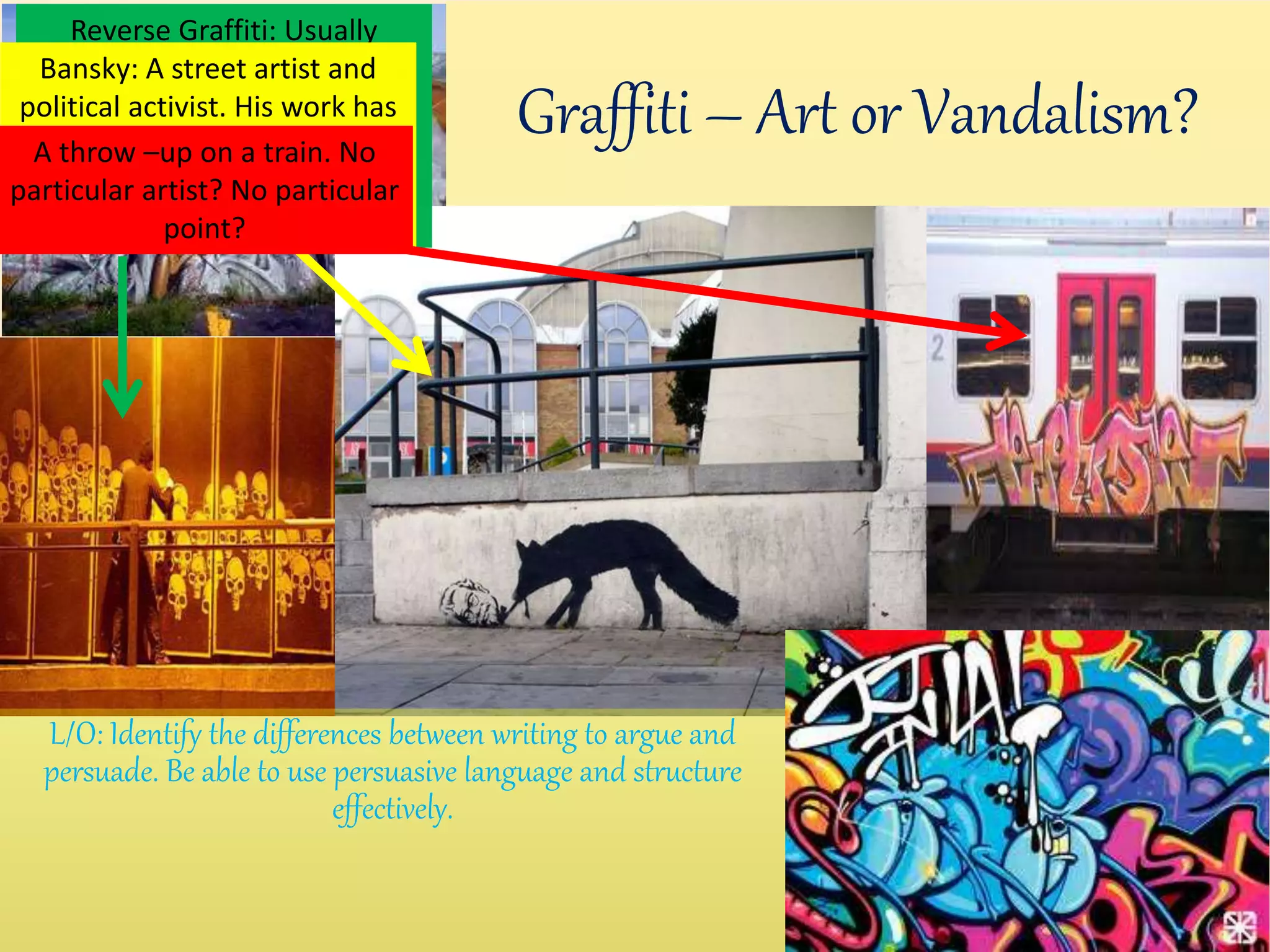
Graffiti – Art or Vandalism?
L/O: Identify the differences between writing to argue and
persuade. Be able to use persuasive language and structure
effectively.
Reverse Graffiti: Usually
temporary, made by cleaning
specific areas of dirt. Quite
political, this highlights
problems with our
environment.
Bansky: A street artist and
political activist. His work has
been exhibited in the Tate
Modern.
Often uses stencils.
A throw –up on a train. No
particular artist? No particular
point?
WALT: Be able to use persuasive language and structure
effectively.
I am your learning success arrow –
stick me in your book, and let’s
move forward together!
Follow me!!
• What can you do already? Tick this.
• What do you want to learn or revise
today? Circle this.
Glue your arrow into your
book!
Watch out for
the arrows and
the grade codes!
Flexing our persuasive muscles!
In groups of
three, label
yourselves A, B,
and C.
Person A
You think
graffiti is art!
Person B
You think graffiti
is vandalalism!
Person C
You are the
language
detective!
L/O: Be able to use persuasive language and structure effectively. (DL)
Flexing our persuasive muscles!
Persons A and B should attempt to persuade
each other that they have the correct
perspective.
Person C should listen very carefully and
note down any language or strategies they
use to do this.
L/O: Be able to use persuasive language and structure effectively. (DL)
Feedback: What persuasive techniques can you
already use?What others do we know of that might be
useful in a persuasive speech?
L/O: Be able to use persuasive language effectively. (DM)
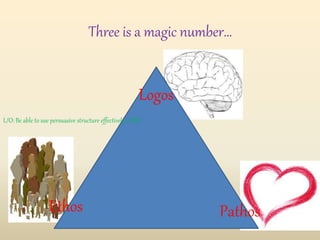
Three is a magic number…
Logos
Ethos Pathos
L/O: Be able to use persuasive structure effectively. (DM)
Group Roles
MOTIVATOR
Ensure everyone in the
group feels positive
and energised!
RECORDER
Record the ideas of
the group neatly and
accurately.
COACH
Encourage and supply
ideas. Support the
group.
CHALLENGER
Ask questions,
challenging people to
extend their ideas.
You have one minute to
discuss the strengths of
people in your group
and assign roles.
Use the stickers to
indicate these.
The Golden Pen Award!!
This prize will go to the group who
demonstrate the best team working
skills!
The Arguments:
• Read the
article.
• Complete the
table
identifying the
justifications
given for graffiti
as art or
vandalism.
You might want
to split this task
up!
EXT:
Rephrase the ideas in
your table using more
persuasive language.
Good teamwork means:
• Sharing a goal.
• Respecting other’s opinions
even if you don’t agree with
them.
• Everybody must speak, and
everybody must listen.
• Supporting each other!
L/O: Be able to use persuasive language effectively. (DM/CL)
How do these speakers persuade us!?
• Match the terms
to the definitions.
• Identify where
these techniques
have been used
in the bold text
section of the
article.
Ext:
What effect do these techniques
have?
Why?
Which techniques are not used?
Why is this?
Good teamwork means:
• Sharing a goal.
• Respecting other’s opinions
even if you don’t agree with
them.
• Everybody must speak, and
everybody must listen.
• Supporting each other!
L/O: Be able to use persuasive language effectively. (DM-CL)
Do you think this was an argumentative text or a
persuasive one?
Why?
L/O: Be able to use persuasive language and structure effectively. (CL +)
Your job is to take the ideas from this
argumentative article and write your own
persuasive article for a school newspaper.
How to succeed!
• Mind the GAP!
• Use persuasive
devices effectively.
• Use the structure of
your article to help
persuade your
audience!
L/O: Be able to use persuasive language and structure effectively.
Genre
Audience
Purpose
Use the tasks you have
completed today to remind
you of what these are!
Remember how to draw your
audience in! Appeal to them!
Present your arguments (you
can be biased!)
Reinforce your point at the
end!
You Must: Show a consistent opinion and use some
persuasive techniques to help the reader understand.
Use paragraphs to show new points.(EH-DM)
You Should: Use a range of persuasive techniques to
influence your reader. Use a structure which draws the
reader in at the beginning and reinforces your point at
the end. (DH-CM)
You could: Control your writing carefully, using a
range of techniques. Aim your points at the logos,
ethos and pathos of the reader. Use sophisticated
connectives to make your article flow. (CH+)
Write an article for a school newspaper, persuading your peers that graffiti is either art or vandalism.
The Golden Pen Award for
excellent collaboration
goes to…
Give them a clap!
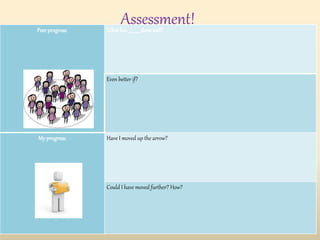
Assessment!Peer progress: Whathas___________donewell?
Even better if?
My progress: Have I moved up the arrow?
Could I have moved further? How?
Well done!!
Thank you year ten!
It was lovely to meet you and I
hope you feel that you have
learned lots today!

Graffiti – art_or_vandalism

  • 1.
    Graffiti – Artor Vandalism? L/O: Identify the differences between writing to argue and persuade. Be able to use persuasive language and structure effectively. Reverse Graffiti: Usually temporary, made by cleaning specific areas of dirt. Quite political, this highlights problems with our environment. Bansky: A street artist and political activist. His work has been exhibited in the Tate Modern. Often uses stencils. A throw –up on a train. No particular artist? No particular point?
  • 2.
    WALT: Be ableto use persuasive language and structure effectively. I am your learning success arrow – stick me in your book, and let’s move forward together! Follow me!! • What can you do already? Tick this. • What do you want to learn or revise today? Circle this. Glue your arrow into your book! Watch out for the arrows and the grade codes!
  • 3.
    Flexing our persuasivemuscles! In groups of three, label yourselves A, B, and C. Person A You think graffiti is art! Person B You think graffiti is vandalalism! Person C You are the language detective! L/O: Be able to use persuasive language and structure effectively. (DL)
  • 4.
    Flexing our persuasivemuscles! Persons A and B should attempt to persuade each other that they have the correct perspective. Person C should listen very carefully and note down any language or strategies they use to do this. L/O: Be able to use persuasive language and structure effectively. (DL)
  • 5.
    Feedback: What persuasivetechniques can you already use?What others do we know of that might be useful in a persuasive speech? L/O: Be able to use persuasive language effectively. (DM)
  • 6.
    Three is amagic number… Logos Ethos Pathos L/O: Be able to use persuasive structure effectively. (DM)
  • 7.
    Group Roles MOTIVATOR Ensure everyonein the group feels positive and energised! RECORDER Record the ideas of the group neatly and accurately. COACH Encourage and supply ideas. Support the group. CHALLENGER Ask questions, challenging people to extend their ideas. You have one minute to discuss the strengths of people in your group and assign roles. Use the stickers to indicate these. The Golden Pen Award!! This prize will go to the group who demonstrate the best team working skills!
  • 8.
    The Arguments: • Readthe article. • Complete the table identifying the justifications given for graffiti as art or vandalism. You might want to split this task up! EXT: Rephrase the ideas in your table using more persuasive language. Good teamwork means: • Sharing a goal. • Respecting other’s opinions even if you don’t agree with them. • Everybody must speak, and everybody must listen. • Supporting each other! L/O: Be able to use persuasive language effectively. (DM/CL)
  • 9.
    How do thesespeakers persuade us!? • Match the terms to the definitions. • Identify where these techniques have been used in the bold text section of the article. Ext: What effect do these techniques have? Why? Which techniques are not used? Why is this? Good teamwork means: • Sharing a goal. • Respecting other’s opinions even if you don’t agree with them. • Everybody must speak, and everybody must listen. • Supporting each other! L/O: Be able to use persuasive language effectively. (DM-CL)
  • 10.
    Do you thinkthis was an argumentative text or a persuasive one? Why? L/O: Be able to use persuasive language and structure effectively. (CL +) Your job is to take the ideas from this argumentative article and write your own persuasive article for a school newspaper.
  • 11.
    How to succeed! •Mind the GAP! • Use persuasive devices effectively. • Use the structure of your article to help persuade your audience! L/O: Be able to use persuasive language and structure effectively. Genre Audience Purpose Use the tasks you have completed today to remind you of what these are! Remember how to draw your audience in! Appeal to them! Present your arguments (you can be biased!) Reinforce your point at the end! You Must: Show a consistent opinion and use some persuasive techniques to help the reader understand. Use paragraphs to show new points.(EH-DM) You Should: Use a range of persuasive techniques to influence your reader. Use a structure which draws the reader in at the beginning and reinforces your point at the end. (DH-CM) You could: Control your writing carefully, using a range of techniques. Aim your points at the logos, ethos and pathos of the reader. Use sophisticated connectives to make your article flow. (CH+) Write an article for a school newspaper, persuading your peers that graffiti is either art or vandalism.
  • 12.
    The Golden PenAward for excellent collaboration goes to… Give them a clap!
  • 13.
    Assessment!Peer progress: Whathas___________donewell? Evenbetter if? My progress: Have I moved up the arrow? Could I have moved further? How?
  • 14.
    Well done!! Thank youyear ten! It was lovely to meet you and I hope you feel that you have learned lots today!