GRADUATE STUDENT SERVICES:
SETTING THE CONTEXT FOR A WAY
          FORWARD


                 Brian D. Dusbiber, Ed.D
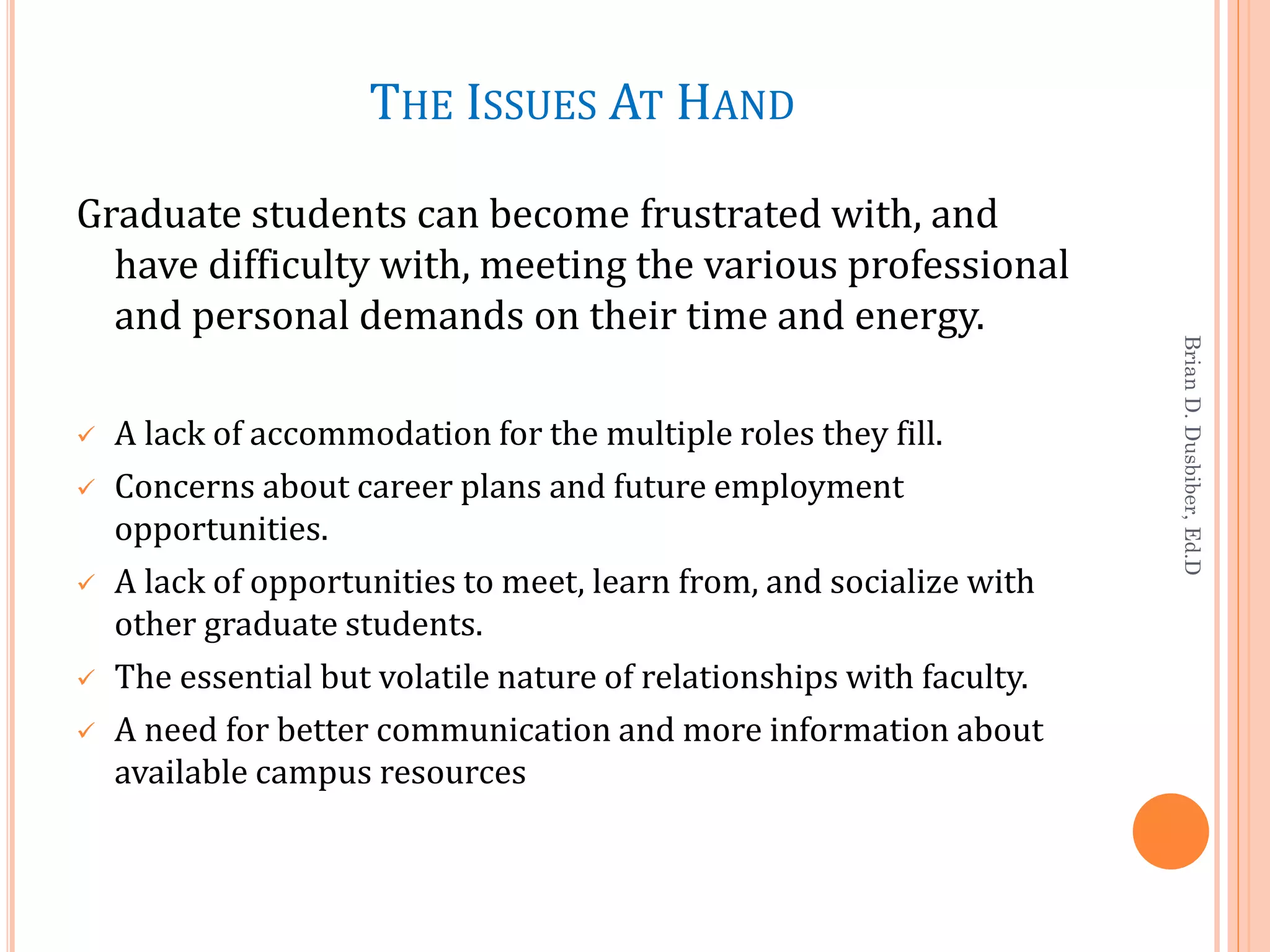
THE ISSUES AT HAND

Graduate students can become frustrated with, and
  have difficulty with, meeting the various professional
  and personal demands on their time and energy.


                                                                       Brian D. Dusbiber, Ed.D
   A lack of accommodation for the multiple roles they fill.
   Concerns about career plans and future employment
    opportunities.
   A lack of opportunities to meet, learn from, and socialize with
    other graduate students.
   The essential but volatile nature of relationships with faculty.
   A need for better communication and more information about
    available campus resources
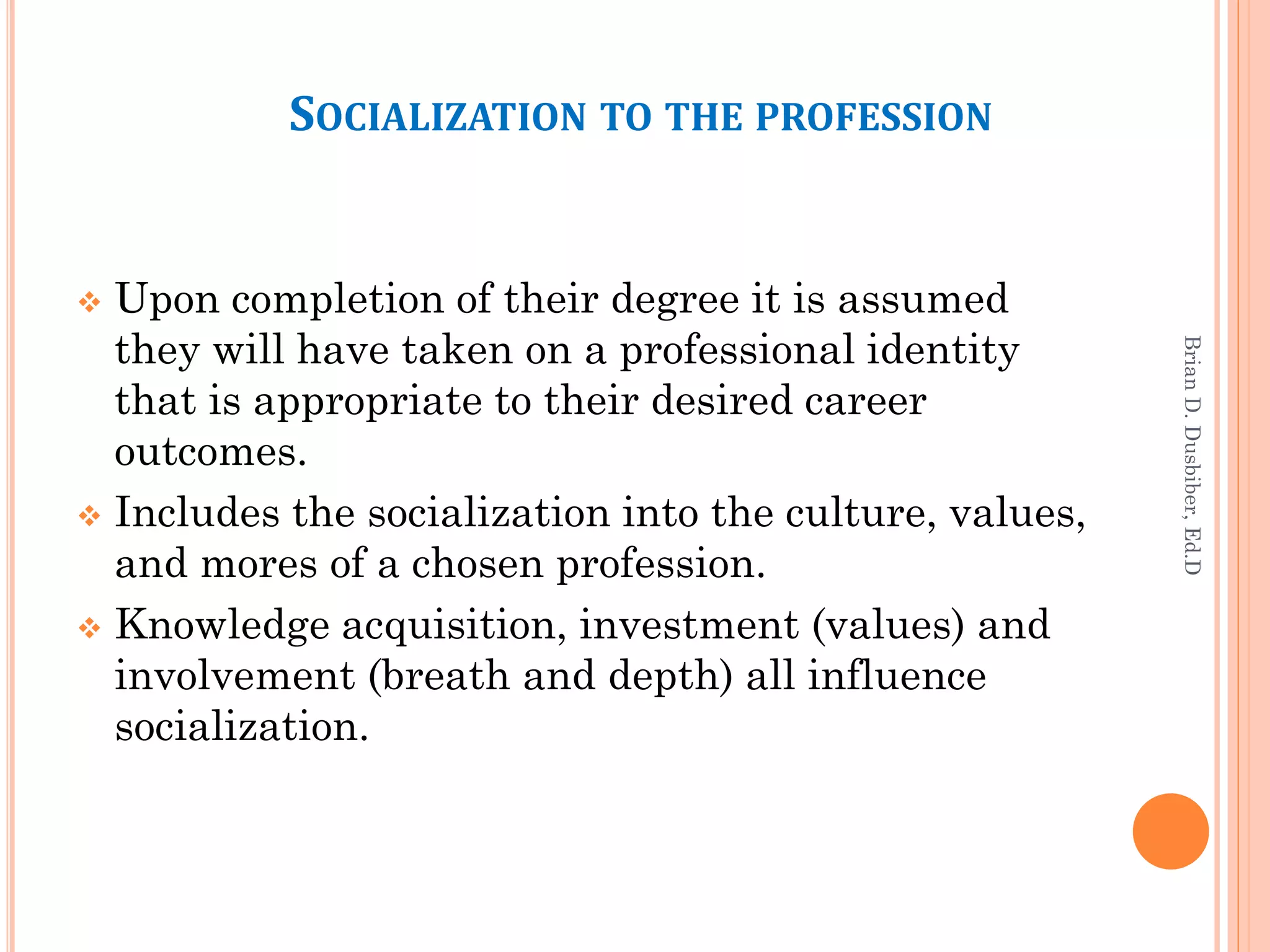
SOCIALIZATION TO THE PROFESSION


 Upon completion of their degree it is assumed
  they will have taken on a professional identity


                                                         Brian D. Dusbiber, Ed.D
  that is appropriate to their desired career
  outcomes.
 Includes the socialization into the culture, values,
  and mores of a chosen profession.
 Knowledge acquisition, investment (values) and
  involvement (breath and depth) all influence
  socialization.
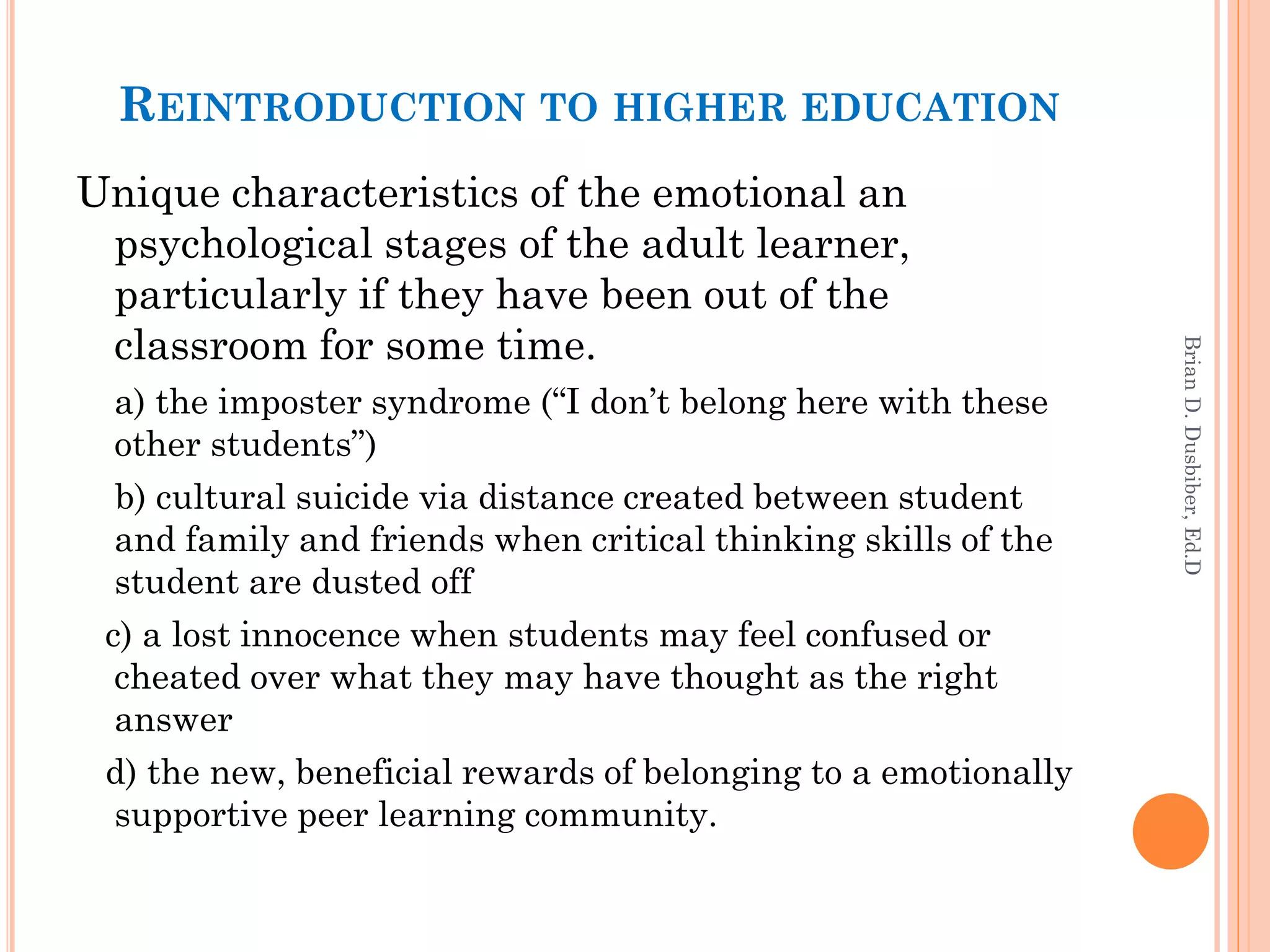
REINTRODUCTION TO HIGHER EDUCATION
Unique characteristics of the emotional an
 psychological stages of the adult learner,
 particularly if they have been out of the
 classroom for some time.


                                                                Brian D. Dusbiber, Ed.D
  a) the imposter syndrome (“I don’t belong here with these
  other students”)
  b) cultural suicide via distance created between student
  and family and friends when critical thinking skills of the
  student are dusted off
 c) a lost innocence when students may feel confused or
  cheated over what they may have thought as the right
  answer
 d) the new, beneficial rewards of belonging to a emotionally
  supportive peer learning community.
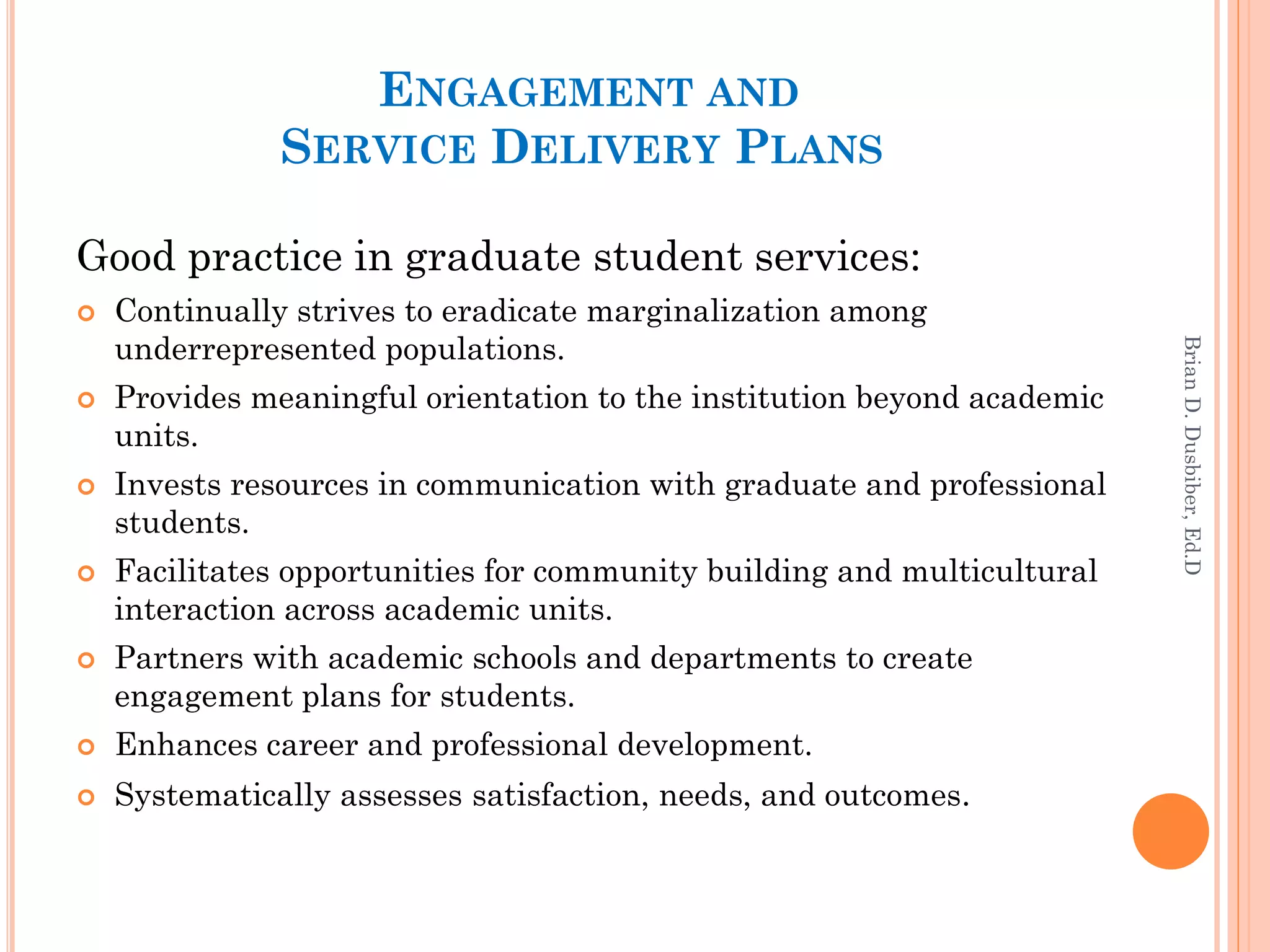
ENGAGEMENT AND
               SERVICE DELIVERY PLANS

Good practice in graduate student services:
   Continually strives to eradicate marginalization among
    underrepresented populations.


                                                                         Brian D. Dusbiber, Ed.D
   Provides meaningful orientation to the institution beyond academic
    units.
   Invests resources in communication with graduate and professional
    students.
   Facilitates opportunities for community building and multicultural
    interaction across academic units.
   Partners with academic schools and departments to create
    engagement plans for students.
   Enhances career and professional development.
   Systematically assesses satisfaction, needs, and outcomes.
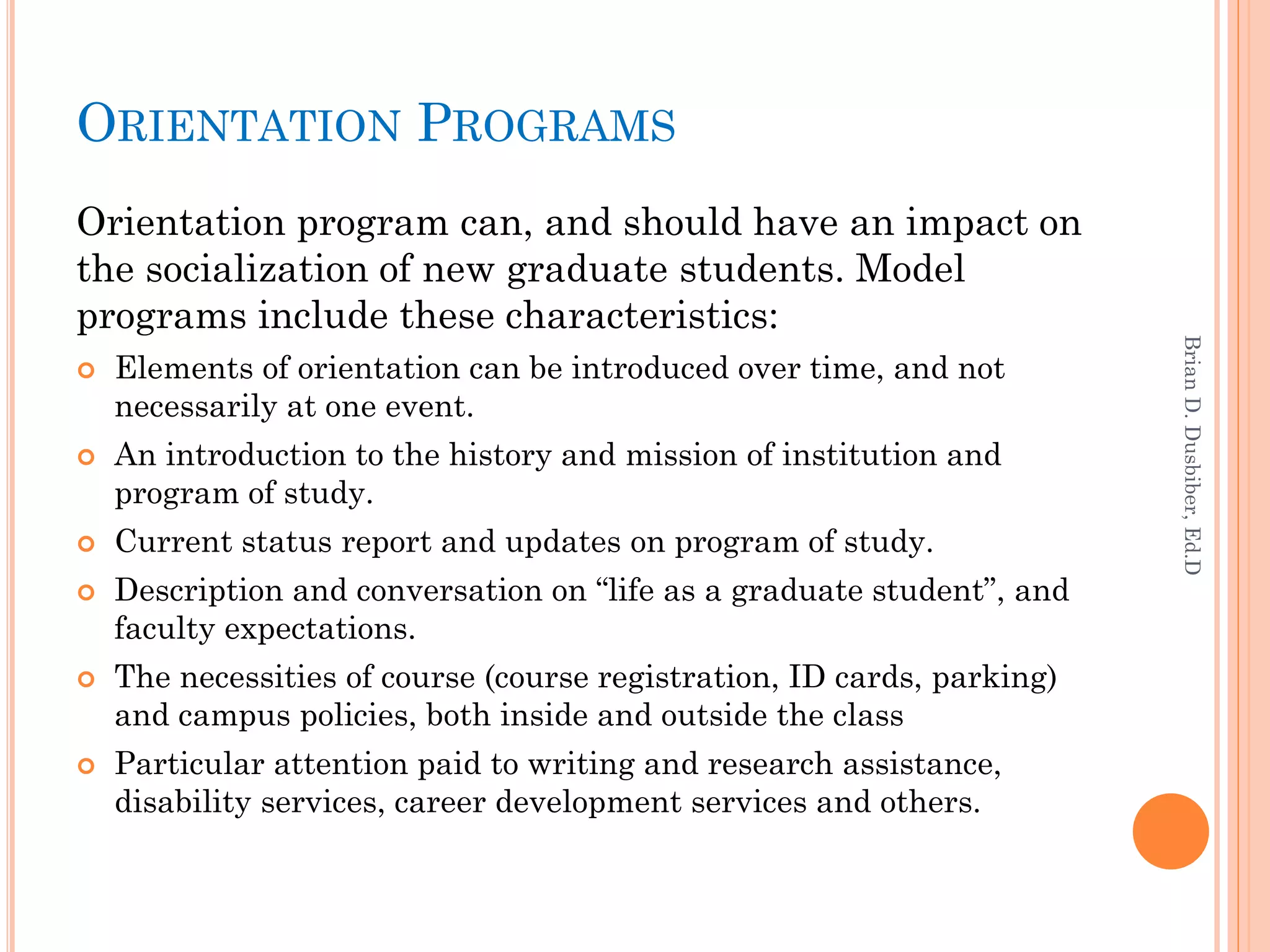
ORIENTATION PROGRAMS
Orientation program can, and should have an impact on
the socialization of new graduate students. Model
programs include these characteristics:


                                                                         Brian D. Dusbiber, Ed.D
   Elements of orientation can be introduced over time, and not
    necessarily at one event.
   An introduction to the history and mission of institution and
    program of study.
   Current status report and updates on program of study.
   Description and conversation on “life as a graduate student”, and
    faculty expectations.
   The necessities of course (course registration, ID cards, parking)
    and campus policies, both inside and outside the class
   Particular attention paid to writing and research assistance,
    disability services, career development services and others.
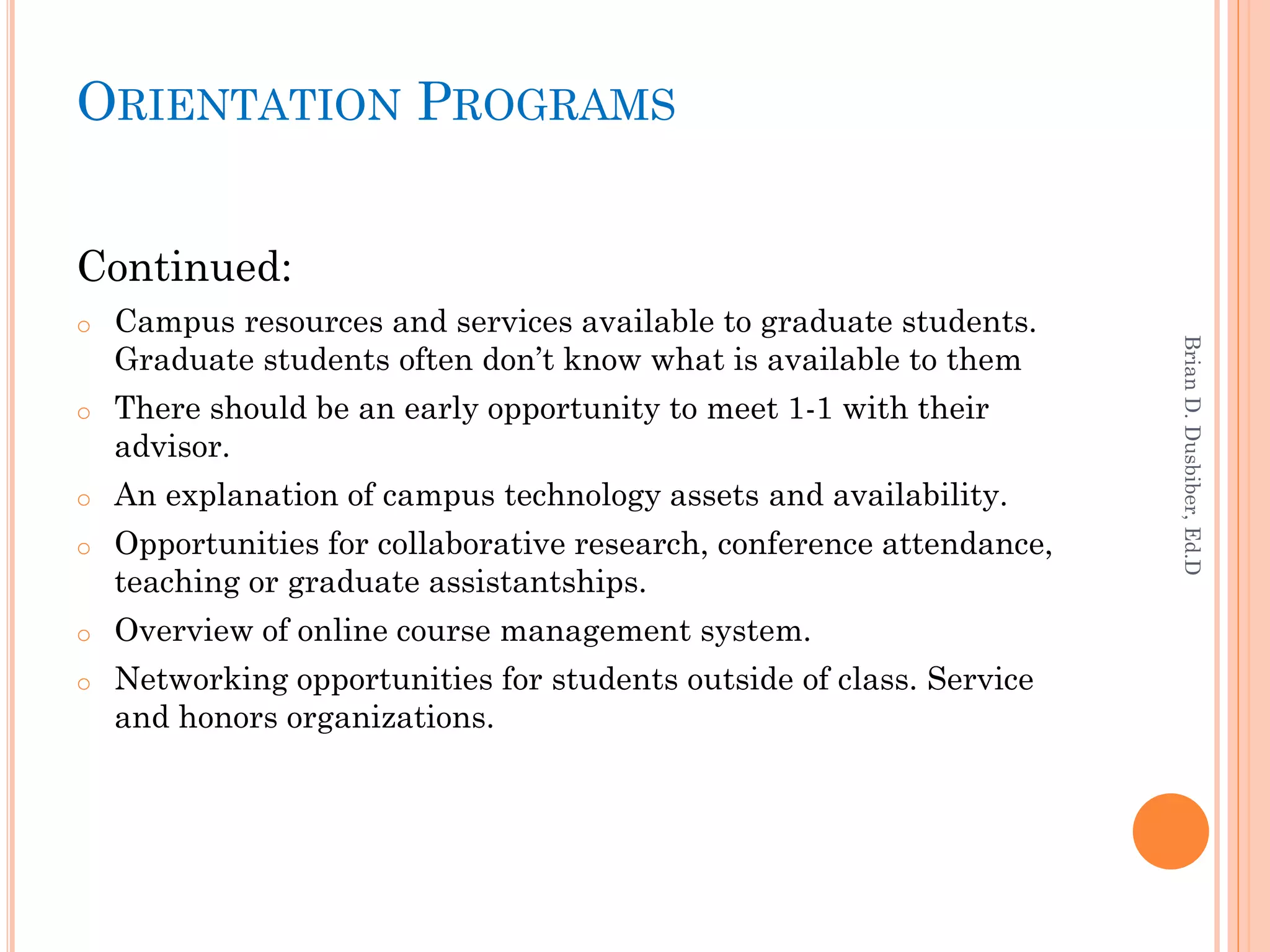
ORIENTATION PROGRAMS


Continued:
o   Campus resources and services available to graduate students.


                                                                       Brian D. Dusbiber, Ed.D
    Graduate students often don’t know what is available to them
o   There should be an early opportunity to meet 1-1 with their
    advisor.
o   An explanation of campus technology assets and availability.
o   Opportunities for collaborative research, conference attendance,
    teaching or graduate assistantships.
o   Overview of online course management system.
o   Networking opportunities for students outside of class. Service
    and honors organizations.
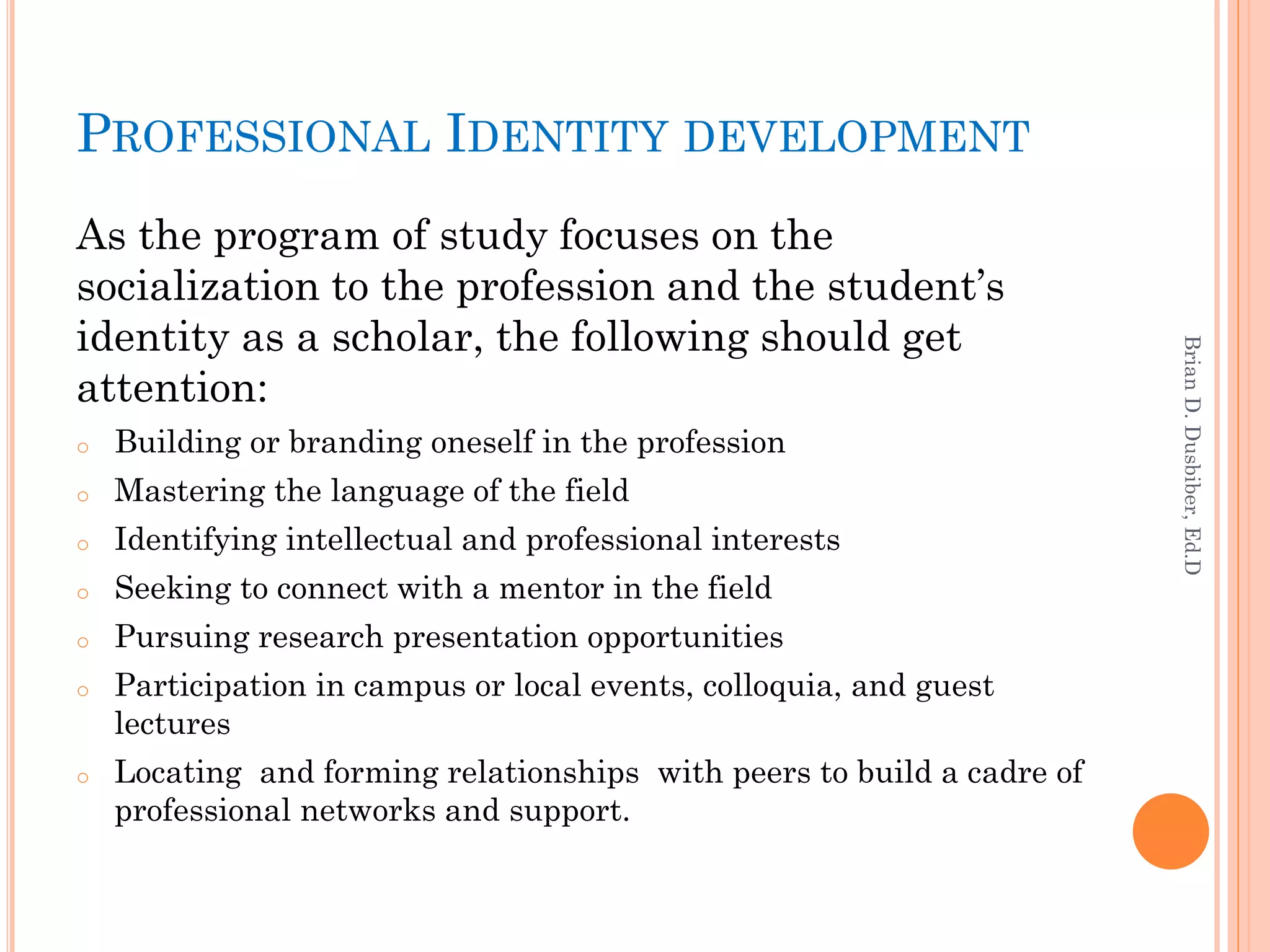
PROFESSIONAL IDENTITY DEVELOPMENT
As the program of study focuses on the
socialization to the profession and the student’s
identity as a scholar, the following should get


                                                                        Brian D. Dusbiber, Ed.D
attention:
o   Building or branding oneself in the profession
o   Mastering the language of the field
o   Identifying intellectual and professional interests
o   Seeking to connect with a mentor in the field
o   Pursuing research presentation opportunities
o   Participation in campus or local events, colloquia, and guest
    lectures
o   Locating and forming relationships with peers to build a cadre of
    professional networks and support.
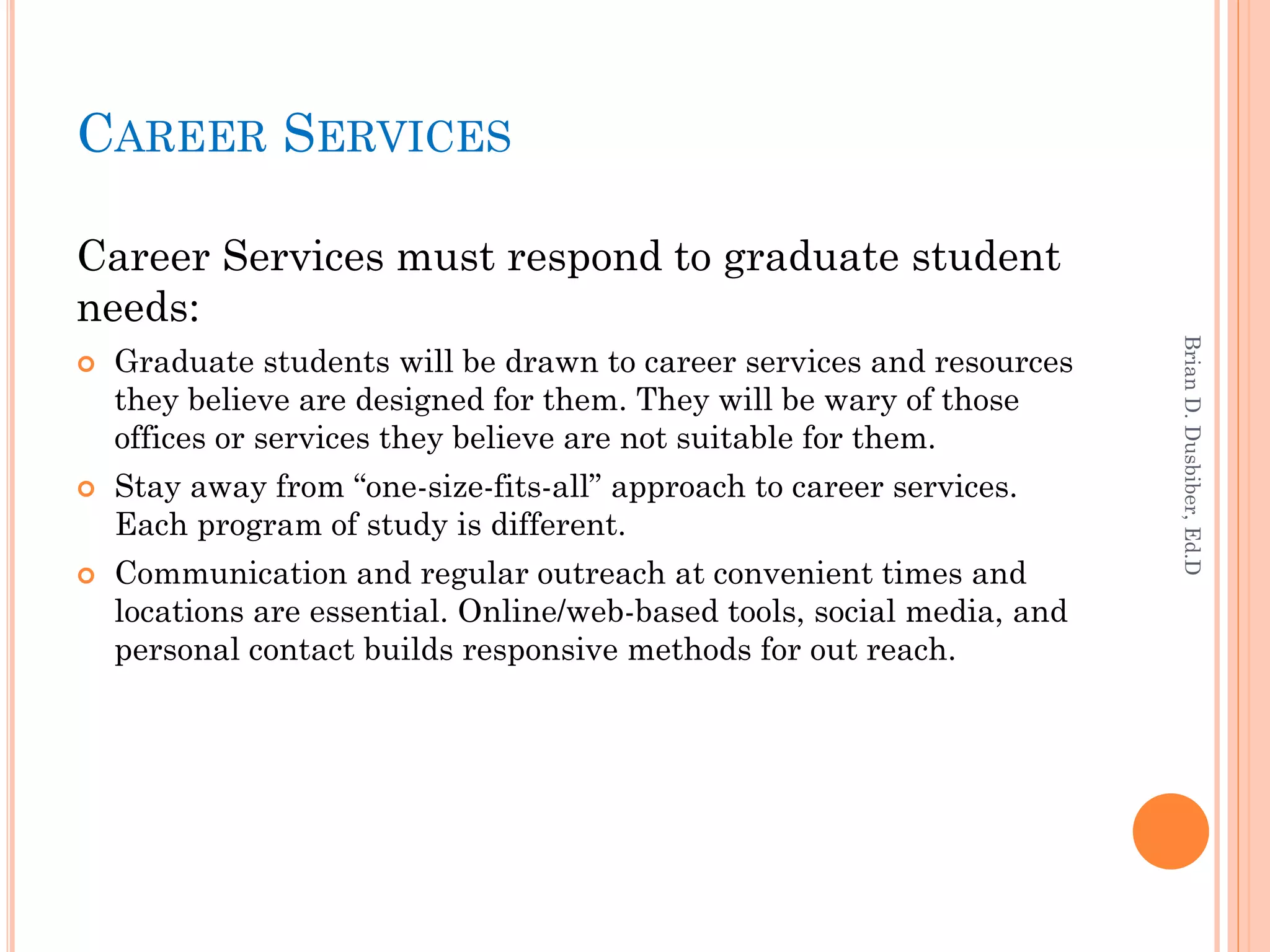
CAREER SERVICES

Career Services must respond to graduate student
needs:


                                                                         Brian D. Dusbiber, Ed.D
   Graduate students will be drawn to career services and resources
    they believe are designed for them. They will be wary of those
    offices or services they believe are not suitable for them.
   Stay away from “one-size-fits-all” approach to career services.
    Each program of study is different.
   Communication and regular outreach at convenient times and
    locations are essential. Online/web-based tools, social media, and
    personal contact builds responsive methods for out reach.
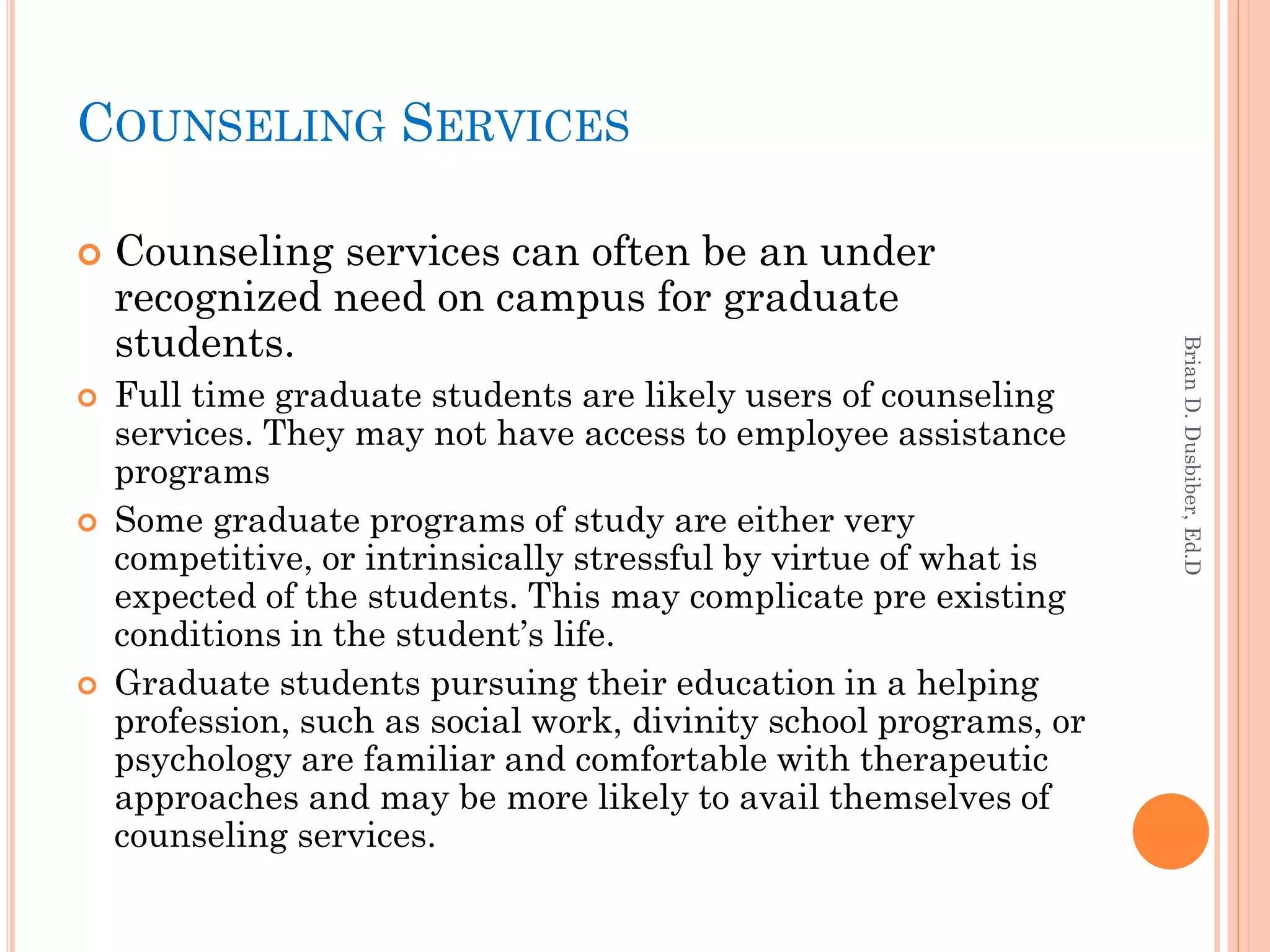
COUNSELING SERVICES

   Counseling services can often be an under
    recognized need on campus for graduate
    students.


                                                                    Brian D. Dusbiber, Ed.D
   Full time graduate students are likely users of counseling
    services. They may not have access to employee assistance
    programs
   Some graduate programs of study are either very
    competitive, or intrinsically stressful by virtue of what is
    expected of the students. This may complicate pre existing
    conditions in the student’s life.
   Graduate students pursuing their education in a helping
    profession, such as social work, divinity school programs, or
    psychology are familiar and comfortable with therapeutic
    approaches and may be more likely to avail themselves of
    counseling services.
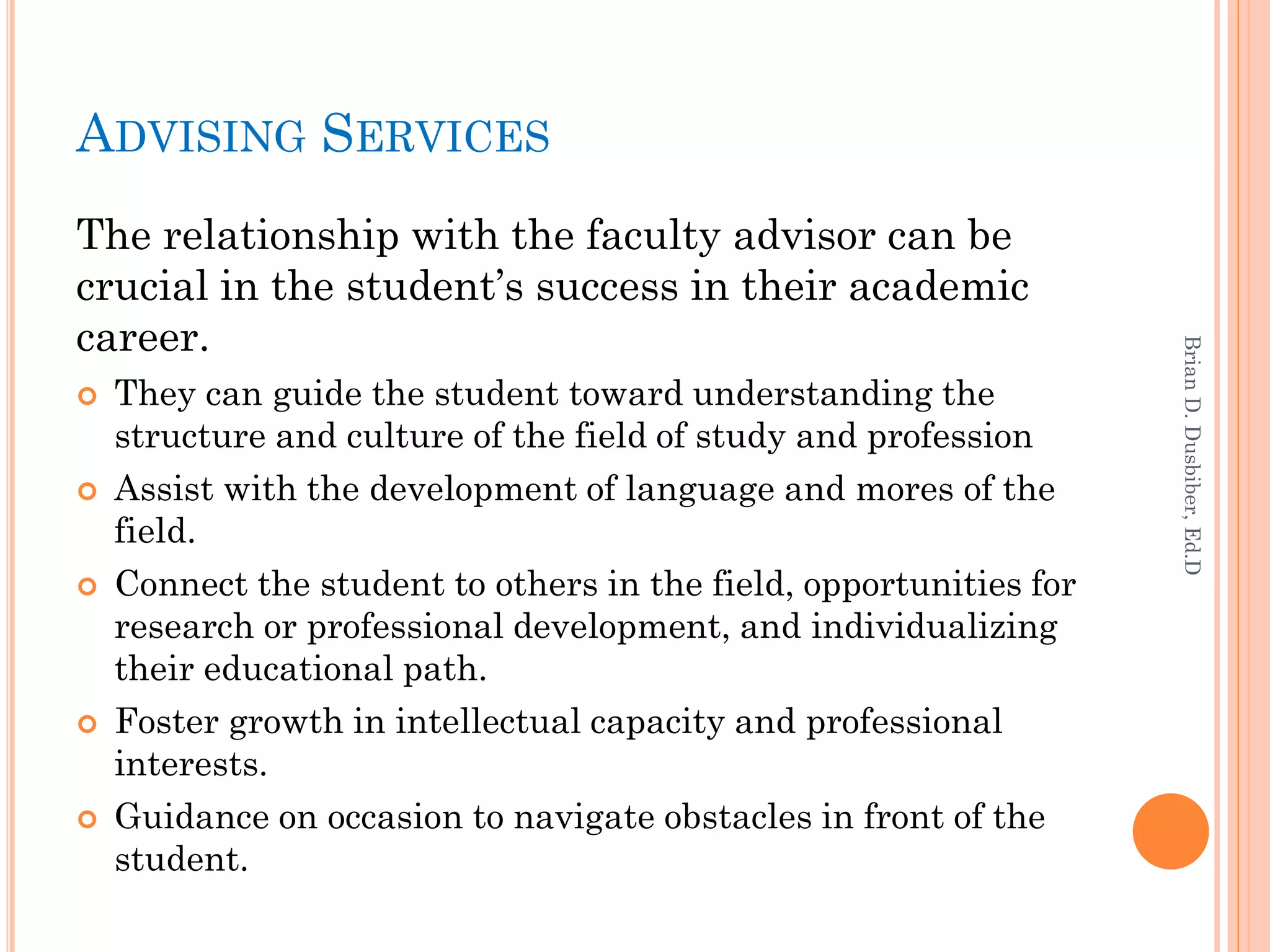
ADVISING SERVICES
The relationship with the faculty advisor can be
crucial in the student’s success in their academic
career.


                                                                    Brian D. Dusbiber, Ed.D
   They can guide the student toward understanding the
    structure and culture of the field of study and profession
   Assist with the development of language and mores of the
    field.
   Connect the student to others in the field, opportunities for
    research or professional development, and individualizing
    their educational path.
   Foster growth in intellectual capacity and professional
    interests.
   Guidance on occasion to navigate obstacles in front of the
    student.
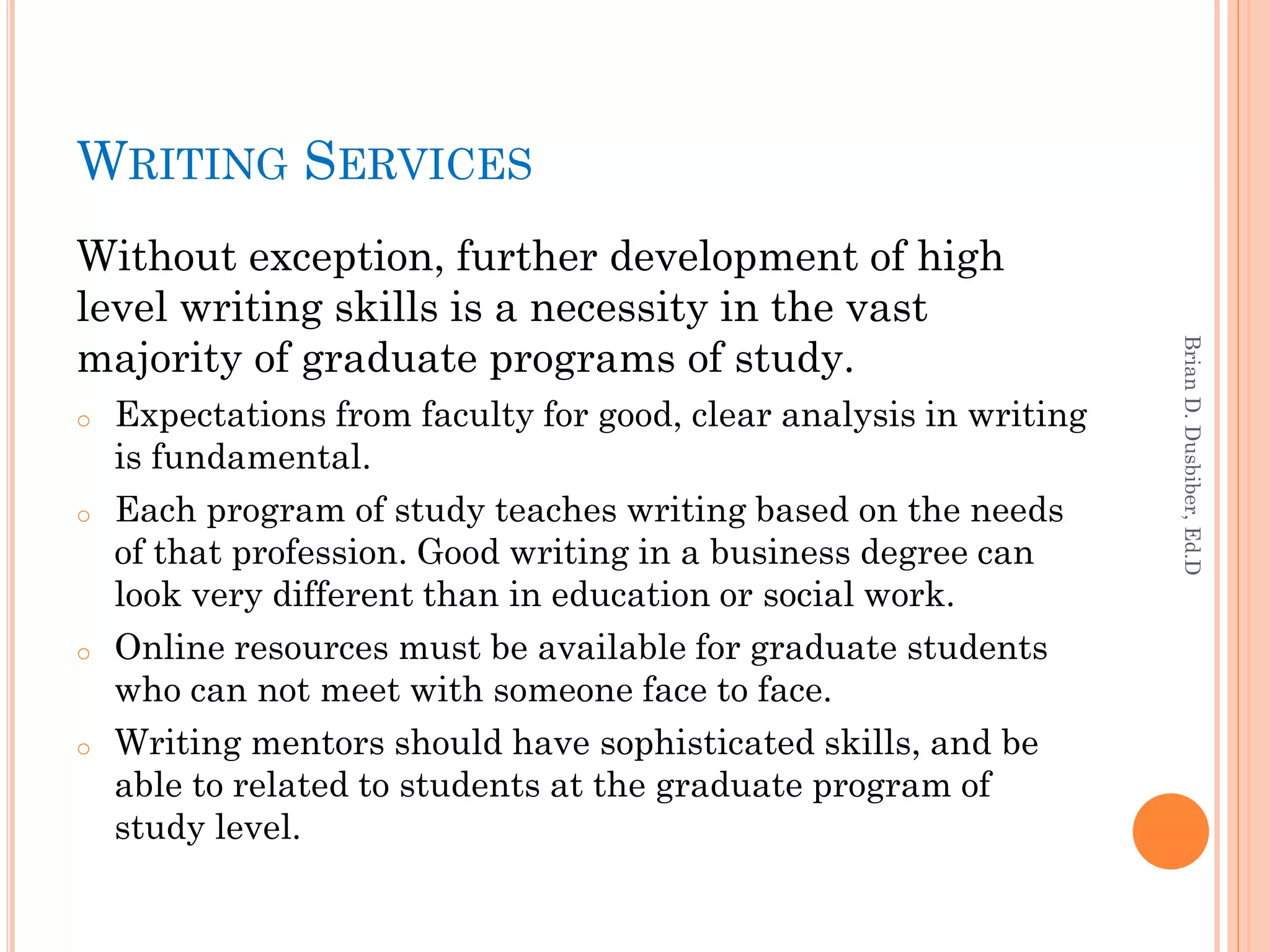
WRITING SERVICES
Without exception, further development of high
level writing skills is a necessity in the vast
majority of graduate programs of study.


                                                                    Brian D. Dusbiber, Ed.D
o   Expectations from faculty for good, clear analysis in writing
    is fundamental.
o   Each program of study teaches writing based on the needs
    of that profession. Good writing in a business degree can
    look very different than in education or social work.
o   Online resources must be available for graduate students
    who can not meet with someone face to face.
o   Writing mentors should have sophisticated skills, and be
    able to related to students at the graduate program of
    study level.
LIBRARY SKILLS

A introduction to library resources and services is
essential.


                                                                    Brian D. Dusbiber, Ed.D
   Frequently graduate students are starting at a new
    university, or have not used a college library for some time.
   New, web based resources emerge frequently or have been
    revitalized. Comfort with working with these features
    requires some just in time training.
   Higher levels of expectations around proper use of writing
    style becomes elevated (APA, Chicago Manual, AMA, MLA)
DISABILITY SERVICES

Graduate students may not be aware of the extent
of services and accommodation available.


                                                              Brian D. Dusbiber, Ed.D
   For some graduate students they may have not been aware
    of a disability while they were an undergraduate
   Course Syllabi should include information on how to
    arrange for accommodation for a disability.
STUDENT HEALTH AND WELL BEING

There is an array of services graduate students
may need from student health services and
wellness programs.


                                                              Brian D. Dusbiber, Ed.D
   Those students without employer supported health care
    may rely on campus services for ongoing care.
   Immunizations both annual, and for international travel
    are often a need.
   Lifestyle balance (home, work, family, school) can
    frequently be a problem for graduate students.
PARENT/FAMILY SERVICES

Many graduate students are enrolled during peak
childbearing years.


                                                               Brian D. Dusbiber, Ed.D
   Convenient, affordable child care on campus or nearby is
    important.
   Professional staff who can assist graduate students who
    are parents through the labyrinth of a college campus.
   Stress is sometimes realized as graduate students face
    demands from home and cultural expectations of idealized
    parenthood.
   Scholarly and professional expectations as the graduate
    level can elevate stress as well.
LEGAL SERVICES

Moving into adulthood and independence, graduate
students frequently need legal service.


                                                                     Brian D. Dusbiber, Ed.D
   There is often financial stress associated with building
    debt.
   Adult relationships on occasion required legal
    representation.
   Many graduate students are entering into contracts and
    leases for the first time.
   Some law firms, or attorneys at law will provide pro bono
    services on a one time basis to assist students.. The cost for
    further legal representation or future meetings can be
    negotiated after that first meeting.
BUSINESS OFFICE/ACCOUNTS PAYABLE,
BOOKSTORE, DINING SERVICES
Graduate students want services that are
convenient to their busy schedules, and exercise
high levels of customer service.


                                                                 Brian D. Dusbiber, Ed.D
   Convenience, particularly using online services, is
    important.
   Assistance with financial aid management, or seeking
    scholarships or grants is another role that is needed.
   Avenues for renting and purchasing textbooks and book
    packs, both online via e-readers and hard copy continually
    advance. Graduate students will focus on ease of
    acquisition and cost.
   Dining services need to be available when graduate
    students wish to use them.
IN CLOSING
   While graduate and professional student services may very
    well overlap with more traditional undergraduate student
    services, there is a need to also understand the unique
    needs of these students. The student is making a significant


                                                                    Brian D. Dusbiber, Ed.D
    personal and financial investment. The university is
    committed to their professional, scholarly education.
    Research, writing, and contributing to the profession
    become increasingly emphasized. During this journey,
    students find that “life goes on” and there are likely more
    responsibility and or intervening circumstance in life that
    conflict with their full attention as a graduate student. A
    strong awareness of that experience, and developing
    sufficient resources to address them effectively continues to
    be a growing concern of graduate and professional school
    administrators, and program directors.

Graduate student services: A way forward

  • 1.
    GRADUATE STUDENT SERVICES: SETTINGTHE CONTEXT FOR A WAY FORWARD Brian D. Dusbiber, Ed.D
  • 2.
    THE ISSUES ATHAND Graduate students can become frustrated with, and have difficulty with, meeting the various professional and personal demands on their time and energy. Brian D. Dusbiber, Ed.D  A lack of accommodation for the multiple roles they fill.  Concerns about career plans and future employment opportunities.  A lack of opportunities to meet, learn from, and socialize with other graduate students.  The essential but volatile nature of relationships with faculty.  A need for better communication and more information about available campus resources
  • 3.
    SOCIALIZATION TO THEPROFESSION  Upon completion of their degree it is assumed they will have taken on a professional identity Brian D. Dusbiber, Ed.D that is appropriate to their desired career outcomes.  Includes the socialization into the culture, values, and mores of a chosen profession.  Knowledge acquisition, investment (values) and involvement (breath and depth) all influence socialization.
  • 4.
    REINTRODUCTION TO HIGHEREDUCATION Unique characteristics of the emotional an psychological stages of the adult learner, particularly if they have been out of the classroom for some time. Brian D. Dusbiber, Ed.D a) the imposter syndrome (“I don’t belong here with these other students”) b) cultural suicide via distance created between student and family and friends when critical thinking skills of the student are dusted off c) a lost innocence when students may feel confused or cheated over what they may have thought as the right answer d) the new, beneficial rewards of belonging to a emotionally supportive peer learning community.
  • 5.
    ENGAGEMENT AND SERVICE DELIVERY PLANS Good practice in graduate student services:  Continually strives to eradicate marginalization among underrepresented populations. Brian D. Dusbiber, Ed.D  Provides meaningful orientation to the institution beyond academic units.  Invests resources in communication with graduate and professional students.  Facilitates opportunities for community building and multicultural interaction across academic units.  Partners with academic schools and departments to create engagement plans for students.  Enhances career and professional development.  Systematically assesses satisfaction, needs, and outcomes.
  • 6.
    ORIENTATION PROGRAMS Orientation programcan, and should have an impact on the socialization of new graduate students. Model programs include these characteristics: Brian D. Dusbiber, Ed.D  Elements of orientation can be introduced over time, and not necessarily at one event.  An introduction to the history and mission of institution and program of study.  Current status report and updates on program of study.  Description and conversation on “life as a graduate student”, and faculty expectations.  The necessities of course (course registration, ID cards, parking) and campus policies, both inside and outside the class  Particular attention paid to writing and research assistance, disability services, career development services and others.
  • 7.
    ORIENTATION PROGRAMS Continued: o Campus resources and services available to graduate students. Brian D. Dusbiber, Ed.D Graduate students often don’t know what is available to them o There should be an early opportunity to meet 1-1 with their advisor. o An explanation of campus technology assets and availability. o Opportunities for collaborative research, conference attendance, teaching or graduate assistantships. o Overview of online course management system. o Networking opportunities for students outside of class. Service and honors organizations.
  • 8.
    PROFESSIONAL IDENTITY DEVELOPMENT Asthe program of study focuses on the socialization to the profession and the student’s identity as a scholar, the following should get Brian D. Dusbiber, Ed.D attention: o Building or branding oneself in the profession o Mastering the language of the field o Identifying intellectual and professional interests o Seeking to connect with a mentor in the field o Pursuing research presentation opportunities o Participation in campus or local events, colloquia, and guest lectures o Locating and forming relationships with peers to build a cadre of professional networks and support.
  • 9.
    CAREER SERVICES Career Servicesmust respond to graduate student needs: Brian D. Dusbiber, Ed.D  Graduate students will be drawn to career services and resources they believe are designed for them. They will be wary of those offices or services they believe are not suitable for them.  Stay away from “one-size-fits-all” approach to career services. Each program of study is different.  Communication and regular outreach at convenient times and locations are essential. Online/web-based tools, social media, and personal contact builds responsive methods for out reach.
  • 10.
    COUNSELING SERVICES  Counseling services can often be an under recognized need on campus for graduate students. Brian D. Dusbiber, Ed.D  Full time graduate students are likely users of counseling services. They may not have access to employee assistance programs  Some graduate programs of study are either very competitive, or intrinsically stressful by virtue of what is expected of the students. This may complicate pre existing conditions in the student’s life.  Graduate students pursuing their education in a helping profession, such as social work, divinity school programs, or psychology are familiar and comfortable with therapeutic approaches and may be more likely to avail themselves of counseling services.
  • 11.
    ADVISING SERVICES The relationshipwith the faculty advisor can be crucial in the student’s success in their academic career. Brian D. Dusbiber, Ed.D  They can guide the student toward understanding the structure and culture of the field of study and profession  Assist with the development of language and mores of the field.  Connect the student to others in the field, opportunities for research or professional development, and individualizing their educational path.  Foster growth in intellectual capacity and professional interests.  Guidance on occasion to navigate obstacles in front of the student.
  • 12.
    WRITING SERVICES Without exception,further development of high level writing skills is a necessity in the vast majority of graduate programs of study. Brian D. Dusbiber, Ed.D o Expectations from faculty for good, clear analysis in writing is fundamental. o Each program of study teaches writing based on the needs of that profession. Good writing in a business degree can look very different than in education or social work. o Online resources must be available for graduate students who can not meet with someone face to face. o Writing mentors should have sophisticated skills, and be able to related to students at the graduate program of study level.
  • 13.
    LIBRARY SKILLS A introductionto library resources and services is essential. Brian D. Dusbiber, Ed.D  Frequently graduate students are starting at a new university, or have not used a college library for some time.  New, web based resources emerge frequently or have been revitalized. Comfort with working with these features requires some just in time training.  Higher levels of expectations around proper use of writing style becomes elevated (APA, Chicago Manual, AMA, MLA)
  • 14.
    DISABILITY SERVICES Graduate studentsmay not be aware of the extent of services and accommodation available. Brian D. Dusbiber, Ed.D  For some graduate students they may have not been aware of a disability while they were an undergraduate  Course Syllabi should include information on how to arrange for accommodation for a disability.
  • 15.
    STUDENT HEALTH ANDWELL BEING There is an array of services graduate students may need from student health services and wellness programs. Brian D. Dusbiber, Ed.D  Those students without employer supported health care may rely on campus services for ongoing care.  Immunizations both annual, and for international travel are often a need.  Lifestyle balance (home, work, family, school) can frequently be a problem for graduate students.
  • 16.
    PARENT/FAMILY SERVICES Many graduatestudents are enrolled during peak childbearing years. Brian D. Dusbiber, Ed.D  Convenient, affordable child care on campus or nearby is important.  Professional staff who can assist graduate students who are parents through the labyrinth of a college campus.  Stress is sometimes realized as graduate students face demands from home and cultural expectations of idealized parenthood.  Scholarly and professional expectations as the graduate level can elevate stress as well.
  • 17.
    LEGAL SERVICES Moving intoadulthood and independence, graduate students frequently need legal service. Brian D. Dusbiber, Ed.D  There is often financial stress associated with building debt.  Adult relationships on occasion required legal representation.  Many graduate students are entering into contracts and leases for the first time.  Some law firms, or attorneys at law will provide pro bono services on a one time basis to assist students.. The cost for further legal representation or future meetings can be negotiated after that first meeting.
  • 18.
    BUSINESS OFFICE/ACCOUNTS PAYABLE, BOOKSTORE,DINING SERVICES Graduate students want services that are convenient to their busy schedules, and exercise high levels of customer service. Brian D. Dusbiber, Ed.D  Convenience, particularly using online services, is important.  Assistance with financial aid management, or seeking scholarships or grants is another role that is needed.  Avenues for renting and purchasing textbooks and book packs, both online via e-readers and hard copy continually advance. Graduate students will focus on ease of acquisition and cost.  Dining services need to be available when graduate students wish to use them.
  • 19.
    IN CLOSING  While graduate and professional student services may very well overlap with more traditional undergraduate student services, there is a need to also understand the unique needs of these students. The student is making a significant Brian D. Dusbiber, Ed.D personal and financial investment. The university is committed to their professional, scholarly education. Research, writing, and contributing to the profession become increasingly emphasized. During this journey, students find that “life goes on” and there are likely more responsibility and or intervening circumstance in life that conflict with their full attention as a graduate student. A strong awareness of that experience, and developing sufficient resources to address them effectively continues to be a growing concern of graduate and professional school administrators, and program directors.