Resources for Individual InstructionSpecifics for: ADHD, Auditory Disabilities, Reading and Writing Learning Disabilities
Reasons to use resourcesIndividuals with Disabilities Act (IDEA, 2004)Follow Individual Education Plan (IEP) accommodationsProvide Least Restrictive Environment (LRE)
IEPEstablished once identification and evaluation has taken placeProvides recommended classroom accommodations and possible assessment modificationsReviewed and updated annually
Least Restrictive Environment (LRE)Progressive path Paths provide as much access to the regular classroom environment as possibleOnly adds specialized services that would remove the student from the regular education environment as needed to meet each student’s goals in the IEP
LRE-most accessSupport ServicesTakes place out of the classroomTherapist consults and may suggest classroom strategies with teachers but does not assist in the classroomPsychological counseling (ADHD)Speech therapy (auditory needs)Occupational Therapy (writing needs)
LRE-after, or in combination with Support ServicesStep One
Special education paraprofessionals
Step Two
Special education teachers as co teachers (regular education teacher as lead teacher)
Step Three
Resource classrooms (special education teacher as lead teacher)Special Education ParaprofessionalsServe as assistants to the special education student in the inclusion classroomADHDProximity controlTimeout optionsSocial SupportAuditory disabilitiesSign languageOral note taking translationLanguage and comprehension supportNote summaryOrganizational skills
Special Education Teachersas Co TeachersSpecial education teacher may or may not be highly qualified in a content area (mostly at 9-12 level)Supports and collaborates with lead, regular education teacherMay do the following:Modifications of assignmentsSmall group instructionBehavior controlInclude subtitles in visual presentationsRead material aloud for reading disabilitiesReview in small groups as needed
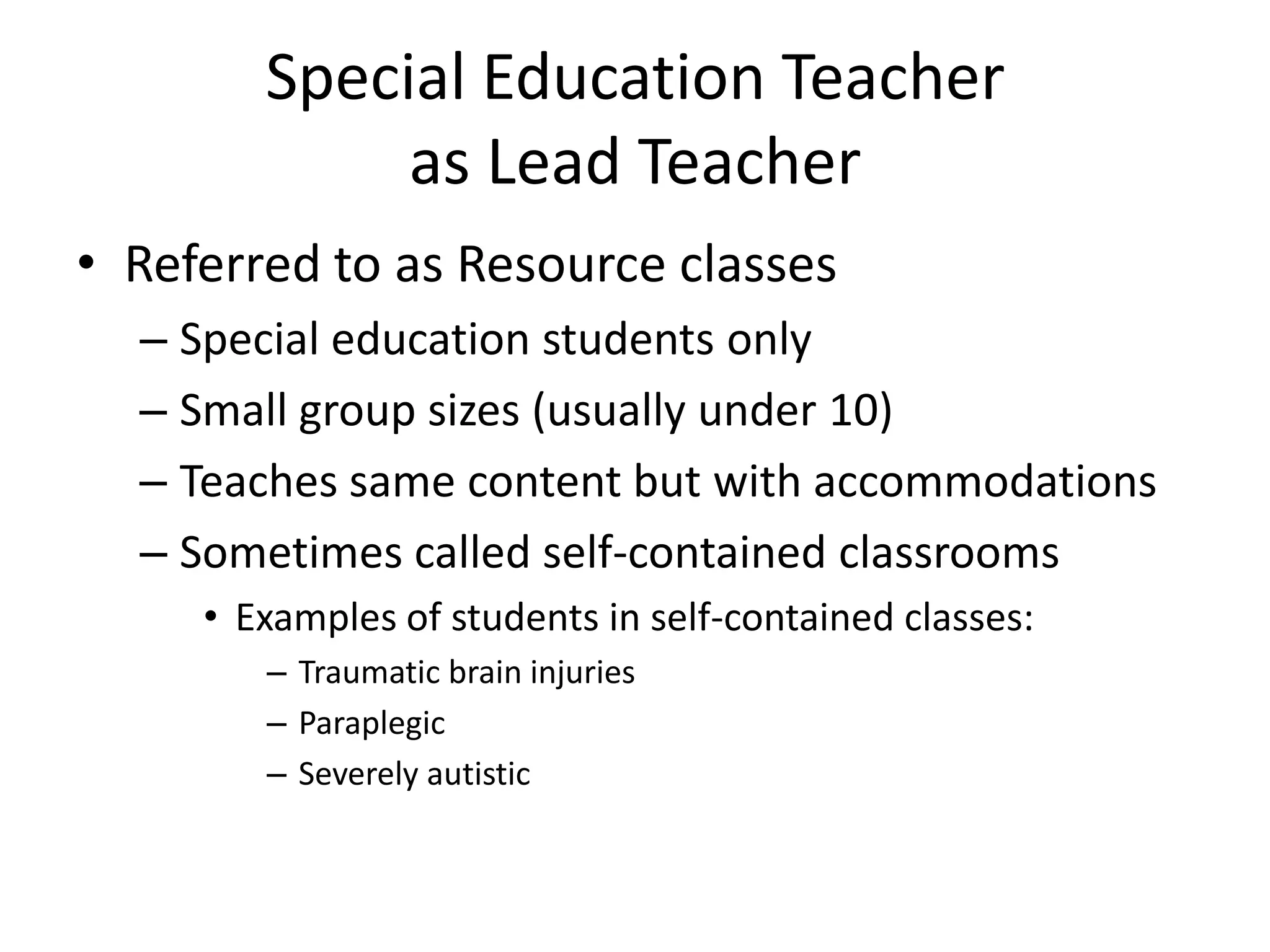
Special Education Teacheras Lead TeacherReferred to as Resource classesSpecial education students onlySmall group sizes (usually under 10)Teaches same content but with accommodationsSometimes called self-contained classroomsExamples of students in self-contained classes:Traumatic brain injuriesParaplegicSeverely autistic
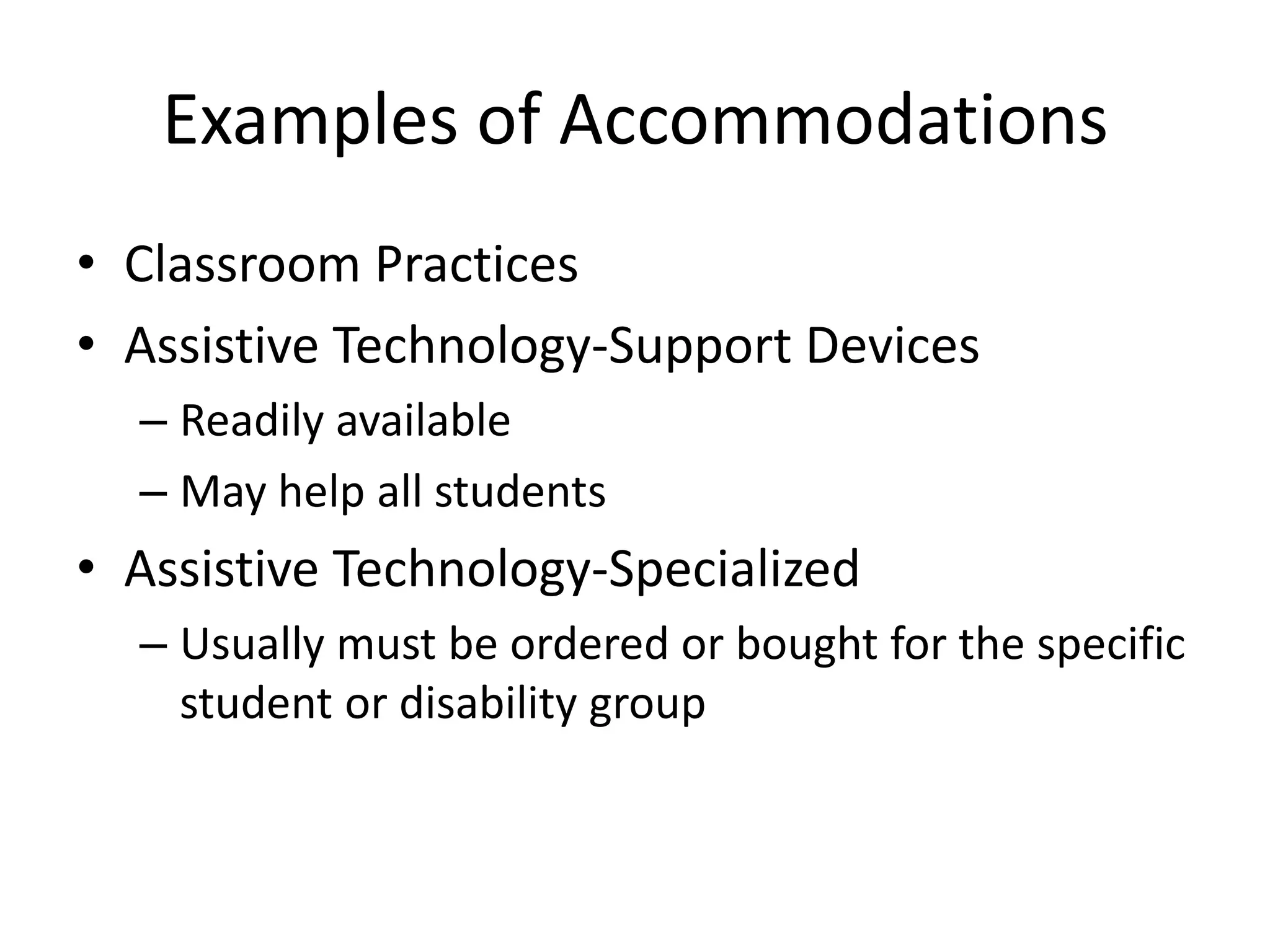
Examples of AccommodationsClassroom PracticesAssistive Technology-Support DevicesReadily availableMay help all studentsAssistive Technology-SpecializedUsually must be ordered or bought for the specific student or disability group
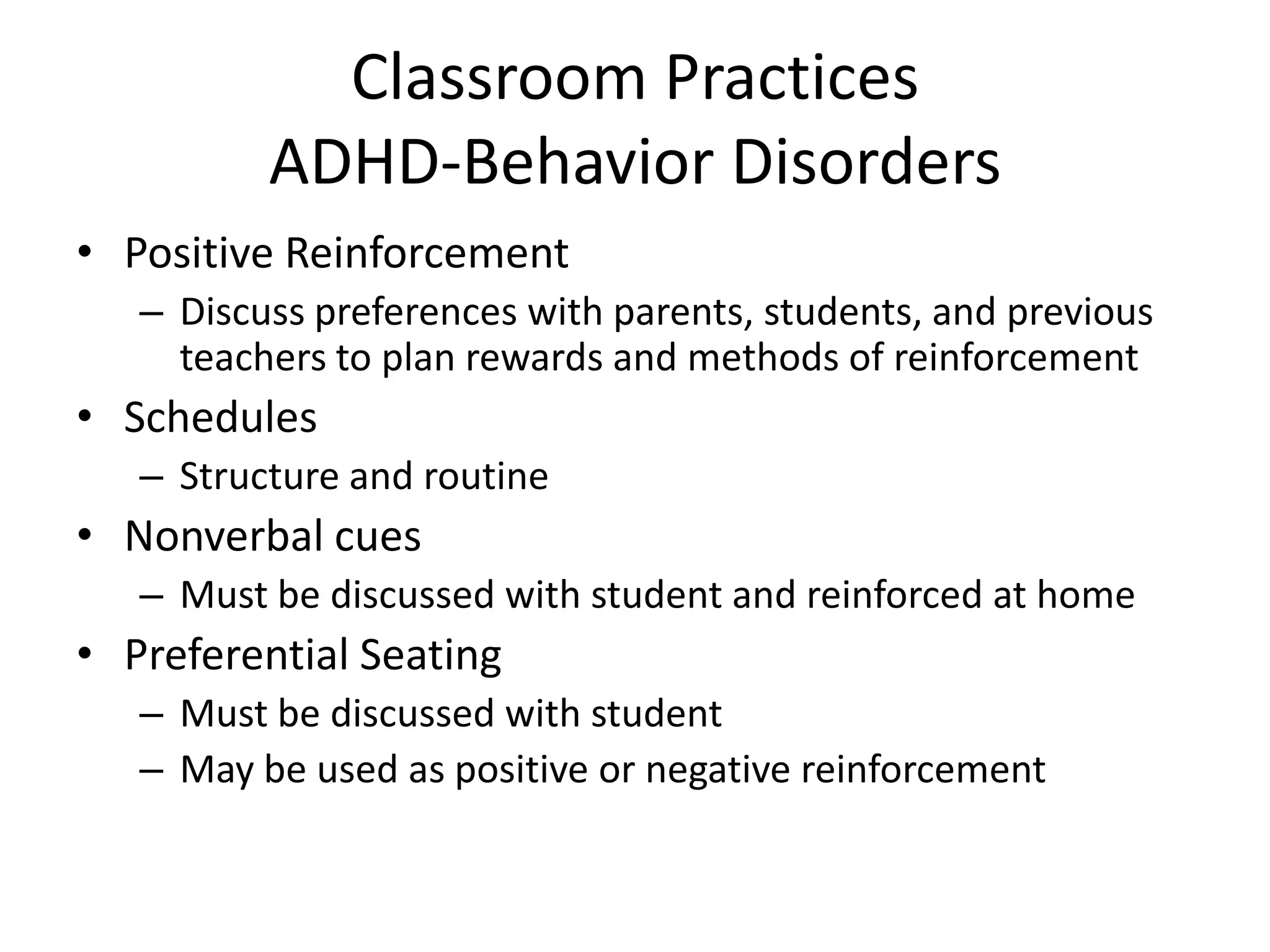
Classroom PracticesADHD-Behavior DisordersPositive ReinforcementDiscuss preferences with parents, students, and previous teachers to plan rewards and methods of reinforcementSchedulesStructure and routineNonverbal cuesMust be discussed with student and reinforced at homePreferential SeatingMust be discussed with studentMay be used as positive or negative reinforcement
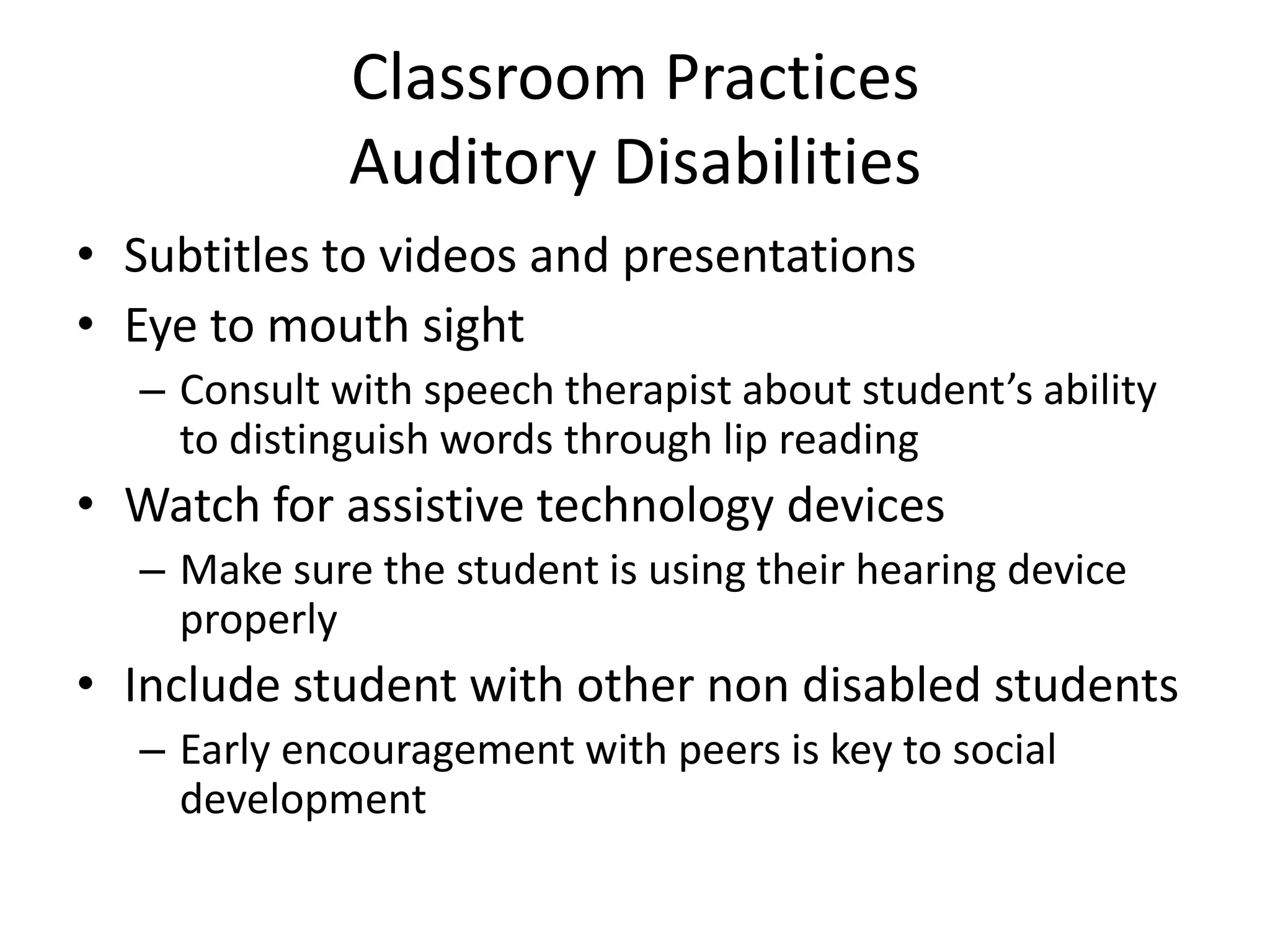
Classroom PracticesAuditory DisabilitiesSubtitles to videos and presentationsEye to mouth sightConsult with speech therapist about student’s ability to distinguish words through lip readingWatch for assistive technology devicesMake sure the student is using their hearing device properlyInclude student with other non disabled studentsEarly encouragement with peers is key to social development
Classroom PracticesLearning Disabilities-Reading/WritingPresentationAudio tapeLarge PrintDesignated ReaderResponseAllow verbal, written, and/or computer use for responsesTimingAllow extra time
What Assistive Technology (AT) is NOT:a person,a strategy,a method,a shorter assignment, ora different location in the classroom.Assistive Technology (AT) ISalso called Support Devices
Assistive Technology (AT) IS:Used to increase, maintain, or improve achievement of students with disabilities.Any piece of equipment or system that has been bought, modified, or customized to meet the above purpose.

Assistive Technology Presentation

  • 1.
    Resources for IndividualInstructionSpecifics for: ADHD, Auditory Disabilities, Reading and Writing Learning Disabilities
  • 2.
    Reasons to useresourcesIndividuals with Disabilities Act (IDEA, 2004)Follow Individual Education Plan (IEP) accommodationsProvide Least Restrictive Environment (LRE)
  • 3.
    IEPEstablished once identificationand evaluation has taken placeProvides recommended classroom accommodations and possible assessment modificationsReviewed and updated annually
  • 4.
    Least Restrictive Environment(LRE)Progressive path Paths provide as much access to the regular classroom environment as possibleOnly adds specialized services that would remove the student from the regular education environment as needed to meet each student’s goals in the IEP
  • 5.
    LRE-most accessSupport ServicesTakesplace out of the classroomTherapist consults and may suggest classroom strategies with teachers but does not assist in the classroomPsychological counseling (ADHD)Speech therapy (auditory needs)Occupational Therapy (writing needs)
  • 6.
    LRE-after, or incombination with Support ServicesStep One
  • 7.
  • 8.
  • 9.
    Special education teachersas co teachers (regular education teacher as lead teacher)
  • 10.
  • 11.
    Resource classrooms (specialeducation teacher as lead teacher)Special Education ParaprofessionalsServe as assistants to the special education student in the inclusion classroomADHDProximity controlTimeout optionsSocial SupportAuditory disabilitiesSign languageOral note taking translationLanguage and comprehension supportNote summaryOrganizational skills
  • 12.
    Special Education TeachersasCo TeachersSpecial education teacher may or may not be highly qualified in a content area (mostly at 9-12 level)Supports and collaborates with lead, regular education teacherMay do the following:Modifications of assignmentsSmall group instructionBehavior controlInclude subtitles in visual presentationsRead material aloud for reading disabilitiesReview in small groups as needed
  • 13.
    Special Education TeacherasLead TeacherReferred to as Resource classesSpecial education students onlySmall group sizes (usually under 10)Teaches same content but with accommodationsSometimes called self-contained classroomsExamples of students in self-contained classes:Traumatic brain injuriesParaplegicSeverely autistic
  • 14.
    Examples of AccommodationsClassroomPracticesAssistive Technology-Support DevicesReadily availableMay help all studentsAssistive Technology-SpecializedUsually must be ordered or bought for the specific student or disability group
  • 15.
    Classroom PracticesADHD-Behavior DisordersPositiveReinforcementDiscuss preferences with parents, students, and previous teachers to plan rewards and methods of reinforcementSchedulesStructure and routineNonverbal cuesMust be discussed with student and reinforced at homePreferential SeatingMust be discussed with studentMay be used as positive or negative reinforcement
  • 16.
    Classroom PracticesAuditory DisabilitiesSubtitlesto videos and presentationsEye to mouth sightConsult with speech therapist about student’s ability to distinguish words through lip readingWatch for assistive technology devicesMake sure the student is using their hearing device properlyInclude student with other non disabled studentsEarly encouragement with peers is key to social development
  • 17.
    Classroom PracticesLearning Disabilities-Reading/WritingPresentationAudiotapeLarge PrintDesignated ReaderResponseAllow verbal, written, and/or computer use for responsesTimingAllow extra time
  • 18.
    What Assistive Technology(AT) is NOT:a person,a strategy,a method,a shorter assignment, ora different location in the classroom.Assistive Technology (AT) ISalso called Support Devices
  • 19.
    Assistive Technology (AT)IS:Used to increase, maintain, or improve achievement of students with disabilities.Any piece of equipment or system that has been bought, modified, or customized to meet the above purpose.
  • 20.
    Assistive TechnologySupport DevicesCalculatorsWordProcessing softwareNote taking guidesGraphic OrganizersSubtitle features (auditory)Smart Response SystemHeadphones-books on tape (reading/writing)Behavior tracking sheets-rewards/consequences (ADHD)Removal of distractions (ADHD)Chorales (ADHD)
  • 21.
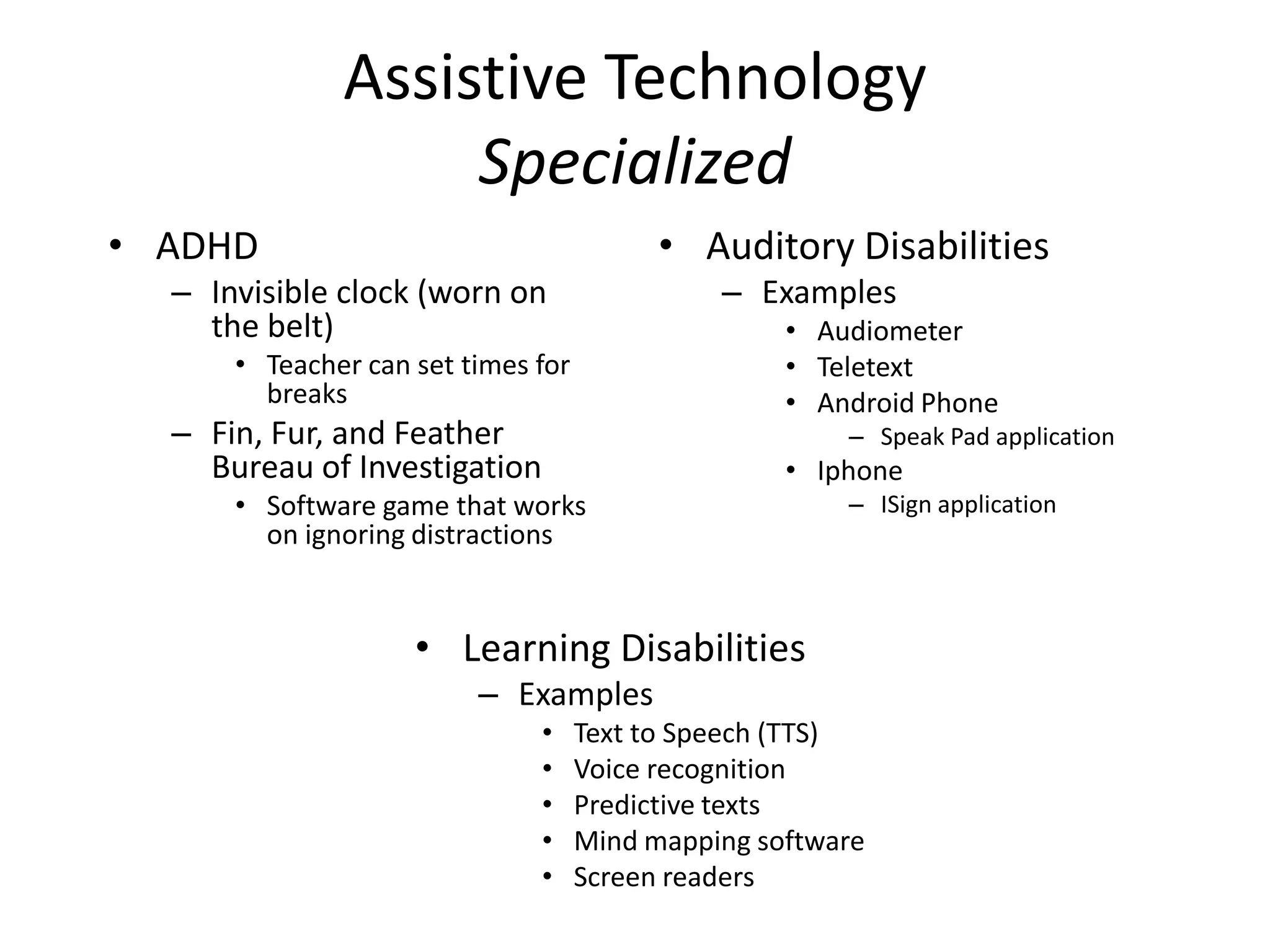
    Assistive TechnologySpecializedADHDInvisible clock(worn on the belt)Teacher can set times for breaksFin, Fur, and Feather Bureau of InvestigationSoftware game that works on ignoring distractionsAuditory DisabilitiesExamplesAudiometerTeletextAndroid PhoneSpeak Pad applicationIphoneISign applicationLearning DisabilitiesExamplesText to Speech (TTS)Voice recognitionPredictive textsMind mapping softwareScreen readers
  • 22.
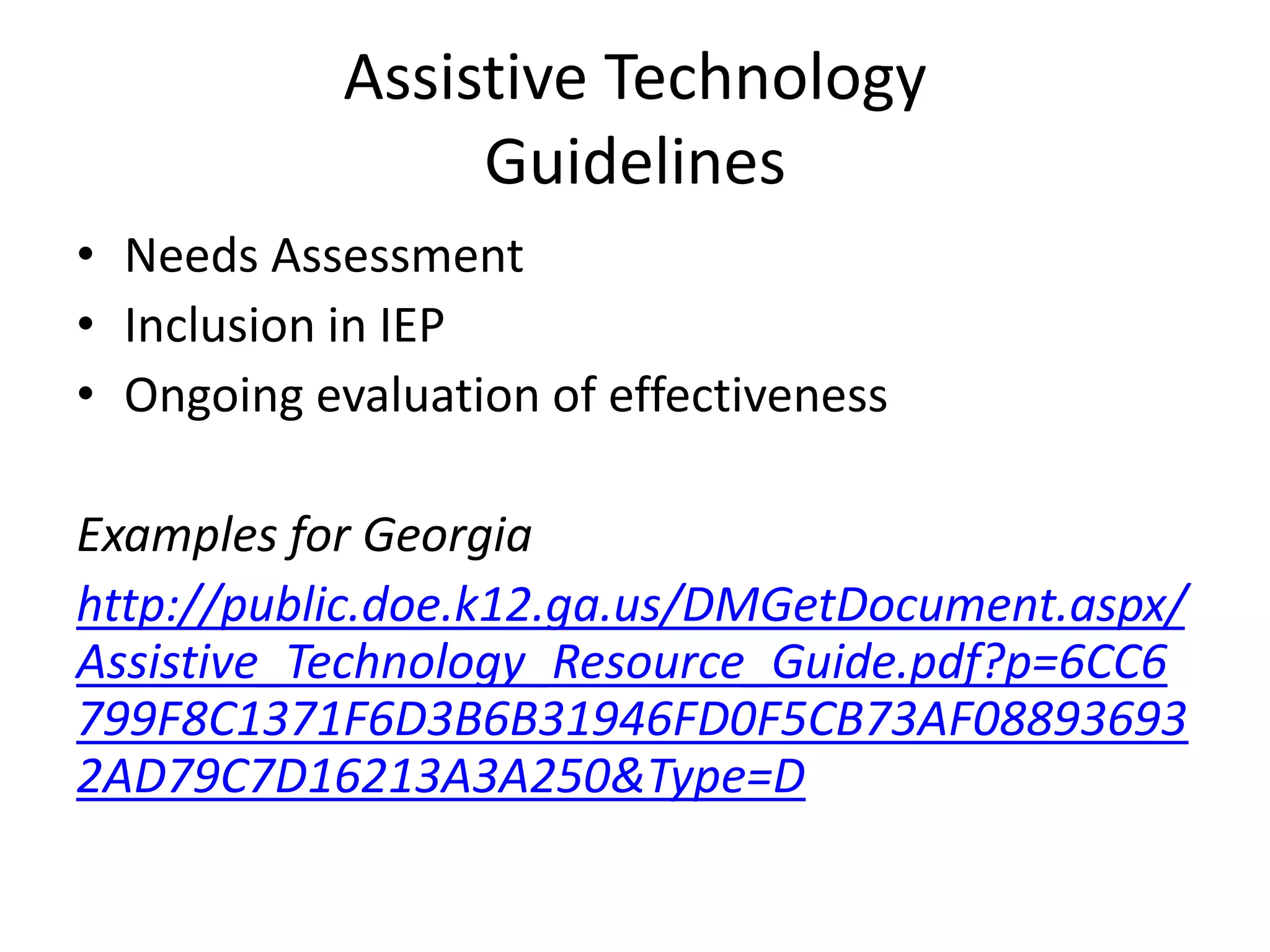
    Assistive TechnologyGuidelinesNeeds AssessmentInclusion in IEPOngoing evaluation of effectivenessExamples for Georgiahttp://public.doe.k12.ga.us/DMGetDocument.aspx/Assistive_Technology_Resource_Guide.pdf?p=6CC6799F8C1371F6D3B6B31946FD0F5CB73AF088936932AD79C7D16213A3A250&Type=D
  • 23.
    ReferencesGeorgia Project forAssistive Technology. (2008). Assistive technology consideration resource guide. Georgia Department of Education. Retrieved from http://public.doe.k12.ga.us/DMGetDocument.aspx/Assistive_Technology_Resource_Guide.pdf?p=6CC6799F8C1371F6D3B6B31946FD0F5CB73AF088936932AD79C7D16213A3A250&Type=DGromisch, E. S. (2010). ADHD and assistive technology. Bright Hub. Retrieved from http://www.brighthub.com/education/special/articles/74108.aspxNational Center for Learning Disorders. (2006). Accommodations for students with LD. LD Online. Retrieved from http://www.ldonline.org/article/Accommodations_for_Students_with_LDReed, P. (2011). Getting started with assistive technology. My Child without Limits.org. Retrieved from http://www.mychildwithoutlimits.org/?page=assessing-your-childs-needs