Gradual Release of
Responsibility Model
ETC 625 - Jeff Martin
What is it?
A teaching and learning strategy
that gradually shifts responsibility
of learning away from the teacher
and on to the learner
(TeachThought,2022)
This is a process…
Which means, that the gradual transfer of
responsibility does not imply a certain
amount of time nor a specific starting point.
The shift can happen in a short moment (one
class) or it can take months or years.
The essential part is that the method and
learning plan is one that will end with the
student capable of complete responsibility for
their individual learning in a field of
knowledge they could not have previously
handled.
2
3
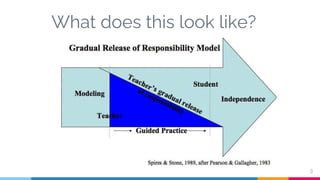
What does this look like?
There are 4 basic steps to the classic
understanding of the Gradual Release Model:
▷ Direct Instruction
▷ Guided Instruction
▷ Collaborative Learning
▷ Independent Practice
Let’s understand each of these better.
4
1.
Focus Lessons
5
Focus Lessons
In this part of the sequence of transferring
responsibility, the teacher maintains 100% of the
responsibility and ensures that clear, concise, and
accurate information, examples, and explanations
are given to the learners. This can be done with
visual aids, lectures, videos, etc. Brevity is usually
preferred. This is meant to be a quick look into the
possibilities for the learner not a full explanation.
6
2.
Guided Instruction
7
Guided Instruction
During this portion of the sequence, teachers “prompt, question,
facilitate, or lead students through tasks that increase their
understanding of the content”(Fisher,2008) .
This can be done with an entire class, smaller groups, or individuals.
Smaller groups have demonstrated to be the most effective at this
stage.
This instructional stage also provides the teacher with the
opportunity to assess and address the needs of the individuals
within small groups and assure that the needed content is
understood. 8
3.
Collaborative Learning
9
Collaborative Learning
Student learning is increased as they can come together, negotiate
meanings, debate statements, troubleshoot, and communicate
together.
This is an essential stage as it equips the learners with the
vocabulary and language skills needed to be successful and reach a
higher level of capacity to hold and maintain new levels of
responsibility.
Often the key to success in this stage is determined by choosing the
right project or workstation experience for the small groups.
10
4.
Independent Practice
11
Independent Practice
This stage of the learning process is where the students practice
using their new found knowledge and skills to achieve the next level
of learning on their own.
This requires giving the students time to try, struggle, and succeed
in being 100% responsible for their own ongoing learning.
They need to apply old and recently gathered information to new
situations and problems.
As this is a non-linear learning approach, students may move back
to previous stages to practice and/or master needed skills.
12
Does it work?
Yes!
Research has found that implementation of the Gradual Release of
Responsibility Model has been very effective.
Here are some sources that tested it’s effectiveness in the field of literacy.
Frey, N., D. Fisher, Language arts workshop: purposeful reading and writing
instruction, Merrill Education, Upper Saddle River, New Jersey, 2006.
Kong, A., P. D. Pearson, “The road to participation: the construction of a
literacy practice in a learning community of linguistically diverse learners,”
Research in the Teaching of English, 38, 2003, pp. 85- 124.
Lloyd, S., “Using comprehension strategies as a springboard for student talk,”
Journal of Adolescent and Adult Literacy, 48, 2004, pp. 114-124.
13
Keep it simple:
TeachThought’s Gradual Release process is
explained in 6 words. “Show Me, Guide Me, Let Me”
14
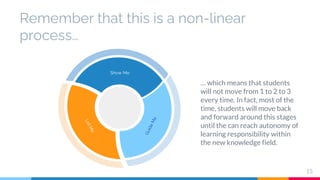
Remember that this is a non-linear
process…
Show Me
15
… which means that students
will not move from 1 to 2 to 3
every time. In fact, most of the
time, students will move back
and forward around this stages
until the can reach autonomy of
learning responsibility within
the new knowledge field.
100%
Responsibility of learning throughout all the
stages of learning means students being
supported and set up for success.
16
Still unclear? Watch this
https://youtu.be/uE_KTMRwbJs
17
Sources:
▷ Fisher, D. (2008) Effective use of gradual release of responsibility model. San Diego
University.https://www.researchgate.net/profile/Douglas-Fisher-
2/publication/266351394_Effective_Use_of_the_Gradual_Release_of_Responsibility_M
odel_The_Gradual_Release_of_Responsibility_Model/links/561bb0e308ae044edbb381
73/Effective-Use-of-the-Gradual-Release-of-Responsibility-Model-The-Gradual-
Release-of-Responsibility-Model.pdf
▷ Frey, N., Fisher, D. (2006) Language arts workshop: purposeful reading and writing
instruction, Merrill Education, Upper Saddle River, New Jersey.
▷ Heick, T. (2022) What is the gradual release of responsibility model?.
TeachThought.https://www.teachthought.com/pedagogy/gradual-release-
responsibility/
▷ Kong, A., Pearson, P.(2003). “The road to participation: the construction of a literacy
practice in a learning community of linguistically diverse learners,” Research in the
Teaching of English, 38, pp. 85- 124.
▷ Lloyd, S.,(2004) “Using comprehension strategies as a springboard for student talk,”
Journal of Adolescent and Adult Literacy, 48, pp. 114-124.
18

Gradual Release Model - ETC625

  • 1.
    Gradual Release of ResponsibilityModel ETC 625 - Jeff Martin
  • 2.
    What is it? Ateaching and learning strategy that gradually shifts responsibility of learning away from the teacher and on to the learner (TeachThought,2022) This is a process… Which means, that the gradual transfer of responsibility does not imply a certain amount of time nor a specific starting point. The shift can happen in a short moment (one class) or it can take months or years. The essential part is that the method and learning plan is one that will end with the student capable of complete responsibility for their individual learning in a field of knowledge they could not have previously handled. 2
  • 3.
    3 What does thislook like?
  • 4.
    There are 4basic steps to the classic understanding of the Gradual Release Model: ▷ Direct Instruction ▷ Guided Instruction ▷ Collaborative Learning ▷ Independent Practice Let’s understand each of these better. 4
  • 5.
  • 6.
    Focus Lessons In thispart of the sequence of transferring responsibility, the teacher maintains 100% of the responsibility and ensures that clear, concise, and accurate information, examples, and explanations are given to the learners. This can be done with visual aids, lectures, videos, etc. Brevity is usually preferred. This is meant to be a quick look into the possibilities for the learner not a full explanation. 6
  • 7.
  • 8.
    Guided Instruction During thisportion of the sequence, teachers “prompt, question, facilitate, or lead students through tasks that increase their understanding of the content”(Fisher,2008) . This can be done with an entire class, smaller groups, or individuals. Smaller groups have demonstrated to be the most effective at this stage. This instructional stage also provides the teacher with the opportunity to assess and address the needs of the individuals within small groups and assure that the needed content is understood. 8
  • 9.
  • 10.
    Collaborative Learning Student learningis increased as they can come together, negotiate meanings, debate statements, troubleshoot, and communicate together. This is an essential stage as it equips the learners with the vocabulary and language skills needed to be successful and reach a higher level of capacity to hold and maintain new levels of responsibility. Often the key to success in this stage is determined by choosing the right project or workstation experience for the small groups. 10
  • 11.
  • 12.
    Independent Practice This stageof the learning process is where the students practice using their new found knowledge and skills to achieve the next level of learning on their own. This requires giving the students time to try, struggle, and succeed in being 100% responsible for their own ongoing learning. They need to apply old and recently gathered information to new situations and problems. As this is a non-linear learning approach, students may move back to previous stages to practice and/or master needed skills. 12
  • 13.
    Does it work? Yes! Researchhas found that implementation of the Gradual Release of Responsibility Model has been very effective. Here are some sources that tested it’s effectiveness in the field of literacy. Frey, N., D. Fisher, Language arts workshop: purposeful reading and writing instruction, Merrill Education, Upper Saddle River, New Jersey, 2006. Kong, A., P. D. Pearson, “The road to participation: the construction of a literacy practice in a learning community of linguistically diverse learners,” Research in the Teaching of English, 38, 2003, pp. 85- 124. Lloyd, S., “Using comprehension strategies as a springboard for student talk,” Journal of Adolescent and Adult Literacy, 48, 2004, pp. 114-124. 13
  • 14.
    Keep it simple: TeachThought’sGradual Release process is explained in 6 words. “Show Me, Guide Me, Let Me” 14
  • 15.
    Remember that thisis a non-linear process… Show Me 15 … which means that students will not move from 1 to 2 to 3 every time. In fact, most of the time, students will move back and forward around this stages until the can reach autonomy of learning responsibility within the new knowledge field.
  • 16.
    100% Responsibility of learningthroughout all the stages of learning means students being supported and set up for success. 16
  • 17.
    Still unclear? Watchthis https://youtu.be/uE_KTMRwbJs 17
  • 18.
    Sources: ▷ Fisher, D.(2008) Effective use of gradual release of responsibility model. San Diego University.https://www.researchgate.net/profile/Douglas-Fisher- 2/publication/266351394_Effective_Use_of_the_Gradual_Release_of_Responsibility_M odel_The_Gradual_Release_of_Responsibility_Model/links/561bb0e308ae044edbb381 73/Effective-Use-of-the-Gradual-Release-of-Responsibility-Model-The-Gradual- Release-of-Responsibility-Model.pdf ▷ Frey, N., Fisher, D. (2006) Language arts workshop: purposeful reading and writing instruction, Merrill Education, Upper Saddle River, New Jersey. ▷ Heick, T. (2022) What is the gradual release of responsibility model?. TeachThought.https://www.teachthought.com/pedagogy/gradual-release- responsibility/ ▷ Kong, A., Pearson, P.(2003). “The road to participation: the construction of a literacy practice in a learning community of linguistically diverse learners,” Research in the Teaching of English, 38, pp. 85- 124. ▷ Lloyd, S.,(2004) “Using comprehension strategies as a springboard for student talk,” Journal of Adolescent and Adult Literacy, 48, pp. 114-124. 18