Milliken Literacy Network
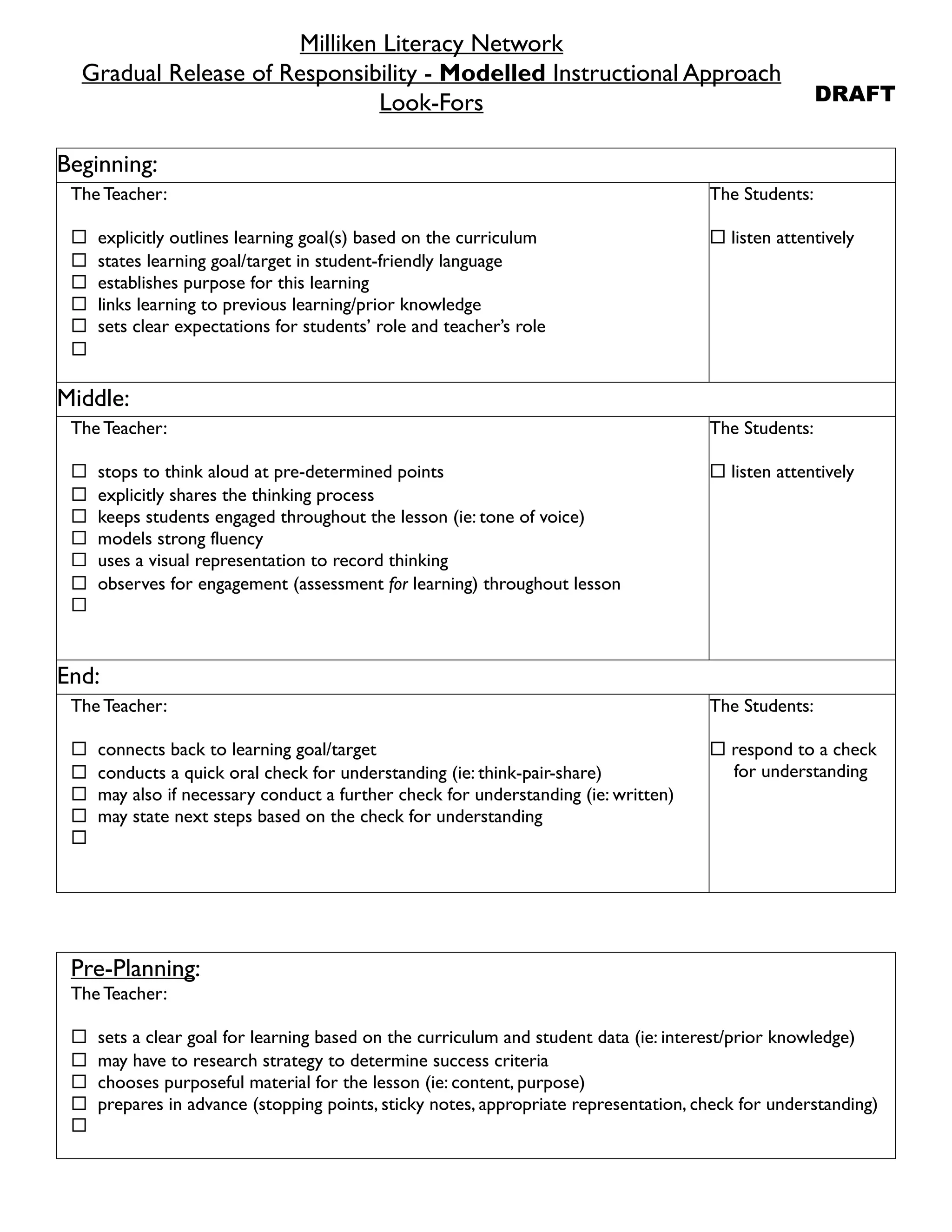
Gradual Release of Responsibility - Modelled Instructional Approach
Look-Fors
Beginning:Beginning:
The Teacher:
 explicitly outlines learning goal(s) based on the curriculum
 states learning goal/target in student-friendly language
 establishes purpose for this learning
 links learning to previous learning/prior knowledge
 sets clear expectations for students’ role and teacher’s role

The Students:
 listen attentively
Middle:Middle:
The Teacher:
 stops to think aloud at pre-determined points
 explicitly shares the thinking process
 keeps students engaged throughout the lesson (ie: tone of voice)
 models strong fluency
 uses a visual representation to record thinking
 observes for engagement (assessment for learning) throughout lesson

The Students:
 listen attentively
End:End:
The Teacher:
 connects back to learning goal/target
 conducts a quick oral check for understanding (ie: think-pair-share)
 may also if necessary conduct a further check for understanding (ie: written)
 may state next steps based on the check for understanding

The Students:
 respond to a check
for understanding
Pre-Planning:
The Teacher:
 sets a clear goal for learning based on the curriculum and student data (ie: interest/prior knowledge)
 may have to research strategy to determine success criteria
 chooses purposeful material for the lesson (ie: content, purpose)
 prepares in advance (stopping points, sticky notes, appropriate representation, check for understanding)

Pre-Planning:
The Teacher:
 sets a clear goal for learning based on the curriculum and student data (ie: interest/prior knowledge)
 may have to research strategy to determine success criteria
 chooses purposeful material for the lesson (ie: content, purpose)
 prepares in advance (stopping points, sticky notes, appropriate representation, check for understanding)

DRAFT
Milliken Literacy Network
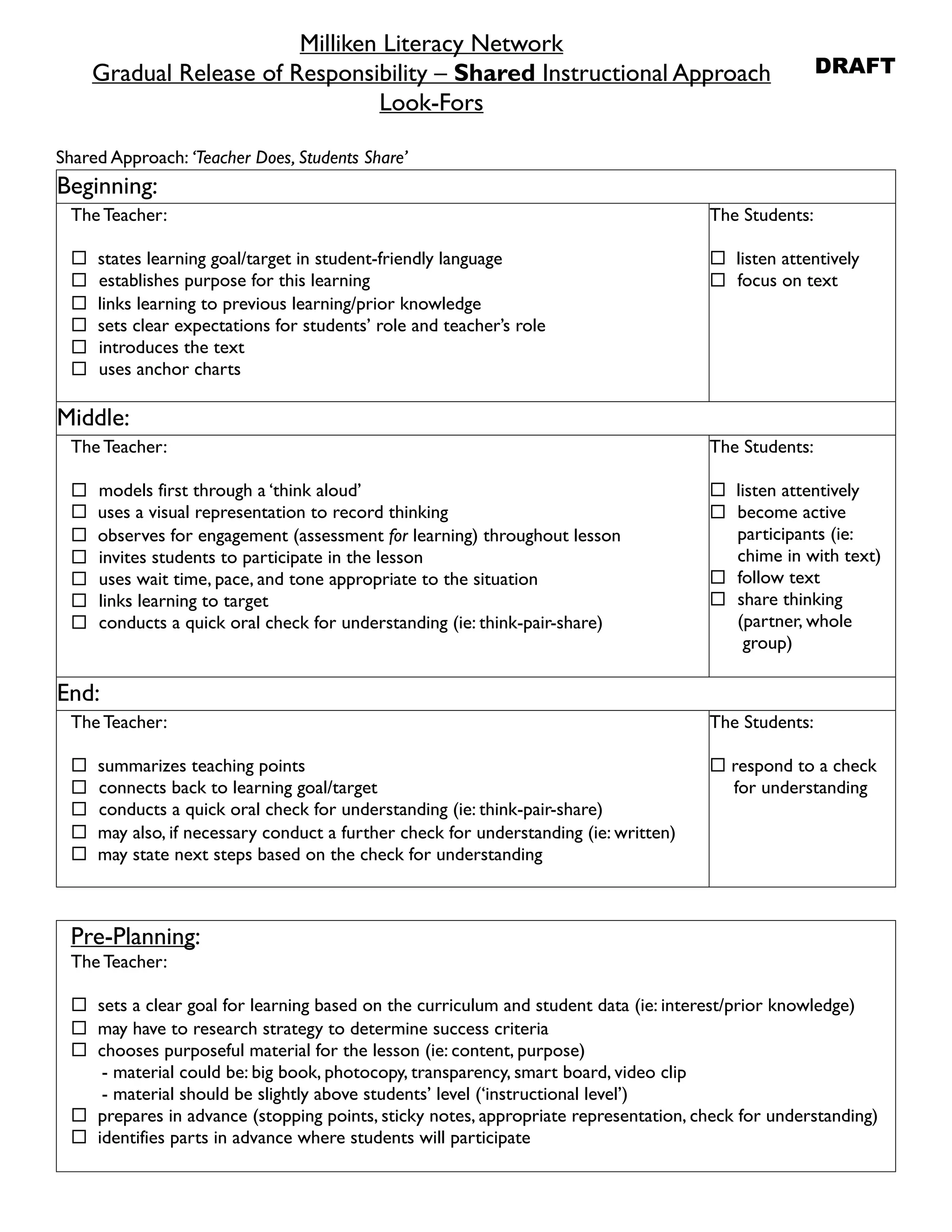
Gradual Release of Responsibility – Shared Instructional Approach
Look-Fors
Shared Approach: ‘Teacher Does, Students Share’
Beginning:Beginning:
The Teacher:
 states learning goal/target in student-friendly language
 establishes purpose for this learning
 links learning to previous learning/prior knowledge
 sets clear expectations for students’ role and teacher’s role
 introduces the text
 uses anchor charts
The Students:
 listen attentively
 focus on text
Middle:Middle:
The Teacher:
 models first through a ‘think aloud’
 uses a visual representation to record thinking
 observes for engagement (assessment for learning) throughout lesson
 invites students to participate in the lesson
 uses wait time, pace, and tone appropriate to the situation
 links learning to target
 conducts a quick oral check for understanding (ie: think-pair-share)
The Students:
 listen attentively
 become active
participants (ie:
chime in with text)
 follow text
 share thinking
(partner, whole
group)
End:End:
The Teacher:
 summarizes teaching points
 connects back to learning goal/target
 conducts a quick oral check for understanding (ie: think-pair-share)
 may also, if necessary conduct a further check for understanding (ie: written)
 may state next steps based on the check for understanding
The Students:
 respond to a check
for understanding
Pre-Planning:
The Teacher:
 sets a clear goal for learning based on the curriculum and student data (ie: interest/prior knowledge)
 may have to research strategy to determine success criteria
 chooses purposeful material for the lesson (ie: content, purpose)
- material could be: big book, photocopy, transparency, smart board, video clip
- material should be slightly above students’ level (‘instructional level’)
 prepares in advance (stopping points, sticky notes, appropriate representation, check for understanding)
 identifies parts in advance where students will participate
Pre-Planning:
The Teacher:
 sets a clear goal for learning based on the curriculum and student data (ie: interest/prior knowledge)
 may have to research strategy to determine success criteria
 chooses purposeful material for the lesson (ie: content, purpose)
- material could be: big book, photocopy, transparency, smart board, video clip
- material should be slightly above students’ level (‘instructional level’)
 prepares in advance (stopping points, sticky notes, appropriate representation, check for understanding)
 identifies parts in advance where students will participate
DRAFT
Milliken Literacy Network
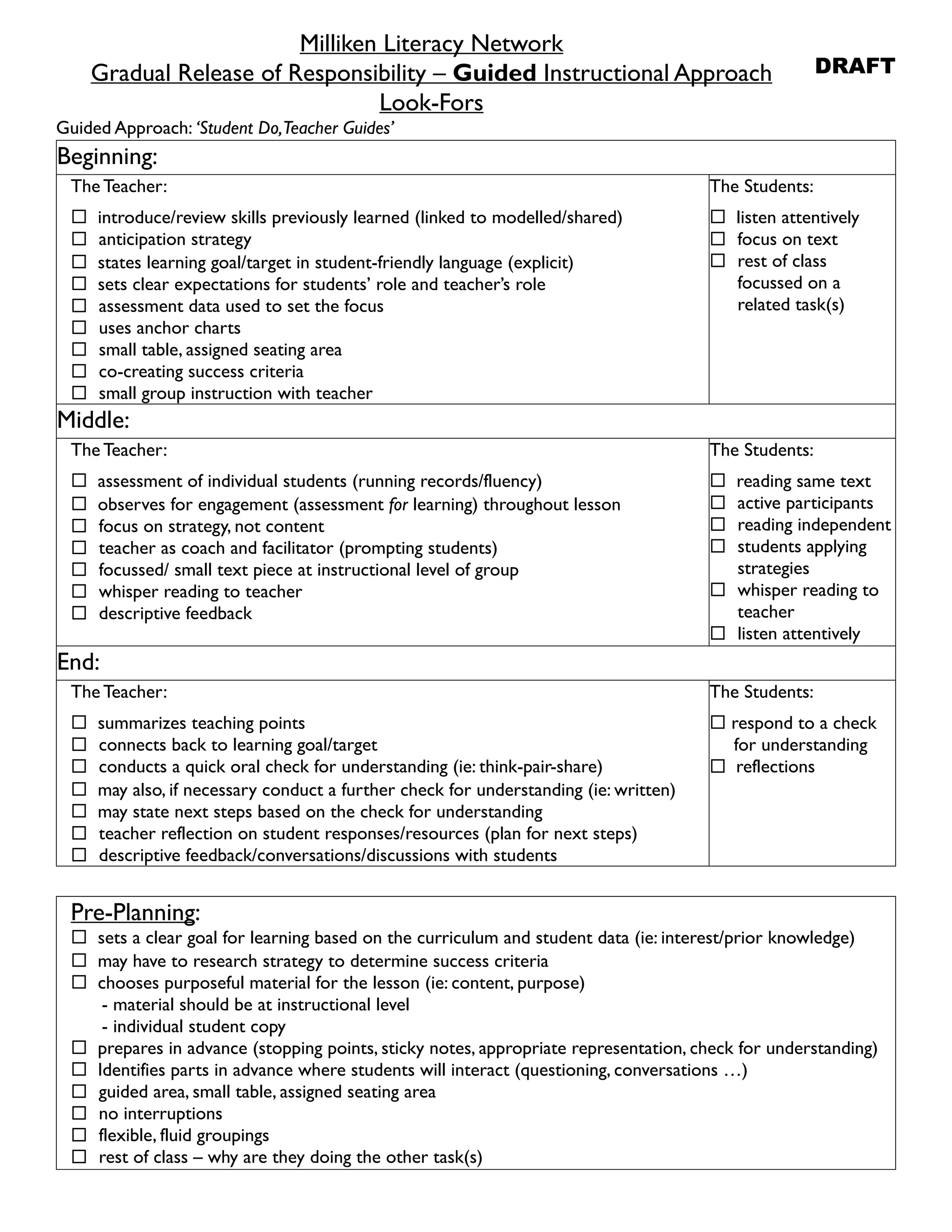
Gradual Release of Responsibility – Guided Instructional Approach
Look-Fors
Guided Approach: ‘Student Do,Teacher Guides’
Beginning:Beginning:
The Teacher:
 introduce/review skills previously learned (linked to modelled/shared)
 anticipation strategy
 states learning goal/target in student-friendly language (explicit)
 sets clear expectations for students’ role and teacher’s role
 assessment data used to set the focus
 uses anchor charts
 small table, assigned seating area
 co-creating success criteria
 small group instruction with teacher
The Students:
 listen attentively
 focus on text
 rest of class
focussed on a
related task(s)
Middle:Middle:
The Teacher:
 assessment of individual students (running records/fluency)
 observes for engagement (assessment for learning) throughout lesson
 focus on strategy, not content
 teacher as coach and facilitator (prompting students)
 focussed/ small text piece at instructional level of group
 whisper reading to teacher
 descriptive feedback
The Students:
 reading same text
 active participants
 reading independent
 students applying
strategies
 whisper reading to
teacher
 listen attentively
End:End:
The Teacher:
 summarizes teaching points
 connects back to learning goal/target
 conducts a quick oral check for understanding (ie: think-pair-share)
 may also, if necessary conduct a further check for understanding (ie: written)
 may state next steps based on the check for understanding
 teacher reflection on student responses/resources (plan for next steps)
 descriptive feedback/conversations/discussions with students
The Students:
 respond to a check
for understanding
 reflections
Pre-Planning:
 sets a clear goal for learning based on the curriculum and student data (ie: interest/prior knowledge)
 may have to research strategy to determine success criteria
 chooses purposeful material for the lesson (ie: content, purpose)
- material should be at instructional level
- individual student copy
 prepares in advance (stopping points, sticky notes, appropriate representation, check for understanding)
 Identifies parts in advance where students will interact (questioning, conversations …)
 guided area, small table, assigned seating area
 no interruptions
 flexible, fluid groupings
 rest of class – why are they doing the other task(s)
Pre-Planning:
 sets a clear goal for learning based on the curriculum and student data (ie: interest/prior knowledge)
 may have to research strategy to determine success criteria
 chooses purposeful material for the lesson (ie: content, purpose)
- material should be at instructional level
- individual student copy
 prepares in advance (stopping points, sticky notes, appropriate representation, check for understanding)
 Identifies parts in advance where students will interact (questioning, conversations …)
 guided area, small table, assigned seating area
 no interruptions
 flexible, fluid groupings
 rest of class – why are they doing the other task(s)
DRAFT
Milliken Literacy Network
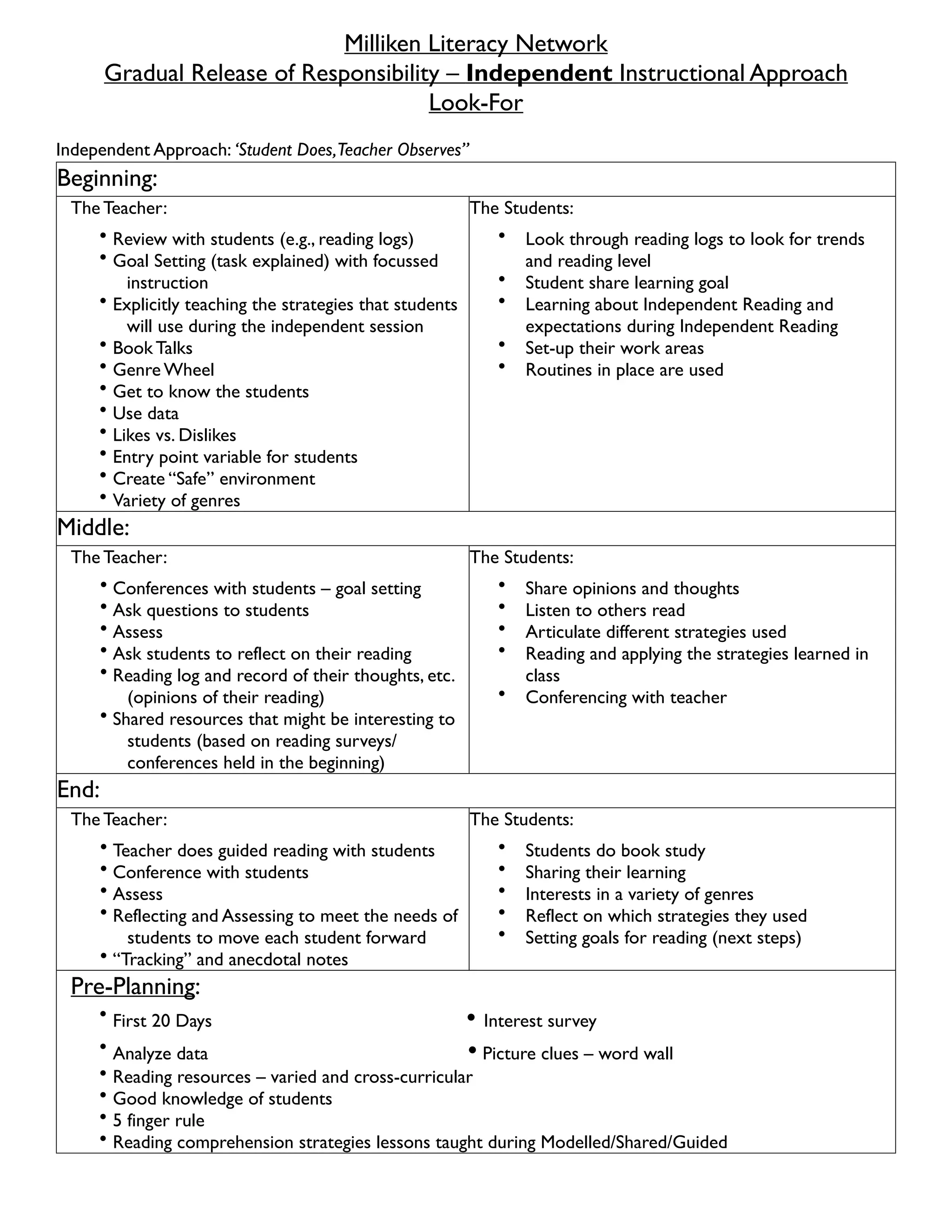
Gradual Release of Responsibility – Independent Instructional Approach
Look-For
Independent Approach: ‘Student Does,Teacher Observes”
Beginning:Beginning:
The Teacher:
• Review with students (e.g., reading logs)
• Goal Setting (task explained) with focussed
instruction
• Explicitly teaching the strategies that students
will use during the independent session
• Book Talks
• Genre Wheel
• Get to know the students
• Use data
• Likes vs. Dislikes
• Entry point variable for students
• Create “Safe” environment
• Variety of genres
The Students:
• Look through reading logs to look for trends
and reading level
• Student share learning goal
• Learning about Independent Reading and
expectations during Independent Reading
• Set-up their work areas
• Routines in place are used
Middle:Middle:
The Teacher:
• Conferences with students – goal setting
• Ask questions to students
• Assess
• Ask students to reflect on their reading
• Reading log and record of their thoughts, etc.
(opinions of their reading)
• Shared resources that might be interesting to
students (based on reading surveys/
conferences held in the beginning)
The Students:
• Share opinions and thoughts
• Listen to others read
• Articulate different strategies used
• Reading and applying the strategies learned in
class
• Conferencing with teacher
End:End:
The Teacher:
• Teacher does guided reading with students
• Conference with students
• Assess
• Reflecting and Assessing to meet the needs of
students to move each student forward
• “Tracking” and anecdotal notes
The Students:
• Students do book study
• Sharing their learning
• Interests in a variety of genres
• Reflect on which strategies they used
• Setting goals for reading (next steps)
Pre-Planning:
• First 20 Days • Interest survey
• Analyze data • Picture clues – word wall
• Reading resources – varied and cross-curricular
• Good knowledge of students
• 5 finger rule
• Reading comprehension strategies lessons taught during Modelled/Shared/Guided
Pre-Planning:
• First 20 Days • Interest survey
• Analyze data • Picture clues – word wall
• Reading resources – varied and cross-curricular
• Good knowledge of students
• 5 finger rule
• Reading comprehension strategies lessons taught during Modelled/Shared/Guided

Gradual Release Look Fors

  • 1.
    Milliken Literacy Network GradualRelease of Responsibility - Modelled Instructional Approach Look-Fors Beginning:Beginning: The Teacher:  explicitly outlines learning goal(s) based on the curriculum  states learning goal/target in student-friendly language  establishes purpose for this learning  links learning to previous learning/prior knowledge  sets clear expectations for students’ role and teacher’s role  The Students:  listen attentively Middle:Middle: The Teacher:  stops to think aloud at pre-determined points  explicitly shares the thinking process  keeps students engaged throughout the lesson (ie: tone of voice)  models strong fluency  uses a visual representation to record thinking  observes for engagement (assessment for learning) throughout lesson  The Students:  listen attentively End:End: The Teacher:  connects back to learning goal/target  conducts a quick oral check for understanding (ie: think-pair-share)  may also if necessary conduct a further check for understanding (ie: written)  may state next steps based on the check for understanding  The Students:  respond to a check for understanding Pre-Planning: The Teacher:  sets a clear goal for learning based on the curriculum and student data (ie: interest/prior knowledge)  may have to research strategy to determine success criteria  chooses purposeful material for the lesson (ie: content, purpose)  prepares in advance (stopping points, sticky notes, appropriate representation, check for understanding)  Pre-Planning: The Teacher:  sets a clear goal for learning based on the curriculum and student data (ie: interest/prior knowledge)  may have to research strategy to determine success criteria  chooses purposeful material for the lesson (ie: content, purpose)  prepares in advance (stopping points, sticky notes, appropriate representation, check for understanding)  DRAFT
  • 2.
    Milliken Literacy Network GradualRelease of Responsibility – Shared Instructional Approach Look-Fors Shared Approach: ‘Teacher Does, Students Share’ Beginning:Beginning: The Teacher:  states learning goal/target in student-friendly language  establishes purpose for this learning  links learning to previous learning/prior knowledge  sets clear expectations for students’ role and teacher’s role  introduces the text  uses anchor charts The Students:  listen attentively  focus on text Middle:Middle: The Teacher:  models first through a ‘think aloud’  uses a visual representation to record thinking  observes for engagement (assessment for learning) throughout lesson  invites students to participate in the lesson  uses wait time, pace, and tone appropriate to the situation  links learning to target  conducts a quick oral check for understanding (ie: think-pair-share) The Students:  listen attentively  become active participants (ie: chime in with text)  follow text  share thinking (partner, whole group) End:End: The Teacher:  summarizes teaching points  connects back to learning goal/target  conducts a quick oral check for understanding (ie: think-pair-share)  may also, if necessary conduct a further check for understanding (ie: written)  may state next steps based on the check for understanding The Students:  respond to a check for understanding Pre-Planning: The Teacher:  sets a clear goal for learning based on the curriculum and student data (ie: interest/prior knowledge)  may have to research strategy to determine success criteria  chooses purposeful material for the lesson (ie: content, purpose) - material could be: big book, photocopy, transparency, smart board, video clip - material should be slightly above students’ level (‘instructional level’)  prepares in advance (stopping points, sticky notes, appropriate representation, check for understanding)  identifies parts in advance where students will participate Pre-Planning: The Teacher:  sets a clear goal for learning based on the curriculum and student data (ie: interest/prior knowledge)  may have to research strategy to determine success criteria  chooses purposeful material for the lesson (ie: content, purpose) - material could be: big book, photocopy, transparency, smart board, video clip - material should be slightly above students’ level (‘instructional level’)  prepares in advance (stopping points, sticky notes, appropriate representation, check for understanding)  identifies parts in advance where students will participate DRAFT
  • 3.
    Milliken Literacy Network GradualRelease of Responsibility – Guided Instructional Approach Look-Fors Guided Approach: ‘Student Do,Teacher Guides’ Beginning:Beginning: The Teacher:  introduce/review skills previously learned (linked to modelled/shared)  anticipation strategy  states learning goal/target in student-friendly language (explicit)  sets clear expectations for students’ role and teacher’s role  assessment data used to set the focus  uses anchor charts  small table, assigned seating area  co-creating success criteria  small group instruction with teacher The Students:  listen attentively  focus on text  rest of class focussed on a related task(s) Middle:Middle: The Teacher:  assessment of individual students (running records/fluency)  observes for engagement (assessment for learning) throughout lesson  focus on strategy, not content  teacher as coach and facilitator (prompting students)  focussed/ small text piece at instructional level of group  whisper reading to teacher  descriptive feedback The Students:  reading same text  active participants  reading independent  students applying strategies  whisper reading to teacher  listen attentively End:End: The Teacher:  summarizes teaching points  connects back to learning goal/target  conducts a quick oral check for understanding (ie: think-pair-share)  may also, if necessary conduct a further check for understanding (ie: written)  may state next steps based on the check for understanding  teacher reflection on student responses/resources (plan for next steps)  descriptive feedback/conversations/discussions with students The Students:  respond to a check for understanding  reflections Pre-Planning:  sets a clear goal for learning based on the curriculum and student data (ie: interest/prior knowledge)  may have to research strategy to determine success criteria  chooses purposeful material for the lesson (ie: content, purpose) - material should be at instructional level - individual student copy  prepares in advance (stopping points, sticky notes, appropriate representation, check for understanding)  Identifies parts in advance where students will interact (questioning, conversations …)  guided area, small table, assigned seating area  no interruptions  flexible, fluid groupings  rest of class – why are they doing the other task(s) Pre-Planning:  sets a clear goal for learning based on the curriculum and student data (ie: interest/prior knowledge)  may have to research strategy to determine success criteria  chooses purposeful material for the lesson (ie: content, purpose) - material should be at instructional level - individual student copy  prepares in advance (stopping points, sticky notes, appropriate representation, check for understanding)  Identifies parts in advance where students will interact (questioning, conversations …)  guided area, small table, assigned seating area  no interruptions  flexible, fluid groupings  rest of class – why are they doing the other task(s) DRAFT
  • 4.
    Milliken Literacy Network GradualRelease of Responsibility – Independent Instructional Approach Look-For Independent Approach: ‘Student Does,Teacher Observes” Beginning:Beginning: The Teacher: • Review with students (e.g., reading logs) • Goal Setting (task explained) with focussed instruction • Explicitly teaching the strategies that students will use during the independent session • Book Talks • Genre Wheel • Get to know the students • Use data • Likes vs. Dislikes • Entry point variable for students • Create “Safe” environment • Variety of genres The Students: • Look through reading logs to look for trends and reading level • Student share learning goal • Learning about Independent Reading and expectations during Independent Reading • Set-up their work areas • Routines in place are used Middle:Middle: The Teacher: • Conferences with students – goal setting • Ask questions to students • Assess • Ask students to reflect on their reading • Reading log and record of their thoughts, etc. (opinions of their reading) • Shared resources that might be interesting to students (based on reading surveys/ conferences held in the beginning) The Students: • Share opinions and thoughts • Listen to others read • Articulate different strategies used • Reading and applying the strategies learned in class • Conferencing with teacher End:End: The Teacher: • Teacher does guided reading with students • Conference with students • Assess • Reflecting and Assessing to meet the needs of students to move each student forward • “Tracking” and anecdotal notes The Students: • Students do book study • Sharing their learning • Interests in a variety of genres • Reflect on which strategies they used • Setting goals for reading (next steps) Pre-Planning: • First 20 Days • Interest survey • Analyze data • Picture clues – word wall • Reading resources – varied and cross-curricular • Good knowledge of students • 5 finger rule • Reading comprehension strategies lessons taught during Modelled/Shared/Guided Pre-Planning: • First 20 Days • Interest survey • Analyze data • Picture clues – word wall • Reading resources – varied and cross-curricular • Good knowledge of students • 5 finger rule • Reading comprehension strategies lessons taught during Modelled/Shared/Guided