Waste Management
Waste Management
• If wastes are not properly handled they can pollute surface
and groundwater and contribute to air pollution.
• Proper management of waste from agricultural operations can
contribute in a significant way to farm operations.
• Waste management helps to maintain healthy environment
for farm animals and can reduce the need for commercial
fertilizers while providing other nutrients needed for crop
production.
• The process--- reduce, recycle and make it usable for different
purpose is waste management.
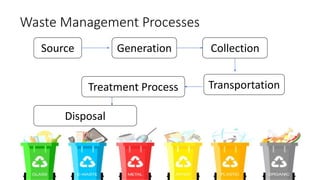
Waste Management Processes
Source Generation Collection
Transportation
Treatment Process
Disposal
Generation
The major quantity of solid waste generated from
agricultural sources are sugarcane bagasse, paddy and wheat
straw and husk, waste of vegetables, food product, tea, oil
production, wooden mill waste, coconut husk, cotton stalk, etc.
Generation
Stubble and
Straw Waste
Green Waste
Generation
Roadside
Waste
Animal
Waste
Collection
• Waste like fruits and vegetable waste collected from houses
(domestic waste)
• Waste collected from road streets or side
• Collected waste like dry refuse and green waste, animal dung
from agricultural field
Transportation Process
• Wastes collected from the side of roads and agricultural field are transported
to decomposed site and for further treatment by trucks, trailers, carts.
• Different types of waste are collected and then transported for further
treatment and the waste which is not used is directly disposed to the
sanitary land.
• Wastes are not burned in open air, so they are then transported for
incineration.
Treatment Process
A.Composting
B.Recycling
C.Incineration
Composting
It is a method in which organic matter present
in agricultural waste is decomposed
aerobically/anaerobically through a biochemical
process and converted into humus.
Three step operation in composting:
1. Preparation of agricultural waste
• shall be free of material that is not produced in agricultural field
• shall be reasonably free of dirt, soil and visible surface
• shall be arranged so that it will burn with a minimum of smoke
Three step operation in composting:
2. Decomposition Waste is decomposed by three ways:
2.1. NADEP System
2.2. Vermiculture Decomposition
2.3. Anaerobic Decomposition
Three step operation in composting:
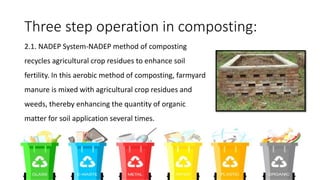
2.1. NADEP System-NADEP method of composting
recycles agricultural crop residues to enhance soil
fertility. In this aerobic method of composting, farmyard
manure is mixed with agricultural crop residues and
weeds, thereby enhancing the quantity of organic
matter for soil application several times.
Three step operation in composting:
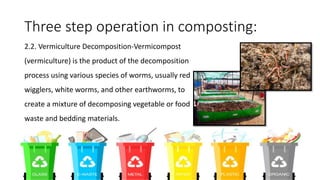
2.2. Vermiculture Decomposition-Vermicompost
(vermiculture) is the product of the decomposition
process using various species of worms, usually red
wigglers, white worms, and other earthworms, to
create a mixture of decomposing vegetable or food
waste and bedding materials.
Three step operation in composting:
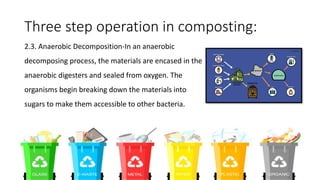
2.3. Anaerobic Decomposition-In an anaerobic
decomposing process, the materials are encased in the
anaerobic digesters and sealed from oxygen. The
organisms begin breaking down the materials into
sugars to make them accessible to other bacteria.
Recycling
• Process to change waste into new product
• Prevent waste of potentially useful materials, reduce the
consumption of fresh raw materials, reduce energy usage
• Reduce air pollution from incineration and water pollution from
land filling.
• Lower greenhouse gas emissions
• Key component of modern waste reduction and is the third
component of the Reduce, Reuse, Recycle
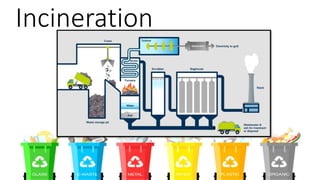
Incineration
Incineration is a waste treatment process that involves
the combustion of organic substances contained in waste
materials. Incineration and other high temperature waste
treatment systems are described as "thermal treatment."
Incineration of waste materials converts the waste into ash,
flue gas and heat.
Incineration
ENVIRONMENTAL LAWS
•Presidential Decree (PD) 1152, ―the Philippine
Environmental Code, which took effect in 1977, provides a
basis for an integrated waste management regulation
starting from waste source to methods of disposal.
ENVIRONMENTAL LAWS
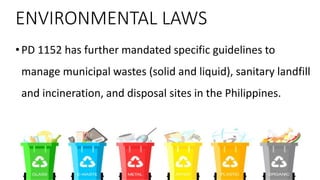
•PD 1152 has further mandated specific guidelines to
manage municipal wastes (solid and liquid), sanitary landfill
and incineration, and disposal sites in the Philippines.
ENVIRONMENTAL LAWS
• In 1990, the Philippine Congress enacted the Toxic Substances, Hazardous
and Nuclear Wastes Control Act, commonly known as Republic Act (RA)
6969, a law designed to respond to increasing problems associated with toxic
chemicals and hazardous and nuclear wastes. RA 6969 mandates control and
management of import, manufacture, process, distribution, use, transport,
treatment, and disposal of toxic substances and hazardous and nuclear
wastes in the country.
ENVIRONMENTAL LAWS
• The Act seeks to protect public health and the environment from unreasonable risks
posed by these substances in the Philippines. Apart from the basic policy rules and
regulations of RA 6969, hazardous waste management must also comply with the
requirements of other specific environmental laws, such as PD 984 (Pollution Control
Law), PD 1586 (Environmental Impact Assessment System Law), RA 8749 (Clean Air Act)
and RA 9003 (Ecological Solid Waste Management Act) and their implementing rules and
regulations. What is I

Grade 9-Waste Management Process.pptx

  • 1.
  • 2.
    Waste Management • Ifwastes are not properly handled they can pollute surface and groundwater and contribute to air pollution. • Proper management of waste from agricultural operations can contribute in a significant way to farm operations. • Waste management helps to maintain healthy environment for farm animals and can reduce the need for commercial fertilizers while providing other nutrients needed for crop production. • The process--- reduce, recycle and make it usable for different purpose is waste management.
  • 3.
    Waste Management Processes SourceGeneration Collection Transportation Treatment Process Disposal
  • 4.
    Generation The major quantityof solid waste generated from agricultural sources are sugarcane bagasse, paddy and wheat straw and husk, waste of vegetables, food product, tea, oil production, wooden mill waste, coconut husk, cotton stalk, etc.
  • 5.
  • 6.
  • 7.
    Collection • Waste likefruits and vegetable waste collected from houses (domestic waste) • Waste collected from road streets or side • Collected waste like dry refuse and green waste, animal dung from agricultural field
  • 8.
    Transportation Process • Wastescollected from the side of roads and agricultural field are transported to decomposed site and for further treatment by trucks, trailers, carts. • Different types of waste are collected and then transported for further treatment and the waste which is not used is directly disposed to the sanitary land. • Wastes are not burned in open air, so they are then transported for incineration.
  • 9.
  • 10.
    Composting It is amethod in which organic matter present in agricultural waste is decomposed aerobically/anaerobically through a biochemical process and converted into humus.
  • 11.
    Three step operationin composting: 1. Preparation of agricultural waste • shall be free of material that is not produced in agricultural field • shall be reasonably free of dirt, soil and visible surface • shall be arranged so that it will burn with a minimum of smoke
  • 12.
    Three step operationin composting: 2. Decomposition Waste is decomposed by three ways: 2.1. NADEP System 2.2. Vermiculture Decomposition 2.3. Anaerobic Decomposition
  • 13.
    Three step operationin composting: 2.1. NADEP System-NADEP method of composting recycles agricultural crop residues to enhance soil fertility. In this aerobic method of composting, farmyard manure is mixed with agricultural crop residues and weeds, thereby enhancing the quantity of organic matter for soil application several times.
  • 14.
    Three step operationin composting: 2.2. Vermiculture Decomposition-Vermicompost (vermiculture) is the product of the decomposition process using various species of worms, usually red wigglers, white worms, and other earthworms, to create a mixture of decomposing vegetable or food waste and bedding materials.
  • 15.
    Three step operationin composting: 2.3. Anaerobic Decomposition-In an anaerobic decomposing process, the materials are encased in the anaerobic digesters and sealed from oxygen. The organisms begin breaking down the materials into sugars to make them accessible to other bacteria.
  • 17.
    Recycling • Process tochange waste into new product • Prevent waste of potentially useful materials, reduce the consumption of fresh raw materials, reduce energy usage • Reduce air pollution from incineration and water pollution from land filling. • Lower greenhouse gas emissions • Key component of modern waste reduction and is the third component of the Reduce, Reuse, Recycle
  • 18.
    Incineration Incineration is awaste treatment process that involves the combustion of organic substances contained in waste materials. Incineration and other high temperature waste treatment systems are described as "thermal treatment." Incineration of waste materials converts the waste into ash, flue gas and heat.
  • 19.
  • 20.
    ENVIRONMENTAL LAWS •Presidential Decree(PD) 1152, ―the Philippine Environmental Code, which took effect in 1977, provides a basis for an integrated waste management regulation starting from waste source to methods of disposal.
  • 21.
    ENVIRONMENTAL LAWS •PD 1152has further mandated specific guidelines to manage municipal wastes (solid and liquid), sanitary landfill and incineration, and disposal sites in the Philippines.
  • 22.
    ENVIRONMENTAL LAWS • In1990, the Philippine Congress enacted the Toxic Substances, Hazardous and Nuclear Wastes Control Act, commonly known as Republic Act (RA) 6969, a law designed to respond to increasing problems associated with toxic chemicals and hazardous and nuclear wastes. RA 6969 mandates control and management of import, manufacture, process, distribution, use, transport, treatment, and disposal of toxic substances and hazardous and nuclear wastes in the country.
  • 23.
    ENVIRONMENTAL LAWS • TheAct seeks to protect public health and the environment from unreasonable risks posed by these substances in the Philippines. Apart from the basic policy rules and regulations of RA 6969, hazardous waste management must also comply with the requirements of other specific environmental laws, such as PD 984 (Pollution Control Law), PD 1586 (Environmental Impact Assessment System Law), RA 8749 (Clean Air Act) and RA 9003 (Ecological Solid Waste Management Act) and their implementing rules and regulations. What is I

Editor's Notes

  • #15 Differnce between NADEP and VERMI Organic remains are decomposed by microbes.Organic remains are pulverized by earthworms.