INTRODUCTION
Sound waves arelongitudinal waves that can travel
through any material medium (i.e., solids, liquids or
gases) with a speed that depends on the properties of
the medium.
3.
As soundtravels through a medium, the particles of the
medium vibrate along the direction of motion of the
wave.
This is in contrast to a transverse wave where the
particle motion is perpendicular to the direction of
propagation (motion).
6.
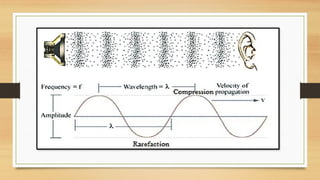
The displacementthat occur as a result of sound waves
involve the longitudinal displacements of individual
molecules.
This results in a series of high and low pressure regions
called compression and rarefaction respectively.
“Sound waves are longitudinal waves that travel through
all media (solid, liquid or gas) in the form of compressions
and rarefactions.”
9.
ORIGIN OF SOUND
•Sound is
A form of energy made by vibrations.
When an object vibrates it causes the air particles around it
to move.
These particles bump into particles close to them and this
continues until they run out of energy.
10.
Sound is avariation in the pressure of the air of a type which has
an effect on our ears and brain.
Sound may be produced in a variety of ways, normally as a result
of some mechanical disturbance on an object, causing it to vibrate.
• For example
-- guitar strings
-- human vocal chord
-- loudspeaker
-- jet engines
-- drum
When wewave our hands, we produce compressions and
rarefactions in air.
However, no audible sounds are produced because the
frequency of such vibrations is too low (< 20 Hz) to affect our
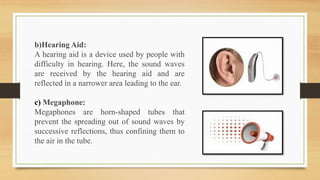
auditory nerves.
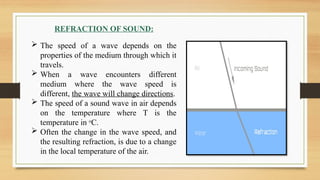
Likewise if the frequency of sound is high (> 20 kHz), no
sound is heard by the human ear. It is because the vibrations
are so rapid that auditory nerves do not respond to them.
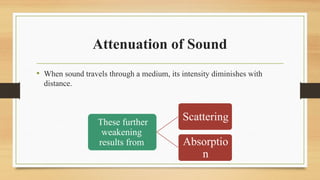
14.
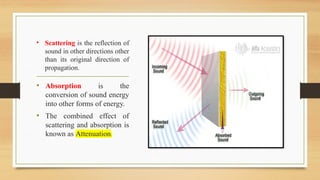
a) Audible SoundWaves:
• Audible waves are sound waves that human ear can hear.
• -- The range of human hearing is 20 Hz to 20 kHz. In other
words, we cannot hear waves of frequency below 20 Hz or
above 20 kHz.
• -- The audible waves can be generated in a variety of ways such
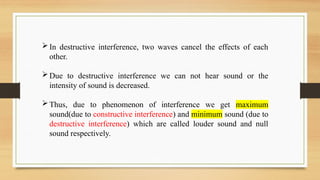
as by musical instruments, human vocal cords and loudspeakers.
15.
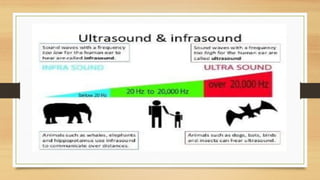
b) Inaudible SoundWaves:
• Those waves which human ear cannot hear are called inaudible waves.
Inaudible
Waves
Infrasonic
Ultrasonic
16.
• Infrasonic arelongitudinal waves with frequencies below 20 Hz.
Earthquake waves are an example.
• Ultrasonic waves are longitudinal waves with frequencies above 20 kHz.
For example, they can be generated by inducing vibrations in a quartz
crystal with an applied alternating electric field.
• Sound may be broadly classified into two general groups :
1. Musical sound
2. Noise
• The difference between a musical sound and a noise is subjective, i.e., its
depends upon the sense of a person.
• A sound which is musical to someone may be noise to others
18.
CHARACTERISTICS OF SOUND
WAVES
•Sound waves are characterised by its pitch (frequency), loudness
(intensity) and quality.
• The speed of the sound depends on the medium transmitting it.
21.
1. Amplitude :It is the maximum displacement of the medium
from its equilibrium state when a mechanical wave passes
through the medium. The amplitude of wave is denoted by
‘a’.
2. Wavelength : The distance between two successive crest or
two successive trough is called wavelength of the wave. It is
denoted by ‘λ’.
3. Time period : The time period of a wave is the time taken
by the wave source to complete 1 vibration or cycle. It is
denoted by ‘T’.
22.
4) Frequency :The frequency of a wave is the number of
complete cycles that pass a given point in one second. It is
denoted by ‘f’.
-- The unit of frequency is Hz.
f = 1/T
5) Wave velocity : The distance covered by a wave in one
second is called wave velocity. It is denoted by ‘v’ and is
measured in ms-1
in SI units.
23.
6) Vibration :Any regularly repeated to-and-fro motion or
change is known as vibration.
7) Phase : The stage in a cycle that a wave has reached at a
particular time from some reference point.
24.
VELOCITY OF SOUND
Asound wave is fundamentally a pressure disturbance that propagates
through a medium by particle interaction.
In other words, sound waves move through a physical medium by
alternately contracting and expanding the section of the medium in which
it propagates.
The rate at which the sound waves propagate through the medium is
known as the speed of sound.
25.
The velocity ofsound is defined as the distance through which a sound
wave’s point, such as a compression or a rarefaction, travels per unit of
time.
The Velocity of sound can be determined by the following formula:
v = λ f
Where v is the velocity, λ is the wavelength of the sound wave, and f is the
frequency
26.
a) In Solids
Sound is nothing more than a disturbance
propagated by the collisions between the
particles, one molecule hitting the next and
so forth.
Solids are significantly denser than liquids
or gases, and this means that the molecules
are closer to each other in solids than in
liquids and liquids than in gases.
This closeness due to density means that
they can collide very quickly.
27.
Effectively ittakes less time for a molecule of a solid to bump into its
neighbouring molecule. Due to this advantage, the velocity of sound in
a solid is faster than in a gas.
The speed of sound in solid is 6000 metres per second, while the
speed of sound in steel is equal to 5100 metres per second.
Another interesting fact about the speed of sound
is that sound travels 35 times faster in diamonds than in the air.
28.
b) In Liquid
Similarly,the density of a liquid is
greater than the density of a gas.
Therefore the distances between
molecules are more in liquids than
in solids but are less than in gases.
Hence the speed of sound in
liquids lies in between the speed
of sound in solids and gases.
29.
The speedof sound in water is more than that of the air, and
sound travels faster in water than in the air.
The speed of sound in water is 1480 metres per second.
It is also interesting that the speed may vary between 1450 to
1498 metres per second in distilled water.
In contrast, seawater’s speed is 1531 metres per second when
the temperature is between 20o
C to 25o
C.
30.
c) In gas/air:
Since gases expand to fill the given space, density is relatively uniform
irrespective of gas type, which isn’t the case with solids and liquids.
Still, it is independent of the frequency of the sound wave or the
pressure and the density of the medium. But none of the gases we find
in real life is ideal gases, and this causes the properties to change
slightly.
The velocity of sound in air at 20o
C is 343.2 m/s which translates to
1,236 km/h
32.
EFFECT OF PRESSURE,TEMPERATUREAND
HUMIDITY ON THE SPEED OF SOUND
EFFECT OF PRESSURE :
When the pressure of a given mass of a gas changes, there is a corresponding
change of volume and density. If the temperature remains constant, then from
Boyle’s law, we have
33.
NEWTON’S FORMULA:
Newton assumed that the propagation of sound waves in air is an
isothermal phenomenon. i.e., a process in which temperature remains
constant and Boyle’s law holds good.
He argued that the small amount of heat which is produced at
compression is rapidly taken away to the places of rarefactions where
a slight cooling is produced.
In this way the temperature of the gas remains constant. Thus, for a
given mass of gas at pressure p and volume V, we have
pV = constant
34.
LAPLACE’S FORMULA :
Laplacepointed out that the propagation of sound waves through air is not an
isothermal process (as suggested by Newton) but it is an adiabatic (no heat
transfer) process.
He argued that due to the reasons
(1) that compressions and rarefactions in sound waves take place very rapidly,
(2) large distances between compressions and rarefactions,
(3) There is no appreciable heat flow from regions of compressions (where temp.
is slightly high) to the regions of rarefactions (where temp. is slightly low).
35.
The relation betweenpressure and volume of air is
governed by the adiabatic relation,
constant
pV
Hence if the temperature of the gas remains constant, the speed of
sound does not change with a change of pressure.
36.
.
EFFECT OF TEMPERATURE:
When the temperature of gas changes, its density also
changes without affecting the pressure. Thus, the speed of
sound also changes. i.e., the speed of sound is different at
different temperatures.
Thus the speed of sound is directly proportional to the
absolute temperature.
37.
EFFECT OF WIND:
If the wind blows in the direction of sound, then the velocity of sound
increased but if wind blows in the opposite direction, the velocity of sound
is decreased.
EFFECT OF FREQUENCY(PITCH):
There is no effect of frequency on the speed of sound in a medium.
Sound waves of different frequency travels with the same speed in the
air although their wavelength in air are different.
38.
EFFECT OF HUMIDITY:
Forthe low temperature and pressure, the density of water vapour is less
than that of air. Therefore, the presence of the moisture in the same
volume of air lowers the density of the mixture.
Therefore the speed of sound in air increases with the increase in
humidity in the air.
39.
REFLECTION, REFRACRTION ANDACOUSTIC
IMPEDANCE OF SOUND
• REFLECTION:
Just like the reflection of light, the reflection of sound is similar as it
follows the laws of reflections, where the angle of reflection is equal to
the angle of incidence and the reflected sound, the incident sound, and the
normal sound belong in the same plane.
Sound bounces off the surface of the medium which can be a solid or a
liquid.
40.
Laws of Reflectionof
Sound
The angle of reflection is
always equal to the angle
of incidence .
The reflected sound, the
incident sound, and the
normal sound belong in
the same plane.
41.
APPLICATIONS OF REFLECTIONOF SOUND:
A) ECHO:
Echo is the repetition of a sound caused by the reflection of sound
waves.
Echo arrives at the listener with a delay after the direct sound.
If the gap between the original sound wave and the reflected sound wave
is greater than 1/10th
of the second, the reflection is called an Echo.
42.
Bats andDolphins use echo to detect obstacles.
Echo is also used in the SONAR (Sound Navigation And Ranging)
technique used for the detection and location of objects inside the water,
such as submerged submarines, and icebergs.
43.
An echo isheard only if the distance between the person producing the
sound and the rigid obstacle (or reflector) is long enough to allow the
reflected sound to reach the person at least 0.1 seconds after the original
sound is heard.
• Conditions for Hearing Echo Distinctly
The minimum distance in air between the source of sound and the reflector
must be 17 m.
The intensity of sound should be sufficient so that the reflected sound
reaching the ear is audible.
44.
b)Hearing Aid:
A hearingaid is a device used by people with
difficulty in hearing. Here, the sound waves
are received by the hearing aid and are
reflected in a narrower area leading to the ear.
c) Megaphone:
Megaphones are horn-shaped tubes that
prevent the spreading out of sound waves by
successive reflections, thus confining them to
the air in the tube.
45.
REFRACTION OF SOUND:
The speed of a wave depends on the
properties of the medium through which it
travels.
When a wave encounters different
medium where the wave speed is
different, the wave will change directions.
The speed of a sound wave in air depends
on the temperature where T is the
temperature in o
C.
Often the change in the wave speed, and
the resulting refraction, is due to a change
in the local temperature of the air.
46.
For example, duringthe day the air is
warmest right next to the ground and grows
cooler above the ground. This is called
a temperature lapse.
Since the temperature decreases with
height, the speed of sound also decreases
with height.
This means that for a sound wave traveling
close to the ground, the part of the wave
closest to the ground is traveling the fastest,
and the part of the wave farthest above the
ground is traveling the slowest.
47.
A temperature inversionis when the
temperature is coolest right next to
the ground and warmer as you
increase in height above the ground.
Since the temperature increases with
height, the speed of sound also
increases with height.
This means that for a sound wave
traveling close to the ground, the part
of the wave closest to the ground is
traveling the slowest, and the part of
the wave farthest above the ground is
traveling the fastest.
48.
Attenuation of Sound
•When sound travels through a medium, its intensity diminishes with
distance.
These further
weakening
results from
Scattering
Absorptio
n
49.
• Scattering isthe reflection of
sound in other directions other
than its original direction of
propagation.
• Absorption is the
conversion of sound energy
into other forms of energy.
• The combined effect of
scattering and absorption is
known as Attenuation.
50.
ACOUSTIC IMPEDANCE
Acoustic impedanceis the opposition of a medium to a longitudinal wave
motion. It characterizes the relationship between the acting sound pressure
and the resulting particle velocity.
This impedance is called the specific acoustic impedance of the medium
because it characterizes the medium itself.
When a sound source transfers its energy to a medium, however, the
medium opposes the movement of the source with some kind of average
impedance that is dependent not only on the medium, but also on the size of
the air mass pushed by the sound source.
51.
INTERFERENCE OF SOUNDWAVES
• When two or more wave of sound of same frequency travelling in almost
same direction superimpose,
• The resultant intensity in the region of superimposition is different than
the intensity of individual waves.
52.
• The modificationin the distribution of intensity of sound in
the region of superposition is called interference.
• Depending upon the way the waves superimpose, the
interference is of two types :
(1) Constructive interference
(2) Destructive interference
53.
A) CONSTRUCTIVE INTERFERENCE
•Constructive interference is when two waves
traveling in the same direction overlap, and
their crests combine to produce a larger
wave.
• This phenomenon is called constructive
interference.
• In constructive interference, two waves of
sound reinforce each other.
• In constructive interference, one can hear a
louder sound.
54.
B) DESTRUCTIVE INTERFERENCE
•Destructive interference is when two
waves traveling in the same direction
are aligned at the crest of one wave
and the trough of the other.
• This is termed as Destructive
interference.
55.
In destructive interference,two waves cancel the effects of each
other.
Due to destructive interference we can not hear sound or the
intensity of sound is decreased.
Thus, due to phenomenon of interference we get maximum
sound(due to constructive interference) and minimum sound (due to
destructive interference) which are called louder sound and null
sound respectively.
56.
DOPPLER EFFECT
When asource generating wave moves relative
to an observer, or when an observer moves
relative to a source, there is an apparent shift in
frequency.
This apparent change in frequency due to the
motion of the source (or receiver) is called the
Doppler effect, after Christian Doppler (1803-
1853), the Austrian Physicist who first
explained this phenomenon.
57.
The Dopplereffect occurs for all types of waves whenever there is a
relative motion between the source of waves and the observer.
The greater the speed of the source, the greater will be the Doppler
effect.
“The apparent change in the observed frequency of a wave due
to the relative motion between the source of waves and the observer is
called Doppler Effect.”
Note: The change in loudness is not the Doppler Effect! It is the shift
in frequency!
59.
The Doppler effectoccurs when a source of waves moves relative to the
observer.
E.g. the rise and subsequent drop in pitch of an automobile horn as it
approaches and then passes.
In other words, frequency of sound is raised when the source of sound
approaches you and lowered when the source is moving away from you.
The reason is simple, as the car approaches a stationary listener, the sound
waves are crowded together, causing a decrease in wavelength and
increase in frequency of the sound heard.
After the car has passed and moving away from the listener, the sound
waves spread out.
As a result, the wavelength is increased and the observed frequency is
decreased.
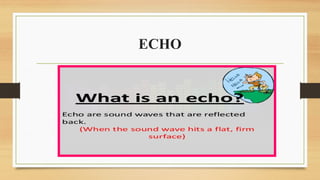
The wordecho derives from
the Greek word.
In audio processing and acoustics,
an echo is a reflection of sound, arriving
at the listener some time after the direct
sound.
Typical examples are the echo produced
by the bottom of a well, by a building, or
by the walls of an enclosed room and an
empty room.
A true echo is a single reflection of the
sound source.
63.
If so manyreflections arrive at a listener that they are unable to
distinguish between them, the proper term is reverberation.
Echoes are reflected off walls or hard surfaces like mountains.
64.
RESONANCE
• When avibrating objects sets up air vibrations in space, the sound
vibrations in the air very weak at some frequencies and strong at other
frequency.
• The frequency at which the sound vibrations are strong are called resonant
frequency of the system and the phenomenon is known as resonance.
65.
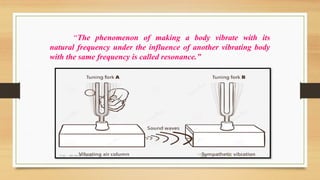
“The phenomenon ofmaking a body vibrate with its
natural frequency under the influence of another vibrating body
with the same frequency is called resonance.”