Chinese Spring:
NewYear Festival
Chinese New Year is the longest and the
most important festivity in the Chinese
calendar.
Chinese New Year is known as “Spring
Festival” the literal translation of the Chinese
name Chunjie, since the spring season in
Chinese calendar starts with lichun, the first
solar term in Chinese calendar year
. It marks
the end of the winter season.
The festival begins on the first day of the first
month in the traditional calendar and ends with
the Lantern Festival which is on the 15th day
Chinese New Year’s Eve, a day where Chinese
families gather for their annual reunion dinner, is
known as Chuxi or “Eve of the Passing Year.”
Because the Chinese calendar is lunar-solar,
the Chinese New Year is often referred to as the
“Lunar New Year.”
The following are the China’s customs and traditions
concerning the celebration of the Chinese New Year:
People will pour out their money to buy presents,
decorations, materials, food, and clothing.
Houses are thoroughly cleaned in order to sweep
away any ill fortune and to make way for good
incoming luck.
Windows and doors will be decorated with red color
paper-cuts and couplets with popular themes of good
fortune or happiness, wealth, and longevity.
On the Eve of Chinese New Year, supper is
feast with families. Food will include item such
as pork, duck, meat, chicken, sweet delicacies.
The family will end the night with firecrackers.
Children greet their parents early in the morning
by wishing them a healthy and a happy new year,
and received money in red paper envelopes. The
Chinese New Year tradition is to reconcile,
forget all hatred, and sincerely wish peace
and happiness for everyone.
The Dragon Dance is a form
of traditional dance and
performance in Chinese
culture; like the lion dance it is
most often seen in festive
celebrations. Many Chinese
people often use the term
“Descendants of the Dragon,’”
(long de chuan ren) as a sign of
ethnic identity. The emperor of
China usually used the dragon
as a symbol of his imperial
power and strength.
The Dragon dance is a
highlight of Chinese New Year
celebrations. The dragon
symbolizes power, strength,
and good luck. The dance
team mimics the supposed
movements of this river spirit in
a flowing, rise and fall manner.
The movements in a
performance traditionally
symbolize historical roles of
dragons demonstrating power
and dignity.
The main objective of
wearing Chinese
costumes is to maintain
the sanctity of their
tradition. They get
haircuts and makeovers
so that they are fully
ready to welcome the
New Year in a brand new
style.
Traditionally women
wear the cheongsams
and qipaos while the
men wear the
mandarin collared
shirts with the Chinese
dragon symbols, and
traditionally kung fu
suits and coats.
Kung Fu suits
Cheongsams
and qipaos
Taiko DrumFestival of
Japan
History
Drums were used in ancient times to signify the
boundaries of a village. Peasant events such as rice
harvests or dance festivals were celebrated with
drums.
Drums were used to pray for rain and other religious
ceremonies.
Drums lead warriors into battles in order to scare the
enemy.
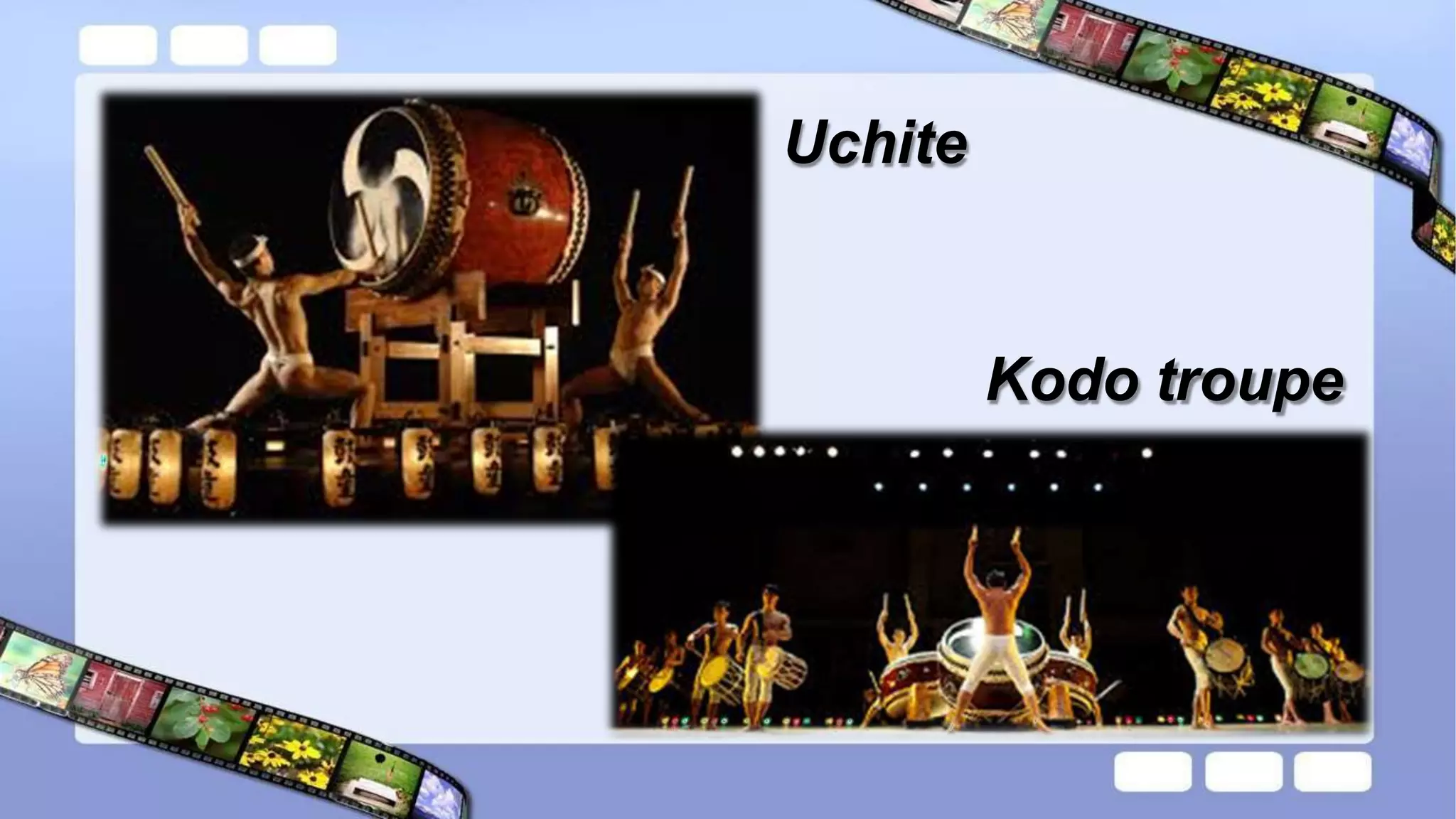
A good example of a professional taiko
drumming troupe is the Kodo.
The name Kodo conveys two meaning:
Heartbeat the primal source of all rhythm
and, read in a different way.
Children of the drum, a reflection of
Kodo’s desire to play their drums simply,
with the heart of a child.
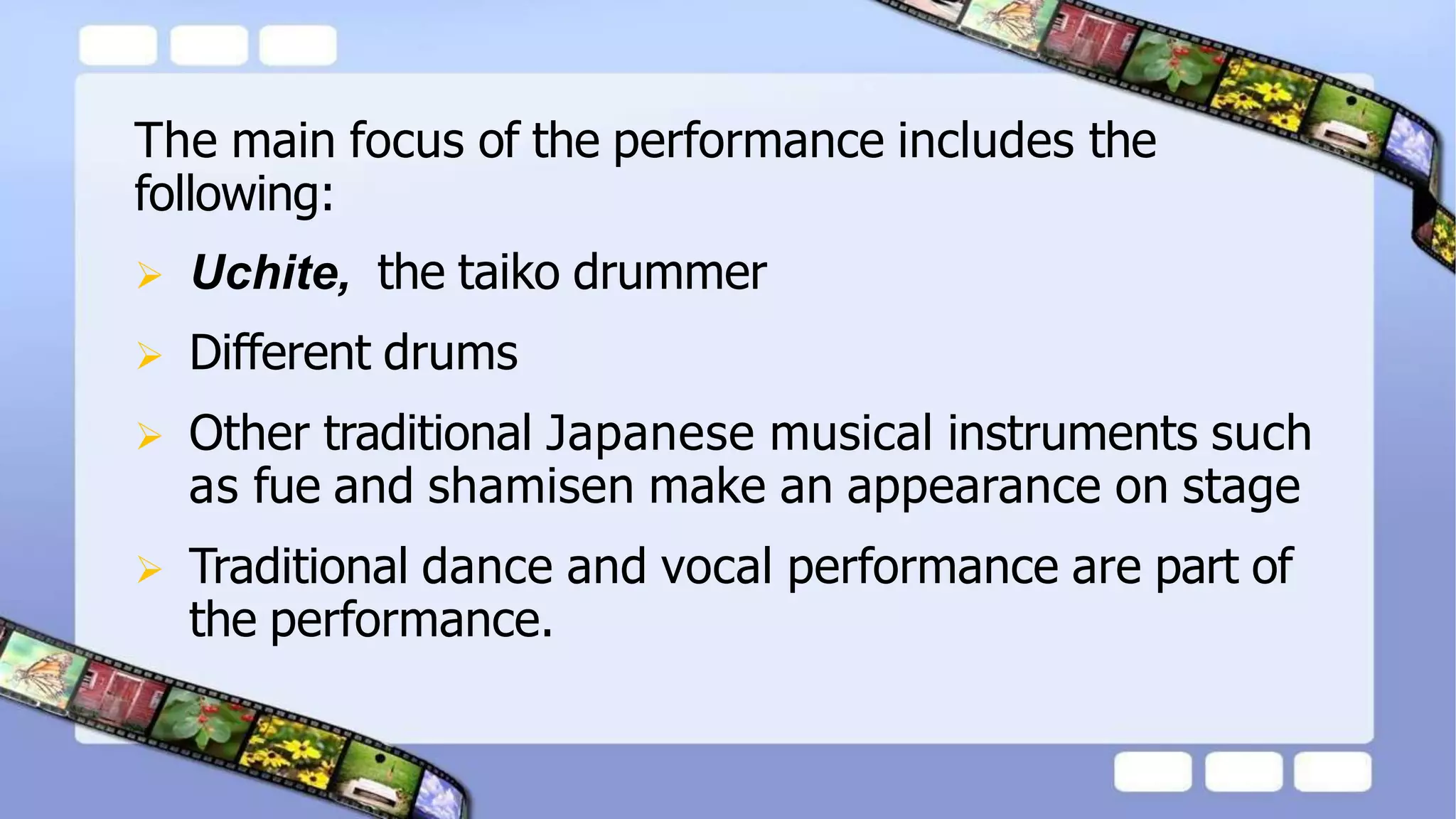
The main focus of the performance includes the
following:
 Uchite, the taiko drummer
 Different drums
 Other traditional Japanese musical instruments such
as fue and shamisen make an appearance on stage
 Traditional dance and vocal performance are part of
the performance.
Uchite
Kodo troupe
 Include pieces based on the
traditional rhythms of regional Japan,
pieces composed for Kodo by
contemporary songwriters, and pieces
written by Kodo members
themselves.
 Performances normally last for about
one hour and forty minutes.
Costumes and Props
Happi – coats over black with white calligraphy. A
baggy-sleeved short cotton jacket, tied with a sash
(obi) around the waist. It is usually a plain color,
typically blue or black, with a symbol printed on the
lapels and on the back.
Hachimaki – white headband
Tabi – shoes with big toe separated
Odaiko (big drum); Jozuke (medium); Chime (small)
Happi
Balinese Dance Festival
of Indonesia
Balinese dances are a
very ancient dance
tradition that is a part of
the religious and artistic
expression among the
Balinese people.
General Description
In Hinduism, dance is an accompaniment
to the perpetual dissolving and reforming
of the world. The creative and
reproductive balance is often personified
as Shiva’s wife, Durga, sometimes called
Uma, Parvati, or Kali. This has
significance in Balinese Hinduism, since
the common figure of Rangda is similar in
many ways to Durga.
Shiva and Durga
Variations
In Bali there are various categories of
dance, including epic performances such
as the universal Mahabharata and
Ramayana. Certain ceremonies at village
temples features a special performance of
a dance-drama, a battle between the
mythical characters Rangda, the witch
representing the evil and Barong, the lion
or dragon, representing good.
Variations
♫ Among the dance traditions in Bali,
these terms deserve special mention:
♫ Barong, the Lion; Legong, a refined
refined dance form characterized by
intricate finger movements,
complicated foot work, and
expressive gestures and facial
expressions; and
Barong
Variations
♫ Among the dance traditions in
Bali, these terms deserve special
mention:
♫ Kecak, (a monkey dance) a form
of Balinese dance and music
drama, it originated in the 1930’s in
Bali and is performed primarily by
men
Kecak
Training of Bali Dance
♫ Bali dancers learn the craft
from their mothers as soon as
they are born. In the womb, they
are played the Balinese music
and are taught to dance with
their hands before they can
walk.
Training of Bali Dance
♫ Official training as a Bali
dancers starts as young as
seven. In Balinese dance the
movement is closely
associated with the rhythms
produced by the gamelan.
Movements
♫ Multiple levels of articulations in the
face, eyes, hands, arms, hips, and
feet are coordinated to reflect layers
of percussive sounds.
♫ The number of codified hand
positions and gestures, the mudras,
is higher in India than in Java or Bali.
Costumes of Balinese Dancers
Most Female dancers wear:
♫ Various colors of makeup
♫ a crown
♫ both real and golden flowers in their hair
♫ Sarong and wrap a long sash from their hips to
their breasts as well as many gold decorations
♫ Crown and decorations are made from
cowhide
Costumes of Balinese Dancers
Most Male dancers wear:
♫ makeup (use more red color for their eyes and
cheeks and their eyebrows are colored to
enhanced masculinity)
♫ a mask when they dance the topeng dance
♫ a crown
♫ a cloak or many pieces of these clothes around
their body
Lantern Festivals of
Thailand
This event is about the launching of lanterns
which are actually small hot air balloons.
Each release of a sky lantern is a petition, small
prayer, or good wishes of the person who
released the lantern.
This event is held on the full moon of the 12th
month in the traditional Thai lunar calendar
. In the
western calendar this usually falls in November.
Sky Lantern Festival (Yi Peng) Festival
The Chiang Mai area has been the scene of
mass sky lantern release. Some of the meaning
of releasing the sky lanterns are:
it sends a person’s bad luck and misfortune away
into the air, especially if it disappears from view
before the fire goes out.
people say a short prayer before launching the
lantern. Sometimes they will also write their
address in the lantern. Anyone who later finds the
lantern can then claim money from the sender. In
this way, the good fortune is shared.
It is considered good luck. Many Thai’s
believe these sky lanterns are symbols
of problems and worries floating away.
It can act as veneration to Pra Ged
Kaew Ju La Mannee (The crystal Chedi
in heaven in which Buddha’s hair is
kept.)
Loy Krathong Festival
Loy or Loi Krathong Festival
This takes place on the
evening of the full moon of the
12th month in the traditional
Thai lunar calendar. In
western calendar this usually
falls in November.
Loy / Loi literally means “to float.”
while Krathong refers to the “lotus-
shaped receptacle” which can float on
water. Originally, the Krathong was
made of banana leaves or the layers
of the trunk of a banana tree or a
spider lily plant.
The festival is believed to originate in an
ancient practice of paying respect to the spirit
of waters. A krathong will be decorated with
elaborately-folded banana leaves, flowers,
candles, and incense sticks. A low value coin
is sometimes included as an offering to the
river spirits. During the night of the full moon,
Thais will float their krathong on a river,
canal, or on a pond lake.
The tradition is said to have
begun in the 13th century
when a young queen made a
small boat adorned with
candles and sent it down the
river
It is a ritual honoring Pra Mae Kongka,
the goddess of water. The construction of
the colorful boats was a way of not only
giving thanks for the abundance of water,
but also a way to seek forgiveness for
oversue and pollution. Today, Loy Krathong
is a way for people to make wishes and
look toward the future.
grade 8 ARTS (mapeh)-  4th quarter.pptx

grade 8 ARTS (mapeh)- 4th quarter.pptx

  • 2.
  • 3.
    Chinese New Yearis the longest and the most important festivity in the Chinese calendar. Chinese New Year is known as “Spring Festival” the literal translation of the Chinese name Chunjie, since the spring season in Chinese calendar starts with lichun, the first solar term in Chinese calendar year . It marks the end of the winter season.
  • 4.
    The festival beginson the first day of the first month in the traditional calendar and ends with the Lantern Festival which is on the 15th day Chinese New Year’s Eve, a day where Chinese families gather for their annual reunion dinner, is known as Chuxi or “Eve of the Passing Year.” Because the Chinese calendar is lunar-solar, the Chinese New Year is often referred to as the “Lunar New Year.”
  • 5.
    The following arethe China’s customs and traditions concerning the celebration of the Chinese New Year: People will pour out their money to buy presents, decorations, materials, food, and clothing. Houses are thoroughly cleaned in order to sweep away any ill fortune and to make way for good incoming luck. Windows and doors will be decorated with red color paper-cuts and couplets with popular themes of good fortune or happiness, wealth, and longevity.
  • 6.
    On the Eveof Chinese New Year, supper is feast with families. Food will include item such as pork, duck, meat, chicken, sweet delicacies. The family will end the night with firecrackers. Children greet their parents early in the morning by wishing them a healthy and a happy new year, and received money in red paper envelopes. The Chinese New Year tradition is to reconcile, forget all hatred, and sincerely wish peace and happiness for everyone.
  • 7.
    The Dragon Danceis a form of traditional dance and performance in Chinese culture; like the lion dance it is most often seen in festive celebrations. Many Chinese people often use the term “Descendants of the Dragon,’” (long de chuan ren) as a sign of ethnic identity. The emperor of China usually used the dragon as a symbol of his imperial power and strength.
  • 8.
    The Dragon danceis a highlight of Chinese New Year celebrations. The dragon symbolizes power, strength, and good luck. The dance team mimics the supposed movements of this river spirit in a flowing, rise and fall manner. The movements in a performance traditionally symbolize historical roles of dragons demonstrating power and dignity.
  • 9.
    The main objectiveof wearing Chinese costumes is to maintain the sanctity of their tradition. They get haircuts and makeovers so that they are fully ready to welcome the New Year in a brand new style.
  • 10.
    Traditionally women wear thecheongsams and qipaos while the men wear the mandarin collared shirts with the Chinese dragon symbols, and traditionally kung fu suits and coats. Kung Fu suits Cheongsams and qipaos
  • 11.
  • 13.
    History Drums were usedin ancient times to signify the boundaries of a village. Peasant events such as rice harvests or dance festivals were celebrated with drums. Drums were used to pray for rain and other religious ceremonies. Drums lead warriors into battles in order to scare the enemy.
  • 14.
    A good exampleof a professional taiko drumming troupe is the Kodo. The name Kodo conveys two meaning: Heartbeat the primal source of all rhythm and, read in a different way. Children of the drum, a reflection of Kodo’s desire to play their drums simply, with the heart of a child.
  • 15.
    The main focusof the performance includes the following:  Uchite, the taiko drummer  Different drums  Other traditional Japanese musical instruments such as fue and shamisen make an appearance on stage  Traditional dance and vocal performance are part of the performance.
  • 16.
  • 17.
     Include piecesbased on the traditional rhythms of regional Japan, pieces composed for Kodo by contemporary songwriters, and pieces written by Kodo members themselves.  Performances normally last for about one hour and forty minutes.
  • 18.
    Costumes and Props Happi– coats over black with white calligraphy. A baggy-sleeved short cotton jacket, tied with a sash (obi) around the waist. It is usually a plain color, typically blue or black, with a symbol printed on the lapels and on the back. Hachimaki – white headband Tabi – shoes with big toe separated Odaiko (big drum); Jozuke (medium); Chime (small)
  • 19.
  • 21.
  • 23.
    Balinese dances area very ancient dance tradition that is a part of the religious and artistic expression among the Balinese people.
  • 24.
    General Description In Hinduism,dance is an accompaniment to the perpetual dissolving and reforming of the world. The creative and reproductive balance is often personified as Shiva’s wife, Durga, sometimes called Uma, Parvati, or Kali. This has significance in Balinese Hinduism, since the common figure of Rangda is similar in many ways to Durga.
  • 25.
  • 26.
    Variations In Bali thereare various categories of dance, including epic performances such as the universal Mahabharata and Ramayana. Certain ceremonies at village temples features a special performance of a dance-drama, a battle between the mythical characters Rangda, the witch representing the evil and Barong, the lion or dragon, representing good.
  • 27.
    Variations ♫ Among thedance traditions in Bali, these terms deserve special mention: ♫ Barong, the Lion; Legong, a refined refined dance form characterized by intricate finger movements, complicated foot work, and expressive gestures and facial expressions; and
  • 28.
  • 29.
    Variations ♫ Among thedance traditions in Bali, these terms deserve special mention: ♫ Kecak, (a monkey dance) a form of Balinese dance and music drama, it originated in the 1930’s in Bali and is performed primarily by men
  • 30.
  • 31.
    Training of BaliDance ♫ Bali dancers learn the craft from their mothers as soon as they are born. In the womb, they are played the Balinese music and are taught to dance with their hands before they can walk.
  • 32.
    Training of BaliDance ♫ Official training as a Bali dancers starts as young as seven. In Balinese dance the movement is closely associated with the rhythms produced by the gamelan.
  • 33.
    Movements ♫ Multiple levelsof articulations in the face, eyes, hands, arms, hips, and feet are coordinated to reflect layers of percussive sounds. ♫ The number of codified hand positions and gestures, the mudras, is higher in India than in Java or Bali.
  • 34.
    Costumes of BalineseDancers Most Female dancers wear: ♫ Various colors of makeup ♫ a crown ♫ both real and golden flowers in their hair ♫ Sarong and wrap a long sash from their hips to their breasts as well as many gold decorations ♫ Crown and decorations are made from cowhide
  • 36.
    Costumes of BalineseDancers Most Male dancers wear: ♫ makeup (use more red color for their eyes and cheeks and their eyebrows are colored to enhanced masculinity) ♫ a mask when they dance the topeng dance ♫ a crown ♫ a cloak or many pieces of these clothes around their body
  • 38.
  • 40.
    This event isabout the launching of lanterns which are actually small hot air balloons. Each release of a sky lantern is a petition, small prayer, or good wishes of the person who released the lantern. This event is held on the full moon of the 12th month in the traditional Thai lunar calendar . In the western calendar this usually falls in November. Sky Lantern Festival (Yi Peng) Festival
  • 41.
    The Chiang Maiarea has been the scene of mass sky lantern release. Some of the meaning of releasing the sky lanterns are: it sends a person’s bad luck and misfortune away into the air, especially if it disappears from view before the fire goes out. people say a short prayer before launching the lantern. Sometimes they will also write their address in the lantern. Anyone who later finds the lantern can then claim money from the sender. In this way, the good fortune is shared.
  • 42.
    It is consideredgood luck. Many Thai’s believe these sky lanterns are symbols of problems and worries floating away. It can act as veneration to Pra Ged Kaew Ju La Mannee (The crystal Chedi in heaven in which Buddha’s hair is kept.)
  • 43.
  • 45.
    Loy or LoiKrathong Festival This takes place on the evening of the full moon of the 12th month in the traditional Thai lunar calendar. In western calendar this usually falls in November.
  • 46.
    Loy / Loiliterally means “to float.” while Krathong refers to the “lotus- shaped receptacle” which can float on water. Originally, the Krathong was made of banana leaves or the layers of the trunk of a banana tree or a spider lily plant.
  • 48.
    The festival isbelieved to originate in an ancient practice of paying respect to the spirit of waters. A krathong will be decorated with elaborately-folded banana leaves, flowers, candles, and incense sticks. A low value coin is sometimes included as an offering to the river spirits. During the night of the full moon, Thais will float their krathong on a river, canal, or on a pond lake.
  • 49.
    The tradition issaid to have begun in the 13th century when a young queen made a small boat adorned with candles and sent it down the river
  • 50.
    It is aritual honoring Pra Mae Kongka, the goddess of water. The construction of the colorful boats was a way of not only giving thanks for the abundance of water, but also a way to seek forgiveness for oversue and pollution. Today, Loy Krathong is a way for people to make wishes and look toward the future.