ASIAN FESTIVALS
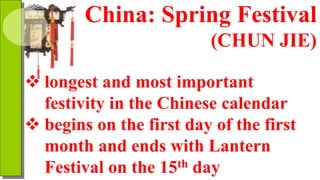
China: Spring Festival
(CHUN JIE)
 longest and most important
festivity in the Chinese calendar
 begins on the first day of the first
month and ends with Lantern
Festival on the 15th day
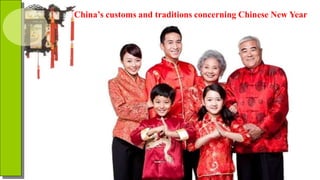
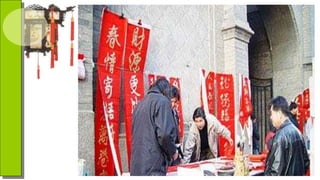
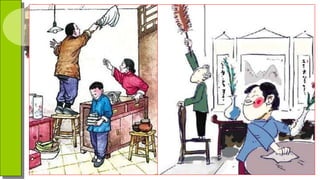
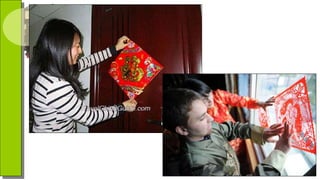
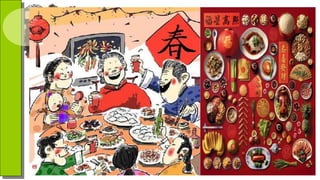
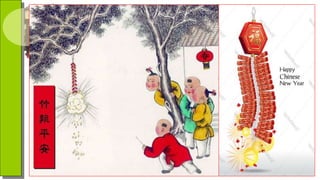
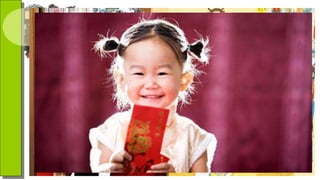
China’s customs and traditions concerning Chinese New Year
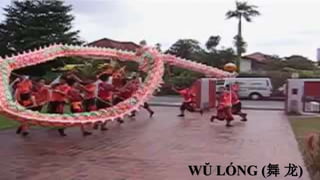
WŬ LÓNG (舞 龙)
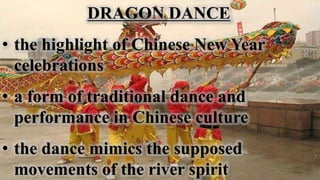
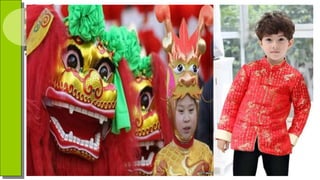
DRAGON DANCE
• the highlight of Chinese New Year
celebrations
• a form of traditional dance and
performance in Chinese culture
• the dance mimics the supposed
movements of the river spirit
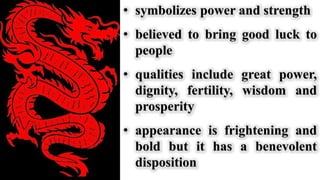
• symbolizes power and strength
• believed to bring good luck to
people
• qualities include great power,
dignity, fertility, wisdom and
prosperity
• appearance is frightening and
bold but it has a benevolent
disposition
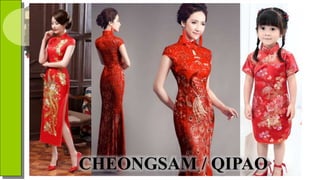
CHEONGSAM / QIPAO
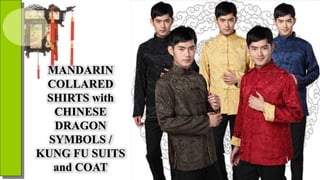
MANDARIN
COLLARED
SHIRTS with
CHINESE
DRAGON
SYMBOLS /
KUNG FU SUITS
and COAT
Japan: Taiko
Drum Festival
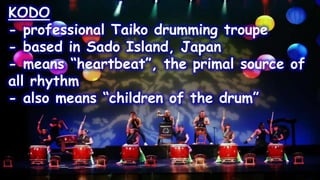
KODO
- professional Taiko drumming troupe
- based in Sado Island, Japan
- means “heartbeat”, the primal source of
all rhythm
- also means “children of the drum”
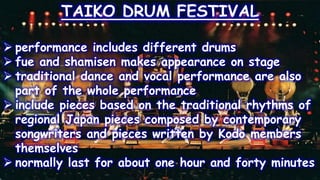
TAIKO DRUM FESTIVAL
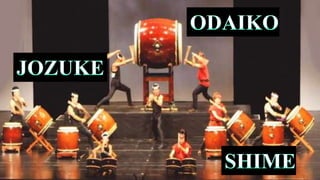
 performance includes different drums
 fue and shamisen makes appearance on stage
 traditional dance and vocal performance are also
part of the whole performance
 include pieces based on the traditional rhythms of
regional Japan pieces composed by contemporary
songwriters and pieces written by Kodo members
themselves
 normally last for about one hour and forty minutes
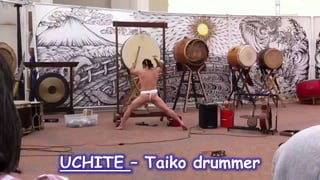
UCHITE – Taiko drummer
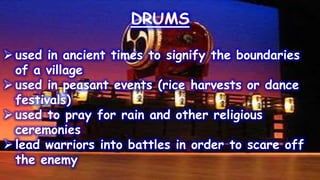
DRUMS
 used in ancient times to signify the boundaries
of a village
 used in peasant events (rice harvests or dance
festivals)
 used to pray for rain and other religious
ceremonies
 lead warriors into battles in order to scare off
the enemy
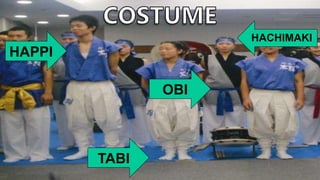
HAPPI
OBI
HACHIMAKI
TABI
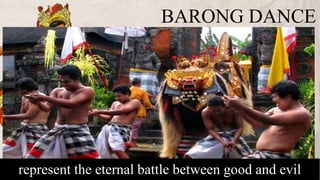
BARONG DANCE
represent the eternal battle between good and evil
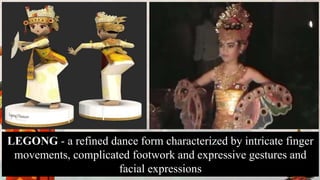
LEGONG - a refined dance form characterized by intricate finger
movements, complicated footwork and expressive gestures and
facial expressions
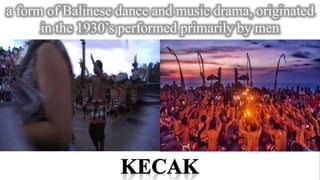
a form of Balinese dance and music drama, originated
in the 1930’s performed primarily by men
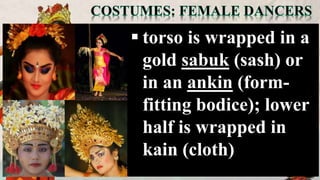
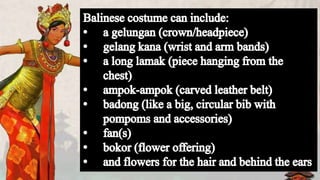
 torso is wrapped in a
gold sabuk (sash) or
in an ankin (form-
fitting bodice); lower
half is wrapped in
kain (cloth)
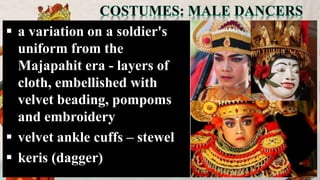
 a variation on a soldier's
uniform from the
Majapahit era - layers of
cloth, embellished with
velvet beading, pompoms
and embroidery
 velvet ankle cuffs – stewel
 keris (dagger)
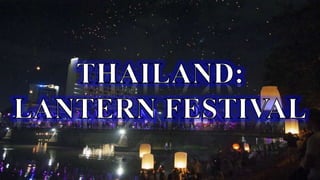
YI PENG – Sky Lantern Festival
 launching of lanterns / small hot air
balloons (khom loi)
 each release is a petition, small
prayer, or good wishes
 held on the full moon of the 12th
month in Thai lunar calendar
YI PENG – Sky Lantern Festival
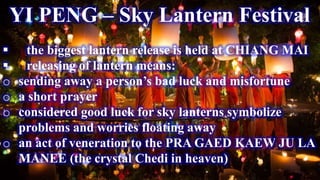
 the biggest lantern release is held at CHIANG MAI
 releasing of lantern means:
o sending away a person’s bad luck and misfortune
o a short prayer
o considered good luck for sky lanterns symbolize
problems and worries floating away
o an act of veneration to the PRA GAED KAEW JU LA
MANEE (the crystal Chedi in heaven)
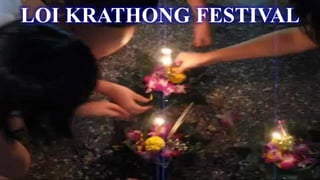
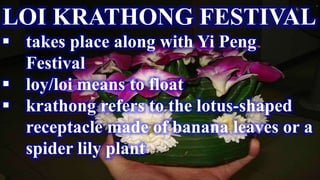
LOI KRATHONG FESTIVAL
 takes place along with Yi Peng
Festival
 loy/loi means to float
 krathong refers to the lotus-shaped
receptacle made of banana leaves or a
spider lily plant
LOI KRATHONG FESTIVAL
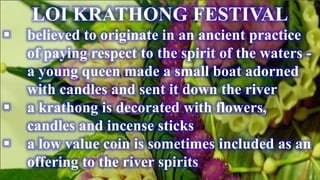
 believed to originate in an ancient practice
of paying respect to the spirit of the waters -
a young queen made a small boat adorned
with candles and sent it down the river
 a krathong is decorated with flowers,
candles and incense sticks
 a low value coin is sometimes included as an
offering to the river spirits
LOI KRATHONG FESTIVAL
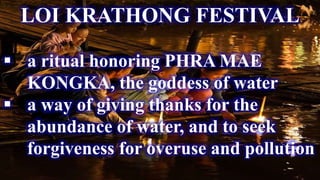
 a ritual honoring PHRA MAE
KONGKA, the goddess of water
 a way of giving thanks for the
abundance of water, and to seek
forgiveness for overuse and pollution
Arts_Asian Festivals-grade 8-powerpoint.pptx

Arts_Asian Festivals-grade 8-powerpoint.pptx

  • 1.
  • 2.
    China: Spring Festival (CHUNJIE)  longest and most important festivity in the Chinese calendar  begins on the first day of the first month and ends with Lantern Festival on the 15th day
  • 3.
    China’s customs andtraditions concerning Chinese New Year
  • 10.
  • 11.
    DRAGON DANCE • thehighlight of Chinese New Year celebrations • a form of traditional dance and performance in Chinese culture • the dance mimics the supposed movements of the river spirit
  • 12.
    • symbolizes powerand strength • believed to bring good luck to people • qualities include great power, dignity, fertility, wisdom and prosperity • appearance is frightening and bold but it has a benevolent disposition
  • 13.
  • 14.
  • 17.
  • 18.
    KODO - professional Taikodrumming troupe - based in Sado Island, Japan - means “heartbeat”, the primal source of all rhythm - also means “children of the drum”
  • 19.
    TAIKO DRUM FESTIVAL performance includes different drums  fue and shamisen makes appearance on stage  traditional dance and vocal performance are also part of the whole performance  include pieces based on the traditional rhythms of regional Japan pieces composed by contemporary songwriters and pieces written by Kodo members themselves  normally last for about one hour and forty minutes
  • 20.
  • 21.
    DRUMS  used inancient times to signify the boundaries of a village  used in peasant events (rice harvests or dance festivals)  used to pray for rain and other religious ceremonies  lead warriors into battles in order to scare off the enemy
  • 22.
  • 26.
    BARONG DANCE represent theeternal battle between good and evil
  • 27.
    LEGONG - arefined dance form characterized by intricate finger movements, complicated footwork and expressive gestures and facial expressions
  • 28.
    a form ofBalinese dance and music drama, originated in the 1930’s performed primarily by men
  • 30.
     torso iswrapped in a gold sabuk (sash) or in an ankin (form- fitting bodice); lower half is wrapped in kain (cloth)
  • 31.
     a variationon a soldier's uniform from the Majapahit era - layers of cloth, embellished with velvet beading, pompoms and embroidery  velvet ankle cuffs – stewel  keris (dagger)
  • 34.
    YI PENG –Sky Lantern Festival
  • 35.
    YI PENG –Sky Lantern Festival  launching of lanterns / small hot air balloons (khom loi)  each release is a petition, small prayer, or good wishes  held on the full moon of the 12th month in Thai lunar calendar
  • 36.
    YI PENG –Sky Lantern Festival  the biggest lantern release is held at CHIANG MAI  releasing of lantern means: o sending away a person’s bad luck and misfortune o a short prayer o considered good luck for sky lanterns symbolize problems and worries floating away o an act of veneration to the PRA GAED KAEW JU LA MANEE (the crystal Chedi in heaven)
  • 37.
  • 38.
    LOI KRATHONG FESTIVAL takes place along with Yi Peng Festival  loy/loi means to float  krathong refers to the lotus-shaped receptacle made of banana leaves or a spider lily plant
  • 39.
    LOI KRATHONG FESTIVAL believed to originate in an ancient practice of paying respect to the spirit of the waters - a young queen made a small boat adorned with candles and sent it down the river  a krathong is decorated with flowers, candles and incense sticks  a low value coin is sometimes included as an offering to the river spirits
  • 40.
    LOI KRATHONG FESTIVAL a ritual honoring PHRA MAE KONGKA, the goddess of water  a way of giving thanks for the abundance of water, and to seek forgiveness for overuse and pollution