Teaching Reading
                                           Teaching Reading


              Report and Recommendations
                                                         Report and
                                                    Recommendations


                                           National Inquiry into the Teaching of Literacy
                                                                         December 2005
7317SCHP05A
Teaching Reading


     Report and Recommendations


National Inquiry into the Teaching of Literacy
                              December 2005
ISBN 0 642 77577 X (print)
ISBN 0 642 77578 8 (internet)

© Commonwealth of Australia 2005

This work is copyright. It may be reproduced in whole or in part for study or training purposes subject
to the inclusion of an acknowledgment of the source and no commercial usage or sale. Reproduction for
purposes other than those indicated above, requires the prior written permission from the Commonwealth.
Requests and inquiries concerning reproduction and rights should be addressed to Commonwealth Copyright
Administration, Attorney General’s Department, Robert Garran Offices, National Circuit, Barton ACT 2600
or posted at http://www.ag.gov.au/cca.

The views expressed in this report do not necessarily reflect the views of the Department of Education,
Science and Training.
Contents
                                                                                                                            iii


Contents
List of abbreviations . . . . . . . . . . . . . . . . . . . . . . . . . . . . . . . . . . . . . . . . . . .            iv
Background . . . . . . . . . . . . . . . . . . . . . . . . . . . . . . . . . . . . . . . . . . . . . . . . . .          1
Terms of reference . . . . . . . . . . . . . . . . . . . . . . . . . . . . . . . . . . . . . . . . . . . .              5
Preface . . . . . . . . . . . . . . . . . . . . . . . . . . . . . . . . . . . . . . . . . . . . . . . . . . . . . .     7
Executive summary . . . . . . . . . . . . . . . . . . . . . . . . . . . . . . . . . . . . . . . . . . . .              11
1.       The importance of literacy . . . . . . . . . . . . . . . . . . . . . . . . . . . . . . . .                    25
2.       Contemporary understandings of effective teaching practices . . .                                             28
3.       The teaching of literacy . . . . . . . . . . . . . . . . . . . . . . . . . . . . . . . . . . .                31
4.       Contexts and conditions for effective teaching . . . . . . . . . . . . . . . .                                39
         Early childhood: the importance of the prior-to-school years . . . . . . . .                                  39
         The role of parents . . . . . . . . . . . . . . . . . . . . . . . . . . . . . . . . . . . . . . . .           40
         School leadership, management and implementation . . . . . . . . . . . . .                                    41
         Standards for teaching literacy . . . . . . . . . . . . . . . . . . . . . . . . . . . . . . .                 43
5.       Assessment . . . . . . . . . . . . . . . . . . . . . . . . . . . . . . . . . . . . . . . . . . . . .          45
6.       The preparation of teachers . . . . . . . . . . . . . . . . . . . . . . . . . . . . . . . .                   49
7.       Quality teaching and ongoing professional learning . . . . . . . . . . .                                      54
         The importance of quality teaching . . . . . . . . . . . . . . . . . . . . . . . . . . . .                    54
         Ongoing professional learning . . . . . . . . . . . . . . . . . . . . . . . . . . . . . . .                   58
8.       Looking forward . . . . . . . . . . . . . . . . . . . . . . . . . . . . . . . . . . . . . . . . .             61
References . . . . . . . . . . . . . . . . . . . . . . . . . . . . . . . . . . . . . . . . . . . . . . . . . . .       64
Appendix 1: Glossary of terms . . . . . . . . . . . . . . . . . . . . . . . . . . . . . . . . . . . .                  84
Appendix 2: A study of the teaching of reading in primary
            teacher education courses . . . . . . . . . . . . . . . . . . . . . . . . . . . . .                        91
Appendix 3: Membership of the Committee and Secretariat . . . . . . . . . . . . .                                     118
Appendix 4: Membership of the Reference Group . . . . . . . . . . . . . . . . . . . .                                 120
Appendix 5: Site visits undertaken by the Committee . . . . . . . . . . . . . . . . . .                               121
Appendix 6: Consultations undertaken by the Committee . . . . . . . . . . . . . . .                                   122
iv
                                                                Teaching Reading


     List of abbreviations
     AATE      Australian Association for the Teaching of English
     ACDE      Australian Council of Deans of Education
     ACER      Australian Council for Educational Research
     ALEA      Australian Literacy Educators’ Association
     CERI      Centre for Educational Research and Innovation
     DEST      Department of Education, Science and Training
     ES        Effect size
     ESL       English as a second language
     ICT       Information and communication technologies
     MCEETYA   Ministerial Council on Education, Employment, Training
               and Youth Affairs
     NRP       National Reading Panel (US)
     NITL      National Inquiry into the Teaching of Literacy
     NICHD     National Institute of Child Health and Human Development (US)
     NLNP      National Literacy and Numeracy Plan
     OECD      Organisation for Economic Co-operation and Development
     PISA      Programme for International Student Assessment
     SD        Standard deviation
     SOSE      Studies of Society and the Environment
     STELLA    Standards for Teachers of English Language and Literacy in Australia
     TAFE      Technical and Further Education
     ZPD       Zone of Proximal Development
Background
                                                                                                                 1


Background
A key policy priority for the Australian Government continues to focus on achieving
sustained improvements in the literacy and numeracy skills of Australian children to
prepare them for their futures. Achieving a goal of each child meeting appropriate
standards in literacy and numeracy is critical in overcoming educational disadvantage.
The OECD Indicators 2005 report, Education at a glance (OECD, 2005a) shows that
Australian school students compare well with the performance of students in other
OECD countries. As a country, this is something we should celebrate. Even so, a
significant minority of children in Australian schools continue to face difficulties in
acquiring acceptable levels of literacy and numeracy.

     The Committee for the National Inquiry into the Teaching of Literacy was reminded
throughout the Inquiry process of the considerable diversity in the life experiences of
children in Australian schools. Boys, girls, Indigenous students, students in urban,
rural and remote locations, students who are recent arrivals in Australia, other students
from non-English speaking backgrounds, children with vision or hearing impairment,
or disability, all begin school with the expectation that they will learn to read and write.
Their parents share this expectation.

      The Committee recognised that the teaching and learning of reading has attracted
the interest of scholars and researchers in many disciplines: linguists, cognitive
psychologists, health professionals, sociolinguists, philosophers, literacy critics, and
critical theorists, as well as educators. However, a characteristic feature of literacy
teaching for more than 40 years in English-speaking countries has been the disagree-
ments among these scholars about how beginning reading (as the basic element of
literacy acquisition) should be taught.1 At the extremes of these disagreements are
educators who advocate whole-language approaches, and cognitive scientists who
argue for explicit, systematic instruction in phonics.


1
    Such disagreements have their origins in the 16th century. John Hart’s ‘An Orthographie’ (1569) and
    Richard Mulcaster’s ‘Elementarie’ (1582) both advocated the utility of the ‘alphabetic principle’ via
    explicit teaching of letter-sound relationships for beginning reading. In contrast, Fredrich Gedike (1754-
    1803) was prominent in advocating a ‘whole-to-part’ approach to the teaching of reading. For specific
    historical details, see Davies (1973). [Note: the Committee is grateful to Professor Max Coltheart for
    supplying this historical information]. Further, for a detailed account of reading instruction during the
    20th century, see Pearson (2000).
2
                                                                                            Teaching Reading


         The contents of an open letter addressed to the Australian Government Minister
    for Education, Science and Training in March 2004, highlight these disagreements as
    they apply in the Australian context. Consistent with their British and North American
    counterparts,2 this letter from 26 Australian psychologists and reading researchers
    expresses concerns about the way in which reading is typically taught in Australian
    schools.3 The letter asserts that the predominant whole-language approach to the
    teaching of reading is both ineffective and inappropriate.4 Further, it is claimed that
            g
    the teaching of beginning reading is mostly not based on findings from the available
    evidence-based research about how children best learn to read, and that poor reading
    skills are in many cases due to ineffective teaching practices based on whole-language
    approaches during the crucial early years of ‘first wave’5 classroom teaching.

         Moreover, the letter claims that the initial gains made by children exposed to
    ‘second wave’ intervention programs are not sustained unless such children are
    located in classrooms with teachers who are skilled in providing further support in
    explicit, systematic phonics instruction for those children.6 Effective initial teaching
    of reading, it is argued, would substantially reduce the need for costly remedial
    programs for under-achieving children. The same applies to ‘third wave’ intervention
    strategies for under-achieving children beyond the early years of schooling.7


    2
        See for example the evidence cited in: (a) the report by British House of Commons Education and Skills
        Committee, Teaching Children to Read (2005); and (b) the US Report of the National Reading Panel: Teaching
        Children to Read (NRP 2000a,b).
    3
        See: Anderson et al. (2004). This letter and accompanying explanatory notes (de Lemos 2004a) have since
        been published by the Reading Reform Foundation, based in the UK and available at: http://www.rrf.
                                                                                                 p //
        org.uk/the%20australian%20scene.htm.
          g /
    4
        This predominance has been documented in several sources, including: de Lemos (2002); the 1992
        Report of the House of Representatives Standing Committee on Employment, Education and Training
        (The Literacy Challenge: Strategies for early intervention for literacy and learning for Australian children); the
        Final Report of the NSW Parliament Inquiry into Early Intervention for Children with Learning Difficulties
        (2003); and the review of literacy instruction in Australian primary schools by van Kraayenoord and
        Paris (1994). For a recent report of an investigation into the preparation of teachers to teach literacy (and
        numeracy), see Louden et al. (2005b).
    5
        Note that ’first wave’ teaching refers to initial mainstream classroom teaching, ‘second wave’ to the first
        intervention, and ‘third wave’ to subsequent intervention.
    6
        See for example: Elbaum et al. (2000); Center, Freeman and Robertson (2001); Tunmer and Chapman (2003).
    7
        See: Clay (1985); Snow, Burns and Griffin (1998). For examples of ‘third wave’ intervention strategies, see:
        Hoad et al. (2005); Ellis (2005); Purdie and Ellis (2005); Rowe and Meiers (2005); Rowe, Pollard and Rowe
        (2005); Westwood (2003, 2004); Wheldall and Beaman (2000).
Background
                                                                                            3


    Within the context of these views about the teaching of reading, the Australian
Government Minister for Education, Science and Training, the Hon Dr Brendan Nelson
MP, appointed an independent Committee to review current practices in the literacy
acquisition of Australian school children.

    The Committee was chaired by Dr Ken Rowe, Research Director of the Learning
Processes and Contexts research program at the Australian Council for Educational
Research (ACER). The Committee comprised people with backgrounds in literacy
research and policy, teacher preparation and professional learning, leadership, a
practising principal and teacher, a parent, and a journalist. A broadly based Reference
Group was established to assist and inform the Committee. A Secretariat drawn from
the Department of Education, Science and Training managed the progress of the
Inquiry. Membership of the Committee, Secretariat and Reference Group are provided
in Appendices 3 and 4, respectively.

       In brief, the Minister asked the Committee to inquire into:

       g   the teaching of reading in Australian schools;
       g   the assessment of reading proficiency including identification of children
           with reading difficulties; and
       g   teacher education and the extent to which it prepares teachers adequately for
           reading instruction.

     Calls for submissions to the Inquiry were published in national newspapers on
4 December 2004 and 12 February 2005. These calls provided an opportunity for parents,
teachers, educators and those interested in the teaching of literacy to contribute to the
Inquiry. The Inquiry received a total of 453 submissions from a range of organisations,
including: State and Territory government and non-government education authorities;
teacher and health professional associations; industry bodies; peak parent, principal,
teacher and union bodies; commercial organisations that provide reading materials
and support of various kinds; as well as a diverse group of individuals. All submissions,
except for those identified as ‘confidential’, have been made available at the Inquiry’s
website.8 The submissions provided a valuable source of information and viewpoints
for the Committee to consider in reporting findings and developing recommendations.


8
    See: www.dest.gov.au/schools/literacyinquiry.
                  g     /       /       y q
4
                                                                     Teaching Reading


         The Committee drew on the collective experience of members and consulted
    widely, including with health professionals. The Committee also visited a cross-
    section of schools and conducted a study of teacher preparation courses at Australian
    higher education institutions. A list of the consultations undertaken by the Committee
    is at Appendix 6. To inform its findings and recommendations, the Committee also
    reviewed Australian and international experience, as well as findings from the available
    evidence-based research literature.

         The Committee’s report, Teaching Reading, comprises the Report and Recommen-
    dations, a Guide to the Report and Recommendations for Parents and Carers, a Literature
    Review, Submission Summaries hyper-linked to Submissions to the Inquiry and Site Visits.
    These are available on the website established for the Inquiry at: www.dest.gov.au/
                                                                                  g       /
    schools/literacyinquiry.
            /      y q

        The Report and Recommendations presents the Committee’s main findings and
    recommendations based on the findings of: research presented in the Literature Review;
    consideration of the information gained during site visits and consultations; the views
    contained in the submissions; and a study of the teaching of reading in primary teacher
    education courses (presented in Appendix 2 of this report).
Terms of reference
                                                                                           5


Terms of reference
The Australian Government is working with the States and Territories to ensure all
Australian children achieve high standards of literacy and numeracy. A key Australian
Government priority is to focus on achieving real, sustained improvements in the
literacy and numeracy skills of Australian children to better prepare them for their
futures.

      In April 1999, the State, Territory and Australian Government Ministers for
Education met in Adelaide as the 10th Ministerial Council on Education, Employment,
Training and Youth Affairs (MCEETYA), and endorsed new National Goals for
Schooling in the Twenty-First Century, known as the Adelaide Declaration. In relation
to literacy and numeracy, it was agreed that upon leaving school:

    … students should have attained the skills of numeracy and English literacy; such
    that every student should be numerate, able to read, write, spell and communicate
    at an appropriate level.

     To help support the achievement of these National Goals, the Australian Government
and the State and Territory Education Ministers have endorsed a National Literacy
and Numeracy Plan, which calls for a coordinated approach to improving literacy and
numeracy standards at the national level. Under the National Plan, Ministers agreed
to support:

    g   assessment of all students by their teachers as early as possible in the initial
        years of schooling;
    g   early intervention strategies for those students identified as having difficulty;
    g   the development of agreed benchmarks for Years 3, 5 and 7, against which all
        children's achievements in these years can be measured;
               g   the measurement of students’ progress against these benchmarks
                   using rigorous assessment procedures;
               g   national reporting of student achievement against the benchmarks;
    g   professional development for teachers to support the key elements of the Plan.
6
                                                                       Teaching Reading


         International data indicate that Australian school students compare well with
    the performance of students in other OECD countries, but some are still not achieving
    acceptable literacy standards. This Inquiry reaffirms the Australian Government’s
    commitment to ensuring that all Australian children achieve high standards of literacy
    and the essential reading skills to make satisfactory progress at school.

         The Inquiry will be conducted in consultation and co-operation with government
    and non-government school education authorities, the teaching profession, universities,
    parents and researchers. To implement the Inquiry, a Committee has been established
    to provide advice and recommendations to the Minister for Education, Science and
    Training on best practice in effective approaches to literacy teaching and the implications
    of this advice for teacher preparation and teaching. It will also report on current
    classroom practice for the teaching of reading. The Committee will be further assisted
    by a Reference Group.


    Objectives of the Inquiry
    The Inquiry will:

        g   Review and analyse recent national and international research about literacy
            teaching approaches, particularly approaches that are shown to be effective
            in assisting students with reading difficulties.
        g   Identify the extent to which prospective teachers are provided with reading
            teaching approaches and skills that are effective in the classroom, and have
            the opportunities to develop and practice the skills required to implement
            effective classroom reading programs. Training in both phonics and whole
            language approaches to reading will be examined.
        g   Identify the ways in which research evidence on literacy teaching and policies
            in Australian schools can best inform classroom teaching practice and support
            teacher professional learning.
        g   Examine the effectiveness of assessment methods being used to monitor the
            progress of students’ early reading learning.
        g   Produce a report of the Inquiry's findings in the second half of 2005 and offer
            best practice in effective approaches to literacy teaching and learning, both at
            the classroom level and in the training of teachers.
Preface
                                                                                                7


Preface
The contents of this report and the processes leading to its production are grounded in
t
two guiding propositions. First, skilled and knowledgeable young people are Australia’s
most valuable resource for the future. Second, teachers are the most valuable resource
available to schools. Equipping young people to engage productively in the knowledge
economy and in society more broadly is fundamental to both individual and national
prosperity, and depends primarily on:

    g   the ability to speak, read and write effectively; and
    g   the provision of quality teaching and learning by teachers who have acquired,
        during their pre-service teacher education, and in-service professional learning,
        evidence-based teaching practices that are shown to be effective in meeting
        the developmental and learning needs of each child.

     In Australia, learning to read and the teaching of reading is usually included within
the broader area of literacy. Literacy teaching focuses on written language, specifically
on the ability to read, understand and use written language, and on the ability to
write appropriately. Literacy involves the integration of speaking, listening, viewing
and critical thinking with reading and writing. Being literate involves the capacity to
deal with a wide range of written texts, in numerous formats and many different
contexts. For those students with hearing or vision impairments, literacy learning
typically requires additional support such as Braille books and hearing loops. Literacy is
developmental in nature, and continues to develop throughout an individual’s lifetime.

     This perspective of literacy provided a useful frame for the Committee’s task.
While the objectives of the Inquiry refer to both ‘literacy’, and to ‘reading’, the Committee
focused its attention on reading, locating reading within the broader context of literacy.
Effective teaching of reading takes account of connections between reading and writing,
and the ways in which the acquisition of the abilities of reading and writing build on family
and community in the context of the oral language that children acquire from birth.

     Literacy teaching and learning are core responsibilities of teachers and schools.
However, the teaching of literacy (reading and writing) is a complex and highly skilled
professional activity. Whereas children enter school with varying degrees of competence
in oral language, typically they have little knowledge about how to read and write.
Thus, the purpose of early and subsequent literacy instruction in school education is
to help children master the challenges of linking written and spoken language.
8
                                                                          Teaching Reading


         In writing this report and recommendations, the Committee for the National Inquiry
    into the Teaching Literacy (NITL) has drawn upon a variety of sources that include
    findings from local and international evidence-based research that identify best practice
    in the support of all children, including those experiencing difficulties in learning to
    read and write. These findings have provided strong evidence about teaching approaches
    that are demonstrably effective. The Committee also drew on the information provided
    during consultations with the education community and others with an interest in
    improving the literacy outcomes of young people, especially for those experiencing
    reading difficulties. For example, consultations with health professionals indicated
    that for some children experiencing difficulty in learning to read, it is essential to
    bring together the support expertise of both health professionals and educators.

         The Committee learned much from the 453 submissions provided to the Inquiry
    and visits to schools across the country where some excellent examples of effective
    practice in the teaching of reading and writing were observed, together with evidence
    of children’s success. The Committee made the selection of schools for the site visits in
    various ways including suggestions by education authorities and member nominations.

         These schools show a strong commitment to teaching children to read and write
    well. Moreover, schools that believe that each child can learn to read effectively, regardless
    of background, are likely to achieve this level of success for all children.

         During school visits the Committee noted the broad range of teaching practices
    from which teachers draw to meet the diverse learning needs of children in their class-
    rooms. While varied approaches to literacy teaching were observed in these schools,
    some commonalities were clearly evident. Explicit, direct teaching of reading via
    systematic phonics instruction is a feature in many of these schools. Several programs
    observed included well-resourced, explicit teaching of letter-sound relationships, and
    a strong focus on the purpose and contexts for the strategies being used to develop
    reading proficiency. Teachers and leaders in these schools use an extensive range of
    observation strategies and assessments to identify specific learning needs and to monitor
    students’ learning progress, and success is celebrated.

         Powerful professional learning communities among teachers, a strong sense of
    collegiality, and a culture of data-informed continuous improvement are driving forces
    in schools visited by the Committee. These features enable teachers to expand their
    professional knowledge and to build a shared culture of effective practice through
    teacher professional learning.
Preface
                                                                                             9


    The schools visited make strong connections with other support agencies, and
plan for and manage transitions from one phase of schooling to another. Outstanding
leadership and management from principals, and other members of the teaching staff
with roles as literacy leaders are key elements of the success that children in these
schools are achieving. These effective schools value parents and provide them with
accurate and timely information about their child’s progress. Whole-school approaches
and policies, and long-term planning are also significant factors that underlie success.

    The Committee found that six key elements operate consistently in the successful
schools visited. These are:

    1. a belief that each child can learn to read and write regardless of background;
    2. an early and systematic emphasis on the explicit teaching of phonics;
    3. a subsequent focus on direct teaching;
    4. a rich print environment with many resources, including fiction and non-
       fiction books, charts and computer programs;
    5. strong leadership and management practices, involving whole-school
       approaches to the teaching of reading and writing; and
    6. an expectation that teachers will engage in evidence-based professional
       learning and learn from each other.

     In general, however, it was clear that teachers in some of the schools visited seemed
unaware of the reasons for using particular strategies rather than others. Teaching,
learning, curriculum and assessment need to be more firmly linked to findings from
evidence-based research indicating effective practices, including those that are
demonstrably effective for the particular learning needs of individual children. This
is an important issue that the Committee recommends be addressed during pre-
service teacher education, and especially through in-service professional learning.

     Information available to the Committee including the visits to schools made it
clear that in addition to participation in external state-wide monitoring assessments
of students’ achievements in literacy and numeracy, schools and teachers use a variety
of assessment methods. During the early years (i.e., the first three years of schooling),
assessment methods for reading range from: no formal assessment; descriptive obser-
vations; running-records; teacher-designed, class-based assessments of word-recognition
and comprehension; to commercially available, age-stage standardised tests.

    The Committee found that many teachers do not use (and are not aware of)
objective, standardised diagnostic tests that assess the essential alphabetic, decoding
10
                                                                                     Teaching Reading


     skills required for reading proficiency.9 Consistent with the findings documented in
     the report titled: Assessment of literacy and numeracy in the early years of schooling - An
     overview (DEST, 2001), assessments of reading in the early years need to be linked to
     formal assessments of reading undertaken during the subsequent years of schooling.

          Acknowledged with thanks are the valued discussions and assistance provided
     by the Hon Dr Brendan Nelson MP (Australian Government Minister for Education,
     Science and Training), as is the support of staff in Dr Nelson’s Office. The DEST
     Secretariat for the Inquiry under the leadership of Ms Di Weddell has provided excellent
     support. I am also grateful for the collaboration of my fellow members of the Committee
     of Inquiry: Ms Miranda Devine (Journalist, Sydney Morning Herald), Ms Fiona Knight
     (Teacher, Rosedale Primary School), Professor Bill Louden (Pro Vice-Chancellor, Edith
     Cowan University), Professor Terry Lovat (Pro Vice-Chancellor, University of Newcastle),
     Ms Yvonne Meyer (Parent), Dr Gregor Ramsey (Chair, Teaching Australia), Professor
     Alan Rice (Interim Dean, Macquarie University), Ms Lina Scalfino (Principal,
     Modbury School), and Mr Ken Smith (Director-General, Queensland Department of
     Education and the Arts). Thanks are also due to the NITL Reference Group for their
     valued contributions to the work of the Committee.

          I am appreciative of the encouragement, collegiality and support of my ACER
     colleagues: Professor Geoff Masters (CEO), Dr John Ainley (Deputy CEO), Dr Lawrence
     Ingvarson (Research Director, Teaching and Learning), Ms Marion Meiers (Senior Research
     Fellow) and Dr Marion de Lemos (Honorary Fellow).

          Also acknowledged for their valued work in the area of effective practices for
     children with learning difficulties are Dr Nola Purdie (Principal Research Fellow) and
     Dr Louise Ellis (Research Fellow) at ACER. The quality services provided by Ms Susan
     Bates (Administrative Officer), as well as staff of ACER’s Cunningham Library – in
     particular by Ms Cheryl Britton, Ms Sue Clark and Ms Joel MacKeen are also greatly
     appreciated. Without the assistance of these key persons, the present report would
     not have been possible.

     Dr Ken Rowe


     Committee Chair, National Inquiry into the Teaching of Literacy
     December 2005
     9
         Two assessment scales from Clay (1993a, 2002) that are used widely for such purposes include: Hearing
         and Recording Sounds in Words (HRSW) and Concepts About Print (CAP). Diagnostic assessments for phonemic
                                                                     t
         awareness and phonological knowledge have been developed by Munro (1997, 2000b). Further diagnostic
         decoding assessment approaches are reviewed by Center (2005, ch. 17, pp. 221-236).
Executive summary
                                                                                                 11


Executive summary
Underlying this report by the Committee for the National Inquiry into the Teaching of
Literacy is the conviction that effective literacy teaching, and of reading in particular,
should be grounded in findings from rigorous evidence-based research. The global
economic, technological and social changes underway, requiring responses from an
increasingly skilled workforce, make evidence-based high-quality schooling an
imperative. Nowhere is this more important than in the teaching of reading (a key
element of literacy) since reading competence is foundational, not only for school-
based learning, but also for children’s behavioural and psychosocial wellbeing, further
education and training, occupational success, productive and fulfilling participation
in social and economic activity, as well as for the nation’s social and economic future.

     The evidence is clear, whether from research, good practice observed in schools,
advice from submissions to the Inquiry, consultations, or from Committee members’
own individual experiences, that direct systematic instruction in phonics during the
early years of schooling is an essential foundation for teaching children to read. Findings
from the research evidence indicate that all students learn best when teachers adopt
an integrated approach to reading that explicitly teaches phonemic awareness, phonics,
fluency, vocabulary knowledge and comprehension. This approach, coupled with
effective support from the child’s home, is critical to success.

      The attention of the Inquiry Committee was drawn to a dichotomy between phonics
and whole-language approaches to the teaching of reading. This dichotomy is false.
Teachers must be able to draw on techniques most suited to the learning needs and
abilities of the child. It was clear, however, that systematic phonics instruction is critical
if children are to be taught to read well, whether or not they experience reading difficulties.
Members of the Committee found it a moment of awe to observe an effective teacher,
with a full range of skills to teach reading, working with a whole class and having each
child productively develop their literacy skills. Such teaching is highly skilled and
professional. Teachers require a range of teaching strategies upon which they can draw,
that meet the developmental and learning needs of individual children. The provision
of such a repertoire of teaching skills is a challenge for teacher education institutions,
and to practicing teachers as they assume the responsibility for the literacy learning
of a whole class.
12
                                                                          Teaching Reading


          The Inquiry found strong evidence that a whole-language approach to the teaching
     of reading on its own is not in the best interests of children, particularly those experienc-
     ing reading difficulties. Moreover, where there is unsystematic or no phonics instruction,  n
     children’s literacy progress is significantly impeded, inhibiting their initial and subsequent
     growth in reading accuracy, fluency, writing, spelling and comprehension.

          Much curriculum design, content, teaching and teacher preparation seems to be
     based, at least implicitly, on an educational philosophy of constructivism (an established
     theory of knowing and learning rather than a theory of teaching). Yet the Inquiry found
     there is a serious lack of supporting evidence for its effectiveness in teaching children
     to read. Further, too often emphasis is given to the nature of the child’s environment
     or background rather than on how a teacher should teach, resulting in insufficient
     attention being given to both ‘what’ and ‘how’ teachers should teach children to read
     and write. Whereas the ‘starting’ levels of children from less advantaged backgrounds
     is lower than those from more advantaged backgrounds, findings from a large body
     of evidence-based research consistently indicate that quality teaching has significant
     positive effects on students’ achievement progress regardless of their backgrounds.

           The Committee came to the view that since the effective teaching of reading is a
     highly developed professional skill, teachers must be adequately prepared both in
     their pre-service education and during subsequent years of practice, if children are to
     achieve at levels consistent with their potential. The quality of teaching provided is
     fundamental to children’s success in reading, and several of the recommendations
     are directed to this end. Indeed, this report places a major emphasis on teacher quality, and
                                                                                            y
     on building capacity in teachers towards quality, evidence-based teaching practices
     that are demonstrably effective in meeting the developmental and learning needs of
     all students.

          The Inquiry found that the preparation of new teachers to teach reading is uneven
     across universities, and that an evidence-based and integrated approach including
     instruction in phonemic awareness, phonics, fluency, vocabulary knowledge and text
     comprehension needs to be adopted. The Inquiry also found that systematic support
     for classroom teachers to build the appropriate skills to teach reading effectively, is
     clearly inadequate.

          Teaching standards and student achievement standards are two interlocking
     issues fundamental to the determination of reading outcomes. The first refers to those
     standards to be reached by a new teacher by the time they graduate, as well as to those
Executive summary
                                                                                             13


that a teacher requires if they are to be described as an accomplished teacher of reading.
These matters are dealt with in some detail in the report, and a way forward is proposed
so that teacher education institutions are clear about the teaching standards that should
be met in their courses, and in establishing standards for teachers of reading. The second
refers to standards to be reached and the levels of accomplishment of students at
various stages in their development.

      The Inquiry Committee came to a view that the assessment of all children by their
teachers at school entry and regularly during the early years of schooling is of critical
importance to the teaching of reading, and in particular, to identify children who are
at risk of not making adequate progress. The early identification of children experiencing
reading difficulties means that interventions to provide support for these children
can be put in place early. This early assessment should be a key element of responsible
system and school literacy planning and monitoring.

     In addition, the reading growth of individual children should be closely monitored
by ongoing assessment to inform parents, as well as provide feedback information
that can be used to guide teaching and learning. Information gathered from these
formative assessments may then be used to shape improvements and to adjust teaching
strategies that meet individual students’ learning needs.

     The Inquiry Committee supports the current assessment of students’ literacy
achievements against national benchmarks and proposes their extension so that the
results for individual children are available for diagnostic and intervention purposes.
The Committee noted that data from external assessments are already provided in ways
that schools can evaluate, review and develop their overall teaching programs. Timely
and reliable diagnostic information about the progress of individual children in reports
to parents and to other teachers are essential. To assist the transfer of achievement
information as students move from school to school and from state to state, mechanisms
are also proposed to make this process a long-overdue national reality.

    The Committee notes the fundamental importance of literacy in schooling and
the recommendations it proposes are designed to make effective evidence-based
practices accessible to all teachers and so influence positively all children in Australian
schools. Health professionals draw attention to the overlap that is often evident between
students’ under-achievement in literacy (especially in reading) and their poor behavioural
health and wellbeing. Dealing with reading problems early, as outlined in this report,
should assist in the alleviation of this seemingly intractable problem.
14
                                                                        Teaching Reading


     Evidence-based approaches to the teaching of reading
     The Inquiry found that many teaching approaches used in schools are not informed by
     findings from evidence-based research, and that too many teachers do not have a clear
     understanding of why, how, what and when to use particular strategies. This has impor-
     tant implications for pre-service teacher education, ongoing teacher professional learning,
        t                                                                                     g
     and for the design and content of literacy curricula. This leads to the Committee’s first
     two and most important recommendations, both of which are designed so that teachers
     are provided with knowledge and teaching skills that are demonstrably effective in
     meeting the developmental and learning needs of children from a diverse range of
     backgrounds during their first three years of schooling, and thereafter where necessary.


             1. The Committee recommends that teachers be equipped
                with teaching strategies based on findings from rigorous,
                evidence-based research that are shown to be effective
                in enhancing the literacy development of all children.


             2. The Committee recommends that teachers provide systematic,
                direct and explicit phonics instruction so that children master
                the essential alphabetic code-breaking skills required for
                foundational reading proficiency. Equally, that teachers
                provide an integrated approach to reading that supports the
                development of oral language, vocabulary, grammar, reading
                fluency, comprehension and the literacies of new technologies.


          Such instruction arising from these two recommendations must be part of an
     intellectually challenging literacy environment that is inclusive of all children.

         While the evidence indicates that some teaching strategies are more effective than
     others, no one approach of itself can address the complex nature of reading difficulties.
     An integrated approach requires that teachers have a thorough understanding of a
     range of effective strategies, as well as knowing when and why to apply them.
Executive summary
                                                                                             15


        3. The Committee recommends that literacy teaching continue
           throughout schooling (K-12) in all areas of the curriculum.
           Literacy must be the responsibility of all teachers across the
           curriculum, to provide an educationally sound program
           meeting the specific skill and knowledge needs of individual
           children from diverse backgrounds and locations.


The role of parents

the best start to their literacy development. While it is the responsibility of schools to
teach children to read and write, there are many things that parents and carers can do
to assist in the development of their children’s literacy skills, such as regular adult-
child and child-adult reading aloud activities. Supporting parents in endeavours of
this kind, particularly during the early years of schooling, leads to the following
recommendation.


        4. The Committee recommends that programs, guides and
           workshops be provided for parents and carers to support
           their children’s literacy development. These should
           acknowledge and build on the language and literacy that
           children learn in their homes and communities.


School leadership and management
The Inquiry came to a view from the evidence that successful teaching of reading
occurs best where there is a consistent and comprehensive whole-school approach
that is clearly specified in a literacy plan. Such plans give priority to the teaching of
literacy across the curriculum at every level of primary and secondary schooling.
Implementation of the plan should be the responsibility of all teachers under the
leadership and direction of the principal and senior staff. The outcome of the plan
must be that children and young people in primary and secondary schools have the
level of literacy that enables them to proceed successfully to the next stage of their
lives, whether it be further schooling, tertiary education or work.
16
                                                                      Teaching Reading


             5. The Committee recommends that all education authorities
                and school leaders examine their approaches to the teaching
                of literacy and put in place an explicit, whole-school literacy
                planning, monitoring and reviewing process in collaboration
                with school communities and parents.


          This process should be comprehensive and recognise the learning needs of children
     experiencing difficulty in learning to read and write, as well as extending successful
     readers and writers, so that all children can proceed with every likelihood of success
     to the next stage of their lives.

          Effective leadership is an important factor in developing whole-school approaches
     to the teaching of reading and to provide staff with the necessary ongoing professional
     support. Without exception, the schools visited by Committee members for the Inquiry
     demonstrated strong leadership from the principal and the school leadership team
     that impacted positively on student literacy learning and teacher professional learning.
     Findings from research, evidence from the consultations and site visits, as well as
     many submissions led to the following recommendation.


             6. The Committee recommends that all schools identify a
                highly trained specialist literacy teacher with specialised
                skills in teaching reading, to be responsible for linking the
                whole-school literacy planning process with classroom
                teaching and learning, and supporting school staff in
                developing, implementing and monitoring progress against
                individual literacy plans, particularly for those children
                experiencing reading and literacy difficulties.


          Together with the leadership team, the specialist literacy teacher would be key
     to identifying and providing professional learning for school staff. The specialist
     literacy teacher would need to be resourced appropriately so that sufficient time is
     dedicated to supporting staff in their professional learning.
Executive summary
                                                                                          17


       7. The Committee recommends that specialist postgraduate
          studies in literacy (especially in teaching reading) be provided
          by higher education providers to support the skill base and
          knowledge of teachers, including the specialist literacy teachers.


Standards for teaching
Given the importance of literacy competence to children’s engagement in schooling,
and to their subsequent educational progress and life chances, the Inquiry Committee
received strong recommendations from peak stakeholder groups for the specification
of literacy teaching standards. To gain professional credibility and commitment, and
to acknowledge the highly professional nature of the teaching of reading, especially
during the primary years, such standards must be developed by the profession, serve
the public interest, and be applied nationally. The Committee was mindful of the work
currently underway both nationally and in the States and Territories in developing
standards. This work should be built on and leads to the following recommendation.


       8. The Committee recommends that Teaching Australia –
          Australian Institute for Teaching and School Leadership,
          in consultation with relevant professional associations,
          employers from the government and Catholic school sectors
          and representatives of the independent school sector, together
          with relevant teacher institutes and registration bodies,
          develop and implement national standards for literacy
          teaching, initial teacher registration, and for accomplished
          teaching, consistent with evidence-based guides for practice.
          It is further recommended that these standards form a basis
          for the accreditation of teacher preparation courses.


Assessment
The Committee acknowledged the critical importance of assessment, if teachers are
to be in the best position to help their students. Assessment serves multiple purposes:
to diagnose and remediate essential skills, measure growth and monitor progress,
provide feedback to learners, and for reporting to parents and education systems.
18
                                                                       Teaching Reading


          The Committee is aware that issues surrounding student assessment and reporting
     of and for learning are a high priority with State and Territory education jurisdictions
     and schools. There are many examples across the country where teachers and schools
     are being informed by assessment data. Such schools recognise the importance of frequent
     and ongoing monitoring of reading proficiency and growth in the early years.

          The Committee discussed the advantages of further developing national approaches
     to student assessment and reporting, particularly where the results of these assess-
     ments could be used by teachers to guide their practice and be provided to parents to
     inform them of their child’s progress. That is, the Committee identified a need for
     nationally consistent diagnostic screening tools to be developed for use when children
     begin school to identify their development of: auditory processing capacity; speech and
     language; fine and gross motor coordination skills; letter identification; and letter-sound
     correspondences. Findings from this objective assessment of specific skills would
     form the basis on which to plan learning and measure individual reading development,
     and should also be provided to parents. To address these issues, the following recom-
     mendations are made.


             9. The Committee recommends that the teaching of literacy
                throughout schooling be informed by comprehensive, diagnostic
                and developmentally appropriate assessments of every child,
                mapped on common scales. Further, it is recommended that:
                 •   nationally consistent assessments on-entry to school be
                     undertaken for every child, including regular monitoring
                     of decoding skills and word reading accuracy using
                     objective testing of specific skills, and that these link
                     to future assessments;
                 •   education authorities and schools be responsible for
                     the measurement of individual progress in literacy by
                     regularly monitoring the development of each child and
                     reporting progress twice each year for the first three years
                     of schooling; and
                 •   the Years 3, 5, 7 and 9 national literacy testing program
                     be refocused to make available diagnostic information
                     on individual student performance, to assist teachers to
                     plan the most effective teaching strategies.
Executive summary
                                                                                            19


     The Inquiry identified the issue of mobility as one that needs to be addressed by
education authorities. Each year, approximately 100,000 students change schools across
State and Territory boundaries, sectors and regions. Mobility is an issue, particularly
for the education of children from Indigenous, newly arrived non-English-speaking,
and Defence Force backgrounds. A long-overdue mechanism to track individual
children throughout their schooling, so that a record of achievement and progress
can follow them wherever they attend school, is seen as essential. This would benefit
transient students, their parents and the schools to which they move. Such a mechanism
would need appropriate protocols to protect privacy.


        10. The Committee recommends that a confidential mechanism
            such as a unique student identifier be established to enable
            information on an individual child’s performance to follow
            the child regardless of location, and to monitor a child’s progress
            throughout schooling and across assessment occasions.


The preparation of teachers
The Inquiry Committee concludes that teaching practices and instructional strategies
per se are not independent of the teachers who deliver them, whether or not children
experience reading difficulties. Highly effective teachers and their professional learning
do make a difference in the classroom. It is not so much what students bring with them
from their backgrounds, but what they experience on a day-to-day basis in interaction
with teachers and other students that matters. Teaching quality has strong effects on
children’s experiences of schooling, including their attitudes, behaviours and achieve-
ment outcomes (see Darling-Hammond & Bransford, 2005).

     Thus, there is need for a major focus on teacher quality, and building capacity in
teachers towards quality, evidence-based teaching practices that are demonstrably
effective in maximising the developmental and learning needs of all children. This is
the case for both teacher education and the ongoing professional learning provided
to teachers throughout their careers. Pre-service teacher education is the first phase
of a teacher’s ongoing commitment to professional learning.
20
                                                                       Teaching Reading


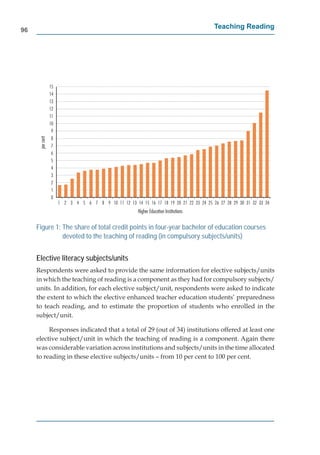
          Responses to the national survey of primary teacher preparation courses undertaken
     by this Inquiry indicate that in almost all of those nominated, less than 10 per cent of
     time in compulsory subjects/units is devoted to preparing student teachers to teach
     reading. They also indicated that in half of all courses, less than five per cent of total
     instructional time is devoted to this task.

         Although the Inquiry has concluded that there are significant opportunities for
     improvement in teacher preparation, it is concerned that an evidence-based approach
     be adopted in the implementation of the recommendations. Increasing the time on
     reading instruction, improving the content of teacher preparation courses and school
     practice arrangements, together with improvements in new graduates’ personal literacy
     should all be examined to secure a firm evidence-base for teacher preparation. Also,
     there is little evidence on the most effective way to prepare pre-service teachers to
     teach reading. This must be given much more research attention by higher education
     providers.


             11. The Committee recommends that the key objective of primary
                 teacher education courses be to prepare student teachers to
                 teach reading, and that the content of course-work in primary
                 literacy education focus on contemporary understandings of:
                 • evidence-based findings and an integrated approach to
                      the teaching of reading, including instruction on how to
                      teach phonemic awareness, phonics, fluency, vocabulary
                      knowledge and text comprehension;
                 • child and adolescent development; and
                 • inclusive approaches to literacy teaching.


             12. The Committee recommends that literacy teaching within
                 subject areas be included in the coursework of secondary
                 teachers so that they are well prepared to continue the
                 literacy development of their students throughout secondary
                 schooling in all areas of the curriculum.
Executive summary
                                                                                               21


        13. The Committee recommends that significant national
            ‘lighthouse’ projects in teacher preparation and education
            be established to link theory and practice that effectively
            prepare pre-service teachers to teach literacy, and especially
            reading, to diverse groups of children.


         14. The Committee recommends that the conditions for teacher
             registration of graduates from all primary and secondary
             teacher education programs include a demonstrated command
             of personal literacy skills necessary for effective teaching,
             and a demonstrated ability to teach literacy within the
             framework of their employment/teaching program.


Ongoing professional learning

literacy teaching (Darling-Hammond & Bransford, 2005).

     For the teaching of reading, quality teaching depends upon knowledge of how
students best learn to read, how to assess reading ability and growth, and how to use
assessment information to apply appropriate intervention strategies from a repertoire
of effective practices informed by findings from evidence-based research. It involves
knowing students and understanding their diverse backgrounds and learning needs
from observation and monitoring.
   m

     Ongoing professional learning is essential for teachers to teach reading. Opportunities
for professional learning can take many forms, including quality induction programs,
teachers’ shared and collaborative learning in school, work in professional learning
teams, mentoring, and professional learning for principals and school literacy leaders.
22
                                                                      Teaching Reading


             15. The Committee recommends that schools and employing
                 authorities, working with appropriate professional
                 organisations and higher education institutions, provide all
                 teachers with appropriate induction and mentoring throughout
                 their careers, and with ongoing opportunities for evidence-
                 based professional learning about effective literacy teaching.


         There is strong evidence that professional learning focused on subject matter
     knowledge and knowledge about how students best learn, when coupled with a clear
     understanding of contextual issues faced by teachers in the classroom, improves
     teaching and learning. Research findings also indicate the importance of linking profess-
     ional learning to curriculum materials and assessments.


             16. The Committee recommends that a national program of
                 literacy action be established to:
                 • design a series of evidence-based teacher professional
                      learning programs focused on effective classroom
                      teaching, and later interventions for those children
                      experiencing reading difficulties;
                 • produce a series of evidence-based guides for effective
                      teaching practice, the first of which should be on reading;
                 • evaluate the effectiveness of approaches to early literacy
                      teaching (especially for early reading) and professional
                      learning programs for practising teachers;
                 • investigate ways of integrating the literacies of
                      information and communication technologies with
                      traditional literacies in the classroom;
                 • establish networks of literacy/reading specialist
                      practitioners to facilitate the application of research
                      to practice; and
                 • promote research into the most effective teaching practices
                      to be used when preparing pre-service teachers to teach
                      reading.
Executive summary
                                                                                             23


     Given that significant funding is provided by the Australian and State and Territory
governments to support the ongoing professional learning of teachers, the Inquiry
concluded that there was a need for more effective coordination of funding and effort
in this area.

        17. The Committee recommends that Australian and State and
            Territory governments’ approaches to literacy improvement
            be aligned to achieve improved outcomes for all Australian
            children.


        18. The Committee recommends that the Australian
            Government, together with State and Territory government
            and non-government education authorities, jointly support
            the proposed national program for literacy action.


Looking forward
There was a clear consensus view among members of the Inquiry Committee to
emphasise the importance of quality teaching and teacher quality. These areas continue to
be given strong financial support by the Australian Government, and recommendations
from this Inquiry will place added demands on resources if major improvements to
teacher professionalism in the area of children’s literacy and learning, behaviour, health
and wellbeing are to occur.

     Quality literacy teaching is central to these outcomes, and especially for early
reading acquisition and subsequent development. This will not be realised until teachers
receive evidence-based knowledge and skill development in their pre-service preparation
and are supported via in-service professional development. The level of this support
must be commensurate with teachers’ invaluable contributions to the enrichment of
children’s wellbeing and life chances, as well as to capacity building for the nation’s
social and economic future.
24
                                                                         Teaching Reading


          For all children, learning to read and write effectively requires effort and commitment
     from many stakeholders: education authorities, principals and their associations, teachers
     and their professional associations, the deans of education, health professionals, parents
     and parent organisations. Responsibility for achieving this ambitious goal at the highest
     levels leads to the Committee’s final recommendations that -


             19. The Australian Government Minister for Education, Science
                 and Training raise these recommendations as issues for
                 attention and action by MCEETYA, and other bodies,
                 agencies and authorities, that will have responsibility
                 to take account of, and implement the recommendations.


             20. Progress in implementing these recommendations, and on
                 the state of literacy in Australia, be reviewed and reported
                 every two years.
The importance of literacy
                                                                                                                 25


1. The importance of literacy
Australia’s young people are the most valuable resource for the nation’s social and
economic prosperity. The key to such prosperity at both the individual and national
level is the provision of quality schooling (Caldwell, 2004). The global economic,
technological and social changes under way, requiring responses from an increasingly
skilled workforce, make high quality schooling an imperative. Whereas OECD educ-
ation ministers have committed their countries to the goal of raising the quality of
learning for all, this ambitious goal will not be achieved unless all children, irrespective
of their backgrounds and locations, receive high-quality teaching.10

     Countries throughout the world are seeking to improve their schools, and to
meet the demands of higher social and economic expectations of young people, parents,
and society as a whole. As the most valuable resource available to schools, teachers
are central to improving children’s learning and progress (Cuttance, 2001; Kennedy,
2001). Because teaching is a highly skilled professional activity, improving the efficiency
and effectiveness of schooling depends, at the outset, on competent people choosing
to work as teachers, and on pre-service and in-service teacher education and teaching
practices that are of the highest professional standard.

     Since the central aim of schooling is to improve teaching and learning, it is vital
that teachers are equipped with evidence-based teaching skills that are demonstrably
effective in meeting the learning needs of the children for whom they are responsible.11
Nowhere is this more important than in the teaching of literacy (i.e., reading, writing,
speaking and listening, and viewing) since literacy competence is foundational, not
only for school-based learning, but also for children’s behavioural and psychosocial
wellbeing, further education and training, occupational success, as well as for productive
and fulfilling participation in social and economic activity. Moreover, the rapidly
changing nature of computer-based technologies and global communication systems


10
     See: Hattie (2003, 2005); LaTrice-Hill (2002); Louden et al. (2005a); OECD (2005a,b); Ramsey (2000); Rowe
     (2003, 2004a-c).
11
     For explications of the importance of evidence-based orientations to educational policy, practice and
     reform, see: de Lemos (2002); Fullan (1991, 1994, 2000); Masters (1999); Slavin (2005).
26
                                                                                                Teaching Reading


     has given rise to demands for competence in increasingly complex multi-literacies
     (Cope & Kalantzis, 2000).12

           These assertions are supported by the work of Nobel Prize winning economist
     James Heckman’s (2000, 2005) overview of the economic aspects of human skills
     formation. Heckman concludes that investment in the learning development of young
     children is crucial. For Heckman, literacy competence is an essential area of learning
     investment in the young, being a ‘skill that begets many other skills’ (an index of
     ‘self-productivity’, as he calls it), because it constitutes a ‘key part of our capacity to
     increase our capacity’.

          International assessments of reading literacy during 2000 and 200313 indicate that
     while 15-year-old students in Australian schools perform notably better (on average)
     than the majority of their counterparts in other OECD countries, 12 per cent (ACT, WA)
     to 28 per cent (NT) are not developing the literacy skills needed for further education,
                                                                                           n
     training and work (defined as low achievers), particularly Indigenous students (35%)
     and males (17%). Similar estimates have been reported for achievement in reading
     comprehension of 14-year-old Australian students between 1975 and 1998, and, with
     few exceptions, the estimates have remained constant during the period.14

          Furthermore, approximately 20 per cent of Australians aged 15-74 years have
     been identified as having ‘very poor’ literacy skills, with an additional 28 per cent
     who ’… could be expected to experience some difficulties in using many of the printed
     materials that may be encountered in daily life’ (ABS, 1997, p. 7). Evidence from the
     1996 National School English Literacy Survey (Masters & Forster, 1997a,b) indicated that
     the proportion of Year 3 and Year 5 students in Australian schools who did not meet

     12
          There is now considerable interest in the impact of information and communication technologies (especially
          computers, either networked or stand-alone, and mobile phones) on children’s literacy learning. See the
          systematic review reported in Andrews et al. (2002).
     13
          In the OECD Programme for International Student Assessment (PISA), the concept of reading literacy
          emphasises skill in using written information in situations that students may encounter in their life both
          at and beyond school. Thus, reading literacy is defined as: … understanding, using and reflecting on written
          texts in order to achieve one’s goals, to develop one’s knowledge and potential, and to participate in society (OECD,
          2003, p. 108). For the PISA results relevant to Australia, see: Lokan, Greenwood and Cresswell (2001);
          Thomson, Cresswell and De Bortoli (2004).
     14
          See Rothman (2002), who notes: ‘For some groups, there has been improvement, most notably for students
          from language backgrounds other than English. For other groups, however, results indicate a significant
          achievement gap. The most significant gap is between Indigenous Australian students and all other
          students in Australian schools’ (p. ix).
The importance of literacy
                                                                                                                    27


minimum performance standards of literacy required for effective participation in
further schooling was found to be as high as 27 per cent for Year 3 students and 29
per cent for Year 5 students.15

     Since then, data for 2003 have been published. These data show the percentages
of Australian students not achieving the minimum National Benchmarks for Reading
are: ~8 per cent (Year 3), ~11 per cent (Year 5 and Year 7) (MCEETYA, 2005). By any
criterion, these outcomes are unacceptable in terms of the educational, psychosocial
wellbeing and life chances of these Australians, as well as the economic and social
future of the nation.

     Literacy under-achievement has high social and economic costs in terms of both
health and crime. The Committee received evidence indicating that the overlap
between under-achievement in literacy (especially in reading) and poor behaviour,
health and wellbeing, is a major issue to the extent that what should be an ‘education
issue’ has become a major health issue (e.g., DeWatt et al., 2004). According to the
Royal Australasian College of Physicians, an increasing number of parents are seek-
ing help from health professionals throughout Australia for their children whose self-
esteem and behaviour problems have arisen as a consequence of (or are exacerbated
by) learning difficulties and failure to acquire adequate literacy skills.

      Paediatric physicians refer to this phenomenon as the new morbidity in education
and child/adolescent health (Oberklaid, 1988, 2004).16 Despite the lack of accurate
estimates on the overlap between literacy under-achievement and crime, the associated
links are well documented (e.g., McNee, 2004; Mayhew, 2003). Clearly, however, it is
vital that educational ‘fences’ be built at the top of the ‘cliff’ in preference to the provision
of belated and costly ‘ambulance services’ at the bottom. A necessary strategy in con-
structing such ‘fences’ requires building capacity in teacher expertise and professionalism.
Given these contexts, an outline of contemporary understandings of effective teaching
practice is helpful.


15
     Comparative international data are of interest. From the evidence cited in the report by British House of
     Commons Education and Skills Committee (2005), Teaching Children to Read, it is estimated that approximately
                                                                              d
     20 per cent of 11-year-old children in British schools do not achieve expected success in reading for their
     age. According to the US National Center for Educational Statistics, ‘… 38 per cent of fourth graders
     (~9-year-olds) cannot read at a basic level – that is, they cannot read and understand a short paragraph
     similar to that in a children’s story book’ (Lyon, 2003, p. 1).
16
     For further explications of this morbidity, see: Lyon (2003); Rowe and Rowe (1999, 2000).
28
                                                                                           Teaching Reading


     2. Contemporary understandings
        of effective teaching practices
     Teaching practices have long generated debate and ideological controversy, especially
     as to best methods for the teaching of literacy. As mentioned in the Background section
     of this report, two clear theoretical orientations have provided the bases for this
     controversy: (a) explicit, code-based instruction in phonics, and (b) implicit, meaning-
     based, whole-language instruction. For several decades, whole-language has been the
     predominant approach for early literacy teaching and learning throughout English-
     speaking countries (Pearson, 2000; Westwood, 1999, 2004).

          Essentially, the whole-language approach to teaching and learning reflects a
     constructivist philosophy of learning in which children are viewed as inherently
     active, self-regulating learners who construct knowledge for themselves, with little
     or no explicit decoding instruction.17 However, there is a strong body of evidence that
     whole-language approaches are not in the best interests of children experiencing
     learning difficulties and especially those experiencing reading difficulties.18 Similarly, for
     children from disadvantaged backgrounds who often do not have rich phonological
     knowledge and phonemic awareness upon which to base new learning, being taught
     under constructivist modes has the effect of compounding their disadvantage once
     they begin school. This is particularly the case for children from non-English speaking
     backgrounds, including Indigenous children where English may be their second or
     third language.

         In contrast, code-based approaches focus on explicit teaching of the structure and
     function of written and oral language in ways that allow children, regardless of their
     backgrounds, to reflect on and consciously manipulate the language. This involves
     an awareness of phonemes, syllables and morphology. Thus, unlike whole-language
     approaches, code-based methods typically require a high degree of teacher-centred
     presentation of learning material, with an emphasis on explicit instruction, scheduled
     practice and feedback (e.g., Center, 2005; Westwood, 2003, 2004).

     17
          For recent critiques of the inappropriateness of constructivism as an operational theory of teaching, see:
          Ellis (2005); Purdie & Ellis (2005); Wilson (2005).
     18
          See: Anderson et al. (2004); Coltheart (2005a-c); de Lemos (2002, 2004a); Louden et al. (2005a); Moats (2000);
          Rohl and Greaves (2004); Sweet (1996); Westwood (1999, 2004).
Contemporary understandings of effective teaching practices
                                                                                                   29


     The key element in constructivism (as a theory of knowing and learning rather than
teaching) is that the learner is an active contributor to the learning process, and that
teaching methods should focus on what the student can bring to the learning situation
as much as on what is received from the environment. This approach has its origins
in the work of Piaget, Vygotsky, and in Ausubel’s (1968) assertion that ’the most important
single factor influencing learning is what the learner already knows’ (p. 332). Learning
that builds effectively on the learner’s current knowledge is said to be within the
child’s zone of proximal development (ZPD). The ZPD establishes what the learner
already knows, and can do with minimal assistance by a teacher or peer – following
which the individual is expected to undertake learning tasks independently.

     Hence, the role of the teacher is to be a facilitator of learning (rather than a director),
                                                         r
and to provide opportunities for individual learners to acquire knowledge and construct
meaning through their own activities, and through discussion, reflection, and the
sharing of ideas with other learners with minimal corrective intervention (Cambourne,
2002; Daniels, 2001). Sasson (2001) refers to constructivism as ’… a mixture of Piagetian
stage theory with postmodernist ideology’ (p. 189) that is devoid of evidence-based
justification for its adoption as an effective method of teaching. For example, in high-
lighting the inappropriateness of constructivism as an operational theory of teaching,
Wilson (2005, pp. 2-3) argues:

     … We largely ignore generations of professional experience and knowledge in favour
     of a slick postmodern theoretical approach, most often characterised by the misuse
     of the notion of constructivism.

     … Australian operational views of constructivism … confuse a theory of knowing
     with a theory of teaching. We confuse the need for the child to construct her own
     knowledge with a form of pedagogy which sees it as the child’s responsibility to achieve
     that. We focus on the action of the student in the construction of knowledge rather
     than the action of the teacher in engaging with the child’s current misconceptions
     and structuring experiences to challenge those misconceptions. … The constructivist
     theory of knowing has been used to justify a non-interventionist theory of pedagogy,
     whereas it is a fair interpretation to argue that constructivism requires vigorous
     interventionist teaching: how, after all, is a student with misconceptions supposed to
     challenge them unaided? How does she even know they are misconceptions?

     We need, instead, a view of teaching which emphasises that the role of the teacher is to
     intervene vigorously and systematically; that is done on the basis of excellent knowledge
     of a domain and of student conceptions and misconceptions in that domain, assembled
30
                                                                          Teaching Reading


         from high quality formative assessments; and that the purpose of the intervention is
         to ensure that the child’s construction of knowledge leads her to a more correct
         understanding of the domain.

          These observations by Wilson are consistent with expressed concerns that too
     many faculties and schools of education in Australian higher education institutions
     currently providing pre-service teacher education base their programs on constructivist
     views of teaching. Westwood (1999), for example, highlights the results of a South
     Australian study which found that most teachers (79%) had been strongly encouraged
     to use a constructivist approach in their initial teacher-education courses and during
     in-service professional development programs. Even more notably, 67 per cent of the
     teacher trainees in this study indicated that constructivism was the only teaching
     approach to which they had been exposed in their teaching method courses. Commenting
     on these findings, Westwood (1999, p. 5) notes:

         At the same time as constructivist approaches have been promoted, direct teaching
         methods have been overtly or covertly criticised and dismissed as inappropriate,
         with the suggestion that they simply don’t work and are dull and boring for learners.
         The message that most teachers appear to have absorbed is that all direct teaching is
         old-fashioned and should be abandoned in favour of student-centred enquiry and
         activity-based learning.
The teaching of literacy
                                                                                                                  31


3. The teaching of literacy
Literacy teaching and learning are complex tasks for both teachers and children and
require a high degree of professional skill.19 Although children enter school with
varying degrees of competence in oral language, typically they have little knowledge
about how to read and write. Reading – the key element of literacy competence –
involves two basic processes: (1) learning how to decipher print; and (2) understanding
what the print means. Findings from the related scientific research indicate that for
these processes to be successful, it is vital that both initial and subsequent literacy
instruction (in the case of children experiencing reading difficulties) be grounded in
the basic building blocks of reading, namely, the set of integrated sub-skills that include:

        g   letter-symbol recognition;
        g   letter-sound rules (phonemic awareness and phonological knowledge);
        g   whole-word recognition; and
        g   the ability to derive meaning from written text.

     Evidence for the effective integration of these sub-skills is unequivocal.20 Indeed
there is now a strong body of scientific evidence that children are greatly assisted in
learning to become proficient readers if their reading tuition is grounded in direct,
explicit and systematic phonics instruction (Coltheart, 2005b,c). Much of this evidence
       t
has been synthesised in the United States of America (US) Report of the National Reading
Panel: Teaching Children to Read (NRP, 2000a,b) – the largest and most influential investi-
                               d
gation to date into the relative effectiveness of different approaches to the teaching of
reading. A brief summary of the key findings from the NRP synthesis is helpful here.21

     Employing a meta-analytic research methodology, the NRP estimated the effect
sizes of systematic phonics instruction compared to unsystematic or no phonics
instruction on learning to read, across 66 treatment-control comparisons in 38 experi-


19
     For example, see: Ainley & Fleming (2000, 2003); Ainley, Fleming & McGregor (2002); Center (2005);
     Coltheart (2005a); Garton & Pratt (1998).
20
     See: Camilli et al. (2003); Center (2005); Coltheart (2005a-c); de Lemos (2002); Ehri et al. (2001); Munro
     (1998, 1999, 2000a); NRP (2000a,b).
21
     For a more detailed overview of findings from the NRP report, see NITL Literature Review (2005).
                                                                                           w
32
                                                                                         Teaching Reading


     mental or quasi-experimental studies.22 The results indicated that while the overall
     effect size (ES) of phonics instruction on reading was moderate (ES = 0.41), the positive
     effects persisted after instruction ended. Effects were larger when phonics instruction
     began early (ES = 0.55) than after first grade (ES = 0.27), benefiting decoding skills,
     word reading, text comprehension and spelling in many readers.

           Phonics instruction helped a wide spectrum of children: those from low and middle
     socio-economic backgrounds; children for whom English was a second language;
     younger children at risk of experiencing reading difficulties; and older children
     experiencing reading difficulties. Synthetic phonics and larger-unit systematic phonics
                  g
     programs produced a similar advantage in children’s reading achievement. In sum,
     systematic phonics instruction helped children learn to read significantly better than
     all forms of control group instruction, including whole-language. The report concluded
     that since systematic phonics instruction proved to be universally effective, it should
     be implemented as part of literacy programs to teach beginning reading, as well as to
     prevent and remediate reading difficulties (see NRP, 2000b, p. 2-89).

           The NRP also provided evidence of how children’s reading comprehension is
     developed as they build letter-sound links, vocabulary knowledge and fluency in reading.
     Similarly, the NRP highlighted evidence of how fluency can be developed through
     repeated readings, provided that children receive teacher feedback and encouragement.
     Fluency also is taught by helping children learn the value and importance of punctuation
     as it relates to reading for meaning.

          The NRP further identified specific text comprehension skills that enable children
     to develop higher order thinking skills, and how the integration and comprehensive
     approaches to literacy enable children to develop reading for both learning and pleasure.
     However, this process is not established as discrete steps but as an integration of all
     the following skills via explicit instruction in: phonemic awareness, phonics, fluency,
     vocabulary knowledge, and text comprehension. Like other studies before it, the NRP
     report emphasised that teacher professional development in literacy instruction is
     crucial to children’s literacy achievements.

     22
          Meta-analysis is a statistical method used for summarising findings from many studies that have investigated
          a similar problem. The method provides a numerical way of assessing and comparing the magnitudes
          of ‘average’ results, known as ‘effect size’ (ES) – expressed in standard deviation (SD) units. An ES is
          calculated as the difference in performance between the average scores of a group in a trial or experimental
          condition and those in a comparison condition, divided by the SD of the comparison group (or more often,
          divided by the pooled SD of both groups). An effect size ≤ 0.2 is regarded as ‘weak’; 0.5 is considered
          ‘moderate’; and 0.8 or larger as ‘strong’.
The teaching of literacy
                                                                                              33


     These results are supported by findings from a more recent meta-analytic study of
phonics and whole-language approaches to the teaching of beginning reading undertaken
by Camilli, Vargas and Yurecko (2003). The findings from this synthesis of 40 studies,
involving a reanalysis of the data reported earlier by the NRP summarised above, indicate
                                                               P
that a combination of tutoring (strategy instruction) and whole-language reading
activities (i.e., print-rich, in-context and meaning-based) yielded effect sizes at least
as large as systematic phonics alone (direct instruction). In addition, the findings suggest
these effects were additive. That is, provided that synthetic phonics formed the basis
of initial instruction, the combined effects of phonics and whole-language approaches
yielded effect sizes (in some cases) up to four times greater than phonics instruction
alone. Camilli et al. note that their findings for all students including those experiencing
reading difficulties are consistent with two conclusions from the NRP reports (NRP,
2000a, p. 2-96; NRP, 2000b, p. 2-97):

    Programs that focus too much on the teaching of letter-sounds relations and not enough
    on putting them to use are unlikely to be very effective. In implementing systematic
    phonics instruction, educators must keep the end [original emphasis] in mind and
    ensure that children understand the purpose of learning letter-sounds and are able
    to apply their skills in their daily reading and writing activities.

    Finally, it is important to emphasize that systematic phonics instruction should be
    integrated with other reading instruction to create a balanced reading program.
    Phonics instruction is never a total reading program.

    These findings are consistent with findings of Center (2005), Louden et al. (2005b)
and of Swanson and Hoskyn (1998), that effective teachers often integrate teaching
practices from several strategies, and that an integrated approach is more effective
than exclusive reliance on one single approach.

     Camilli et al. (2003) warn that if effective instruction in reading should focus on
phonics to the exclusion of other instructional approaches, both policy and practice
are likely to be misdirected. Program administrators and teachers need to understand
that while ‘scientifically-based reading research’ supports the teaching of foundational
reading skills promoted via phonemic awareness and systematic phonics instruction, it
also supports a strong meaning-based approach that provides individualised strategy
                                      d
34
                                                                                       Teaching Reading


     instruction, especially for students during their middle years of schooling.23 As such,
     it is important that teachers not over-emphasise one aspect of a complex process.
     This conclusion is consistent with the observations made in the British report by the
     House of Commons Education and Skills Committee, Teaching Children to Read (2005,
     pp. 3-4), as follows:

             It is unlikely that any one method (of teaching reading) … would lead to a complete
             elimination of underachievement in reading; however, it seems at present around
             20% of eleven-year-olds are not reading at an age-appropriate level. We recommend
             a review of the NLS [National Literacy Strategy] to determine whether its current
             prescriptions and recommendations (re: synthetic phonics) are the best available metho-
             dology for the teaching of reading in primary schools. Further large-scale, comparative
             research on the best ways of teaching children to read, comparing synthetic phonics
             ‘fast and first’ with other methods (for example analytical phonics and the searchlights
             model promoted in the NLS) is necessary to determine which methods of teaching
             are most effective for which children. It may be that some methods of teaching (such
                                                                                    f
             as phonics) are more effective for children in danger of being left behind.

          On the basis of a comprehensive synthesis of findings from the related evidence-
     based research, Center (2005) notes that the systematic, explicit teaching of phonics is
     a necessary condition but not a sufficient condition for the teaching of reading. Since
     reading essentially involves two basic and complementary processes: learning how
     to decipher print and understanding what the print means, an integrated approach
     to reading instruction is mandatory. This assertion is consistent with key findings from
     Cowen’s (2003) synthesis of six major research studies of approaches to beginning
     reading – each of which concur that reading text cannot be taught separately from
     direct phonics instruction.24

        Likewise, and despite the cautions raised by Adams (1991) and Moats (2000), in
     making the case for a ‘balanced approach to reading instruction’, Strickland (1998)

     23
          In contrast to direct instruction, which focuses primarily upon the acquisition of foundational skills (a
          ‘bottom-up’ approach), strategy instruction aims to develop students’ higher-order cognitive abilities (a
          ‘top-down’ approach) via the construction of meaning through the interrogation of existing and new
          knowledge, and the flexible use of cognitive and meta-cognitive strategies to foster, monitor, regulate
          and master comprehension. For an outline of the utility of strategy instruction approaches, particularly
          for students experiencing literacy learning difficulties beyond the early years of schooling, see: Ellis
          (2005); Purdie and Ellis (2005).
     24
          These studies, which are summarised in more detail in the Literature Review, are: Adams (1990);
          Anderson, Hiebert, Scott and Wilkinson (1985); Bond and Dykstra (1967); Chall (1967); NRP (2000a,b);
          Snow, Burns and Griffin (1998).
The teaching of literacy
                                                                                                                       35


notes: ’Avoiding instructional extremes is at the heart of providing a balanced program
of reading instruction’ (p. 52). Further, Pressley (1998) observes: ‘Balanced literacy
teachers combine the strengths of whole language and skills instruction, and in doing
so, create instruction that is more than the sum of its parts’ (p. 1).

     Notwithstanding these assertions, findings from the seven-year study undertaken
by Johnston and Watson (2005a,b) clearly indicate the superior efficacy of synthetic
phonics instruction,25 and are worthy of mention here. This study was carried out in
Clackmannanshire primary schools (Scotland) in mostly disadvantaged areas, with a
few schools from moderately advantaged areas. Three training programs were conducted
with 300 children for 16 weeks, beginning soon after entry to the first year of formal
schooling. For 20 minutes per day, children were taught either: (a) by a synthetic phonics
program, or (b) by an analytic phonics program, or (c) by an analytic phonics plus
phonological-awareness training program.

    At the end of these programs, the synthetic phonics taught group were: (a) reading
words around seven months ahead of the other two groups, (b) were reading around
seven months ahead for their chronological age, (c) were spelling around eight to nine
months ahead of the other groups, and (d) were again performing in spelling around
seven months ahead of chronological age. The synthetic phonics taught group also
read irregular words better than the other groups, and was the only group that could
read unfamiliar words by analogy.

     By the end of the children’s seventh year of primary schooling, the gains made
in reading achievement by the children who had been taught synthetic phonics during
their first year had increased six-fold, increasing from seven months to three years and
six months ahead of chronological age. The gain in spelling was 4.5-fold, improving
from seven months to one year and nine months ahead of chronological age. Johnston
and Watson note that although children from disadvantaged backgrounds typically had
poorer literacy skills at school entry, the children from less disadvantaged backgrounds
who had initially been taught synthetic phonics were still performing at or above


25
     For the distinction between analytic and synthetic phonics instruction, see Glossary. Note that synthetic
     phonics is used in Germany and Austria and is mostly taught before children are introduced to books
     or reading. It involves teaching small groups of letters very rapidly, and children are shown how letter
     sounds can be co-articulated to pronounce unfamiliar words. In another version of synthetic phonics
     (i.e., the Hickey Multi-Sensory Language Course; Augur and Briggs, 1992), the first block of letter sounds
     is ‘s’, ‘a’, ‘t’, ‘i’, ‘p’, ‘n’, which make up more three-letter words than any other six letters. Children are
     shown many of the words that these letters generate (e.g., ‘sat’, ‘tin’, ‘pin’).
36
                                                                                   Teaching Reading


     chronological age on word reading, spelling and reading comprehension. Johnston
     and Watson (2005b, p. 8) note:

             It can be concluded that the synthetic phonics programme led to children from lower
             socio-economic backgrounds performing at the same level as children from advantaged
             backgrounds for most of their time in primary school. It also led to boys performing
             better than or as well as girls.

          These results provide further support to findings from the extensive, evidence-
     based research supported by the National Institute of Child Health and Human
     Development (NICHD). This work is important to the present Inquiry, since in response
     to the question: ’Can children with reading problems overcome their difficulties?’,
     Lyon responds in the affirmative. Consistent findings from this work indicate that the
     majority of children who enter the early years of schooling at risk of experiencing
     difficulties can and do learn to read at average or above average levels:

             … but only if they are identified early and provided with systematic, explicit, and
             intensive instruction in phonemic awareness, phonics, reading fluency, vocabulary,
             and reading comprehension strategies. Substantial research supported by NICHD
             shows clearly that without systematic, focused and intensive interventions, the majority
             of children rarely ‘catch-up’. Failure to develop basic reading skills by age nine predicts
             a lifetime of illiteracy. Unless these children receive the appropriate instruction,
             more than 74% of the children entering first grade who are at-risk for reading failure
             will continue to have reading problems into adulthood. On the other hand, the early
             identification of children at-risk for reading failure, coupled with the provision of
             comprehensive early reading interventions, can reduce the percentage of children
             reading below the basic level in the fourth grade (i.e. 38%) to six per cent or less (Lyon,
             2003, pp. 3-4).26

          Thus, the purpose of early reading instruction in school education is to help
     children master the challenges of linking written and spoken language. These include
     acquiring knowledge about the alphabetic system, learning to decode new words,
     building a vocabulary that can be read on sight from memory, and becoming facile at
     constructing, integrating, interpreting and remembering meanings represented in
     text in whatever form such representations are presented.

     26
          Further details about findings from the reading research supported by NICHD derive from an interview
          between Dr Norman Swan and Dr Reid Lyon on ABC Radio National’s Health Report on 17 January 2005.
                                                                                         t
          A full transcript of this interview is available at: http://www.abc.net.au/rn/talks/8.30/helthrp/
                                                                   p //             / /        /   /       p/
          stories/s1266657.htm.
                 /
The teaching of literacy
                                                                                                                    37


     In sum, the incontrovertible finding from the extensive body of local and international
evidence-based literacy research is that for children during the early years of schooling
(and subsequently if needed), to be able to link their knowledge of spoken language
to their knowledge of written language, they must first master the alphabetic code –
the system of grapheme-phoneme correspondences that link written words to their
pronunciations. Because these are both foundational and essential skills for the develop-
ment of competence in reading, writing and spelling, they must be taught explicitly,
systematically, early and well.27

     Consistent with the documented concerns and findings of psychologists and
reading researchers,28 the Committee has concluded that many teachers in Australian
primary and secondary schools are not being adequately equipped with the evidence-
based knowledge and related practical strategies to teach these essential skills – either
during their pre-service teacher education courses, or during in-service professional
development.29 The Committee also received evidence that largely as a consequence
of this inadequacy, significant numbers of Australian children are not being provided with
                 y
the opportunity to acquire adequate standards of reading for their age and grade levels,
regardless of their socio-cultural, socio-economic backgrounds or residential locations.

      Given the centrality of teaching standards to children’s literacy acquisition, it follows
that teachers must have access to, understand, know, and be able to use teaching strategies
that have consistently been shown from evidence-based research findings to be
demonstrably effective. This evidence, together with the consultation advice received
by the Committee from reading research experts and submissions, leads to the compelling
conclusion that systematic phonics teaching within a stimulating and rich literacy

27
     It is worth noting that following the work of Liberman (1973), a comprehensive review of the research
     literature on the mental processing that underlies skilled reading and on how reading should be taught
     has been undertaken by a group of leading experts in the field (i.e., Rayner et al., 2001, 2002).
28
     For example, see: Anderson et al. (2004); Coltheart (2005b,c); de Lemos (2002, 2004a,b); Louden et al.
     (2005b); Rohl and Greaves (2004); Sweet (1996); Westwood (1999, 2003, 2004).
29
     Despite its lack of empirical support, the theoretical ‘four resources’ model of literacy acquisition
     (initially proposed by Freebody & Luke, 1990 and subsequently refined by Luke & Freebody, 1999), is
     widely acknowledged and espoused among Australian teacher educators and classroom teachers.
     However, the Committee is not confident that sufficient numbers of teachers have the necessary knowledge,
     training and teaching strategies to provide their students with the essential alphabetic code-breaking
     ‘resources’. Commenting on this model, Hay, Elias and Booker (2005) note: ‘Students with reading difficulties
     can have persistent problems in engaging with texts in these various ways, and teachers must be able to
     select and implement suitable interventions for them’ (p. 5), particularly in essential alphabetic code-
     breaking skills (see Sweet, 1996).
38
                                                                   Teaching Reading


     environment is essential to the effective teaching of reading during children’s first
     three years of schooling, and thereafter where necessary. Thus, the following two
     recommendations are of the highest priority and are made as a basis for all other
     recommendations in this report.


            Recommendation 1
            The Committee recommends that teachers be equipped with
            teaching strategies based on findings from rigorous, evidence-based
            research that are shown to be effective in enhancing the literacy
            development of all children.


            Recommendation 2
            The Committee recommends that teachers provide systematic,
            direct and explicit phonics instruction so that children master the
            essential alphabetic code-breaking skills required for foundational
            reading proficiency. Equally, that teachers provide an integrated
            approach to reading that supports the development of oral
            language, vocabulary, grammar, reading fluency, comprehension
            and the literacies of new technologies.


          Such instruction arising from these two recommendations must be part of an
     intellectually challenging literacy environment that is inclusive of all children.

          Research into effective teaching practices during and beyond the early years
     provided compelling evidence that teachers need a comprehensive repertoire of
     strategies and approaches plus the knowledge to select and apply the strategies and
     approaches that meet individual learning needs.


            Recommendation 3
            The Committee recommends that literacy teaching continue
            throughout schooling (K-12) in all areas of the curriculum.
            Literacy must be the responsibility of all teachers across the
            curriculum, to provide an educationally sound program meeting
            the specific skill and knowledge needs of individual children
            from diverse backgrounds and locations.
Contexts and conditions for effective teaching
                                                                                             39


4. Contexts and conditions
   for effective teaching
Early childhood: the importance of the
prior-to-school years
Early childhood, to eight years of age, is a time of rapid growth and development, more
than at any other time of life, with 75 per cent of brain development occurring in the
first five years of life, much of this in the first three years of life. The learning that
occurs in early childhood is crucial to later development – early experiences affect
physical and social development, the ability to learn, the capacity to regulate emotions
and the way in which children respond to the external environment in fundamental
ways. Findings from local and international research confirms the importance of such
early development for establishing the foundation of a child’s future health, learning and
social wellbeing (CCCH, 2004; McCain & Mustard, 1999; Shonkoff & Phillips, 2000).

     In addition, there are significant transitions that children typically face, such as
commencing childcare, participating in early learning settings or entering school. A
recent analysis of the costs and benefits of investment in high-quality, large-scale early-
childhood development services has found that early learning experiences, including
learning social and pre-literacy and numeracy skills, make the transition to school
easier for the child, increasing the chances of school success and life chances more
broadly (Lynch, 2004).

      There is good evidence that children, especially those from disadvantaged back-
grounds, who attend quality early education and care programs have a clear advantage
when they begin school, and in turn benefit more from their school experiences over
time (Sylva et al., 2003). Quality early learning and care experiences from birth lay the
foundation for a smooth transition to school, doing well at school and having better
life chances more generally. The significance of the years prior-to-school cannot be
underestimated in providing exposure to literacy and the development of pre-literacy
skills through families, childcare, preschool and community experiences.
40
                                                                                  Teaching Reading


     The role of parents
     The evidence is consistent, positive and convincing that parental involvement in
     children’s education has a powerful impact on their achievement and engagement.30
     This relationship holds across families of all economic, ethnic, and educational back-
     grounds and for children of all ages. The benefits for children include: demonstrating
     more positive attitudes and behaviours; attending school more regularly; earning
     higher grades and achieving better examination results; and increasing the likelihood
     of completing secondary school and continuing their education.

          In highly effective schools, parents are encouraged to take an active role in discussing,
     monitoring and supporting their children’s learning and are involved in setting goals
     for the school and in developing school policies. Recent national research has also
     highlighted that one of the six characteristics of highly effective schools is that they have
     high levels of parent and community involvement (Masters, 2005).

         Improving the participation of Indigenous parents and communities is a long-
     standing national priority (MCEETYA, 1995, 2000). Indigenous parents need to be fully
     consulted and their opinions valued by decision makers. Active, strong participation
     can flow from well-formed partnerships (see: MCEETYA, 2001; DEST, 2002).

           Children’s educational opportunities are greatly enhanced when parents have
     confidence in the principal and teachers at their child’s school. The Committee recognised
     the importance of the years prior-to-school in providing children with a positive start
     to literacy development. While it is the responsibility of schools to teach children to
     read and write, there are many things that parents and carers can do to develop the
     language skills of their children. For example, reading aloud with children during
     the early preschool years is important in assisting children’s familiarity with books,
     with the pleasurable aspects of reading, as well as in developing early links between
     print and meaning. Supporting parents in this endeavour, which may best be under-
     taken through early learning settings, has led to the following recommendation:


                Recommendation 4
                The Committee recommends that programs, guides and workshops
                be provided for parents and carers to support their children’s
                literacy development. These should acknowledge and build on
                the language and literacy that children learn in their homes and
                communities.


     30
          See, for example: Desforges and Abouchaar (2003); Henderson and Mapp (2002); Rowe (1991).
Contexts and conditions for effective teaching
                                                                                                  41


School Leadership, management and implementation
Evidence obtained by the Committee demonstrated that successful literacy teaching
and learning occurs best where there is leadership that develops a consistent and
comprehensive whole-school approach that is clearly specified in a literacy plan. Such
plans give priority to the teaching of literacy across the curriculum at every level of primary
and secondary schooling. Implementation of the plan is made the responsibility of all
teachers under the leadership and direction of the principal and senior staff. The outcome
of the plan must be that children and young people in primary and secondary schools
achieve the level of literacy that enables them to proceed successfully to the next stage
of their lives, whether it be for further schooling, tertiary education or work.


        Recommendation 5
        The Committee recommends that all education authorities and
        school leaders examine their approaches to the teaching of
        literacy and put in place an explicit, whole-school literacy
        planning, monitoring and reviewing process in collaboration
        with school communities and parents.


     This process should be comprehensive and recognise the learning needs of
children experiencing difficulty in learning to read and write, as well as extending
successful readers and writers, so that each child can proceed with every likelihood
of success to the next stages of his or her life.

     The Committee’s visits to schools confirmed the research evidence that strong
leadership has a significant effect both directly and indirectly on student outcomes. A
strong leadership team impacts on classroom teaching and on other school-based factors
such as developing and engendering shared visions and goals; fostering a positive
learning environment; focusing on teaching and learning; modelling purposeful teaching;
       g
having high expectations; providing positive reinforcement; monitoring progress;
clear articulation of pupil rights and responsibilities; fostering trust between the home
and school; and promoting the school as a learning organisation (Sammons, Hillman
& Mortimore, 1995). Indeed, leadership effects are second only to teacher effects in
terms of their impact on student outcomes (Hill, 1998; Watson, 2005). Hill (1998) notes
that because most of these characteristics, along with others associated with effective
teaching, are factors over which school leaders can potentially exercise influence, it is
probable that the impact of school leaders is understated in much of the research.
42
                                                                       Teaching Reading


          Effective leadership is a critical factor in developing whole-school approaches to
     the teaching of reading and providing staff with the necessary ongoing professional
     support. Without exception, the schools visited by the Committee demonstrated strong
     leadership from the principal and the school leadership team which impact positively
     on student literacy learning and teacher professional learning. Several schools visited
     have identified a dedicated specialist literacy teacher responsible for supporting staff
     through providing assistance with diagnostic assessment, planning appropriate activities
     with classroom teachers, providing one-on-one assistance for those students experiencing
     difficulties and those needing extension, providing professional learning for staff,
     and connecting with parents. The Committee took note of the findings from research,
     evidence from the consultations and site visits as well as many submissions in making
     the following recommendations.


             Recommendation 6
             The Committee recommends that all schools identify a highly
             trained specialist literacy teacher with specialised skills in teaching
             reading, to be responsible for linking the whole-school literacy
             planning process with classroom teaching and learning, and
             supporting school staff in developing, implementing and
             monitoring progress against individual literacy plans, particularly
             for those children experiencing reading and literacy difficulties.


          Together with the school leadership team, the specialist literacy teacher would be
     key to identifying and providing professional learning for staff. The specialist literacy
     teacher needs to be resourced appropriately so that sufficient time is dedicated to
     supporting staff in their professional learning, including working alongside fellow
     teachers in classrooms.


             Recommendation 7
             The Committee recommends that specialist postgraduate studies
             in literacy (especially in teaching reading) be provided by higher
             education providers to support the skill base and knowledge of
             teachers, including the specialist literacy teachers.
Contexts and conditions for effective teaching
                                                                                                              43


Standards for teaching literacy
Given the importance of literacy competence to children’s engagement in schooling,
and to their subsequent educational progress and life chances, the Committee received
strong recommendations from peak stakeholders for the specification of literacy teaching
standards for teachers of children during the early and middle years of schooling. To
gain professional credibility and commitment, and to acknowledge the highly professional
nature of the teaching of reading, it is vital that such standards are developed by the
profession, that they serve the public interest, and are applied nationally.

     As advocated by Ingvarson (2002), developers of professional teaching standards
are required to identify the central tasks of teaching, namely, what teachers should
know, do, and be able to improve. Since teaching standards need to identify the unique
features of what teachers are required to know and do, they should clarify teaching
practice in the light of findings from evidence-based research and related best practice.
Thus, teaching standards are not immutable; they need regular revision by being
informed by research and professional knowledge, with important implications for
both pre-service teacher education and in-service professional learning.

     Standards for Teachers of English Language and Literacy in Australia (STELLA) have
been developed for accomplished teachers in the language modes of reading, writing,
listening and speaking, and viewing.31 The Committee considers that although these
provide a useful framework for teachers’ professional learning, they are neither
sufficiently fine-grained nor targeted to meet evidence-based best-practice require-
ments for: (a) accreditation of teacher education courses/programs; (b) initial teacher
registration; and (c) accomplished teaching of reading for children with diverse needs
at different levels of schooling.

     Evidence-based guides for the teaching of literacy, that support standards especially
for reading and writing, also need to be developed for use in teacher education
programs and in schools. Hence, the following recommendation is made:


31
     These standards have been developed jointly by the Australian Association for the Teaching of English
     (AATE) and the Australian Literacy Educators’ Association (ALEA). Specific details about the STELLA
     Project and the related teacher professional development support provided by the Project are available
     at: http://www.stella.org.au.
            p //               g
44
                                                           Teaching Reading


     Recommendation 8
     The Committee recommends that Teaching Australia – Australian
     Institute for Teaching and School Leadership, in consultation
     with relevant professional associations, employers from the
     government and Catholic school sectors and representatives of
     the independent school sector, together with relevant teacher
     institutes and registration bodies, develop and implement national
     standards for literacy teaching, initial teacher registration, and
     for accomplished teaching, consistent with evidence-based guides
     for practice. It is further recommended that these standards form
     a basis for the accreditation of teacher preparation courses.
Assessment
                                                                                                       45


5. Assessment
The Committee acknowledges the critical importance of assessment, if teachers are to
be in the best position to help their students. Assessment serves multiple purposes: to
diagnose and remediate essential skills; measure growth and monitor progress;
provide feedback to learners; and for reporting to parents and education systems.

     The Committee is aware that issues surrounding student assessment and reporting
of and for learning are a high priority with State and Territory education jurisdictions
and schools. There are many examples across the country where teachers and schools are
being informed by assessment data. Such schools recognise the importance of frequent
and ongoing monitoring of reading proficiency and growth in the early years.

     Assessment of children in the early years of schooling, from school entry, is of critical
importance in teaching reading and, in particular, identifying children who are at risk of
not making adequate progress. The early identification of children experiencing diffi-
culties in learning to read means that interventions to provide support for these students
can be put in place early. The assessment of all children by their teachers as early as possible
after school entry is a key element in the National Literacy and Numeracy Plan (NLNP).32

     The reading growth of individual children should be closely monitored by ongoing
assessment for learning within schools. Assessment for learning includes ‘all those
activities undertaken by teachers and/or by their students, which provide information
to be used as feedback to modify the teaching and learning activities in which they are
engaged’ (Black & Wiliam, 1998). Information gathered from these formative assessments
is used to shape improvements, rather than provide a summary of performance. Teachers
use this assessment information to adjust teaching processes to meet students’ learning
needs. Research into formative assessment by the OECD Centre for Educational Research
and Innovation provides evidence of improved student achievement, including gains
for underachieving students (CERI, 2005).

    When assessing for learning, teachers use a range of strategies to identify individual
                      r
students’ prior knowledge and to monitor progress. This information is used to identify
specific learning needs, to select appropriate teaching activities to meet those needs,

32
     The National Literacy and Numeracy Plan is available at: http://www.dest.gov.au/sectors/school_
                                                                 p //         g     /       /      _
     education/policy_initiatives_reviews/key_issues/literacy_numeracy/national_literacy_and_
              /p      y_         _       / y_          /        y_       y/          _       y_    _
     numeracy.plan.htm.
             yp
46
                                                                        Teaching Reading


     and to plan for future learning. Information from assessment for learning is considered
                                                                    r
     along with data from large-scale assessments of learning. State-wide assessments and
                                                     f
     basic national comparisons through benchmarks enable teachers and schools to assess
     the quality of their teaching and in so doing provide teachers with useful information
     that can be used to plan classroom teaching programs.

           The reporting of the results of state-wide assessments of students’ achievements
     in literacy and numeracy against national benchmarks is an element of the NLNP. In
     recent years, the data from these assessments has been provided to schools in ways
     that schools can use to evaluate, review and develop teaching programs to improve
     learning outcomes for all students. Teachers use this assessment information to provide
     timely and reliable information about children’s progress in reports to parents.

          Assessment of and for learning is an integral part of any literacy plan. Teachers need
                        f       r
     to monitor children’s achievement progress from school entry to determine appropriate
     teaching strategies, especially for those children identified at-risk. Assessments for
     learning should first be based on a thorough understanding of child and adolescent
     development. Feedback data from assessments of and for learning are essential to: (a)
                                                         f        r
     assist teachers in determining the extent to which a student has mastered the skills
     that have been taught and learned; and (b) inform both teachers and parents what
     must be done to meet the learning needs of the student (see: Griffin & Nix, 1991;
     Griffin et al., 1995a, b; Rowe, 2005; Rowe & Hill, 1996).

          Monitoring individual learners and their progress over time requires assessments
     of children’s progress on well-constructed, common, empirical scales that are qualitatively
     described. Such scales are often referred to as progress maps. The use of such progress
     maps enables the monitoring of both individuals and groups across the years of schooling
     (e.g., see Masters, Meiers & Rowe, 2003).

          The fact that most children make progress through an area of learning in much
     the same way makes group teaching possible. Nevertheless, not all children learn in
     precisely the same way, and some children appear to be markedly different in the
     way they learn and how quickly they learn. An understanding of typical patterns of
     learning facilitates the identification and appreciation of individuals who learn in
     uniquely different ways, including those with learning difficulties. The evidence available
     to the Committee made it clear that children in the first years of schooling develop at
     such a rapid rate that there is a need to monitor their reading growth regularly and
     report progress to parents at least twice each year.

          The Committee discussed the advantages of further developing national approaches
     to student assessment and reporting, particularly where the results of these assessments
Assessment
                                                                                                             47


could be used by teachers to guide their practice and be provided to parents to inform
them of their child’s progress. That is, the Committee identified a need for nationally
consistent diagnostic screening tools to be developed for use when children begin
school to identify their development of: auditory processing capacity; speech and
language; fine and gross motor coordination skills; letter identification; and letter-
sound correspondences.33 Findings from this objective assessment of specific skills would
form the basis on which to plan learning and measure individual reading development,
and should also be provided to parents. To address these issues, the following recom-
mendations are made:


            Recommendation 9
            The Committee recommends that the teaching of literacy
            throughout schooling be informed by comprehensive, diagnostic
            and developmentally appropriate assessments of every child,
            mapped on common scales. Further, it is recommended that:
            • nationally consistent assessments on-entry to school be
              undertaken for every child, including regular monitoring
              of decoding skills and word reading accuracy using objective
              testing of specific skills, and that these link to future
              assessments;
            • education authorities and schools be responsible for the
              measurement of individual progress in literacy by regularly
              monitoring the development of each child and reporting
              progress twice each year for the first three years of schooling;
              and
            • the Years 3, 5, 7 and 9 national literacy testing program
              be refocused to make available diagnostic information on
              individual student performance, to assist teachers to plan
              the most effective teaching strategies.


33
     Two assessment scales from Clay (1993a, 2002) that are used widely for such purposes include: Hearing
     and Recording Sounds in Words (HRSW) and Concepts About Print (CAP). Diagnostic assessments for
                                                                     t
     phonemic awareness and phonological knowledge have been developed by Munro (1997, 2000b).
     Further diagnostic decoding assessment approaches are reviewed by Center (2005, ch. 17, pp. 221-236).
48
                                                                       Teaching Reading


          The Committee identified mobility as an issue to be addressed by education
     authorities. Each year, approximately 100,000 students change schools across State and
     Territory boundaries, sectors and regions. Mobility is particularly an issue for the
     education of Indigenous children, newly arrived non-English speaking background
     children and the children of Defence Forces personnel. By tracking individual
     children across a number of years of schooling, it is possible to identify similarities
     in their patterns of learning and achievement progress.
          Assessments of this kind show that, in most areas of school learning, it is possible
     to identify typical patterns of learning, due in part to natural learning sequences (the
     fact that some learning inevitably builds on to and requires earlier learning), but also
     due to conventions for sequencing teaching and learning. This has highlighted for
     the Committee the need for a mechanism that allows student performance information
     to follow the child, regardless of whether families move within or across sectors or
     State and Territory boundaries. Such a mechanism would need appropriate protocols
     to protect privacy.


             Recommendation 10
             The Committee recommends that a confidential mechanism such
             as a unique student identifier be established to enable information
             on an individual child’s performance to follow the child regardless
             of location, and to monitor a child’s progress throughout schooling
             and across assessment occasions.
The preparation of teachers
                                                                                              49


6. The preparation of teachers
The Inquiry was asked to identify the extent to which prospective teachers are provided
with the skills and approaches to the teaching of reading that are effective in the
classroom, and the opportunities to develop and practice these skills. For this purpose,
the Inquiry conducted a national survey of teacher education institutions that focused
on preparing teachers to teach reading and literacy in primary schools within four-
year bachelor degrees. All 34 teacher education institutions that offer primary teacher
education courses participated. The survey was augmented by a series of five focus
groups involving representatives of 32 of these institutions. See Appendix 2 for the
full report of A study of the teaching of reading in primary teacher education courses.

     Responses to the national survey indicate that in almost all of the nominated courses,
less than 10 per cent of time in compulsory subjects/units is devoted to preparing
student teachers to teach reading. They also indicated that in half of all courses, less
than five per cent of total instructional time is devoted to teaching reading.

     Teacher educators participating in the focus groups agreed that prospective
teachers need to have a sound understanding and appreciation of language, including
linguistic structures, grammar, the alphabetic principle, spelling and the connections
between oral language and reading, writing and spelling. It was generally acknow-
ledged that it is essential for student teachers to be able to undertake explicit teaching
of phonological awareness and phonics. About two-thirds of institutions (21 out of
34) indicated that their compulsory coursework in reading and literacy covered all of
the skills and capabilities identified in the survey instrument.

     Participants in focus group sessions agreed that practical experience in schools
is crucial for the preparation of teachers, but the survey found that across the sector
there is a marked variability in the number of days that student teachers spend in
schools. School experience in four-year programs varied between 50 and 160 days,
with the most commonly reported commitment to school experience being 100 days.
Focus group participants reported that the practical experience their students have in
schools varies greatly, and there was a general concern that some student teachers
graduate without experiencing a school placement with a high-quality teacher. Moreover,r
some students could graduate from their primary preparation without ever seeing
children in their first year of school being taught to read. On a more positive note, the
survey found that the student teachers in many institutions had opportunities in
50
                                                                                     Teaching Reading


     addition to the practicum to link theory and practice. These opportunities include
     micro-teaching and experience in teaching and learning clinics.

          Focus group participants reported a range of approaches to forming partnerships
     in schools and working with other professionals. Some institutions had developed strong
     alliances with groups of schools, but participants stressed that these were resource
     intensive and took time to build and maintain. The strengthening of partnerships
     between teacher education faculties and schools was seen as desirable. Partnerships
     with other professionals such as paediatricians, psychologists and speech pathologists
     are not as strong as partnerships with schools and school systems.

          The literacy competency of student teachers was raised as an issue in all focus
     group discussions.34 Participants reported that many students lacked the literacy skills
     required to be effective teachers of reading. These students needed help to develop
     their foundational literacy skills. They also needed explicit teaching about meta-linguistic
     concepts, for example, phonemic awareness, phonics, and the alphabetic principle.
     Although the literacy competence of student teachers is assessed in some way in most
     courses, and in some cases students who do not have particular assessed levels are
     required to undertake specific course work to redress this deficiency, the practice was
     not universal.35

          Issues that emerged from the national survey and focus group meetings are among
     those frequently mentioned in the local and international teacher education literature.
     A recent summary prepared by Gore and Griffiths (see Louden et al., 2005b, pp. 9-27)
     confirms that many commentators have called for longer teacher education programs
     with stronger accreditation (NBPTS, 1989, 1996; NCATE, 2001; Ramsey, 2000), and more
     time within these programs for literacy (Nolen, McCutchen & Berninger, 1990). Calls
     for longer and better quality school experience frequently are associated with calls
     for improved partnerships with schools (Burstein et al., 1999; Grimmett, 1995; NBEET
     & ALLC, 1995).

          With regard to content of these courses, commentators have called for more back-
     ground knowledge about language acquisition and linguistics (AATE, 1999a; Layton
     & Deeney, 1995), and have identified lists of essential content knowledge about reading
     and literacy (Snow, Burns & Griffin, 1998). Recent Australian survey research has confirmed

     34
          For a relevant assessment instrument, see TWA (2005). A similar instrument is available for assessment
          of tertiary students’ basic mathematical skills (i.e., TEMT, 2005).
     35
          For more information about the survey and focus group discussion, see Appendix 2.
The preparation of teachers
                                                                                             51


that prospective teachers have a positive attitude towards but poor knowledge of
language structures (Fielding-Barnsley & Purdie, 2005), and that beginning primary
teachers are not confident about teaching specific aspects of literacy such as viewing,
spelling, grammar and phonics (Louden et al., 2005b). The need for high levels of personal
literacy among prospective teachers has frequently been expressed (ACDE, 1998; AATE,
1999b; NBEET & ALLC, 1995). These concerns reflect some scepticism among practising
teachers about the personal literacy standards of new graduates (Louden et al., 2005b).

     In general terms, the reputation of the effectiveness of teacher preparation among
new graduates is not high (Batten et al., 1991; Holmes-Smith, 1999; Dinham & Scott in
Senate Employment, Education and Training References Committee, 1998). Although these
concerns are often shared by experienced teachers (Louden et al., 2005b), some have
argued that this reflects a ‘generational blame game’ (Luke, Luke & Mayer, 2000). In
exploring the preparation of ‘teacher ready’ graduates (Parliament of Victoria, 2005),
the Inquiry was aware of three confounding issues: rising student staff ratios, the
impact of graduates’ first appointments on development of teaching quality, and the
lack of robust evidence of the effectiveness of particular programs.

     In the three years since 2001, the number of domestic students enrolled in initial
teacher education has increased by approximately 11 per cent. Anecdotally, academics
report higher work loads and a decline in the numbers of staff employed in universities
to support these students. In addition, there is some evidence that ’transition shock’
limits the capacity of new graduates to implement the approaches they have learned
in teacher education (Corcoran, 1981; Dann et al., 1978; Khamis, 2000). Some studies also
indicate that, confronted by the realities of classroom management and student diversity,
the school context and the level of practical support available from colleagues make
more difference to the quality of teaching in the first two years than the characteristics
of pre-service teacher education programs (Brouwer & Korthagen, 2005). In addition,
the capacity to demonstrate the impact of changes to course content, quality of school
experience, or any of the other improvements suggested by the many inquiries into
teacher education, is limited by the culture of innovation within teacher education in
Australia and internationally.

     Whereas there is a high level of innovation, the evidence base for the effectiveness
of these innovations is not strong. There are few large-scale empirical studies linking
teacher education program characteristics with the subsequent literacy success of children
(Wilson, Floden & Ferrini-Mundy, 2001). The work of Hoffman et al. (2003) is one clear
exception, demonstrating that some programs do have lasting and statistically significant
52
                                                                                 Teaching Reading


     effects on student learning outcomes in reading.36 This important study contrasts
     with the broader literature which is dominated by small-scale case studies based on
     individual programs and initiatives (Louden et al., 2005b).

          Although the Committee has concluded that there are significant opportunities for
     improvement of teacher education, the Committee is concerned that an evidence-based
     approach be adopted when implementing the recommendations. Increasing the time
     on reading instruction, improving the content of teacher preparation courses and school
     practice arrangements, together with improvements in new graduates’ personal literacy,
     should be examined to secure a firm evidence base in teacher education.


                Recommendation 11
                The Committee recommends that the key objective of primary
                teacher education courses be to prepare student teachers to teach
                reading, and that the content of coursework in primary literacy
                education focus on contemporary understandings of:
                • evidence-based findings and an integrated approach to the
                  teaching of reading, including instruction on how to teach
                  phonemic awareness, phonics, fluency, vocabulary knowledge
                  and text comprehension;
                • child and adolescent development; and
                • inclusive approaches to literacy teaching.


                Recommendation 12
                The Committee recommends that literacy teaching within subject
                areas be included in the coursework of secondary teachers so that
                they are well prepared to continue the literacy development of
                their students throughout secondary schooling in all areas of the
                curriculum.


     36
          For example, see the offerings and recommendations provided by: Cochran-Smith & Zeichner (2005);
          Darling-Hammond & Bransford (2005); and in NSW Legislative Council (2005).
The preparation of teachers
                                                                             53


      Recommendation 13
      The Committee recommends that significant national
      ‘lighthouse’ projects in teacher preparation and education be
      established to link theory and practice that effectively prepare
      pre-service teachers to teach literacy, and especially reading,
      to diverse groups of children.


      Recommendation 14
      The Committee recommends that the conditions for teacher
      registration of graduates from all primary and secondary teacher
      education programs include a demonstrated command of personal
      literacy skills necessary for effective teaching, and a demonstrated
      ability to teach literacy within the framework of their employment/
      teaching program.
54
                                                                                            Teaching Reading


     7. Quality teaching and ongoing
        professional learning
     The importance of quality teaching
     Despite the focus on the relative effectiveness of instructional strategies in the present
     report, it is important to stress that teaching practices and instructional strategies per
     se are not independent of the teachers who deliver them to children, whether or not
     those children experience learning difficulties and behaviour problems. Effective
     schooling for all children is crucially dependent on the provision of quality teaching by
                                                                                           g
     competent teachers, especially in reading instruction. They must be supported by
     capacity-building to maintain high teaching standards via strategic professional
     learning at all levels of schooling (Darling-Hammond & Bransford, 2005; Hattie, 2003,
     2005; Kennedy, 2001; OECD, 2001, 2005b; Rowe, 2003b, 2004b,c,d).37 The summary of
                                                                            7

     findings from evidence-based research for the effects of quality teaching on student
     outcomes provided by Linda Darling-Hammond at Stanford University (US) are
     pertinent and require emphasis:

             The effect of poor quality teaching on student outcomes is debilitating and cumulative.
             … The effects of quality teaching on educational outcomes are greater than those
             that arise from children’s backgrounds. … A reliance on curriculum standards and
             state-wide assessment strategies without paying due attention to teacher quality
             appears to be insufficient to gain the improvements in student outcomes sought. …


     37
          It should be noted that teaching quality and teacher professional development constitute major foci of the
                                                                                           t
          2000 US No Child Left Behind (NCLB) policy (for specific details, see: Center on Education Policy, 2003;
          LaTrice-Hill, 2002; US Department of Education, 2002). The importance of these elements have been
          particularly evident in findings from a longitudinal evaluation of the Restart Initiative in Victorian government
                                                                                                 e
          secondary schools undertaken and reported by Rowe and Meiers (2005). Reading pre-assessment was used
          to identify Restart students, who were the lowest achieving group, and a ‘control’ group, whose performance
                            t
          was slightly higher than the identified Restart group. Key findings from the evaluation of the Initiative
                                                            t
          from 2002 to 2004 indicate that significant and sustained gains in reading achievement progress were
          achieved by students taught by Restart teachers, many of whom had been trained in strategic reading instruction
          techniques, and supported by professional development in explicit reading instruction strategies provided
          by Dr John Munro – a reading research specialist at the University of Melbourne.
Quality teaching and ongoing professional learning
                                                                                                   55


    The quality of teacher education and teaching appear to be more strongly related to
    student achievement than class sizes, overall spending levels or teacher salaries (Darling-
    Hammond, 2000, p. 3).

     Professor John Hattie from the University of Auckland (New Zealand) has provided
compelling evidence for the importance of quality teaching via a meta-analytic analysis
of the relevant evidence-based research, drawn from an extensive synthesis of over
half a million studies (Hattie et al., 1995). In drawing from this research, Hattie (2003,
pp. 2-3) asserts:

    When I review the initiatives of the previous Ministries of Education up to a couple
    of years ago, and when I review the policies in so many New Zealand schools, I note
    that the focus of discussions are more about the influences of the home, and the
    structures of schools. We have poured more money into school buildings, school
    structures, we hear so much about reduced class sizes and new examinations and
    curricula, we ask parents to help manage schools and thus ignore their major responsibility
    to help co-educate, and we highlight student problems as if students are the problem
    whereas it is the role of schools to reduce these problems. Interventions at the structural,
    home, policy, or school level is like searching for your wallet which you lost in the
    bushes, under the lamppost because that is where there is light. The answer lies elsewhere
    – it lies in the person who gently closes the classroom door and performs the teaching
    act – the person who puts into place the end effects of so many policies, who interprets
    these policies, and who is alone with students during their 15,000 hours of schooling.

    I therefore suggest that we should focus on the greatest source of variance that can
    make the difference – the teacher. We need to ensure that this greatest influence is
    optimised to have powerful and sensationally positive effects on the learner. Teachers
    can and usually do have positive effects, but they must have exceptional effects. We
    need to direct attention at higher quality teaching, and higher expectations that
    students can meet appropriate challenges – and these occur once the classroom door
    is closed and not by reorganising which or how many students are behind those
    doors, by promoting different topics for these teachers to teach, or by bringing in
    more sticks to ensure they are following policy.

     The fundamental distinction between structure and function in school education
is relevant here. A key function of schools is the provision of quality teaching and
learning experiences that meet the developmental and psychosocial needs of children,
and is dependent on funding and organisational structures that support this function.
However, there is a typical proclivity on the part of teachers and educational admini-
56
                                                                                               Teaching Reading


     strators to stress structure (e.g., single-sex schooling, class size,38 etc.) and pedagogical
     strategies at the expense of function (quality teaching and learning). Unfortunately,
     such emphases indicate a pervasive ignorance about what really matters in school
     education (i.e., quality teaching and learning), and the location of major sources of
     variation in children’s educational outcomes (i.e., the classroom). Schools and their
     structural arrangements are only as effective as those responsible for making them
     work (school leaders and teachers) – in cooperation with those for whom they are
     charged and obligated to provide a professional service (children and parents).

          There continues to be several barriers to reform that: (1) perpetrate prevailing
     myths of school effectiveness (or ineffectiveness), and (2) generate misinformed and/
     or misdirected rationalisations of children’s differential experiences and outcomes of
     schooling. Perhaps the most pervasive of these is the widespread tendency to place
     undue credence on various outmoded forms of biological and social determinism which
     assume that individual children – whether they be boys or girls – do poorly or well
     at school because of developmental differences, or come from ‘disadvantaged’ or
     ‘advantaged’ backgrounds. In this context, Edmonds (1978, p. 33) long ago made the
     following insightful comment:

             The belief that family background is the chief cause of the quality of student performance
             … has the effect of absolving educators of their professional responsibility to be
             instructionally effective.

          The widespread acceptance of these beliefs and their expectations at the teacher,
     school and system levels have little justification in the light of findings from emerging
     evidence-based research. These findings provide strong support for the proposition
     that it is the identity of the class/teacher groups to which children are assigned that

     38
          For almost 70 years, the contentious issues surrounding the link between class size and students’ educational
          outcomes have been hotly debated and extensively researched – particularly in the US and Britain. Reviews
          of this research, including rigorous meta-analytic syntheses, consistently indicate negligible improvements
          to student achievement outcomes, even when class sizes of 30 students are reduced to 15. The weight of
          evidence suggests that reductions in class size do not yield improvements to student learning independent
          of changes to teachers’ classroom teaching practices, nor to students’ behaviors in the class-room (e.g., Rowe,
          2004b,c). That is, the personal and professional characteristics of the teacher appear to be key factors
          associated with notable gains in students’ learning outcomes. Slavin (1990) argues that reducing class sizes
          is a low-yield and expensive policy option. Rather, he suggests that providing additional teachers for one-
          to-one tutoring in the early years of schooling yields far greater improvements in student achievement
          and is more cost effective. For relevant reviews of ‘class size’ issues and research, see: Blatchford and Mortimore
          (1994); Glass (1992); Glass and Smith (1979); Glass et al. (1982); Goldstein and Blatchford (1997); Harder
          (1990); Hattie (1987, 1992); Hill and Holmes-Smith (1997); Prais (1996); Robinson (1990); Slavin (1989, 1990).
                                                                                                 n
Quality teaching and ongoing professional learning
                                                                                                     57


is a key determinant of their perceptions and experiences of schooling. These also
determine their progress in literacy and attentive-inattentive behaviours in the class-
room. For example, Professor David Monk cites a number of studies in support of the
observation that:

    One of the recurring and most compelling findings within the corpus of production
    function research is the demonstration that how much a student learns depends on
    the identity of the classroom to which that student is assigned (Monk, 1992, p. 320).

     Similarly, based on multilevel analyses of children’s results on the Year 10 General
Certificate of School Education and final year A-levels assessments in the UK, Tymms
(1993, pp. 292-293) commented:

    In every case (subjects) more variance was accounted for by the departmental level (than
    between schools), and the proportion of variance accounted for at the class level was
    more than for the departmental level. A general principle emerges from data such as
    these and that is that the smaller the unit of analysis and the closer one gets to the pupil’s
    experience of education, the greater the proportion of variance explicable by that unit.
    In accountability terms the models indicate that teachers have the greatest influence.
                                                                                     t

     More recently, and consistent with the longitudinal research findings reported by
Hill and Rowe (1996, 1998) and by Rowe and Hill (1998), Cuttance (1998, pp. 1158-1159)
concluded:

    Recent research on the impact of schools on student learning leads to the conclusion that
    8-15% of the variation in student learning outcomes lies between schools with a further
    amount of up to 55% of the variation in individual learning outcomes between classrooms
    within schools. In total, approximately 60% of the variation in the performance of students
                                                                                     f
    lies either between schools or between classrooms, with the remaining 40% being due
    to either variation associated with students themselves or to random influences.

    Likewise, from the related British research, Muijs and Reynolds (2001, p. vii) report:

    All the evidence that has been generated in the school effectiveness research community
    shows that classrooms are far more important than schools in determining how children
    perform at school.

    In sum, teachers can and do make a difference – regardless of children’s social
backgrounds and intake characteristics, and whether or not they have learning difficulties
(Cuttance, 2001). As Slavin and colleagues’ evaluations of the ’Success for All’ program
among low socio-economic schools in Baltimore and Philadelphia have shown, children
who, regardless of their gender, socio-economic or ethnic backgrounds (including
58
                                                                                    Teaching Reading


     ‘compositional effects’) are taught by well-trained, strategically focused, energetic and
     enthusiastic teachers, are fortunate indeed (Slavin, 1996, 2005; Slavin et al., 1994, 1997).
     The empirical evidence indicates that the proportion of variation in children’s achievement
     progress due to differences in student background (~9-15%) is considerably less
     important than variation associated with class/teacher membership (~30-55%).39
     Rather, the key message to be gained from educational effectiveness research is that
     quality teachers and their professional learning do make a difference in the classroom.
     It is not so much what students bring with them that really matters, but what they
     experience on a day-to-day basis in interaction with teachers and other students in
     classrooms that does.


     Ongoing professional learning
     Professional learning is vital to building capacity in literacy teaching. It begins during
     pre-service teacher education and continues throughout teachers’ careers.

          Quality teaching depends upon a thorough knowledge of content and of how
     students learn that content. It also requires knowledge about how to teach the content.
     In the case of the teaching of reading, quality teaching depends upon knowledge of how
     students learn to read, knowledge of how to assess reading ability and growth, as well as
     knowledge of how to use assessment information to apply appropriate strategies from a
     range of evidence-based effective practices for teaching students to read. It also involves
     knowing students from observation and monitoring and understanding their diverse
     backgrounds and learning needs. It is also important that teachers have access to the find-
     ings of rigorous research evidence about what is essential in initial reading instruction.

         Research findings indicate that professional learning that is focused on subject
     matter and how students learn that subject matter improves learning. Findings of
     research also indicate that it is important that professional learning occurs within a
     context linked to curriculum materials and assessments.40

          Ongoing professional learning is, therefore, essential for teachers to teach reading.
     Opportunities for professional learning can take many forms, including quality induction
     programs, teachers’ shared and collaborative learning in school, work in professional
     learning teams, mentoring and professional learning for principals and school literacy
     leaders. The following three recommendations highlight the importance the Committee
     placed on professional learning.
     39
          See: Cuttance (1998); Darling-Hammond and Bransford (2005); Hattie (2003, 2005); Hill and Rowe (1996,
          1998); Louden et al. (2005b); Rowe (2004b,c,d); Rowe and Hill (1998).
     40
          See: Rowe, Pollard and Rowe (2005); Thompson (2003).
Quality teaching and ongoing professional learning
                                                                                            59


        Recommendation 15
        The Committee recommends that schools and employing
        authorities, working with appropriate professional organisations
        and higher education institutions, provide all teachers with
        appropriate induction and mentoring throughout their careers,
        and with ongoing opportunities for evidence-based professional
        learning about effective literacy teaching.


        Recommendation 16
        The Committee recommends that a national program of literacy
        action be established to:
         • design a series of evidence-based teacher professional
             learning programs focused on effective classroom teaching,
             and later interventions for those children experiencing
             reading difficulties;
         • produce a series of evidence-based guides for effective
           teaching practice, the first of which should be on reading;
         • evaluate the effectiveness of approaches to early literacy
           teaching (especially for early reading) and professional
           learning programs for practising teachers;
         • investigate ways of integrating the literacies of information and
           communication technologies with traditional literacies in the
           classroom;
         • establish networks of literacy/reading specialist practitioners
           to facilitate the application of research to practice; and
         • promote research into the most effective teaching practices to
           be used when preparing pre-service teachers to teach reading.


     Given that significant funding is provided by the Australian Government and
State and Territory governments to support the ongoing professional learning of teachers,
the Committee concluded that there was a need to better coordinate funding and
effort in this area.
60
                                                        Teaching Reading


     Recommendation 17
     The Committee recommends that Australian and State and
     Territory governments’ approaches to literacy improvement
     be aligned to achieve improved outcomes for all Australian
     children.


     Recommendation 18
     The Committee recommends that the Australian Government,
     together with State and Territory government and non-government
     education authorities, jointly support the proposed national
     program for literacy action.
Looking forward
                                                                                              61


8. Looking forward
An important conclusion arising from the present Inquiry is that curriculum policies
and teaching practices based on beliefs about what may and should work can no longer
                                                      t                    k
be justified. To meet the literacy learning needs of children in Australian schools, it is
vital that such policies and practices be grounded firmly in findings from evidence-
based research as to what does work. This is essential information for the specification
of: professional teaching standards, initial teacher education, accreditation, professional
teaching practice, and ongoing teacher professional learning. Nowhere is such
information more important than the teaching of reading, by ensuring that teachers
are well equipped with evidence-based teaching practices that are demonstrably
effective in meeting the learning needs of children – especially for those children who
experience reading difficulties.

      Such outcomes, however, call for major reform requiring an investment in providing
teachers with the practices that have been demonstrated to be effective. These can then
be used to change the ways in which teachers teach and children learn. Too many
educational reforms stop short of changing what happens in the classroom, and thus
fail to deliver improved teaching and learning outcomes for teachers and children.
Rather, real reform directed at improving outcomes for each child calls for substantial
change in the nature of teaching and learning provided. Unless there is total commitment
to effective ways of working by teachers, led by principals and accomplished teachers,
and supported by education authorities, reform efforts soon falter.

    The fact that teaching quality has strong positive effects on children’s experiences
of schooling, including their attitudes, behaviours and achievements, is of vital
importance. At the very basis of the notion of educational effectiveness is what children
themselves nominate as key characteristics of ‘effective teachers’, and are particularly
worthy of note. For example, evidence cited in the NSW Report of the Review of Teacher
Education (Ramsey, 2000, p. 12) indicates that children want their teachers to:

    g   know and understand their subject(s);
    g   treat each student as an individual;
    g   make learning the core of what happens in the classroom; and
    g   manage distractions that disrupt and prevent learning.
62
                                                                                         Teaching Reading


         Similarly, from the work of Rowe and Rowe (2002), Slade (2002),41 Slade and
     Trent (2000), children consistently report that ‘good’ teachers are those who:

             g   ’care about me and encourage me’;
             g   ’know what they are doing, are enthusiastic about what they teach, and want
                 me to share in their enjoyment of learning’; and
             g   ’are fair’ [this is a particularly salient issue for boys at any school-age level in
                 consequence of what is demonstrably shown to be a highly developed sense
                 of ‘injustice’].

          While it is not feasible to legislate such quality teaching into existence, the fact that
     teachers and teaching make a difference should provide impetus and encouragement
     to those concerned with the crucial issues of educational effectiveness, quality teaching and
                                                                                             g
     teaching standards, to at least invest in quality teacher recruitment, pre-service education
     and professional learning.

          For the sake of Australia’s children and teachers, the consensus desire of the
     Committee for the National Inquiry into the Teaching of Literacy is that current emphases
     on the importance of teaching and teacher quality which continue to be granted strong
     support by the Australian Government, will be evident in the reality of major
     improvements to teacher professionalism and children’s learning, behaviour, health
     and wellbeing. Key to these outcomes, and especially for reading acquisition and
     development, is quality literacy teaching (see Hill & Crévola, 2003). But such reality
     will not be realised until teachers are at least in receipt of evidence-based pre-service
     education and in-service professional learning support that equips them with a repertoire
     of teaching skills that are effective in improving outcomes for all students. The level
     of this support must be commensurate with teachers’ essential status in terms of the
     invaluable contributions they make to the enrichment of children’s wellbeing and life
     chances, as well as to capacity-building for the nation’s social and economic future.

          A crucial component of this repertoire is a deep understanding of what individual
     children bring to the classroom from their home backgrounds and community contexts.
     However, it is vital that teachers do not presume that such contexts pre-determine
     children’s learning progress, nor that any single teaching practice alone will improve
     outcomes for all children. Rather, teachers must seek to build motivation in children

     41
          From extensive interview data, Slade (2002, pp. 175-177) provides a list of 68 characteristics and practices
          of ‘good teachers’ reported by students. The chapter in which this list is provided (Chapter 10) is
          compelling reading.
Looking forward
                                                                                             63


by understanding and building on each child’s social, cultural and linguistic resources,
and employ evidence-based teaching strategies that are effective (e.g., Rayner et al.,
2002). This is important in planning and delivering personalised instruction for each
child, and particularly for those ‘at risk’ (Comber et al., 2001; Gregory & Williams,
2000; Knapp et al., 1995; McNaughton, 1995, 2002; Moll, 1992).

     Finally, to ensure that all children learn to read and write effectively will require
effort and commitment from many stakeholders: education authorities, principals
and their associations, teachers and their professional associations, the deans of
education, health professionals, parents and parent organisations. Responsibility for
achieving this ambitious goal at the highest levels has led to the Committee’s final
recommendations.


        Recommendation 19
        The Committee recommends that the Australian Government
        Minister for Education, Science and Training raise these
        recommendations as issues for attention and action by
        MCEETYA, and other bodies, agencies and authorities, that will
        have responsibility to take account of, and implement the
        recommendations.


        Recommendation 20
        The Committee recommends that progress in implementing
        these recommendations, and on the state of literacy in Australia,
        be reviewed and reported every two years.
64
                                                                             Teaching Reading


     References
     AATE (1999a). AATE Position Papers: Professional Development for English Teachers.
       Australian Association for the Teaching of English.

     AATE (1999b). 1418 AATE Position Paper: Teachers Teaching English for the First Time.
       Australian Association for the Teaching of English.

     ABS (1997). Aspects of literacy: Assessed literacy skills. Canberra, ACT: Australian Bureau
       of Statistics (4228.0). Available at: http://www.abs.gov.au/Ausstats/abs@.nsf/0/
                                                  p //             g      /       /          / /
       887AE32D628DC922CA2568A900139365?Open.             p

     ACDE (1998). Preparing a Profession: Report of the National Standards and Guidelines
       for Initial Teacher Education Project. Canberra: Australian Council of Deans of
       Education.

     Adams, M.J. (1990). Beginning to read: Thinking and learning about print. Cambridge,
       MA: MIT Press.

     Adams, M.J. (1991). Why not phonics and whole language? In W. Ellis (Ed.), All language
       and the creation of literacy (pp. 40-52). Baltimore, MD: Orton Dyslexia Society.

     Ainley, J., & Fleming, M. (2000). Learning to read in the early primary years: A report from
        the Literacy Advance Research Project to the Catholic Education Commission of Victoria.
        Canberra, ACT: Department of Employment, Education, Training and Youth Affairs.

     Ainley, J., & Fleming, M. (2003). Five years on: Literacy advance in the early and middle primary
        years: A report from the Literacy Advance Research Project to the Catholic Education
        Commission of Victoria. Canberra, ACT: Department of Employment, Education,
        Training and Youth Affairs.

     Ainley, J., Fleming, M., & McGregor, M. (2002). Three years on: Literacy advance in the
        early and middle primary years. Melbourne: Catholic Education Commission of Victoria.
            y

     Anderson, R.C., Hiebert, E.H., Scott, J.A., & Wilkinson, I.A.G. (1985). Becoming a Nation
       of Readers: The report of the Commission on Reading. Washington, DC: National
       Institute of Education.
References
                                                                                                 65


Anderson, V., Bowey, J., Bretherton, L., Brunsdon, R., Castles, A., Coltheart, M., Colheart,
  V
  V., Cupples, L., de Lemos, M., Fielding-Barnsley, R., Fletcher, J., Heath, S., Hogben,
  J., Iacono, T., Joy, P., McArthur, G., Newell, P., Nickels, L., Smith-Lock, K., Stuart,
  G.W., Wheldall, K., Byrne, B., Hempenstall, K., Leito, S., Pammer, K., & Prior, M.
  (2004, March). Reading instruction in Australian schools: An ‘open’ letter to Dr Brendan
  Nelson, Australian Government Minister for Education, Science and Training. Available
  at: http://www.rrf.org.uk/the%20australian%20scene.htm.
         p //               g /

Andrews, R., Burn, A., Leach, Locke, T., Low, G., & Torgerson, C. (2002). A systematic
  review of the impact of networked ICT on 5-16 year olds’ literacy in English (EPPI-
  Centre Review). In Research Evidence in Education. Library, Issue 1, EPPI-Centre,
  Social Science Research Unit, Institute of Education.

Augur, J., & Briggs, S. (1992). Hickey Multi-Sensory Language Course. London: Whurr
  Publishers Ltd.

Ausubel, D. (1968). Educational psychology: A cognitive view. New York: Holt, Rinehart
  and Winston, Inc.

Batten, M., Griffin, M., Ainley, J. (1991). Recently recruited teachers: Their views and
   experiences of preservice education, professional development and teaching. Canberra:
   ACER, AGPS.

Bond, G.I., & Dykstra, R. (1967). The cooperative research program in first-grade reading
   instruction. Reading Research Quarterly, 2, 5-142.

Black, P., & Wiliam, D. (1998). Inside the black box: Raising standards through classroom
   assessment. Kings College London.

Blatchford, P., & Mortimore, P. (1994). The issue of class size for young children in schools:
   What can we learn from research? Oxford Review of Education, 20, 411-428.

Brouwer, N., & Korthagen, F. (2005). Can teacher education make a difference? American
   Educational Research Journal, 42(1), 153-224.

Burstein, N., Kretschmer, D., Smith, C., & Gudoski, P. (1999). Redesigning teacher
   education as a shared responsibility of schools and universities. Journal of Teacher
   Education 50(2), 106-118.

Caldwell, B.J. (2004). Re-imagining the self-managing school. London: Specialist Schools
   Trust.
66
                                                                         Teaching Reading


     Cambourne, B. (1988). The whole story: Natural learning and the acquisition of literacy in
       the classroom. Sydney, NSW: Ashton Scholastic.

     Cambourne, B. (2002). The conditions of learning: is learning natural? Reading Teacher
       55(8), 758-62. EJ 646 935.

     Camilli, G., Vargas, S., & Yurecko, M. (2003). Teaching Children to Read: The fragile link
       between science and federal education policy. Education Policy Analysis Archives,
       11(15). Retrieved [July 16, 2003] from http://epaa.asu.edu/epaa/v11n15/
                                                   p // p             / p /           /.

     Casey, K. (1994). Teaching children with special needs: An Australian perspective. Wentworth
        Falls, NSW: Social Science Press.

     CCCH (2004). “Let’s Read” literature review. Parkville, VIC: Centre for Community Child
       Health. Available at: www.rch.org.au/ccch/research.
                                            g /       /

     Center on Education Policy (2003). State and federal efforts to implement the No Child Left
       Behind Act. Washington, DC: Author.

     Center, Y. (2005). Beginning reading: A balanced approach to reading instruction in the first
       three years at school. Sydney, NSW: Allen & Unwin.

     Center, Y., Freeman, L., & Robertson, G. (2001). The relative effect of a code-oriented and
       a meaning-oriented early literacy program on regular and low progress Australian
       students in Year 1 classrooms which implement Reading Recovery. International
       Journal of Disability, Development and Education, 48(2), 207-232.

     CERI (2005). Formative Assessment: Improving Learning in Secondary Classrooms. Paris:
       Centre for Educational Research and Innovation, OECD.

     Chall, J.S. (1967). Learning to read: The Great Debate. New York: McGraw Hill.

     Clay, M.M. (1985). The early detection of reading difficulties (3rd ed.). Auckland, NZ:
        Heinemann Education.

     Clay, M.M. (1991). Becoming Literate: The construction of inner control. Auckland, NZ:
        Heinemann Education.

     Clay, M.M. (1993a). An observation survey of early literacy achievement. Portsmouth,
        NH: Heinemann.

     Clay, M.M. (1993b). Reading Recovery: A guidebook for teachers in training. Auckland,
        NZ: Heinemann.
References
                                                                                                  67


Clay, M.M. (2001). Change over time in children’s literacy development. Portsmouth, NH:
   Heinemann Education.

Clay, M.M. (2002). An observation survey of early literacy achievement (2nd ed.). Portsmouth,
                                                                     t
   NH: Heinemann Education.

Coltheart, M. (2005a, September). Understanding reading and spelling difficulties. Keynote
   address presented at the ‘Learning About Learning Difficulties’ conference, Westmead
   Hospital, Sydney, NSW, 1-2 September, 2005.

Coltheart, M. (2005b). Quality teaching and the ‘literacy debate’. Professional Educator,
   4(1), 5.

Coltheart, M (2005c). Direct, explicit, systematic teaching of phonics is essential in teaching
   reading. Submission to the National Inquiry into the Teaching of Literacy (No. 377),
   Macquarie University. Available at: http://www.dest.gov.au/schools/literacyinquiry/.
                                          p //            g      /         /       y q y/

Comber, B., Badger, L., Barnett, J., Nixon, H., & Pitt, J. (2001). Socio-economically
  disadvantaged students and the development of literacies in school—a longitudinal study,
  vol. 1. Adelaide: University of South Australia.

Cope, B., & Kalantzis, M. (Eds.) (2000). Multiliteracies: Literacy learning and the design
  of social futures. Melbourne: Macmillan.

Cochran-Smith, M., & Zeichner, K.M. (Eds.) (2005). Studying teacher education: The
  report of the AERA Panel on Research and Teacher Education. Mahwah, NJ: Lawrence
  Erlbaum Associates, Inc.

Corcoran, E. (1981). Transition shock: The beginning teachers’ paradox. Journal of
  Teacher Education, 32(3), 19-23.

Cuttance, P. (1998). Quality assurance reviews as a catalyst for school improvement in
   Australia. In A. Hargreaves, A. Lieberman, M. Fullan and D. Hopkins (Eds.). International
   handbook of educational change. Dordrecht, The Netherlands: Kluwer Academic Publishers.

Cuttance, P. (2001). The impact of teaching on student learning. In K.J. Kennedy (Ed.),
  Beyond the rhetoric: Building a teaching profession to support quality teaching (pp. 35-
  55). Deakin West, ACT: Australian College of Education; College Year Book 2001.

Cowen, J.E. (2003). A balanced approach to beginning reading instruction: A synthesis of
  six major U.S. research studies. Newark, DE: International Reading Association.
68
                                                                        Teaching Reading


     Daniels, H., (2001). Vygotsky and pedagogy. London: Routledge-Falmer.

     Dann, H-D., Cloetta, B., Müller-Fohrbrodt, G., & Helmreich, R. (1978). Umweltbedin-
       gungen innovativer Kompetenz: Eine Lüngsschnittuntersucbung zur Sozialisation von
       Lebrern in Ausbildung und Beru? [Contextual conditions of innovative competence:
       A longitudinal study of teacher socialization during pre-service training and
       beginning teaching]. Stuttgart, Germany: Klett-Cotta.

     Darling-Hammond, L. (2000). Teacher quality and student achievement: A review of
       state policy evidence. Education Policy Analysis Archives, 8(1); Available in PDF
       format at: http://epaa.asu.edu/epaa/v8n1.
                     p // p           / p /

     Darling-Hammond, L., & Bransford, J. (Eds.) (2005). Preparing teachers for a changing
       world: What teachers should learn and be able to do. San Francisco, CA: Jossey-Bass.

     Davies, F.W.J. (1973). Teaching reading in early England. London: Pitman and Sons Ltd.

     DEETYA (1998). Literacy for all: The challenge for Australian schools. Canberra, ACT:
       Department of Employment, Education, Training and Youth Affairs. Available at:
       http://www.dest.gov.au/archive/schools/literacy&numeracy/publications/.
          p //           g      /         /        /       y            y/p

     Desforges, C., & Abouchaar, A. (2003). The impact of parental involvement, parental support
       and family education on pupil achievements and adjustment: A literature review. London:
       DfES, Research Report RR433. Available at: http://www.dfes.gov.uk/research/
                                                            p //            g       /         /
       data/uploadfiles/RR433.pdf.
            / p          /        p

     de Lemos, M. (2002). Closing the gap between research and practice: Foundations for the
        acquisition of literacy. Camberwell, VIC: Australian Council for Educational Research.

     de Lemos, M. (2004a). Reading instruction in Australian schools: Explanatory notes to
        accompany Letter to Dr Brendan Nelson, March 2004. Available at: http://www.rrf.
                                                                            p //
        org.uk/the%20australian%20scene.htm.
          g /

     de Lemos, M.M. (2004b). Effective strategies for the teaching of reading: What works,
        and why. In B.A. Knight & W. Scott (Eds.), Learning difficulties: Multiple perspectives.
        Frenchs Forest, NSW: Pearson Education.

     DEST (2001). Assessment of literacy and numeracy in the early years of schooling: An
       overview. Canberra, ACT: Commonwealth Department of Education, Science and
       Training.
References
                                                                                                      69


DEST (2002). National report to Parliament on Indigenous education and training, 2001.
  Canberra, ACT: Department of Education, Science and Training. Available for download
  at: http://www.dest.gov.au/sectors/indigenous_education/publications_resources/
         p //          g      /       /    g      _          /p             _        /
  p
  profiles//national_report_indigenous_education_and_training_2001.htm.
                   _ p _         g      _           _   _        g_

DeWatt, D., Berkman, N.D, Sheridan, S., Lohr, K.N., & Pignone, M.P. (2004). Literacy
  and health outcomes: A systematic review of the literature. Journal of General
  Internal Medicine, 19(12), 1228-1239.

Dole, J.A., Brown, K.J., & Trathen, W. (1996). The effects of strategy instruction on compre-
   hension performance of at-risk students. Reading Research Quarterly, 31(1), 62-88.

Dole, J.A., Duffy, G.G., Roehler, L.R., & Pearson, P.D. (1991). Moving from the old to the
  new: Research on reading comprehension instruction. Review of Educational Research,    h
  61(2), 239-264.

Edmonds, R. (1978). A discussion of the literature and issues related to effective schooling. Paper
  presented to the National Conference on Urban Education, CEMREL, St. Louis, USA.

Ehri, L.C., Nunes, S.R., Stahl, S.A., & Willows, D.M. (2001). Systematic phonics
   instruction helps students learn to read: Evidence from the National Reading
   Panel’s meta-analysis. Review of Educational Research, 71(3), 393-447.

Elbaum, B., Vaughn, S., Hughes, M., & Moody, S. (2000). How effective are one-to-one
   tutoring programs in reading for elementary students at risk of reading failure? A
   meta-analysis of the intervention research. Journal of Educational Psychology, 92,
   605-619.

Ellis, L.A. (2005). Balancing approaches: Revisiting the educational psychology research
    on teaching students with learning difficulties. Australian Education Review No. 48.
    Camberwell, VIC: Australian Council for Educational Research.

Engelmann, S. (1999). The benefits of Direct Instruction: Affirmative action for at-risk
  students. Educational Leadership, 57(1), 77-79.

Farkota, R.M. (2003a). Effects of direct instruction on self-efficacy and achievement in
   mathematics. Unpublished PhD thesis: Monash University, Australia.

Farkota, R.M. (2003b). Elementary Math Mastery (EMM). North Ryde, Sydney, NSW:
   McGraw Hill Australia Pty Limited.
70
                                                                            Teaching Reading


     Fielding-Barnsley, R., & Purdie, N. (2005). Teachers’ attitude to and knowledge of
        metalinguistics in the process of learning to read. Asia-Pacific Journal of Teacher
        Education, 33(1), 65-76.

     Freebody, P. & Luke, A. (1990). Literacies’ programmes: Debates and demands in cultural
        context. Prospect: a Journal of Australian TESOL 11, 7-16.

     Fullan, M.F. (1991). The new meaning of educational change. New York: Teachers College Press.

     Fullan, M.F. (1994). Coordinating top-down and bottom-up strategies for educational
        reform. In R.F. Elmore & S.H. Fuhrman (Eds.), The governance of curriculum (pp.
        186-202). Alexandria, VA: Association for Supervision and Curriculum Development.

     Fullan, M.F. (2000). The return of large-scale reform. Journal of Educational Change,
        1(1), 5-8.

     Garton, A.F., & Pratt, C. (1998). Learning to be literate: The development of spoken and written
       language (2nd ed.). Oxford: Basil Blackwell.

     Glass, G.V. (1992). Class size. In M.C. Alkin (Ed.), Encyclopedia of educational research
        (pp. 164-166). New York: Macmillan.

     Glass, G.V., & Smith, M.L. (1979). Meta-analysis of research on class size and achievement.
        Educational Evaluation and Policy Analysis, 1, 2-16.

     Glass, G., Cahen, L., Smith, M., and Filby, N. (1982). School class size: Research and policy.
        Beverly Hills: Sage Publications.

     Goldstein, H., & Blachford, P. (1997). Class size and educational achievement. New York:
       UNESCO.

     Goodman, K.S. (1986). What’s whole in whole language? Portsmouth, NH: Heinemann.

     Goodman, Y.M. (1985). A whole-language comprehension-centred view of reading
       development. Gnosis, 7 (September), 2-8.

     Gregory, E., & Williams, A. (2000). City literacies: Learning to read across generations and
        cultures. London & New York: Routledge.

     Griffin, P.E., & Nix, P. (1991). Educational assessment and reporting: A new approach.
        Sydney, NSW: Harcourt Brace Jovanovich.
References
                                                                                                 71


Griffin, P.E., Smith, P., & Burrill, L.(1995a). The literacy Profile Scales: Towards effective
   assessment and reporting. Clifton Hill, VIC: Robert Anderson & Associates.

Griffin, P.E., Smith, P., & Burrill, L.(1995b). The American Literacy Profiles. Portsmouth,
   NH: Heinemann.

Grimmett, P. (1995). Reconceptualizing teacher education: Preparing teachers for
   revitalized schools. In M.F. Wideen and P.P. Grimmett (Eds.), Changing times in
   teacher education: Restructuring or reconceptualization? Washington, DC: Falmer Press.

Harder, H. (1990). A critical look at reduced class size. Contemporary Education, 62, 28-30.

Hattie, J.A. (1987). Identifying the salient facets of a model of student learning: A
  synthesis of meta-analyses. International Journal of Educational Research, 11(2), 187-212.

Hattie, J.A. (1992). Measuring the effects of schooling. Australian Journal of Education
  36(1), 5–13.

Hattie, J.A. (2003, October). Teachers make a difference: What is the research evidence? Back-
  ground paper to invited address presented at the 2003 ACER Research Conference,
  Carlton Crest Hotel, Melbourne, Australia, October 19-21, 2003. Available at:
  http://www.acer.edu.au/documents/TeachersMakeaDifferenceHattie.doc.
      p //                     /            /

Hattie, J.A. (2005). What is the nature of evidence that makes a difference to learning?
  Research Conference 2005 Proceedings (pp. 11-21). Camberwell, VIC: Australian
  Council for Educational Research [ISBN 0-86431-684-4]. Available at: http://      p //
  www.acer.edu.au/workshops/documents/Hattie.pdf.
                      /           p /           /        p

Hattie, J.A., Clinton, J., Thompson, M., & Schmidt-Davies, H. (1995). Identifying highly
  accomplished teachers: A validation study. Greensboro, NC: Center for Educational
  Research and Evaluation, University of North Carolina.
           h

Hay, I., Elias, G., & Booker, G. (2005). Students with learning difficulties in relation to
  literacy and numeracy. Schooling Issues Digest No. 2005/1. Canberra, ACT:
  Australian Government Department of Education, Science and Training. Available
  at: http://www.dest.gov.au/sectors/school_education/publications_resources/
           p //            g       /        /      _          /p             _           /
  schooling_issues_digest/schooling_issues_digest_learning_difficulties.htm.
             g_        _ g /             g_      _ g _          g_

Heckman, J.J. (2000). Invest in the very young. Working Paper, Harris Graduate School
  of Public Policy Studies. Available at: http://www.HarrisSchool.uchicago.edu.
                                              p //                         g
72
                                                                           Teaching Reading


     Heckman, J.J. (2005). Lessons from the technology of skills formation. National Bureau of
       Economic Research, Working Paper No.1142, February 2005.

     Hempenstall, K.J. (1996). The gulf between educational research and policy: The
       example of direct instruction and whole language. Behaviour Change, 13(1), 33-46.

     Hempenstall, K.J. (1997). The effects on the phonological processing skills of disabled readers
       participating in DI reading programs. Unpublished PhD thesis; RMIT University, Australia.

     Henderson, A.T., & Mapp, K.L. (2002). A new wave of evidence: The impact of school,
       family and community connections on student achievement. National Center for Family
       and Community Connections with Schools, Annual Synthesis 2002. Available in
       PDF format at: http://www.sedl.org/connections/resources/evidence.pdf.
                         p //               g/             /          /          p

     Hill, P.W. (1998). Shaking the Foundations: research-driven school reform. School
        Effectiveness and School Improvement, 9(4): 419-436.

     Hill, P.W., & Crévola, C.A.M. (2003). The literacy challenge in Australian primary
        schools. In V. Zbar and T. Mackay (Eds.), Leading the education debate (pp. 100-111).
        Melbourne, VIC: Incorporated Association of Registered Teachers of Victoria
        [ISBN 1 876323 79 5].

     Hill, P.W. & Holmes-Smith, P. (1997). Class size: What can be learnt from the research?
        Unpublished monograph, prepared for Department of Education, Victoria, Australia.
        Melbourne: Centre for Applied Educational Research, the University of Melbourne.

     Hill, P.W., & Rowe, K.J. (1996). Multilevel modeling in school effectiveness research.
        School Effectiveness and School Improvement, 7(1), 1-34.

     Hill, P.W., & Rowe, K.J. (1998). Modelling student progress in studies of educational
        effectiveness. School Effectiveness and School Improvement, 9(3), 310-333.

     Hoad, K-A., Munro, J., Pearn, C., Rowe, K.S., & Rowe, K.J. (2005). Working Out What Works
       (WOWW) Training and Resource Manual: A teacher professional development program
       designed to support teachers to improve literacy and numeracy outcomes for students
       with learning difficulties. Canberra, ACT: Australian Government Department of
       Education, Science and Training; and Australian Council for Educational Research.

     Hoffman, J.V., Roller, C.M., Maloch, B., Beretvas, N. (2003). Excellence in Elementary
       Teacher Preparation for Reading Instruction: Prepared to make a difference. Final report
       of Commission on Excellence in Teacher Preparation in Reading. Newark, DE:
       Inter-national Reading Association.
References
                                                                                                   73


Holmes-Smith, P., Holmes-Smith, J. (1999). Teacher Education Course Satisfaction Survey.
  Standards Council of the Teaching Profession, Department of Education, Victoria.

House of Commons Education and Skills Committee (March, 2005). Teaching children
  to read: Eighth Report of Session 2004-05. London, UK: The Stationery Office Limited.

Ingvarson, L. (2002). Development of a National Standards Framework for the teaching profession.
   An Issues paper prepared for the MCEETYA Taskforce on Teacher Quality and
   Educational Leadership. Camberwell, VIC: Australian Council for Educational Research.

Johnston, R.S., & Watson, J.E. (2005a). The effects of synthetic phonics teaching on reading and
   spelling attainment: A seven-year longitudinal study. Edinburgh, UK: Scottish Education
   Executive.

Johnston, R.S., & Watson, J.E. (2005b). A seven-year study of the effects of synthetic
   phonics teaching on reading and spelling attainment. Insight 17. Edinburgh, UK:
   Scottish Education Executive. Available at: http://www.scotland.gov.uk/library5/
                                                  p //              g      /      y /
   education/ins17-00.asp.
             /           p

Kameenui, E.J., Simmons, D.C., Chard, D., & Dickson, S. (1997). Direct instruction reading.
  In S.A. Stahl & D.A. Hayes (Eds.), Instructional models in reading (pp. 59-84). Mahwah,
                                                                   g
  NJ: Erlbaum.

Kennedy, K.J. (Ed.) (2001). Beyond the rhetoric: Building a teaching profession to support
  quality teaching. Deakin West, ACT: Australian College of Education; College Year
  Book 2001.

Kershner, R. (2000). Teaching children whose progress in learning is causing concern.
   In D. Whitebread (Ed.), The psychology of teaching and learning in the primary school
   (pp. 277-299). London: Routledge-Falmer.

Khamis, M. (2000). The beginning teacher. In S. Dinham and C. Scott (Eds.), Teaching
  in context. Camberwell, VIC: Australian Council for Educational Research.

Knapp, M.S., Adelman, N., Marder, C., McCollum, H., Needles, M., Padilla, C., Shileds,
  P., Turnbull, B., & Zucker, A. (1995). Teaching for meaning in high-poverty classrooms.
  Teachers College Press, Columbia University.

LaTrice-Hill, T. (2002). No Child Left Behind Policy Brief: Teaching quality. Denver, CO:
                            C
   Education Commission of the States. Available at: http://www.ecs.org/clearinghouse/.
                                                        p //           g/       g
74
                                                                        Teaching Reading


     Layton, L., & Deeny, K. (1995). Tackling Literacy Difficulties: can teacher training
        meet the challenge? British Journal of Special Education 22 (1):20-23.

     Liberman, I.Y. (1973). Segmentation of the spoken word and reading acquisition.
        Bulletin of the Orton Society, 23, 65-77.

     Lokan, J., Greenwood, L., & Cresswell, J. (2001). 15-up and counting, reading, writing,
       reasoning: How literate are Australia’s students? The PISA 2000 survey of students’
       reading, mathematical and scientific skills. Camberwell, VIC: Australian Council for
       Educational Research.

     Louden, W., Rohl, M., Barrat-Pugh, C., Brown, C., Cairney, T., Elderfield, J., House,
       H., Meiers, M., Rivalland, J., & Rowe, K.J. (2005a). In teachers’ hands: Effective
       literacy teaching practices in the early years of schooling. Canberra, ACT: Australian
       Government Department of Education, Science and Training.

     Louden, W., Rohl, M., Gore, J., Greaves, D., Mcintosh, A., Wright, R., Siemon, D., &
       House, H. (2005b). Prepared to teach: An investigation into the preparation of teachers
       to teach literacy and numeracy. Canberra, ACT: Australian Government Department
       of Education, Science and Training.

     Luke, A., & Freebody, P. (1999). A map of possible practices: Further notes on the four
       resources model. Practically Primary, 4(2), 5-8.

     Luke, A., Luke, C., & Mayer, D. (2000). Redesigning teacher education. Teaching Education,
       11(1), 5-11.

     Lynch, R. (2004). Exceptional returns: Economic, fiscal, and social benefits of investment in
        early childhood development. Washington, DC: Economic Policy Institute.

     Lyon, G.R. (2003). Reading disabilities: Why do some children have difficulty learning
        to read? What can be done about it? Perspectives, 29(2). Available from the
        International Dyslexia Association’s website at: www.interdys.org.
                                                                     y

     Masters, G.N. (1999, December). Towards a national school research agenda. Keynote address
       presented at the joint NZARE/AARE Conference, Melbourne.

     Masters, G.N. (2005, April). Beyond political rhetoric: The research on what makes a school
       good, Online opinion – Australia’s e-journal of political debate, available at: http://
                                                                                           p //
       www.onlineopinion.com.au/print.asp?article=2100.
                      p              /p        p
References
                                                                                              75


Masters, G.N., & Forster, M. (1997a). Mapping literacy achievement: Results of the 1996
  National School English Literacy Survey. A report on behalf of the Management
  Committee for the National School English Literacy Survey. Canberra, ACT:
  Commonwealth Department of Employment, Education, Training and Youth Affairs.

Masters, G.N., & Forster, M. (1997b). Literacy standards in Australia. Canberra, ACT:
  Commonwealth of Australia.

Masters, G.N., Meiers, M., & Rowe, K.J. (2003). Understanding and monitoring children’s
  growth. Educare News, 136 (May 2003), 52-53.

Mayhew, P. (2003). Counting the costs of crime in Australia: Technical report. Technical
  and Background Paper Series, No. 4. Canberra, ACT: Australian Institute of Criminology.
                                                                                       y
  Available at: www.aic.gov.au/publications/.
                        g       /p

McCain, M.M., & Mustard, J.M. (1999). Reversing the real brain drain: Early Years Study
  final report. Toronto: Government of Ontario.

MCEETYA (1995). A national strategy for the education of Aboriginal and Torres Strait
  Islander peoples 1996-2002. Ministerial Council on Education, Employment, Training
  and Youth Affairs. Available at: http://www.mceetya.edu.au/public/pub3312.htm.
                                      p //            y        /p    /p

MCEETYA (2000). Achieving educational equality for Australia’s Aboriginal and Torres Strait
  Islander peoples: A discussion paper. Ministerial Council on Education, Employment,
  Training and Youth Affairs, Taskforce on Indigenous Education. Available in PDF
  format at: http://www.mceetya.edu.au/pdf/reporta.pdf.
                 p //              y         /p / p         p

MCEETYA (2001). Solid foundations: health and education partnership for Indigenous children
  aged 0 to 8 years: A discussion paper. Ministerial Council on Education, Employment,
  Training and Youth Affairs, Taskforce on Indigenous Education. Available in PDF
  format at: http://www.mceetya.edu.au/pdf/solidfoundations_healthed08.pdf.
                 p //               y         /p /                     _             p

MCEETYA (2005). National Report on Schooling in Australia 2003, Preliminary paper,
  National Benchmark results for Reading, Writing and Numeracy, Years 3, 5 and 7.
  Ministerial Council on Education, Employment, Training and Youth Affairs. Available
  for download in PDF format at: http://cms.curriculum.edu.au/anr2003/pdfs/2003_
                                    p //                      /        /p /         _
  benchmarks3_5_7.pdf.
                _ _ p

McNaughton, S. (1995). Patterns of Emergent Literacy. Sydney: Oxford University Press.
76
                                                                        Teaching Reading


     McNaughton, S. (2002). Meeting of minds. Wellington, NZ: Learning Media.

     McNee, M. (2004). Link between illiteracy and crime? Manassas Park, VA: National
       Right to Read Foundation. Available at: http://www.nrrf.org.
                                                  p //

     Moats, L.C. (2000). Whole language lives on: The illusion of “balanced” reading
       instruction. Available at: http://www.ldonline.org/ld_indepth/reading/whole_
                                     p //               g/ _     p /       g/      _
       language_lives_on.html.
          g g _       _

     Moll, L. (1992). Literacy research in community and classrooms: A sociocultural
       approach. In R. Beach, J.L. Green, M.L. Kamil and T. Shanahan (Eds.), Multidisciplinary
       perspectives on literacy research (pp. 211–244). Urbana, Illinois: National Council of
       Teachers of English.

     Monk, D.H. (1992). Education productivity research: An update and assessment of its
       role in education finance reform. Education Evaluation and Policy Analysis, 14, 307-332.

     Muijs, D., & Reynolds, D. (2001). Effective teaching: Evidence and practice. London: Paul
       Chapman Publishing.

     Munro, J.K. (1997). Assessing a child’s level of phonological knowledge. Camberwell, VIC:
       Australian Council for Educational Research.

     Munro, J.K. (1998). Phonological and phonemic awareness: Their impact on learning
       to read prose and to spell. Australian Journal of Learning Disabilities, 3(2), 15-21.

     Munro, J.K. (1999). The phonemic-orthographic nexus. Australian Journal of Learning
       Disabilities, 4(3), 27-34.

     Munro, J.K. (2000a). Phoneme awareness span: A neglected dimension of phonemic
       awareness. Australian Developmental and Educational Psychologist, 17(1), 76-89.

     Munro, J.K. (2000b). Assessing and teaching phonological knowledge. Camberwell, VIC:
       Australian Council for Educational Research.

     NBEET (1995). Teacher education in English language and literacy: Preservice and inservice
       teacher education in both school and adult education contexts, in the fields of English
       Literacy and English as a Second Language. National Board of Employment, Education
       and Training (NBEET), and Australian Language and Literacy Council (ALLC).
       Canberra: Australian Government Publishing Services.
References
                                                                                                       77


NBPTS (1989). Toward high and rigorous standards for the teaching profession: Initial
  policies and perspectives of the National Board for Professional Teaching Standards.
  National Board for Professional Teaching Standards. Michigan: NBPTS.

NBPTS (1996). The early adolescence English language Arts standards. National Board for
  Professional Teaching Standards. Michigan: NBPTS.

NCATE, National Council for the Accreditation of Teacher Education. (2001). Professional
  Standards for the Accreditation of Schools, Colleges, and Departments of Education [cited
  18/07/01].

New South Wales Parliament, Legislative Council Standing Committee on Social Issues.
  (2003). Realising potential: Final report of the Inquiry into Early Intervention for Children
  with Learning Difficulties.

New South Wales Parliament, Legislative Council Standing Committee on Social Issues
  (2005). Recruitment and training of teachers. Report No. 35. Available at: http://www.
                                                                                p //
  p
  parliament.nsw.gov.au/prod/parlment/committee.nsf/0/0b3853846bf60107ca
                   g       /p     /p            /               / /
  2570a5000b44a5/$FILE/ Recruitment%20and%20training%20of%20teachers%20
                   /       /                                    g
  report.pdf.
    p     p

NITL Literature Review (2005). A review of the evidence-based research literature on approaches
  to the teaching of literacy, particularly those that are effective in assisting students with
  reading difficulties. A review prepared by the Committee for the National Inquiry
  into the Teaching of Literacy. Canberra, ACT: Australian Government Department
  of Education, Science and Training.

Nolen, P.A., McCutchen, D., & Berninger, V. (1990). Ensuring tomorrow’s literacy: A
  shared responsibility. Journal of Teacher Education 41(3), 63-72.

NRP, National Reading Panel. (2000a). Teaching children to read: An evidence-based assess-
  ment of the scientific research literature on reading and its implications for reading instruction.
  Washington, DC: National Institute of Child Health and Human Development
  (NICHD).

NRP, National Reading Panel (2000b). Alphabetics Part II: Phonics Instruction (Chapter
  2) in Report of the National Reading Panel: Teaching children to read: An evidence-
  based assessment of the scientific research literature on reading and its implications for
  reading instruction. Reports of the subgroups. Rockville, MD: National Institute of
  Child Health and Human Development (NICHD) Clearinghouse.
78
                                                                            Teaching Reading


     Oberklaid, F. (1988). Australian paediatricians and the new morbidity: A national
       survey of changing paediatric practice patterns. Australian Paediatric Journal, 24, 5-9.

     Oberklaid, F. (2004). The new morbidity in education: The paediatrician’s role. Journal
       of Paediatrics and Child Health, 40, 250-251.

     OECD (2001). Teachers for tomorrow’s schools: Analysis of the World Education Indicators,
       2001 edition. Paris: Organization for Economic Cooperation and Development and
       UNESCO Institute for Statistics.

     OECD (2003). The PISA 2003 assessment framework: Reading, mathematical and scientific
       literacy. Paris: Organization for Economic Cooperation and Development.

     OECD (2005a). Education at a glance: OECD indicators 2005. Paris: Organization for
       Economic Cooperation and Development.

     OECD (2005b). Teachers matter: Attracting, developing and retaining effective teachers.
       Paris: Organization for Economic Cooperation and Development.

     Parliament of Victoria Education and Training Committee (2005, February). Step Up,
        Step In, Step Out: Report on the Inquiry into the Suitability of Pre-Service Teacher Training
        in Victoria. Melbourne, Victoria: Victorian Government Printer.

     Prais, S.J. (1996). Class-size and learning: The Tennessee experience – what follows?
        Oxford Review of Education, 22(4), 399-415.

     Pressley, M. (1998). Reading instruction that works: The case for balanced instruction. New
        York: Guilford Press.

     Pearson, P.D. (2000). Reading in the 20th century. In T. Good (Ed), American Education:
        Yesterday, Today, and Tomorrow. Yearbook of the National Society for the Study of Education
        (pp. 152-208). Chicago: University of Chicago Press.

     Purdie, N., & Ellis, L. (2005). A review of the empirical evidence identifying effective inter-
        ventions and teaching practices for students with learning difficulties in Years 4, 5 and 6.
        A report prepared for the Australian Government Department of Education, Science
        and Training. Camberwell, VIC: Australian Council for Educational Research. Avail-
        able at: http://www.acer.edu.au/research/programs/documents/literaturereview.pdf.
                    p //                 /         /p g        /           /                   p

     Ramsey, G. (2000). Quality matters – revitalising teaching: Critical times, critical choices.
       Report of the Review of Teacher Education. Sydney, NSW: NSW Department of
       Education and Training [ISBN 073107 8842].
References
                                                                                                     79


Rayner, K., Foorman, B.R., Perfetti, C.A., Pesetsky, D., & Seidenberg, M.S. (2001). How
  psychological science informs the teaching of reading. Psychological Science in the
  Public Interest, 2(2), 31-74.

Rayner, K., Foorman, B.R., Perfetti, C.A., Pesetsky, D., & Seidenberg, M.S. (2002). How
  should reading be taught. Scientific American, 286(3), 84-91.

Robinson, G.E. (1990). Synthesis of research on the effects of class size. Educational
  Leadership, 47, April, 80-90.
               7

Rohl, M., & Greaves, D. (2004). What’s happening with pre-service preparation of teachers
  for literacy and numeracy teaching in Australia. Paper presented at the Sixth British
  Dyslexia Association (BDA) international conference, London, UK, 14 June 2004.
  Available at: http://www.bdainternationalconference.org/2004/presentations/.
                    p //                                    g/      /p

Rosenshine, B.V. (1986). Synthesis of research on explicit teaching. Educational Leadership,
   43(7), 60-69.

Rothman, S. (2002). Achievement in literacy and numeracy by Australian 14 year-
   olds, 1975-1998. Longitudinal Surveys of Australian Youth, Research Report No. 29.
   Camberwell, VIC: Australian Council for Educational Research. Available at:
   http://www.acer.edu.au/research/lsay/reports/LSAY29.pdf.
      p //                  /         / y/ p         /        p

Rowe, K.J. (1991). The influence of reading activity at home on students’ attitudes towards
  reading, classroom attentiveness and reading achievement: An application of
  structural equation modelling. British Journal of Educational Psychology, 61(1), 19-35.

Rowe, K.J. (2003). The importance of teacher quality as a key determinant of students’ experiences
  and outcomes of schooling. Background paper to invited address presented at the 2003
  ACER Research Conference, Carlton Crest Hotel, Melbourne, 19-21 October 2003.
  Available in PDF format at: http://www.acer.edu.au/research/programs/
                                              p //                     /           /p g         /
  learningprocess.html.
           gp

Rowe, K.J. (2004a). In good hands? The importance of teacher quality. Educare News,
  Issue No. 149, July, pp. 4-14.

Rowe, K.J. (2004b). The importance of teaching: Ensuring better schooling by building teacher
  capacities that maximize the quality of teaching and learning provision – implications of
  findings from the international and Australian evidence-based research. Background paper
  to invited address presented at the Making Schools Better summit conference, Melbourne
                                                          r
  Business School, the University of Melbourne, 26-27 August 2004. Available in PDF
  format at: http://www.acer.edu.au/research/programs/learningprocess.html.
                p //                    /         /p g        /         gp
80
                                                                         Teaching Reading


     Rowe, K.J. (2004c). Invited submission to Inquiry into the Sex Discrimination Amendment
       (Teaching Profession) Bill 2004, by the Australian Senate Legal and Constitutional
       Legislation Committee. Camberwell, VIC: Australian Council for Educational Research.
       Available at: http://www.aph.gov.au/senate/committee/legcon_ctte/, and from ACER’s
                        p //       p g      /      /            / g _
       website at: http://www.acer.edu.au/research/programs/learningprocess.html.
                        p //                  /          /p g        /        gp

     Rowe, K.J. (2004d). Educating boys: Research in teacher and school effectiveness,
       with practical pedagogical implications. Learning Matters, 9(2), 3-11.

     Rowe, K.J. (2005). Evidence for the kinds of feedback data that support both student
       and teacher learning. Research Conference 2005 Proceedings (pp. 131-146). Camberwell,
       VIC: Australian Council for Educational Research [ISBN 0-86431-684-4]. Available in
       PDF format at: http://www.acer.edu.au/research/programs/learningprocess.html.
                          p //                  /         /p g       /        gp

     Rowe, K.J., & Hill, P.W. (1998). Modeling educational effectiveness in classrooms: The
       use of multilevel structural equations to model students’ progress. Educational Research
       and Evaluation, 4(4), 307-347.

     Rowe, K.J, & Meiers, M. (2005). Evaluation of the Restart Initiative in Victorian Government
       secondary schools 2002-2004. A research and evaluation report to the Targeted
       Initiatives Unit, Student Learning Division, Department of Education and Training,
       Victoria. Camberwell, VIC: Australian Council for Educational Research.

     Rowe, K.J., & Rowe, K.S. (1999). Investigating the relationship between students’ attentive-
       inattentive behaviors in the classroom and their literacy progress. International
       Journal of Educational Research, 31(1-2), 1-138 (Whole Issue).

     Rowe, K.J., & Rowe, K.S. (2000). Literacy and behavior: Preventing the shift from
       what should be an ‘educational issue’ to what has become a major ‘health issue’.
       International Journal of Behavioral Medicine, 7 (Supplement. 1), 81-82.

     Rowe, K.J., & Rowe, K.S. (2002). What matters most: Evidence-based findings of key factors
       affecting the educational experiences and outcomes for girls and boys throughout their
       primary and secondary schooling. Invited supplementary submission to House of
       Representatives Standing Committee on Education and Training: Inquiry Into the
       Education of Boys (MIMEO). Melbourne, VIC: Australian Council for Educational
       Research, and Department of General Paediatrics, Royal Children’s Hospital.
       Available in PDF format as submission No. 111.1 at: http://www.aph.gov.au/house/
                                                              p //        p g       /       /
       committee/edt/eofb/index.htm, and on ACER’s website at: http://www.acer.edu.
                   / /       /                                           p //
       au/research/programs/learningprocess.html.
          /          /p g        /       gp
References
                                                                                                  81


Rowe, K.S., Pollard, J., & Rowe, K.J. (2005). Literacy, behaviour and auditory processing:
  Does teacher professional development make a difference? Background paper to Rue
  Wright Memorial Award presentation at the 2005 Royal Australasian College of
  Physicians Scientific Meeting, Wellington, New Zealand, 8-11 May 2005. Available
  for download in PDF format at: http://www.acer.edu.au/research/programs/
                                           p //                    /         /p g       /
  learningprocess.html.
         gp

Sammons, P., Hillman, J., & Mortimore, P. (1995). Key characteristics of effective schools:
  a review of school effectiveness research. London, Office for Standards in Education
  (OfSTED).

Sasson, G.M. (2001). The retreat from inquiry and knowledge in special education.
   Journal of Special Education, 34(4), 178-193.

Selley, N. (1999). The art of constructivist teaching in primary school. London: Fulton.

Senate Employment, Education and Training References Committee (1998). A Class
   Act. Canberra, ACT: Australian Government Printing Office.

Shonkoff, J., & Phillips (2000). From neurons to neighborhoods: The science of early
   childhood development. Washington, DC: National Academy Press.

Slade, M. (2002). Listening to the boys: Issues and problems influencing school achievement
   and retention. Series: Flinders University Institute of International Education
   Research Collection, No. 5. Adelaide, SA: Shannon Research Press.

Slade, M., & Trent, F. (2000). What the boys are saying: An examination of the views
   of boys about declining rates of achievement and retention. International Education
   Journal, 1(2), 201-229.

Slavin, R.E. (1989). Class size and student achievement: Small effects of small classes.
   Educational Psychologist, 24, 99-110.

Slavin, R.E. (1990). Class size and student achievement: Is smaller better? Contemporary
   Education, 62, 6-12.

Slavin, R.E. (1996). Education for all. Lisse: Swets & Zeitlinger.

Slavin, R.E. (2005). Evidence-based reform: Advancing the education of students at risk. Report
   prepared for Renewing Our Schools, Securing Our Future: A National Task Force
   on Public Education (A joint initiative of the Center for American Progress and the
   Institute for America’s Future). Available at: http://www.americanprogress.org/site/.
                                                     p //                 p g          g/
82
                                                                           Teaching Reading


     Slavin, R.E., Madden, N.A., Dolan, L.J., Wasik, B.A., Ross, S.M., & Smith, L.J. (1994).
        Whenever and wherever we choose: The replication of ‘Success for All’. Phi Delta
        Kappan, 75, 639-647.

     Slavin, R.E., Madden, N.A., Dolan, L.J., Wasik, B.A., Ross, S.M., Smith, L.J., & Dianda,
        M. (1997). Success for All: A summary of research. Journal of Education for Students
        Placed at Risk, 1, 41-76.

     Snow, C.E., Burns, M.S., & Griffin, P. (Eds.) (1998). Preventing reading difficulties in young
        children. Washington, DC: National Academy Press.

     Strickland, D.S. (1998). Teaching phonics today: A primer for educators. Newark, DE:
         International Reading Association.

     Swanson, H.L., & Hoskyn, M. (1998). Experimental intervention research on students
       with learning disabilities: A meta-analysis of treatment outcomes. Review of
       Educational Research, 68 (3), 277-321.

     Sweet, R.F. (1996). Illiteracy: An incurable disease or education malpractice? Manassas Park,
       V
       VA (USA): National Right to Read Foundation. Available at: http://www.nrrf.  p //
       org/essay_Illiteracy.html.
         g/       y_           y

     Sylva, K., Siraj-Blatchford, I., & Taggart, B. (2003). Assessing quality in the early years.
        Early Childhood Environment Rating Scale Extension (ECERS-E). Four curricular subscales.
        Stoke on Trent, UK: Trentham Books.

     TEMT (2005). Tertiary Education Mathematics Test. Camberwell, VIC: Australian Council
       for Educational Research. Information available at: http://www.acer.edu.au; and
                                                              p //
       by contacting temt@acer.edu.au.

     Thompson, C.L. (2003). Improving student performance through professional development
       for teachers. NC Education Research Council, April 2003.

     Thomson, S., Cresswell, J., & De Bortoli, L. (2004). Facing the future: A focus on mathematical
       literacy among Australian 15-year-old students in PISA 2003. Camberwell, VIC: Australian
       Council for Educational Research.

     Tunmer, W.E., & Chapman, J.W. (2003). The Reading Recovery approach to preventive
        early intervention. Reading Psychology, 34, 337-360.
References
                                                                                                   83


TWA (2005). Tertiary Writing Assessment. Camberwell, VIC: Australian Council for
  Educational Research. Information available at http://www.acer.edu.au; and by
                                                    p //
  contacting twa@acer.edu.au.

Tymms, P. (1993). Accountability – can it be fair? Oxford Review of Education, 19, 291-299.

US Department of Education (2002). No Child Left Behind: A desktop reference. Washington,
   DC: Author. Available at: www.ed.gov/offices/OESE/reference.
                                      g /          /       /

van Kraayenoord, C.E., & Paris, S.G. (1994). Literacy instruction in Australian primary
   schools. The Reading Teacher, 48(3), 218-228.
                              r

Watson, L. (2005). Quality teaching and school leadership: A scan of research findings. A
  report prepared for the National Institute for Quality Teaching and School
  Leadership (now Teaching Australia). Available at: www.teachingaustralia.edu.au.
                                                            w         g

Westwood, P. (1999). Constructivist approaches to mathematical learning: A note of
  caution. In D. Barwood, D. Greaves, & P. Jeffrey (Eds.), Teaching numeracy and literacy:
  I
  Interventions and strategies for ‘at risk’ students. Coldstream, Victoria: Australian Resource
  Educators’ Association.

Westwood, P.S. (2003). Reading and learning difficulties: Approaches to teaching and assessment.
  Camberwell, VIC: Australian Council for Educational Research.

Westwood, P.S. (2004). Learning and learning difficulties: A handbook for teachers. Camberwell,
  VIC: Australian Council for Educational Research.

Wheldall, K., & Beaman, R. (2000). An evaluation of MULTILIT: Making up for lost time
  in literacy. Macquarie University Special Education Centre, and Commonwealth
  Department of Education, Training and Youth Affairs.

Wilson, B. (2005). Unlocking potential. Paper presented at the 2005 ANZSOG conference,
   University of Sydney, 29 September 2005.

Wilson, S., Floden, R. E. & Ferrini-Mundy, J. (2001). Teacher Preparation Research:
   Current Knowledge, gaps, and Recommendations. Washington: Centre for the
   Study of Teaching and Policy.

Zammit, K., & Downes, T. (2002). New learning environments and the multiliterate
  individual: A framework for educators. Australian Journal of Language and Literacy,
  25(2), 24-36.
84
                                                                        Teaching Reading


     Appendix 1
     Glossary of terms
     Longstanding disagreements among educators about ‘best’ approaches to literacy
     instruction, and to the teaching of reading in particular, have resulted in ideological
     commitments by their respective adherents to particular approaches. In addition to
     philosophical differences, each group of adherents have developed proprietorial
     terminology that has generated considerable confusion, even among their proponents
     and purveyors. Drawn mostly from Center (2005), Ehri et al. (2001) and Westwood
     (2004), the following Glossary of Terms related to reading and reading instruction is
     provided for clarification and to minimise confusion.

     Auditory discrimination is the ability to hear similarities and differences in spoken
     words and phonemes; for example, do Pam and Sam sound the same? (Center, 2005,
     p. 266).

     Auditory processing is the ability to hold, sequence and process accurately what is
                           g
     heard. This ability is typically indicated by the number of ‘pieces’ of information that
     are recalled accurately (digit span) and the length and complexity of a sentence
     (sentence length). See: Rowe, Pollard and Rowe (2005).

     Coda/peak: A monosyllabic word such as ‘cat’ can be divided into its onset /c/ and
     its rime /at/. A rime (see below) must contain a peak or vowel nucleus, in this case /a/
     and its rime /at/, and may also contain a consonantal coda, in this case /t/. In a
     word like ‘free’, the rime has an obligatory peak /e/, but no coda (Center, 2005, p. 266).

     Constructivism is a theory of learning that builds on the work of Piaget, Bruner and
     Vygotsky, which views students as inherently active, self-regulating learners who
     construct knowledge cooperatively with other learners in developmentally appropriate
     ways (Cambourne, 2002; Daniels, 2001). The constructivist viewpoint on human learning
     suggests that true understanding cannot be directly passed from one individual to
     another, but rather has to be socially constructed anew by each learner as a consequence
     of experience and reflection, as well as inter-personal collaborative effort among
     learners. Adoption of a constructivist approach in the classroom involves a shift from
     predominantly teacher-directed methods to student-centred, active discovery learning and
     immersion approaches via cooperative group work, discussion focused on investigations
Appendix 1
                                                                                               85


and problem solving (Cambourne, 1988; Selley, 1999). In brief, constructivism emphasises
the social nature of the learning process, the role of language in learning and concept
formation, and the pedagogical strategy of ‘scaffolding’ (see below). Its tenets have
given rise to what is known and practiced as whole-language approaches to literacy
instruction and to the teaching of reading in particular (see below).

Corrective reading is a direct instruction approach to the teaching of reading with
                   g
individuals or small groups – characterised by explicit performance expectations, systematic
prompting, structured practice, monitoring of achievement, reinforcement and corrective
feedback. A widely used corrective reading program is Reading Mastery for students in
                                                                          y
Grades K to 6. This program uses an explicit phonics approach and emphasises students’
ability to apply thinking skills in order to comprehend what they read.

Direct instruction (sometimes referred to as explicit instruction) ’… is a systematic method
                  n
for presenting material in small steps, pausing to check for student understanding,
and eliciting active and successful participation from all students’ (Rosenshine, 1986,
p. 60). Grounded in behaviourist theory, this mode of instruction places emphasis on
the learning environment and gives little attention to the ‘causes’ of learning difficulties
or the student’s underlying abilities (Casey, 1994; Engelmann, 1999; Kameenui et al.,
1997). Thus, direct instruction programs are designed according to ‘what’ and ‘how’,
not ‘who’ is to be taught. Individual differences among students are allowed for through  g
different entry points, reinforcement, practice, and correction strategies (see: Farkota,
2003a,b; Hempenstall, 1996, 1997).

An Effect size is calculated as the difference in performance between the average scores
of a group in a trial or experimental condition and those in a comparison condition,
divided by the standard deviation of the comparison group (or more typically,
divided by the pooled standard deviation of both groups). An effect size of ≤ 0.2 is
regarded as ‘weak’; 0.5 is considered as ‘moderate’; and 0.8 or larger as ‘strong’.

Evidence-based research involves the application of rigorous, objective methods to
obtain valid answers to clearly specified research questions. It includes research that:
(1) employs systematic, empirical methods that draw on observation and/or experiment
designed to minimise threats to validity; (2) relies on sound measurement; (3) involves
rigorous data analyses and statistical modelling of data that are commensurate with
the stated research questions; and (4) is subject to expert scientific review.

Fluency in reading is the ability to read text quickly and accurately.
86
                                                                          Teaching Reading


     Graphemes are units of written language that represent phonemes in the spelling of
     words; for example, the written word ‘no’ has two graphemes /n/ and /o/, and the
     written word ‘yes’ has three graphemes /y/, /e/ and /s/ (Center, 2005, p. 266).

     Guided reading typically involves teacher-facilitated reading of instruction level
                     g
     texts by students in a small-group context.

     Learning difficulties are multi-faceted and multi-dimensional. For the purpose of
     this report, students with learning difficulties are defined as those who experience
     significant difficulties in acquiring literacy (and numeracy) skills, but excludes students
     who have an intellectual, physical or sensory impairment, or whose learning difficulty
     is due to social, cultural or environmental factors. This group of students includes
     (but is not limited to) those with learning disabilities, dyslexia, Attention Deficit Disorder
     and Attention-Deficit/Hyperactivity Disorder, and language and communication
     difficulties. Typically, these students have memory and organisation problems and
     do not make satisfactory progress with the regular classroom curriculum (Hay, Elias
     & Booker, 2005). However, contributing factors include: socio-economic and socio-
     cultural impoverishment, indigenous status, as well as inadequate and/or inappropriate
     teaching and learning provision.

     Literacy is the ability to read, write and use written language appropriately in a range
     of contexts, for different purposes, and to communicate with a variety of audiences.
     ‘Reading and writing, when integrated with speaking, listening, viewing and critical
     thinking, constitute valued aspects of literacy in modern life’ (DEETYA, 1998, p. 7). In
     the Programme for International Student Assessment (PISA), reading literacy is defined
     as the ability to understand, use and reflect on written texts in order to achieve one’s
     goals, to develop one’s knowledge and potential, and to participate effectively in
     society (Lokan, Greenwood & Cresswell, 2001).

     Meta-analysis is a statistical method used for summarising findings from many studies
     that have investigated a similar problem. It provides a numerical way of assessing
     and comparing the magnitudes of ‘average’ results – typically expressed as effect sizes
     (see above).

     Morphemes are the smallest meaning units into which words can be divided; e.g.,
     ‘dog’. Note that the word ‘dogs’ has two morphemes – ‘dog’ and ‘s’ – representing
     the plural form (Center, 2005, p. 267).
Appendix 1
                                                                                             87


Multiliteracies is a term that reflects the growing significance of cultural and linguistic
diversity, marked by accent, national origin, sub-cultural style, professional and
technical contexts. Encompassed in the concept of multiliteracies is the influence of
contemporary communications technologies. Meaning is made in ways that are
increasingly multimodal - in which written-linguistic modes of meaning are part and
parcel of visual, audio, and spatial patterns of meaning (Cope & Kalantzis, 2000). The
essential skills of the multiliterate individual are: locating, comprehending, using,
creating and critiquing texts within personal, social, educational, historical, cultural
and workplace contexts (Zammit & Downes, 2002, pp. 24-25).

Orthographic knowledge is knowing how a word looks in print (Center, 2005, p. 267).

Orthography is the written system of a language (Center, p. 267).

Phonemes are the smallest units in spoken language that change the meaning of
words; e.g. /b/ and /h/ in ‘bat’ and ‘hat’. Phonemes represent distinct sounds in words;
e.g. the spoken word ‘go’ has two phonemes g/o, and the spoken word ‘check’ has
three phonemes ch/e/ck (Center, p. 267).

Phonemic awareness is the ability to deal explicitly with the smallest unit in the
spoken word, i.e., the phoneme; for example, the ability to subdivide the word ‘hat’
into its three phonemes /h/ /a/ /t/ (Center, 2005, p. 267).

Phonemic awareness instruction involves teaching children to focus on and manipulate
phonemes in spoken words; e.g., blending sounds to form words (/h/-/o/-/t/ =
‘hot’), or segmenting words into phonemes (‘hot’ = /h/-/o/-/t/).

Phonetics is the study of the speech sounds that occur in spoken languages, including
the way such sounds are articulated; e.g. the first sound in ‘pie’ is bilabial – it is made
with both lips. Phonetic strategies are used to assist persons experiencing difficulties
with speech articulation, including those studying foreign languages (Center, 2005,
p. 267).

Phonics is the explicit teaching of reading and spelling via letter-sound correspondences
involving decoding and phoneme/grapheme translations (see: Center, 2005, p. 267;
Ehri et al., 2001).
88
                                                                          Teaching Reading


     Phonics instruction is different from instruction in phonemic awareness to the extent
     of providing explicit instruction and practice with reading words in and out of text.
     Several approaches have been used to teach phonics systematically, including: synthetic
     phonics, analytic phonics, embedded phonics, analogy phonics, onset-rime phonics, and phonics
     through spelling. Key features of these approaches are summarised below, drawn from
     Ehri et al. (2001):

         Analytic phonics uses a whole-to-part approach that avoids having children
         pronounce sounds in isolation to recognise words. Rather, children are taught to
         analyse letter-sound relations once the word is identified. For example, a teacher
         might write the letter ‘p’ followed by several words: put, pig, pet, play. The teacher
         would help students to read the words by noting that each word begins with the
         same sound that is associated with ‘p’.

         Synthetic phonics programs use a part-to-whole approach that teaches children
         to convert graphemes into phonemes (e.g., to pronounce each letter in ‘stop’, /
         s/-/t/-/o/-/p/) and then blend the phonemes into a recognisable word.

         Embedded phonics and onset-rime phonics approaches teach children to use letter-
         sound relationships with context clues to identify and spell unfamiliar words
         encountered in text.

         Analogy phonics teaches children to use parts of written words they already
         know to identify new words. For example, children are taught a set of key words
         that are posted on the classroom wall (e.g., tent, make, pig) and are then taught to
         use these words to decode unfamiliar words by segmenting the shared rime and
         blending it with a new onset (e.g., rent, bake, jig).

         Phonics through spelling programs teach children to segment and write the
         phonemes in words.

     Some phonics programs are hybrids that include components of two or more of these
     approaches, and may differ in important ways (Ehri et al., 2001). Two of these ways
     include: (a) the extent to which the teaching approach involves direct instruction in
     which the teacher takes an active role in eliciting student responses, or a ‘constructivist’,
     problem-solving approach is used; and (b) how interesting the explicit instructional
     activities are for teachers and students.
Appendix 1
                                                                                                     89


Phonological knowledge entails knowing the sound structure of speech rather than
its meaning; i.e., recognising that ‘cat’ and ‘hat’ rhyme.

Phonology is the study of the unconscious rules governing speech-sound production;
e.g., children unconsciously learn the rules of admissible consonants and vowels when
uttering words (e.g., cat compared with cta); see Center (2005, p. 267).
                        t

Reading involves two basic processes: one is learning how to decipher print and the
other is understanding what the print means (Center, 2005, p. 7). Clay (1991) defines
reading as a ’message-getting, problem-solving activity which increases in power
and flexibility the more it is practised’ (p. 6); and ’a process by which children can, on
the run, extract a sequence of cues from printed texts and relate these, one to the
other, so that they understand the message of the text’ (p. 22) – the instructional purpose
of which is that children are able to read and understand continuous text with ease
(see also: Clay, 1993b). Coltheart (2005a) asserts that the basic building blocks of reading
are a set of integrated cognitive sub-skills that include: letter symbol recognition,
letter-sound rules, whole word recognition, and ability to access meaning from the
written word. In the Programme for International Student Assessment (PISA), the
concept of reading literacy involves ’… understanding, using and reflecting on written
information in a range of situations’ (Thomson, Cresswell & De Bortoli, 2004, p. 92).
The following offering from Anderson et al. (1985, p. 7) is helpful:

    Reading can be compared to the performance of a symphony orchestra. This analogy
    illustrates three points. First, like the performance of a symphony, reading is a holistic
    act. In other words, while reading can be analysed into sub skills such as discriminating
    letters and identifying words, performing the sub skills one at a time does not constitute
    reading. Reading can be said to take place only when the parts are put together in a
    smooth, integrated performance. Second, success in reading comes from practice
    over long periods of time, like skill in playing musical instruments. Indeed, it is a lifelong
    endeavour. Third, as with a musical score, there may be more than one interpretation
    of a text. The interpretation depends on the background of the reader, the purpose
    for reading, and the context in which reading occurs.

Rime in a one-syllable word is the part that includes the vowel and any following
consonants; for example, the rime in ‘hat’, ‘mat’ and ‘cat’ is ‘at’ (Center, 2005, p. 267).
90
                                                                       Teaching Reading


     Scaffolding refers to the variety of ways in which teachers and others help to support
                g
     learners to move beyond their current levels of understanding by providing cues,
     suggestions or direct guidance at appropriate moments in their investigative activities.
     These ’… social acts of assistance are gradually internalised by the child to become
     the basis of self-regulated thinking and learning’ (Kershner, 2000, p. 292).

     Shared reading involves teacher-directed text that is read to promote children’s
                   g
     listening comprehension, generally above children’s independent reading levels.

     Strategy instruction assumes an active reader (mostly for students beyond the early
     years of schooling) who constructs meaning through the interrogation of existing
     and new knowledge, and the flexible use of cognitive and meta-cognitive strategies to
     foster, monitor, regulate and master comprehension (Dole et al., 1991, 1996). In contrast
     to direct instruction, which focuses primarily upon the acquisition of foundational
     skills (a ‘bottom-up’ approach), strategy instruction aims to develop students’ higher-
     order cognitive abilities (a ‘top-down’ approach).

     A Syllable is a word or part of a word pronounced with a single, uninterrupted sounding
     of the voice; e.g. the word ‘cat’ has one syllable, whereas the word ‘bobcat’ has two
     syllables.

     Whole-language, as a movement, has at its core that learning is ‘holistic’. That is, a
     whole-language approach views listening, speaking, reading and writing as inte-
     grated, not separate entities. It is meaning-centred and recognises that students learn
     the subsystems of language as they engage in it. This means that the teaching of the
     components of language (the phoneme/grapheme relationship, the grammar, the
     spelling patterns, punctuation, specific genres) is taught in meaningful contexts.
     Within such contexts, these components can be withdrawn and taught systematically
     and explicitly. Such learning is systematic, explicit, mindful and contextualised so
     learners integrate their new learning with what they already know. Whole-language also
     operates at a metacognitive and metalinguistics level so that children learn a language
                               e
     to talk about learning and language.42

     Whole-word approaches to the teaching of reading (also known as ‘look-say’ methods)
     make no attempt to encourage children to analyse words into letter-sound relationships
     until a corpus of ‘sight words’ has been learnt.


     42
          Description provided by Dr Jan Turbill.
Appendix 2
                                                                                            91


Appendix 2
A study of the teaching of reading in primary teacher
education courses
1. Introduction
The Inquiry was asked to examine the way reading is taught and assessed in classrooms
as well as the adequacy of teacher education courses in preparing teachers for reading
instruction. With regard to the latter, the second objective asked the Inquiry to:

    Identify the extent to which prospective teachers are provided with reading teaching
    approaches and skills that are effective in the classroom, and have the opportunities
    to develop and practice the skills required to implement effective classroom reading
    programs. Training in both phonics and whole language approaches to reading will
    be examined.

     The present study was initiated by the Inquiry to provide it with up-to-date
sector-wide information on the preparation of student teachers to teach reading in
Australian schools. The following section describes the design of the study, and
Sections 3 and 4 present the results of the questionnaire and the focus group sessions,
respectively. Concluding remarks are made in the last section. References appear in
the References section of this report.

2. Study design
Many models for teacher education programs are currently being used by Australian
teacher education institutions, including four-year bachelor degrees, double degrees,
and graduate programs of one or two years. This study has focused on one of these
models: four-year bachelor degree courses that prepare student teachers to teach
students in primary schools and, in particular, in the early years of primary school.
This choice was made because of the significance of the four-year qualification as a
source of primary school teachers and because it was likely that such courses would
devote more time than the other models to the preparation of student teachers to
teach reading.
92
                                                                        Teaching Reading


          The deans of education from teacher education institutions were each invited to
     nominate a bachelor of education course offered by their institution that fitted the
     above description. The deans were also asked to nominate a member of their staff with
     responsibility for teaching and planning the compulsory literacy subjects/units in
     the nominated course. These course experts were asked to complete a questionnaire
     about the nominated course and to attend a focus group session. All 34 institutions
     assisted the Inquiry by nominating suitable courses and course experts. Institutions
     and course experts participated in the study on the basis that the individual institutions
     and individual course experts would not be identified by name in this report.

          The central focus of the study, reflected both in the survey questions and the
     focus group discussions, was on the preparation of student teachers to teach children
     to read. This focus was dictated by the need to provide information that was relevant
     to the Inquiry’s second objective (set out in full in Section 1). This recognises that
     learning to read lays the necessary foundation on which students can develop the
     wider and deeper literacy skills that they will need to access the curriculum as they
     progress through their schooling.

          The questionnaire invited comment from respondents and some took up this
     opportunity. One respondent noted that the questionnaire was an artificial constraint
     which isolated reading from other aspects of receptive and productive literacy. Along
     similar lines, another respondent, noting that the specific teaching of reading is
     appropriate, indicated that the questionnaire asked respondents to look at reading in
     isolation and, in doing so, it overlooked the connections between reading and social
     engagement. It was this respondent’s view that the questionnaire did not allow
     respondents to express the richness of the teaching in their respective institutions. A
     third respondent commented that more attention could have been given to reading
     of visual and multi-modal texts, pointing out that the questionnaire did not ask about
     the reading of non-print (visual, digital, and other) texts.

          The information gained from the survey questionnaire and follow-up focus group
     sessions provides a snapshot of a changing landscape. Many institutions reported
     that the nominated courses had not been running for four years, were about to be
     replaced, or were currently under review. Several focus group participants talked of
     a shift in student numbers from four-year bachelor courses to one and two-year
     postgraduate courses, and one indicated that her institution was going to cease
     offering the four-year course and expand its postgraduate offering. This was attributed
     to difficulties in funding the four-year degree.
Appendix 2
                                                                                            93


The survey
The questionnaire was developed by the Committee and was trialled by a small
number of teacher educators who had extensive experience in preparing student teachers
to teach reading, and literacy more generally. All 34 institutions returned question-
naires, although in a small number of cases, not all questions were answered. The
deans of education in 22 institutions signed the questionnaire form.

    The questionnaire was organised under the following headings:

    g   Section A:       About the nominated teacher education course;
    g   Section B:       Compulsory subjects/units in literacy;
    g   Section C:       Elective subjects/units in literacy;
    g   Section D:       Course content;
    g   Section E:       Teaching practice in schools in the nominated course;
    g   Section F:       Partnerships; and
    g   Section G:       Further comments.

     In Section A, respondents were asked to provide an overview of the nominated
course: the total number of credit points that students need to gain in order to graduate
and the number of compulsory and elective subjects/units. They were also asked
about the credit points assigned to the compulsory subjects/units (in total) and to the
elective subjects/units (in total).

     Respondents were asked to indicate the number of students currently undertaking
the course. Usable data on numbers was not obtained, however, largely because responses
included both number of students and equivalent full time student units. Moreover,
for those courses that had yet to run for a full four years, numbers reported related to
one, two or three annual cohorts only. Nevertheless, the data suggest that there is
considerable variation in the number of students enrolled in courses with large
cohorts in some institutions.

    In Sections B and C, respondents were asked about compulsory and elective
subjects/units in which the teaching of reading is a component. Of particular interest
was information on the credit points associated with each of these subjects/units and
the proportion of each devoted to the teaching of reading. Respondents were also
asked to indicate the year of the course in which these subjects/units would typically
be undertaken.
94
                                                                        Teaching Reading


         Additional information was sought for elective subjects/units that had a reading
     component. Respondents were asked to estimate the extent to which each elective
     enhanced teacher education students’ preparedness to teach reading (substantially,
     considerably, not much, or not at all) and to estimate the share of students who would
     typically undertake each subject/unit.

          Section D was about course content. The questionnaire provided a list of skills
     and capabilities that it was thought student teachers need to develop in order to become
     effective teachers of reading. This list was compiled with the assistance of the Committee
     of Inquiry and experienced teacher educators. Respondents were asked to indicate which
     compulsory and elective subjects/units included each item on the list. Respondents
     were also invited to add items if they thought that the list was incomplete.

         Section E focused on the practical experience in schools that student teachers
     gain as part of the nominated course. Most questions in this section were about the
     practical experience in general and the extent to which it linked theory and practice,
     but several questionnaire items asked specifically about practical experience in the
     teaching of reading.

         Section F sought information about links between the teacher educational instit-
     utions and other relevant organisations such as schools, education authorities, and
     other professionals such as speech pathologists and psychologists.

         Section G invited respondents to make additional comments.

     The focus groups
     The course experts who completed the survey were also invited to attend focus group
     meetings and all but two (out of 34) institutions were able to send representatives.
     Focus group meetings were held in Melbourne, Sydney, Brisbane, Adelaide and Perth
     in late August 2005.

         The focus group sessions gave participants an opportunity to expand on the
     responses they had given to the questionnaire and to share their views on a range of
     other issues. These sessions provided valuable additional information that complements
Appendix 2
                                                                                             95


the survey data. The discussion centred on the ways in which the nominated courses
prepared beginning teachers to teach literacy, and reading in particular. Participants
also provided copies of course outlines and reading lists. The outcomes of the focus
group sessions are reported in Section 4.

3. Survey results
The survey collected information from across the sector about four-year bachelor of
education courses that prepared student teachers to teach in primary schools including
the early years. The information relates mainly to the elective and compulsory subjects/
units in which the teaching of reading is a component, and on the practical experience
that student teachers gain during the course.

Compulsory subjects/units
For the nominated four-year bachelor of education courses, respondents were asked
to list the compulsory subjects/units in which their students learned how to teach
reading, and to indicate the number of credit points associated with each of these
subjects/units. Institutions were also asked to indicate, for each of these compulsory
subjects/units, the proportion of the subject/unit devoted to the teaching of reading.

     This information allowed the estimation of the share of total credit points devoted
to the teaching of reading (in compulsory subjects/units). This was seen as a measure
of the priority institutions gave to preparing their students to teach reading among
the other competing priorities in the teacher education curriculum.

     As Figure 1 shows, this share varies considerably across the 34 teacher education
institutions, from a low of less than two per cent to a high of over 14 per cent. All but
three institutions devoted less than 10 per cent of total credit points to the teaching of
reading, and half of all institutions devoted five per cent or less of total credit points
to this activity.
96
                                                                                         Teaching Reading


                 15
                 14
                 13
                 12
                 11
                 10
                 9
      per cent


                 8
                 7
                 6
                 5
                 4
                 3
                 2
                 1
                 0
                      1 2 3 4 5 6 7 8 9 10 11 12 13 14 15 16 17 18 19 20 21 22 23 24 25 26 27 28 29 30 31 32 33 34
                                                        Higher Education Institutions

     Figure 1: The share of total credit points in four-year bachelor of education courses
               devoted to the teaching of reading (in compulsory subjects/units)


     Elective literacy subjects/units
     Respondents were asked to provide the same information for elective subjects/units
     in which the teaching of reading is a component as they had for compulsory subjects/
     units. In addition, for each elective subject/unit, respondents were asked to indicate
     the extent to which the elective enhanced teacher education students’ preparedness
     to teach reading, and to estimate the proportion of students who enrolled in the
     subject/unit.

          Responses indicated that a total of 29 (out of 34) institutions offered at least one
     elective subject/unit in which the teaching of reading is a component. Again there
     was considerable variation across institutions and subjects/units in the time allocated
     to reading in these elective subjects/units – from 10 per cent to 100 per cent.
Appendix 2
                                                                                             97


    A useful indicator of the value of these elective subjects/units is the extent to
which they enhance teacher education students’ preparedness to teach reading. Only
three respondents indicated that one of their elective units did not much enhance
teacher education students’ preparedness to teach reading. All other respondents
expressed the belief that their elective units either ’substantially’ or ’considerably’
enhanced teacher education students’ preparedness to teach reading.

     In terms of popularity, respondents most frequently reported that these elective
units attract up to a quarter of their students. A smaller number of respondents indicated
that at their institutions, a higher proportion of students enrol in these subjects/units.

     The survey indicates that elective subjects/units can enhance the ability of student
teachers to teach reading, quite often substantially, and that these electives can be
quite popular. The survey did not provide the data that would allow us to quantify
the share of graduates who complete such electives. It seems safe to assume that
some students graduate without completing an elective that has a reading component.
A small number of institutions do not offer such electives, and it seems likely that not
all of the graduates from the other institutions would complete such electives. This
underlines the importance of the content of compulsory subjects/units. The following
section examines this aspect in more detail.

Subject /unit content
The questionnaire provided a list of skills and capabilities that it was thought student
teachers need to become effective teachers of reading. Respondents were asked to
identify which of the skills and capabilities below are developed in compulsary and
elective subjects/units.

    a. teach children how to read in the early primary years
    b. teach children how to read in the middle and upper primary years
    c. teach reading to a diverse range of students (e.g. learners of English as a second
       language; Indigenous students; students with disabilities)
    d. use strategies for modelled, guided, shared, and independent reading
    e. teach code-breaking strategies
    f. teach phonics
    g. teach strategies that develop phonemic awareness
98
                                                                        Teaching Reading


         h. make connections between learning to read and learning to write
         i. teach spelling
         j. teach comprehension strategies to children
         k. teach children to analyse texts critically
         l. develop students’ vocabulary
         m. select texts to match students’ stage of reading development
         n. identify students who are ‘at risk’ of experiencing difficulty in learning to read
         o. use literacy intervention strategies for students experiencing difficulty in
            learning to read
         p. assess and monitor students’ progress in reading
         q. locate students on progress maps (e.g., the First Steps Reading Map of Development)
                                                                                             t
         r. provide students with feedback on their reading progress
         s. keep records of students reading aloud
         t. use standardised assessments of reading achievement
         u. interpret and use achievement data from state-wide assessments at Years 3, 5
            and 7
         v. use assessment information to identify students’ learning needs
         w. use assessment information to plan teaching and learning activities that
            address students’ learning needs.

          Respondents from 21 institutions indicated that their student teachers learn about
     all of the items on the list in compulsory subjects/units that they undertake.

           The remaining 13 respondents indicated there were some items that were not
     included in the compulsory subjects/units at their institution. For each of these
     institutions the relevant items are listed in Table 1. Five of the 13 institutions included
     all items except one. The omitted item most frequently relates to the use of assessment,
     specifically ‘the use of standardised assessment of reading achievement’ and ‘the
     interpretations and use of data from state-wide assessments in Years 3, 5 and 7’. At the
     other end of the scale were five institutions (Institutions 8 to 13 in Table 1) that did not
     include three or more items.
Appendix 2
                                                                                                    99


Table 1: Skills and capabilities not included in compulsory subjects/units for the
         13 institutions that did not include all of the listed skills and capabilities

  Institution 1
  q. locate students on progress maps (e.g. the First Steps Reading Map of Development)

  Institution 2
  u. interpret and use achievement data from state-wide assessments at Years 3, 5 and 7

  Institution 3
  u. interpret and use achievement data from state-wide assessments at Years 3, 5 and 7

  Institution 4
  t. use standardised assessments of reading achievement

  Institution 5
  t. use standardised assessments of reading achievement

  Institution 6
  o. use literacy intervention strategies for students experiencing difficulty in learning to read
  u. interpret and use achievement data from state-wide assessments at Years 3, 5 and 7

  Institution 7
  c. teach reading to a diverse range of students
  u. interpret and use achievement data from state-wide assessments at Years 3, 5 and 7

  Institution 8
  c. teach reading to a diverse range of students
  k. teach children to analyse texts critically
  u. interpret and use achievement data from state-wide assessments at Years 3, 5 and 7

  Institution 9
  e. teach code-breaking strategies
  f. teach phonics
  i. teach spelling
100
                                                                                 Teaching Reading


      Table 1 continued

        Institution 10
        o. use literacy intervention strategies for students experiencing difficulty in learning to read
        t. use standardised assessments of reading achievement
        u. interpret and use achievement data from state-wide assessments at Years 3, 5 and 7

        Institution 11
        s. keep records of students reading aloud
        t. use standardised assessments of reading achievement
        u. interpret and use achievement data from state-wide assessments at Years 3, 5 and 7
        v. use assessment information to identify students’ learning needs

        Institution 12
        b. teach children how to read in the middle and upper primary years
        j. teach comprehension strategies to children
        k. teach children to analyse texts critically
        l. develop students’ vocabulary
        q. locate students on progress maps (e.g. the First Steps Reading Map of Development)

        Institution 13
        e. teach code-breaking strategies
        p. assess and monitor students’ progress in reading
        q. locate students on progress maps (e.g. the First Steps Reading Map of Development)
        t. use standardised assessments of reading achievement
        u. interpret and use achievement data from state-wide assessments at Years 3, 5 and 7


          As previously noted, respondents were invited to add to the list of skills and
      capabilities (Table 1) if they thought that there were additional skills and capabilities
      student teachers would need to develop in order to become effective teachers of
      reading. The consolidated list from the five respondents who made additions is
      provided below:

           g   recognise the relationship between spoken language and literacy;
           g   develop their own (student teachers’) understanding of English grammar;
           g   use children’s literature to teach reading;
Appendix 2
                                                                                            101


    g   design pre-reading, during-reading and after-reading activities for ESL students,
        to develop effective reading strategies;
    g   recognise potential language and cultural ‘barriers’ to reading in the books
        children may read/evaluate texts;
    g   teaching students to read and respond to children’s literature;
    g   teaching how English grammar works;
    g   linking home and community reading to school reading;
    g   working in professional learning teams to make reading instructional decisions;
    g   reading a variety of texts for different purposes;
    g   reading multimedia and digital texts;
    g   identifying multi-modal reading resources available to children at home;
    g   reading strategies for multimedia texts;
    g   code-breaking strategies for multimedia texts; and
    g   use multi-modal texts in the teaching of reading.

Teaching practice in schools
The questionnaire asked a series of questions about the operation of the teaching
practicum and the extent to which student teachers are able to practise the skills they
learned in the theoretical components of the course. For most questions in this part of
the survey there were 33 usable responses from the 34 institutions that participated
in the survey; the exceptions are noted in the text.

     There is considerable variability across institutions regarding the number of
days that students spend undertaking teaching practice in schools, ranging from a
low of 50 days in one institution to a high of 160 days in two others, with an average
of 101 days overall (Figure 2).
102
                                                                                                                        Teaching Reading


                       200

                       180

                       160

                       140

                       120
      Number of days


                       100

                       80

                       60

                       40

                       20

                        0
                             1 2 3 4 5 6 7 8 9 10 11 12 13 14 15 16 17 18 19 20 21 22 23 24 25 26 27 28 29 30 31 32 33
                                                                      Higher Education Institutions
                                           Actual days of practice in schools                         Desired days of practice in schools


      Figure 2: Days spent on teaching practice in schools

           About one third of respondents (11 out of 30), believed that the students at their
      institution would benefit from more teaching practice in schools. These institutions,
      and the corresponding preferred number of days, are shown by the triangles in Figure
      2. The number of preferred days ranged from 90 to 200, and averaged 121 days.

          In annotations to the questionnaire, three respondents indicated that the preferred
      number of days depends on the quality of the in-school experience and one of these
      respondents indicated that the preferred number of days varies with student characteristics,
      depending on how capable students are and on their prior experience.

           Typically, institutions (26 out of 34) reported that student teachers are assessed
      on their teaching practice in schools by both the host school and the teacher education
      faculty/school. Around one-quarter of respondents (8 out of 34), however, reported
      that the host school takes sole responsibility for this task. No institutions reported
      that the teacher education faculty is wholly responsible for assessing students on
      their teaching practice in schools. One respondent noted that the education faculty
      was only involved in borderline cases.
Appendix 2
                                                                                          103


     With regard to the organisation of practical experience within schools, 32
respondents indicated that students in their course spend a block or blocks of time in
a school (Table 2). Practical experience by internship (21) or students spending one or
more days each week in a school during a semester or term (20) were less prevalent.

Table 2: How practical experience in schools is organised - the number of institutions
         using each approach

  Students spend a block or blocks of time in a school                          32

  The practicum is conducted as an internship                                   21

  Students spend one or more days each week in a school during                  20
  a semester or term

  Other                                                                         9


    In most cases respondents indicated that more than one type of the practical
experiences listed was a requirement of their course: eight respondents indicated that
students undertake all three types; 23 indicated that their students undertake two,
and three indicated that their students undertake one type of practical experience.

    Nine respondents indicated that their students undertake types of practical
experience other than those listed in Table 2. These were mainly variants of dispersed
single days, or dispersed single days plus block placements each year.

     Respondents were also asked to indicate their level of agreement with a number
of statements about the practicum component of the nominated course. A clear majority
of respondents either ‘agreed’ or ‘strongly agreed’ with all of the listed statements
(Table 3). The strongest level of agreement was recorded against the statements that
’students receive adequate supervision by an experienced teacher during the practicum’
and ’during the practicum students receive sufficient feedback from an experienced
classroom teacher or teachers’. While small, the strongest level of disagreement was
recorded by six respondents against the statement that ’the faculty works closely
with primary schools to ensure that the teaching practicum aligns with the theoretical
orientation of the course’.

     Two of the items related specifically to the teaching of reading and are therefore
of special interest (see the last two rows of Table 3):
104
                                                                                 Teaching Reading


          g   ’during the practicum students have opportunities to see expert teachers
              modelling effective teaching practice as they relate to teaching children to
              read’; and
          g   ’students have sufficient opportunity to practise the teaching of reading during
              the nominated course’.

           Most respondents (24 and 29 respectively) ‘strongly agreed’ or ‘agreed’ with these
      statements, leaving nine and four respectively that either disagreed or could not judge.

      Table 3: Respondents views regarding the practicum of the nominated course


                                                                      Disagree


                                                                                 disagree
                                                   Strongly


                                                                                 Strongly


                                                                                            Not able
                                                                                            to judge
                                                              Agree
                                                   agree


                                                                                                       Total
       Students receive adequate supervision
       by an experienced teacher during the          15       16       1           0          1        33
       practicum.
       During the practicum students receive
       sufficient feedback from an experienced        12       19       0           0          2        33
       classroom teacher or teachers.
       During the practicum students have
       sufficient time to monitor the progress        10       18       4           0          1        33
       of a specific group of students.
       The faculty works closely with primary
       schools to ensure that the teaching
                                                     11       13       5           1          3        33
       practicum aligns with the theoretical
       orientation of the course.
       What students learn in the practicum
       is linked to what is taught in the            18       12       1           0          2        33
       nominated course.
       During the practicum students have
       opportunities to see expert teachers
                                                     6        18       3           0          6        33
       modelling effective teaching practices as
       they relate to teaching children to read.
       Students have sufficient opportunity to
       practise the teaching of reading, during      12       17       1           0          3        33
       the nominated course.
Appendix 2
                                                                                                  105


     Respondents were also asked to indicate other opportunities for student teachers,
beyond the practicum in schools, to link theory and practice. A list of six types of
activity was provided. The number of respondents who indicated that each of the
activities was available to students, either as a part of their compulsory or elective
studies or as an optional activity arranged by the faculty, is shown in Table 4. All
institutions provided a response to this question.

    With regard to compulsory subjects/units, Table 4 shows that most institutions
provide their students with learning opportunities in micro-teaching, computer
mediated rich tasks (such as analysis of video records of expert teachers’ classroom
work), and the observation of demonstration lessons in schools. Fewer provide
opportunities in teaching and learning clinics and non-school placements or offer the
opportunity to coach school students in reading.

Table 4: Opportunities beyond the practicum that student teachers have to link theory
         and practice

                                                                            Optional activities
                                                                            available beyond
                                                   Compulsory   Elective       the course,
                                                    subjects/   subjects/    arranged by the
                                                      units       units       school/faculty
 Micro teaching (e.g.. working with small
 groups of students, collecting video records
                                                       25          11               11
 of teaching, receiving peer or expert feed-
 back on teaching and learning performance)
 Experience in teaching and learning clinics
 (e.g., supervised assessment, intervention,
                                                       17          9                9
 feedback and writing up of clinical case
 studies of children with learning difficulties)
 Coaching school students in reading (e.g.,
 participation as a tutor in the Australian            12          4                13
 Government’s Tutorial Voucher Initiative)
 Authentic computer mediated rich tasks
 (e.g., analysis of digital video records of           24          9                11
 expert teachers’ classroom work)
 Observation of demonstration lessons in
                                                       25          4                9
 schools (e.g., literacy blocks, guided reading)
 Non-school placements (e.g., in child care            13          5                14
 centres, galleries, museums, non-school
 disability settings)
106
                                                                                  Teaching Reading


      Partnerships
      Respondents were asked to agree or disagree with a number of statements about
      partnerships between their faculty and teacher employing authorities, schools and
      other professionals.

      Table 5: Partnerships between teacher education institutions and other organisations
               and individuals


                                                                       Disagree


                                                                                  disagree
                                                    Strongly


                                                                                  Strongly


                                                                                             Not able
                                                                                             to judge
                                                               Agree
                                                    agree


                                                                                                        Total
       There are strong partnerships between
       our teacher education faculty/school
                                                      18       11       0           1          0        30
       and primary schools in which students
       undertake teaching practice
       The education school / faculty provides
       ongoing professional development
                                                      4        10      15           1          0        30
       about the teaching of reading to support
       teachers in primary schools
       Our teacher education faculty/school
       works closely with primary schools in          6        19       4           1          1        31
       the development of course content.
       Our teacher education faculty/school
       works closely with education authorities       9        17       4           1          0        31
       in the development of course content.
       Our teacher education faculty/school
       works closely with other professionals
       such as speech pathologists, audiologists,     1         9      19           1          0        30
       psychologists and paediatricians when
       developing course content.


           Table 5 shows that the use of partnerships varies across the institutions. The
      strongest frequency of agreement was recorded against the statement ’there are strong
      partnerships between our teacher education faculty and primary schools in which
      students undertake teaching practice’ with 29 institutions either agreeing or strongly
Appendix 2
                                                                                              107


agreeing with this statement. In addition, most institutions reported that they worked
closely with primary schools and education authorities in the development of course
content.

     The strongest frequency of disagreement was recorded against the statement
that ’our teacher education faculty/school works closely with other professionals such
as speech pathologists, audiologists, psychologists and paediatricians when developing
course content’, with 20 of the 30 usable responses either disagreeing or strongly
disagreeing with this statement. Sixteen institutions also disagreed with the statement
that their education faculty provided ongoing professional development about the
teaching of reading to support teachers in primary schools.

4. Perspectives on literacy in teacher education courses: insights
   from the focus groups
This section reports the views participants expressed in the focus group sessions. The
focus groups gave course experts an opportunity to expand on their responses to the
survey questionnaire. Participants also provided copies of course outlines and reading
lists. Discussion centred on the ways in which the nominated courses prepared beginning
teachers to teach literacy and, in particular, to teach reading. Other matters that
emerged from the focus groups include the literacy competence of teacher education
students, standards and recognition. There were some general themes that emerged
from each of the focus group discussions.

     First, many participants commented on the sessions themselves, indicating that
they found sharing information about the nominated courses to be valuable. Moreover,
most participants thought that regular meetings to discuss such matters would also
be valuable. The high attendance at the five focus groups and the 100 per cent response
rate to the questionnaire indicate the high levels of professional interest in the Inquiry.

   Second, participants noted that teacher education courses were continually
under review, had not been running for four years, were about to be replaced, or were
under review.

    Third, many participants at each focus group session commented on the phonics/
whole-language dichotomy. These participants saw the use of this dichotomy as out
dated.
108
                                                                        Teaching Reading


      Learning about teaching reading
      Generally, participants agreed that teacher education students learn how to teach reading
      from the literacy component of compulsory and elective units within courses, as well
      as from their practical experience in schools. It was emphasised that both contexts are
      essential. Through course work, students develop knowledge about the acquisition
      and development of reading, knowledge about how language works (e.g., the alpha-
      betic principle) and knowledge about effective strategies for teaching reading. Practical
      experience in schools enabled student teachers to observe the effective teaching of  g
      reading, and to work, over time, with individuals, small groups and whole classes. In
      the preparation of teachers to teach reading, course work and practical experiences
      were seen as complementary.

      Course content and structure
      Participants noted that they found it difficult to separate reading from literacy, and
      that phonemic awareness and phonics were taught within the broad framework of
      literacy. Some participants pointed out that in their institutions, literacy was taught
      in a range of other units such as mathematics and ICT. They also pointed out that the
      underpinning skills needed by student teachers to become effective classroom teachers
      were taught across a variety of units.

          The focus group discussions showed that there was much variation in both the
      content and structure of courses and the quality of practical school experience. This
      variation was seen to affect the preparedness of teacher education students to teach
      reading.

           The descriptions of the nominated courses provided by participants indicated
      that there were significant differences across institutions in the content and structure
      of subjects/units in which the teaching of reading was a focus. These differences related
      both to the overall time allocated to teaching reading and to the timing of relevant
      subjects/units within the course.

           Many participants noted that in their nominated course, the ‘four resources’ model
      proposed by Luke and Freebody (1999) was used to varying degrees. Where it was
      used it was seen as a useful means of identifying the repertoire of practices used by
      readers, with each practice being necessary but not sufficient. The model was valued
      by these participants as a means of avoiding polarisations between different approaches
      to teaching reading.
Appendix 2
                                                                                             109


Time allocated to teaching reading
Most focus group participants agreed that the time currently available for teaching
literacy, including reading, was insufficient, and that a greater priority should be
given to literacy and reading in teacher education courses in recognition of the
centrality of literacy to all learning. Many participants indicated that the accreditation
of primary teacher education courses should be linked to the priority given in courses
to the teaching of literacy, including reading.

     Focus group participants described a number of factors that impacted on
opportunities for teacher education students to learn about reading. Some institutions
did not set minimum attendance requirements for compulsory units. Numbers in
lecture and tutorial groups have increased in recent years, and high student-staff
ratios limit opportunities for focused teaching. The teacher education curriculum has
become crowded, and literacy competes with many other elements. Often literacy,
including reading was not categorised as a discipline unit, and so did not have the
share of time available to key learning areas such as mathematics, SOSE and science.

      The timing within the course of subjects/units that have a focus on reading and
literacy was also raised. Some compulsory units were offered only in the first year of the
course, whereas it was suggested that many students need opportunities to learn
about the teaching of reading every year, as they learn more about the whole context
of learning and teaching. A focus on the teaching of reading in the later years of the
course, when students have had some experience of the actual demands of the classroom, m
was seen to be desirable. Revisiting strategies learnt early in the course was seen as
important. It was suggested that offering a linked sequence of units about literacy
and reading across the four years of the teacher education course would strengthen
the preparation of teachers.

Personal literacy competence of teacher education students
Student teachers’ knowledge about language was raised as an issue by many participants
at the focus group sessions. The personal literacy competence of teacher education
 t
students was seen as an issue. This was related to the diversity of students entering
teacher education courses who may have entered through alternative routes, such as
TAFE Certificate IV or mature age-entry. Personal literacy was assessed in some way
in most courses and students who did not have particular assessed levels were
required to undertake specific course work that addressed their needs.
110
                                                                         Teaching Reading


           While participants reported that many students needed support for the further
      development of their own literacy skills, they also indicated that many students needed
      explicit instruction about linguistic structures and features of language. It was said
      that these student teachers needed to learn how language works. Specific knowledge
      about meta-linguistic concepts, phonemic awareness, phonics, and the alphabetic
      principle required explicit teaching. In addition many students did not read widely,
      and lacked knowledge of the range of children’s literature appropriate for classrooms.
      These needs were being addressed in a variety of ways including: course components
      offered by linguistic departments; electives in children’s literature; the assessment of
      teacher education students’ written assignments; the use of standardised assessments
      to identify students needing specific support in their own reading and writing; and
      the provision of additional grammar tutorials.

      Teaching knowledge about language
      There was general recognition in the focus group sessions of the importance of teaching
      teacher education students about linguistic structures and features, grammar, the
      alphabetic principle, spelling and connections between oral language, reading, writing
      and spelling and other aspects of language. Overall, preparation for the explicit teaching
      of phonological awareness and phonics was acknowledged to be essential.

           Participants indicated that while the nominated courses include the study and
      teaching of phonological awareness and phonics, a range of factors meant that in
      practice the amount of time allocated to these varied from course to course. All course
      experts noted that literacy underpins the curriculum and recognised that English is
      an alphabetic language and it is essential for teacher education students to know about
      and be able to teach phonological awareness, phonics and spelling. Most noted that
      the teacher education curriculum is crowded and that literacy has to compete for time
      with other curriculum areas. There was a widely held view that all teacher education
      courses, for early childhood, primary and secondary teaching, should include a
      component of explicit teaching of knowledge about language, including the alphabetic
      principle and a common range of linguistic structures and features.

          Participants reported using a variety of strategies in teaching about the alphabetic
      principle. These included teaching about recognising units of sound, matching graphemes
      and phonemes, recording and transcribing children’s speech to gain practice in hearing
      sounds, including recognising syllable patterns. It was noted that students have intuitive
      knowledge of some of these matters, but needed help to make this knowledge explicit.
Appendix 2
                                                                                            111


Practical experience in schools
Practical experience in schools was discussed extensively in the focus groups and
was universally seen to be crucial in the preparation of teachers. The impact of school
experience in shaping future teachers was identified as a major influence: ‘what they
see of schools is what they remember’. Student teachers need to see experienced
teachers in action, modelling effective literacy teaching practices, and working with
diverse groups of students. They also need opportunities to try out strategies they
have observed or have learnt about.

     With regard to the practicum, focus groups reported that there were variations
in the quantity, quality and range of classroom experiences. Problems relating to the
placement of students in schools was a common concern. There was concern that the
practicum is expensive and that this limits the opportunities of students in some
teacher education institutions. Resourcing practical experiences, including clinical
experiences for the diverse range of students, was commonly identified as an issue.

     Some participants expressed the concern that it would be possible for students
to graduate from the four-year course without placement with a high-quality teacher,
or in schools with a range of socio-cultural and linguistic contexts. It was noted that
students could graduate without ever seeing reading being taught to students in
their first year at school.

     There was considerable variation in the ways in which practical experience in
schools was organised. Some variation was due to difficulties associated with placing
large numbers of student teachers in available schools. It was acknowledged that it is
not possible to ensure that all teacher education students experience strong models
of effective teaching.

     The focus group participants indicated that the characteristics of the individual
teachers who are mentors to their teacher education students are of paramount importance
and that while there is much excellent teaching in schools, the quality and effectiveness
of the teaching modelled is variable.

     The provision of models of effective reading teaching approaches through the
use of stored visual exemplars was discussed. Even so, the analysis of videos of teachers
in action in their classrooms was seen to complement, but not replace, practical experi-
ences and observations in schools. Participants expressed interest in the possibility of
developing a resource bank of high-quality video examples of effective literacy teaching
112
                                                                         Teaching Reading


      practices in Australian schools for use in teacher education programs. Such a collection
      could be continually updated to reflect current practice, and include examples of effective
      approaches for working with diverse groups of students experiencing difficulty in
      learning to read.

           Participants indicated that teacher educators were willing to be flexible in approaches
      to providing students with access to practical experience in schools, including options
      for a range of paid and unpaid partnerships between schools and teacher education
      institutions.

      Partnerships with schools
      Focus group participants reported a wide range of different approaches to forming
      partnerships with schools and working with other professionals. Some institutions had
      developed strong alliances with groups of schools. The strengthening of partnerships
      between teacher education faculties and schools was seen as desirable.

          A possible option was seen as partnerships between teacher education institutions,
      education systems and schools that provide a range of pathways enabling classroom
      teachers to spend periods of time working in teacher education institutions, so that
      they can contribute current classroom experience to teacher education courses.
      Partnerships with other professionals such as paediatricians, psychologists and
      speech pathologists were not reported to be strong.

      Standards and recognition
      It was suggested that the development of a national system of advanced standards
      for accomplished teachers being progressed by Teaching Australia (formerly the
      National Institute for Quality Teaching and School Leadership) acknowledge the
      professional responsibility of accomplished teachers to mentor and model exemplary
      practice for teacher education students. This could add value to the role of the
      supervisor of teacher education students, and encourage more experienced teachers
      to take on this role.

           There was recognition by participants that initial teacher education courses
      should prepare teachers to begin their careers but that graduates would need strong
      mentoring and support to fully develop their skills and knowledge. Teacher education
      and the first years of teaching were described as a continuum. Teacher professional
      learning was seen as career-long and could include postgraduate study.
Appendix 2
                                                                                             113


5. Conclusions
The Inquiry was asked to identify the extent to which prospective teachers are provided
with reading teaching approaches and skills that are effective in the classroom, and
have the opportunities to develop and practise the skills required to implement
effective classroom reading programs. The present study set out to gather sector-
wide information to assist the Inquiry address this objective.

The priority given to preparing student teachers to teach reading
Responses to the survey suggest that in almost all of the nominated courses, less than
10 per cent of course time is devoted to preparing student teachers to teach reading.
They also indicate that in half of all the nominated courses less than five per cent of
time is devoted to this activity.

     It should be noted that this finding is based on compulsory subjects/units; and
that the time devoted to preparing student teachers to teach reading in elective
subjects/units and in teaching practice has not been taken into account in calculating
these proportions. The actual time needed to prepare student teachers to become
effective teachers of reading is largely an empirical question and depends on the
quality of the course and the characteristics of the student teachers.

     Nevertheless, it would seem that some, and perhaps most, institutions are not
giving sufficient priority to this particular aspect of teaching. Most focus group partici-
pants thought that insufficient time is being allocated to preparing students to teach
literacy, including reading, and almost all thought that this activity should be given
a higher priority.

      Many institutions offer elective subjects/units in which the teaching of reading
is a component. In almost all cases respondents judged that these electives substantially
or considerably enhanced preparedness to teach reading. It seems, therefore, that
some graduates are better prepared than others to teach reading because they have
completed such electives. In light of how important it is that children learn to read
and continue to develop their literacy skills to access the curriculum throughout their
schooling, this raises the question of why these are elective subjects/units rather than
compulsory subjects/units.
114
                                                                         Teaching Reading


      Course content
      The focus group sessions showed that, on the whole, teacher educators recognise that
      students need to have a sound understanding and appreciation of language, including
      linguistic structures, grammar, the alphabetic principle, spelling and connections
      between oral language and reading, as well as writing and spelling. It was generally
      acknowledged that it is essential that student teachers be able to undertake explicit
      teaching of phonological awareness and phonics. Participants noted, however, that it
      was difficult to separate reading from literacy, and that phonemic awareness and
      phonics were generally taught in teacher education courses within the broad framework
      of literacy.

           The survey showed that about two-thirds of courses (21 out of 34) included in
      their compulsory subjects/units all of the listed skills and capabilities that student
      teachers need to develop in order to become effective teachers of reading. Of the remaining
      third, some have significant gaps in their offering. This suggests that considerable
      gains would accrue if all institutions made provision in their curriculum for the
      development of all of the understandings, skills and capabilities that graduates need
      to become effective teachers of reading.

           The information from this study indicates considerable variation across pre-
      service teacher education institutions and only begins to answer the question about
      how well prepared new graduates are to teach reading. It is not only a matter of the
      content but also the quality of the teaching and learning in teacher education courses
      that influence graduate preparedness.

           There is evidence from other sources that sheds light on this question. Drawing
      on quantitative data of teachers’ perceptions of the quality of teacher preparation in
      Australia, Louden et al. (2005b) conclude that, on the whole, beginning primary teachers
      are not confident about teaching some specific aspects of literacy, namely viewing,
      spelling, and grammar as well as phonics. Moreover, barely a third of senior staff in
      schools thought that beginning teachers were prepared to teach literacy. A further
      report based on the perceptions of some school principals and experienced teachers
      also concluded that new teachers are graduating without sufficient specific strategies
      to improve literacy or numeracy standards (Parliament of Victoria Education and
      Training Committee, 2005).
Appendix 2
                                                                                             115


Practice in schools
The focus group sessions indicated that participants viewed practical experience in
schools as crucial for the preparation of teachers. It was a general conclusion that,
during their teaching practice, student teachers need to see experienced teachers
modelling effective literacy teaching and working with diverse groups of children.
Student teachers need opportunities to try out the strategies they have observed and
learned in their courses.

     The survey found that across institutions there is a marked variability in the
number of days that student teachers spend in schools. While about a third of respondents
would like to see student teachers undertaking more practice in schools, there is a
need to ensure that, whatever its length, the quality of the practical experience
enables them to learn how effective teachers develop the reading competencies of
their students.

     Focus group participants reported that the practical experience varies greatly,
and that there was a general concern that some student teachers graduate without
experiencing a school placement with a high-quality teacher. Moreover, some students
could graduate from their primary preparation without ever seeing children in their
first year of school being taught to read, or without experience in schools from a
range of socio-economic or geographical contexts.

     On a more positive note, the survey found that the student teachers in many
institutions had opportunities, in addition to the practicum, to link theory and practice.
These opportunities include micro-teaching, experience in teaching and learning
clinics and exposure to computer mediated rich tasks.

Partnerships
It seems that partnerships between teacher education institutions and primary schools
are, in general, strong, and involve, among other things, the development of course
content. However, less than half of the survey respondents reported that their institution
provides ongoing professional development in the teaching of reading to support
teachers in primary schools.
116
                                                                         Teaching Reading


           About a third of respondents indicated that in developing course content, their
      faculty or school worked closely with non-teaching professionals such as speech
      pathologists, audiologists, psychologists, and paediatricians. It would be potentially
      very useful to explore the benefits that student teachers at these institutions gain
      from these links, especially relating to their capacity to be effective teachers of reading
      to students who are experiencing difficulties.

      The literacy competence of student teachers
      The literacy competence of student teachers was raised as an issue in all focus group
      discussions. Participants reported that many students lacked the literacy skills required
      to be effective teachers of reading and needed help to develop their foundational
      literacy skills. The literacy of student teachers is assessed in some way in most courses,
      and some participants indicated that the students who do not have appropriate levels
      are required to undertake specific remedial course work. This approach seems to be
      ad hoc, with no national approach to determining entry standards in literacy.

           Students also needed explicit teaching about meta-linguistic concepts, phonemic
      awareness, phonics, and the alphabetic principle. In addition, many students did not
      read widely, and lacked knowledge of the range of children’s literature appropriate
      for use in classrooms.

           The central issue is how well equipped student teachers are when they graduate
      rather than the level of skill they have on entry. It is reasonable to expect that teacher
      education should take responsibility for developing the specialist knowledge, skills
      and capabilities their students will need to become effective teachers of reading.
      There is an issue, however, about the time and resources that are devoted to building
      the basic literacy of student teachers. The focus group discussions suggested that while
      institutions would prefer to spend resources elsewhere, teacher educators felt obliged
      to assist students build their literacy skills.

           A recent study provides some evidence on teachers’ underpinning knowledge
      for the teaching of reading. On the basis of a survey of 340 teachers (pre-service, general
      and special education) in Queensland, Fielding-Barnsley and Purdie (2005) conclude
      that teachers have a positive attitude but poor knowledge of metalinguistics (awareness
      of language structure) in the process of learning to read. It should be noted that the
      pre-service teachers surveyed by Fielding-Barnsley and Purdie were in their final
      year. This finding has implications not only for the preparation of student teachers
      but also for professional development.
Appendix 2
                                                                                             117


Overview
The information gathered from the survey and the focus group sessions yielded
similarities across institutions, especially in regard to the practical components of
courses, but also showed considerable variation with regard to the priority given by
teacher education institutions to the teaching of reading within the overall program;
to the selection of course content; to the length and quality of the practical experience
in schools; and to the nature of the partnerships with schools and teachers.

    It suggests that the preparedness of cohorts of graduates to teach reading in
primary schools would be improved if greater priority was given to this activity by
teacher education institutions, especially by those that currently allocate a relatively
lower priority. Further, this study suggests that graduating cohorts would be better
prepared if all graduates in all teacher education courses that prepare primary teachers
covered all of the underlying knowledge, skills and capabilities student teachers
need to become effective teachers of reading.

     Since the focus of this study has been on the four-year bachelor of education
qualification, it is not possible to draw firm conclusions regarding other models, such
as double degrees and graduate programs of one and two years duration. It seems
probable, however, that similar issues are likely to apply to the preparation for literacy
teaching in these course structures.
       g
118
                                                                     Teaching Reading


      Appendix 3
      Committee Members
      Dr Ken Rowe – Chair
      Research Director
      Learning Processes and Contexts
      Australian Council for Educational Research

      Ms Miranda Devine
      Journalist
      Sydney Morning Herald

      Ms Fiona Knight
      Teacher
      Rosedale Primary School
      Victoria

      Professor Bill Louden
      Pro Vice-Chancellor (Research) and
      Executive Dean of the Faculty of Community Services, Education and Social Sciences
      Edith Cowan University
      Western Australia

      Professor Terry Lovat
      Pro Vice-Chancellor
      Faculty of Education and Arts
      University of Newcastle
      New South Wales

      Ms Yvonne Meyer
      Parent

      Dr Gregor Ramsey
      Chair
      Teaching Australia — Australian Institute for Quality Teaching and School Leadership
Appendix 3
                                                                            119


Professor Alan Rice AM
Dean (Interim)
Australian Centre for Educational Studies at Macquarie University
New South Wales

Ms Lina Scalfino
Principal
Modbury School
South Australia

Mr Ken Smith
Director-General
Queensland Department of Education and the Arts, and
Chair, Performance, Measuring and Reporting Taskforce
Ministerial Council for Education, Employment, Training and Youth Affairs


Critical Friends
Professor Peter Freebody
Professor Geoff Masters


DEST Secretariat
Ms Di Weddell – Manager
Ms Sujinder Badhni
Mr Stephen Baker
Ms Jenny Christmass
Ms Marie Hird
Ms Millennia Pullen
Dr Pippa Carron (Secretariat Australia)
120
                                                                  Teaching Reading


      Appendix 4
      Reference Group
      Association of Heads of Independent Schools of Australia
      Australian Association for the Teaching of English
      Australian Association of Special Education Inc.
      Australian College of Educators
      Australian Council for Educational Research
      Australian Council of Deans of Education Inc.
      Australian Council of State School Organisations
      Australian Education Systems Officials Committee
      Australian Education Union
      Australian Federation of SPELD Associations
      Australian Literacy Educators’ Association
      Australian Parents Council
      Australian Primary Principals’ Association
      Australian Principals Associations Professional Development Council
      Australian Psychological Society Ltd.
      Australian Secondary Principals’ Association
      Early Childhood Australia Inc.
      Independent Education Union of Australia
      Independent Schools Council of Australia
      Indigenous College of Education and Research, University of South Australia
      National Catholic Education Commission
      National Council on Intellectual Disability
      Primary English Teaching Association
      Speech Pathology Australia
Appendix 5
                                           121


Appendix 5
Site Visits
Modbury School – Adelaide
The Grange Schools – Adelaide
Bellfield Primary School – Melbourne
St Monica’s College – Melbourne
Granville East Primary School – Sydney
St Michael’s Primary School – Sydney
Helena College – Perth
Willandra Primary School – Perth
Multilit – NSW
Yarrabah State School – North Queensland
Gillen Primary School – Alice Springs
Larapinta Primary School – Alice Springs
122
                                                                     Teaching Reading


      Appendix 6
      Consultations
      Association of Independent Schools Australian Capital Territory Inc.
      Association of Independent Schools of New South Wales Inc.
      Association of Independent Schools of Queensland Inc.
      Association of Independent Schools of South Australia Inc.
      Association of Independent Schools of the Northern Territory Inc.
      Association of Independent Schools of Victoria Inc.
      Association of Independent Schools of Western Australia Inc.
      Australian Capital Territory Department of Education and Training
      Australian Education Union
      Australian Primary Principals’ Association
      Australian Psychological Society
      Blind Citizens Australia
      Catholic Education Commission New South Wales
      Catholic Education Commission of Victoria
      Catholic Education Office of South Australia
      Catholic Education Office of Western Australia
      Catholic Education Office, Archdiocese of Canberra and Goulburn
      Catholic Education, Diocese of Darwin
      Centre for Community Child Health, Royal Children’s Hospital Melbourne
      Chapter of Community Child Health Paediatric and Child Health Division,
      Department of Education and the Arts, Queensland
      Department of Education and Training, Victoria
      Independent Education Union
      Independent Schools Council of Australia
      New South Wales Department of Education and Training
      Northern Territory Department of Employment, Education and Training
Appendix 6
                                                                       123


Queensland Catholic Education Commission
Royal Australasian College of Physicians
South Australian Department of Education and Children’s Services
Tasmanian Catholic Education Commission
Tasmanian Department of Education
Teaching Australia (formerly National Institute for Quality Teaching
    and School Leadership)
The Australian and New Zealand Reading Recovery Trainers
Western Australian Department of Education and Training
124
      Teaching Reading

Teach Reading Australia - Inquiry Report Recommendation

  • 1.
    Teaching Reading Teaching Reading Report and Recommendations Report and Recommendations National Inquiry into the Teaching of Literacy December 2005 7317SCHP05A
  • 2.
    Teaching Reading Report and Recommendations National Inquiry into the Teaching of Literacy December 2005
  • 3.
    ISBN 0 64277577 X (print) ISBN 0 642 77578 8 (internet) © Commonwealth of Australia 2005 This work is copyright. It may be reproduced in whole or in part for study or training purposes subject to the inclusion of an acknowledgment of the source and no commercial usage or sale. Reproduction for purposes other than those indicated above, requires the prior written permission from the Commonwealth. Requests and inquiries concerning reproduction and rights should be addressed to Commonwealth Copyright Administration, Attorney General’s Department, Robert Garran Offices, National Circuit, Barton ACT 2600 or posted at http://www.ag.gov.au/cca. The views expressed in this report do not necessarily reflect the views of the Department of Education, Science and Training.
  • 4.
    Contents iii Contents List of abbreviations . . . . . . . . . . . . . . . . . . . . . . . . . . . . . . . . . . . . . . . . . . . iv Background . . . . . . . . . . . . . . . . . . . . . . . . . . . . . . . . . . . . . . . . . . . . . . . . . . 1 Terms of reference . . . . . . . . . . . . . . . . . . . . . . . . . . . . . . . . . . . . . . . . . . . . 5 Preface . . . . . . . . . . . . . . . . . . . . . . . . . . . . . . . . . . . . . . . . . . . . . . . . . . . . . . 7 Executive summary . . . . . . . . . . . . . . . . . . . . . . . . . . . . . . . . . . . . . . . . . . . . 11 1. The importance of literacy . . . . . . . . . . . . . . . . . . . . . . . . . . . . . . . . 25 2. Contemporary understandings of effective teaching practices . . . 28 3. The teaching of literacy . . . . . . . . . . . . . . . . . . . . . . . . . . . . . . . . . . . 31 4. Contexts and conditions for effective teaching . . . . . . . . . . . . . . . . 39 Early childhood: the importance of the prior-to-school years . . . . . . . . 39 The role of parents . . . . . . . . . . . . . . . . . . . . . . . . . . . . . . . . . . . . . . . . 40 School leadership, management and implementation . . . . . . . . . . . . . 41 Standards for teaching literacy . . . . . . . . . . . . . . . . . . . . . . . . . . . . . . . 43 5. Assessment . . . . . . . . . . . . . . . . . . . . . . . . . . . . . . . . . . . . . . . . . . . . . 45 6. The preparation of teachers . . . . . . . . . . . . . . . . . . . . . . . . . . . . . . . . 49 7. Quality teaching and ongoing professional learning . . . . . . . . . . . 54 The importance of quality teaching . . . . . . . . . . . . . . . . . . . . . . . . . . . . 54 Ongoing professional learning . . . . . . . . . . . . . . . . . . . . . . . . . . . . . . . 58 8. Looking forward . . . . . . . . . . . . . . . . . . . . . . . . . . . . . . . . . . . . . . . . . 61 References . . . . . . . . . . . . . . . . . . . . . . . . . . . . . . . . . . . . . . . . . . . . . . . . . . . 64 Appendix 1: Glossary of terms . . . . . . . . . . . . . . . . . . . . . . . . . . . . . . . . . . . . 84 Appendix 2: A study of the teaching of reading in primary teacher education courses . . . . . . . . . . . . . . . . . . . . . . . . . . . . . 91 Appendix 3: Membership of the Committee and Secretariat . . . . . . . . . . . . . 118 Appendix 4: Membership of the Reference Group . . . . . . . . . . . . . . . . . . . . 120 Appendix 5: Site visits undertaken by the Committee . . . . . . . . . . . . . . . . . . 121 Appendix 6: Consultations undertaken by the Committee . . . . . . . . . . . . . . . 122
  • 5.
    iv Teaching Reading List of abbreviations AATE Australian Association for the Teaching of English ACDE Australian Council of Deans of Education ACER Australian Council for Educational Research ALEA Australian Literacy Educators’ Association CERI Centre for Educational Research and Innovation DEST Department of Education, Science and Training ES Effect size ESL English as a second language ICT Information and communication technologies MCEETYA Ministerial Council on Education, Employment, Training and Youth Affairs NRP National Reading Panel (US) NITL National Inquiry into the Teaching of Literacy NICHD National Institute of Child Health and Human Development (US) NLNP National Literacy and Numeracy Plan OECD Organisation for Economic Co-operation and Development PISA Programme for International Student Assessment SD Standard deviation SOSE Studies of Society and the Environment STELLA Standards for Teachers of English Language and Literacy in Australia TAFE Technical and Further Education ZPD Zone of Proximal Development
  • 6.
    Background 1 Background A key policy priority for the Australian Government continues to focus on achieving sustained improvements in the literacy and numeracy skills of Australian children to prepare them for their futures. Achieving a goal of each child meeting appropriate standards in literacy and numeracy is critical in overcoming educational disadvantage. The OECD Indicators 2005 report, Education at a glance (OECD, 2005a) shows that Australian school students compare well with the performance of students in other OECD countries. As a country, this is something we should celebrate. Even so, a significant minority of children in Australian schools continue to face difficulties in acquiring acceptable levels of literacy and numeracy. The Committee for the National Inquiry into the Teaching of Literacy was reminded throughout the Inquiry process of the considerable diversity in the life experiences of children in Australian schools. Boys, girls, Indigenous students, students in urban, rural and remote locations, students who are recent arrivals in Australia, other students from non-English speaking backgrounds, children with vision or hearing impairment, or disability, all begin school with the expectation that they will learn to read and write. Their parents share this expectation. The Committee recognised that the teaching and learning of reading has attracted the interest of scholars and researchers in many disciplines: linguists, cognitive psychologists, health professionals, sociolinguists, philosophers, literacy critics, and critical theorists, as well as educators. However, a characteristic feature of literacy teaching for more than 40 years in English-speaking countries has been the disagree- ments among these scholars about how beginning reading (as the basic element of literacy acquisition) should be taught.1 At the extremes of these disagreements are educators who advocate whole-language approaches, and cognitive scientists who argue for explicit, systematic instruction in phonics. 1 Such disagreements have their origins in the 16th century. John Hart’s ‘An Orthographie’ (1569) and Richard Mulcaster’s ‘Elementarie’ (1582) both advocated the utility of the ‘alphabetic principle’ via explicit teaching of letter-sound relationships for beginning reading. In contrast, Fredrich Gedike (1754- 1803) was prominent in advocating a ‘whole-to-part’ approach to the teaching of reading. For specific historical details, see Davies (1973). [Note: the Committee is grateful to Professor Max Coltheart for supplying this historical information]. Further, for a detailed account of reading instruction during the 20th century, see Pearson (2000).
  • 7.
    2 Teaching Reading The contents of an open letter addressed to the Australian Government Minister for Education, Science and Training in March 2004, highlight these disagreements as they apply in the Australian context. Consistent with their British and North American counterparts,2 this letter from 26 Australian psychologists and reading researchers expresses concerns about the way in which reading is typically taught in Australian schools.3 The letter asserts that the predominant whole-language approach to the teaching of reading is both ineffective and inappropriate.4 Further, it is claimed that g the teaching of beginning reading is mostly not based on findings from the available evidence-based research about how children best learn to read, and that poor reading skills are in many cases due to ineffective teaching practices based on whole-language approaches during the crucial early years of ‘first wave’5 classroom teaching. Moreover, the letter claims that the initial gains made by children exposed to ‘second wave’ intervention programs are not sustained unless such children are located in classrooms with teachers who are skilled in providing further support in explicit, systematic phonics instruction for those children.6 Effective initial teaching of reading, it is argued, would substantially reduce the need for costly remedial programs for under-achieving children. The same applies to ‘third wave’ intervention strategies for under-achieving children beyond the early years of schooling.7 2 See for example the evidence cited in: (a) the report by British House of Commons Education and Skills Committee, Teaching Children to Read (2005); and (b) the US Report of the National Reading Panel: Teaching Children to Read (NRP 2000a,b). 3 See: Anderson et al. (2004). This letter and accompanying explanatory notes (de Lemos 2004a) have since been published by the Reading Reform Foundation, based in the UK and available at: http://www.rrf. p // org.uk/the%20australian%20scene.htm. g / 4 This predominance has been documented in several sources, including: de Lemos (2002); the 1992 Report of the House of Representatives Standing Committee on Employment, Education and Training (The Literacy Challenge: Strategies for early intervention for literacy and learning for Australian children); the Final Report of the NSW Parliament Inquiry into Early Intervention for Children with Learning Difficulties (2003); and the review of literacy instruction in Australian primary schools by van Kraayenoord and Paris (1994). For a recent report of an investigation into the preparation of teachers to teach literacy (and numeracy), see Louden et al. (2005b). 5 Note that ’first wave’ teaching refers to initial mainstream classroom teaching, ‘second wave’ to the first intervention, and ‘third wave’ to subsequent intervention. 6 See for example: Elbaum et al. (2000); Center, Freeman and Robertson (2001); Tunmer and Chapman (2003). 7 See: Clay (1985); Snow, Burns and Griffin (1998). For examples of ‘third wave’ intervention strategies, see: Hoad et al. (2005); Ellis (2005); Purdie and Ellis (2005); Rowe and Meiers (2005); Rowe, Pollard and Rowe (2005); Westwood (2003, 2004); Wheldall and Beaman (2000).
  • 8.
    Background 3 Within the context of these views about the teaching of reading, the Australian Government Minister for Education, Science and Training, the Hon Dr Brendan Nelson MP, appointed an independent Committee to review current practices in the literacy acquisition of Australian school children. The Committee was chaired by Dr Ken Rowe, Research Director of the Learning Processes and Contexts research program at the Australian Council for Educational Research (ACER). The Committee comprised people with backgrounds in literacy research and policy, teacher preparation and professional learning, leadership, a practising principal and teacher, a parent, and a journalist. A broadly based Reference Group was established to assist and inform the Committee. A Secretariat drawn from the Department of Education, Science and Training managed the progress of the Inquiry. Membership of the Committee, Secretariat and Reference Group are provided in Appendices 3 and 4, respectively. In brief, the Minister asked the Committee to inquire into: g the teaching of reading in Australian schools; g the assessment of reading proficiency including identification of children with reading difficulties; and g teacher education and the extent to which it prepares teachers adequately for reading instruction. Calls for submissions to the Inquiry were published in national newspapers on 4 December 2004 and 12 February 2005. These calls provided an opportunity for parents, teachers, educators and those interested in the teaching of literacy to contribute to the Inquiry. The Inquiry received a total of 453 submissions from a range of organisations, including: State and Territory government and non-government education authorities; teacher and health professional associations; industry bodies; peak parent, principal, teacher and union bodies; commercial organisations that provide reading materials and support of various kinds; as well as a diverse group of individuals. All submissions, except for those identified as ‘confidential’, have been made available at the Inquiry’s website.8 The submissions provided a valuable source of information and viewpoints for the Committee to consider in reporting findings and developing recommendations. 8 See: www.dest.gov.au/schools/literacyinquiry. g / / y q
  • 9.
    4 Teaching Reading The Committee drew on the collective experience of members and consulted widely, including with health professionals. The Committee also visited a cross- section of schools and conducted a study of teacher preparation courses at Australian higher education institutions. A list of the consultations undertaken by the Committee is at Appendix 6. To inform its findings and recommendations, the Committee also reviewed Australian and international experience, as well as findings from the available evidence-based research literature. The Committee’s report, Teaching Reading, comprises the Report and Recommen- dations, a Guide to the Report and Recommendations for Parents and Carers, a Literature Review, Submission Summaries hyper-linked to Submissions to the Inquiry and Site Visits. These are available on the website established for the Inquiry at: www.dest.gov.au/ g / schools/literacyinquiry. / y q The Report and Recommendations presents the Committee’s main findings and recommendations based on the findings of: research presented in the Literature Review; consideration of the information gained during site visits and consultations; the views contained in the submissions; and a study of the teaching of reading in primary teacher education courses (presented in Appendix 2 of this report).
  • 10.
    Terms of reference 5 Terms of reference The Australian Government is working with the States and Territories to ensure all Australian children achieve high standards of literacy and numeracy. A key Australian Government priority is to focus on achieving real, sustained improvements in the literacy and numeracy skills of Australian children to better prepare them for their futures. In April 1999, the State, Territory and Australian Government Ministers for Education met in Adelaide as the 10th Ministerial Council on Education, Employment, Training and Youth Affairs (MCEETYA), and endorsed new National Goals for Schooling in the Twenty-First Century, known as the Adelaide Declaration. In relation to literacy and numeracy, it was agreed that upon leaving school: … students should have attained the skills of numeracy and English literacy; such that every student should be numerate, able to read, write, spell and communicate at an appropriate level. To help support the achievement of these National Goals, the Australian Government and the State and Territory Education Ministers have endorsed a National Literacy and Numeracy Plan, which calls for a coordinated approach to improving literacy and numeracy standards at the national level. Under the National Plan, Ministers agreed to support: g assessment of all students by their teachers as early as possible in the initial years of schooling; g early intervention strategies for those students identified as having difficulty; g the development of agreed benchmarks for Years 3, 5 and 7, against which all children's achievements in these years can be measured; g the measurement of students’ progress against these benchmarks using rigorous assessment procedures; g national reporting of student achievement against the benchmarks; g professional development for teachers to support the key elements of the Plan.
  • 11.
    6 Teaching Reading International data indicate that Australian school students compare well with the performance of students in other OECD countries, but some are still not achieving acceptable literacy standards. This Inquiry reaffirms the Australian Government’s commitment to ensuring that all Australian children achieve high standards of literacy and the essential reading skills to make satisfactory progress at school. The Inquiry will be conducted in consultation and co-operation with government and non-government school education authorities, the teaching profession, universities, parents and researchers. To implement the Inquiry, a Committee has been established to provide advice and recommendations to the Minister for Education, Science and Training on best practice in effective approaches to literacy teaching and the implications of this advice for teacher preparation and teaching. It will also report on current classroom practice for the teaching of reading. The Committee will be further assisted by a Reference Group. Objectives of the Inquiry The Inquiry will: g Review and analyse recent national and international research about literacy teaching approaches, particularly approaches that are shown to be effective in assisting students with reading difficulties. g Identify the extent to which prospective teachers are provided with reading teaching approaches and skills that are effective in the classroom, and have the opportunities to develop and practice the skills required to implement effective classroom reading programs. Training in both phonics and whole language approaches to reading will be examined. g Identify the ways in which research evidence on literacy teaching and policies in Australian schools can best inform classroom teaching practice and support teacher professional learning. g Examine the effectiveness of assessment methods being used to monitor the progress of students’ early reading learning. g Produce a report of the Inquiry's findings in the second half of 2005 and offer best practice in effective approaches to literacy teaching and learning, both at the classroom level and in the training of teachers.
  • 12.
    Preface 7 Preface The contents of this report and the processes leading to its production are grounded in t two guiding propositions. First, skilled and knowledgeable young people are Australia’s most valuable resource for the future. Second, teachers are the most valuable resource available to schools. Equipping young people to engage productively in the knowledge economy and in society more broadly is fundamental to both individual and national prosperity, and depends primarily on: g the ability to speak, read and write effectively; and g the provision of quality teaching and learning by teachers who have acquired, during their pre-service teacher education, and in-service professional learning, evidence-based teaching practices that are shown to be effective in meeting the developmental and learning needs of each child. In Australia, learning to read and the teaching of reading is usually included within the broader area of literacy. Literacy teaching focuses on written language, specifically on the ability to read, understand and use written language, and on the ability to write appropriately. Literacy involves the integration of speaking, listening, viewing and critical thinking with reading and writing. Being literate involves the capacity to deal with a wide range of written texts, in numerous formats and many different contexts. For those students with hearing or vision impairments, literacy learning typically requires additional support such as Braille books and hearing loops. Literacy is developmental in nature, and continues to develop throughout an individual’s lifetime. This perspective of literacy provided a useful frame for the Committee’s task. While the objectives of the Inquiry refer to both ‘literacy’, and to ‘reading’, the Committee focused its attention on reading, locating reading within the broader context of literacy. Effective teaching of reading takes account of connections between reading and writing, and the ways in which the acquisition of the abilities of reading and writing build on family and community in the context of the oral language that children acquire from birth. Literacy teaching and learning are core responsibilities of teachers and schools. However, the teaching of literacy (reading and writing) is a complex and highly skilled professional activity. Whereas children enter school with varying degrees of competence in oral language, typically they have little knowledge about how to read and write. Thus, the purpose of early and subsequent literacy instruction in school education is to help children master the challenges of linking written and spoken language.
  • 13.
    8 Teaching Reading In writing this report and recommendations, the Committee for the National Inquiry into the Teaching Literacy (NITL) has drawn upon a variety of sources that include findings from local and international evidence-based research that identify best practice in the support of all children, including those experiencing difficulties in learning to read and write. These findings have provided strong evidence about teaching approaches that are demonstrably effective. The Committee also drew on the information provided during consultations with the education community and others with an interest in improving the literacy outcomes of young people, especially for those experiencing reading difficulties. For example, consultations with health professionals indicated that for some children experiencing difficulty in learning to read, it is essential to bring together the support expertise of both health professionals and educators. The Committee learned much from the 453 submissions provided to the Inquiry and visits to schools across the country where some excellent examples of effective practice in the teaching of reading and writing were observed, together with evidence of children’s success. The Committee made the selection of schools for the site visits in various ways including suggestions by education authorities and member nominations. These schools show a strong commitment to teaching children to read and write well. Moreover, schools that believe that each child can learn to read effectively, regardless of background, are likely to achieve this level of success for all children. During school visits the Committee noted the broad range of teaching practices from which teachers draw to meet the diverse learning needs of children in their class- rooms. While varied approaches to literacy teaching were observed in these schools, some commonalities were clearly evident. Explicit, direct teaching of reading via systematic phonics instruction is a feature in many of these schools. Several programs observed included well-resourced, explicit teaching of letter-sound relationships, and a strong focus on the purpose and contexts for the strategies being used to develop reading proficiency. Teachers and leaders in these schools use an extensive range of observation strategies and assessments to identify specific learning needs and to monitor students’ learning progress, and success is celebrated. Powerful professional learning communities among teachers, a strong sense of collegiality, and a culture of data-informed continuous improvement are driving forces in schools visited by the Committee. These features enable teachers to expand their professional knowledge and to build a shared culture of effective practice through teacher professional learning.
  • 14.
    Preface 9 The schools visited make strong connections with other support agencies, and plan for and manage transitions from one phase of schooling to another. Outstanding leadership and management from principals, and other members of the teaching staff with roles as literacy leaders are key elements of the success that children in these schools are achieving. These effective schools value parents and provide them with accurate and timely information about their child’s progress. Whole-school approaches and policies, and long-term planning are also significant factors that underlie success. The Committee found that six key elements operate consistently in the successful schools visited. These are: 1. a belief that each child can learn to read and write regardless of background; 2. an early and systematic emphasis on the explicit teaching of phonics; 3. a subsequent focus on direct teaching; 4. a rich print environment with many resources, including fiction and non- fiction books, charts and computer programs; 5. strong leadership and management practices, involving whole-school approaches to the teaching of reading and writing; and 6. an expectation that teachers will engage in evidence-based professional learning and learn from each other. In general, however, it was clear that teachers in some of the schools visited seemed unaware of the reasons for using particular strategies rather than others. Teaching, learning, curriculum and assessment need to be more firmly linked to findings from evidence-based research indicating effective practices, including those that are demonstrably effective for the particular learning needs of individual children. This is an important issue that the Committee recommends be addressed during pre- service teacher education, and especially through in-service professional learning. Information available to the Committee including the visits to schools made it clear that in addition to participation in external state-wide monitoring assessments of students’ achievements in literacy and numeracy, schools and teachers use a variety of assessment methods. During the early years (i.e., the first three years of schooling), assessment methods for reading range from: no formal assessment; descriptive obser- vations; running-records; teacher-designed, class-based assessments of word-recognition and comprehension; to commercially available, age-stage standardised tests. The Committee found that many teachers do not use (and are not aware of) objective, standardised diagnostic tests that assess the essential alphabetic, decoding
  • 15.
    10 Teaching Reading skills required for reading proficiency.9 Consistent with the findings documented in the report titled: Assessment of literacy and numeracy in the early years of schooling - An overview (DEST, 2001), assessments of reading in the early years need to be linked to formal assessments of reading undertaken during the subsequent years of schooling. Acknowledged with thanks are the valued discussions and assistance provided by the Hon Dr Brendan Nelson MP (Australian Government Minister for Education, Science and Training), as is the support of staff in Dr Nelson’s Office. The DEST Secretariat for the Inquiry under the leadership of Ms Di Weddell has provided excellent support. I am also grateful for the collaboration of my fellow members of the Committee of Inquiry: Ms Miranda Devine (Journalist, Sydney Morning Herald), Ms Fiona Knight (Teacher, Rosedale Primary School), Professor Bill Louden (Pro Vice-Chancellor, Edith Cowan University), Professor Terry Lovat (Pro Vice-Chancellor, University of Newcastle), Ms Yvonne Meyer (Parent), Dr Gregor Ramsey (Chair, Teaching Australia), Professor Alan Rice (Interim Dean, Macquarie University), Ms Lina Scalfino (Principal, Modbury School), and Mr Ken Smith (Director-General, Queensland Department of Education and the Arts). Thanks are also due to the NITL Reference Group for their valued contributions to the work of the Committee. I am appreciative of the encouragement, collegiality and support of my ACER colleagues: Professor Geoff Masters (CEO), Dr John Ainley (Deputy CEO), Dr Lawrence Ingvarson (Research Director, Teaching and Learning), Ms Marion Meiers (Senior Research Fellow) and Dr Marion de Lemos (Honorary Fellow). Also acknowledged for their valued work in the area of effective practices for children with learning difficulties are Dr Nola Purdie (Principal Research Fellow) and Dr Louise Ellis (Research Fellow) at ACER. The quality services provided by Ms Susan Bates (Administrative Officer), as well as staff of ACER’s Cunningham Library – in particular by Ms Cheryl Britton, Ms Sue Clark and Ms Joel MacKeen are also greatly appreciated. Without the assistance of these key persons, the present report would not have been possible. Dr Ken Rowe Committee Chair, National Inquiry into the Teaching of Literacy December 2005 9 Two assessment scales from Clay (1993a, 2002) that are used widely for such purposes include: Hearing and Recording Sounds in Words (HRSW) and Concepts About Print (CAP). Diagnostic assessments for phonemic t awareness and phonological knowledge have been developed by Munro (1997, 2000b). Further diagnostic decoding assessment approaches are reviewed by Center (2005, ch. 17, pp. 221-236).
  • 16.
    Executive summary 11 Executive summary Underlying this report by the Committee for the National Inquiry into the Teaching of Literacy is the conviction that effective literacy teaching, and of reading in particular, should be grounded in findings from rigorous evidence-based research. The global economic, technological and social changes underway, requiring responses from an increasingly skilled workforce, make evidence-based high-quality schooling an imperative. Nowhere is this more important than in the teaching of reading (a key element of literacy) since reading competence is foundational, not only for school- based learning, but also for children’s behavioural and psychosocial wellbeing, further education and training, occupational success, productive and fulfilling participation in social and economic activity, as well as for the nation’s social and economic future. The evidence is clear, whether from research, good practice observed in schools, advice from submissions to the Inquiry, consultations, or from Committee members’ own individual experiences, that direct systematic instruction in phonics during the early years of schooling is an essential foundation for teaching children to read. Findings from the research evidence indicate that all students learn best when teachers adopt an integrated approach to reading that explicitly teaches phonemic awareness, phonics, fluency, vocabulary knowledge and comprehension. This approach, coupled with effective support from the child’s home, is critical to success. The attention of the Inquiry Committee was drawn to a dichotomy between phonics and whole-language approaches to the teaching of reading. This dichotomy is false. Teachers must be able to draw on techniques most suited to the learning needs and abilities of the child. It was clear, however, that systematic phonics instruction is critical if children are to be taught to read well, whether or not they experience reading difficulties. Members of the Committee found it a moment of awe to observe an effective teacher, with a full range of skills to teach reading, working with a whole class and having each child productively develop their literacy skills. Such teaching is highly skilled and professional. Teachers require a range of teaching strategies upon which they can draw, that meet the developmental and learning needs of individual children. The provision of such a repertoire of teaching skills is a challenge for teacher education institutions, and to practicing teachers as they assume the responsibility for the literacy learning of a whole class.
  • 17.
    12 Teaching Reading The Inquiry found strong evidence that a whole-language approach to the teaching of reading on its own is not in the best interests of children, particularly those experienc- ing reading difficulties. Moreover, where there is unsystematic or no phonics instruction, n children’s literacy progress is significantly impeded, inhibiting their initial and subsequent growth in reading accuracy, fluency, writing, spelling and comprehension. Much curriculum design, content, teaching and teacher preparation seems to be based, at least implicitly, on an educational philosophy of constructivism (an established theory of knowing and learning rather than a theory of teaching). Yet the Inquiry found there is a serious lack of supporting evidence for its effectiveness in teaching children to read. Further, too often emphasis is given to the nature of the child’s environment or background rather than on how a teacher should teach, resulting in insufficient attention being given to both ‘what’ and ‘how’ teachers should teach children to read and write. Whereas the ‘starting’ levels of children from less advantaged backgrounds is lower than those from more advantaged backgrounds, findings from a large body of evidence-based research consistently indicate that quality teaching has significant positive effects on students’ achievement progress regardless of their backgrounds. The Committee came to the view that since the effective teaching of reading is a highly developed professional skill, teachers must be adequately prepared both in their pre-service education and during subsequent years of practice, if children are to achieve at levels consistent with their potential. The quality of teaching provided is fundamental to children’s success in reading, and several of the recommendations are directed to this end. Indeed, this report places a major emphasis on teacher quality, and y on building capacity in teachers towards quality, evidence-based teaching practices that are demonstrably effective in meeting the developmental and learning needs of all students. The Inquiry found that the preparation of new teachers to teach reading is uneven across universities, and that an evidence-based and integrated approach including instruction in phonemic awareness, phonics, fluency, vocabulary knowledge and text comprehension needs to be adopted. The Inquiry also found that systematic support for classroom teachers to build the appropriate skills to teach reading effectively, is clearly inadequate. Teaching standards and student achievement standards are two interlocking issues fundamental to the determination of reading outcomes. The first refers to those standards to be reached by a new teacher by the time they graduate, as well as to those
  • 18.
    Executive summary 13 that a teacher requires if they are to be described as an accomplished teacher of reading. These matters are dealt with in some detail in the report, and a way forward is proposed so that teacher education institutions are clear about the teaching standards that should be met in their courses, and in establishing standards for teachers of reading. The second refers to standards to be reached and the levels of accomplishment of students at various stages in their development. The Inquiry Committee came to a view that the assessment of all children by their teachers at school entry and regularly during the early years of schooling is of critical importance to the teaching of reading, and in particular, to identify children who are at risk of not making adequate progress. The early identification of children experiencing reading difficulties means that interventions to provide support for these children can be put in place early. This early assessment should be a key element of responsible system and school literacy planning and monitoring. In addition, the reading growth of individual children should be closely monitored by ongoing assessment to inform parents, as well as provide feedback information that can be used to guide teaching and learning. Information gathered from these formative assessments may then be used to shape improvements and to adjust teaching strategies that meet individual students’ learning needs. The Inquiry Committee supports the current assessment of students’ literacy achievements against national benchmarks and proposes their extension so that the results for individual children are available for diagnostic and intervention purposes. The Committee noted that data from external assessments are already provided in ways that schools can evaluate, review and develop their overall teaching programs. Timely and reliable diagnostic information about the progress of individual children in reports to parents and to other teachers are essential. To assist the transfer of achievement information as students move from school to school and from state to state, mechanisms are also proposed to make this process a long-overdue national reality. The Committee notes the fundamental importance of literacy in schooling and the recommendations it proposes are designed to make effective evidence-based practices accessible to all teachers and so influence positively all children in Australian schools. Health professionals draw attention to the overlap that is often evident between students’ under-achievement in literacy (especially in reading) and their poor behavioural health and wellbeing. Dealing with reading problems early, as outlined in this report, should assist in the alleviation of this seemingly intractable problem.
  • 19.
    14 Teaching Reading Evidence-based approaches to the teaching of reading The Inquiry found that many teaching approaches used in schools are not informed by findings from evidence-based research, and that too many teachers do not have a clear understanding of why, how, what and when to use particular strategies. This has impor- tant implications for pre-service teacher education, ongoing teacher professional learning, t g and for the design and content of literacy curricula. This leads to the Committee’s first two and most important recommendations, both of which are designed so that teachers are provided with knowledge and teaching skills that are demonstrably effective in meeting the developmental and learning needs of children from a diverse range of backgrounds during their first three years of schooling, and thereafter where necessary. 1. The Committee recommends that teachers be equipped with teaching strategies based on findings from rigorous, evidence-based research that are shown to be effective in enhancing the literacy development of all children. 2. The Committee recommends that teachers provide systematic, direct and explicit phonics instruction so that children master the essential alphabetic code-breaking skills required for foundational reading proficiency. Equally, that teachers provide an integrated approach to reading that supports the development of oral language, vocabulary, grammar, reading fluency, comprehension and the literacies of new technologies. Such instruction arising from these two recommendations must be part of an intellectually challenging literacy environment that is inclusive of all children. While the evidence indicates that some teaching strategies are more effective than others, no one approach of itself can address the complex nature of reading difficulties. An integrated approach requires that teachers have a thorough understanding of a range of effective strategies, as well as knowing when and why to apply them.
  • 20.
    Executive summary 15 3. The Committee recommends that literacy teaching continue throughout schooling (K-12) in all areas of the curriculum. Literacy must be the responsibility of all teachers across the curriculum, to provide an educationally sound program meeting the specific skill and knowledge needs of individual children from diverse backgrounds and locations. The role of parents the best start to their literacy development. While it is the responsibility of schools to teach children to read and write, there are many things that parents and carers can do to assist in the development of their children’s literacy skills, such as regular adult- child and child-adult reading aloud activities. Supporting parents in endeavours of this kind, particularly during the early years of schooling, leads to the following recommendation. 4. The Committee recommends that programs, guides and workshops be provided for parents and carers to support their children’s literacy development. These should acknowledge and build on the language and literacy that children learn in their homes and communities. School leadership and management The Inquiry came to a view from the evidence that successful teaching of reading occurs best where there is a consistent and comprehensive whole-school approach that is clearly specified in a literacy plan. Such plans give priority to the teaching of literacy across the curriculum at every level of primary and secondary schooling. Implementation of the plan should be the responsibility of all teachers under the leadership and direction of the principal and senior staff. The outcome of the plan must be that children and young people in primary and secondary schools have the level of literacy that enables them to proceed successfully to the next stage of their lives, whether it be further schooling, tertiary education or work.
  • 21.
    16 Teaching Reading 5. The Committee recommends that all education authorities and school leaders examine their approaches to the teaching of literacy and put in place an explicit, whole-school literacy planning, monitoring and reviewing process in collaboration with school communities and parents. This process should be comprehensive and recognise the learning needs of children experiencing difficulty in learning to read and write, as well as extending successful readers and writers, so that all children can proceed with every likelihood of success to the next stage of their lives. Effective leadership is an important factor in developing whole-school approaches to the teaching of reading and to provide staff with the necessary ongoing professional support. Without exception, the schools visited by Committee members for the Inquiry demonstrated strong leadership from the principal and the school leadership team that impacted positively on student literacy learning and teacher professional learning. Findings from research, evidence from the consultations and site visits, as well as many submissions led to the following recommendation. 6. The Committee recommends that all schools identify a highly trained specialist literacy teacher with specialised skills in teaching reading, to be responsible for linking the whole-school literacy planning process with classroom teaching and learning, and supporting school staff in developing, implementing and monitoring progress against individual literacy plans, particularly for those children experiencing reading and literacy difficulties. Together with the leadership team, the specialist literacy teacher would be key to identifying and providing professional learning for school staff. The specialist literacy teacher would need to be resourced appropriately so that sufficient time is dedicated to supporting staff in their professional learning.
  • 22.
    Executive summary 17 7. The Committee recommends that specialist postgraduate studies in literacy (especially in teaching reading) be provided by higher education providers to support the skill base and knowledge of teachers, including the specialist literacy teachers. Standards for teaching Given the importance of literacy competence to children’s engagement in schooling, and to their subsequent educational progress and life chances, the Inquiry Committee received strong recommendations from peak stakeholder groups for the specification of literacy teaching standards. To gain professional credibility and commitment, and to acknowledge the highly professional nature of the teaching of reading, especially during the primary years, such standards must be developed by the profession, serve the public interest, and be applied nationally. The Committee was mindful of the work currently underway both nationally and in the States and Territories in developing standards. This work should be built on and leads to the following recommendation. 8. The Committee recommends that Teaching Australia – Australian Institute for Teaching and School Leadership, in consultation with relevant professional associations, employers from the government and Catholic school sectors and representatives of the independent school sector, together with relevant teacher institutes and registration bodies, develop and implement national standards for literacy teaching, initial teacher registration, and for accomplished teaching, consistent with evidence-based guides for practice. It is further recommended that these standards form a basis for the accreditation of teacher preparation courses. Assessment The Committee acknowledged the critical importance of assessment, if teachers are to be in the best position to help their students. Assessment serves multiple purposes: to diagnose and remediate essential skills, measure growth and monitor progress, provide feedback to learners, and for reporting to parents and education systems.
  • 23.
    18 Teaching Reading The Committee is aware that issues surrounding student assessment and reporting of and for learning are a high priority with State and Territory education jurisdictions and schools. There are many examples across the country where teachers and schools are being informed by assessment data. Such schools recognise the importance of frequent and ongoing monitoring of reading proficiency and growth in the early years. The Committee discussed the advantages of further developing national approaches to student assessment and reporting, particularly where the results of these assess- ments could be used by teachers to guide their practice and be provided to parents to inform them of their child’s progress. That is, the Committee identified a need for nationally consistent diagnostic screening tools to be developed for use when children begin school to identify their development of: auditory processing capacity; speech and language; fine and gross motor coordination skills; letter identification; and letter-sound correspondences. Findings from this objective assessment of specific skills would form the basis on which to plan learning and measure individual reading development, and should also be provided to parents. To address these issues, the following recom- mendations are made. 9. The Committee recommends that the teaching of literacy throughout schooling be informed by comprehensive, diagnostic and developmentally appropriate assessments of every child, mapped on common scales. Further, it is recommended that: • nationally consistent assessments on-entry to school be undertaken for every child, including regular monitoring of decoding skills and word reading accuracy using objective testing of specific skills, and that these link to future assessments; • education authorities and schools be responsible for the measurement of individual progress in literacy by regularly monitoring the development of each child and reporting progress twice each year for the first three years of schooling; and • the Years 3, 5, 7 and 9 national literacy testing program be refocused to make available diagnostic information on individual student performance, to assist teachers to plan the most effective teaching strategies.
  • 24.
    Executive summary 19 The Inquiry identified the issue of mobility as one that needs to be addressed by education authorities. Each year, approximately 100,000 students change schools across State and Territory boundaries, sectors and regions. Mobility is an issue, particularly for the education of children from Indigenous, newly arrived non-English-speaking, and Defence Force backgrounds. A long-overdue mechanism to track individual children throughout their schooling, so that a record of achievement and progress can follow them wherever they attend school, is seen as essential. This would benefit transient students, their parents and the schools to which they move. Such a mechanism would need appropriate protocols to protect privacy. 10. The Committee recommends that a confidential mechanism such as a unique student identifier be established to enable information on an individual child’s performance to follow the child regardless of location, and to monitor a child’s progress throughout schooling and across assessment occasions. The preparation of teachers The Inquiry Committee concludes that teaching practices and instructional strategies per se are not independent of the teachers who deliver them, whether or not children experience reading difficulties. Highly effective teachers and their professional learning do make a difference in the classroom. It is not so much what students bring with them from their backgrounds, but what they experience on a day-to-day basis in interaction with teachers and other students that matters. Teaching quality has strong effects on children’s experiences of schooling, including their attitudes, behaviours and achieve- ment outcomes (see Darling-Hammond & Bransford, 2005). Thus, there is need for a major focus on teacher quality, and building capacity in teachers towards quality, evidence-based teaching practices that are demonstrably effective in maximising the developmental and learning needs of all children. This is the case for both teacher education and the ongoing professional learning provided to teachers throughout their careers. Pre-service teacher education is the first phase of a teacher’s ongoing commitment to professional learning.
  • 25.
    20 Teaching Reading Responses to the national survey of primary teacher preparation courses undertaken by this Inquiry indicate that in almost all of those nominated, less than 10 per cent of time in compulsory subjects/units is devoted to preparing student teachers to teach reading. They also indicated that in half of all courses, less than five per cent of total instructional time is devoted to this task. Although the Inquiry has concluded that there are significant opportunities for improvement in teacher preparation, it is concerned that an evidence-based approach be adopted in the implementation of the recommendations. Increasing the time on reading instruction, improving the content of teacher preparation courses and school practice arrangements, together with improvements in new graduates’ personal literacy should all be examined to secure a firm evidence-base for teacher preparation. Also, there is little evidence on the most effective way to prepare pre-service teachers to teach reading. This must be given much more research attention by higher education providers. 11. The Committee recommends that the key objective of primary teacher education courses be to prepare student teachers to teach reading, and that the content of course-work in primary literacy education focus on contemporary understandings of: • evidence-based findings and an integrated approach to the teaching of reading, including instruction on how to teach phonemic awareness, phonics, fluency, vocabulary knowledge and text comprehension; • child and adolescent development; and • inclusive approaches to literacy teaching. 12. The Committee recommends that literacy teaching within subject areas be included in the coursework of secondary teachers so that they are well prepared to continue the literacy development of their students throughout secondary schooling in all areas of the curriculum.
  • 26.
    Executive summary 21 13. The Committee recommends that significant national ‘lighthouse’ projects in teacher preparation and education be established to link theory and practice that effectively prepare pre-service teachers to teach literacy, and especially reading, to diverse groups of children. 14. The Committee recommends that the conditions for teacher registration of graduates from all primary and secondary teacher education programs include a demonstrated command of personal literacy skills necessary for effective teaching, and a demonstrated ability to teach literacy within the framework of their employment/teaching program. Ongoing professional learning literacy teaching (Darling-Hammond & Bransford, 2005). For the teaching of reading, quality teaching depends upon knowledge of how students best learn to read, how to assess reading ability and growth, and how to use assessment information to apply appropriate intervention strategies from a repertoire of effective practices informed by findings from evidence-based research. It involves knowing students and understanding their diverse backgrounds and learning needs from observation and monitoring. m Ongoing professional learning is essential for teachers to teach reading. Opportunities for professional learning can take many forms, including quality induction programs, teachers’ shared and collaborative learning in school, work in professional learning teams, mentoring, and professional learning for principals and school literacy leaders.
  • 27.
    22 Teaching Reading 15. The Committee recommends that schools and employing authorities, working with appropriate professional organisations and higher education institutions, provide all teachers with appropriate induction and mentoring throughout their careers, and with ongoing opportunities for evidence- based professional learning about effective literacy teaching. There is strong evidence that professional learning focused on subject matter knowledge and knowledge about how students best learn, when coupled with a clear understanding of contextual issues faced by teachers in the classroom, improves teaching and learning. Research findings also indicate the importance of linking profess- ional learning to curriculum materials and assessments. 16. The Committee recommends that a national program of literacy action be established to: • design a series of evidence-based teacher professional learning programs focused on effective classroom teaching, and later interventions for those children experiencing reading difficulties; • produce a series of evidence-based guides for effective teaching practice, the first of which should be on reading; • evaluate the effectiveness of approaches to early literacy teaching (especially for early reading) and professional learning programs for practising teachers; • investigate ways of integrating the literacies of information and communication technologies with traditional literacies in the classroom; • establish networks of literacy/reading specialist practitioners to facilitate the application of research to practice; and • promote research into the most effective teaching practices to be used when preparing pre-service teachers to teach reading.
  • 28.
    Executive summary 23 Given that significant funding is provided by the Australian and State and Territory governments to support the ongoing professional learning of teachers, the Inquiry concluded that there was a need for more effective coordination of funding and effort in this area. 17. The Committee recommends that Australian and State and Territory governments’ approaches to literacy improvement be aligned to achieve improved outcomes for all Australian children. 18. The Committee recommends that the Australian Government, together with State and Territory government and non-government education authorities, jointly support the proposed national program for literacy action. Looking forward There was a clear consensus view among members of the Inquiry Committee to emphasise the importance of quality teaching and teacher quality. These areas continue to be given strong financial support by the Australian Government, and recommendations from this Inquiry will place added demands on resources if major improvements to teacher professionalism in the area of children’s literacy and learning, behaviour, health and wellbeing are to occur. Quality literacy teaching is central to these outcomes, and especially for early reading acquisition and subsequent development. This will not be realised until teachers receive evidence-based knowledge and skill development in their pre-service preparation and are supported via in-service professional development. The level of this support must be commensurate with teachers’ invaluable contributions to the enrichment of children’s wellbeing and life chances, as well as to capacity building for the nation’s social and economic future.
  • 29.
    24 Teaching Reading For all children, learning to read and write effectively requires effort and commitment from many stakeholders: education authorities, principals and their associations, teachers and their professional associations, the deans of education, health professionals, parents and parent organisations. Responsibility for achieving this ambitious goal at the highest levels leads to the Committee’s final recommendations that - 19. The Australian Government Minister for Education, Science and Training raise these recommendations as issues for attention and action by MCEETYA, and other bodies, agencies and authorities, that will have responsibility to take account of, and implement the recommendations. 20. Progress in implementing these recommendations, and on the state of literacy in Australia, be reviewed and reported every two years.
  • 30.
    The importance ofliteracy 25 1. The importance of literacy Australia’s young people are the most valuable resource for the nation’s social and economic prosperity. The key to such prosperity at both the individual and national level is the provision of quality schooling (Caldwell, 2004). The global economic, technological and social changes under way, requiring responses from an increasingly skilled workforce, make high quality schooling an imperative. Whereas OECD educ- ation ministers have committed their countries to the goal of raising the quality of learning for all, this ambitious goal will not be achieved unless all children, irrespective of their backgrounds and locations, receive high-quality teaching.10 Countries throughout the world are seeking to improve their schools, and to meet the demands of higher social and economic expectations of young people, parents, and society as a whole. As the most valuable resource available to schools, teachers are central to improving children’s learning and progress (Cuttance, 2001; Kennedy, 2001). Because teaching is a highly skilled professional activity, improving the efficiency and effectiveness of schooling depends, at the outset, on competent people choosing to work as teachers, and on pre-service and in-service teacher education and teaching practices that are of the highest professional standard. Since the central aim of schooling is to improve teaching and learning, it is vital that teachers are equipped with evidence-based teaching skills that are demonstrably effective in meeting the learning needs of the children for whom they are responsible.11 Nowhere is this more important than in the teaching of literacy (i.e., reading, writing, speaking and listening, and viewing) since literacy competence is foundational, not only for school-based learning, but also for children’s behavioural and psychosocial wellbeing, further education and training, occupational success, as well as for productive and fulfilling participation in social and economic activity. Moreover, the rapidly changing nature of computer-based technologies and global communication systems 10 See: Hattie (2003, 2005); LaTrice-Hill (2002); Louden et al. (2005a); OECD (2005a,b); Ramsey (2000); Rowe (2003, 2004a-c). 11 For explications of the importance of evidence-based orientations to educational policy, practice and reform, see: de Lemos (2002); Fullan (1991, 1994, 2000); Masters (1999); Slavin (2005).
  • 31.
    26 Teaching Reading has given rise to demands for competence in increasingly complex multi-literacies (Cope & Kalantzis, 2000).12 These assertions are supported by the work of Nobel Prize winning economist James Heckman’s (2000, 2005) overview of the economic aspects of human skills formation. Heckman concludes that investment in the learning development of young children is crucial. For Heckman, literacy competence is an essential area of learning investment in the young, being a ‘skill that begets many other skills’ (an index of ‘self-productivity’, as he calls it), because it constitutes a ‘key part of our capacity to increase our capacity’. International assessments of reading literacy during 2000 and 200313 indicate that while 15-year-old students in Australian schools perform notably better (on average) than the majority of their counterparts in other OECD countries, 12 per cent (ACT, WA) to 28 per cent (NT) are not developing the literacy skills needed for further education, n training and work (defined as low achievers), particularly Indigenous students (35%) and males (17%). Similar estimates have been reported for achievement in reading comprehension of 14-year-old Australian students between 1975 and 1998, and, with few exceptions, the estimates have remained constant during the period.14 Furthermore, approximately 20 per cent of Australians aged 15-74 years have been identified as having ‘very poor’ literacy skills, with an additional 28 per cent who ’… could be expected to experience some difficulties in using many of the printed materials that may be encountered in daily life’ (ABS, 1997, p. 7). Evidence from the 1996 National School English Literacy Survey (Masters & Forster, 1997a,b) indicated that the proportion of Year 3 and Year 5 students in Australian schools who did not meet 12 There is now considerable interest in the impact of information and communication technologies (especially computers, either networked or stand-alone, and mobile phones) on children’s literacy learning. See the systematic review reported in Andrews et al. (2002). 13 In the OECD Programme for International Student Assessment (PISA), the concept of reading literacy emphasises skill in using written information in situations that students may encounter in their life both at and beyond school. Thus, reading literacy is defined as: … understanding, using and reflecting on written texts in order to achieve one’s goals, to develop one’s knowledge and potential, and to participate in society (OECD, 2003, p. 108). For the PISA results relevant to Australia, see: Lokan, Greenwood and Cresswell (2001); Thomson, Cresswell and De Bortoli (2004). 14 See Rothman (2002), who notes: ‘For some groups, there has been improvement, most notably for students from language backgrounds other than English. For other groups, however, results indicate a significant achievement gap. The most significant gap is between Indigenous Australian students and all other students in Australian schools’ (p. ix).
  • 32.
    The importance ofliteracy 27 minimum performance standards of literacy required for effective participation in further schooling was found to be as high as 27 per cent for Year 3 students and 29 per cent for Year 5 students.15 Since then, data for 2003 have been published. These data show the percentages of Australian students not achieving the minimum National Benchmarks for Reading are: ~8 per cent (Year 3), ~11 per cent (Year 5 and Year 7) (MCEETYA, 2005). By any criterion, these outcomes are unacceptable in terms of the educational, psychosocial wellbeing and life chances of these Australians, as well as the economic and social future of the nation. Literacy under-achievement has high social and economic costs in terms of both health and crime. The Committee received evidence indicating that the overlap between under-achievement in literacy (especially in reading) and poor behaviour, health and wellbeing, is a major issue to the extent that what should be an ‘education issue’ has become a major health issue (e.g., DeWatt et al., 2004). According to the Royal Australasian College of Physicians, an increasing number of parents are seek- ing help from health professionals throughout Australia for their children whose self- esteem and behaviour problems have arisen as a consequence of (or are exacerbated by) learning difficulties and failure to acquire adequate literacy skills. Paediatric physicians refer to this phenomenon as the new morbidity in education and child/adolescent health (Oberklaid, 1988, 2004).16 Despite the lack of accurate estimates on the overlap between literacy under-achievement and crime, the associated links are well documented (e.g., McNee, 2004; Mayhew, 2003). Clearly, however, it is vital that educational ‘fences’ be built at the top of the ‘cliff’ in preference to the provision of belated and costly ‘ambulance services’ at the bottom. A necessary strategy in con- structing such ‘fences’ requires building capacity in teacher expertise and professionalism. Given these contexts, an outline of contemporary understandings of effective teaching practice is helpful. 15 Comparative international data are of interest. From the evidence cited in the report by British House of Commons Education and Skills Committee (2005), Teaching Children to Read, it is estimated that approximately d 20 per cent of 11-year-old children in British schools do not achieve expected success in reading for their age. According to the US National Center for Educational Statistics, ‘… 38 per cent of fourth graders (~9-year-olds) cannot read at a basic level – that is, they cannot read and understand a short paragraph similar to that in a children’s story book’ (Lyon, 2003, p. 1). 16 For further explications of this morbidity, see: Lyon (2003); Rowe and Rowe (1999, 2000).
  • 33.
    28 Teaching Reading 2. Contemporary understandings of effective teaching practices Teaching practices have long generated debate and ideological controversy, especially as to best methods for the teaching of literacy. As mentioned in the Background section of this report, two clear theoretical orientations have provided the bases for this controversy: (a) explicit, code-based instruction in phonics, and (b) implicit, meaning- based, whole-language instruction. For several decades, whole-language has been the predominant approach for early literacy teaching and learning throughout English- speaking countries (Pearson, 2000; Westwood, 1999, 2004). Essentially, the whole-language approach to teaching and learning reflects a constructivist philosophy of learning in which children are viewed as inherently active, self-regulating learners who construct knowledge for themselves, with little or no explicit decoding instruction.17 However, there is a strong body of evidence that whole-language approaches are not in the best interests of children experiencing learning difficulties and especially those experiencing reading difficulties.18 Similarly, for children from disadvantaged backgrounds who often do not have rich phonological knowledge and phonemic awareness upon which to base new learning, being taught under constructivist modes has the effect of compounding their disadvantage once they begin school. This is particularly the case for children from non-English speaking backgrounds, including Indigenous children where English may be their second or third language. In contrast, code-based approaches focus on explicit teaching of the structure and function of written and oral language in ways that allow children, regardless of their backgrounds, to reflect on and consciously manipulate the language. This involves an awareness of phonemes, syllables and morphology. Thus, unlike whole-language approaches, code-based methods typically require a high degree of teacher-centred presentation of learning material, with an emphasis on explicit instruction, scheduled practice and feedback (e.g., Center, 2005; Westwood, 2003, 2004). 17 For recent critiques of the inappropriateness of constructivism as an operational theory of teaching, see: Ellis (2005); Purdie & Ellis (2005); Wilson (2005). 18 See: Anderson et al. (2004); Coltheart (2005a-c); de Lemos (2002, 2004a); Louden et al. (2005a); Moats (2000); Rohl and Greaves (2004); Sweet (1996); Westwood (1999, 2004).
  • 34.
    Contemporary understandings ofeffective teaching practices 29 The key element in constructivism (as a theory of knowing and learning rather than teaching) is that the learner is an active contributor to the learning process, and that teaching methods should focus on what the student can bring to the learning situation as much as on what is received from the environment. This approach has its origins in the work of Piaget, Vygotsky, and in Ausubel’s (1968) assertion that ’the most important single factor influencing learning is what the learner already knows’ (p. 332). Learning that builds effectively on the learner’s current knowledge is said to be within the child’s zone of proximal development (ZPD). The ZPD establishes what the learner already knows, and can do with minimal assistance by a teacher or peer – following which the individual is expected to undertake learning tasks independently. Hence, the role of the teacher is to be a facilitator of learning (rather than a director), r and to provide opportunities for individual learners to acquire knowledge and construct meaning through their own activities, and through discussion, reflection, and the sharing of ideas with other learners with minimal corrective intervention (Cambourne, 2002; Daniels, 2001). Sasson (2001) refers to constructivism as ’… a mixture of Piagetian stage theory with postmodernist ideology’ (p. 189) that is devoid of evidence-based justification for its adoption as an effective method of teaching. For example, in high- lighting the inappropriateness of constructivism as an operational theory of teaching, Wilson (2005, pp. 2-3) argues: … We largely ignore generations of professional experience and knowledge in favour of a slick postmodern theoretical approach, most often characterised by the misuse of the notion of constructivism. … Australian operational views of constructivism … confuse a theory of knowing with a theory of teaching. We confuse the need for the child to construct her own knowledge with a form of pedagogy which sees it as the child’s responsibility to achieve that. We focus on the action of the student in the construction of knowledge rather than the action of the teacher in engaging with the child’s current misconceptions and structuring experiences to challenge those misconceptions. … The constructivist theory of knowing has been used to justify a non-interventionist theory of pedagogy, whereas it is a fair interpretation to argue that constructivism requires vigorous interventionist teaching: how, after all, is a student with misconceptions supposed to challenge them unaided? How does she even know they are misconceptions? We need, instead, a view of teaching which emphasises that the role of the teacher is to intervene vigorously and systematically; that is done on the basis of excellent knowledge of a domain and of student conceptions and misconceptions in that domain, assembled
  • 35.
    30 Teaching Reading from high quality formative assessments; and that the purpose of the intervention is to ensure that the child’s construction of knowledge leads her to a more correct understanding of the domain. These observations by Wilson are consistent with expressed concerns that too many faculties and schools of education in Australian higher education institutions currently providing pre-service teacher education base their programs on constructivist views of teaching. Westwood (1999), for example, highlights the results of a South Australian study which found that most teachers (79%) had been strongly encouraged to use a constructivist approach in their initial teacher-education courses and during in-service professional development programs. Even more notably, 67 per cent of the teacher trainees in this study indicated that constructivism was the only teaching approach to which they had been exposed in their teaching method courses. Commenting on these findings, Westwood (1999, p. 5) notes: At the same time as constructivist approaches have been promoted, direct teaching methods have been overtly or covertly criticised and dismissed as inappropriate, with the suggestion that they simply don’t work and are dull and boring for learners. The message that most teachers appear to have absorbed is that all direct teaching is old-fashioned and should be abandoned in favour of student-centred enquiry and activity-based learning.
  • 36.
    The teaching ofliteracy 31 3. The teaching of literacy Literacy teaching and learning are complex tasks for both teachers and children and require a high degree of professional skill.19 Although children enter school with varying degrees of competence in oral language, typically they have little knowledge about how to read and write. Reading – the key element of literacy competence – involves two basic processes: (1) learning how to decipher print; and (2) understanding what the print means. Findings from the related scientific research indicate that for these processes to be successful, it is vital that both initial and subsequent literacy instruction (in the case of children experiencing reading difficulties) be grounded in the basic building blocks of reading, namely, the set of integrated sub-skills that include: g letter-symbol recognition; g letter-sound rules (phonemic awareness and phonological knowledge); g whole-word recognition; and g the ability to derive meaning from written text. Evidence for the effective integration of these sub-skills is unequivocal.20 Indeed there is now a strong body of scientific evidence that children are greatly assisted in learning to become proficient readers if their reading tuition is grounded in direct, explicit and systematic phonics instruction (Coltheart, 2005b,c). Much of this evidence t has been synthesised in the United States of America (US) Report of the National Reading Panel: Teaching Children to Read (NRP, 2000a,b) – the largest and most influential investi- d gation to date into the relative effectiveness of different approaches to the teaching of reading. A brief summary of the key findings from the NRP synthesis is helpful here.21 Employing a meta-analytic research methodology, the NRP estimated the effect sizes of systematic phonics instruction compared to unsystematic or no phonics instruction on learning to read, across 66 treatment-control comparisons in 38 experi- 19 For example, see: Ainley & Fleming (2000, 2003); Ainley, Fleming & McGregor (2002); Center (2005); Coltheart (2005a); Garton & Pratt (1998). 20 See: Camilli et al. (2003); Center (2005); Coltheart (2005a-c); de Lemos (2002); Ehri et al. (2001); Munro (1998, 1999, 2000a); NRP (2000a,b). 21 For a more detailed overview of findings from the NRP report, see NITL Literature Review (2005). w
  • 37.
    32 Teaching Reading mental or quasi-experimental studies.22 The results indicated that while the overall effect size (ES) of phonics instruction on reading was moderate (ES = 0.41), the positive effects persisted after instruction ended. Effects were larger when phonics instruction began early (ES = 0.55) than after first grade (ES = 0.27), benefiting decoding skills, word reading, text comprehension and spelling in many readers. Phonics instruction helped a wide spectrum of children: those from low and middle socio-economic backgrounds; children for whom English was a second language; younger children at risk of experiencing reading difficulties; and older children experiencing reading difficulties. Synthetic phonics and larger-unit systematic phonics g programs produced a similar advantage in children’s reading achievement. In sum, systematic phonics instruction helped children learn to read significantly better than all forms of control group instruction, including whole-language. The report concluded that since systematic phonics instruction proved to be universally effective, it should be implemented as part of literacy programs to teach beginning reading, as well as to prevent and remediate reading difficulties (see NRP, 2000b, p. 2-89). The NRP also provided evidence of how children’s reading comprehension is developed as they build letter-sound links, vocabulary knowledge and fluency in reading. Similarly, the NRP highlighted evidence of how fluency can be developed through repeated readings, provided that children receive teacher feedback and encouragement. Fluency also is taught by helping children learn the value and importance of punctuation as it relates to reading for meaning. The NRP further identified specific text comprehension skills that enable children to develop higher order thinking skills, and how the integration and comprehensive approaches to literacy enable children to develop reading for both learning and pleasure. However, this process is not established as discrete steps but as an integration of all the following skills via explicit instruction in: phonemic awareness, phonics, fluency, vocabulary knowledge, and text comprehension. Like other studies before it, the NRP report emphasised that teacher professional development in literacy instruction is crucial to children’s literacy achievements. 22 Meta-analysis is a statistical method used for summarising findings from many studies that have investigated a similar problem. The method provides a numerical way of assessing and comparing the magnitudes of ‘average’ results, known as ‘effect size’ (ES) – expressed in standard deviation (SD) units. An ES is calculated as the difference in performance between the average scores of a group in a trial or experimental condition and those in a comparison condition, divided by the SD of the comparison group (or more often, divided by the pooled SD of both groups). An effect size ≤ 0.2 is regarded as ‘weak’; 0.5 is considered ‘moderate’; and 0.8 or larger as ‘strong’.
  • 38.
    The teaching ofliteracy 33 These results are supported by findings from a more recent meta-analytic study of phonics and whole-language approaches to the teaching of beginning reading undertaken by Camilli, Vargas and Yurecko (2003). The findings from this synthesis of 40 studies, involving a reanalysis of the data reported earlier by the NRP summarised above, indicate P that a combination of tutoring (strategy instruction) and whole-language reading activities (i.e., print-rich, in-context and meaning-based) yielded effect sizes at least as large as systematic phonics alone (direct instruction). In addition, the findings suggest these effects were additive. That is, provided that synthetic phonics formed the basis of initial instruction, the combined effects of phonics and whole-language approaches yielded effect sizes (in some cases) up to four times greater than phonics instruction alone. Camilli et al. note that their findings for all students including those experiencing reading difficulties are consistent with two conclusions from the NRP reports (NRP, 2000a, p. 2-96; NRP, 2000b, p. 2-97): Programs that focus too much on the teaching of letter-sounds relations and not enough on putting them to use are unlikely to be very effective. In implementing systematic phonics instruction, educators must keep the end [original emphasis] in mind and ensure that children understand the purpose of learning letter-sounds and are able to apply their skills in their daily reading and writing activities. Finally, it is important to emphasize that systematic phonics instruction should be integrated with other reading instruction to create a balanced reading program. Phonics instruction is never a total reading program. These findings are consistent with findings of Center (2005), Louden et al. (2005b) and of Swanson and Hoskyn (1998), that effective teachers often integrate teaching practices from several strategies, and that an integrated approach is more effective than exclusive reliance on one single approach. Camilli et al. (2003) warn that if effective instruction in reading should focus on phonics to the exclusion of other instructional approaches, both policy and practice are likely to be misdirected. Program administrators and teachers need to understand that while ‘scientifically-based reading research’ supports the teaching of foundational reading skills promoted via phonemic awareness and systematic phonics instruction, it also supports a strong meaning-based approach that provides individualised strategy d
  • 39.
    34 Teaching Reading instruction, especially for students during their middle years of schooling.23 As such, it is important that teachers not over-emphasise one aspect of a complex process. This conclusion is consistent with the observations made in the British report by the House of Commons Education and Skills Committee, Teaching Children to Read (2005, pp. 3-4), as follows: It is unlikely that any one method (of teaching reading) … would lead to a complete elimination of underachievement in reading; however, it seems at present around 20% of eleven-year-olds are not reading at an age-appropriate level. We recommend a review of the NLS [National Literacy Strategy] to determine whether its current prescriptions and recommendations (re: synthetic phonics) are the best available metho- dology for the teaching of reading in primary schools. Further large-scale, comparative research on the best ways of teaching children to read, comparing synthetic phonics ‘fast and first’ with other methods (for example analytical phonics and the searchlights model promoted in the NLS) is necessary to determine which methods of teaching are most effective for which children. It may be that some methods of teaching (such f as phonics) are more effective for children in danger of being left behind. On the basis of a comprehensive synthesis of findings from the related evidence- based research, Center (2005) notes that the systematic, explicit teaching of phonics is a necessary condition but not a sufficient condition for the teaching of reading. Since reading essentially involves two basic and complementary processes: learning how to decipher print and understanding what the print means, an integrated approach to reading instruction is mandatory. This assertion is consistent with key findings from Cowen’s (2003) synthesis of six major research studies of approaches to beginning reading – each of which concur that reading text cannot be taught separately from direct phonics instruction.24 Likewise, and despite the cautions raised by Adams (1991) and Moats (2000), in making the case for a ‘balanced approach to reading instruction’, Strickland (1998) 23 In contrast to direct instruction, which focuses primarily upon the acquisition of foundational skills (a ‘bottom-up’ approach), strategy instruction aims to develop students’ higher-order cognitive abilities (a ‘top-down’ approach) via the construction of meaning through the interrogation of existing and new knowledge, and the flexible use of cognitive and meta-cognitive strategies to foster, monitor, regulate and master comprehension. For an outline of the utility of strategy instruction approaches, particularly for students experiencing literacy learning difficulties beyond the early years of schooling, see: Ellis (2005); Purdie and Ellis (2005). 24 These studies, which are summarised in more detail in the Literature Review, are: Adams (1990); Anderson, Hiebert, Scott and Wilkinson (1985); Bond and Dykstra (1967); Chall (1967); NRP (2000a,b); Snow, Burns and Griffin (1998).
  • 40.
    The teaching ofliteracy 35 notes: ’Avoiding instructional extremes is at the heart of providing a balanced program of reading instruction’ (p. 52). Further, Pressley (1998) observes: ‘Balanced literacy teachers combine the strengths of whole language and skills instruction, and in doing so, create instruction that is more than the sum of its parts’ (p. 1). Notwithstanding these assertions, findings from the seven-year study undertaken by Johnston and Watson (2005a,b) clearly indicate the superior efficacy of synthetic phonics instruction,25 and are worthy of mention here. This study was carried out in Clackmannanshire primary schools (Scotland) in mostly disadvantaged areas, with a few schools from moderately advantaged areas. Three training programs were conducted with 300 children for 16 weeks, beginning soon after entry to the first year of formal schooling. For 20 minutes per day, children were taught either: (a) by a synthetic phonics program, or (b) by an analytic phonics program, or (c) by an analytic phonics plus phonological-awareness training program. At the end of these programs, the synthetic phonics taught group were: (a) reading words around seven months ahead of the other two groups, (b) were reading around seven months ahead for their chronological age, (c) were spelling around eight to nine months ahead of the other groups, and (d) were again performing in spelling around seven months ahead of chronological age. The synthetic phonics taught group also read irregular words better than the other groups, and was the only group that could read unfamiliar words by analogy. By the end of the children’s seventh year of primary schooling, the gains made in reading achievement by the children who had been taught synthetic phonics during their first year had increased six-fold, increasing from seven months to three years and six months ahead of chronological age. The gain in spelling was 4.5-fold, improving from seven months to one year and nine months ahead of chronological age. Johnston and Watson note that although children from disadvantaged backgrounds typically had poorer literacy skills at school entry, the children from less disadvantaged backgrounds who had initially been taught synthetic phonics were still performing at or above 25 For the distinction between analytic and synthetic phonics instruction, see Glossary. Note that synthetic phonics is used in Germany and Austria and is mostly taught before children are introduced to books or reading. It involves teaching small groups of letters very rapidly, and children are shown how letter sounds can be co-articulated to pronounce unfamiliar words. In another version of synthetic phonics (i.e., the Hickey Multi-Sensory Language Course; Augur and Briggs, 1992), the first block of letter sounds is ‘s’, ‘a’, ‘t’, ‘i’, ‘p’, ‘n’, which make up more three-letter words than any other six letters. Children are shown many of the words that these letters generate (e.g., ‘sat’, ‘tin’, ‘pin’).
  • 41.
    36 Teaching Reading chronological age on word reading, spelling and reading comprehension. Johnston and Watson (2005b, p. 8) note: It can be concluded that the synthetic phonics programme led to children from lower socio-economic backgrounds performing at the same level as children from advantaged backgrounds for most of their time in primary school. It also led to boys performing better than or as well as girls. These results provide further support to findings from the extensive, evidence- based research supported by the National Institute of Child Health and Human Development (NICHD). This work is important to the present Inquiry, since in response to the question: ’Can children with reading problems overcome their difficulties?’, Lyon responds in the affirmative. Consistent findings from this work indicate that the majority of children who enter the early years of schooling at risk of experiencing difficulties can and do learn to read at average or above average levels: … but only if they are identified early and provided with systematic, explicit, and intensive instruction in phonemic awareness, phonics, reading fluency, vocabulary, and reading comprehension strategies. Substantial research supported by NICHD shows clearly that without systematic, focused and intensive interventions, the majority of children rarely ‘catch-up’. Failure to develop basic reading skills by age nine predicts a lifetime of illiteracy. Unless these children receive the appropriate instruction, more than 74% of the children entering first grade who are at-risk for reading failure will continue to have reading problems into adulthood. On the other hand, the early identification of children at-risk for reading failure, coupled with the provision of comprehensive early reading interventions, can reduce the percentage of children reading below the basic level in the fourth grade (i.e. 38%) to six per cent or less (Lyon, 2003, pp. 3-4).26 Thus, the purpose of early reading instruction in school education is to help children master the challenges of linking written and spoken language. These include acquiring knowledge about the alphabetic system, learning to decode new words, building a vocabulary that can be read on sight from memory, and becoming facile at constructing, integrating, interpreting and remembering meanings represented in text in whatever form such representations are presented. 26 Further details about findings from the reading research supported by NICHD derive from an interview between Dr Norman Swan and Dr Reid Lyon on ABC Radio National’s Health Report on 17 January 2005. t A full transcript of this interview is available at: http://www.abc.net.au/rn/talks/8.30/helthrp/ p // / / / / p/ stories/s1266657.htm. /
  • 42.
    The teaching ofliteracy 37 In sum, the incontrovertible finding from the extensive body of local and international evidence-based literacy research is that for children during the early years of schooling (and subsequently if needed), to be able to link their knowledge of spoken language to their knowledge of written language, they must first master the alphabetic code – the system of grapheme-phoneme correspondences that link written words to their pronunciations. Because these are both foundational and essential skills for the develop- ment of competence in reading, writing and spelling, they must be taught explicitly, systematically, early and well.27 Consistent with the documented concerns and findings of psychologists and reading researchers,28 the Committee has concluded that many teachers in Australian primary and secondary schools are not being adequately equipped with the evidence- based knowledge and related practical strategies to teach these essential skills – either during their pre-service teacher education courses, or during in-service professional development.29 The Committee also received evidence that largely as a consequence of this inadequacy, significant numbers of Australian children are not being provided with y the opportunity to acquire adequate standards of reading for their age and grade levels, regardless of their socio-cultural, socio-economic backgrounds or residential locations. Given the centrality of teaching standards to children’s literacy acquisition, it follows that teachers must have access to, understand, know, and be able to use teaching strategies that have consistently been shown from evidence-based research findings to be demonstrably effective. This evidence, together with the consultation advice received by the Committee from reading research experts and submissions, leads to the compelling conclusion that systematic phonics teaching within a stimulating and rich literacy 27 It is worth noting that following the work of Liberman (1973), a comprehensive review of the research literature on the mental processing that underlies skilled reading and on how reading should be taught has been undertaken by a group of leading experts in the field (i.e., Rayner et al., 2001, 2002). 28 For example, see: Anderson et al. (2004); Coltheart (2005b,c); de Lemos (2002, 2004a,b); Louden et al. (2005b); Rohl and Greaves (2004); Sweet (1996); Westwood (1999, 2003, 2004). 29 Despite its lack of empirical support, the theoretical ‘four resources’ model of literacy acquisition (initially proposed by Freebody & Luke, 1990 and subsequently refined by Luke & Freebody, 1999), is widely acknowledged and espoused among Australian teacher educators and classroom teachers. However, the Committee is not confident that sufficient numbers of teachers have the necessary knowledge, training and teaching strategies to provide their students with the essential alphabetic code-breaking ‘resources’. Commenting on this model, Hay, Elias and Booker (2005) note: ‘Students with reading difficulties can have persistent problems in engaging with texts in these various ways, and teachers must be able to select and implement suitable interventions for them’ (p. 5), particularly in essential alphabetic code- breaking skills (see Sweet, 1996).
  • 43.
    38 Teaching Reading environment is essential to the effective teaching of reading during children’s first three years of schooling, and thereafter where necessary. Thus, the following two recommendations are of the highest priority and are made as a basis for all other recommendations in this report. Recommendation 1 The Committee recommends that teachers be equipped with teaching strategies based on findings from rigorous, evidence-based research that are shown to be effective in enhancing the literacy development of all children. Recommendation 2 The Committee recommends that teachers provide systematic, direct and explicit phonics instruction so that children master the essential alphabetic code-breaking skills required for foundational reading proficiency. Equally, that teachers provide an integrated approach to reading that supports the development of oral language, vocabulary, grammar, reading fluency, comprehension and the literacies of new technologies. Such instruction arising from these two recommendations must be part of an intellectually challenging literacy environment that is inclusive of all children. Research into effective teaching practices during and beyond the early years provided compelling evidence that teachers need a comprehensive repertoire of strategies and approaches plus the knowledge to select and apply the strategies and approaches that meet individual learning needs. Recommendation 3 The Committee recommends that literacy teaching continue throughout schooling (K-12) in all areas of the curriculum. Literacy must be the responsibility of all teachers across the curriculum, to provide an educationally sound program meeting the specific skill and knowledge needs of individual children from diverse backgrounds and locations.
  • 44.
    Contexts and conditionsfor effective teaching 39 4. Contexts and conditions for effective teaching Early childhood: the importance of the prior-to-school years Early childhood, to eight years of age, is a time of rapid growth and development, more than at any other time of life, with 75 per cent of brain development occurring in the first five years of life, much of this in the first three years of life. The learning that occurs in early childhood is crucial to later development – early experiences affect physical and social development, the ability to learn, the capacity to regulate emotions and the way in which children respond to the external environment in fundamental ways. Findings from local and international research confirms the importance of such early development for establishing the foundation of a child’s future health, learning and social wellbeing (CCCH, 2004; McCain & Mustard, 1999; Shonkoff & Phillips, 2000). In addition, there are significant transitions that children typically face, such as commencing childcare, participating in early learning settings or entering school. A recent analysis of the costs and benefits of investment in high-quality, large-scale early- childhood development services has found that early learning experiences, including learning social and pre-literacy and numeracy skills, make the transition to school easier for the child, increasing the chances of school success and life chances more broadly (Lynch, 2004). There is good evidence that children, especially those from disadvantaged back- grounds, who attend quality early education and care programs have a clear advantage when they begin school, and in turn benefit more from their school experiences over time (Sylva et al., 2003). Quality early learning and care experiences from birth lay the foundation for a smooth transition to school, doing well at school and having better life chances more generally. The significance of the years prior-to-school cannot be underestimated in providing exposure to literacy and the development of pre-literacy skills through families, childcare, preschool and community experiences.
  • 45.
    40 Teaching Reading The role of parents The evidence is consistent, positive and convincing that parental involvement in children’s education has a powerful impact on their achievement and engagement.30 This relationship holds across families of all economic, ethnic, and educational back- grounds and for children of all ages. The benefits for children include: demonstrating more positive attitudes and behaviours; attending school more regularly; earning higher grades and achieving better examination results; and increasing the likelihood of completing secondary school and continuing their education. In highly effective schools, parents are encouraged to take an active role in discussing, monitoring and supporting their children’s learning and are involved in setting goals for the school and in developing school policies. Recent national research has also highlighted that one of the six characteristics of highly effective schools is that they have high levels of parent and community involvement (Masters, 2005). Improving the participation of Indigenous parents and communities is a long- standing national priority (MCEETYA, 1995, 2000). Indigenous parents need to be fully consulted and their opinions valued by decision makers. Active, strong participation can flow from well-formed partnerships (see: MCEETYA, 2001; DEST, 2002). Children’s educational opportunities are greatly enhanced when parents have confidence in the principal and teachers at their child’s school. The Committee recognised the importance of the years prior-to-school in providing children with a positive start to literacy development. While it is the responsibility of schools to teach children to read and write, there are many things that parents and carers can do to develop the language skills of their children. For example, reading aloud with children during the early preschool years is important in assisting children’s familiarity with books, with the pleasurable aspects of reading, as well as in developing early links between print and meaning. Supporting parents in this endeavour, which may best be under- taken through early learning settings, has led to the following recommendation: Recommendation 4 The Committee recommends that programs, guides and workshops be provided for parents and carers to support their children’s literacy development. These should acknowledge and build on the language and literacy that children learn in their homes and communities. 30 See, for example: Desforges and Abouchaar (2003); Henderson and Mapp (2002); Rowe (1991).
  • 46.
    Contexts and conditionsfor effective teaching 41 School Leadership, management and implementation Evidence obtained by the Committee demonstrated that successful literacy teaching and learning occurs best where there is leadership that develops a consistent and comprehensive whole-school approach that is clearly specified in a literacy plan. Such plans give priority to the teaching of literacy across the curriculum at every level of primary and secondary schooling. Implementation of the plan is made the responsibility of all teachers under the leadership and direction of the principal and senior staff. The outcome of the plan must be that children and young people in primary and secondary schools achieve the level of literacy that enables them to proceed successfully to the next stage of their lives, whether it be for further schooling, tertiary education or work. Recommendation 5 The Committee recommends that all education authorities and school leaders examine their approaches to the teaching of literacy and put in place an explicit, whole-school literacy planning, monitoring and reviewing process in collaboration with school communities and parents. This process should be comprehensive and recognise the learning needs of children experiencing difficulty in learning to read and write, as well as extending successful readers and writers, so that each child can proceed with every likelihood of success to the next stages of his or her life. The Committee’s visits to schools confirmed the research evidence that strong leadership has a significant effect both directly and indirectly on student outcomes. A strong leadership team impacts on classroom teaching and on other school-based factors such as developing and engendering shared visions and goals; fostering a positive learning environment; focusing on teaching and learning; modelling purposeful teaching; g having high expectations; providing positive reinforcement; monitoring progress; clear articulation of pupil rights and responsibilities; fostering trust between the home and school; and promoting the school as a learning organisation (Sammons, Hillman & Mortimore, 1995). Indeed, leadership effects are second only to teacher effects in terms of their impact on student outcomes (Hill, 1998; Watson, 2005). Hill (1998) notes that because most of these characteristics, along with others associated with effective teaching, are factors over which school leaders can potentially exercise influence, it is probable that the impact of school leaders is understated in much of the research.
  • 47.
    42 Teaching Reading Effective leadership is a critical factor in developing whole-school approaches to the teaching of reading and providing staff with the necessary ongoing professional support. Without exception, the schools visited by the Committee demonstrated strong leadership from the principal and the school leadership team which impact positively on student literacy learning and teacher professional learning. Several schools visited have identified a dedicated specialist literacy teacher responsible for supporting staff through providing assistance with diagnostic assessment, planning appropriate activities with classroom teachers, providing one-on-one assistance for those students experiencing difficulties and those needing extension, providing professional learning for staff, and connecting with parents. The Committee took note of the findings from research, evidence from the consultations and site visits as well as many submissions in making the following recommendations. Recommendation 6 The Committee recommends that all schools identify a highly trained specialist literacy teacher with specialised skills in teaching reading, to be responsible for linking the whole-school literacy planning process with classroom teaching and learning, and supporting school staff in developing, implementing and monitoring progress against individual literacy plans, particularly for those children experiencing reading and literacy difficulties. Together with the school leadership team, the specialist literacy teacher would be key to identifying and providing professional learning for staff. The specialist literacy teacher needs to be resourced appropriately so that sufficient time is dedicated to supporting staff in their professional learning, including working alongside fellow teachers in classrooms. Recommendation 7 The Committee recommends that specialist postgraduate studies in literacy (especially in teaching reading) be provided by higher education providers to support the skill base and knowledge of teachers, including the specialist literacy teachers.
  • 48.
    Contexts and conditionsfor effective teaching 43 Standards for teaching literacy Given the importance of literacy competence to children’s engagement in schooling, and to their subsequent educational progress and life chances, the Committee received strong recommendations from peak stakeholders for the specification of literacy teaching standards for teachers of children during the early and middle years of schooling. To gain professional credibility and commitment, and to acknowledge the highly professional nature of the teaching of reading, it is vital that such standards are developed by the profession, that they serve the public interest, and are applied nationally. As advocated by Ingvarson (2002), developers of professional teaching standards are required to identify the central tasks of teaching, namely, what teachers should know, do, and be able to improve. Since teaching standards need to identify the unique features of what teachers are required to know and do, they should clarify teaching practice in the light of findings from evidence-based research and related best practice. Thus, teaching standards are not immutable; they need regular revision by being informed by research and professional knowledge, with important implications for both pre-service teacher education and in-service professional learning. Standards for Teachers of English Language and Literacy in Australia (STELLA) have been developed for accomplished teachers in the language modes of reading, writing, listening and speaking, and viewing.31 The Committee considers that although these provide a useful framework for teachers’ professional learning, they are neither sufficiently fine-grained nor targeted to meet evidence-based best-practice require- ments for: (a) accreditation of teacher education courses/programs; (b) initial teacher registration; and (c) accomplished teaching of reading for children with diverse needs at different levels of schooling. Evidence-based guides for the teaching of literacy, that support standards especially for reading and writing, also need to be developed for use in teacher education programs and in schools. Hence, the following recommendation is made: 31 These standards have been developed jointly by the Australian Association for the Teaching of English (AATE) and the Australian Literacy Educators’ Association (ALEA). Specific details about the STELLA Project and the related teacher professional development support provided by the Project are available at: http://www.stella.org.au. p // g
  • 49.
    44 Teaching Reading Recommendation 8 The Committee recommends that Teaching Australia – Australian Institute for Teaching and School Leadership, in consultation with relevant professional associations, employers from the government and Catholic school sectors and representatives of the independent school sector, together with relevant teacher institutes and registration bodies, develop and implement national standards for literacy teaching, initial teacher registration, and for accomplished teaching, consistent with evidence-based guides for practice. It is further recommended that these standards form a basis for the accreditation of teacher preparation courses.
  • 50.
    Assessment 45 5. Assessment The Committee acknowledges the critical importance of assessment, if teachers are to be in the best position to help their students. Assessment serves multiple purposes: to diagnose and remediate essential skills; measure growth and monitor progress; provide feedback to learners; and for reporting to parents and education systems. The Committee is aware that issues surrounding student assessment and reporting of and for learning are a high priority with State and Territory education jurisdictions and schools. There are many examples across the country where teachers and schools are being informed by assessment data. Such schools recognise the importance of frequent and ongoing monitoring of reading proficiency and growth in the early years. Assessment of children in the early years of schooling, from school entry, is of critical importance in teaching reading and, in particular, identifying children who are at risk of not making adequate progress. The early identification of children experiencing diffi- culties in learning to read means that interventions to provide support for these students can be put in place early. The assessment of all children by their teachers as early as possible after school entry is a key element in the National Literacy and Numeracy Plan (NLNP).32 The reading growth of individual children should be closely monitored by ongoing assessment for learning within schools. Assessment for learning includes ‘all those activities undertaken by teachers and/or by their students, which provide information to be used as feedback to modify the teaching and learning activities in which they are engaged’ (Black & Wiliam, 1998). Information gathered from these formative assessments is used to shape improvements, rather than provide a summary of performance. Teachers use this assessment information to adjust teaching processes to meet students’ learning needs. Research into formative assessment by the OECD Centre for Educational Research and Innovation provides evidence of improved student achievement, including gains for underachieving students (CERI, 2005). When assessing for learning, teachers use a range of strategies to identify individual r students’ prior knowledge and to monitor progress. This information is used to identify specific learning needs, to select appropriate teaching activities to meet those needs, 32 The National Literacy and Numeracy Plan is available at: http://www.dest.gov.au/sectors/school_ p // g / / _ education/policy_initiatives_reviews/key_issues/literacy_numeracy/national_literacy_and_ /p y_ _ / y_ / y_ y/ _ y_ _ numeracy.plan.htm. yp
  • 51.
    46 Teaching Reading and to plan for future learning. Information from assessment for learning is considered r along with data from large-scale assessments of learning. State-wide assessments and f basic national comparisons through benchmarks enable teachers and schools to assess the quality of their teaching and in so doing provide teachers with useful information that can be used to plan classroom teaching programs. The reporting of the results of state-wide assessments of students’ achievements in literacy and numeracy against national benchmarks is an element of the NLNP. In recent years, the data from these assessments has been provided to schools in ways that schools can use to evaluate, review and develop teaching programs to improve learning outcomes for all students. Teachers use this assessment information to provide timely and reliable information about children’s progress in reports to parents. Assessment of and for learning is an integral part of any literacy plan. Teachers need f r to monitor children’s achievement progress from school entry to determine appropriate teaching strategies, especially for those children identified at-risk. Assessments for learning should first be based on a thorough understanding of child and adolescent development. Feedback data from assessments of and for learning are essential to: (a) f r assist teachers in determining the extent to which a student has mastered the skills that have been taught and learned; and (b) inform both teachers and parents what must be done to meet the learning needs of the student (see: Griffin & Nix, 1991; Griffin et al., 1995a, b; Rowe, 2005; Rowe & Hill, 1996). Monitoring individual learners and their progress over time requires assessments of children’s progress on well-constructed, common, empirical scales that are qualitatively described. Such scales are often referred to as progress maps. The use of such progress maps enables the monitoring of both individuals and groups across the years of schooling (e.g., see Masters, Meiers & Rowe, 2003). The fact that most children make progress through an area of learning in much the same way makes group teaching possible. Nevertheless, not all children learn in precisely the same way, and some children appear to be markedly different in the way they learn and how quickly they learn. An understanding of typical patterns of learning facilitates the identification and appreciation of individuals who learn in uniquely different ways, including those with learning difficulties. The evidence available to the Committee made it clear that children in the first years of schooling develop at such a rapid rate that there is a need to monitor their reading growth regularly and report progress to parents at least twice each year. The Committee discussed the advantages of further developing national approaches to student assessment and reporting, particularly where the results of these assessments
  • 52.
    Assessment 47 could be used by teachers to guide their practice and be provided to parents to inform them of their child’s progress. That is, the Committee identified a need for nationally consistent diagnostic screening tools to be developed for use when children begin school to identify their development of: auditory processing capacity; speech and language; fine and gross motor coordination skills; letter identification; and letter- sound correspondences.33 Findings from this objective assessment of specific skills would form the basis on which to plan learning and measure individual reading development, and should also be provided to parents. To address these issues, the following recom- mendations are made: Recommendation 9 The Committee recommends that the teaching of literacy throughout schooling be informed by comprehensive, diagnostic and developmentally appropriate assessments of every child, mapped on common scales. Further, it is recommended that: • nationally consistent assessments on-entry to school be undertaken for every child, including regular monitoring of decoding skills and word reading accuracy using objective testing of specific skills, and that these link to future assessments; • education authorities and schools be responsible for the measurement of individual progress in literacy by regularly monitoring the development of each child and reporting progress twice each year for the first three years of schooling; and • the Years 3, 5, 7 and 9 national literacy testing program be refocused to make available diagnostic information on individual student performance, to assist teachers to plan the most effective teaching strategies. 33 Two assessment scales from Clay (1993a, 2002) that are used widely for such purposes include: Hearing and Recording Sounds in Words (HRSW) and Concepts About Print (CAP). Diagnostic assessments for t phonemic awareness and phonological knowledge have been developed by Munro (1997, 2000b). Further diagnostic decoding assessment approaches are reviewed by Center (2005, ch. 17, pp. 221-236).
  • 53.
    48 Teaching Reading The Committee identified mobility as an issue to be addressed by education authorities. Each year, approximately 100,000 students change schools across State and Territory boundaries, sectors and regions. Mobility is particularly an issue for the education of Indigenous children, newly arrived non-English speaking background children and the children of Defence Forces personnel. By tracking individual children across a number of years of schooling, it is possible to identify similarities in their patterns of learning and achievement progress. Assessments of this kind show that, in most areas of school learning, it is possible to identify typical patterns of learning, due in part to natural learning sequences (the fact that some learning inevitably builds on to and requires earlier learning), but also due to conventions for sequencing teaching and learning. This has highlighted for the Committee the need for a mechanism that allows student performance information to follow the child, regardless of whether families move within or across sectors or State and Territory boundaries. Such a mechanism would need appropriate protocols to protect privacy. Recommendation 10 The Committee recommends that a confidential mechanism such as a unique student identifier be established to enable information on an individual child’s performance to follow the child regardless of location, and to monitor a child’s progress throughout schooling and across assessment occasions.
  • 54.
    The preparation ofteachers 49 6. The preparation of teachers The Inquiry was asked to identify the extent to which prospective teachers are provided with the skills and approaches to the teaching of reading that are effective in the classroom, and the opportunities to develop and practice these skills. For this purpose, the Inquiry conducted a national survey of teacher education institutions that focused on preparing teachers to teach reading and literacy in primary schools within four- year bachelor degrees. All 34 teacher education institutions that offer primary teacher education courses participated. The survey was augmented by a series of five focus groups involving representatives of 32 of these institutions. See Appendix 2 for the full report of A study of the teaching of reading in primary teacher education courses. Responses to the national survey indicate that in almost all of the nominated courses, less than 10 per cent of time in compulsory subjects/units is devoted to preparing student teachers to teach reading. They also indicated that in half of all courses, less than five per cent of total instructional time is devoted to teaching reading. Teacher educators participating in the focus groups agreed that prospective teachers need to have a sound understanding and appreciation of language, including linguistic structures, grammar, the alphabetic principle, spelling and the connections between oral language and reading, writing and spelling. It was generally acknow- ledged that it is essential for student teachers to be able to undertake explicit teaching of phonological awareness and phonics. About two-thirds of institutions (21 out of 34) indicated that their compulsory coursework in reading and literacy covered all of the skills and capabilities identified in the survey instrument. Participants in focus group sessions agreed that practical experience in schools is crucial for the preparation of teachers, but the survey found that across the sector there is a marked variability in the number of days that student teachers spend in schools. School experience in four-year programs varied between 50 and 160 days, with the most commonly reported commitment to school experience being 100 days. Focus group participants reported that the practical experience their students have in schools varies greatly, and there was a general concern that some student teachers graduate without experiencing a school placement with a high-quality teacher. Moreover,r some students could graduate from their primary preparation without ever seeing children in their first year of school being taught to read. On a more positive note, the survey found that the student teachers in many institutions had opportunities in
  • 55.
    50 Teaching Reading addition to the practicum to link theory and practice. These opportunities include micro-teaching and experience in teaching and learning clinics. Focus group participants reported a range of approaches to forming partnerships in schools and working with other professionals. Some institutions had developed strong alliances with groups of schools, but participants stressed that these were resource intensive and took time to build and maintain. The strengthening of partnerships between teacher education faculties and schools was seen as desirable. Partnerships with other professionals such as paediatricians, psychologists and speech pathologists are not as strong as partnerships with schools and school systems. The literacy competency of student teachers was raised as an issue in all focus group discussions.34 Participants reported that many students lacked the literacy skills required to be effective teachers of reading. These students needed help to develop their foundational literacy skills. They also needed explicit teaching about meta-linguistic concepts, for example, phonemic awareness, phonics, and the alphabetic principle. Although the literacy competence of student teachers is assessed in some way in most courses, and in some cases students who do not have particular assessed levels are required to undertake specific course work to redress this deficiency, the practice was not universal.35 Issues that emerged from the national survey and focus group meetings are among those frequently mentioned in the local and international teacher education literature. A recent summary prepared by Gore and Griffiths (see Louden et al., 2005b, pp. 9-27) confirms that many commentators have called for longer teacher education programs with stronger accreditation (NBPTS, 1989, 1996; NCATE, 2001; Ramsey, 2000), and more time within these programs for literacy (Nolen, McCutchen & Berninger, 1990). Calls for longer and better quality school experience frequently are associated with calls for improved partnerships with schools (Burstein et al., 1999; Grimmett, 1995; NBEET & ALLC, 1995). With regard to content of these courses, commentators have called for more back- ground knowledge about language acquisition and linguistics (AATE, 1999a; Layton & Deeney, 1995), and have identified lists of essential content knowledge about reading and literacy (Snow, Burns & Griffin, 1998). Recent Australian survey research has confirmed 34 For a relevant assessment instrument, see TWA (2005). A similar instrument is available for assessment of tertiary students’ basic mathematical skills (i.e., TEMT, 2005). 35 For more information about the survey and focus group discussion, see Appendix 2.
  • 56.
    The preparation ofteachers 51 that prospective teachers have a positive attitude towards but poor knowledge of language structures (Fielding-Barnsley & Purdie, 2005), and that beginning primary teachers are not confident about teaching specific aspects of literacy such as viewing, spelling, grammar and phonics (Louden et al., 2005b). The need for high levels of personal literacy among prospective teachers has frequently been expressed (ACDE, 1998; AATE, 1999b; NBEET & ALLC, 1995). These concerns reflect some scepticism among practising teachers about the personal literacy standards of new graduates (Louden et al., 2005b). In general terms, the reputation of the effectiveness of teacher preparation among new graduates is not high (Batten et al., 1991; Holmes-Smith, 1999; Dinham & Scott in Senate Employment, Education and Training References Committee, 1998). Although these concerns are often shared by experienced teachers (Louden et al., 2005b), some have argued that this reflects a ‘generational blame game’ (Luke, Luke & Mayer, 2000). In exploring the preparation of ‘teacher ready’ graduates (Parliament of Victoria, 2005), the Inquiry was aware of three confounding issues: rising student staff ratios, the impact of graduates’ first appointments on development of teaching quality, and the lack of robust evidence of the effectiveness of particular programs. In the three years since 2001, the number of domestic students enrolled in initial teacher education has increased by approximately 11 per cent. Anecdotally, academics report higher work loads and a decline in the numbers of staff employed in universities to support these students. In addition, there is some evidence that ’transition shock’ limits the capacity of new graduates to implement the approaches they have learned in teacher education (Corcoran, 1981; Dann et al., 1978; Khamis, 2000). Some studies also indicate that, confronted by the realities of classroom management and student diversity, the school context and the level of practical support available from colleagues make more difference to the quality of teaching in the first two years than the characteristics of pre-service teacher education programs (Brouwer & Korthagen, 2005). In addition, the capacity to demonstrate the impact of changes to course content, quality of school experience, or any of the other improvements suggested by the many inquiries into teacher education, is limited by the culture of innovation within teacher education in Australia and internationally. Whereas there is a high level of innovation, the evidence base for the effectiveness of these innovations is not strong. There are few large-scale empirical studies linking teacher education program characteristics with the subsequent literacy success of children (Wilson, Floden & Ferrini-Mundy, 2001). The work of Hoffman et al. (2003) is one clear exception, demonstrating that some programs do have lasting and statistically significant
  • 57.
    52 Teaching Reading effects on student learning outcomes in reading.36 This important study contrasts with the broader literature which is dominated by small-scale case studies based on individual programs and initiatives (Louden et al., 2005b). Although the Committee has concluded that there are significant opportunities for improvement of teacher education, the Committee is concerned that an evidence-based approach be adopted when implementing the recommendations. Increasing the time on reading instruction, improving the content of teacher preparation courses and school practice arrangements, together with improvements in new graduates’ personal literacy, should be examined to secure a firm evidence base in teacher education. Recommendation 11 The Committee recommends that the key objective of primary teacher education courses be to prepare student teachers to teach reading, and that the content of coursework in primary literacy education focus on contemporary understandings of: • evidence-based findings and an integrated approach to the teaching of reading, including instruction on how to teach phonemic awareness, phonics, fluency, vocabulary knowledge and text comprehension; • child and adolescent development; and • inclusive approaches to literacy teaching. Recommendation 12 The Committee recommends that literacy teaching within subject areas be included in the coursework of secondary teachers so that they are well prepared to continue the literacy development of their students throughout secondary schooling in all areas of the curriculum. 36 For example, see the offerings and recommendations provided by: Cochran-Smith & Zeichner (2005); Darling-Hammond & Bransford (2005); and in NSW Legislative Council (2005).
  • 58.
    The preparation ofteachers 53 Recommendation 13 The Committee recommends that significant national ‘lighthouse’ projects in teacher preparation and education be established to link theory and practice that effectively prepare pre-service teachers to teach literacy, and especially reading, to diverse groups of children. Recommendation 14 The Committee recommends that the conditions for teacher registration of graduates from all primary and secondary teacher education programs include a demonstrated command of personal literacy skills necessary for effective teaching, and a demonstrated ability to teach literacy within the framework of their employment/ teaching program.
  • 59.
    54 Teaching Reading 7. Quality teaching and ongoing professional learning The importance of quality teaching Despite the focus on the relative effectiveness of instructional strategies in the present report, it is important to stress that teaching practices and instructional strategies per se are not independent of the teachers who deliver them to children, whether or not those children experience learning difficulties and behaviour problems. Effective schooling for all children is crucially dependent on the provision of quality teaching by g competent teachers, especially in reading instruction. They must be supported by capacity-building to maintain high teaching standards via strategic professional learning at all levels of schooling (Darling-Hammond & Bransford, 2005; Hattie, 2003, 2005; Kennedy, 2001; OECD, 2001, 2005b; Rowe, 2003b, 2004b,c,d).37 The summary of 7 findings from evidence-based research for the effects of quality teaching on student outcomes provided by Linda Darling-Hammond at Stanford University (US) are pertinent and require emphasis: The effect of poor quality teaching on student outcomes is debilitating and cumulative. … The effects of quality teaching on educational outcomes are greater than those that arise from children’s backgrounds. … A reliance on curriculum standards and state-wide assessment strategies without paying due attention to teacher quality appears to be insufficient to gain the improvements in student outcomes sought. … 37 It should be noted that teaching quality and teacher professional development constitute major foci of the t 2000 US No Child Left Behind (NCLB) policy (for specific details, see: Center on Education Policy, 2003; LaTrice-Hill, 2002; US Department of Education, 2002). The importance of these elements have been particularly evident in findings from a longitudinal evaluation of the Restart Initiative in Victorian government e secondary schools undertaken and reported by Rowe and Meiers (2005). Reading pre-assessment was used to identify Restart students, who were the lowest achieving group, and a ‘control’ group, whose performance t was slightly higher than the identified Restart group. Key findings from the evaluation of the Initiative t from 2002 to 2004 indicate that significant and sustained gains in reading achievement progress were achieved by students taught by Restart teachers, many of whom had been trained in strategic reading instruction techniques, and supported by professional development in explicit reading instruction strategies provided by Dr John Munro – a reading research specialist at the University of Melbourne.
  • 60.
    Quality teaching andongoing professional learning 55 The quality of teacher education and teaching appear to be more strongly related to student achievement than class sizes, overall spending levels or teacher salaries (Darling- Hammond, 2000, p. 3). Professor John Hattie from the University of Auckland (New Zealand) has provided compelling evidence for the importance of quality teaching via a meta-analytic analysis of the relevant evidence-based research, drawn from an extensive synthesis of over half a million studies (Hattie et al., 1995). In drawing from this research, Hattie (2003, pp. 2-3) asserts: When I review the initiatives of the previous Ministries of Education up to a couple of years ago, and when I review the policies in so many New Zealand schools, I note that the focus of discussions are more about the influences of the home, and the structures of schools. We have poured more money into school buildings, school structures, we hear so much about reduced class sizes and new examinations and curricula, we ask parents to help manage schools and thus ignore their major responsibility to help co-educate, and we highlight student problems as if students are the problem whereas it is the role of schools to reduce these problems. Interventions at the structural, home, policy, or school level is like searching for your wallet which you lost in the bushes, under the lamppost because that is where there is light. The answer lies elsewhere – it lies in the person who gently closes the classroom door and performs the teaching act – the person who puts into place the end effects of so many policies, who interprets these policies, and who is alone with students during their 15,000 hours of schooling. I therefore suggest that we should focus on the greatest source of variance that can make the difference – the teacher. We need to ensure that this greatest influence is optimised to have powerful and sensationally positive effects on the learner. Teachers can and usually do have positive effects, but they must have exceptional effects. We need to direct attention at higher quality teaching, and higher expectations that students can meet appropriate challenges – and these occur once the classroom door is closed and not by reorganising which or how many students are behind those doors, by promoting different topics for these teachers to teach, or by bringing in more sticks to ensure they are following policy. The fundamental distinction between structure and function in school education is relevant here. A key function of schools is the provision of quality teaching and learning experiences that meet the developmental and psychosocial needs of children, and is dependent on funding and organisational structures that support this function. However, there is a typical proclivity on the part of teachers and educational admini-
  • 61.
    56 Teaching Reading strators to stress structure (e.g., single-sex schooling, class size,38 etc.) and pedagogical strategies at the expense of function (quality teaching and learning). Unfortunately, such emphases indicate a pervasive ignorance about what really matters in school education (i.e., quality teaching and learning), and the location of major sources of variation in children’s educational outcomes (i.e., the classroom). Schools and their structural arrangements are only as effective as those responsible for making them work (school leaders and teachers) – in cooperation with those for whom they are charged and obligated to provide a professional service (children and parents). There continues to be several barriers to reform that: (1) perpetrate prevailing myths of school effectiveness (or ineffectiveness), and (2) generate misinformed and/ or misdirected rationalisations of children’s differential experiences and outcomes of schooling. Perhaps the most pervasive of these is the widespread tendency to place undue credence on various outmoded forms of biological and social determinism which assume that individual children – whether they be boys or girls – do poorly or well at school because of developmental differences, or come from ‘disadvantaged’ or ‘advantaged’ backgrounds. In this context, Edmonds (1978, p. 33) long ago made the following insightful comment: The belief that family background is the chief cause of the quality of student performance … has the effect of absolving educators of their professional responsibility to be instructionally effective. The widespread acceptance of these beliefs and their expectations at the teacher, school and system levels have little justification in the light of findings from emerging evidence-based research. These findings provide strong support for the proposition that it is the identity of the class/teacher groups to which children are assigned that 38 For almost 70 years, the contentious issues surrounding the link between class size and students’ educational outcomes have been hotly debated and extensively researched – particularly in the US and Britain. Reviews of this research, including rigorous meta-analytic syntheses, consistently indicate negligible improvements to student achievement outcomes, even when class sizes of 30 students are reduced to 15. The weight of evidence suggests that reductions in class size do not yield improvements to student learning independent of changes to teachers’ classroom teaching practices, nor to students’ behaviors in the class-room (e.g., Rowe, 2004b,c). That is, the personal and professional characteristics of the teacher appear to be key factors associated with notable gains in students’ learning outcomes. Slavin (1990) argues that reducing class sizes is a low-yield and expensive policy option. Rather, he suggests that providing additional teachers for one- to-one tutoring in the early years of schooling yields far greater improvements in student achievement and is more cost effective. For relevant reviews of ‘class size’ issues and research, see: Blatchford and Mortimore (1994); Glass (1992); Glass and Smith (1979); Glass et al. (1982); Goldstein and Blatchford (1997); Harder (1990); Hattie (1987, 1992); Hill and Holmes-Smith (1997); Prais (1996); Robinson (1990); Slavin (1989, 1990). n
  • 62.
    Quality teaching andongoing professional learning 57 is a key determinant of their perceptions and experiences of schooling. These also determine their progress in literacy and attentive-inattentive behaviours in the class- room. For example, Professor David Monk cites a number of studies in support of the observation that: One of the recurring and most compelling findings within the corpus of production function research is the demonstration that how much a student learns depends on the identity of the classroom to which that student is assigned (Monk, 1992, p. 320). Similarly, based on multilevel analyses of children’s results on the Year 10 General Certificate of School Education and final year A-levels assessments in the UK, Tymms (1993, pp. 292-293) commented: In every case (subjects) more variance was accounted for by the departmental level (than between schools), and the proportion of variance accounted for at the class level was more than for the departmental level. A general principle emerges from data such as these and that is that the smaller the unit of analysis and the closer one gets to the pupil’s experience of education, the greater the proportion of variance explicable by that unit. In accountability terms the models indicate that teachers have the greatest influence. t More recently, and consistent with the longitudinal research findings reported by Hill and Rowe (1996, 1998) and by Rowe and Hill (1998), Cuttance (1998, pp. 1158-1159) concluded: Recent research on the impact of schools on student learning leads to the conclusion that 8-15% of the variation in student learning outcomes lies between schools with a further amount of up to 55% of the variation in individual learning outcomes between classrooms within schools. In total, approximately 60% of the variation in the performance of students f lies either between schools or between classrooms, with the remaining 40% being due to either variation associated with students themselves or to random influences. Likewise, from the related British research, Muijs and Reynolds (2001, p. vii) report: All the evidence that has been generated in the school effectiveness research community shows that classrooms are far more important than schools in determining how children perform at school. In sum, teachers can and do make a difference – regardless of children’s social backgrounds and intake characteristics, and whether or not they have learning difficulties (Cuttance, 2001). As Slavin and colleagues’ evaluations of the ’Success for All’ program among low socio-economic schools in Baltimore and Philadelphia have shown, children who, regardless of their gender, socio-economic or ethnic backgrounds (including
  • 63.
    58 Teaching Reading ‘compositional effects’) are taught by well-trained, strategically focused, energetic and enthusiastic teachers, are fortunate indeed (Slavin, 1996, 2005; Slavin et al., 1994, 1997). The empirical evidence indicates that the proportion of variation in children’s achievement progress due to differences in student background (~9-15%) is considerably less important than variation associated with class/teacher membership (~30-55%).39 Rather, the key message to be gained from educational effectiveness research is that quality teachers and their professional learning do make a difference in the classroom. It is not so much what students bring with them that really matters, but what they experience on a day-to-day basis in interaction with teachers and other students in classrooms that does. Ongoing professional learning Professional learning is vital to building capacity in literacy teaching. It begins during pre-service teacher education and continues throughout teachers’ careers. Quality teaching depends upon a thorough knowledge of content and of how students learn that content. It also requires knowledge about how to teach the content. In the case of the teaching of reading, quality teaching depends upon knowledge of how students learn to read, knowledge of how to assess reading ability and growth, as well as knowledge of how to use assessment information to apply appropriate strategies from a range of evidence-based effective practices for teaching students to read. It also involves knowing students from observation and monitoring and understanding their diverse backgrounds and learning needs. It is also important that teachers have access to the find- ings of rigorous research evidence about what is essential in initial reading instruction. Research findings indicate that professional learning that is focused on subject matter and how students learn that subject matter improves learning. Findings of research also indicate that it is important that professional learning occurs within a context linked to curriculum materials and assessments.40 Ongoing professional learning is, therefore, essential for teachers to teach reading. Opportunities for professional learning can take many forms, including quality induction programs, teachers’ shared and collaborative learning in school, work in professional learning teams, mentoring and professional learning for principals and school literacy leaders. The following three recommendations highlight the importance the Committee placed on professional learning. 39 See: Cuttance (1998); Darling-Hammond and Bransford (2005); Hattie (2003, 2005); Hill and Rowe (1996, 1998); Louden et al. (2005b); Rowe (2004b,c,d); Rowe and Hill (1998). 40 See: Rowe, Pollard and Rowe (2005); Thompson (2003).
  • 64.
    Quality teaching andongoing professional learning 59 Recommendation 15 The Committee recommends that schools and employing authorities, working with appropriate professional organisations and higher education institutions, provide all teachers with appropriate induction and mentoring throughout their careers, and with ongoing opportunities for evidence-based professional learning about effective literacy teaching. Recommendation 16 The Committee recommends that a national program of literacy action be established to: • design a series of evidence-based teacher professional learning programs focused on effective classroom teaching, and later interventions for those children experiencing reading difficulties; • produce a series of evidence-based guides for effective teaching practice, the first of which should be on reading; • evaluate the effectiveness of approaches to early literacy teaching (especially for early reading) and professional learning programs for practising teachers; • investigate ways of integrating the literacies of information and communication technologies with traditional literacies in the classroom; • establish networks of literacy/reading specialist practitioners to facilitate the application of research to practice; and • promote research into the most effective teaching practices to be used when preparing pre-service teachers to teach reading. Given that significant funding is provided by the Australian Government and State and Territory governments to support the ongoing professional learning of teachers, the Committee concluded that there was a need to better coordinate funding and effort in this area.
  • 65.
    60 Teaching Reading Recommendation 17 The Committee recommends that Australian and State and Territory governments’ approaches to literacy improvement be aligned to achieve improved outcomes for all Australian children. Recommendation 18 The Committee recommends that the Australian Government, together with State and Territory government and non-government education authorities, jointly support the proposed national program for literacy action.
  • 66.
    Looking forward 61 8. Looking forward An important conclusion arising from the present Inquiry is that curriculum policies and teaching practices based on beliefs about what may and should work can no longer t k be justified. To meet the literacy learning needs of children in Australian schools, it is vital that such policies and practices be grounded firmly in findings from evidence- based research as to what does work. This is essential information for the specification of: professional teaching standards, initial teacher education, accreditation, professional teaching practice, and ongoing teacher professional learning. Nowhere is such information more important than the teaching of reading, by ensuring that teachers are well equipped with evidence-based teaching practices that are demonstrably effective in meeting the learning needs of children – especially for those children who experience reading difficulties. Such outcomes, however, call for major reform requiring an investment in providing teachers with the practices that have been demonstrated to be effective. These can then be used to change the ways in which teachers teach and children learn. Too many educational reforms stop short of changing what happens in the classroom, and thus fail to deliver improved teaching and learning outcomes for teachers and children. Rather, real reform directed at improving outcomes for each child calls for substantial change in the nature of teaching and learning provided. Unless there is total commitment to effective ways of working by teachers, led by principals and accomplished teachers, and supported by education authorities, reform efforts soon falter. The fact that teaching quality has strong positive effects on children’s experiences of schooling, including their attitudes, behaviours and achievements, is of vital importance. At the very basis of the notion of educational effectiveness is what children themselves nominate as key characteristics of ‘effective teachers’, and are particularly worthy of note. For example, evidence cited in the NSW Report of the Review of Teacher Education (Ramsey, 2000, p. 12) indicates that children want their teachers to: g know and understand their subject(s); g treat each student as an individual; g make learning the core of what happens in the classroom; and g manage distractions that disrupt and prevent learning.
  • 67.
    62 Teaching Reading Similarly, from the work of Rowe and Rowe (2002), Slade (2002),41 Slade and Trent (2000), children consistently report that ‘good’ teachers are those who: g ’care about me and encourage me’; g ’know what they are doing, are enthusiastic about what they teach, and want me to share in their enjoyment of learning’; and g ’are fair’ [this is a particularly salient issue for boys at any school-age level in consequence of what is demonstrably shown to be a highly developed sense of ‘injustice’]. While it is not feasible to legislate such quality teaching into existence, the fact that teachers and teaching make a difference should provide impetus and encouragement to those concerned with the crucial issues of educational effectiveness, quality teaching and g teaching standards, to at least invest in quality teacher recruitment, pre-service education and professional learning. For the sake of Australia’s children and teachers, the consensus desire of the Committee for the National Inquiry into the Teaching of Literacy is that current emphases on the importance of teaching and teacher quality which continue to be granted strong support by the Australian Government, will be evident in the reality of major improvements to teacher professionalism and children’s learning, behaviour, health and wellbeing. Key to these outcomes, and especially for reading acquisition and development, is quality literacy teaching (see Hill & Crévola, 2003). But such reality will not be realised until teachers are at least in receipt of evidence-based pre-service education and in-service professional learning support that equips them with a repertoire of teaching skills that are effective in improving outcomes for all students. The level of this support must be commensurate with teachers’ essential status in terms of the invaluable contributions they make to the enrichment of children’s wellbeing and life chances, as well as to capacity-building for the nation’s social and economic future. A crucial component of this repertoire is a deep understanding of what individual children bring to the classroom from their home backgrounds and community contexts. However, it is vital that teachers do not presume that such contexts pre-determine children’s learning progress, nor that any single teaching practice alone will improve outcomes for all children. Rather, teachers must seek to build motivation in children 41 From extensive interview data, Slade (2002, pp. 175-177) provides a list of 68 characteristics and practices of ‘good teachers’ reported by students. The chapter in which this list is provided (Chapter 10) is compelling reading.
  • 68.
    Looking forward 63 by understanding and building on each child’s social, cultural and linguistic resources, and employ evidence-based teaching strategies that are effective (e.g., Rayner et al., 2002). This is important in planning and delivering personalised instruction for each child, and particularly for those ‘at risk’ (Comber et al., 2001; Gregory & Williams, 2000; Knapp et al., 1995; McNaughton, 1995, 2002; Moll, 1992). Finally, to ensure that all children learn to read and write effectively will require effort and commitment from many stakeholders: education authorities, principals and their associations, teachers and their professional associations, the deans of education, health professionals, parents and parent organisations. Responsibility for achieving this ambitious goal at the highest levels has led to the Committee’s final recommendations. Recommendation 19 The Committee recommends that the Australian Government Minister for Education, Science and Training raise these recommendations as issues for attention and action by MCEETYA, and other bodies, agencies and authorities, that will have responsibility to take account of, and implement the recommendations. Recommendation 20 The Committee recommends that progress in implementing these recommendations, and on the state of literacy in Australia, be reviewed and reported every two years.
  • 69.
    64 Teaching Reading References AATE (1999a). AATE Position Papers: Professional Development for English Teachers. Australian Association for the Teaching of English. AATE (1999b). 1418 AATE Position Paper: Teachers Teaching English for the First Time. Australian Association for the Teaching of English. ABS (1997). Aspects of literacy: Assessed literacy skills. Canberra, ACT: Australian Bureau of Statistics (4228.0). Available at: http://www.abs.gov.au/Ausstats/abs@.nsf/0/ p // g / / / / 887AE32D628DC922CA2568A900139365?Open. p ACDE (1998). Preparing a Profession: Report of the National Standards and Guidelines for Initial Teacher Education Project. Canberra: Australian Council of Deans of Education. Adams, M.J. (1990). Beginning to read: Thinking and learning about print. Cambridge, MA: MIT Press. Adams, M.J. (1991). Why not phonics and whole language? In W. Ellis (Ed.), All language and the creation of literacy (pp. 40-52). Baltimore, MD: Orton Dyslexia Society. Ainley, J., & Fleming, M. (2000). Learning to read in the early primary years: A report from the Literacy Advance Research Project to the Catholic Education Commission of Victoria. Canberra, ACT: Department of Employment, Education, Training and Youth Affairs. Ainley, J., & Fleming, M. (2003). Five years on: Literacy advance in the early and middle primary years: A report from the Literacy Advance Research Project to the Catholic Education Commission of Victoria. Canberra, ACT: Department of Employment, Education, Training and Youth Affairs. Ainley, J., Fleming, M., & McGregor, M. (2002). Three years on: Literacy advance in the early and middle primary years. Melbourne: Catholic Education Commission of Victoria. y Anderson, R.C., Hiebert, E.H., Scott, J.A., & Wilkinson, I.A.G. (1985). Becoming a Nation of Readers: The report of the Commission on Reading. Washington, DC: National Institute of Education.
  • 70.
    References 65 Anderson, V., Bowey, J., Bretherton, L., Brunsdon, R., Castles, A., Coltheart, M., Colheart, V V., Cupples, L., de Lemos, M., Fielding-Barnsley, R., Fletcher, J., Heath, S., Hogben, J., Iacono, T., Joy, P., McArthur, G., Newell, P., Nickels, L., Smith-Lock, K., Stuart, G.W., Wheldall, K., Byrne, B., Hempenstall, K., Leito, S., Pammer, K., & Prior, M. (2004, March). Reading instruction in Australian schools: An ‘open’ letter to Dr Brendan Nelson, Australian Government Minister for Education, Science and Training. Available at: http://www.rrf.org.uk/the%20australian%20scene.htm. p // g / Andrews, R., Burn, A., Leach, Locke, T., Low, G., & Torgerson, C. (2002). A systematic review of the impact of networked ICT on 5-16 year olds’ literacy in English (EPPI- Centre Review). In Research Evidence in Education. Library, Issue 1, EPPI-Centre, Social Science Research Unit, Institute of Education. Augur, J., & Briggs, S. (1992). Hickey Multi-Sensory Language Course. London: Whurr Publishers Ltd. Ausubel, D. (1968). Educational psychology: A cognitive view. New York: Holt, Rinehart and Winston, Inc. Batten, M., Griffin, M., Ainley, J. (1991). Recently recruited teachers: Their views and experiences of preservice education, professional development and teaching. Canberra: ACER, AGPS. Bond, G.I., & Dykstra, R. (1967). The cooperative research program in first-grade reading instruction. Reading Research Quarterly, 2, 5-142. Black, P., & Wiliam, D. (1998). Inside the black box: Raising standards through classroom assessment. Kings College London. Blatchford, P., & Mortimore, P. (1994). The issue of class size for young children in schools: What can we learn from research? Oxford Review of Education, 20, 411-428. Brouwer, N., & Korthagen, F. (2005). Can teacher education make a difference? American Educational Research Journal, 42(1), 153-224. Burstein, N., Kretschmer, D., Smith, C., & Gudoski, P. (1999). Redesigning teacher education as a shared responsibility of schools and universities. Journal of Teacher Education 50(2), 106-118. Caldwell, B.J. (2004). Re-imagining the self-managing school. London: Specialist Schools Trust.
  • 71.
    66 Teaching Reading Cambourne, B. (1988). The whole story: Natural learning and the acquisition of literacy in the classroom. Sydney, NSW: Ashton Scholastic. Cambourne, B. (2002). The conditions of learning: is learning natural? Reading Teacher 55(8), 758-62. EJ 646 935. Camilli, G., Vargas, S., & Yurecko, M. (2003). Teaching Children to Read: The fragile link between science and federal education policy. Education Policy Analysis Archives, 11(15). Retrieved [July 16, 2003] from http://epaa.asu.edu/epaa/v11n15/ p // p / p / /. Casey, K. (1994). Teaching children with special needs: An Australian perspective. Wentworth Falls, NSW: Social Science Press. CCCH (2004). “Let’s Read” literature review. Parkville, VIC: Centre for Community Child Health. Available at: www.rch.org.au/ccch/research. g / / Center on Education Policy (2003). State and federal efforts to implement the No Child Left Behind Act. Washington, DC: Author. Center, Y. (2005). Beginning reading: A balanced approach to reading instruction in the first three years at school. Sydney, NSW: Allen & Unwin. Center, Y., Freeman, L., & Robertson, G. (2001). The relative effect of a code-oriented and a meaning-oriented early literacy program on regular and low progress Australian students in Year 1 classrooms which implement Reading Recovery. International Journal of Disability, Development and Education, 48(2), 207-232. CERI (2005). Formative Assessment: Improving Learning in Secondary Classrooms. Paris: Centre for Educational Research and Innovation, OECD. Chall, J.S. (1967). Learning to read: The Great Debate. New York: McGraw Hill. Clay, M.M. (1985). The early detection of reading difficulties (3rd ed.). Auckland, NZ: Heinemann Education. Clay, M.M. (1991). Becoming Literate: The construction of inner control. Auckland, NZ: Heinemann Education. Clay, M.M. (1993a). An observation survey of early literacy achievement. Portsmouth, NH: Heinemann. Clay, M.M. (1993b). Reading Recovery: A guidebook for teachers in training. Auckland, NZ: Heinemann.
  • 72.
    References 67 Clay, M.M. (2001). Change over time in children’s literacy development. Portsmouth, NH: Heinemann Education. Clay, M.M. (2002). An observation survey of early literacy achievement (2nd ed.). Portsmouth, t NH: Heinemann Education. Coltheart, M. (2005a, September). Understanding reading and spelling difficulties. Keynote address presented at the ‘Learning About Learning Difficulties’ conference, Westmead Hospital, Sydney, NSW, 1-2 September, 2005. Coltheart, M. (2005b). Quality teaching and the ‘literacy debate’. Professional Educator, 4(1), 5. Coltheart, M (2005c). Direct, explicit, systematic teaching of phonics is essential in teaching reading. Submission to the National Inquiry into the Teaching of Literacy (No. 377), Macquarie University. Available at: http://www.dest.gov.au/schools/literacyinquiry/. p // g / / y q y/ Comber, B., Badger, L., Barnett, J., Nixon, H., & Pitt, J. (2001). Socio-economically disadvantaged students and the development of literacies in school—a longitudinal study, vol. 1. Adelaide: University of South Australia. Cope, B., & Kalantzis, M. (Eds.) (2000). Multiliteracies: Literacy learning and the design of social futures. Melbourne: Macmillan. Cochran-Smith, M., & Zeichner, K.M. (Eds.) (2005). Studying teacher education: The report of the AERA Panel on Research and Teacher Education. Mahwah, NJ: Lawrence Erlbaum Associates, Inc. Corcoran, E. (1981). Transition shock: The beginning teachers’ paradox. Journal of Teacher Education, 32(3), 19-23. Cuttance, P. (1998). Quality assurance reviews as a catalyst for school improvement in Australia. In A. Hargreaves, A. Lieberman, M. Fullan and D. Hopkins (Eds.). International handbook of educational change. Dordrecht, The Netherlands: Kluwer Academic Publishers. Cuttance, P. (2001). The impact of teaching on student learning. In K.J. Kennedy (Ed.), Beyond the rhetoric: Building a teaching profession to support quality teaching (pp. 35- 55). Deakin West, ACT: Australian College of Education; College Year Book 2001. Cowen, J.E. (2003). A balanced approach to beginning reading instruction: A synthesis of six major U.S. research studies. Newark, DE: International Reading Association.
  • 73.
    68 Teaching Reading Daniels, H., (2001). Vygotsky and pedagogy. London: Routledge-Falmer. Dann, H-D., Cloetta, B., Müller-Fohrbrodt, G., & Helmreich, R. (1978). Umweltbedin- gungen innovativer Kompetenz: Eine Lüngsschnittuntersucbung zur Sozialisation von Lebrern in Ausbildung und Beru? [Contextual conditions of innovative competence: A longitudinal study of teacher socialization during pre-service training and beginning teaching]. Stuttgart, Germany: Klett-Cotta. Darling-Hammond, L. (2000). Teacher quality and student achievement: A review of state policy evidence. Education Policy Analysis Archives, 8(1); Available in PDF format at: http://epaa.asu.edu/epaa/v8n1. p // p / p / Darling-Hammond, L., & Bransford, J. (Eds.) (2005). Preparing teachers for a changing world: What teachers should learn and be able to do. San Francisco, CA: Jossey-Bass. Davies, F.W.J. (1973). Teaching reading in early England. London: Pitman and Sons Ltd. DEETYA (1998). Literacy for all: The challenge for Australian schools. Canberra, ACT: Department of Employment, Education, Training and Youth Affairs. Available at: http://www.dest.gov.au/archive/schools/literacy&numeracy/publications/. p // g / / / y y/p Desforges, C., & Abouchaar, A. (2003). The impact of parental involvement, parental support and family education on pupil achievements and adjustment: A literature review. London: DfES, Research Report RR433. Available at: http://www.dfes.gov.uk/research/ p // g / / data/uploadfiles/RR433.pdf. / p / p de Lemos, M. (2002). Closing the gap between research and practice: Foundations for the acquisition of literacy. Camberwell, VIC: Australian Council for Educational Research. de Lemos, M. (2004a). Reading instruction in Australian schools: Explanatory notes to accompany Letter to Dr Brendan Nelson, March 2004. Available at: http://www.rrf. p // org.uk/the%20australian%20scene.htm. g / de Lemos, M.M. (2004b). Effective strategies for the teaching of reading: What works, and why. In B.A. Knight & W. Scott (Eds.), Learning difficulties: Multiple perspectives. Frenchs Forest, NSW: Pearson Education. DEST (2001). Assessment of literacy and numeracy in the early years of schooling: An overview. Canberra, ACT: Commonwealth Department of Education, Science and Training.
  • 74.
    References 69 DEST (2002). National report to Parliament on Indigenous education and training, 2001. Canberra, ACT: Department of Education, Science and Training. Available for download at: http://www.dest.gov.au/sectors/indigenous_education/publications_resources/ p // g / / g _ /p _ / p profiles//national_report_indigenous_education_and_training_2001.htm. _ p _ g _ _ _ g_ DeWatt, D., Berkman, N.D, Sheridan, S., Lohr, K.N., & Pignone, M.P. (2004). Literacy and health outcomes: A systematic review of the literature. Journal of General Internal Medicine, 19(12), 1228-1239. Dole, J.A., Brown, K.J., & Trathen, W. (1996). The effects of strategy instruction on compre- hension performance of at-risk students. Reading Research Quarterly, 31(1), 62-88. Dole, J.A., Duffy, G.G., Roehler, L.R., & Pearson, P.D. (1991). Moving from the old to the new: Research on reading comprehension instruction. Review of Educational Research, h 61(2), 239-264. Edmonds, R. (1978). A discussion of the literature and issues related to effective schooling. Paper presented to the National Conference on Urban Education, CEMREL, St. Louis, USA. Ehri, L.C., Nunes, S.R., Stahl, S.A., & Willows, D.M. (2001). Systematic phonics instruction helps students learn to read: Evidence from the National Reading Panel’s meta-analysis. Review of Educational Research, 71(3), 393-447. Elbaum, B., Vaughn, S., Hughes, M., & Moody, S. (2000). How effective are one-to-one tutoring programs in reading for elementary students at risk of reading failure? A meta-analysis of the intervention research. Journal of Educational Psychology, 92, 605-619. Ellis, L.A. (2005). Balancing approaches: Revisiting the educational psychology research on teaching students with learning difficulties. Australian Education Review No. 48. Camberwell, VIC: Australian Council for Educational Research. Engelmann, S. (1999). The benefits of Direct Instruction: Affirmative action for at-risk students. Educational Leadership, 57(1), 77-79. Farkota, R.M. (2003a). Effects of direct instruction on self-efficacy and achievement in mathematics. Unpublished PhD thesis: Monash University, Australia. Farkota, R.M. (2003b). Elementary Math Mastery (EMM). North Ryde, Sydney, NSW: McGraw Hill Australia Pty Limited.
  • 75.
    70 Teaching Reading Fielding-Barnsley, R., & Purdie, N. (2005). Teachers’ attitude to and knowledge of metalinguistics in the process of learning to read. Asia-Pacific Journal of Teacher Education, 33(1), 65-76. Freebody, P. & Luke, A. (1990). Literacies’ programmes: Debates and demands in cultural context. Prospect: a Journal of Australian TESOL 11, 7-16. Fullan, M.F. (1991). The new meaning of educational change. New York: Teachers College Press. Fullan, M.F. (1994). Coordinating top-down and bottom-up strategies for educational reform. In R.F. Elmore & S.H. Fuhrman (Eds.), The governance of curriculum (pp. 186-202). Alexandria, VA: Association for Supervision and Curriculum Development. Fullan, M.F. (2000). The return of large-scale reform. Journal of Educational Change, 1(1), 5-8. Garton, A.F., & Pratt, C. (1998). Learning to be literate: The development of spoken and written language (2nd ed.). Oxford: Basil Blackwell. Glass, G.V. (1992). Class size. In M.C. Alkin (Ed.), Encyclopedia of educational research (pp. 164-166). New York: Macmillan. Glass, G.V., & Smith, M.L. (1979). Meta-analysis of research on class size and achievement. Educational Evaluation and Policy Analysis, 1, 2-16. Glass, G., Cahen, L., Smith, M., and Filby, N. (1982). School class size: Research and policy. Beverly Hills: Sage Publications. Goldstein, H., & Blachford, P. (1997). Class size and educational achievement. New York: UNESCO. Goodman, K.S. (1986). What’s whole in whole language? Portsmouth, NH: Heinemann. Goodman, Y.M. (1985). A whole-language comprehension-centred view of reading development. Gnosis, 7 (September), 2-8. Gregory, E., & Williams, A. (2000). City literacies: Learning to read across generations and cultures. London & New York: Routledge. Griffin, P.E., & Nix, P. (1991). Educational assessment and reporting: A new approach. Sydney, NSW: Harcourt Brace Jovanovich.
  • 76.
    References 71 Griffin, P.E., Smith, P., & Burrill, L.(1995a). The literacy Profile Scales: Towards effective assessment and reporting. Clifton Hill, VIC: Robert Anderson & Associates. Griffin, P.E., Smith, P., & Burrill, L.(1995b). The American Literacy Profiles. Portsmouth, NH: Heinemann. Grimmett, P. (1995). Reconceptualizing teacher education: Preparing teachers for revitalized schools. In M.F. Wideen and P.P. Grimmett (Eds.), Changing times in teacher education: Restructuring or reconceptualization? Washington, DC: Falmer Press. Harder, H. (1990). A critical look at reduced class size. Contemporary Education, 62, 28-30. Hattie, J.A. (1987). Identifying the salient facets of a model of student learning: A synthesis of meta-analyses. International Journal of Educational Research, 11(2), 187-212. Hattie, J.A. (1992). Measuring the effects of schooling. Australian Journal of Education 36(1), 5–13. Hattie, J.A. (2003, October). Teachers make a difference: What is the research evidence? Back- ground paper to invited address presented at the 2003 ACER Research Conference, Carlton Crest Hotel, Melbourne, Australia, October 19-21, 2003. Available at: http://www.acer.edu.au/documents/TeachersMakeaDifferenceHattie.doc. p // / / Hattie, J.A. (2005). What is the nature of evidence that makes a difference to learning? Research Conference 2005 Proceedings (pp. 11-21). Camberwell, VIC: Australian Council for Educational Research [ISBN 0-86431-684-4]. Available at: http:// p // www.acer.edu.au/workshops/documents/Hattie.pdf. / p / / p Hattie, J.A., Clinton, J., Thompson, M., & Schmidt-Davies, H. (1995). Identifying highly accomplished teachers: A validation study. Greensboro, NC: Center for Educational Research and Evaluation, University of North Carolina. h Hay, I., Elias, G., & Booker, G. (2005). Students with learning difficulties in relation to literacy and numeracy. Schooling Issues Digest No. 2005/1. Canberra, ACT: Australian Government Department of Education, Science and Training. Available at: http://www.dest.gov.au/sectors/school_education/publications_resources/ p // g / / _ /p _ / schooling_issues_digest/schooling_issues_digest_learning_difficulties.htm. g_ _ g / g_ _ g _ g_ Heckman, J.J. (2000). Invest in the very young. Working Paper, Harris Graduate School of Public Policy Studies. Available at: http://www.HarrisSchool.uchicago.edu. p // g
  • 77.
    72 Teaching Reading Heckman, J.J. (2005). Lessons from the technology of skills formation. National Bureau of Economic Research, Working Paper No.1142, February 2005. Hempenstall, K.J. (1996). The gulf between educational research and policy: The example of direct instruction and whole language. Behaviour Change, 13(1), 33-46. Hempenstall, K.J. (1997). The effects on the phonological processing skills of disabled readers participating in DI reading programs. Unpublished PhD thesis; RMIT University, Australia. Henderson, A.T., & Mapp, K.L. (2002). A new wave of evidence: The impact of school, family and community connections on student achievement. National Center for Family and Community Connections with Schools, Annual Synthesis 2002. Available in PDF format at: http://www.sedl.org/connections/resources/evidence.pdf. p // g/ / / p Hill, P.W. (1998). Shaking the Foundations: research-driven school reform. School Effectiveness and School Improvement, 9(4): 419-436. Hill, P.W., & Crévola, C.A.M. (2003). The literacy challenge in Australian primary schools. In V. Zbar and T. Mackay (Eds.), Leading the education debate (pp. 100-111). Melbourne, VIC: Incorporated Association of Registered Teachers of Victoria [ISBN 1 876323 79 5]. Hill, P.W. & Holmes-Smith, P. (1997). Class size: What can be learnt from the research? Unpublished monograph, prepared for Department of Education, Victoria, Australia. Melbourne: Centre for Applied Educational Research, the University of Melbourne. Hill, P.W., & Rowe, K.J. (1996). Multilevel modeling in school effectiveness research. School Effectiveness and School Improvement, 7(1), 1-34. Hill, P.W., & Rowe, K.J. (1998). Modelling student progress in studies of educational effectiveness. School Effectiveness and School Improvement, 9(3), 310-333. Hoad, K-A., Munro, J., Pearn, C., Rowe, K.S., & Rowe, K.J. (2005). Working Out What Works (WOWW) Training and Resource Manual: A teacher professional development program designed to support teachers to improve literacy and numeracy outcomes for students with learning difficulties. Canberra, ACT: Australian Government Department of Education, Science and Training; and Australian Council for Educational Research. Hoffman, J.V., Roller, C.M., Maloch, B., Beretvas, N. (2003). Excellence in Elementary Teacher Preparation for Reading Instruction: Prepared to make a difference. Final report of Commission on Excellence in Teacher Preparation in Reading. Newark, DE: Inter-national Reading Association.
  • 78.
    References 73 Holmes-Smith, P., Holmes-Smith, J. (1999). Teacher Education Course Satisfaction Survey. Standards Council of the Teaching Profession, Department of Education, Victoria. House of Commons Education and Skills Committee (March, 2005). Teaching children to read: Eighth Report of Session 2004-05. London, UK: The Stationery Office Limited. Ingvarson, L. (2002). Development of a National Standards Framework for the teaching profession. An Issues paper prepared for the MCEETYA Taskforce on Teacher Quality and Educational Leadership. Camberwell, VIC: Australian Council for Educational Research. Johnston, R.S., & Watson, J.E. (2005a). The effects of synthetic phonics teaching on reading and spelling attainment: A seven-year longitudinal study. Edinburgh, UK: Scottish Education Executive. Johnston, R.S., & Watson, J.E. (2005b). A seven-year study of the effects of synthetic phonics teaching on reading and spelling attainment. Insight 17. Edinburgh, UK: Scottish Education Executive. Available at: http://www.scotland.gov.uk/library5/ p // g / y / education/ins17-00.asp. / p Kameenui, E.J., Simmons, D.C., Chard, D., & Dickson, S. (1997). Direct instruction reading. In S.A. Stahl & D.A. Hayes (Eds.), Instructional models in reading (pp. 59-84). Mahwah, g NJ: Erlbaum. Kennedy, K.J. (Ed.) (2001). Beyond the rhetoric: Building a teaching profession to support quality teaching. Deakin West, ACT: Australian College of Education; College Year Book 2001. Kershner, R. (2000). Teaching children whose progress in learning is causing concern. In D. Whitebread (Ed.), The psychology of teaching and learning in the primary school (pp. 277-299). London: Routledge-Falmer. Khamis, M. (2000). The beginning teacher. In S. Dinham and C. Scott (Eds.), Teaching in context. Camberwell, VIC: Australian Council for Educational Research. Knapp, M.S., Adelman, N., Marder, C., McCollum, H., Needles, M., Padilla, C., Shileds, P., Turnbull, B., & Zucker, A. (1995). Teaching for meaning in high-poverty classrooms. Teachers College Press, Columbia University. LaTrice-Hill, T. (2002). No Child Left Behind Policy Brief: Teaching quality. Denver, CO: C Education Commission of the States. Available at: http://www.ecs.org/clearinghouse/. p // g/ g
  • 79.
    74 Teaching Reading Layton, L., & Deeny, K. (1995). Tackling Literacy Difficulties: can teacher training meet the challenge? British Journal of Special Education 22 (1):20-23. Liberman, I.Y. (1973). Segmentation of the spoken word and reading acquisition. Bulletin of the Orton Society, 23, 65-77. Lokan, J., Greenwood, L., & Cresswell, J. (2001). 15-up and counting, reading, writing, reasoning: How literate are Australia’s students? The PISA 2000 survey of students’ reading, mathematical and scientific skills. Camberwell, VIC: Australian Council for Educational Research. Louden, W., Rohl, M., Barrat-Pugh, C., Brown, C., Cairney, T., Elderfield, J., House, H., Meiers, M., Rivalland, J., & Rowe, K.J. (2005a). In teachers’ hands: Effective literacy teaching practices in the early years of schooling. Canberra, ACT: Australian Government Department of Education, Science and Training. Louden, W., Rohl, M., Gore, J., Greaves, D., Mcintosh, A., Wright, R., Siemon, D., & House, H. (2005b). Prepared to teach: An investigation into the preparation of teachers to teach literacy and numeracy. Canberra, ACT: Australian Government Department of Education, Science and Training. Luke, A., & Freebody, P. (1999). A map of possible practices: Further notes on the four resources model. Practically Primary, 4(2), 5-8. Luke, A., Luke, C., & Mayer, D. (2000). Redesigning teacher education. Teaching Education, 11(1), 5-11. Lynch, R. (2004). Exceptional returns: Economic, fiscal, and social benefits of investment in early childhood development. Washington, DC: Economic Policy Institute. Lyon, G.R. (2003). Reading disabilities: Why do some children have difficulty learning to read? What can be done about it? Perspectives, 29(2). Available from the International Dyslexia Association’s website at: www.interdys.org. y Masters, G.N. (1999, December). Towards a national school research agenda. Keynote address presented at the joint NZARE/AARE Conference, Melbourne. Masters, G.N. (2005, April). Beyond political rhetoric: The research on what makes a school good, Online opinion – Australia’s e-journal of political debate, available at: http:// p // www.onlineopinion.com.au/print.asp?article=2100. p /p p
  • 80.
    References 75 Masters, G.N., & Forster, M. (1997a). Mapping literacy achievement: Results of the 1996 National School English Literacy Survey. A report on behalf of the Management Committee for the National School English Literacy Survey. Canberra, ACT: Commonwealth Department of Employment, Education, Training and Youth Affairs. Masters, G.N., & Forster, M. (1997b). Literacy standards in Australia. Canberra, ACT: Commonwealth of Australia. Masters, G.N., Meiers, M., & Rowe, K.J. (2003). Understanding and monitoring children’s growth. Educare News, 136 (May 2003), 52-53. Mayhew, P. (2003). Counting the costs of crime in Australia: Technical report. Technical and Background Paper Series, No. 4. Canberra, ACT: Australian Institute of Criminology. y Available at: www.aic.gov.au/publications/. g /p McCain, M.M., & Mustard, J.M. (1999). Reversing the real brain drain: Early Years Study final report. Toronto: Government of Ontario. MCEETYA (1995). A national strategy for the education of Aboriginal and Torres Strait Islander peoples 1996-2002. Ministerial Council on Education, Employment, Training and Youth Affairs. Available at: http://www.mceetya.edu.au/public/pub3312.htm. p // y /p /p MCEETYA (2000). Achieving educational equality for Australia’s Aboriginal and Torres Strait Islander peoples: A discussion paper. Ministerial Council on Education, Employment, Training and Youth Affairs, Taskforce on Indigenous Education. Available in PDF format at: http://www.mceetya.edu.au/pdf/reporta.pdf. p // y /p / p p MCEETYA (2001). Solid foundations: health and education partnership for Indigenous children aged 0 to 8 years: A discussion paper. Ministerial Council on Education, Employment, Training and Youth Affairs, Taskforce on Indigenous Education. Available in PDF format at: http://www.mceetya.edu.au/pdf/solidfoundations_healthed08.pdf. p // y /p / _ p MCEETYA (2005). National Report on Schooling in Australia 2003, Preliminary paper, National Benchmark results for Reading, Writing and Numeracy, Years 3, 5 and 7. Ministerial Council on Education, Employment, Training and Youth Affairs. Available for download in PDF format at: http://cms.curriculum.edu.au/anr2003/pdfs/2003_ p // / /p / _ benchmarks3_5_7.pdf. _ _ p McNaughton, S. (1995). Patterns of Emergent Literacy. Sydney: Oxford University Press.
  • 81.
    76 Teaching Reading McNaughton, S. (2002). Meeting of minds. Wellington, NZ: Learning Media. McNee, M. (2004). Link between illiteracy and crime? Manassas Park, VA: National Right to Read Foundation. Available at: http://www.nrrf.org. p // Moats, L.C. (2000). Whole language lives on: The illusion of “balanced” reading instruction. Available at: http://www.ldonline.org/ld_indepth/reading/whole_ p // g/ _ p / g/ _ language_lives_on.html. g g _ _ Moll, L. (1992). Literacy research in community and classrooms: A sociocultural approach. In R. Beach, J.L. Green, M.L. Kamil and T. Shanahan (Eds.), Multidisciplinary perspectives on literacy research (pp. 211–244). Urbana, Illinois: National Council of Teachers of English. Monk, D.H. (1992). Education productivity research: An update and assessment of its role in education finance reform. Education Evaluation and Policy Analysis, 14, 307-332. Muijs, D., & Reynolds, D. (2001). Effective teaching: Evidence and practice. London: Paul Chapman Publishing. Munro, J.K. (1997). Assessing a child’s level of phonological knowledge. Camberwell, VIC: Australian Council for Educational Research. Munro, J.K. (1998). Phonological and phonemic awareness: Their impact on learning to read prose and to spell. Australian Journal of Learning Disabilities, 3(2), 15-21. Munro, J.K. (1999). The phonemic-orthographic nexus. Australian Journal of Learning Disabilities, 4(3), 27-34. Munro, J.K. (2000a). Phoneme awareness span: A neglected dimension of phonemic awareness. Australian Developmental and Educational Psychologist, 17(1), 76-89. Munro, J.K. (2000b). Assessing and teaching phonological knowledge. Camberwell, VIC: Australian Council for Educational Research. NBEET (1995). Teacher education in English language and literacy: Preservice and inservice teacher education in both school and adult education contexts, in the fields of English Literacy and English as a Second Language. National Board of Employment, Education and Training (NBEET), and Australian Language and Literacy Council (ALLC). Canberra: Australian Government Publishing Services.
  • 82.
    References 77 NBPTS (1989). Toward high and rigorous standards for the teaching profession: Initial policies and perspectives of the National Board for Professional Teaching Standards. National Board for Professional Teaching Standards. Michigan: NBPTS. NBPTS (1996). The early adolescence English language Arts standards. National Board for Professional Teaching Standards. Michigan: NBPTS. NCATE, National Council for the Accreditation of Teacher Education. (2001). Professional Standards for the Accreditation of Schools, Colleges, and Departments of Education [cited 18/07/01]. New South Wales Parliament, Legislative Council Standing Committee on Social Issues. (2003). Realising potential: Final report of the Inquiry into Early Intervention for Children with Learning Difficulties. New South Wales Parliament, Legislative Council Standing Committee on Social Issues (2005). Recruitment and training of teachers. Report No. 35. Available at: http://www. p // p parliament.nsw.gov.au/prod/parlment/committee.nsf/0/0b3853846bf60107ca g /p /p / / / 2570a5000b44a5/$FILE/ Recruitment%20and%20training%20of%20teachers%20 / / g report.pdf. p p NITL Literature Review (2005). A review of the evidence-based research literature on approaches to the teaching of literacy, particularly those that are effective in assisting students with reading difficulties. A review prepared by the Committee for the National Inquiry into the Teaching of Literacy. Canberra, ACT: Australian Government Department of Education, Science and Training. Nolen, P.A., McCutchen, D., & Berninger, V. (1990). Ensuring tomorrow’s literacy: A shared responsibility. Journal of Teacher Education 41(3), 63-72. NRP, National Reading Panel. (2000a). Teaching children to read: An evidence-based assess- ment of the scientific research literature on reading and its implications for reading instruction. Washington, DC: National Institute of Child Health and Human Development (NICHD). NRP, National Reading Panel (2000b). Alphabetics Part II: Phonics Instruction (Chapter 2) in Report of the National Reading Panel: Teaching children to read: An evidence- based assessment of the scientific research literature on reading and its implications for reading instruction. Reports of the subgroups. Rockville, MD: National Institute of Child Health and Human Development (NICHD) Clearinghouse.
  • 83.
    78 Teaching Reading Oberklaid, F. (1988). Australian paediatricians and the new morbidity: A national survey of changing paediatric practice patterns. Australian Paediatric Journal, 24, 5-9. Oberklaid, F. (2004). The new morbidity in education: The paediatrician’s role. Journal of Paediatrics and Child Health, 40, 250-251. OECD (2001). Teachers for tomorrow’s schools: Analysis of the World Education Indicators, 2001 edition. Paris: Organization for Economic Cooperation and Development and UNESCO Institute for Statistics. OECD (2003). The PISA 2003 assessment framework: Reading, mathematical and scientific literacy. Paris: Organization for Economic Cooperation and Development. OECD (2005a). Education at a glance: OECD indicators 2005. Paris: Organization for Economic Cooperation and Development. OECD (2005b). Teachers matter: Attracting, developing and retaining effective teachers. Paris: Organization for Economic Cooperation and Development. Parliament of Victoria Education and Training Committee (2005, February). Step Up, Step In, Step Out: Report on the Inquiry into the Suitability of Pre-Service Teacher Training in Victoria. Melbourne, Victoria: Victorian Government Printer. Prais, S.J. (1996). Class-size and learning: The Tennessee experience – what follows? Oxford Review of Education, 22(4), 399-415. Pressley, M. (1998). Reading instruction that works: The case for balanced instruction. New York: Guilford Press. Pearson, P.D. (2000). Reading in the 20th century. In T. Good (Ed), American Education: Yesterday, Today, and Tomorrow. Yearbook of the National Society for the Study of Education (pp. 152-208). Chicago: University of Chicago Press. Purdie, N., & Ellis, L. (2005). A review of the empirical evidence identifying effective inter- ventions and teaching practices for students with learning difficulties in Years 4, 5 and 6. A report prepared for the Australian Government Department of Education, Science and Training. Camberwell, VIC: Australian Council for Educational Research. Avail- able at: http://www.acer.edu.au/research/programs/documents/literaturereview.pdf. p // / /p g / / p Ramsey, G. (2000). Quality matters – revitalising teaching: Critical times, critical choices. Report of the Review of Teacher Education. Sydney, NSW: NSW Department of Education and Training [ISBN 073107 8842].
  • 84.
    References 79 Rayner, K., Foorman, B.R., Perfetti, C.A., Pesetsky, D., & Seidenberg, M.S. (2001). How psychological science informs the teaching of reading. Psychological Science in the Public Interest, 2(2), 31-74. Rayner, K., Foorman, B.R., Perfetti, C.A., Pesetsky, D., & Seidenberg, M.S. (2002). How should reading be taught. Scientific American, 286(3), 84-91. Robinson, G.E. (1990). Synthesis of research on the effects of class size. Educational Leadership, 47, April, 80-90. 7 Rohl, M., & Greaves, D. (2004). What’s happening with pre-service preparation of teachers for literacy and numeracy teaching in Australia. Paper presented at the Sixth British Dyslexia Association (BDA) international conference, London, UK, 14 June 2004. Available at: http://www.bdainternationalconference.org/2004/presentations/. p // g/ /p Rosenshine, B.V. (1986). Synthesis of research on explicit teaching. Educational Leadership, 43(7), 60-69. Rothman, S. (2002). Achievement in literacy and numeracy by Australian 14 year- olds, 1975-1998. Longitudinal Surveys of Australian Youth, Research Report No. 29. Camberwell, VIC: Australian Council for Educational Research. Available at: http://www.acer.edu.au/research/lsay/reports/LSAY29.pdf. p // / / y/ p / p Rowe, K.J. (1991). The influence of reading activity at home on students’ attitudes towards reading, classroom attentiveness and reading achievement: An application of structural equation modelling. British Journal of Educational Psychology, 61(1), 19-35. Rowe, K.J. (2003). The importance of teacher quality as a key determinant of students’ experiences and outcomes of schooling. Background paper to invited address presented at the 2003 ACER Research Conference, Carlton Crest Hotel, Melbourne, 19-21 October 2003. Available in PDF format at: http://www.acer.edu.au/research/programs/ p // / /p g / learningprocess.html. gp Rowe, K.J. (2004a). In good hands? The importance of teacher quality. Educare News, Issue No. 149, July, pp. 4-14. Rowe, K.J. (2004b). The importance of teaching: Ensuring better schooling by building teacher capacities that maximize the quality of teaching and learning provision – implications of findings from the international and Australian evidence-based research. Background paper to invited address presented at the Making Schools Better summit conference, Melbourne r Business School, the University of Melbourne, 26-27 August 2004. Available in PDF format at: http://www.acer.edu.au/research/programs/learningprocess.html. p // / /p g / gp
  • 85.
    80 Teaching Reading Rowe, K.J. (2004c). Invited submission to Inquiry into the Sex Discrimination Amendment (Teaching Profession) Bill 2004, by the Australian Senate Legal and Constitutional Legislation Committee. Camberwell, VIC: Australian Council for Educational Research. Available at: http://www.aph.gov.au/senate/committee/legcon_ctte/, and from ACER’s p // p g / / / g _ website at: http://www.acer.edu.au/research/programs/learningprocess.html. p // / /p g / gp Rowe, K.J. (2004d). Educating boys: Research in teacher and school effectiveness, with practical pedagogical implications. Learning Matters, 9(2), 3-11. Rowe, K.J. (2005). Evidence for the kinds of feedback data that support both student and teacher learning. Research Conference 2005 Proceedings (pp. 131-146). Camberwell, VIC: Australian Council for Educational Research [ISBN 0-86431-684-4]. Available in PDF format at: http://www.acer.edu.au/research/programs/learningprocess.html. p // / /p g / gp Rowe, K.J., & Hill, P.W. (1998). Modeling educational effectiveness in classrooms: The use of multilevel structural equations to model students’ progress. Educational Research and Evaluation, 4(4), 307-347. Rowe, K.J, & Meiers, M. (2005). Evaluation of the Restart Initiative in Victorian Government secondary schools 2002-2004. A research and evaluation report to the Targeted Initiatives Unit, Student Learning Division, Department of Education and Training, Victoria. Camberwell, VIC: Australian Council for Educational Research. Rowe, K.J., & Rowe, K.S. (1999). Investigating the relationship between students’ attentive- inattentive behaviors in the classroom and their literacy progress. International Journal of Educational Research, 31(1-2), 1-138 (Whole Issue). Rowe, K.J., & Rowe, K.S. (2000). Literacy and behavior: Preventing the shift from what should be an ‘educational issue’ to what has become a major ‘health issue’. International Journal of Behavioral Medicine, 7 (Supplement. 1), 81-82. Rowe, K.J., & Rowe, K.S. (2002). What matters most: Evidence-based findings of key factors affecting the educational experiences and outcomes for girls and boys throughout their primary and secondary schooling. Invited supplementary submission to House of Representatives Standing Committee on Education and Training: Inquiry Into the Education of Boys (MIMEO). Melbourne, VIC: Australian Council for Educational Research, and Department of General Paediatrics, Royal Children’s Hospital. Available in PDF format as submission No. 111.1 at: http://www.aph.gov.au/house/ p // p g / / committee/edt/eofb/index.htm, and on ACER’s website at: http://www.acer.edu. / / / p // au/research/programs/learningprocess.html. / /p g / gp
  • 86.
    References 81 Rowe, K.S., Pollard, J., & Rowe, K.J. (2005). Literacy, behaviour and auditory processing: Does teacher professional development make a difference? Background paper to Rue Wright Memorial Award presentation at the 2005 Royal Australasian College of Physicians Scientific Meeting, Wellington, New Zealand, 8-11 May 2005. Available for download in PDF format at: http://www.acer.edu.au/research/programs/ p // / /p g / learningprocess.html. gp Sammons, P., Hillman, J., & Mortimore, P. (1995). Key characteristics of effective schools: a review of school effectiveness research. London, Office for Standards in Education (OfSTED). Sasson, G.M. (2001). The retreat from inquiry and knowledge in special education. Journal of Special Education, 34(4), 178-193. Selley, N. (1999). The art of constructivist teaching in primary school. London: Fulton. Senate Employment, Education and Training References Committee (1998). A Class Act. Canberra, ACT: Australian Government Printing Office. Shonkoff, J., & Phillips (2000). From neurons to neighborhoods: The science of early childhood development. Washington, DC: National Academy Press. Slade, M. (2002). Listening to the boys: Issues and problems influencing school achievement and retention. Series: Flinders University Institute of International Education Research Collection, No. 5. Adelaide, SA: Shannon Research Press. Slade, M., & Trent, F. (2000). What the boys are saying: An examination of the views of boys about declining rates of achievement and retention. International Education Journal, 1(2), 201-229. Slavin, R.E. (1989). Class size and student achievement: Small effects of small classes. Educational Psychologist, 24, 99-110. Slavin, R.E. (1990). Class size and student achievement: Is smaller better? Contemporary Education, 62, 6-12. Slavin, R.E. (1996). Education for all. Lisse: Swets & Zeitlinger. Slavin, R.E. (2005). Evidence-based reform: Advancing the education of students at risk. Report prepared for Renewing Our Schools, Securing Our Future: A National Task Force on Public Education (A joint initiative of the Center for American Progress and the Institute for America’s Future). Available at: http://www.americanprogress.org/site/. p // p g g/
  • 87.
    82 Teaching Reading Slavin, R.E., Madden, N.A., Dolan, L.J., Wasik, B.A., Ross, S.M., & Smith, L.J. (1994). Whenever and wherever we choose: The replication of ‘Success for All’. Phi Delta Kappan, 75, 639-647. Slavin, R.E., Madden, N.A., Dolan, L.J., Wasik, B.A., Ross, S.M., Smith, L.J., & Dianda, M. (1997). Success for All: A summary of research. Journal of Education for Students Placed at Risk, 1, 41-76. Snow, C.E., Burns, M.S., & Griffin, P. (Eds.) (1998). Preventing reading difficulties in young children. Washington, DC: National Academy Press. Strickland, D.S. (1998). Teaching phonics today: A primer for educators. Newark, DE: International Reading Association. Swanson, H.L., & Hoskyn, M. (1998). Experimental intervention research on students with learning disabilities: A meta-analysis of treatment outcomes. Review of Educational Research, 68 (3), 277-321. Sweet, R.F. (1996). Illiteracy: An incurable disease or education malpractice? Manassas Park, V VA (USA): National Right to Read Foundation. Available at: http://www.nrrf. p // org/essay_Illiteracy.html. g/ y_ y Sylva, K., Siraj-Blatchford, I., & Taggart, B. (2003). Assessing quality in the early years. Early Childhood Environment Rating Scale Extension (ECERS-E). Four curricular subscales. Stoke on Trent, UK: Trentham Books. TEMT (2005). Tertiary Education Mathematics Test. Camberwell, VIC: Australian Council for Educational Research. Information available at: http://www.acer.edu.au; and p // by contacting temt@acer.edu.au. Thompson, C.L. (2003). Improving student performance through professional development for teachers. NC Education Research Council, April 2003. Thomson, S., Cresswell, J., & De Bortoli, L. (2004). Facing the future: A focus on mathematical literacy among Australian 15-year-old students in PISA 2003. Camberwell, VIC: Australian Council for Educational Research. Tunmer, W.E., & Chapman, J.W. (2003). The Reading Recovery approach to preventive early intervention. Reading Psychology, 34, 337-360.
  • 88.
    References 83 TWA (2005). Tertiary Writing Assessment. Camberwell, VIC: Australian Council for Educational Research. Information available at http://www.acer.edu.au; and by p // contacting twa@acer.edu.au. Tymms, P. (1993). Accountability – can it be fair? Oxford Review of Education, 19, 291-299. US Department of Education (2002). No Child Left Behind: A desktop reference. Washington, DC: Author. Available at: www.ed.gov/offices/OESE/reference. g / / / van Kraayenoord, C.E., & Paris, S.G. (1994). Literacy instruction in Australian primary schools. The Reading Teacher, 48(3), 218-228. r Watson, L. (2005). Quality teaching and school leadership: A scan of research findings. A report prepared for the National Institute for Quality Teaching and School Leadership (now Teaching Australia). Available at: www.teachingaustralia.edu.au. w g Westwood, P. (1999). Constructivist approaches to mathematical learning: A note of caution. In D. Barwood, D. Greaves, & P. Jeffrey (Eds.), Teaching numeracy and literacy: I Interventions and strategies for ‘at risk’ students. Coldstream, Victoria: Australian Resource Educators’ Association. Westwood, P.S. (2003). Reading and learning difficulties: Approaches to teaching and assessment. Camberwell, VIC: Australian Council for Educational Research. Westwood, P.S. (2004). Learning and learning difficulties: A handbook for teachers. Camberwell, VIC: Australian Council for Educational Research. Wheldall, K., & Beaman, R. (2000). An evaluation of MULTILIT: Making up for lost time in literacy. Macquarie University Special Education Centre, and Commonwealth Department of Education, Training and Youth Affairs. Wilson, B. (2005). Unlocking potential. Paper presented at the 2005 ANZSOG conference, University of Sydney, 29 September 2005. Wilson, S., Floden, R. E. & Ferrini-Mundy, J. (2001). Teacher Preparation Research: Current Knowledge, gaps, and Recommendations. Washington: Centre for the Study of Teaching and Policy. Zammit, K., & Downes, T. (2002). New learning environments and the multiliterate individual: A framework for educators. Australian Journal of Language and Literacy, 25(2), 24-36.
  • 89.
    84 Teaching Reading Appendix 1 Glossary of terms Longstanding disagreements among educators about ‘best’ approaches to literacy instruction, and to the teaching of reading in particular, have resulted in ideological commitments by their respective adherents to particular approaches. In addition to philosophical differences, each group of adherents have developed proprietorial terminology that has generated considerable confusion, even among their proponents and purveyors. Drawn mostly from Center (2005), Ehri et al. (2001) and Westwood (2004), the following Glossary of Terms related to reading and reading instruction is provided for clarification and to minimise confusion. Auditory discrimination is the ability to hear similarities and differences in spoken words and phonemes; for example, do Pam and Sam sound the same? (Center, 2005, p. 266). Auditory processing is the ability to hold, sequence and process accurately what is g heard. This ability is typically indicated by the number of ‘pieces’ of information that are recalled accurately (digit span) and the length and complexity of a sentence (sentence length). See: Rowe, Pollard and Rowe (2005). Coda/peak: A monosyllabic word such as ‘cat’ can be divided into its onset /c/ and its rime /at/. A rime (see below) must contain a peak or vowel nucleus, in this case /a/ and its rime /at/, and may also contain a consonantal coda, in this case /t/. In a word like ‘free’, the rime has an obligatory peak /e/, but no coda (Center, 2005, p. 266). Constructivism is a theory of learning that builds on the work of Piaget, Bruner and Vygotsky, which views students as inherently active, self-regulating learners who construct knowledge cooperatively with other learners in developmentally appropriate ways (Cambourne, 2002; Daniels, 2001). The constructivist viewpoint on human learning suggests that true understanding cannot be directly passed from one individual to another, but rather has to be socially constructed anew by each learner as a consequence of experience and reflection, as well as inter-personal collaborative effort among learners. Adoption of a constructivist approach in the classroom involves a shift from predominantly teacher-directed methods to student-centred, active discovery learning and immersion approaches via cooperative group work, discussion focused on investigations
  • 90.
    Appendix 1 85 and problem solving (Cambourne, 1988; Selley, 1999). In brief, constructivism emphasises the social nature of the learning process, the role of language in learning and concept formation, and the pedagogical strategy of ‘scaffolding’ (see below). Its tenets have given rise to what is known and practiced as whole-language approaches to literacy instruction and to the teaching of reading in particular (see below). Corrective reading is a direct instruction approach to the teaching of reading with g individuals or small groups – characterised by explicit performance expectations, systematic prompting, structured practice, monitoring of achievement, reinforcement and corrective feedback. A widely used corrective reading program is Reading Mastery for students in y Grades K to 6. This program uses an explicit phonics approach and emphasises students’ ability to apply thinking skills in order to comprehend what they read. Direct instruction (sometimes referred to as explicit instruction) ’… is a systematic method n for presenting material in small steps, pausing to check for student understanding, and eliciting active and successful participation from all students’ (Rosenshine, 1986, p. 60). Grounded in behaviourist theory, this mode of instruction places emphasis on the learning environment and gives little attention to the ‘causes’ of learning difficulties or the student’s underlying abilities (Casey, 1994; Engelmann, 1999; Kameenui et al., 1997). Thus, direct instruction programs are designed according to ‘what’ and ‘how’, not ‘who’ is to be taught. Individual differences among students are allowed for through g different entry points, reinforcement, practice, and correction strategies (see: Farkota, 2003a,b; Hempenstall, 1996, 1997). An Effect size is calculated as the difference in performance between the average scores of a group in a trial or experimental condition and those in a comparison condition, divided by the standard deviation of the comparison group (or more typically, divided by the pooled standard deviation of both groups). An effect size of ≤ 0.2 is regarded as ‘weak’; 0.5 is considered as ‘moderate’; and 0.8 or larger as ‘strong’. Evidence-based research involves the application of rigorous, objective methods to obtain valid answers to clearly specified research questions. It includes research that: (1) employs systematic, empirical methods that draw on observation and/or experiment designed to minimise threats to validity; (2) relies on sound measurement; (3) involves rigorous data analyses and statistical modelling of data that are commensurate with the stated research questions; and (4) is subject to expert scientific review. Fluency in reading is the ability to read text quickly and accurately.
  • 91.
    86 Teaching Reading Graphemes are units of written language that represent phonemes in the spelling of words; for example, the written word ‘no’ has two graphemes /n/ and /o/, and the written word ‘yes’ has three graphemes /y/, /e/ and /s/ (Center, 2005, p. 266). Guided reading typically involves teacher-facilitated reading of instruction level g texts by students in a small-group context. Learning difficulties are multi-faceted and multi-dimensional. For the purpose of this report, students with learning difficulties are defined as those who experience significant difficulties in acquiring literacy (and numeracy) skills, but excludes students who have an intellectual, physical or sensory impairment, or whose learning difficulty is due to social, cultural or environmental factors. This group of students includes (but is not limited to) those with learning disabilities, dyslexia, Attention Deficit Disorder and Attention-Deficit/Hyperactivity Disorder, and language and communication difficulties. Typically, these students have memory and organisation problems and do not make satisfactory progress with the regular classroom curriculum (Hay, Elias & Booker, 2005). However, contributing factors include: socio-economic and socio- cultural impoverishment, indigenous status, as well as inadequate and/or inappropriate teaching and learning provision. Literacy is the ability to read, write and use written language appropriately in a range of contexts, for different purposes, and to communicate with a variety of audiences. ‘Reading and writing, when integrated with speaking, listening, viewing and critical thinking, constitute valued aspects of literacy in modern life’ (DEETYA, 1998, p. 7). In the Programme for International Student Assessment (PISA), reading literacy is defined as the ability to understand, use and reflect on written texts in order to achieve one’s goals, to develop one’s knowledge and potential, and to participate effectively in society (Lokan, Greenwood & Cresswell, 2001). Meta-analysis is a statistical method used for summarising findings from many studies that have investigated a similar problem. It provides a numerical way of assessing and comparing the magnitudes of ‘average’ results – typically expressed as effect sizes (see above). Morphemes are the smallest meaning units into which words can be divided; e.g., ‘dog’. Note that the word ‘dogs’ has two morphemes – ‘dog’ and ‘s’ – representing the plural form (Center, 2005, p. 267).
  • 92.
    Appendix 1 87 Multiliteracies is a term that reflects the growing significance of cultural and linguistic diversity, marked by accent, national origin, sub-cultural style, professional and technical contexts. Encompassed in the concept of multiliteracies is the influence of contemporary communications technologies. Meaning is made in ways that are increasingly multimodal - in which written-linguistic modes of meaning are part and parcel of visual, audio, and spatial patterns of meaning (Cope & Kalantzis, 2000). The essential skills of the multiliterate individual are: locating, comprehending, using, creating and critiquing texts within personal, social, educational, historical, cultural and workplace contexts (Zammit & Downes, 2002, pp. 24-25). Orthographic knowledge is knowing how a word looks in print (Center, 2005, p. 267). Orthography is the written system of a language (Center, p. 267). Phonemes are the smallest units in spoken language that change the meaning of words; e.g. /b/ and /h/ in ‘bat’ and ‘hat’. Phonemes represent distinct sounds in words; e.g. the spoken word ‘go’ has two phonemes g/o, and the spoken word ‘check’ has three phonemes ch/e/ck (Center, p. 267). Phonemic awareness is the ability to deal explicitly with the smallest unit in the spoken word, i.e., the phoneme; for example, the ability to subdivide the word ‘hat’ into its three phonemes /h/ /a/ /t/ (Center, 2005, p. 267). Phonemic awareness instruction involves teaching children to focus on and manipulate phonemes in spoken words; e.g., blending sounds to form words (/h/-/o/-/t/ = ‘hot’), or segmenting words into phonemes (‘hot’ = /h/-/o/-/t/). Phonetics is the study of the speech sounds that occur in spoken languages, including the way such sounds are articulated; e.g. the first sound in ‘pie’ is bilabial – it is made with both lips. Phonetic strategies are used to assist persons experiencing difficulties with speech articulation, including those studying foreign languages (Center, 2005, p. 267). Phonics is the explicit teaching of reading and spelling via letter-sound correspondences involving decoding and phoneme/grapheme translations (see: Center, 2005, p. 267; Ehri et al., 2001).
  • 93.
    88 Teaching Reading Phonics instruction is different from instruction in phonemic awareness to the extent of providing explicit instruction and practice with reading words in and out of text. Several approaches have been used to teach phonics systematically, including: synthetic phonics, analytic phonics, embedded phonics, analogy phonics, onset-rime phonics, and phonics through spelling. Key features of these approaches are summarised below, drawn from Ehri et al. (2001): Analytic phonics uses a whole-to-part approach that avoids having children pronounce sounds in isolation to recognise words. Rather, children are taught to analyse letter-sound relations once the word is identified. For example, a teacher might write the letter ‘p’ followed by several words: put, pig, pet, play. The teacher would help students to read the words by noting that each word begins with the same sound that is associated with ‘p’. Synthetic phonics programs use a part-to-whole approach that teaches children to convert graphemes into phonemes (e.g., to pronounce each letter in ‘stop’, / s/-/t/-/o/-/p/) and then blend the phonemes into a recognisable word. Embedded phonics and onset-rime phonics approaches teach children to use letter- sound relationships with context clues to identify and spell unfamiliar words encountered in text. Analogy phonics teaches children to use parts of written words they already know to identify new words. For example, children are taught a set of key words that are posted on the classroom wall (e.g., tent, make, pig) and are then taught to use these words to decode unfamiliar words by segmenting the shared rime and blending it with a new onset (e.g., rent, bake, jig). Phonics through spelling programs teach children to segment and write the phonemes in words. Some phonics programs are hybrids that include components of two or more of these approaches, and may differ in important ways (Ehri et al., 2001). Two of these ways include: (a) the extent to which the teaching approach involves direct instruction in which the teacher takes an active role in eliciting student responses, or a ‘constructivist’, problem-solving approach is used; and (b) how interesting the explicit instructional activities are for teachers and students.
  • 94.
    Appendix 1 89 Phonological knowledge entails knowing the sound structure of speech rather than its meaning; i.e., recognising that ‘cat’ and ‘hat’ rhyme. Phonology is the study of the unconscious rules governing speech-sound production; e.g., children unconsciously learn the rules of admissible consonants and vowels when uttering words (e.g., cat compared with cta); see Center (2005, p. 267). t Reading involves two basic processes: one is learning how to decipher print and the other is understanding what the print means (Center, 2005, p. 7). Clay (1991) defines reading as a ’message-getting, problem-solving activity which increases in power and flexibility the more it is practised’ (p. 6); and ’a process by which children can, on the run, extract a sequence of cues from printed texts and relate these, one to the other, so that they understand the message of the text’ (p. 22) – the instructional purpose of which is that children are able to read and understand continuous text with ease (see also: Clay, 1993b). Coltheart (2005a) asserts that the basic building blocks of reading are a set of integrated cognitive sub-skills that include: letter symbol recognition, letter-sound rules, whole word recognition, and ability to access meaning from the written word. In the Programme for International Student Assessment (PISA), the concept of reading literacy involves ’… understanding, using and reflecting on written information in a range of situations’ (Thomson, Cresswell & De Bortoli, 2004, p. 92). The following offering from Anderson et al. (1985, p. 7) is helpful: Reading can be compared to the performance of a symphony orchestra. This analogy illustrates three points. First, like the performance of a symphony, reading is a holistic act. In other words, while reading can be analysed into sub skills such as discriminating letters and identifying words, performing the sub skills one at a time does not constitute reading. Reading can be said to take place only when the parts are put together in a smooth, integrated performance. Second, success in reading comes from practice over long periods of time, like skill in playing musical instruments. Indeed, it is a lifelong endeavour. Third, as with a musical score, there may be more than one interpretation of a text. The interpretation depends on the background of the reader, the purpose for reading, and the context in which reading occurs. Rime in a one-syllable word is the part that includes the vowel and any following consonants; for example, the rime in ‘hat’, ‘mat’ and ‘cat’ is ‘at’ (Center, 2005, p. 267).
  • 95.
    90 Teaching Reading Scaffolding refers to the variety of ways in which teachers and others help to support g learners to move beyond their current levels of understanding by providing cues, suggestions or direct guidance at appropriate moments in their investigative activities. These ’… social acts of assistance are gradually internalised by the child to become the basis of self-regulated thinking and learning’ (Kershner, 2000, p. 292). Shared reading involves teacher-directed text that is read to promote children’s g listening comprehension, generally above children’s independent reading levels. Strategy instruction assumes an active reader (mostly for students beyond the early years of schooling) who constructs meaning through the interrogation of existing and new knowledge, and the flexible use of cognitive and meta-cognitive strategies to foster, monitor, regulate and master comprehension (Dole et al., 1991, 1996). In contrast to direct instruction, which focuses primarily upon the acquisition of foundational skills (a ‘bottom-up’ approach), strategy instruction aims to develop students’ higher- order cognitive abilities (a ‘top-down’ approach). A Syllable is a word or part of a word pronounced with a single, uninterrupted sounding of the voice; e.g. the word ‘cat’ has one syllable, whereas the word ‘bobcat’ has two syllables. Whole-language, as a movement, has at its core that learning is ‘holistic’. That is, a whole-language approach views listening, speaking, reading and writing as inte- grated, not separate entities. It is meaning-centred and recognises that students learn the subsystems of language as they engage in it. This means that the teaching of the components of language (the phoneme/grapheme relationship, the grammar, the spelling patterns, punctuation, specific genres) is taught in meaningful contexts. Within such contexts, these components can be withdrawn and taught systematically and explicitly. Such learning is systematic, explicit, mindful and contextualised so learners integrate their new learning with what they already know. Whole-language also operates at a metacognitive and metalinguistics level so that children learn a language e to talk about learning and language.42 Whole-word approaches to the teaching of reading (also known as ‘look-say’ methods) make no attempt to encourage children to analyse words into letter-sound relationships until a corpus of ‘sight words’ has been learnt. 42 Description provided by Dr Jan Turbill.
  • 96.
    Appendix 2 91 Appendix 2 A study of the teaching of reading in primary teacher education courses 1. Introduction The Inquiry was asked to examine the way reading is taught and assessed in classrooms as well as the adequacy of teacher education courses in preparing teachers for reading instruction. With regard to the latter, the second objective asked the Inquiry to: Identify the extent to which prospective teachers are provided with reading teaching approaches and skills that are effective in the classroom, and have the opportunities to develop and practice the skills required to implement effective classroom reading programs. Training in both phonics and whole language approaches to reading will be examined. The present study was initiated by the Inquiry to provide it with up-to-date sector-wide information on the preparation of student teachers to teach reading in Australian schools. The following section describes the design of the study, and Sections 3 and 4 present the results of the questionnaire and the focus group sessions, respectively. Concluding remarks are made in the last section. References appear in the References section of this report. 2. Study design Many models for teacher education programs are currently being used by Australian teacher education institutions, including four-year bachelor degrees, double degrees, and graduate programs of one or two years. This study has focused on one of these models: four-year bachelor degree courses that prepare student teachers to teach students in primary schools and, in particular, in the early years of primary school. This choice was made because of the significance of the four-year qualification as a source of primary school teachers and because it was likely that such courses would devote more time than the other models to the preparation of student teachers to teach reading.
  • 97.
    92 Teaching Reading The deans of education from teacher education institutions were each invited to nominate a bachelor of education course offered by their institution that fitted the above description. The deans were also asked to nominate a member of their staff with responsibility for teaching and planning the compulsory literacy subjects/units in the nominated course. These course experts were asked to complete a questionnaire about the nominated course and to attend a focus group session. All 34 institutions assisted the Inquiry by nominating suitable courses and course experts. Institutions and course experts participated in the study on the basis that the individual institutions and individual course experts would not be identified by name in this report. The central focus of the study, reflected both in the survey questions and the focus group discussions, was on the preparation of student teachers to teach children to read. This focus was dictated by the need to provide information that was relevant to the Inquiry’s second objective (set out in full in Section 1). This recognises that learning to read lays the necessary foundation on which students can develop the wider and deeper literacy skills that they will need to access the curriculum as they progress through their schooling. The questionnaire invited comment from respondents and some took up this opportunity. One respondent noted that the questionnaire was an artificial constraint which isolated reading from other aspects of receptive and productive literacy. Along similar lines, another respondent, noting that the specific teaching of reading is appropriate, indicated that the questionnaire asked respondents to look at reading in isolation and, in doing so, it overlooked the connections between reading and social engagement. It was this respondent’s view that the questionnaire did not allow respondents to express the richness of the teaching in their respective institutions. A third respondent commented that more attention could have been given to reading of visual and multi-modal texts, pointing out that the questionnaire did not ask about the reading of non-print (visual, digital, and other) texts. The information gained from the survey questionnaire and follow-up focus group sessions provides a snapshot of a changing landscape. Many institutions reported that the nominated courses had not been running for four years, were about to be replaced, or were currently under review. Several focus group participants talked of a shift in student numbers from four-year bachelor courses to one and two-year postgraduate courses, and one indicated that her institution was going to cease offering the four-year course and expand its postgraduate offering. This was attributed to difficulties in funding the four-year degree.
  • 98.
    Appendix 2 93 The survey The questionnaire was developed by the Committee and was trialled by a small number of teacher educators who had extensive experience in preparing student teachers to teach reading, and literacy more generally. All 34 institutions returned question- naires, although in a small number of cases, not all questions were answered. The deans of education in 22 institutions signed the questionnaire form. The questionnaire was organised under the following headings: g Section A: About the nominated teacher education course; g Section B: Compulsory subjects/units in literacy; g Section C: Elective subjects/units in literacy; g Section D: Course content; g Section E: Teaching practice in schools in the nominated course; g Section F: Partnerships; and g Section G: Further comments. In Section A, respondents were asked to provide an overview of the nominated course: the total number of credit points that students need to gain in order to graduate and the number of compulsory and elective subjects/units. They were also asked about the credit points assigned to the compulsory subjects/units (in total) and to the elective subjects/units (in total). Respondents were asked to indicate the number of students currently undertaking the course. Usable data on numbers was not obtained, however, largely because responses included both number of students and equivalent full time student units. Moreover, for those courses that had yet to run for a full four years, numbers reported related to one, two or three annual cohorts only. Nevertheless, the data suggest that there is considerable variation in the number of students enrolled in courses with large cohorts in some institutions. In Sections B and C, respondents were asked about compulsory and elective subjects/units in which the teaching of reading is a component. Of particular interest was information on the credit points associated with each of these subjects/units and the proportion of each devoted to the teaching of reading. Respondents were also asked to indicate the year of the course in which these subjects/units would typically be undertaken.
  • 99.
    94 Teaching Reading Additional information was sought for elective subjects/units that had a reading component. Respondents were asked to estimate the extent to which each elective enhanced teacher education students’ preparedness to teach reading (substantially, considerably, not much, or not at all) and to estimate the share of students who would typically undertake each subject/unit. Section D was about course content. The questionnaire provided a list of skills and capabilities that it was thought student teachers need to develop in order to become effective teachers of reading. This list was compiled with the assistance of the Committee of Inquiry and experienced teacher educators. Respondents were asked to indicate which compulsory and elective subjects/units included each item on the list. Respondents were also invited to add items if they thought that the list was incomplete. Section E focused on the practical experience in schools that student teachers gain as part of the nominated course. Most questions in this section were about the practical experience in general and the extent to which it linked theory and practice, but several questionnaire items asked specifically about practical experience in the teaching of reading. Section F sought information about links between the teacher educational instit- utions and other relevant organisations such as schools, education authorities, and other professionals such as speech pathologists and psychologists. Section G invited respondents to make additional comments. The focus groups The course experts who completed the survey were also invited to attend focus group meetings and all but two (out of 34) institutions were able to send representatives. Focus group meetings were held in Melbourne, Sydney, Brisbane, Adelaide and Perth in late August 2005. The focus group sessions gave participants an opportunity to expand on the responses they had given to the questionnaire and to share their views on a range of other issues. These sessions provided valuable additional information that complements
  • 100.
    Appendix 2 95 the survey data. The discussion centred on the ways in which the nominated courses prepared beginning teachers to teach literacy, and reading in particular. Participants also provided copies of course outlines and reading lists. The outcomes of the focus group sessions are reported in Section 4. 3. Survey results The survey collected information from across the sector about four-year bachelor of education courses that prepared student teachers to teach in primary schools including the early years. The information relates mainly to the elective and compulsory subjects/ units in which the teaching of reading is a component, and on the practical experience that student teachers gain during the course. Compulsory subjects/units For the nominated four-year bachelor of education courses, respondents were asked to list the compulsory subjects/units in which their students learned how to teach reading, and to indicate the number of credit points associated with each of these subjects/units. Institutions were also asked to indicate, for each of these compulsory subjects/units, the proportion of the subject/unit devoted to the teaching of reading. This information allowed the estimation of the share of total credit points devoted to the teaching of reading (in compulsory subjects/units). This was seen as a measure of the priority institutions gave to preparing their students to teach reading among the other competing priorities in the teacher education curriculum. As Figure 1 shows, this share varies considerably across the 34 teacher education institutions, from a low of less than two per cent to a high of over 14 per cent. All but three institutions devoted less than 10 per cent of total credit points to the teaching of reading, and half of all institutions devoted five per cent or less of total credit points to this activity.
  • 101.
    96 Teaching Reading 15 14 13 12 11 10 9 per cent 8 7 6 5 4 3 2 1 0 1 2 3 4 5 6 7 8 9 10 11 12 13 14 15 16 17 18 19 20 21 22 23 24 25 26 27 28 29 30 31 32 33 34 Higher Education Institutions Figure 1: The share of total credit points in four-year bachelor of education courses devoted to the teaching of reading (in compulsory subjects/units) Elective literacy subjects/units Respondents were asked to provide the same information for elective subjects/units in which the teaching of reading is a component as they had for compulsory subjects/ units. In addition, for each elective subject/unit, respondents were asked to indicate the extent to which the elective enhanced teacher education students’ preparedness to teach reading, and to estimate the proportion of students who enrolled in the subject/unit. Responses indicated that a total of 29 (out of 34) institutions offered at least one elective subject/unit in which the teaching of reading is a component. Again there was considerable variation across institutions and subjects/units in the time allocated to reading in these elective subjects/units – from 10 per cent to 100 per cent.
  • 102.
    Appendix 2 97 A useful indicator of the value of these elective subjects/units is the extent to which they enhance teacher education students’ preparedness to teach reading. Only three respondents indicated that one of their elective units did not much enhance teacher education students’ preparedness to teach reading. All other respondents expressed the belief that their elective units either ’substantially’ or ’considerably’ enhanced teacher education students’ preparedness to teach reading. In terms of popularity, respondents most frequently reported that these elective units attract up to a quarter of their students. A smaller number of respondents indicated that at their institutions, a higher proportion of students enrol in these subjects/units. The survey indicates that elective subjects/units can enhance the ability of student teachers to teach reading, quite often substantially, and that these electives can be quite popular. The survey did not provide the data that would allow us to quantify the share of graduates who complete such electives. It seems safe to assume that some students graduate without completing an elective that has a reading component. A small number of institutions do not offer such electives, and it seems likely that not all of the graduates from the other institutions would complete such electives. This underlines the importance of the content of compulsory subjects/units. The following section examines this aspect in more detail. Subject /unit content The questionnaire provided a list of skills and capabilities that it was thought student teachers need to become effective teachers of reading. Respondents were asked to identify which of the skills and capabilities below are developed in compulsary and elective subjects/units. a. teach children how to read in the early primary years b. teach children how to read in the middle and upper primary years c. teach reading to a diverse range of students (e.g. learners of English as a second language; Indigenous students; students with disabilities) d. use strategies for modelled, guided, shared, and independent reading e. teach code-breaking strategies f. teach phonics g. teach strategies that develop phonemic awareness
  • 103.
    98 Teaching Reading h. make connections between learning to read and learning to write i. teach spelling j. teach comprehension strategies to children k. teach children to analyse texts critically l. develop students’ vocabulary m. select texts to match students’ stage of reading development n. identify students who are ‘at risk’ of experiencing difficulty in learning to read o. use literacy intervention strategies for students experiencing difficulty in learning to read p. assess and monitor students’ progress in reading q. locate students on progress maps (e.g., the First Steps Reading Map of Development) t r. provide students with feedback on their reading progress s. keep records of students reading aloud t. use standardised assessments of reading achievement u. interpret and use achievement data from state-wide assessments at Years 3, 5 and 7 v. use assessment information to identify students’ learning needs w. use assessment information to plan teaching and learning activities that address students’ learning needs. Respondents from 21 institutions indicated that their student teachers learn about all of the items on the list in compulsory subjects/units that they undertake. The remaining 13 respondents indicated there were some items that were not included in the compulsory subjects/units at their institution. For each of these institutions the relevant items are listed in Table 1. Five of the 13 institutions included all items except one. The omitted item most frequently relates to the use of assessment, specifically ‘the use of standardised assessment of reading achievement’ and ‘the interpretations and use of data from state-wide assessments in Years 3, 5 and 7’. At the other end of the scale were five institutions (Institutions 8 to 13 in Table 1) that did not include three or more items.
  • 104.
    Appendix 2 99 Table 1: Skills and capabilities not included in compulsory subjects/units for the 13 institutions that did not include all of the listed skills and capabilities Institution 1 q. locate students on progress maps (e.g. the First Steps Reading Map of Development) Institution 2 u. interpret and use achievement data from state-wide assessments at Years 3, 5 and 7 Institution 3 u. interpret and use achievement data from state-wide assessments at Years 3, 5 and 7 Institution 4 t. use standardised assessments of reading achievement Institution 5 t. use standardised assessments of reading achievement Institution 6 o. use literacy intervention strategies for students experiencing difficulty in learning to read u. interpret and use achievement data from state-wide assessments at Years 3, 5 and 7 Institution 7 c. teach reading to a diverse range of students u. interpret and use achievement data from state-wide assessments at Years 3, 5 and 7 Institution 8 c. teach reading to a diverse range of students k. teach children to analyse texts critically u. interpret and use achievement data from state-wide assessments at Years 3, 5 and 7 Institution 9 e. teach code-breaking strategies f. teach phonics i. teach spelling
  • 105.
    100 Teaching Reading Table 1 continued Institution 10 o. use literacy intervention strategies for students experiencing difficulty in learning to read t. use standardised assessments of reading achievement u. interpret and use achievement data from state-wide assessments at Years 3, 5 and 7 Institution 11 s. keep records of students reading aloud t. use standardised assessments of reading achievement u. interpret and use achievement data from state-wide assessments at Years 3, 5 and 7 v. use assessment information to identify students’ learning needs Institution 12 b. teach children how to read in the middle and upper primary years j. teach comprehension strategies to children k. teach children to analyse texts critically l. develop students’ vocabulary q. locate students on progress maps (e.g. the First Steps Reading Map of Development) Institution 13 e. teach code-breaking strategies p. assess and monitor students’ progress in reading q. locate students on progress maps (e.g. the First Steps Reading Map of Development) t. use standardised assessments of reading achievement u. interpret and use achievement data from state-wide assessments at Years 3, 5 and 7 As previously noted, respondents were invited to add to the list of skills and capabilities (Table 1) if they thought that there were additional skills and capabilities student teachers would need to develop in order to become effective teachers of reading. The consolidated list from the five respondents who made additions is provided below: g recognise the relationship between spoken language and literacy; g develop their own (student teachers’) understanding of English grammar; g use children’s literature to teach reading;
  • 106.
    Appendix 2 101 g design pre-reading, during-reading and after-reading activities for ESL students, to develop effective reading strategies; g recognise potential language and cultural ‘barriers’ to reading in the books children may read/evaluate texts; g teaching students to read and respond to children’s literature; g teaching how English grammar works; g linking home and community reading to school reading; g working in professional learning teams to make reading instructional decisions; g reading a variety of texts for different purposes; g reading multimedia and digital texts; g identifying multi-modal reading resources available to children at home; g reading strategies for multimedia texts; g code-breaking strategies for multimedia texts; and g use multi-modal texts in the teaching of reading. Teaching practice in schools The questionnaire asked a series of questions about the operation of the teaching practicum and the extent to which student teachers are able to practise the skills they learned in the theoretical components of the course. For most questions in this part of the survey there were 33 usable responses from the 34 institutions that participated in the survey; the exceptions are noted in the text. There is considerable variability across institutions regarding the number of days that students spend undertaking teaching practice in schools, ranging from a low of 50 days in one institution to a high of 160 days in two others, with an average of 101 days overall (Figure 2).
  • 107.
    102 Teaching Reading 200 180 160 140 120 Number of days 100 80 60 40 20 0 1 2 3 4 5 6 7 8 9 10 11 12 13 14 15 16 17 18 19 20 21 22 23 24 25 26 27 28 29 30 31 32 33 Higher Education Institutions Actual days of practice in schools Desired days of practice in schools Figure 2: Days spent on teaching practice in schools About one third of respondents (11 out of 30), believed that the students at their institution would benefit from more teaching practice in schools. These institutions, and the corresponding preferred number of days, are shown by the triangles in Figure 2. The number of preferred days ranged from 90 to 200, and averaged 121 days. In annotations to the questionnaire, three respondents indicated that the preferred number of days depends on the quality of the in-school experience and one of these respondents indicated that the preferred number of days varies with student characteristics, depending on how capable students are and on their prior experience. Typically, institutions (26 out of 34) reported that student teachers are assessed on their teaching practice in schools by both the host school and the teacher education faculty/school. Around one-quarter of respondents (8 out of 34), however, reported that the host school takes sole responsibility for this task. No institutions reported that the teacher education faculty is wholly responsible for assessing students on their teaching practice in schools. One respondent noted that the education faculty was only involved in borderline cases.
  • 108.
    Appendix 2 103 With regard to the organisation of practical experience within schools, 32 respondents indicated that students in their course spend a block or blocks of time in a school (Table 2). Practical experience by internship (21) or students spending one or more days each week in a school during a semester or term (20) were less prevalent. Table 2: How practical experience in schools is organised - the number of institutions using each approach Students spend a block or blocks of time in a school 32 The practicum is conducted as an internship 21 Students spend one or more days each week in a school during 20 a semester or term Other 9 In most cases respondents indicated that more than one type of the practical experiences listed was a requirement of their course: eight respondents indicated that students undertake all three types; 23 indicated that their students undertake two, and three indicated that their students undertake one type of practical experience. Nine respondents indicated that their students undertake types of practical experience other than those listed in Table 2. These were mainly variants of dispersed single days, or dispersed single days plus block placements each year. Respondents were also asked to indicate their level of agreement with a number of statements about the practicum component of the nominated course. A clear majority of respondents either ‘agreed’ or ‘strongly agreed’ with all of the listed statements (Table 3). The strongest level of agreement was recorded against the statements that ’students receive adequate supervision by an experienced teacher during the practicum’ and ’during the practicum students receive sufficient feedback from an experienced classroom teacher or teachers’. While small, the strongest level of disagreement was recorded by six respondents against the statement that ’the faculty works closely with primary schools to ensure that the teaching practicum aligns with the theoretical orientation of the course’. Two of the items related specifically to the teaching of reading and are therefore of special interest (see the last two rows of Table 3):
  • 109.
    104 Teaching Reading g ’during the practicum students have opportunities to see expert teachers modelling effective teaching practice as they relate to teaching children to read’; and g ’students have sufficient opportunity to practise the teaching of reading during the nominated course’. Most respondents (24 and 29 respectively) ‘strongly agreed’ or ‘agreed’ with these statements, leaving nine and four respectively that either disagreed or could not judge. Table 3: Respondents views regarding the practicum of the nominated course Disagree disagree Strongly Strongly Not able to judge Agree agree Total Students receive adequate supervision by an experienced teacher during the 15 16 1 0 1 33 practicum. During the practicum students receive sufficient feedback from an experienced 12 19 0 0 2 33 classroom teacher or teachers. During the practicum students have sufficient time to monitor the progress 10 18 4 0 1 33 of a specific group of students. The faculty works closely with primary schools to ensure that the teaching 11 13 5 1 3 33 practicum aligns with the theoretical orientation of the course. What students learn in the practicum is linked to what is taught in the 18 12 1 0 2 33 nominated course. During the practicum students have opportunities to see expert teachers 6 18 3 0 6 33 modelling effective teaching practices as they relate to teaching children to read. Students have sufficient opportunity to practise the teaching of reading, during 12 17 1 0 3 33 the nominated course.
  • 110.
    Appendix 2 105 Respondents were also asked to indicate other opportunities for student teachers, beyond the practicum in schools, to link theory and practice. A list of six types of activity was provided. The number of respondents who indicated that each of the activities was available to students, either as a part of their compulsory or elective studies or as an optional activity arranged by the faculty, is shown in Table 4. All institutions provided a response to this question. With regard to compulsory subjects/units, Table 4 shows that most institutions provide their students with learning opportunities in micro-teaching, computer mediated rich tasks (such as analysis of video records of expert teachers’ classroom work), and the observation of demonstration lessons in schools. Fewer provide opportunities in teaching and learning clinics and non-school placements or offer the opportunity to coach school students in reading. Table 4: Opportunities beyond the practicum that student teachers have to link theory and practice Optional activities available beyond Compulsory Elective the course, subjects/ subjects/ arranged by the units units school/faculty Micro teaching (e.g.. working with small groups of students, collecting video records 25 11 11 of teaching, receiving peer or expert feed- back on teaching and learning performance) Experience in teaching and learning clinics (e.g., supervised assessment, intervention, 17 9 9 feedback and writing up of clinical case studies of children with learning difficulties) Coaching school students in reading (e.g., participation as a tutor in the Australian 12 4 13 Government’s Tutorial Voucher Initiative) Authentic computer mediated rich tasks (e.g., analysis of digital video records of 24 9 11 expert teachers’ classroom work) Observation of demonstration lessons in 25 4 9 schools (e.g., literacy blocks, guided reading) Non-school placements (e.g., in child care 13 5 14 centres, galleries, museums, non-school disability settings)
  • 111.
    106 Teaching Reading Partnerships Respondents were asked to agree or disagree with a number of statements about partnerships between their faculty and teacher employing authorities, schools and other professionals. Table 5: Partnerships between teacher education institutions and other organisations and individuals Disagree disagree Strongly Strongly Not able to judge Agree agree Total There are strong partnerships between our teacher education faculty/school 18 11 0 1 0 30 and primary schools in which students undertake teaching practice The education school / faculty provides ongoing professional development 4 10 15 1 0 30 about the teaching of reading to support teachers in primary schools Our teacher education faculty/school works closely with primary schools in 6 19 4 1 1 31 the development of course content. Our teacher education faculty/school works closely with education authorities 9 17 4 1 0 31 in the development of course content. Our teacher education faculty/school works closely with other professionals such as speech pathologists, audiologists, 1 9 19 1 0 30 psychologists and paediatricians when developing course content. Table 5 shows that the use of partnerships varies across the institutions. The strongest frequency of agreement was recorded against the statement ’there are strong partnerships between our teacher education faculty and primary schools in which students undertake teaching practice’ with 29 institutions either agreeing or strongly
  • 112.
    Appendix 2 107 agreeing with this statement. In addition, most institutions reported that they worked closely with primary schools and education authorities in the development of course content. The strongest frequency of disagreement was recorded against the statement that ’our teacher education faculty/school works closely with other professionals such as speech pathologists, audiologists, psychologists and paediatricians when developing course content’, with 20 of the 30 usable responses either disagreeing or strongly disagreeing with this statement. Sixteen institutions also disagreed with the statement that their education faculty provided ongoing professional development about the teaching of reading to support teachers in primary schools. 4. Perspectives on literacy in teacher education courses: insights from the focus groups This section reports the views participants expressed in the focus group sessions. The focus groups gave course experts an opportunity to expand on their responses to the survey questionnaire. Participants also provided copies of course outlines and reading lists. Discussion centred on the ways in which the nominated courses prepared beginning teachers to teach literacy and, in particular, to teach reading. Other matters that emerged from the focus groups include the literacy competence of teacher education students, standards and recognition. There were some general themes that emerged from each of the focus group discussions. First, many participants commented on the sessions themselves, indicating that they found sharing information about the nominated courses to be valuable. Moreover, most participants thought that regular meetings to discuss such matters would also be valuable. The high attendance at the five focus groups and the 100 per cent response rate to the questionnaire indicate the high levels of professional interest in the Inquiry. Second, participants noted that teacher education courses were continually under review, had not been running for four years, were about to be replaced, or were under review. Third, many participants at each focus group session commented on the phonics/ whole-language dichotomy. These participants saw the use of this dichotomy as out dated.
  • 113.
    108 Teaching Reading Learning about teaching reading Generally, participants agreed that teacher education students learn how to teach reading from the literacy component of compulsory and elective units within courses, as well as from their practical experience in schools. It was emphasised that both contexts are essential. Through course work, students develop knowledge about the acquisition and development of reading, knowledge about how language works (e.g., the alpha- betic principle) and knowledge about effective strategies for teaching reading. Practical experience in schools enabled student teachers to observe the effective teaching of g reading, and to work, over time, with individuals, small groups and whole classes. In the preparation of teachers to teach reading, course work and practical experiences were seen as complementary. Course content and structure Participants noted that they found it difficult to separate reading from literacy, and that phonemic awareness and phonics were taught within the broad framework of literacy. Some participants pointed out that in their institutions, literacy was taught in a range of other units such as mathematics and ICT. They also pointed out that the underpinning skills needed by student teachers to become effective classroom teachers were taught across a variety of units. The focus group discussions showed that there was much variation in both the content and structure of courses and the quality of practical school experience. This variation was seen to affect the preparedness of teacher education students to teach reading. The descriptions of the nominated courses provided by participants indicated that there were significant differences across institutions in the content and structure of subjects/units in which the teaching of reading was a focus. These differences related both to the overall time allocated to teaching reading and to the timing of relevant subjects/units within the course. Many participants noted that in their nominated course, the ‘four resources’ model proposed by Luke and Freebody (1999) was used to varying degrees. Where it was used it was seen as a useful means of identifying the repertoire of practices used by readers, with each practice being necessary but not sufficient. The model was valued by these participants as a means of avoiding polarisations between different approaches to teaching reading.
  • 114.
    Appendix 2 109 Time allocated to teaching reading Most focus group participants agreed that the time currently available for teaching literacy, including reading, was insufficient, and that a greater priority should be given to literacy and reading in teacher education courses in recognition of the centrality of literacy to all learning. Many participants indicated that the accreditation of primary teacher education courses should be linked to the priority given in courses to the teaching of literacy, including reading. Focus group participants described a number of factors that impacted on opportunities for teacher education students to learn about reading. Some institutions did not set minimum attendance requirements for compulsory units. Numbers in lecture and tutorial groups have increased in recent years, and high student-staff ratios limit opportunities for focused teaching. The teacher education curriculum has become crowded, and literacy competes with many other elements. Often literacy, including reading was not categorised as a discipline unit, and so did not have the share of time available to key learning areas such as mathematics, SOSE and science. The timing within the course of subjects/units that have a focus on reading and literacy was also raised. Some compulsory units were offered only in the first year of the course, whereas it was suggested that many students need opportunities to learn about the teaching of reading every year, as they learn more about the whole context of learning and teaching. A focus on the teaching of reading in the later years of the course, when students have had some experience of the actual demands of the classroom, m was seen to be desirable. Revisiting strategies learnt early in the course was seen as important. It was suggested that offering a linked sequence of units about literacy and reading across the four years of the teacher education course would strengthen the preparation of teachers. Personal literacy competence of teacher education students Student teachers’ knowledge about language was raised as an issue by many participants at the focus group sessions. The personal literacy competence of teacher education t students was seen as an issue. This was related to the diversity of students entering teacher education courses who may have entered through alternative routes, such as TAFE Certificate IV or mature age-entry. Personal literacy was assessed in some way in most courses and students who did not have particular assessed levels were required to undertake specific course work that addressed their needs.
  • 115.
    110 Teaching Reading While participants reported that many students needed support for the further development of their own literacy skills, they also indicated that many students needed explicit instruction about linguistic structures and features of language. It was said that these student teachers needed to learn how language works. Specific knowledge about meta-linguistic concepts, phonemic awareness, phonics, and the alphabetic principle required explicit teaching. In addition many students did not read widely, and lacked knowledge of the range of children’s literature appropriate for classrooms. These needs were being addressed in a variety of ways including: course components offered by linguistic departments; electives in children’s literature; the assessment of teacher education students’ written assignments; the use of standardised assessments to identify students needing specific support in their own reading and writing; and the provision of additional grammar tutorials. Teaching knowledge about language There was general recognition in the focus group sessions of the importance of teaching teacher education students about linguistic structures and features, grammar, the alphabetic principle, spelling and connections between oral language, reading, writing and spelling and other aspects of language. Overall, preparation for the explicit teaching of phonological awareness and phonics was acknowledged to be essential. Participants indicated that while the nominated courses include the study and teaching of phonological awareness and phonics, a range of factors meant that in practice the amount of time allocated to these varied from course to course. All course experts noted that literacy underpins the curriculum and recognised that English is an alphabetic language and it is essential for teacher education students to know about and be able to teach phonological awareness, phonics and spelling. Most noted that the teacher education curriculum is crowded and that literacy has to compete for time with other curriculum areas. There was a widely held view that all teacher education courses, for early childhood, primary and secondary teaching, should include a component of explicit teaching of knowledge about language, including the alphabetic principle and a common range of linguistic structures and features. Participants reported using a variety of strategies in teaching about the alphabetic principle. These included teaching about recognising units of sound, matching graphemes and phonemes, recording and transcribing children’s speech to gain practice in hearing sounds, including recognising syllable patterns. It was noted that students have intuitive knowledge of some of these matters, but needed help to make this knowledge explicit.
  • 116.
    Appendix 2 111 Practical experience in schools Practical experience in schools was discussed extensively in the focus groups and was universally seen to be crucial in the preparation of teachers. The impact of school experience in shaping future teachers was identified as a major influence: ‘what they see of schools is what they remember’. Student teachers need to see experienced teachers in action, modelling effective literacy teaching practices, and working with diverse groups of students. They also need opportunities to try out strategies they have observed or have learnt about. With regard to the practicum, focus groups reported that there were variations in the quantity, quality and range of classroom experiences. Problems relating to the placement of students in schools was a common concern. There was concern that the practicum is expensive and that this limits the opportunities of students in some teacher education institutions. Resourcing practical experiences, including clinical experiences for the diverse range of students, was commonly identified as an issue. Some participants expressed the concern that it would be possible for students to graduate from the four-year course without placement with a high-quality teacher, or in schools with a range of socio-cultural and linguistic contexts. It was noted that students could graduate without ever seeing reading being taught to students in their first year at school. There was considerable variation in the ways in which practical experience in schools was organised. Some variation was due to difficulties associated with placing large numbers of student teachers in available schools. It was acknowledged that it is not possible to ensure that all teacher education students experience strong models of effective teaching. The focus group participants indicated that the characteristics of the individual teachers who are mentors to their teacher education students are of paramount importance and that while there is much excellent teaching in schools, the quality and effectiveness of the teaching modelled is variable. The provision of models of effective reading teaching approaches through the use of stored visual exemplars was discussed. Even so, the analysis of videos of teachers in action in their classrooms was seen to complement, but not replace, practical experi- ences and observations in schools. Participants expressed interest in the possibility of developing a resource bank of high-quality video examples of effective literacy teaching
  • 117.
    112 Teaching Reading practices in Australian schools for use in teacher education programs. Such a collection could be continually updated to reflect current practice, and include examples of effective approaches for working with diverse groups of students experiencing difficulty in learning to read. Participants indicated that teacher educators were willing to be flexible in approaches to providing students with access to practical experience in schools, including options for a range of paid and unpaid partnerships between schools and teacher education institutions. Partnerships with schools Focus group participants reported a wide range of different approaches to forming partnerships with schools and working with other professionals. Some institutions had developed strong alliances with groups of schools. The strengthening of partnerships between teacher education faculties and schools was seen as desirable. A possible option was seen as partnerships between teacher education institutions, education systems and schools that provide a range of pathways enabling classroom teachers to spend periods of time working in teacher education institutions, so that they can contribute current classroom experience to teacher education courses. Partnerships with other professionals such as paediatricians, psychologists and speech pathologists were not reported to be strong. Standards and recognition It was suggested that the development of a national system of advanced standards for accomplished teachers being progressed by Teaching Australia (formerly the National Institute for Quality Teaching and School Leadership) acknowledge the professional responsibility of accomplished teachers to mentor and model exemplary practice for teacher education students. This could add value to the role of the supervisor of teacher education students, and encourage more experienced teachers to take on this role. There was recognition by participants that initial teacher education courses should prepare teachers to begin their careers but that graduates would need strong mentoring and support to fully develop their skills and knowledge. Teacher education and the first years of teaching were described as a continuum. Teacher professional learning was seen as career-long and could include postgraduate study.
  • 118.
    Appendix 2 113 5. Conclusions The Inquiry was asked to identify the extent to which prospective teachers are provided with reading teaching approaches and skills that are effective in the classroom, and have the opportunities to develop and practise the skills required to implement effective classroom reading programs. The present study set out to gather sector- wide information to assist the Inquiry address this objective. The priority given to preparing student teachers to teach reading Responses to the survey suggest that in almost all of the nominated courses, less than 10 per cent of course time is devoted to preparing student teachers to teach reading. They also indicate that in half of all the nominated courses less than five per cent of time is devoted to this activity. It should be noted that this finding is based on compulsory subjects/units; and that the time devoted to preparing student teachers to teach reading in elective subjects/units and in teaching practice has not been taken into account in calculating these proportions. The actual time needed to prepare student teachers to become effective teachers of reading is largely an empirical question and depends on the quality of the course and the characteristics of the student teachers. Nevertheless, it would seem that some, and perhaps most, institutions are not giving sufficient priority to this particular aspect of teaching. Most focus group partici- pants thought that insufficient time is being allocated to preparing students to teach literacy, including reading, and almost all thought that this activity should be given a higher priority. Many institutions offer elective subjects/units in which the teaching of reading is a component. In almost all cases respondents judged that these electives substantially or considerably enhanced preparedness to teach reading. It seems, therefore, that some graduates are better prepared than others to teach reading because they have completed such electives. In light of how important it is that children learn to read and continue to develop their literacy skills to access the curriculum throughout their schooling, this raises the question of why these are elective subjects/units rather than compulsory subjects/units.
  • 119.
    114 Teaching Reading Course content The focus group sessions showed that, on the whole, teacher educators recognise that students need to have a sound understanding and appreciation of language, including linguistic structures, grammar, the alphabetic principle, spelling and connections between oral language and reading, as well as writing and spelling. It was generally acknowledged that it is essential that student teachers be able to undertake explicit teaching of phonological awareness and phonics. Participants noted, however, that it was difficult to separate reading from literacy, and that phonemic awareness and phonics were generally taught in teacher education courses within the broad framework of literacy. The survey showed that about two-thirds of courses (21 out of 34) included in their compulsory subjects/units all of the listed skills and capabilities that student teachers need to develop in order to become effective teachers of reading. Of the remaining third, some have significant gaps in their offering. This suggests that considerable gains would accrue if all institutions made provision in their curriculum for the development of all of the understandings, skills and capabilities that graduates need to become effective teachers of reading. The information from this study indicates considerable variation across pre- service teacher education institutions and only begins to answer the question about how well prepared new graduates are to teach reading. It is not only a matter of the content but also the quality of the teaching and learning in teacher education courses that influence graduate preparedness. There is evidence from other sources that sheds light on this question. Drawing on quantitative data of teachers’ perceptions of the quality of teacher preparation in Australia, Louden et al. (2005b) conclude that, on the whole, beginning primary teachers are not confident about teaching some specific aspects of literacy, namely viewing, spelling, and grammar as well as phonics. Moreover, barely a third of senior staff in schools thought that beginning teachers were prepared to teach literacy. A further report based on the perceptions of some school principals and experienced teachers also concluded that new teachers are graduating without sufficient specific strategies to improve literacy or numeracy standards (Parliament of Victoria Education and Training Committee, 2005).
  • 120.
    Appendix 2 115 Practice in schools The focus group sessions indicated that participants viewed practical experience in schools as crucial for the preparation of teachers. It was a general conclusion that, during their teaching practice, student teachers need to see experienced teachers modelling effective literacy teaching and working with diverse groups of children. Student teachers need opportunities to try out the strategies they have observed and learned in their courses. The survey found that across institutions there is a marked variability in the number of days that student teachers spend in schools. While about a third of respondents would like to see student teachers undertaking more practice in schools, there is a need to ensure that, whatever its length, the quality of the practical experience enables them to learn how effective teachers develop the reading competencies of their students. Focus group participants reported that the practical experience varies greatly, and that there was a general concern that some student teachers graduate without experiencing a school placement with a high-quality teacher. Moreover, some students could graduate from their primary preparation without ever seeing children in their first year of school being taught to read, or without experience in schools from a range of socio-economic or geographical contexts. On a more positive note, the survey found that the student teachers in many institutions had opportunities, in addition to the practicum, to link theory and practice. These opportunities include micro-teaching, experience in teaching and learning clinics and exposure to computer mediated rich tasks. Partnerships It seems that partnerships between teacher education institutions and primary schools are, in general, strong, and involve, among other things, the development of course content. However, less than half of the survey respondents reported that their institution provides ongoing professional development in the teaching of reading to support teachers in primary schools.
  • 121.
    116 Teaching Reading About a third of respondents indicated that in developing course content, their faculty or school worked closely with non-teaching professionals such as speech pathologists, audiologists, psychologists, and paediatricians. It would be potentially very useful to explore the benefits that student teachers at these institutions gain from these links, especially relating to their capacity to be effective teachers of reading to students who are experiencing difficulties. The literacy competence of student teachers The literacy competence of student teachers was raised as an issue in all focus group discussions. Participants reported that many students lacked the literacy skills required to be effective teachers of reading and needed help to develop their foundational literacy skills. The literacy of student teachers is assessed in some way in most courses, and some participants indicated that the students who do not have appropriate levels are required to undertake specific remedial course work. This approach seems to be ad hoc, with no national approach to determining entry standards in literacy. Students also needed explicit teaching about meta-linguistic concepts, phonemic awareness, phonics, and the alphabetic principle. In addition, many students did not read widely, and lacked knowledge of the range of children’s literature appropriate for use in classrooms. The central issue is how well equipped student teachers are when they graduate rather than the level of skill they have on entry. It is reasonable to expect that teacher education should take responsibility for developing the specialist knowledge, skills and capabilities their students will need to become effective teachers of reading. There is an issue, however, about the time and resources that are devoted to building the basic literacy of student teachers. The focus group discussions suggested that while institutions would prefer to spend resources elsewhere, teacher educators felt obliged to assist students build their literacy skills. A recent study provides some evidence on teachers’ underpinning knowledge for the teaching of reading. On the basis of a survey of 340 teachers (pre-service, general and special education) in Queensland, Fielding-Barnsley and Purdie (2005) conclude that teachers have a positive attitude but poor knowledge of metalinguistics (awareness of language structure) in the process of learning to read. It should be noted that the pre-service teachers surveyed by Fielding-Barnsley and Purdie were in their final year. This finding has implications not only for the preparation of student teachers but also for professional development.
  • 122.
    Appendix 2 117 Overview The information gathered from the survey and the focus group sessions yielded similarities across institutions, especially in regard to the practical components of courses, but also showed considerable variation with regard to the priority given by teacher education institutions to the teaching of reading within the overall program; to the selection of course content; to the length and quality of the practical experience in schools; and to the nature of the partnerships with schools and teachers. It suggests that the preparedness of cohorts of graduates to teach reading in primary schools would be improved if greater priority was given to this activity by teacher education institutions, especially by those that currently allocate a relatively lower priority. Further, this study suggests that graduating cohorts would be better prepared if all graduates in all teacher education courses that prepare primary teachers covered all of the underlying knowledge, skills and capabilities student teachers need to become effective teachers of reading. Since the focus of this study has been on the four-year bachelor of education qualification, it is not possible to draw firm conclusions regarding other models, such as double degrees and graduate programs of one and two years duration. It seems probable, however, that similar issues are likely to apply to the preparation for literacy teaching in these course structures. g
  • 123.
    118 Teaching Reading Appendix 3 Committee Members Dr Ken Rowe – Chair Research Director Learning Processes and Contexts Australian Council for Educational Research Ms Miranda Devine Journalist Sydney Morning Herald Ms Fiona Knight Teacher Rosedale Primary School Victoria Professor Bill Louden Pro Vice-Chancellor (Research) and Executive Dean of the Faculty of Community Services, Education and Social Sciences Edith Cowan University Western Australia Professor Terry Lovat Pro Vice-Chancellor Faculty of Education and Arts University of Newcastle New South Wales Ms Yvonne Meyer Parent Dr Gregor Ramsey Chair Teaching Australia — Australian Institute for Quality Teaching and School Leadership
  • 124.
    Appendix 3 119 Professor Alan Rice AM Dean (Interim) Australian Centre for Educational Studies at Macquarie University New South Wales Ms Lina Scalfino Principal Modbury School South Australia Mr Ken Smith Director-General Queensland Department of Education and the Arts, and Chair, Performance, Measuring and Reporting Taskforce Ministerial Council for Education, Employment, Training and Youth Affairs Critical Friends Professor Peter Freebody Professor Geoff Masters DEST Secretariat Ms Di Weddell – Manager Ms Sujinder Badhni Mr Stephen Baker Ms Jenny Christmass Ms Marie Hird Ms Millennia Pullen Dr Pippa Carron (Secretariat Australia)
  • 125.
    120 Teaching Reading Appendix 4 Reference Group Association of Heads of Independent Schools of Australia Australian Association for the Teaching of English Australian Association of Special Education Inc. Australian College of Educators Australian Council for Educational Research Australian Council of Deans of Education Inc. Australian Council of State School Organisations Australian Education Systems Officials Committee Australian Education Union Australian Federation of SPELD Associations Australian Literacy Educators’ Association Australian Parents Council Australian Primary Principals’ Association Australian Principals Associations Professional Development Council Australian Psychological Society Ltd. Australian Secondary Principals’ Association Early Childhood Australia Inc. Independent Education Union of Australia Independent Schools Council of Australia Indigenous College of Education and Research, University of South Australia National Catholic Education Commission National Council on Intellectual Disability Primary English Teaching Association Speech Pathology Australia
  • 126.
    Appendix 5 121 Appendix 5 Site Visits Modbury School – Adelaide The Grange Schools – Adelaide Bellfield Primary School – Melbourne St Monica’s College – Melbourne Granville East Primary School – Sydney St Michael’s Primary School – Sydney Helena College – Perth Willandra Primary School – Perth Multilit – NSW Yarrabah State School – North Queensland Gillen Primary School – Alice Springs Larapinta Primary School – Alice Springs
  • 127.
    122 Teaching Reading Appendix 6 Consultations Association of Independent Schools Australian Capital Territory Inc. Association of Independent Schools of New South Wales Inc. Association of Independent Schools of Queensland Inc. Association of Independent Schools of South Australia Inc. Association of Independent Schools of the Northern Territory Inc. Association of Independent Schools of Victoria Inc. Association of Independent Schools of Western Australia Inc. Australian Capital Territory Department of Education and Training Australian Education Union Australian Primary Principals’ Association Australian Psychological Society Blind Citizens Australia Catholic Education Commission New South Wales Catholic Education Commission of Victoria Catholic Education Office of South Australia Catholic Education Office of Western Australia Catholic Education Office, Archdiocese of Canberra and Goulburn Catholic Education, Diocese of Darwin Centre for Community Child Health, Royal Children’s Hospital Melbourne Chapter of Community Child Health Paediatric and Child Health Division, Department of Education and the Arts, Queensland Department of Education and Training, Victoria Independent Education Union Independent Schools Council of Australia New South Wales Department of Education and Training Northern Territory Department of Employment, Education and Training
  • 128.
    Appendix 6 123 Queensland Catholic Education Commission Royal Australasian College of Physicians South Australian Department of Education and Children’s Services Tasmanian Catholic Education Commission Tasmanian Department of Education Teaching Australia (formerly National Institute for Quality Teaching and School Leadership) The Australian and New Zealand Reading Recovery Trainers Western Australian Department of Education and Training
  • 129.
    124 Teaching Reading