Organize. Humanize.
Maximize.
Wage and Hour Compliance
in 2020:
It’s More Than Just Calculating Overtime
April 9, 2020
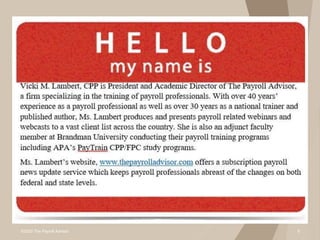
Vicki Lambert
Organize. Humanize. Maximize.
2
Recruiting &
Onboarding
Talent
Management
HR &
Benefits
Payroll
Time &
Attendance
Ascentis
Ascentis provides:
• A-la-carte HR technology
• Industry-leading time & attendance
• Easy dashboards for actionable insights
• Unsurpassed support
30+ Years of experience growing with you as an
HR professional throughout unprecedented
change in the role of HR and expectations of
employees.
Opening Remarks
Speaker
Housekeeping
Organize. Humanize. Maximize.
3
Questions
Today’s
Topic
Organize. Humanize. Maximize.
4
Housekeeping - How to earn credit
Stay on the webinar,
online for the
full 60 minutes
Be watching using
your unique URL
sent to you from
GoToWebcast
Program codes delivered
by email,
to registered email,
approximately 30 days
following today’s session
Speaker
Housekeeping
Organize. Humanize. Maximize.
5
Questions
Today’s
Topic
©2020 The Payroll Advisor 6
©2020 The Payroll Advisor
7
Wage And Hour Law: Its
More Than Just
Calculating Overtime
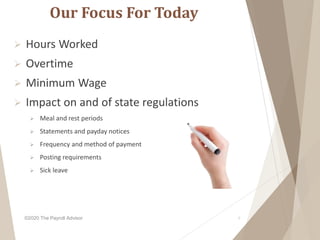
Our Focus For Today
 Hours Worked
 Overtime
 Minimum Wage
 Impact on and of state regulations
 Meal and rest periods
 Statements and payday notices
 Frequency and method of payment
 Posting requirements
 Sick leave
©2020 The Payroll Advisor 8
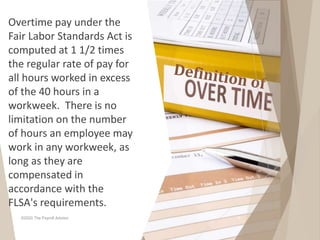
Overtime pay under the
Fair Labor Standards Act is
computed at 1 1/2 times
the regular rate of pay for
all hours worked in excess
of the 40 hours in a
workweek. There is no
limitation on the number
of hours an employee may
work in any workweek, as
long as they are
compensated in
accordance with the
FLSA's requirements.
©2020 The Payroll Advisor 9
But Maybe
the States
Require
Daily
Overtime…
©2020 The Payroll Advisor 10
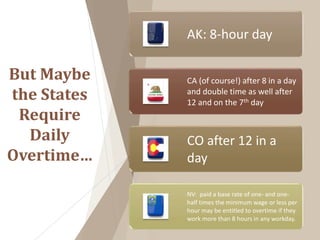
AK: 8-hour day
CA (of course!) after 8 in a day
and double time as well after
12 and on the 7th day
CO after 12 in a
day
NV: paid a base rate of one- and one-
half times the minimum wage or less per
hour may be entitled to overtime if they
work more than 8 hours in any workday.
But Maybe the States
Require… Special Overtime
©2020 The Payroll Advisor 11
KY: Work 7 days in one
work week, overtime
on 7th day
OR: certain industries
only such as mills,
factories or
manufacturing (10
hour days)
Useful
Definitions…
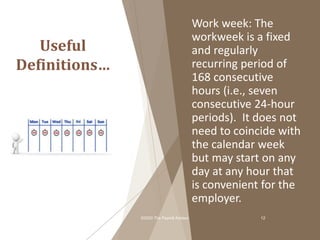
Work week: The
workweek is a fixed
and regularly
recurring period of
168 consecutive
hours (i.e., seven
consecutive 24-hour
periods). It does not
need to coincide with
the calendar week
but may start on any
day at any hour that
is convenient for the
employer.
©2020 The Payroll Advisor 12
And…
©2020 The Payroll Advisor 13
Work Day: The Portal to Portal Act of 1947,
excludes from hours worked under the FLSA
requirements any hours for time spent by an
employee "walking, riding, or traveling to and
from the actual place of performance of the
principal activity or activities" unless these
activities are compensable under the terms of
a contract, by custom or by practice. The
Portal Act also excludes activities performed
before or after the employee's principle
activities in a workday.
Public Sector Work Week
©2020 The Payroll Advisor 14
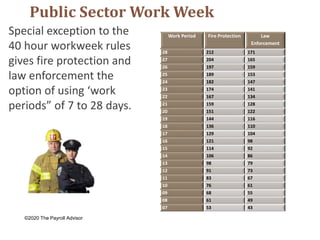
Special exception to the
40 hour workweek rules
gives fire protection and
law enforcement the
option of using ‘work
periods” of 7 to 28 days.
Work Period Fire Protection Law
Enforcement
28 212 171
27 204 165
26 197 159
25 189 153
24 182 147
23 174 141
22 167 134
21 159 128
20 151 122
19 144 116
18 136 110
17 129 104
16 121 98
15 114 92
14 106 86
13 98 79
12 91 73
11 83 67
10 76 61
09 68 55
08 61 49
07 53 43
Hospital
Employees
©2020 The Payroll Advisor 15
Hospitals have an optional method to compute
overtime pay for their employees
Called the 8/80 rule
Overtime computed using a designated work
period of 14 consecutive days instead of 7 days
Employees paid 1 ½ times their regular rate of
pay for all hours worked in excess of 8 hours in
one day or 80 hours in any 14 day period
whichever is the greater number of hours
Hours
Worked…
No matter what type of
time keeping system
employers use, problems
may arise over the correct
treatment of small
amounts of scheduled or
unscheduled time worked
or missed by employees.
Employers must pay for all
time worked and cannot
use rough estimates or
arbitrary formulas to
compute hours worked
©2020 The Payroll Advisor 16
While the FLSA requires
accurate records of hours
worked, employers are
not required to use time
clocks, time cards, or any
particular type of time
keeping system. If a time
clock is used, employers
are free to disregard
early or late punching by
employees who
voluntarily arrive early or
remain after hours, so
long as the employees
do not perform any work
during these times.
©2020 The Payroll Advisor 17
Keeping Track of
Hours Worked
Two
Exceptions
 Rounding of
hours
 De minimis or
insignificant
timekeeping
©2020 The Payroll Advisor 18
Rounding Practices
©2020 The Payroll Advisor 19
 Rounding'' practices are acceptable
 Rounding employees' starting time and
stopping time to the nearest 5 minutes, or to
the nearest one-tenth or quarter of an hour.
 For enforcement purposes this practice of
computing working time will be accepted,
provided that it is used in such a manner that
it will not result, over a period of time, in
failure to compensate the employees properly
for all the time they have actually worked.
Rounding Example—Fact Sheet # 21
©2020 The Payroll Advisor
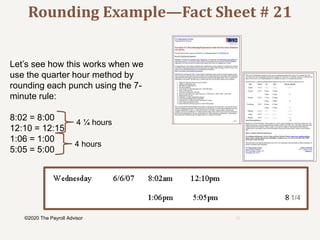
Let’s see how this works when we
use the quarter hour method by
rounding each punch using the 7-
minute rule:
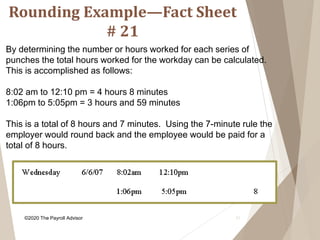
8:02 = 8:00
12:10 = 12:15
1:06 = 1:00
5:05 = 5:00
20
1/4
4 ¼ hours
4 hours
Rounding Example—Fact Sheet
# 21
©2020 The Payroll Advisor
By determining the number or hours worked for each series of
punches the total hours worked for the workday can be calculated.
This is accomplished as follows:
8:02 am to 12:10 pm = 4 hours 8 minutes
1:06pm to 5:05pm = 3 hours and 59 minutes
This is a total of 8 hours and 7 minutes. Using the 7-minute rule the
employer would round back and the employee would be paid for a
total of 8 hours.
21
Definition of Hours Worked
©2020 The Payroll Advisor 22
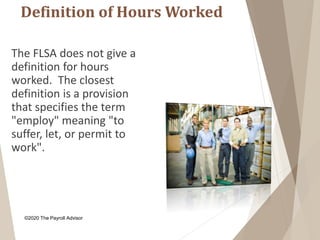
The FLSA does not give a
definition for hours
worked. The closest
definition is a provision
that specifies the term
"employ" meaning "to
suffer, let, or permit to
work".
The U.S.
Supreme
Court Has
Ruled That
Hours
Worked
Include…
©2020 The Payroll Advisor 23
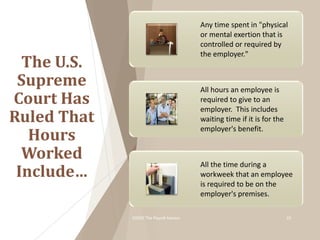
Any time spent in "physical
or mental exertion that is
controlled or required by
the employer."
All hours an employee is
required to give to an
employer. This includes
waiting time if it is for the
employer's benefit.
All the time during a
workweek that an employee
is required to be on the
employer's premises.
To comply with the
FLSA, hours
worked need to
include not only
hours actually
performing job
duties but also any
other hours
suffered or
permitted to work
by the employer
for the employer's
benefit.
©2020 The Payroll Advisor 24
Therefore…
Which Means…
©2020 The Payroll Advisor 25
Work not requested but suffered or permitted
is work time. For example, an employee may
voluntarily continue to work at the end of the
shift. He may be a piece worker, he may desire
to finish an assigned task, or he may wish to
correct errors, prepare time reports or
complete other duties. The reason is
immaterial. If the employer knows or has
reason to believe the employee is continuing
to work, the time is working time and must be
paid.
Therefore…
©2020 The Payroll Advisor 26
In all such cases, it is the duty of the
management to exercise its control and see
that the work is not performed if it does not
want it to be performed. Employers cannot
sit back and accept the benefits without
compensating for them. The mere
promulgation of a rule against such work is
not enough. Management has the power to
enforce the rule and must make every effort
to do so. (Section 785.11, 12, & 13.)
Travel and
Other
Types of
Pay
©2020 The Payroll Advisor 27
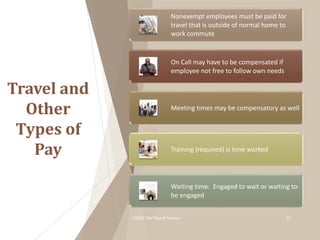
Nonexempt employees must be paid for
travel that is outside of normal home to
work commute
On Call may have to be compensated if
employee not free to follow own needs
Meeting times may be compensatory as well
Training (required) is time worked
Waiting time: Engaged to wait or waiting to
be engaged
Travel and Other Types of Pay
©2020 The Payroll Advisor 28
Vacation, sick
pay and
holidays are
not hours
worked under
the FLSA
Nights and
weekends
are hours
worked if
worked
Meal
periods:
don’t dock if
not taken
States may have
more types such
as show up pay or
limit number of
hours that an
employee may
work
Regular Rate
of Pay
 It is a calculated rate
and not just the file
rate
 The employer must
consider many
different payments in
accurately calculating
the correct rate of pay
for overtime hours.
©2020 The Payroll Advisor 29
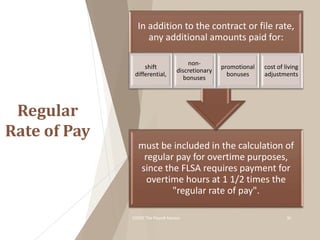
Regular
Rate of Pay
©2020 The Payroll Advisor 30
must be included in the calculation of
regular pay for overtime purposes,
since the FLSA requires payment for
overtime hours at 1 1/2 times the
"regular rate of pay".
In addition to the contract or file rate,
any additional amounts paid for:
shift
differential,
non-
discretionary
bonuses
promotional
bonuses
cost of living
adjustments
Regular
Rate of Pay
©2020 The Payroll Advisor 31
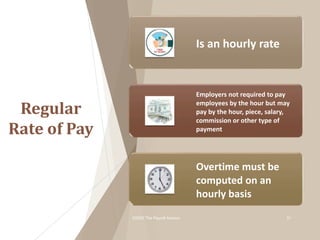
Is an hourly rate
Employers not required to pay
employees by the hour but may
pay by the hour, piece, salary,
commission or other type of
payment
Overtime must be
computed on an
hourly basis
©2020 The Payroll Advisor
Methods for
Calculating
Overtime
32
FLSA way: This requires
calculating all the
straight time due and
adding the “overtime
premium” to reach 1 ½
the employee’s regular
rate of pay. It is used
when additional
compensation other
than straight time and
overtime hours are paid.
Example: when the
employee receives a
non-discretionary bonus.
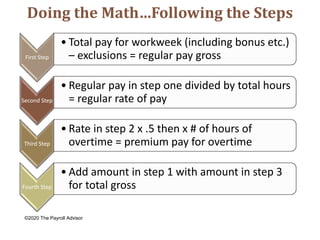
Doing the Math…Following the Steps
©2020 The Payroll Advisor 33
First Step
• Total pay for workweek (including bonus etc.)
– exclusions = regular pay gross
Second Step
• Regular pay in step one divided by total hours
= regular rate of pay
Third Step
• Rate in step 2 x .5 then x # of hours of
overtime = premium pay for overtime
Fourth Step
• Add amount in step 1 with amount in step 3
for total gross
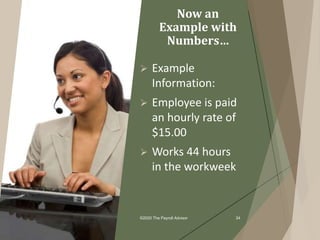
Now an
Example with
Numbers…
 Example
Information:
 Employee is paid
an hourly rate of
$15.00
 Works 44 hours
in the workweek
©2020 The Payroll Advisor 34
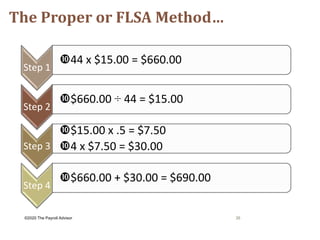
The Proper or FLSA Method…
©2020 The Payroll Advisor 35
Step 1
44 x $15.00 = $660.00
Step 2
$660.00 ÷ 44 = $15.00
Step 3
$15.00 x .5 = $7.50
4 x $7.50 = $30.00
Step 4
$660.00 + $30.00 = $690.00
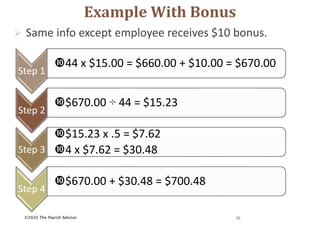
Example With Bonus
©2020 The Payroll Advisor 36
 Same info except employee receives $10 bonus.
Step 1
44 x $15.00 = $660.00 + $10.00 = $670.00
Step 2
$670.00 ÷ 44 = $15.23
Step 3
$15.23 x .5 = $7.62
4 x $7.62 = $30.48
Step 4
$670.00 + $30.48 = $700.48
Let’s Do Another Example
©2020 The Payroll Advisor
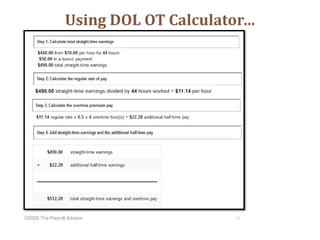
A warehouse worker worked 44 hours last
week. In additional to his regular wage of
$10.00 an hour, he was paid $50.00 for
completing a job on time and on budget.
37
©2020 The Payroll Advisor 38
Using DOL OT Calculator…
But What if More than
One Work Week Is Involved?
©2020 The Payroll Advisor 39
When a nondiscretionary bonus covers a period of time
longer than a workweek, it must be apportioned back
over the workweeks of the period during which it was
earned. If it is not possible or practicable to allocate the
bonus on the basis of when the bonus was actually
earned, some other reasonable or equitable method
must be adopted (for example, allocation of an equal
amount for each workweek covered by the bonus). The
employee must then receive additional overtime pay for
each workweek in which overtime was worked during the
period.
Multiple Rates of
Pay
When an employee in a
single workweek works at
two or more different
types of work for which
different straight time rates
have been established, the
regular rate of pay for that
week is the weighted
average of all the rates.
©2020 The Payroll Advisor 40
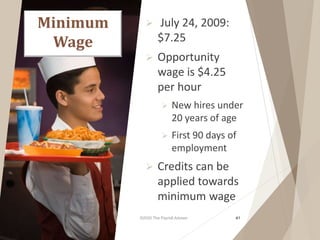
 July 24, 2009:
$7.25
 Opportunity
wage is $4.25
per hour
 New hires under
20 years of age
 First 90 days of
employment
 Credits can be
applied towards
minimum wage
©2020 The Payroll Advisor 41
Minimum
Wage
Room and
Board
©2020 The Payroll Advisor 42
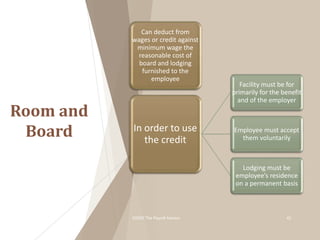
Can deduct from
wages or credit against
minimum wage the
reasonable cost of
board and lodging
furnished to the
employee
In order to use
the credit
Facility must be for
primarily for the benefit
and of the employer
Employee must accept
them voluntarily
Lodging must be
employee’s residence
on a permanent basis
Tip Credit
©2020 The Payroll Advisor 43
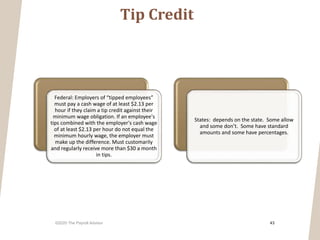
Federal: Employers of “tipped employees”
must pay a cash wage of at least $2.13 per
hour if they claim a tip credit against their
minimum wage obligation. If an employee's
tips combined with the employer's cash wage
of at least $2.13 per hour do not equal the
minimum hourly wage, the employer must
make up the difference. Must customarily
and regularly receive more than $30 a month
in tips.
States: depends on the state. Some allow
and some don’t. Some have standard
amounts and some have percentages.
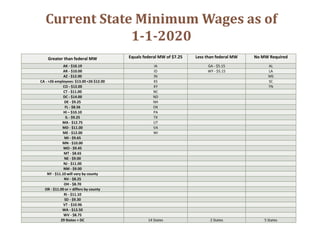
Current State Minimum Wages as of
1-1-2020
©2020 The Payroll Advisor 44
Greater than federal MW Equals federal MW of $7.25 Less than federal MW No MW Required
AK - $10.19 IA GA - $5.15 AL
AR - $10.00 ID WY - $5.15 LA
AZ - $12.00 IN MS
CA - >26 employees: $13.00 <26 $12.00 KS SC
CO - $12.00 KY TN
CT - $11.00 NC
DC - $14.00 ND
DE - $9.25 NH
FL - $8.56 OK
HI – $10.10 PA
IL - $9.25 TX
MA - $12.75 UT
MD - $11.00 VA
ME - $12.00 WI
MI - $9.65
MN - $10.00
MO - $9.45
MT - $8.65
NE - $9.00
NJ - $11.00
NM - $9.00
NY - $11.10 will vary by county
NV - $8.25
OH - $8.70
OR - $11.00 or > differs by county
RI - $11.10
SD - $9.30
VT - $10.96
WA - $13.50
WV - $8.75
29 States + DC 14 States 2 States 5 States
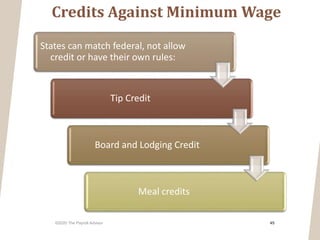
Credits Against Minimum Wage
©2020 The Payroll Advisor 45
States can match federal, not allow
credit or have their own rules:
Tip Credit
Board and Lodging Credit
Meal credits
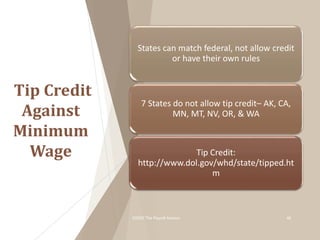
Tip Credit
Against
Minimum
Wage
©2020 The Payroll Advisor 46
States can match federal, not allow credit
or have their own rules
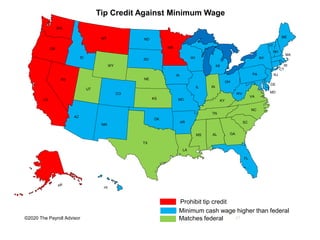
7 States do not allow tip credit– AK, CA,
MN, MT, NV, OR, & WA
Tip Credit:
http://www.dol.gov/whd/state/tipped.ht
m
MT
WY
ID
WA
OR
NV
UT
CA
AZ
ND
SD
NE
CO
NM
TX
OK
KS
AR
LA
MO
IA
MN
WI
IL IN
KY
TN
MS AL GA
FL
SC
NC
VA
WV
OH
MI
NY
PA
MD
DE
NJ
CT
RI
MA
ME
VT
NH
HI
Prohibit tip credit
©2020 The Payroll Advisor 47
Minimum cash wage higher than federal
Matches federal
Tip Credit Against Minimum Wage
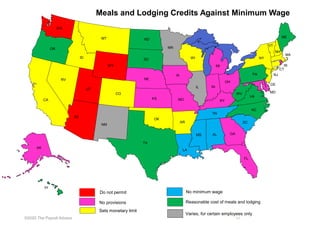
Meals and
Lodging Credits
Against
Minimum Wage
 States can match federal, not
allow credit or have their own
rules
©2020 The Payroll Advisor 48
MT
WY
ID
WA
OR
NV
UT
CA
AZ
ND
SD
NE
CO
NM
TX
OK
KS
AR
LA
MO
IA
MN
WI
IL IN
KY
TN
MS AL GA
FL
SC
NC
VA
WV
OH
MI
NY
PA
MD
DE
NJ
CT
RI
MA
ME
VT
NH
AK
HI
Do not permit
No provisions
Meals and Lodging Credits Against Minimum Wage
Sets monetary limit
49
No minimum wage
Reasonable cost of meals and lodging
Varies, for certain employees only
©2020 The Payroll Advisor
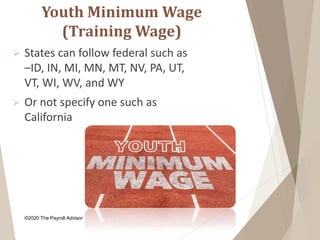
Youth Minimum Wage
(Training Wage)
©2020 The Payroll Advisor 50
 States can follow federal such as
–ID, IN, MI, MN, MT, NV, PA, UT,
VT, WI, WV, and WY
 Or not specify one such as
California
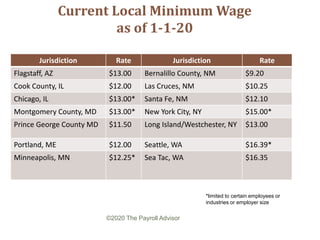
Current Local Minimum Wage
as of 1-1-20
©2020 The Payroll Advisor 51
Jurisdiction Rate Jurisdiction Rate
Flagstaff, AZ $13.00 Bernalillo County, NM $9.20
Cook County, IL $12.00 Las Cruces, NM $10.25
Chicago, IL $13.00* Santa Fe, NM $12.10
Montgomery County, MD $13.00* New York City, NY $15.00*
Prince George County MD $11.50 Long Island/Westchester, NY $13.00
Portland, ME $12.00 Seattle, WA $16.39*
Minneapolis, MN $12.25* Sea Tac, WA $16.35
*limited to certain employees or
industries or employer size
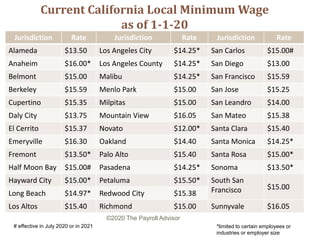
Current California Local Minimum Wage
as of 1-1-20
©2020 The Payroll Advisor 52
Jurisdiction Rate Jurisdiction Rate Jurisdiction Rate
Alameda $13.50 Los Angeles City $14.25* San Carlos $15.00#
Anaheim $16.00* Los Angeles County $14.25* San Diego $13.00
Belmont $15.00 Malibu $14.25* San Francisco $15.59
Berkeley $15.59 Menlo Park $15.00 San Jose $15.25
Cupertino $15.35 Milpitas $15.00 San Leandro $14.00
Daly City $13.75 Mountain View $16.05 San Mateo $15.38
El Cerrito $15.37 Novato $12.00* Santa Clara $15.40
Emeryville $16.30 Oakland $14.40 Santa Monica $14.25*
Fremont $13.50* Palo Alto $15.40 Santa Rosa $15.00*
Half Moon Bay $15.00# Pasadena $14.25* Sonoma $13.50*
Hayward City $15.00* Petaluma $15.50* South San
Francisco $15.00
Long Beach $14.97* Redwood City $15.38
Los Altos $15.40 Richmond $15.00 Sunnyvale $16.05
*limited to certain employees or
industries or employer size
# effective in July 2020 or in 2021
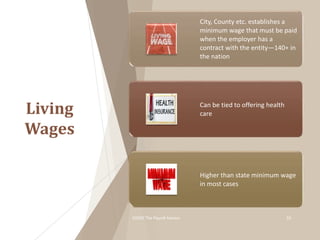
Living
Wages
©2020 The Payroll Advisor 53
City, County etc. establishes a
minimum wage that must be paid
when the employer has a
contract with the entity—140+ in
the nation
Can be tied to offering health
care
Higher than state minimum wage
in most cases
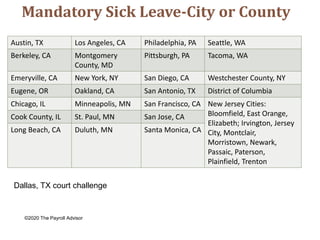
Mandatory Sick Leave-City or County
©2020 The Payroll Advisor 54
Austin, TX Los Angeles, CA Philadelphia, PA Seattle, WA
Berkeley, CA Montgomery
County, MD
Pittsburgh, PA Tacoma, WA
Emeryville, CA New York, NY San Diego, CA Westchester County, NY
Eugene, OR Oakland, CA San Antonio, TX District of Columbia
Chicago, IL Minneapolis, MN San Francisco, CA New Jersey Cities:
Bloomfield, East Orange,
Elizabeth; Irvington, Jersey
City, Montclair,
Morristown, Newark,
Passaic, Paterson,
Plainfield, Trenton
Cook County, IL St. Paul, MN San Jose, CA
Long Beach, CA Duluth, MN Santa Monica, CA
Dallas, TX court challenge
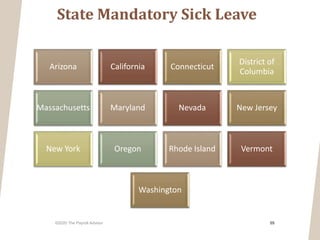
State Mandatory Sick Leave
©2020 The Payroll Advisor 55
Arizona California Connecticut
District of
Columbia
Massachusetts Maryland Nevada New Jersey
New York Oregon Rhode Island Vermont
Washington
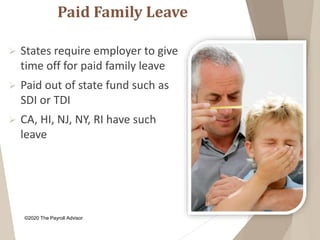
Paid Family Leave
©2020 The Payroll Advisor 56
 States require employer to give
time off for paid family leave
 Paid out of state fund such as
SDI or TDI
 CA, HI, NJ, NY, RI have such
leave
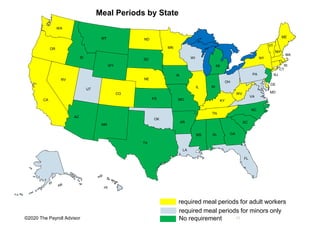
Meal and
Rest
Periods
©2020 The Payroll Advisor 57
No requirement on the federal level for
either
States: State may have meal period and
rest period such as CA. Or just one or the
other such as CT which has just meal
period. Or they could not address the
issue such as such as FL, GA, LA, and ID.
Reference for meals:
http://www.dol.gov/whd/state/meal.htm
MT
WY
ID
WA
OR
NV
UT
CA
AZ
ND
SD
NE
CO
NM
TX
OK
KS
AR
LA
MO
IA
MN
WI
IL IN
KY
TN
MS AL GA
FL
SC
NC
VA
WV
OH
MI
NY
PA
MD
DE
NJ
CT
RI
MA
ME
VT
NH
HI
required meal periods for adult workers
©2020 The Payroll Advisor 58
required meal periods for minors only
No requirement
Meal Periods by State
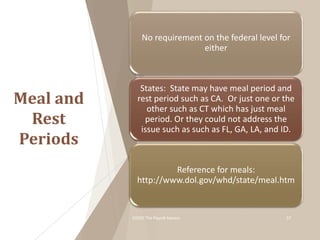
Rest
Periods
©2020 The Payroll Advisor 59
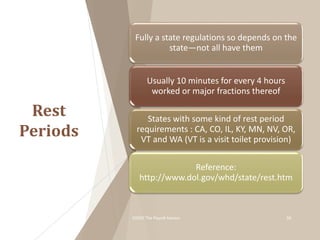
Fully a state regulations so depends on the
state—not all have them
Usually 10 minutes for every 4 hours
worked or major fractions thereof
States with some kind of rest period
requirements : CA, CO, IL, KY, MN, NV, OR,
VT and WA (VT is a visit toilet provision)
Reference:
http://www.dol.gov/whd/state/rest.htm
Posting
Requirements
©2020 The Payroll Advisor 60
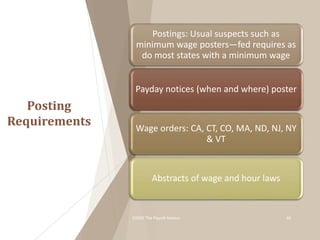
Postings: Usual suspects such as
minimum wage posters—fed requires as
do most states with a minimum wage
Payday notices (when and where) poster
Wage orders: CA, CT, CO, MA, ND, NJ, NY
& VT
Abstracts of wage and hour laws
Statements (Paystubs)
©2020 The Payroll Advisor 61
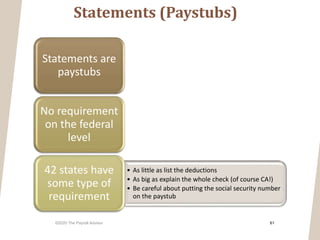
Statements are
paystubs
No requirement
on the federal
level
• As little as list the deductions
• As big as explain the whole check (of course CA!)
• Be careful about putting the social security number
on the paystub
42 states have
some type of
requirement
States With No Requirement
©2020 The Payroll Advisor 62
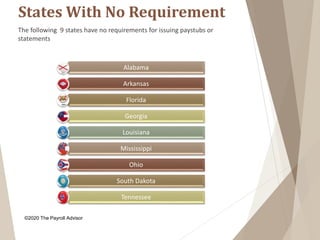
The following 9 states have no requirements for issuing paystubs or
statements
Alabama
Arkansas
Florida
Georgia
Louisiana
Mississippi
Ohio
South Dakota
Tennessee
Payday Notices
©2020 The Payroll Advisor 63
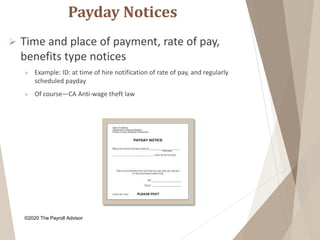
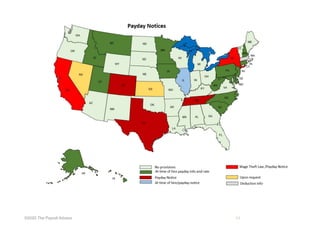
 Time and place of payment, rate of pay,
benefits type notices
 Example: ID: at time of hire notification of rate of pay, and regularly
scheduled payday
 Of course—CA Anti-wage theft law
©2020 The Payroll Advisor 64
Frequency
of Wage
Payments
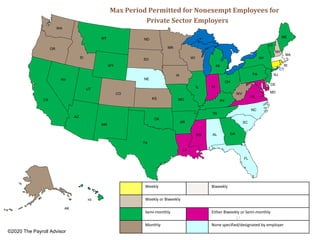
©2020 The Payroll Advisor 65
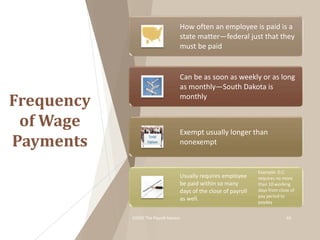
How often an employee is paid is a
state matter—federal just that they
must be paid
Can be as soon as weekly or as long
as monthly—South Dakota is
monthly
Exempt usually longer than
nonexempt
Usually requires employee
be paid within so many
days of the close of payroll
as well.
Example: D.C.
requires no more
than 10 working
days from close of
pay period to
payday
Permitted Payroll Frequencies
©2020 The Payroll Advisor 66
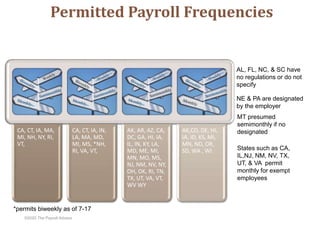
CA, CT, IA, MA,
MI, NH, NY, RI,
VT,
CA, CT, IA, IN,
LA, MA, MD,
MI, MS, *NH,
RI, VA, VT,
AK, AR, AZ, CA,
DC, GA, HI, IA,
IL, IN, KY, LA,
MD, ME, MI,
MN, MO, MS,
NJ, NM, NV, NY,
OH, OK, RI, TN,
TX, UT, VA, VT,
WV WY
AK,CO, DE, HI,
IA, ID, KS, MI,
MN, ND, OR,
SD, WA , WI
AL, FL, NC, & SC have
no regulations or do not
specify
NE & PA are designated
by the employer
MT presumed
semimonthly if no
designated
States such as CA,
IL,NJ, NM, NV, TX,
UT, & VA permit
monthly for exempt
employees
*permits biweekly as of 7-17
MT
WY
ID
WA
OR
NV
UT
CA
AZ
ND
SD
NE
CO
NM
TX
OK
KS
AR
LA
MO
IA
MN
WI
IL IN
KY
TN
MS AL GA
FL
SC
NC
VA
WV
OH
MI
NY
PA
MD
DE
NJ
CT
RI
MA
ME
VT
NH
AK
HI
Max Period Permitted for Nonexempt Employees for
Private Sector Employers
©2020 The Payroll Advisor
67
Weekly Biweekly
Weekly or Biweekly
Semi-monthly Either Biweekly or Semi-monthly
Monthly None specified/designated by employer
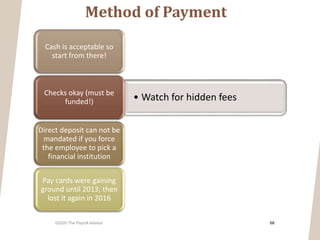
Method of Payment
©2020 The Payroll Advisor 68
Cash is acceptable so
start from there!
• Watch for hidden fees
Checks okay (must be
funded!)
Direct deposit can not be
mandated if you force
the employee to pick a
financial institution
Pay cards were gaining
ground until 2013; then
lost it again in 2016
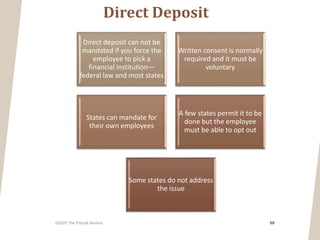
Direct Deposit
©2020 The Payroll Advisor 69
Direct deposit can not be
mandated if you force the
employee to pick a
financial institution—
federal law and most states
Written consent is normally
required and it must be
voluntary
States can mandate for
their own employees
A few states permit it to be
done but the employee
must be able to opt out
Some states do not address
the issue
©2020 The Payroll Advisor 70
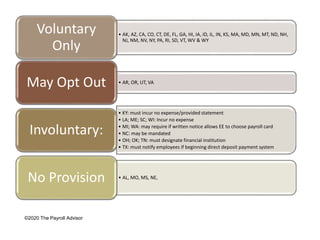
• AK, AZ, CA, CO, CT, DE, FL, GA, HI, IA, ID, IL, IN, KS, MA, MD, MN, MT, ND, NH,
NJ, NM, NV, NY, PA, RI, SD, VT, WV & WY
Voluntary
Only
• AR, OR, UT, VA
May Opt Out
• KY: must incur no expense/provided statement
• LA; ME; SC; WI: Incur no expense
• MI; WA: may require if written notice allows EE to choose payroll card
• NC: may be mandated
• OH; OK; TN: must designate financial institution
• TX: must notify employees if beginning direct deposit payment system
Involuntary:
• AL, MO, MS, NE,
No Provision
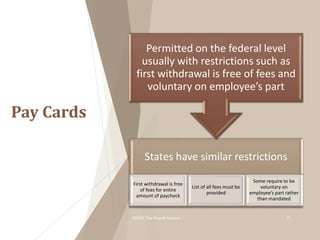
Pay Cards
©2020 The Payroll Advisor 71
States have similar restrictions
First withdrawal is free
of fees for entire
amount of paycheck
List of all fees must be
provided
Some require to be
voluntary on
employee’s part rather
than mandated
Permitted on the federal level
usually with restrictions such as
first withdrawal is free of fees and
voluntary on employee’s part
MT
WY
ID
WA
OR
NV
UT
CA
AZ
ND
SD
NE
CO
NM
TX
OK
KS
AR
LA
MO
IA
MN
WI
IL IN
KY
TN
MS AL GA
FL
SC
NC
VA
WV
OH
MI
NY
PA
MD
DE
NJ
CT
RI
MA
ME
VT
NH
AK
HI
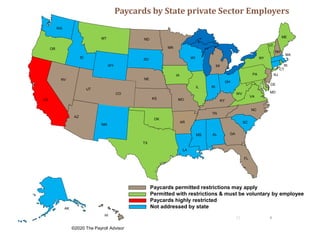
I
Paycards permitted restrictions may apply
Permitted with restrictions & must be voluntary by employee
Paycards highly restricted
Not addressed by state
Paycards by State private Sector Employers
©2020 The Payroll Advisor
72
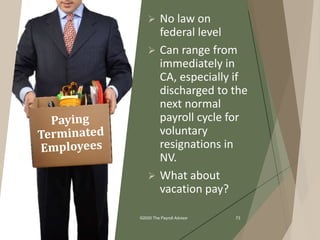
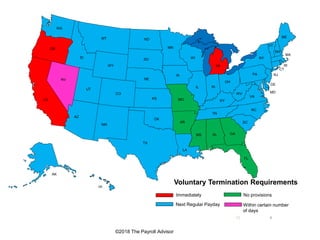
 No law on
federal level
 Can range from
immediately in
CA, especially if
discharged to the
next normal
payroll cycle for
voluntary
resignations in
NV.
 What about
vacation pay?
©2020 The Payroll Advisor 73
MT
WY
ID
WA
OR
NV
UT
CA
AZ
ND
SD
NE
CO
NM
TX
OK
KS
AR
LA
MO
IA
MN
WI
IL IN
KY
TN
MS AL GA
FL
SC
NC
VA
WV
OH
MI
NY
PA
MD
DE
NJ
CT
RI
MA
ME
VT
NH
AK
HI
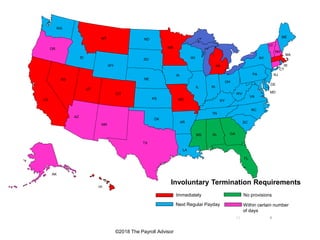
I
Involuntary Termination Requirements
©2018 The Payroll Advisor
74
Immediately No provisions
Next Regular Payday Within certain number
of days
MT
WY
ID
WA
OR
NV
UT
CA
AZ
ND
SD
NE
CO
NM
TX
OK
KS
AR
LA
MO
IA
MN
WI
IL IN
KY
TN
MS AL GA
FL
SC
NC
VA
WV
OH
MI
NY
PA
MD
DE
NJ
CT
RI
MA
ME
VT
NH
AK
HI
I
Voluntary Termination Requirements
©2018 The Payroll Advisor
75
Immediately No provisions
Next Regular Payday Within certain number
of days
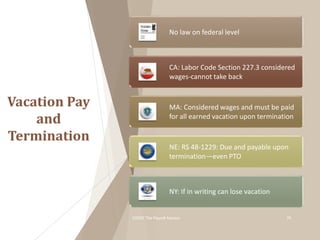
Vacation Pay
and
Termination
©2020 The Payroll Advisor 76
No law on federal level
CA: Labor Code Section 227.3 considered
wages-cannot take back
MA: Considered wages and must be paid
for all earned vacation upon termination
NE: RS 48-1229: Due and payable upon
termination—even PTO
NY: If in writing can lose vacation
MT
WY
ID
WA
OR
NV
UT
CA
AZ
ND
SD
NE
CO
NM
TX
OK
KS
AR
LA
MO
IA
MN
WI
IL IN
KY
TN
MS AL GA
FL
SC
NC
VA
WV
OH
MI
NY
PA
MD
DE
NJ
CT
RI
MA
ME
VT
NH
AK
HI
I
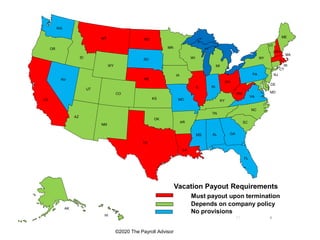
Vacation Payout Requirements
Must payout upon termination
Depends on company policy
No provisions
©2020 The Payroll Advisor
77
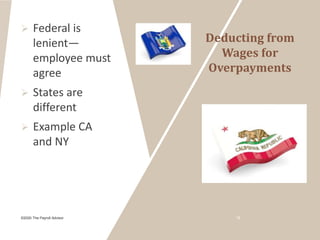
 Federal is
lenient—
employee must
agree
 States are
different
 Example CA
and NY
©2020 The Payroll Advisor 78
Deducting from
Wages for
Overpayments
FLSA
Requirements
©2020 The Payroll Advisor 79
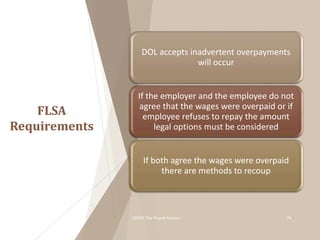
DOL accepts inadvertent overpayments
will occur
If the employer and the employee do not
agree that the wages were overpaid or if
employee refuses to repay the amount
legal options must be considered
If both agree the wages were overpaid
there are methods to recoup
Additional Resources
©2020 The Payroll Advisor 80
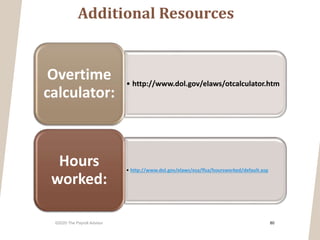
• http://www.dol.gov/elaws/otcalculator.htm
Overtime
calculator:
• http://www.dol.gov/elaws/esa/flsa/hoursworked/default.asp
Hours
worked:
Are There Any Questions?
©2020 The Payroll Advisor 81
Organize. Humanize. Maximize.
82
How Ascentis Timekeeper Can Help
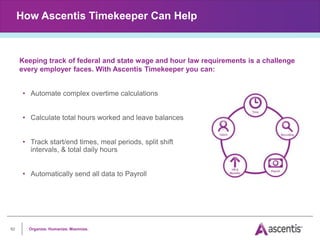
Keeping track of federal and state wage and hour law requirements is a challenge
every employer faces. With Ascentis Timekeeper you can:
• Automate complex overtime calculations
• Calculate total hours worked and leave balances
• Track start/end times, meal periods, split shift
intervals, & total daily hours
• Automatically send all data to Payroll
Ending Remarks
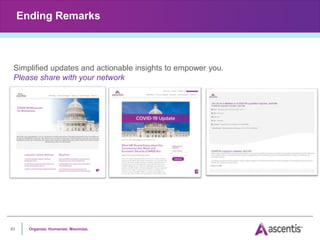
Simplified updates and actionable insights to empower you.
Please share with your network
Organize. Humanize. Maximize.
83
Ascentis
Payroll, HR, Time,
Talent, Recruiting
Ascentis: Extension of your team
84
Education
Software
Solutions You can focus on your
employee experience!
What you should expect from your HR
technology partner
Organize. Humanize. Maximize.
85
How to earn credit
Stay on the webinar,
online for the
full 60 minutes
Be watching using
your unique URL
sent to you from
GoToWebcast
Program codes delivered
by email,
to registered email,
approximately 30 days
following today’s session
Organize. Humanize. Maximize.
86
Contact Us
info@ascentis.com
www.ascentis.com
800.229.2713