Government Affairs Chamber
Training
Mid-America Chamber
Executives
Midwest Regional Office
One of 7 regional offices - Office of
Congressional and Public Affairs
Represents: MN, WI, IA, NE, ND, SD
Team: John Kirchner, Executive Director
Ethan Hellier, Manager
Why be involved in Government Affairs?
Public policy affects your members
Elected officials need to hear from you as the “voice
of business”
Your members can’t accomplish alone what they
can together
If you don’t, someone else will; and the #1 reason
Why be involved in Government Affairs?
Fulfill your Mission Statement:
Voice for business
Promote economic growth and development
Advocate for the business community
Why be involved in Government Affairs?
“Business must learn the lesson long ago learned by labor and other
self-interest groups. This lesson is that political power is necessary;
that such power must be assiduously cultivated and that, when
necessary, it must be used aggressively and with determination –
without the reluctance which has been so characteristic of American
business.”
-- Justice Lewis F. Powell, 1971, in a memo to the U.S.
Chamber of Commerce, prior to his appointment to the
U.S. Supreme Court
Overcoming obstacles to advocacy
Shattering the myths . . .
“Our chamber isn’t political.”
Neither are pro-business public policy statements. Issues are
not partisan.
“It will jeopardize our tax status.”
Actually, it won’t. In1975, the tax code was changed to permit a
501(c)6 organization to administer and solicit funds for political
activities. As a result, today many chambers are forming
political action committees to endorse and support pro-business
candidates.
Overcoming obstacles to advocacy
“It’s not our job and our by-laws prohibit
political activity.”
Your by-laws can be changed to match your mission, or your
mission statement should be changed to match you by-laws.
“Someone might get mad; we could lose
members.”
It will make more people happy and it will allow you to recruit
new, stronger members who share your chamber’s vision for
creating a healthier business climate.
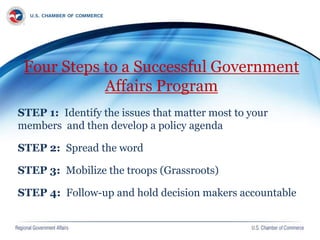
Four Steps to a Successful Government
Affairs Program
STEP 1: Identify the issues that matter most to your
members and then develop a policy agenda
STEP 2: Spread the word
STEP 3: Mobilize the troops (Grassroots)
STEP 4: Follow-up and hold decision makers accountable
STEP 1: Adopt Policy
Establish a legislative or government affairs committee
to identify issues of importance
Those you should consider avoiding placing on your
committee include:
• Elected Officials: Mayors, city council members,
city government employees
• Political party leaders
• School superintendent or other association
leaders
STEP 1: Adopt Policy
What do your members care about? Survey them and
find out!
Pick your battles carefully. Avoid controversial issues
that may split your membership, especially at first.
Use the resources provided by your state chamber and
the U.S. Chamber.
Specific policies vs. broad policy statements
Politics vs. Policy
The All-purpose Agenda
Sample policy statement:
The Anywhere Chamber of Commerce believes that adequate and affordable health
care is important to all citizens. To ensure our member companies can offer the best
possible options to their employees, we encourage:
Greater options for individuals to choose the coverage that best meets
individual needs and circumstances.
Efforts to make health care affordable to small businesses and the self
employed.
Medical malpractice and other legal reforms that will make health care more
affordable and accessible.
STEP 2: Spread the Word
Inform your Membership
Create and publish your legislative agenda
Include your agenda/adopted policies in your
newsletter, email and social media communications
As the issues move forward, update your members
on the progress
STEP 2: Spread the Word
Inform your Community
Promote newspaper articles featuring local businesses
that highlight your position
Write letters to the editor, signed by your board
chairman, that outlines your position(s)
Schedule meetings with newspaper editorial boards
and key volunteers (board chairman, legislative
committee chairman, etc.)
Look for unique ways to get your message out (Example:
Partner with local media outlets to provide regular updates/activities)
STEP 2: Spread the Word
Inform your Elected Officials
Provide written policy statements to all appropriate
elected officials
Ask them to identify where they stand on your issues
Hold meetings with your legislative committee and
elected officials to discuss your issues
Boldly explain why your issues are important to the
health of the business community
STEP 2: Spread the Word
Join/Form Coalitions
Local issues: Partner with organizations who care about
the same issue and share your position
Regional issues: Look beyond your traditional borders
to other chambers and associations who share your views
Federal issues: Build on existing partnerships
spearheaded by the U.S. Chamber and other national
organizations
STEP 2: Spread the Word
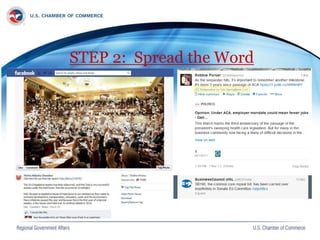
Social Media
Facebook Twitter
YouTube LinkedIn
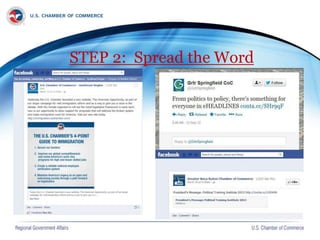
STEP 2: Spread the Word
STEP 3: Grassroots Network
Develop a Grassroots Network - a collection of e-
mails of members interested in public policy efforts
including:
Members of your government affairs committee
Board members
Major contributors
Most influential chamber members
STEP 3: Grassroots Network
Using the Network
Provide issue updates on a regular basis
Issue “Calls to Action” as necessary, include:
An issue summary
Contact information for elected officials
Timetable for action
Gather Intel or feedback from elected officials
WARNING!! Try not to overuse your grassroots network
STEP 4: Follow-up and Accountability
Follow-up on the outcome of an issue:
Elected officials
Express thanks or disappointment
Develop a scorecard or voting record
Membership
Use this as an opportunity to recruit new members
to your grassroots network
Summary
Identify the issues important to your chamber and
adopt policy statements
Spread the word – Membership, Community,
Elected Officials
Develop and effectively use a grassroots network
Follow-up
Take it to the next level
Recognize that it is easier to pass your agenda if
your elected officials share your point of view.
Candidate support
Candidate Events (Hob-Nobs, Meet & Greets, Forums)
Candidate Endorsements / PACs
Candidate Training Programs
THANK YOU
John Kirchner, Executive Director,
Midwest Region
(612) 619-2048
jkirchner@uschamber.com

Government Affairs Training

  • 1.
  • 2.
    Midwest Regional Office Oneof 7 regional offices - Office of Congressional and Public Affairs Represents: MN, WI, IA, NE, ND, SD Team: John Kirchner, Executive Director Ethan Hellier, Manager
  • 3.
    Why be involvedin Government Affairs? Public policy affects your members Elected officials need to hear from you as the “voice of business” Your members can’t accomplish alone what they can together If you don’t, someone else will; and the #1 reason
  • 4.
    Why be involvedin Government Affairs? Fulfill your Mission Statement: Voice for business Promote economic growth and development Advocate for the business community
  • 5.
    Why be involvedin Government Affairs? “Business must learn the lesson long ago learned by labor and other self-interest groups. This lesson is that political power is necessary; that such power must be assiduously cultivated and that, when necessary, it must be used aggressively and with determination – without the reluctance which has been so characteristic of American business.” -- Justice Lewis F. Powell, 1971, in a memo to the U.S. Chamber of Commerce, prior to his appointment to the U.S. Supreme Court
  • 6.
    Overcoming obstacles toadvocacy Shattering the myths . . . “Our chamber isn’t political.” Neither are pro-business public policy statements. Issues are not partisan. “It will jeopardize our tax status.” Actually, it won’t. In1975, the tax code was changed to permit a 501(c)6 organization to administer and solicit funds for political activities. As a result, today many chambers are forming political action committees to endorse and support pro-business candidates.
  • 7.
    Overcoming obstacles toadvocacy “It’s not our job and our by-laws prohibit political activity.” Your by-laws can be changed to match your mission, or your mission statement should be changed to match you by-laws. “Someone might get mad; we could lose members.” It will make more people happy and it will allow you to recruit new, stronger members who share your chamber’s vision for creating a healthier business climate.
  • 8.
    Four Steps toa Successful Government Affairs Program STEP 1: Identify the issues that matter most to your members and then develop a policy agenda STEP 2: Spread the word STEP 3: Mobilize the troops (Grassroots) STEP 4: Follow-up and hold decision makers accountable
  • 9.
    STEP 1: AdoptPolicy Establish a legislative or government affairs committee to identify issues of importance Those you should consider avoiding placing on your committee include: • Elected Officials: Mayors, city council members, city government employees • Political party leaders • School superintendent or other association leaders
  • 10.
    STEP 1: AdoptPolicy What do your members care about? Survey them and find out! Pick your battles carefully. Avoid controversial issues that may split your membership, especially at first. Use the resources provided by your state chamber and the U.S. Chamber. Specific policies vs. broad policy statements Politics vs. Policy
  • 11.
    The All-purpose Agenda Samplepolicy statement: The Anywhere Chamber of Commerce believes that adequate and affordable health care is important to all citizens. To ensure our member companies can offer the best possible options to their employees, we encourage: Greater options for individuals to choose the coverage that best meets individual needs and circumstances. Efforts to make health care affordable to small businesses and the self employed. Medical malpractice and other legal reforms that will make health care more affordable and accessible.
  • 12.
    STEP 2: Spreadthe Word Inform your Membership Create and publish your legislative agenda Include your agenda/adopted policies in your newsletter, email and social media communications As the issues move forward, update your members on the progress
  • 13.
    STEP 2: Spreadthe Word Inform your Community Promote newspaper articles featuring local businesses that highlight your position Write letters to the editor, signed by your board chairman, that outlines your position(s) Schedule meetings with newspaper editorial boards and key volunteers (board chairman, legislative committee chairman, etc.) Look for unique ways to get your message out (Example: Partner with local media outlets to provide regular updates/activities)
  • 14.
    STEP 2: Spreadthe Word Inform your Elected Officials Provide written policy statements to all appropriate elected officials Ask them to identify where they stand on your issues Hold meetings with your legislative committee and elected officials to discuss your issues Boldly explain why your issues are important to the health of the business community
  • 15.
    STEP 2: Spreadthe Word Join/Form Coalitions Local issues: Partner with organizations who care about the same issue and share your position Regional issues: Look beyond your traditional borders to other chambers and associations who share your views Federal issues: Build on existing partnerships spearheaded by the U.S. Chamber and other national organizations
  • 16.
    STEP 2: Spreadthe Word Social Media Facebook Twitter YouTube LinkedIn
  • 17.
  • 18.
  • 19.
    STEP 3: GrassrootsNetwork Develop a Grassroots Network - a collection of e- mails of members interested in public policy efforts including: Members of your government affairs committee Board members Major contributors Most influential chamber members
  • 20.
    STEP 3: GrassrootsNetwork Using the Network Provide issue updates on a regular basis Issue “Calls to Action” as necessary, include: An issue summary Contact information for elected officials Timetable for action Gather Intel or feedback from elected officials WARNING!! Try not to overuse your grassroots network
  • 21.
    STEP 4: Follow-upand Accountability Follow-up on the outcome of an issue: Elected officials Express thanks or disappointment Develop a scorecard or voting record Membership Use this as an opportunity to recruit new members to your grassroots network
  • 22.
    Summary Identify the issuesimportant to your chamber and adopt policy statements Spread the word – Membership, Community, Elected Officials Develop and effectively use a grassroots network Follow-up
  • 23.
    Take it tothe next level Recognize that it is easier to pass your agenda if your elected officials share your point of view. Candidate support Candidate Events (Hob-Nobs, Meet & Greets, Forums) Candidate Endorsements / PACs Candidate Training Programs
  • 24.
    THANK YOU John Kirchner,Executive Director, Midwest Region (612) 619-2048 jkirchner@uschamber.com