Goodwill by super
profit method
By Raj Narayan Yadav
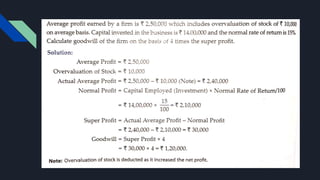
Goodwill = super profit x no. of years purchase
Super Profit =( Actual / Average Profit – Normal Profit.)
Normal profit = Capital employed x rate /100
Capital Employed means capital invested in the business by the partners. It may
also be termed as ‘Firm’s Capital.
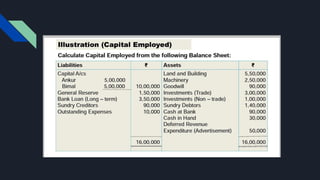
How to compute capital employed or firm’s capital
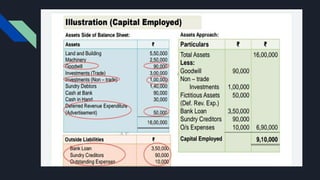
Asset approach
Capital employed = Total assets - Goodwill - Non-trade Investments -
Fictitious Assets - outside liabilities.
● Trade Investments are the investments made by the enterprise (firm) in another enterprise for the
furtherance or for better operations of own business.
● Non-trade Investments are the investments made with the purpose to earn income from it.
● Fictitious assets are assets which are neither tangible assets nor intangible assets but represent loss or
expenses yet to be written off. Example are debit balance of profit and loss account, Deferred
advertisement expenditure, Deferred revenue expenditure.
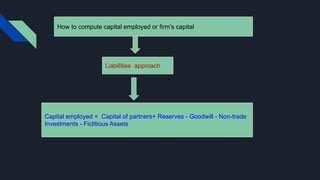
How to compute capital employed or firm’s capital
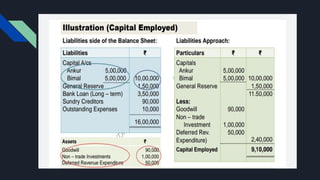
Liabilities approach
Capital employed = Capital of partners+ Reserves - Goodwill - Non-trade
Investments - Fictitious Assets
Normal profit = capital employed x rate/100
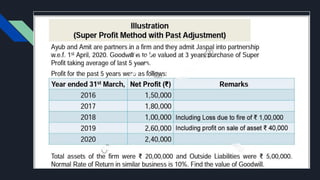
Normal profit = ( 20,00,000-5,00,000) x10/100
= 1,50,000
Super Profit = Average Profit – Normal Profit = ₹ 1,98,000 ─ ₹ 1,50,000 = ₹ 48,000
Goodwill = Super Profit x Number of Years Purchase = ₹ 48,000 x 3 = ₹ 1,44,000
Goodwill by super profit method

Goodwill by super profit method

  • 1.
    Goodwill by super profitmethod By Raj Narayan Yadav
  • 2.
    Goodwill = superprofit x no. of years purchase Super Profit =( Actual / Average Profit – Normal Profit.) Normal profit = Capital employed x rate /100 Capital Employed means capital invested in the business by the partners. It may also be termed as ‘Firm’s Capital.
  • 3.
    How to computecapital employed or firm’s capital Asset approach Capital employed = Total assets - Goodwill - Non-trade Investments - Fictitious Assets - outside liabilities. ● Trade Investments are the investments made by the enterprise (firm) in another enterprise for the furtherance or for better operations of own business. ● Non-trade Investments are the investments made with the purpose to earn income from it. ● Fictitious assets are assets which are neither tangible assets nor intangible assets but represent loss or expenses yet to be written off. Example are debit balance of profit and loss account, Deferred advertisement expenditure, Deferred revenue expenditure.
  • 6.
    How to computecapital employed or firm’s capital Liabilities approach Capital employed = Capital of partners+ Reserves - Goodwill - Non-trade Investments - Fictitious Assets
  • 9.
    Normal profit =capital employed x rate/100 Normal profit = ( 20,00,000-5,00,000) x10/100 = 1,50,000 Super Profit = Average Profit – Normal Profit = ₹ 1,98,000 ─ ₹ 1,50,000 = ₹ 48,000 Goodwill = Super Profit x Number of Years Purchase = ₹ 48,000 x 3 = ₹ 1,44,000