Importance/Significance
of planning
By Raj Narayan Yadav
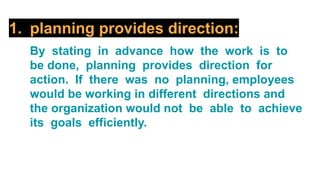
1. planning provides direction:
By stating in advance how the work is to
be done, planning provides direction for
action. If there was no planning, employees
would be working in different directions and
the organization would not be able to achieve
its goals efficiently.
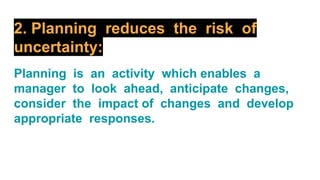
2. Planning reduces the risk of
uncertainty:
Planning is an activity which enables a
manager to look ahead, anticipate changes,
consider the impact of changes and develop
appropriate responses.
3. Planning reduces wasteful
activities:
Planning serves as the basis of coordinating
the activities and efforts of different
departments and individuals whereby useless
and redundant activities are reduced.
4. Planning promotes innovative ideas:
Planning is the first function of management.
Managers get the opportunity to develop new
ideas and new ideas can take the shape of
concrete plans.
5. Planning facilitates decision
making:
Under planning targets are laid down. The
manager has to evaluate each alternative and
select the most viable option. Thus planning
facilitates decision making.
6. Planning establishes standards for
controlling:
Planning provides the standards against which
the actual performance can be measured and
evaluated. Controlling is blind without planning.
Thus planning provides the basis for controlling.

Importance/significance of planning

  • 1.
  • 2.
    1. planning providesdirection: By stating in advance how the work is to be done, planning provides direction for action. If there was no planning, employees would be working in different directions and the organization would not be able to achieve its goals efficiently.
  • 3.
    2. Planning reducesthe risk of uncertainty: Planning is an activity which enables a manager to look ahead, anticipate changes, consider the impact of changes and develop appropriate responses.
  • 4.
    3. Planning reduceswasteful activities: Planning serves as the basis of coordinating the activities and efforts of different departments and individuals whereby useless and redundant activities are reduced.
  • 5.
    4. Planning promotesinnovative ideas: Planning is the first function of management. Managers get the opportunity to develop new ideas and new ideas can take the shape of concrete plans.
  • 6.
    5. Planning facilitatesdecision making: Under planning targets are laid down. The manager has to evaluate each alternative and select the most viable option. Thus planning facilitates decision making.
  • 7.
    6. Planning establishesstandards for controlling: Planning provides the standards against which the actual performance can be measured and evaluated. Controlling is blind without planning. Thus planning provides the basis for controlling.