Anorexia


(Good Presentation)
 By: Lizbeth Cedillo
What is Anorexia?
• An eating disorder
• People with anorexia
  have an intense fear of
  gaining weight
• Hardly eat any food and
  become very slim
• Also a psychological
  issue– focuses on food;
  its actually an attempt to
  deal with
  perfectionism, depressio
  n or loneliness
• Commonly seen in
  women of 11 to 25 yrs
Types of Anorexia
• Purging                   • Restricting
   - Weight loss achieved      - Weight loss achieved
  by vomiting, laxatives      by restricting calories
  or diuretics                *Following by diets, fasting
                              and exercising to excess
Probable Causes
• People with anorexia tend to
  have
  - Poor body image
  - Idealize thinness
  - Low self-evaluations
  - Set perfectionist standards
  - Genetics
  - Culture
  - Intensely concerned with
  how others perceive them
  - Fear falling short of
  expectations
Symptoms
•   Dramatic weight loss
•   Denial of hunger
•   Excessive, rigid exercise regimen
•   Refusal to eat certain foods, or
    whole categories of food (ex.
    Carbohydrates)
•   Preoccupation with
    weight, food, calories, fat
    grams, and dieting
•   Constant excuses to avoid
    mealtimes
•   Anxiety about gaining weight or
    being fat
•   Weight loss and dieting become
    primary concerns in life
•   Withdrawal from friends and
    activities
Physical Signs
•   Loss of periods
•   Weight loss without illness
•   Visible bones
•   Dry skin
•   Fainting
•   Thinning hair
•   Lanugos – growth of fine hair all over the body
•   Always feeling cold
•   Rotten teeth
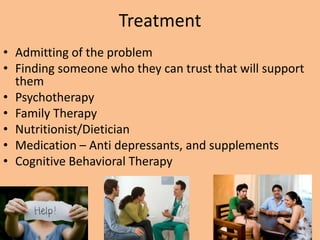
Treatment
• Admitting of the problem
• Finding someone who they can trust that will support
  them
• Psychotherapy
• Family Therapy
• Nutritionist/Dietician
• Medication – Anti depressants, and supplements
• Cognitive Behavioral Therapy
Summary
• Eating disorder
• Psychological issue
• Two types of anorexia – purging and restricting
• Some causes – poor body
  image, genetics, culture, family values, peers
• Some symptoms – refusal to eat, avoids certain
  foods, anxiety of gaining weight, excessive
  exercising
• Some physical signs – hair loss, visible
  bones, rotten teeth, dry skin, thinning hair
• Treatment – therapies, counseling, medication

Good presentation

  • 1.
  • 2.
    What is Anorexia? •An eating disorder • People with anorexia have an intense fear of gaining weight • Hardly eat any food and become very slim • Also a psychological issue– focuses on food; its actually an attempt to deal with perfectionism, depressio n or loneliness • Commonly seen in women of 11 to 25 yrs
  • 3.
    Types of Anorexia •Purging • Restricting - Weight loss achieved - Weight loss achieved by vomiting, laxatives by restricting calories or diuretics *Following by diets, fasting and exercising to excess
  • 4.
    Probable Causes • Peoplewith anorexia tend to have - Poor body image - Idealize thinness - Low self-evaluations - Set perfectionist standards - Genetics - Culture - Intensely concerned with how others perceive them - Fear falling short of expectations
  • 5.
    Symptoms • Dramatic weight loss • Denial of hunger • Excessive, rigid exercise regimen • Refusal to eat certain foods, or whole categories of food (ex. Carbohydrates) • Preoccupation with weight, food, calories, fat grams, and dieting • Constant excuses to avoid mealtimes • Anxiety about gaining weight or being fat • Weight loss and dieting become primary concerns in life • Withdrawal from friends and activities
  • 6.
    Physical Signs • Loss of periods • Weight loss without illness • Visible bones • Dry skin • Fainting • Thinning hair • Lanugos – growth of fine hair all over the body • Always feeling cold • Rotten teeth
  • 7.
    Treatment • Admitting ofthe problem • Finding someone who they can trust that will support them • Psychotherapy • Family Therapy • Nutritionist/Dietician • Medication – Anti depressants, and supplements • Cognitive Behavioral Therapy
  • 8.
    Summary • Eating disorder •Psychological issue • Two types of anorexia – purging and restricting • Some causes – poor body image, genetics, culture, family values, peers • Some symptoms – refusal to eat, avoids certain foods, anxiety of gaining weight, excessive exercising • Some physical signs – hair loss, visible bones, rotten teeth, dry skin, thinning hair • Treatment – therapies, counseling, medication