Good ideas
that
we forgot
Joe Armstrong
My goals
• To remind you of the important things
worth knowing
• Identify the stuff worth learning
• Identify some problems worth solving


[note: this is a very biased view]
What ideas has we forgotten?
I made some lists
• Collect lots of items easy
• Assign to lists difficult
• Shorten the lists to N items (N is small) very difficult

Throwing things away is much more difficult than
collecting things - but what’s left is better.
But before we get to the
lists we need some
principles to evaluate
the results
Computer
science
101
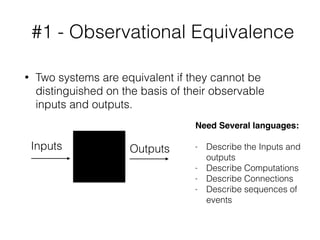
#1 - Observational Equivalence
• Two systems are equivalent if they cannot be
distinguished on the basis of their observable
inputs and outputs.
Inputs Outputs
Need Several languages:
- Describe the Inputs and
outputs
- Describe Computations
- Describe Connections
- Describe sequences of
events
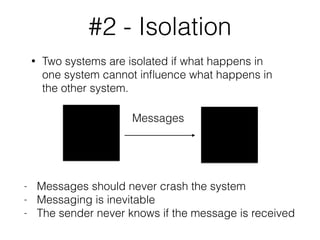
#2 - Isolation
• Two systems are isolated if what happens in
one system cannot influence what happens in
the other system.
Messages
- Messages should never crash the system
- Messaging is inevitable
- The sender never knows if the message is received
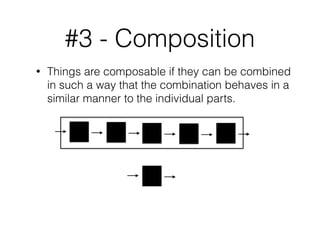
#3 - Composition
• Things are composable if they can be combined
in such a way that the combination behaves in a
similar manner to the individual parts.
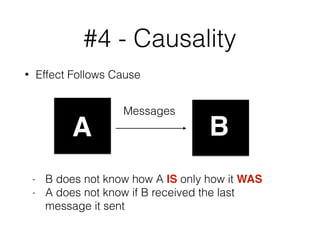
#4 - Causality
• Effect Follows Cause
Messages
A B
- B does not know how A IS only how it WAS
- A does not know if B received the last
message it sent
#5 - Physics
• For a computation to take place
all the data and the program must
be at the same place in space time
So you can move the data or the
program or both.
Tip: get all the data you need and
the program to one place before
doing a computation
Violating any one of these principles
will lead to brittle software that may
appear to work but will one day fail in
ways that are difficult to understand
Following these
principles has many
benefits …
isolation gives
• Fault-tolerance
• Scalability
• Security
For free :-)
What benefits
come from obeying
the other principles?
Part 2
Things to learn
which you might have forgotten
or not known about
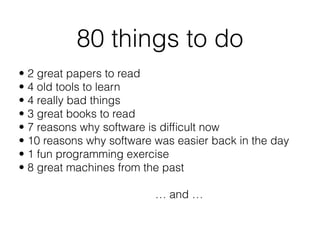
• 2 great papers to read
• 4 old tools to learn
• 4 really bad things
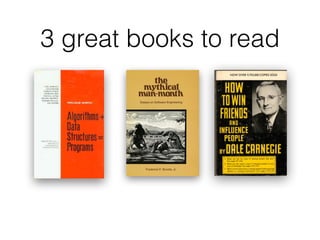
• 3 great books to read
• 7 reasons why software is difficult now
• 10 reasons why software was easier back in the day
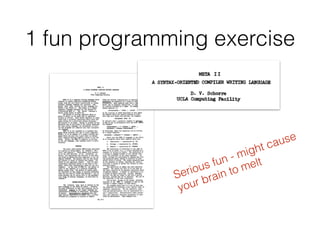
• 1 fun programming exercise
• 8 great machines from the past


… and …
80 things to do
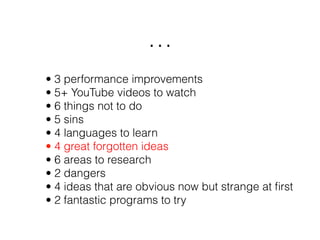
…
• 3 performance improvements
• 5+ YouTube videos to watch
• 6 things not to do
• 5 sins
• 4 languages to learn
• 4 great forgotten ideas
• 6 areas to research
• 2 dangers
• 4 ideas that are obvious now but strange at first
• 2 fantastic programs to try
80
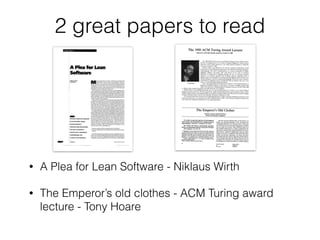
2 great papers to read
• A Plea for Lean Software - Niklaus Wirth
• The Emperor’s old clothes - ACM Turing award
lecture - Tony Hoare
4 old tools to learn
• emacs (vi)
• bash
• make
• shell

3 great books to read
1 fun programming exercise
Serious fun - might cause
your brain to melt
YouTube videos to watch
• The computer revolution has not happened yet

Alan Kay
• Computers for Cynics

Ted Nelson
Part 4
Four great forgotten ideas
Flow Based
Programming
Flow Based Programming
• Invented by John Paul Morrison in the early 1970’s
• Programming by “placing objects next to each
other”
• Binary distribution of components
• Account for all packets
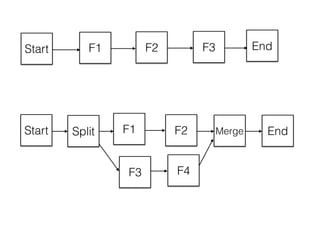
EndStart F1 F2 F3
Start F1
F3 F4
EndSplit F2 Merge
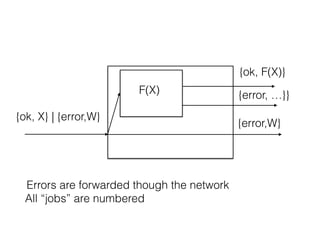
{ok, X} | {error,W}
F(X)
{ok, F(X)}
{error, …}}
{error,W}
Errors are forwarded though the network
All “jobs” are numbered
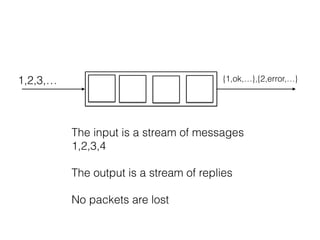
1,2,3,… {1,ok,…},{2,error,…}
The input is a stream of messages
1,2,3,4
The output is a stream of replies
No packets are lost
• We’re building apps and websites
• We should be building components that can be
wired together
Sins
• Programs that cannot be remotely controlled
• Programs that cannot share their data
• Programs that create data in a proprietary format
• Program without a published interface
Pipes
Pipes
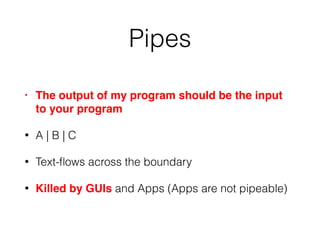
• The output of my program should be the input
to your program
• A | B | C
• Text-flows across the boundary
• Killed by GUIs and Apps (Apps are not pipeable)
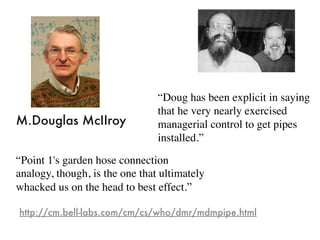
“Doug has been explicit in saying
that he very nearly exercised
managerial control to get pipes
installed.”
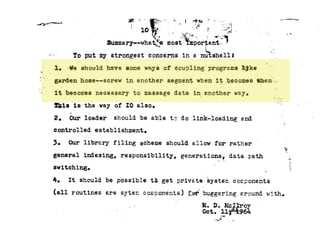
“Point 1's garden hose connection
analogy, though, is the one that ultimately
whacked us on the head to best effect.”
http://cm.bell-labs.com/cm/cs/who/dmr/mdmpipe.html
M.Douglas McIIroy
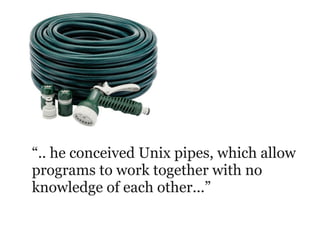
“.. he conceived Unix pipes, which allow
programs to work together with no
knowledge of each other...”
Pipes
• Are formed by composing items
• Items are black box equivalent
• Items obey causality
• Individual Items are isolated
Apps
• Pads - Tablets - Phones
• Human can interact with Apps
• Apps can’t interact with each other
• You are locked inside your Apps. They all do
different things with a varying degree of success.
Linda Tuple
Spaces
Linda Tuple Spaces
• Shared Whiteboard
• Gelernter and Carriero 1986
• More declarative than message passing
• We just create jobs and don’t know who will do
them
Tuple Space Operations
• out (adds a tuple to the store)
• in (reads a tuple and removes it from the store)
• rd (reads a tuple)
• eval (create a new parallel process)
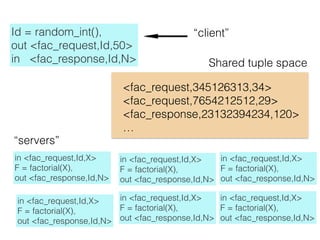
Id = random_int(),
out <fac_request,Id,50>
in <fac_response,Id,N>
in <fac_request,Id,X>
F = factorial(X),
out <fac_response,Id,N>
<fac_request,345126313,34>
<fac_request,7654212512,29>
<fac_response,23132394234,120>
…
in <fac_request,Id,X>
F = factorial(X),
out <fac_response,Id,N>
in <fac_request,Id,X>
F = factorial(X),
out <fac_response,Id,N>
in <fac_request,Id,X>
F = factorial(X),
out <fac_response,Id,N>
in <fac_request,Id,X>
F = factorial(X),
out <fac_response,Id,N>
in <fac_request,Id,X>
F = factorial(X),
out <fac_response,Id,N>
“client”
“servers”
Shared tuple space
Hypertext
Hypertext
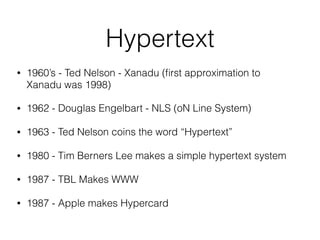
• 1960’s - Ted Nelson - Xanadu (first approximation to
Xanadu was 1998)
• 1962 - Douglas Engelbart - NLS (oN Line System)
• 1963 - Ted Nelson coins the word “Hypertext”
• 1980 - Tim Berners Lee makes a simple hypertext system
• 1987 - TBL Makes WWW
• 1987 - Apple makes Hypercard
• WWW is not hypertext
• HTML is not hypertext
• HTML links are not hypertext links
Page not found
404
All web pages are
not writable
How to correct a typo
on a web page
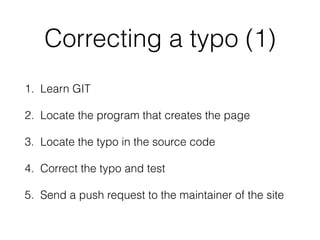
Correcting a typo (1)
1. Learn GIT
2. Locate the program that creates the page
3. Locate the typo in the source code
4. Correct the typo and test
5. Send a push request to the maintainer of the site
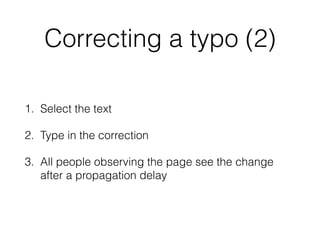
Correcting a typo (2)
1. Select the text
2. Type in the correction
3. All people observing the page see the change
after a propagation delay
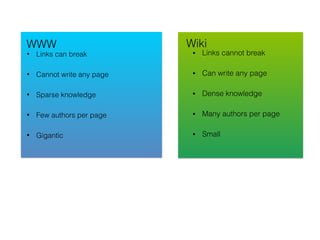
• Links can break
• Cannot write any page
• Sparse knowledge
• Few authors per page
• Gigantic
WWW Wiki
• Links cannot break
• Can write any page
• Dense knowledge
• Many authors per page
• Small
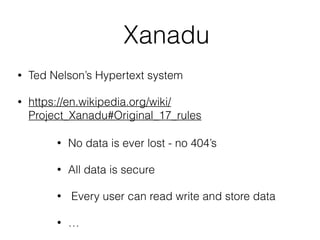
Xanadu
• Ted Nelson’s Hypertext system
• https://en.wikipedia.org/wiki/
Project_Xanadu#Original_17_rules
• No data is ever lost - no 404’s
• All data is secure
• Every user can read write and store data
• …
It’s your turn nextt
Programs that are not secure and cannot be
remotely controlled should not be written
All Apps should be scriptable
All Apps should be composable
Finally

Good ideas that we forgot

  • 1.
  • 2.
  • 3.
    • To remindyou of the important things worth knowing • Identify the stuff worth learning • Identify some problems worth solving
 
 [note: this is a very biased view]
  • 4.
    What ideas haswe forgotten?
  • 6.
    I made somelists • Collect lots of items easy • Assign to lists difficult • Shorten the lists to N items (N is small) very difficult
 Throwing things away is much more difficult than collecting things - but what’s left is better.
  • 7.
    But before weget to the lists we need some principles to evaluate the results
  • 8.
  • 9.
    #1 - ObservationalEquivalence • Two systems are equivalent if they cannot be distinguished on the basis of their observable inputs and outputs. Inputs Outputs Need Several languages: - Describe the Inputs and outputs - Describe Computations - Describe Connections - Describe sequences of events
  • 10.
    #2 - Isolation •Two systems are isolated if what happens in one system cannot influence what happens in the other system. Messages - Messages should never crash the system - Messaging is inevitable - The sender never knows if the message is received
  • 11.
    #3 - Composition •Things are composable if they can be combined in such a way that the combination behaves in a similar manner to the individual parts.
  • 12.
    #4 - Causality •Effect Follows Cause Messages A B - B does not know how A IS only how it WAS - A does not know if B received the last message it sent
  • 13.
    #5 - Physics •For a computation to take place all the data and the program must be at the same place in space time So you can move the data or the program or both. Tip: get all the data you need and the program to one place before doing a computation
  • 14.
    Violating any oneof these principles will lead to brittle software that may appear to work but will one day fail in ways that are difficult to understand
  • 15.
  • 16.
    isolation gives • Fault-tolerance •Scalability • Security For free :-) What benefits come from obeying the other principles?
  • 17.
    Part 2 Things tolearn which you might have forgotten or not known about
  • 18.
    • 2 greatpapers to read • 4 old tools to learn • 4 really bad things • 3 great books to read • 7 reasons why software is difficult now • 10 reasons why software was easier back in the day • 1 fun programming exercise • 8 great machines from the past 
 … and … 80 things to do
  • 19.
    … • 3 performanceimprovements • 5+ YouTube videos to watch • 6 things not to do • 5 sins • 4 languages to learn • 4 great forgotten ideas • 6 areas to research • 2 dangers • 4 ideas that are obvious now but strange at first • 2 fantastic programs to try
  • 20.
  • 21.
    2 great papersto read • A Plea for Lean Software - Niklaus Wirth • The Emperor’s old clothes - ACM Turing award lecture - Tony Hoare
  • 22.
    4 old toolsto learn • emacs (vi) • bash • make • shell

  • 23.
  • 24.
    1 fun programmingexercise Serious fun - might cause your brain to melt
  • 25.
    YouTube videos towatch • The computer revolution has not happened yet
 Alan Kay • Computers for Cynics
 Ted Nelson
  • 26.
    Part 4 Four greatforgotten ideas
  • 27.
  • 28.
    Flow Based Programming •Invented by John Paul Morrison in the early 1970’s • Programming by “placing objects next to each other” • Binary distribution of components • Account for all packets
  • 30.
    EndStart F1 F2F3 Start F1 F3 F4 EndSplit F2 Merge
  • 31.
    {ok, X} |{error,W} F(X) {ok, F(X)} {error, …}} {error,W} Errors are forwarded though the network All “jobs” are numbered
  • 32.
    1,2,3,… {1,ok,…},{2,error,…} The inputis a stream of messages 1,2,3,4 The output is a stream of replies No packets are lost
  • 33.
    • We’re buildingapps and websites • We should be building components that can be wired together
  • 34.
    Sins • Programs thatcannot be remotely controlled • Programs that cannot share their data • Programs that create data in a proprietary format • Program without a published interface
  • 35.
  • 36.
    Pipes • The outputof my program should be the input to your program • A | B | C • Text-flows across the boundary • Killed by GUIs and Apps (Apps are not pipeable)
  • 38.
    “Doug has beenexplicit in saying that he very nearly exercised managerial control to get pipes installed.” “Point 1's garden hose connection analogy, though, is the one that ultimately whacked us on the head to best effect.” http://cm.bell-labs.com/cm/cs/who/dmr/mdmpipe.html M.Douglas McIIroy
  • 39.
    “.. he conceivedUnix pipes, which allow programs to work together with no knowledge of each other...”
  • 40.
    Pipes • Are formedby composing items • Items are black box equivalent • Items obey causality • Individual Items are isolated
  • 41.
    Apps • Pads -Tablets - Phones • Human can interact with Apps • Apps can’t interact with each other • You are locked inside your Apps. They all do different things with a varying degree of success.
  • 42.
  • 43.
    Linda Tuple Spaces •Shared Whiteboard • Gelernter and Carriero 1986 • More declarative than message passing • We just create jobs and don’t know who will do them
  • 44.
    Tuple Space Operations •out (adds a tuple to the store) • in (reads a tuple and removes it from the store) • rd (reads a tuple) • eval (create a new parallel process)
  • 45.
    Id = random_int(), out<fac_request,Id,50> in <fac_response,Id,N> in <fac_request,Id,X> F = factorial(X), out <fac_response,Id,N> <fac_request,345126313,34> <fac_request,7654212512,29> <fac_response,23132394234,120> … in <fac_request,Id,X> F = factorial(X), out <fac_response,Id,N> in <fac_request,Id,X> F = factorial(X), out <fac_response,Id,N> in <fac_request,Id,X> F = factorial(X), out <fac_response,Id,N> in <fac_request,Id,X> F = factorial(X), out <fac_response,Id,N> in <fac_request,Id,X> F = factorial(X), out <fac_response,Id,N> “client” “servers” Shared tuple space
  • 46.
  • 47.
    Hypertext • 1960’s -Ted Nelson - Xanadu (first approximation to Xanadu was 1998) • 1962 - Douglas Engelbart - NLS (oN Line System) • 1963 - Ted Nelson coins the word “Hypertext” • 1980 - Tim Berners Lee makes a simple hypertext system • 1987 - TBL Makes WWW • 1987 - Apple makes Hypercard
  • 48.
    • WWW isnot hypertext • HTML is not hypertext • HTML links are not hypertext links
  • 49.
  • 50.
    All web pagesare not writable
  • 51.
    How to correcta typo on a web page
  • 52.
    Correcting a typo(1) 1. Learn GIT 2. Locate the program that creates the page 3. Locate the typo in the source code 4. Correct the typo and test 5. Send a push request to the maintainer of the site
  • 53.
    Correcting a typo(2) 1. Select the text 2. Type in the correction 3. All people observing the page see the change after a propagation delay
  • 54.
    • Links canbreak • Cannot write any page • Sparse knowledge • Few authors per page • Gigantic WWW Wiki • Links cannot break • Can write any page • Dense knowledge • Many authors per page • Small
  • 55.
    Xanadu • Ted Nelson’sHypertext system • https://en.wikipedia.org/wiki/ Project_Xanadu#Original_17_rules • No data is ever lost - no 404’s • All data is secure • Every user can read write and store data • …
  • 56.
  • 57.
    Programs that arenot secure and cannot be remotely controlled should not be written All Apps should be scriptable All Apps should be composable Finally