More Related Content

PPTX
English_Grammar_C1_Past_Tense_Presentation.pptx 
PPTX
all tenses simple perfect and future.pptx 
PPTX
Formula_Grammar_ppt_B2_U2 (1).pptx 
PPTX
Present and Past tenses for C1 learners of English 
PPTX
Gold experience B2 - Grammar_Presentation_B2_Unit_1.pptx 
PPTX
Formula_Grammar Level Advanced C1 Present tenses 
PPTX

PPT
Simple Past and Past Continuous Tense Similar to Gold_Exp_Grammar_ppt_B1P_U2_presentation.pptx

PPTX
Presentation Grammar A2_5 past continuous.pptx 
PPTX

PPTX

PPT

PPT

PPT

PPT

PDF
2nd study of english - 6th grade - october 
PDF

PDF

PPTX
PAST SIMPLE VS PAST CONTINUOUS presntation 
PPTX
NewHeadway4th_PreIntermediate_Grammar.pptx 
PPT
Past vs present for english teaching.ppt 
PDF
Present perfect handout enblog 
PPTX
TENSES Practica 2 chacon guzman grupo 1 
PPTX
WiderWorld2e_4_GrammarPresentation_1.4.pptx 
ODP

PDF
Resumen de-gramatica-inglesa 
PPTX
PPT Micro Teaching Ms. Putri-Present Perfect Tense vs Simple Past Tense.pptx 
PDF
Past simple past continuous used to Recently uploaded

DOCX
Mobile applications Devlopment ReTest year 2025-2026 
DOCX
TOXICITY AND ITS MANAGEMENT 6th sem unit 5, PHARMACOLOGY-III B. PHARMACY 
PDF
Orchard Floor Managment.pdf Orchard Floor Management 
PPTX
Rectal Surgery in Senior Citiizens .pptx 
PPTX
How to Automate Quality Checks in Odoo 18 Quality App 
PDF
Unit-III pdf (Basic listening Skill, Effective Writing Communication & Writin... 
PDF
Basics of Systematic Literature Search - Nasra Gathoni 
PDF
Principles and Practices of GST 2.0 Study material 
PDF
Chaplin's Visual Critique of Modernism: Modern Times and The Great Dictator 
PDF
The Tale of Melon City poem ppt by Sahasra 
PPTX
SOCIAL SYSTEM.......................pptx 
PDF
Models of Teaching - TNTEU - B.Ed I Semester - Teaching and Learning - BD1TL ... 
PPTX
Pain. definition, causes, factor influencing pain & pain assessment.pptx 
PDF
Blue / Green: Troop Leading Procedure (TLP) Overview.pdf 
PDF
Nutrients & Role in Horticulture.pdf, Dr. Sharad Bisen Horticulture 
PDF
All Students Workshop 25 Yoga Wellness by LDMMIA 
PPTX
MACSYMA introduction,working,application 
PDF
Projecte de la porta de la classe de primer A: Mar i cel. 
PPTX
ELEMENTS OF COMMUNICATION (UNIT 2) .pptx 
PPTX
What is the Post load hook in Odoo 18 Gold_Exp_Grammar_ppt_B1P_U2_presentation.pptx
- 1.
- 2.
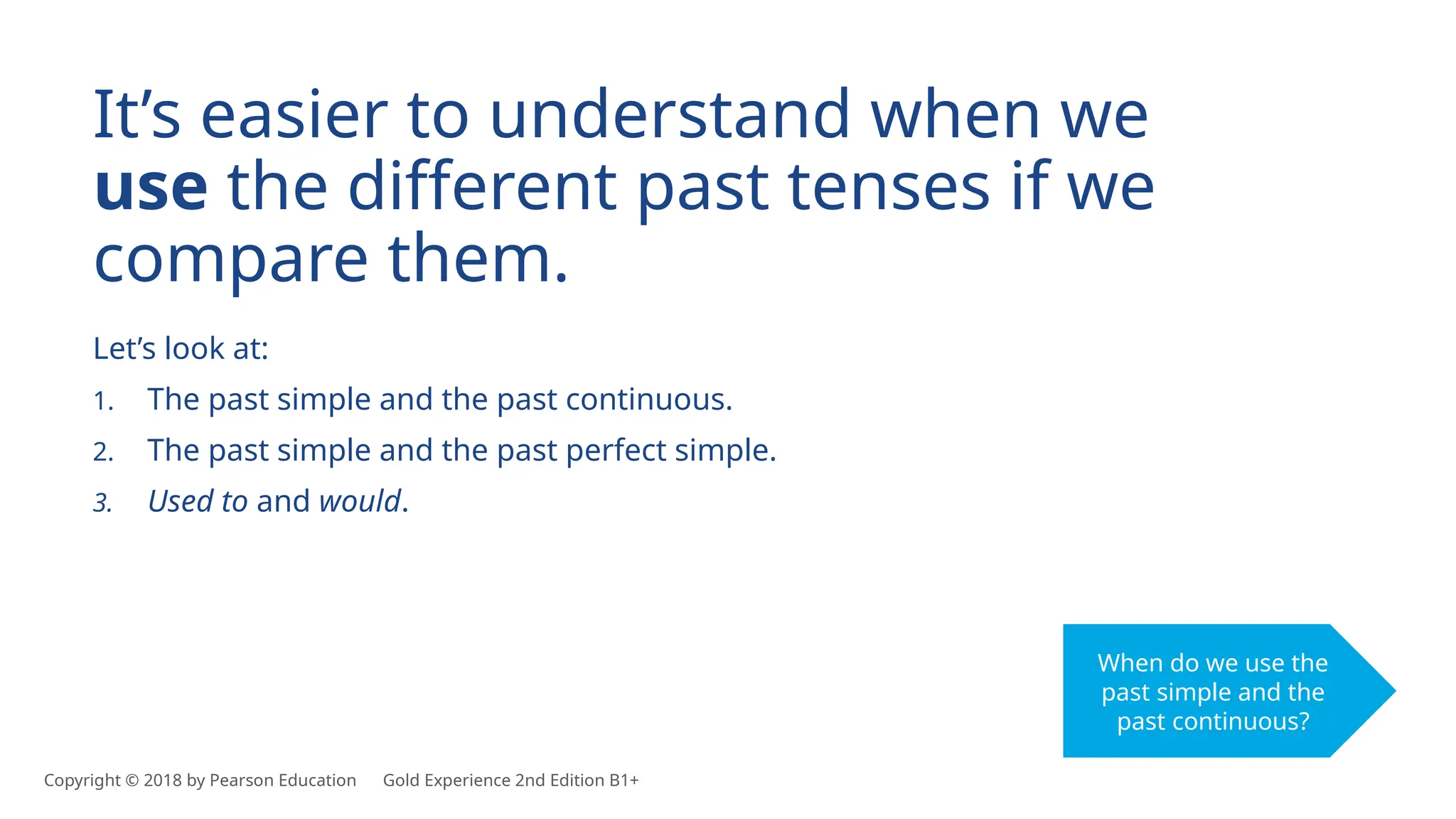
It’s easier tounderstand when we
use the different past tenses if we
compare them.
Let’s look at:
1. The past simple and the past continuous.
2. The past simple and the past perfect simple.
3. Used to and would.
When do we use the
past simple and the
past continuous?
Copyright © 2018 by Pearson Education Gold Experience 2nd Edition B1+
- 3.
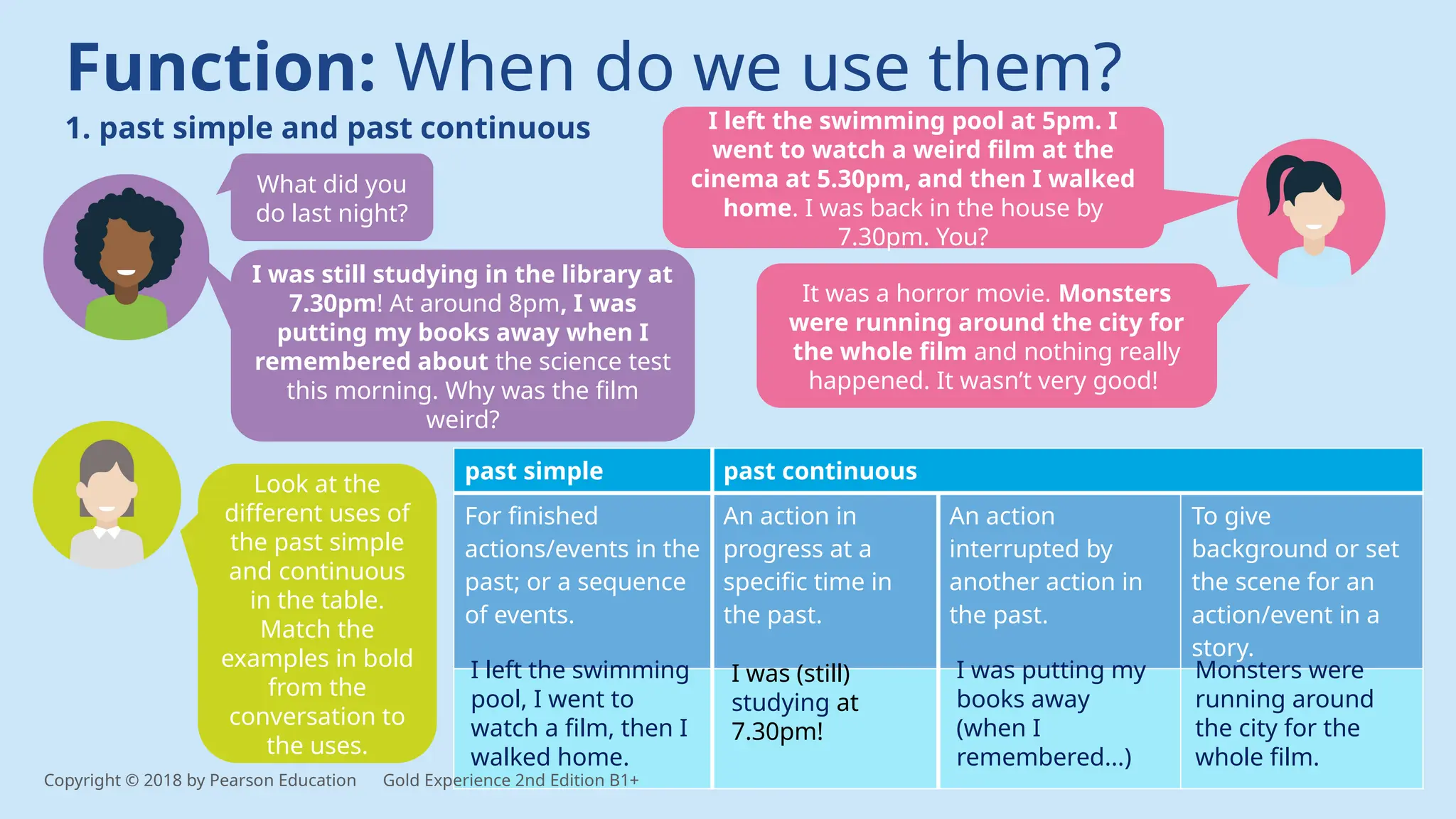
Function: When dowe use them?
1. past simple and past continuous
What did you
do last night?
I left the swimming pool at 5pm. I
went to watch a weird film at the
cinema at 5.30pm, and then I walked
home. I was back in the house by
7.30pm. You?
I was still studying in the library at
7.30pm! At around 8pm, I was
putting my books away when I
remembered about the science test
this morning. Why was the film
weird?
It was a horror movie. Monsters
were running around the city for
the whole film and nothing really
happened. It wasn’t very good!
Look at the
different uses of
the past simple
and continuous
in the table.
Match the
examples in bold
from the
conversation to
the uses.
past simple past continuous
For finished
actions/events in the
past; or a sequence
of events.
An action in
progress at a
specific time in
the past.
An action
interrupted by
another action in
the past.
To give
background or set
the scene for an
action/event in a
story.
I left the swimming
pool, I went to
watch a film, then I
walked home.
I was (still)
studying at
7.30pm!
I was putting my
books away
(when I
remembered...)
Monsters were
running around
the city for the
whole film.
Copyright © 2018 by Pearson Education Gold Experience 2nd Edition B1+
- 4.
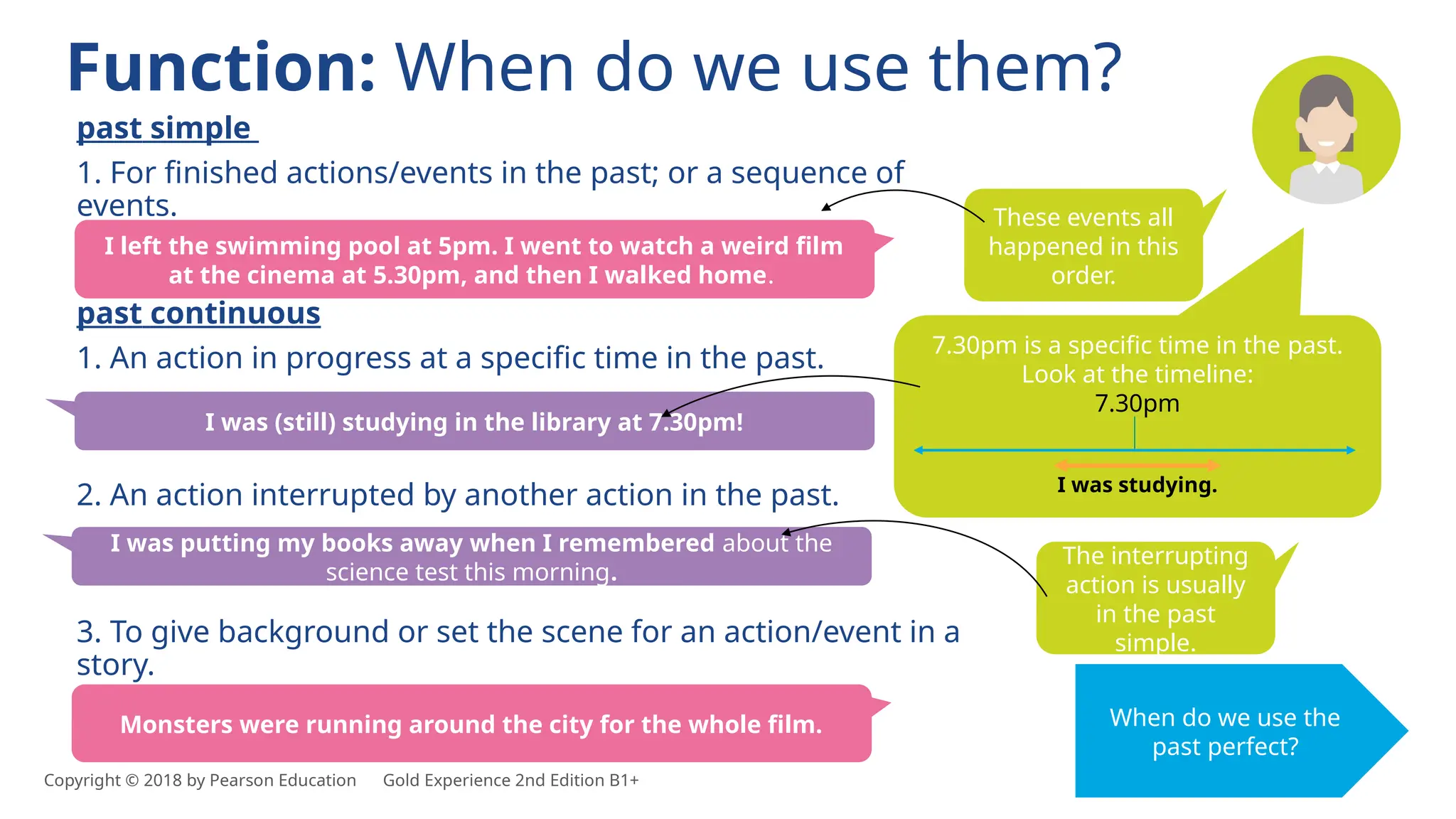
Function: When dowe use them?
past simple
These events all
happened in this
order.
1. For finished actions/events in the past; or a sequence of
events.
I left the swimming pool at 5pm. I went to watch a weird film
at the cinema at 5.30pm, and then I walked home.
past continuous
1. An action in progress at a specific time in the past.
I was (still) studying in the library at 7.30pm!
2. An action interrupted by another action in the past.
I was putting my books away when I remembered about the
science test this morning.
3. To give background or set the scene for an action/event in a
story.
Monsters were running around the city for the whole film.
7.30pm is a specific time in the past.
Look at the timeline:
7.30pm
I was studying.
The interrupting
action is usually
in the past
simple.
When do we use the
past perfect?
Copyright © 2018 by Pearson Education Gold Experience 2nd Edition B1+
- 5.
Function: When dowe use them?
2. past simple and past perfect simple
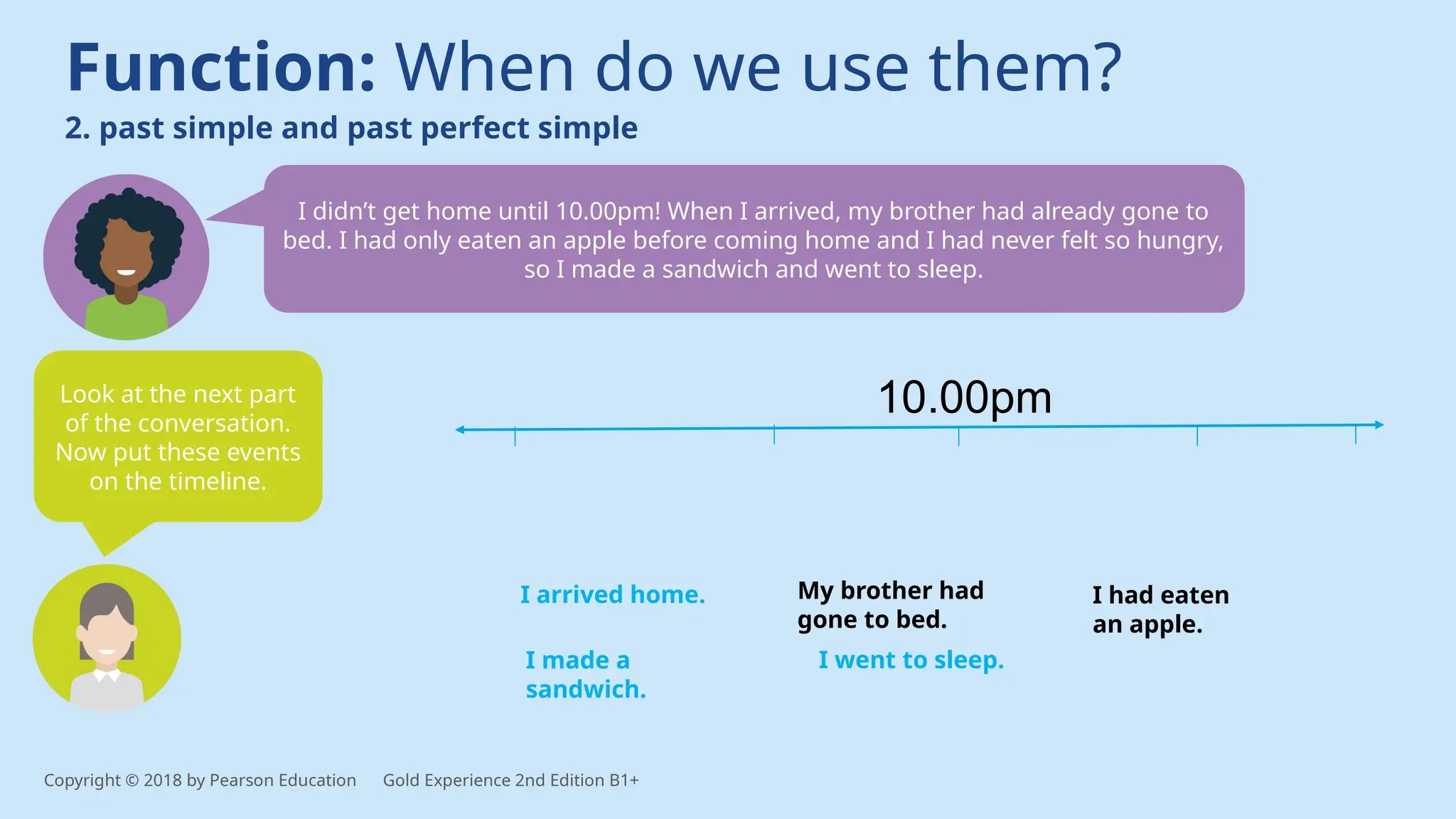
Look at the next part
of the conversation.
Now put these events
on the timeline.
I didn’t get home until 10.00pm! When I arrived, my brother had already gone to
bed. I had only eaten an apple before coming home and I had never felt so hungry,
so I made a sandwich and went to sleep.
I arrived home. My brother had
gone to bed.
I had eaten
an apple.
I made a
sandwich.
I went to sleep.
10.00pm
Copyright © 2018 by Pearson Education Gold Experience 2nd Edition B1+
- 6.
Function: When dowe use them?
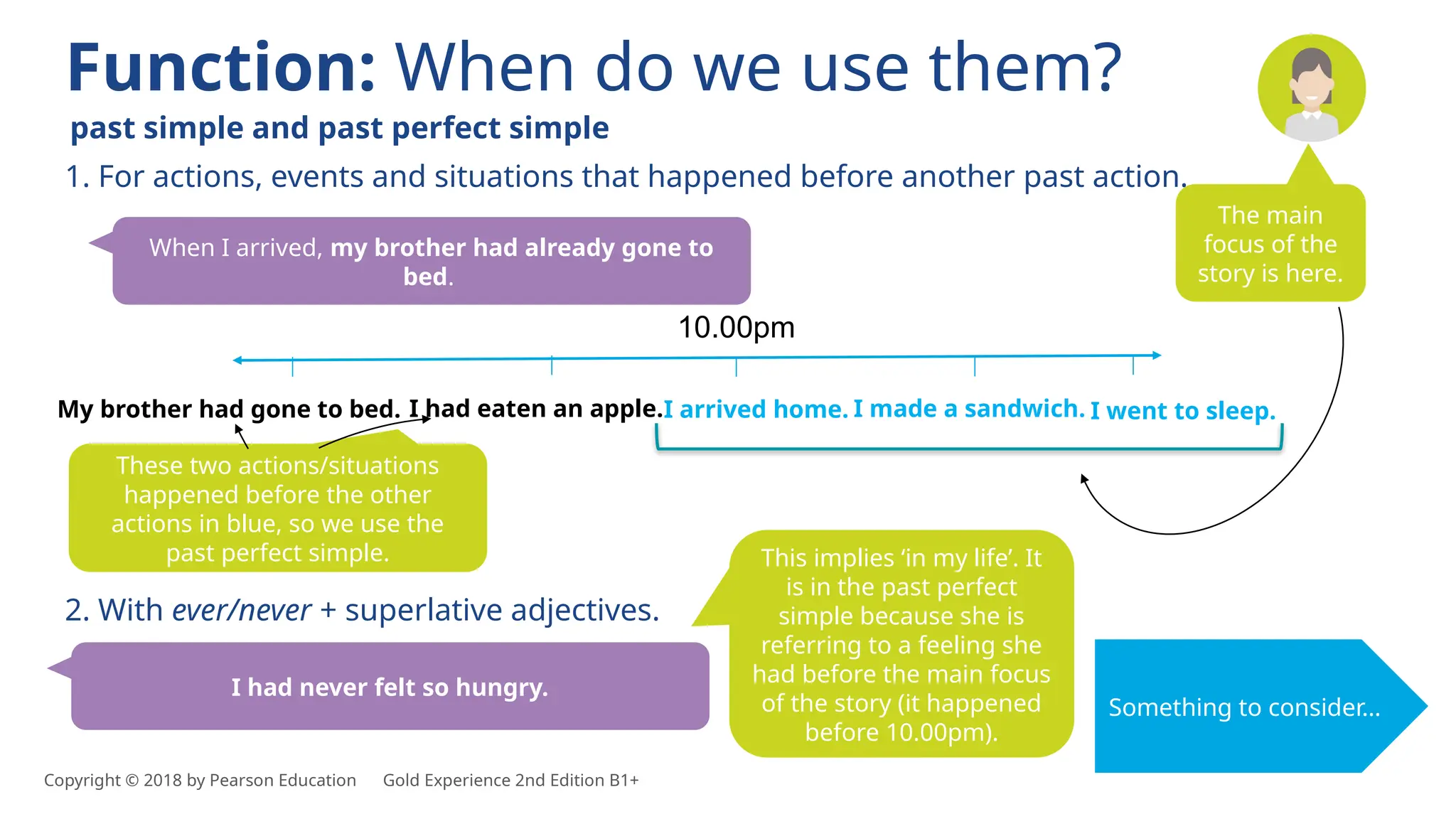
past simple and past perfect simple
The main
focus of the
story is here.
When I arrived, my brother had already gone to
bed.
I arrived home.
My brother had gone to bed. I had eaten an apple. I made a sandwich. I went to sleep.
10.00pm
1. For actions, events and situations that happened before another past action.
These two actions/situations
happened before the other
actions in blue, so we use the
past perfect simple.
2. With ever/never + superlative adjectives.
I had never felt so hungry.
This implies ‘in my life’. It
is in the past perfect
simple because she is
referring to a feeling she
had before the main focus
of the story (it happened
before 10.00pm).
Something to consider…
Copyright © 2018 by Pearson Education Gold Experience 2nd Edition B1+
- 7.
Something to consider…Look at the next part of
the conversation.
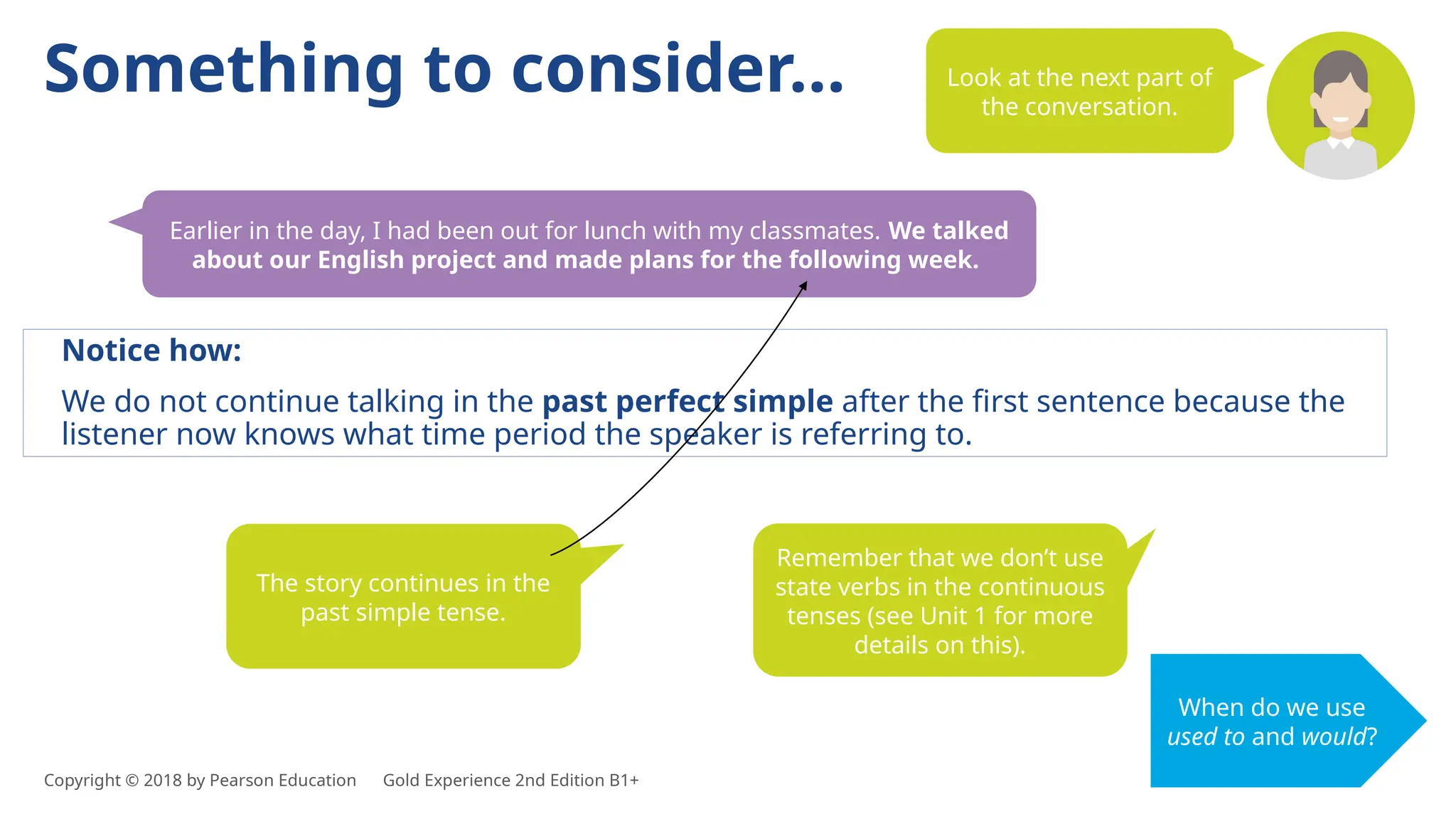
Notice how:
We do not continue talking in the past perfect simple after the first sentence because the
listener now knows what time period the speaker is referring to.
The story continues in the
past simple tense.
Remember that we don’t use
state verbs in the continuous
tenses (see Unit 1 for more
details on this).
When do we use
used to and would?
Copyright © 2018 by Pearson Education Gold Experience 2nd Edition B1+
Earlier in the day, I had been out for lunch with my classmates. We talked
about our English project and made plans for the following week.
- 8.
Function: When dowe use them?
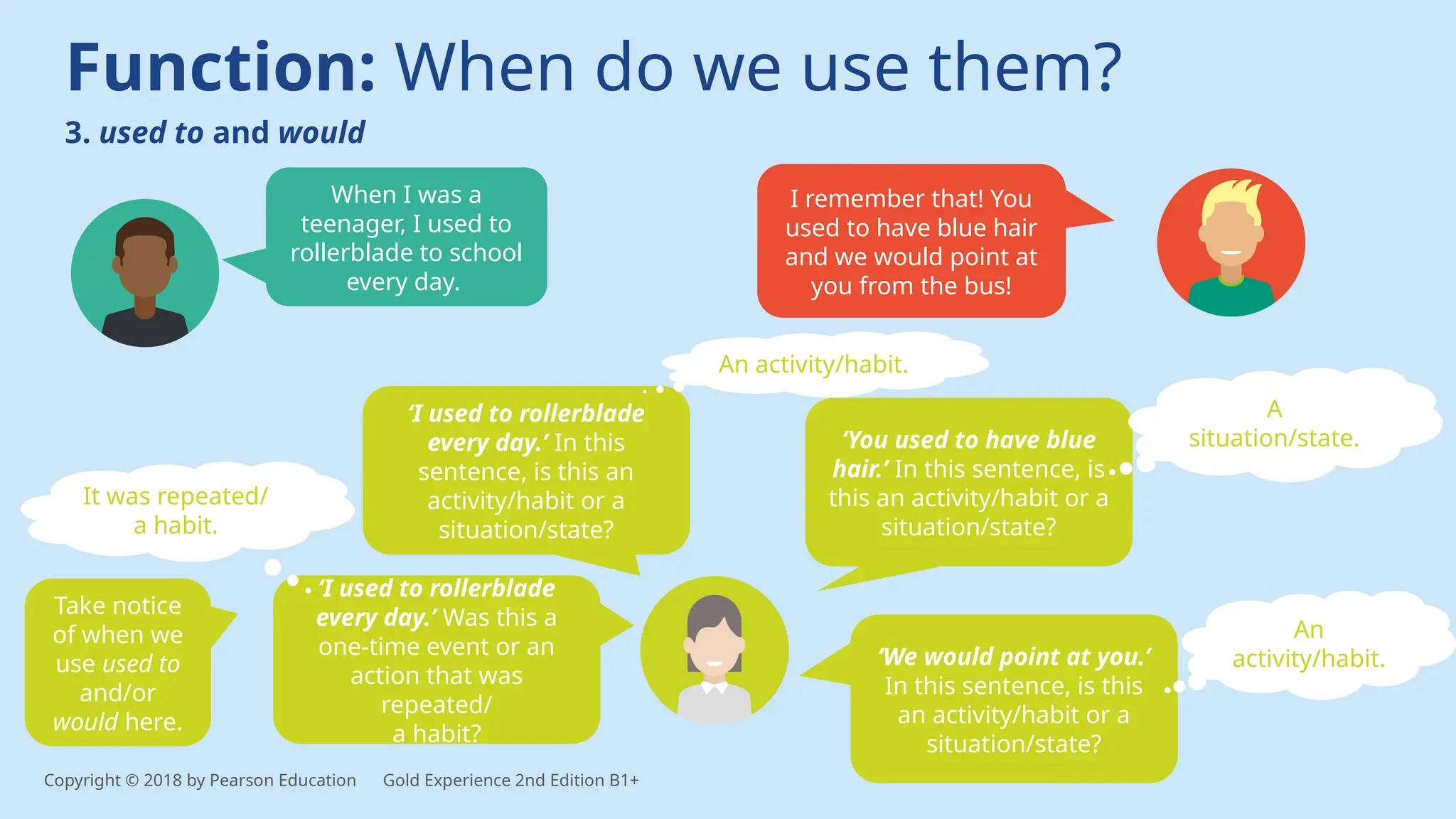
3. used to and would
When I was a
teenager, I used to
rollerblade to school
every day.
I remember that! You
used to have blue hair
and we would point at
you from the bus!
‘I used to rollerblade
every day.’ Was this a
one-time event or an
action that was
repeated/
a habit?
It was repeated/
a habit.
‘You used to have blue
hair.’ In this sentence, is
this an activity/habit or a
situation/state?
A
situation/state.
‘We would point at you.’
In this sentence, is this
an activity/habit or a
situation/state?
An
activity/habit.
‘I used to rollerblade
every day.’ In this
sentence, is this an
activity/habit or a
situation/state?
An activity/habit.
Take notice
of when we
use used to
and/or
would here.
Copyright © 2018 by Pearson Education Gold Experience 2nd Edition B1+
- 9.
Function: When dowe use them?
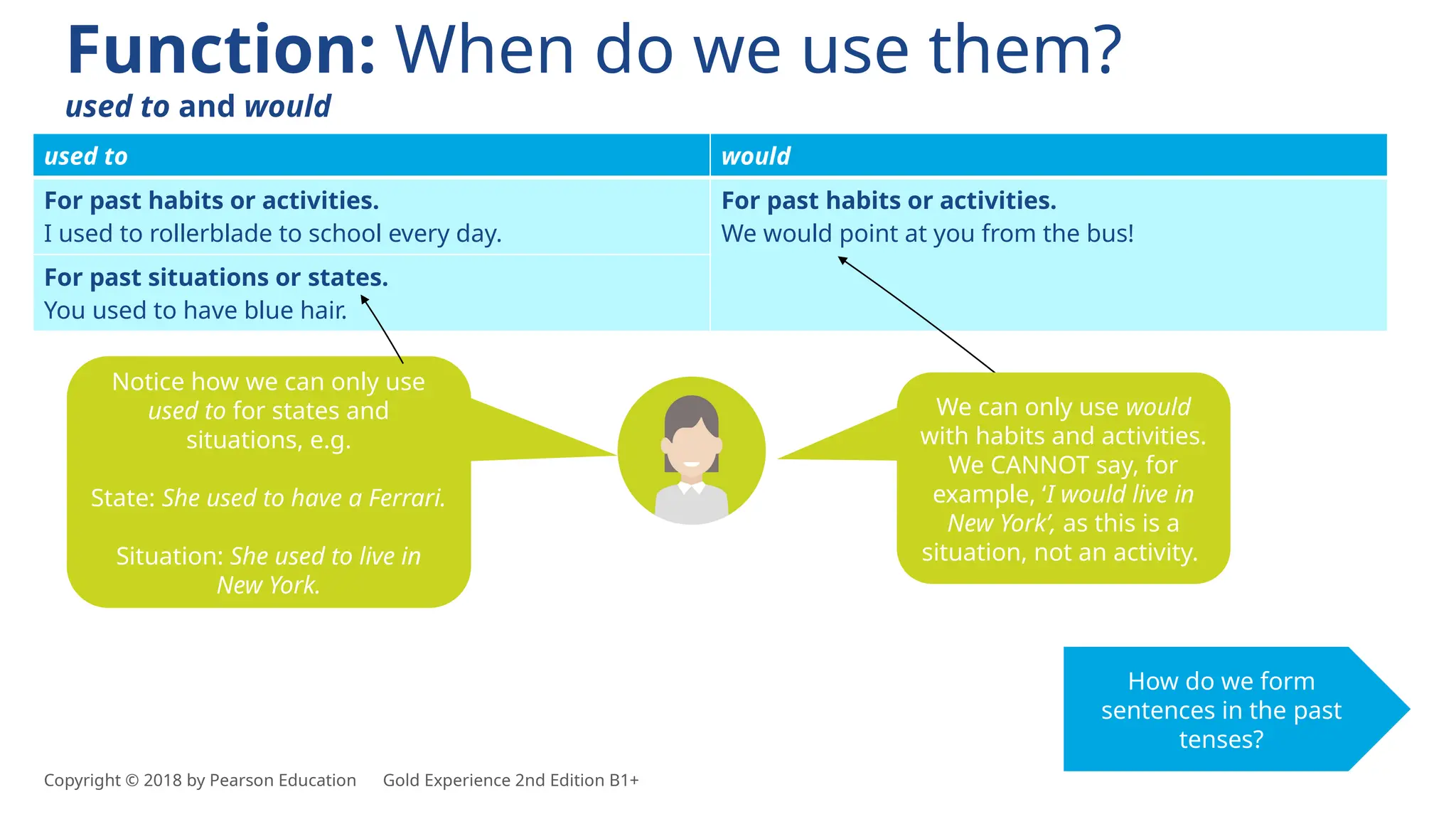
used to and would
used to would
For past habits or activities.
I used to rollerblade to school every day.
For past habits or activities.
We would point at you from the bus!
For past situations or states.
You used to have blue hair.
How do we form
sentences in the past
tenses?
Notice how we can only use
used to for states and
situations, e.g.
State: She used to have a Ferrari.
Situation: She used to live in
New York.
We can only use would
with habits and activities.
We CANNOT say, for
example, ‘I would live in
New York’, as this is a
situation, not an activity.
Copyright © 2018 by Pearson Education Gold Experience 2nd Edition B1+
- 10.
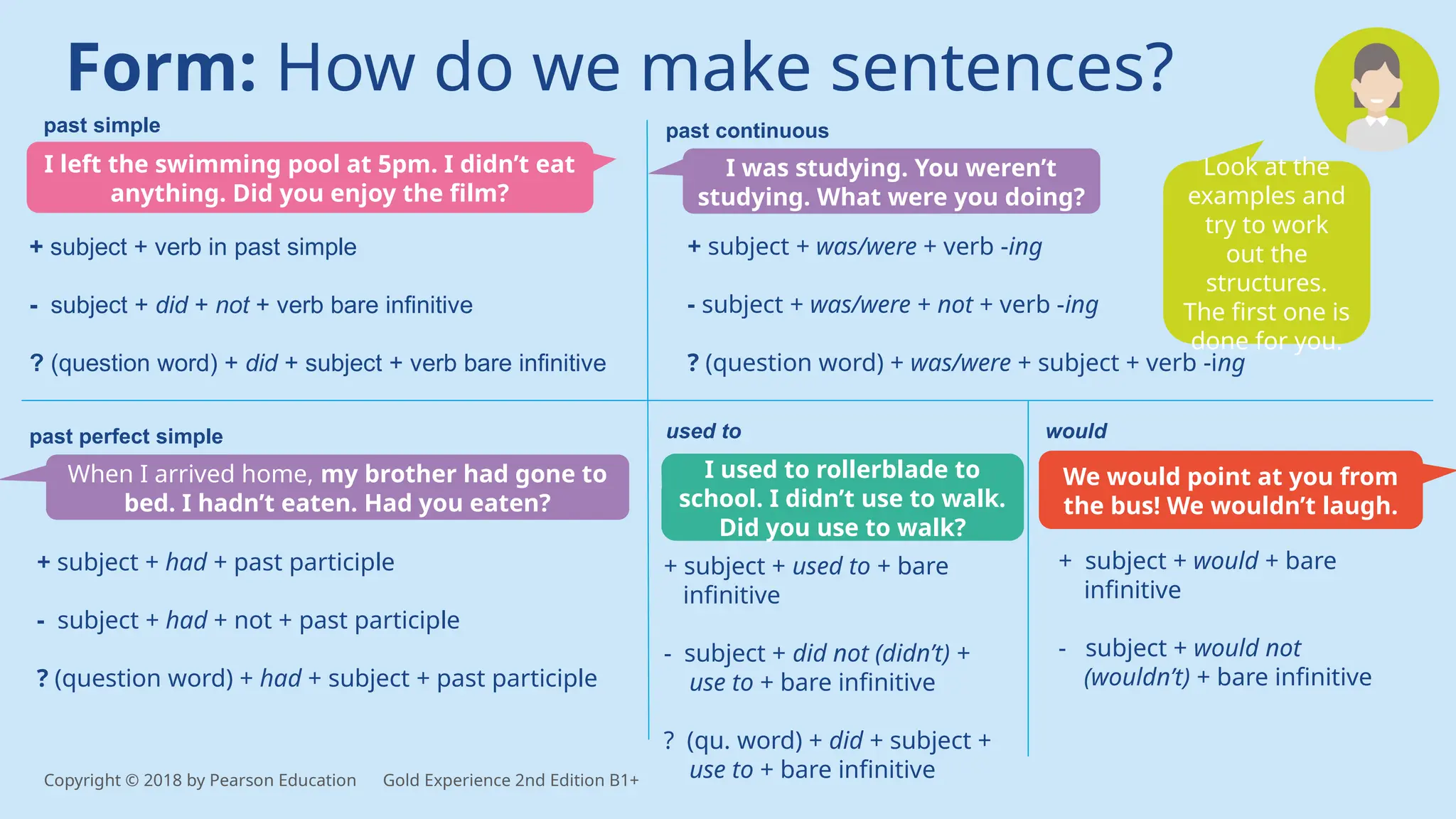
Form: How dowe make sentences?
Look at the
examples and
try to work
out the
structures.
The first one is
done for you.
I was studying. You weren’t
studying. What were you doing?
I left the swimming pool at 5pm. I didn’t eat
anything. Did you enjoy the film?
past continuous
past perfect simple
past simple
used to would
When I arrived home, my brother had gone to
bed. I hadn’t eaten. Had you eaten?
I used to rollerblade to
school. I didn’t use to walk.
Did you use to walk?
We would point at you from
the bus! We wouldn’t laugh.
+ subject + verb in past simple
- subject + did + not + verb bare infinitive
? (question word) + did + subject + verb bare infinitive
+ subject + was/were + verb -ing
- subject + was/were + not + verb -ing
? (question word) + was/were + subject + verb -ing
+ subject + had + past participle
- subject + had + not + past participle
? (question word) + had + subject + past participle
+ subject + used to + bare
infinitive
- subject + did not (didn’t) +
use to + bare infinitive
? (qu. word) + did + subject +
use to + bare infinitive
+ subject + would + bare
infinitive
- subject + would not
(wouldn’t) + bare infinitive
Copyright © 2018 by Pearson Education Gold Experience 2nd Edition B1+
- 11.
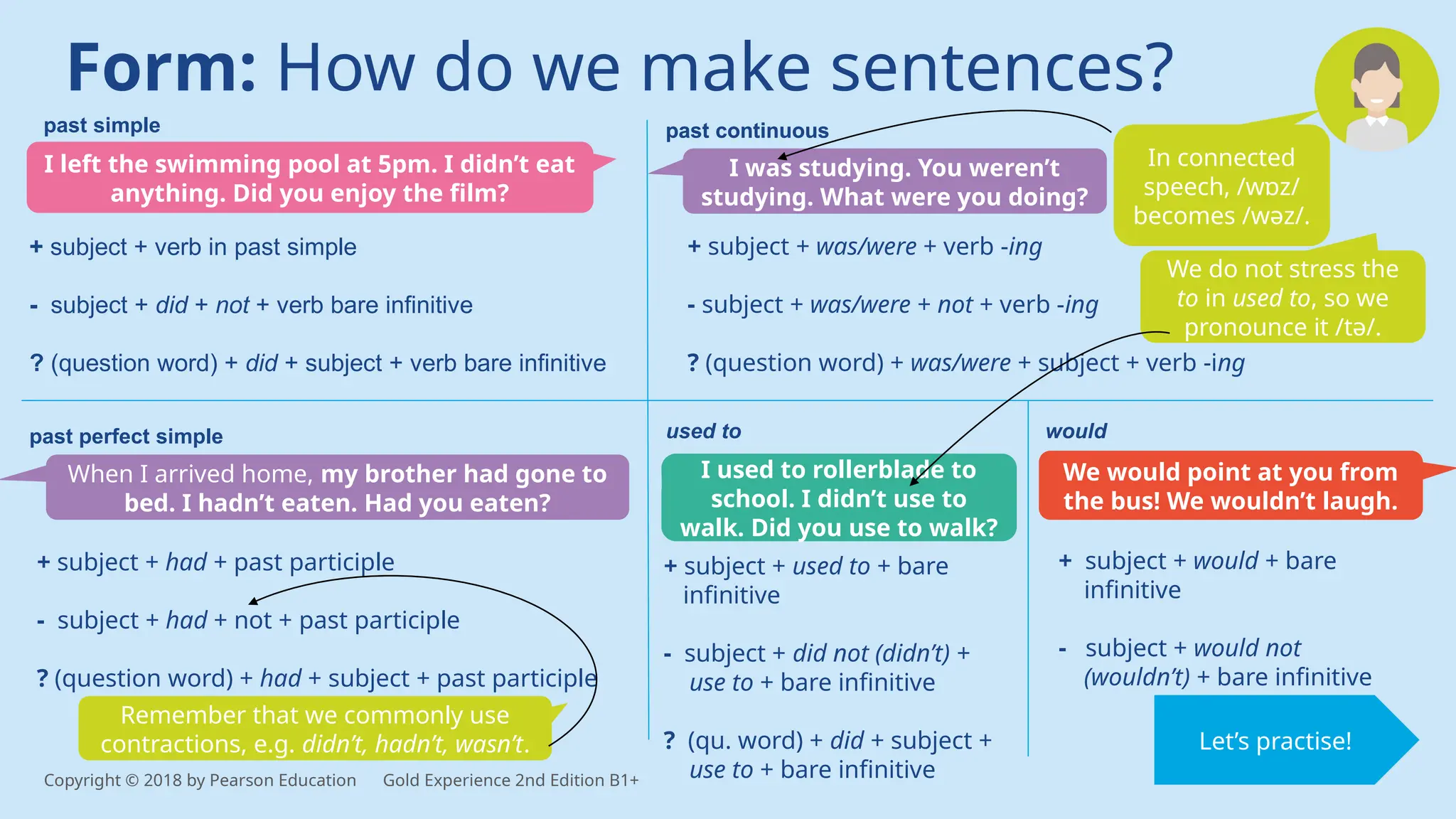
Form: How dowe make sentences?
I was studying. You weren’t
studying. What were you doing?
I left the swimming pool at 5pm. I didn’t eat
anything. Did you enjoy the film?
past continuous
past perfect simple
past simple
used to would
When I arrived home, my brother had gone to
bed. I hadn’t eaten. Had you eaten?
I used to rollerblade to
school. I didn’t use to
walk. Did you use to walk?
We would point at you from
the bus! We wouldn’t laugh.
+ subject + verb in past simple
- subject + did + not + verb bare infinitive
? (question word) + did + subject + verb bare infinitive
+ subject + was/were + verb -ing
- subject + was/were + not + verb -ing
? (question word) + was/were + subject + verb -ing
+ subject + had + past participle
- subject + had + not + past participle
? (question word) + had + subject + past participle
+ subject + used to + bare
infinitive
- subject + did not (didn’t) +
use to + bare infinitive
? (qu. word) + did + subject +
use to + bare infinitive
+ subject + would + bare
infinitive
- subject + would not
(wouldn’t) + bare infinitive
Copyright © 2018 by Pearson Education Gold Experience 2nd Edition B1+
past continuous
In connected
speech, /wɒz/
becomes /wəz/.
Remember that we commonly use
contractions, e.g. didn’t, hadn’t, wasn’t.
We do not stress the
to in used to, so we
pronounce it /tə/.
Let’s practise!
- 12.
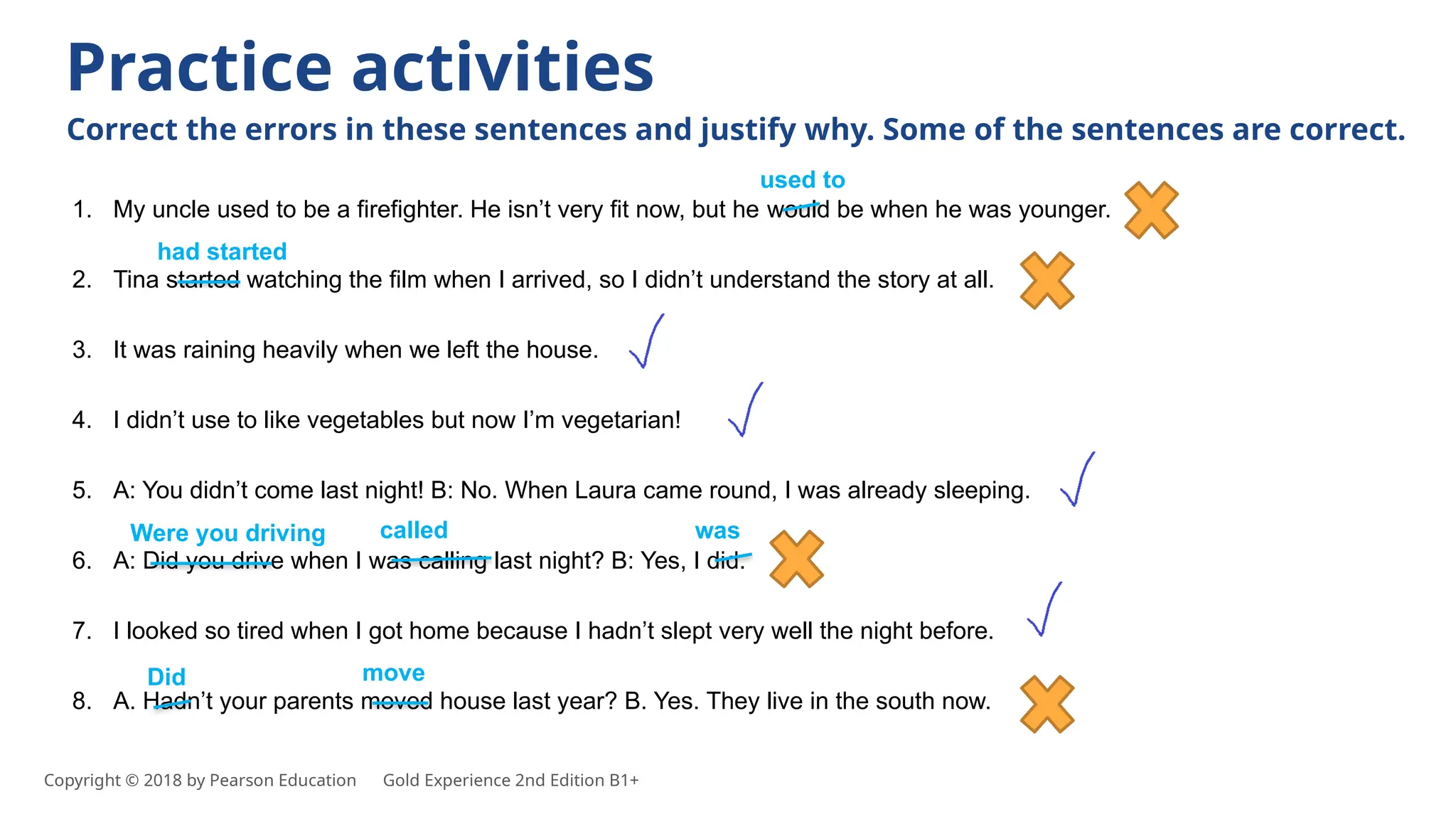
1. My uncleused to be a firefighter. He isn’t very fit now, but he would be when he was younger.
2. Tina started watching the film when I arrived, so I didn’t understand the story at all.
3. It was raining heavily when we left the house.
4. I didn’t use to like vegetables but now I’m vegetarian!
5. A: You didn’t come last night! B: No. When Laura came round, I was already sleeping.
6. A: Did you drive when I was calling last night? B: Yes, I did.
7. I looked so tired when I got home because I hadn’t slept very well the night before.
8. A. Hadn’t your parents moved house last year? B. Yes. They live in the south now.
Practice activities
Correct the errors in these sentences and justify why. Some of the sentences are correct.
used to
had started
Were you driving called was
Did move
Copyright © 2018 by Pearson Education Gold Experience 2nd Edition B1+