Unit 2 – Past tenses
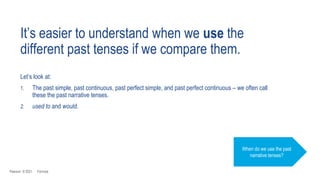
It’s easier to understand when we use the
different past tenses if we compare them.
Let’s look at:
1. The past simple, past continuous, past perfect simple, and past perfect continuous – we often call
these the past narrative tenses.
2. used to and would.
Pearson © 2021 Formula
When do we use the past
narrative tenses?
Function: When do we use them?
1. past narrative tenses
Pearson © 2021 Formula
Read the sections of the story and
answer the questions.
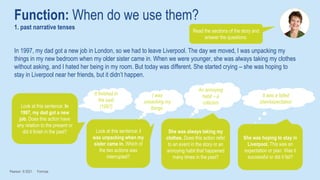
In 1997, my dad got a new job in London, so we had to leave Liverpool. The day we moved, I was unpacking my
things in my new bedroom when my older sister came in. When we were younger, she was always taking my clothes
without asking, and I hated her being in my room. But today was different. She started crying – she was hoping to
stay in Liverpool near her friends, but it didn’t happen.
Look at this sentence: In
1997, my dad got a new
job. Does this action have
any relation to the present or
did it finish in the past?
It finished in
the past
(1997)
Look at this sentence: I
was unpacking when my
sister came in. Which of
the two actions was
interrupted?
It was a failed
plan/expectation
She was always taking my
clothes. Does this action refer
to an event in the story or an
annoying habit that happened
many times in the past?
An annoying
habit – a
criticism
She was hoping to stay in
Liverpool. This was an
expectation or plan. Was it
successful or did it fail?
I was
unpacking my
things.
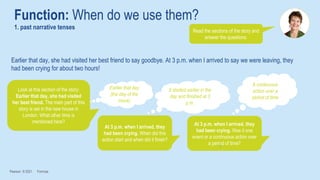
Earlier that day, she had visited her best friend to say goodbye. At 3 p.m. when I arrived to say we were leaving, they
had been crying for about two hours!
Function: When do we use them?
1. past narrative tenses
Pearson © 2021 Formula
Look at this section of the story:
Earlier that day, she had visited
her best friend. The main part of this
story is set in the new house in
London. What other time is
mentioned here?
Earlier that day
(the day of the
move)
At 3 p.m. when I arrived, they
had been crying. When did this
action start and when did it finish?
It started earlier in the
day and finished at 3
p.m.
At 3 p.m. when I arrived, they
had been crying. Was it one
event or a continuous action over
a period of time?
A continuous
action over a
period of time
Read the sections of the story and
answer the questions.
Function: When do we use them?
1. past narrative tenses
Pearson © 2021 Formula
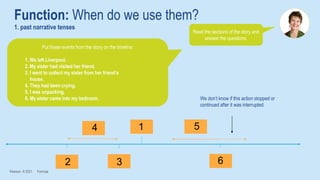
Put these events from the story on the timeline:
1. We left Liverpool.
2. My sister had visited her friend.
3. I went to collect my sister from her friend’s
house.
4. They had been crying.
5. I was unpacking.
6. My sister came into my bedroom.
1
2 3
4 5
6
We don’t know if this action stopped or
continued after it was interrupted.
Read the sections of the story and
answer the questions.
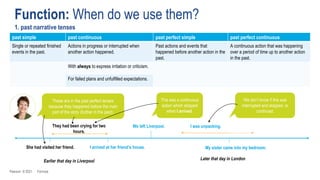
past simple past continuous past perfect simple past perfect continuous
Single or repeated finished
events in the past.
Actions in progress or interrupted when
another action happened.
Past actions and events that
happened before another action in the
past.
A continuous action that was happening
over a period of time up to another action
in the past.
With always to express irritation or criticism.
For failed plans and unfulfilled expectations.
Pearson © 2021 Formula
Function: When do we use them?
1. past narrative tenses
These are in the past perfect tenses
because they happened before the main
part of the story (further in the past).
This was a continuous
action which stopped
when I arrived.
We don’t know if this was
interrupted and stopped, or
continued.
They had been crying for two
hours.
She had visited her friend.
We left Liverpool.
My sister came into my bedroom.
I was unpacking.
I arrived at her friend’s house.
Earlier that day in Liverpool Later that day in London
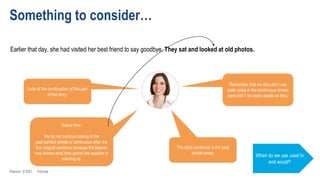
Something to consider…
Earlier that day, she had visited her best friend to say goodbye. They sat and looked at old photos.
When do we use used to
and would?
Look at the continuation of this part
of the story.
The story continues in the past
simple tense.
Remember that we also don’t use
state verbs in the continuous tenses
(see Unit 1 for more details on this).
Notice how:
We do not continue talking in the
past perfect simple or continuous after the
first original sentence because the listener
now knows what time period the speaker is
referring to.
Pearson © 2021 Formula
Function: When do we use them?
2. used to and would
Pearson © 2021 Formula
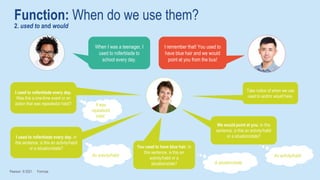
When I was a teenager, I
used to rollerblade to
school every day.
I remember that! You used to
have blue hair and we would
point at you from the bus!
I used to rollerblade every day.
Was this a one-time event or an
action that was repeated/a habit? It was
repeated/a
habit.
You used to have blue hair. In
this sentence, is this an
activity/habit or a
situation/state? A situation/state
We would point at you. In this
sentence, is this an activity/habit
or a situation/state?
An activity/habit
I used to rollerblade every day. In
this sentence, is this an activity/habit
or a situation/state?
An activity/habit
Take notice of when we use
used to and/or would here.
Function: When do we use them?
2. used to and would
Pearson © 2021 Formula
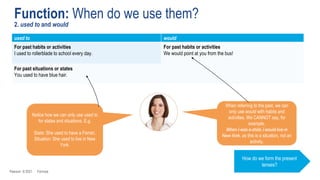
How do we form the present
tenses?
used to would
For past habits or activities
I used to rollerblade to school every day.
For past habits or activities
We would point at you from the bus!
For past situations or states
You used to have blue hair.
When referring to the past, we can
only use would with habits and
activities. We CANNOT say, for
example,
When I was a child, I would live in
New York, as this is a situation, not an
activity.
Notice how we can only use used to
for states and situations. E.g.
State: She used to have a Ferrari.
Situation: She used to live in New
York.
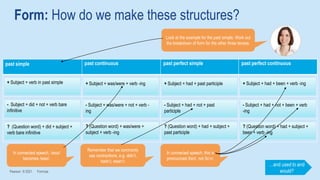
Form: How do we make these structures?
past simple
Look at the example for the past simple. Work out
the breakdown of form for the other three tenses.
past continuous past perfect simple past perfect continuous
+ Subject + verb in past simple
- Subject + did + not + verb bare
infinitive
? (Question word) + did + subject +
verb bare infinitive
+ Subject + was/were + verb -ing
- Subject + was/were + not + verb -
ing
? (Question word) + was/were +
subject + verb -ing
+ Subject + had + past participle
- Subject + had + not + past
participle
? (Question word) + had + subject +
past participle
+ Subject + had + been + verb -ing
- Subject + had + not + been + verb
-ing
? (Question word) + had + subject +
been + verb -ing
Remember that we commonly
use contractions, e.g. didn’t,
hadn’t, wasn’t.
In connected speech, this is
pronounced /bɪn/, not /bi:n/.
…and used to and
would?
In connected speech, /wɒz/
becomes /wəz/.
Pearson © 2021 Formula
Form: How do we make these structures?
Pearson © 2021 Formula
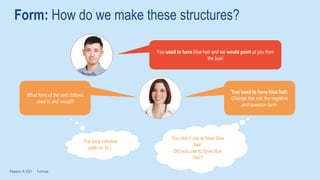
You used to have blue hair and we would point at you from
the bus!
The bare infinitive
(with no ‘to’).
You didn’t use to have blue
hair.
Did you use to have blue
hair?
You used to have blue hair.
Change this into the negative
and question form.
What form of the verb follows
used to and would?
Form: How do we make these structures?
Pearson © 2021 Formula
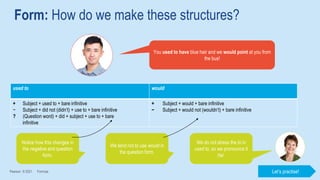
You used to have blue hair and we would point at you from
the bus!
used to would
+ Subject + used to + bare infinitive
− Subject + did not (didn’t) + use to + bare infinitive
? (Question word) + did + subject + use to + bare
infinitive
+ Subject + would + bare infinitive
− Subject + would not (wouldn’t) + bare infinitive
Notice how this changes in
the negative and question
form.
We tend not to use would in
the question form.
We do not stress the to in
used to, so we pronounce it
/tə/.
Let’s practise!
Pearson © 2021 Formula
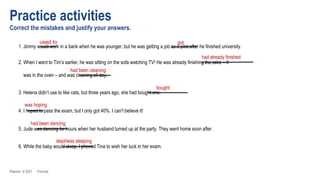
Practice activities
Correct the mistakes and justify your answers.
1. Jimmy would work in a bank when he was younger, but he was getting a job as a pilot after he finished university.
2. When I went to Tim’s earlier, he was sitting on the sofa watching TV! He was already finishing the cake – it
was in the oven – and was cleaning all day.
3. Helena didn’t use to like cats, but three years ago, she had bought one.
4. I hoped to pass the exam, but I only got 40%. I can’t believe it!
5. Jude was dancing for hours when her husband turned up at the party. They went home soon after.
6. While the baby would sleep, I phoned Tina to wish her luck in her exam.
used to got
had already finished
had been cleaning
bought
was hoping
had been dancing
slept/was sleeping

Formula_Grammar_ppt_B2_U2 (1).pptx

  • 1.
    Unit 2 –Past tenses
  • 2.
    It’s easier tounderstand when we use the different past tenses if we compare them. Let’s look at: 1. The past simple, past continuous, past perfect simple, and past perfect continuous – we often call these the past narrative tenses. 2. used to and would. Pearson © 2021 Formula When do we use the past narrative tenses?
  • 3.
    Function: When dowe use them? 1. past narrative tenses Pearson © 2021 Formula Read the sections of the story and answer the questions. In 1997, my dad got a new job in London, so we had to leave Liverpool. The day we moved, I was unpacking my things in my new bedroom when my older sister came in. When we were younger, she was always taking my clothes without asking, and I hated her being in my room. But today was different. She started crying – she was hoping to stay in Liverpool near her friends, but it didn’t happen. Look at this sentence: In 1997, my dad got a new job. Does this action have any relation to the present or did it finish in the past? It finished in the past (1997) Look at this sentence: I was unpacking when my sister came in. Which of the two actions was interrupted? It was a failed plan/expectation She was always taking my clothes. Does this action refer to an event in the story or an annoying habit that happened many times in the past? An annoying habit – a criticism She was hoping to stay in Liverpool. This was an expectation or plan. Was it successful or did it fail? I was unpacking my things.
  • 4.
    Earlier that day,she had visited her best friend to say goodbye. At 3 p.m. when I arrived to say we were leaving, they had been crying for about two hours! Function: When do we use them? 1. past narrative tenses Pearson © 2021 Formula Look at this section of the story: Earlier that day, she had visited her best friend. The main part of this story is set in the new house in London. What other time is mentioned here? Earlier that day (the day of the move) At 3 p.m. when I arrived, they had been crying. When did this action start and when did it finish? It started earlier in the day and finished at 3 p.m. At 3 p.m. when I arrived, they had been crying. Was it one event or a continuous action over a period of time? A continuous action over a period of time Read the sections of the story and answer the questions.
  • 5.
    Function: When dowe use them? 1. past narrative tenses Pearson © 2021 Formula Put these events from the story on the timeline: 1. We left Liverpool. 2. My sister had visited her friend. 3. I went to collect my sister from her friend’s house. 4. They had been crying. 5. I was unpacking. 6. My sister came into my bedroom. 1 2 3 4 5 6 We don’t know if this action stopped or continued after it was interrupted. Read the sections of the story and answer the questions.
  • 6.
    past simple pastcontinuous past perfect simple past perfect continuous Single or repeated finished events in the past. Actions in progress or interrupted when another action happened. Past actions and events that happened before another action in the past. A continuous action that was happening over a period of time up to another action in the past. With always to express irritation or criticism. For failed plans and unfulfilled expectations. Pearson © 2021 Formula Function: When do we use them? 1. past narrative tenses These are in the past perfect tenses because they happened before the main part of the story (further in the past). This was a continuous action which stopped when I arrived. We don’t know if this was interrupted and stopped, or continued. They had been crying for two hours. She had visited her friend. We left Liverpool. My sister came into my bedroom. I was unpacking. I arrived at her friend’s house. Earlier that day in Liverpool Later that day in London
  • 7.
    Something to consider… Earlierthat day, she had visited her best friend to say goodbye. They sat and looked at old photos. When do we use used to and would? Look at the continuation of this part of the story. The story continues in the past simple tense. Remember that we also don’t use state verbs in the continuous tenses (see Unit 1 for more details on this). Notice how: We do not continue talking in the past perfect simple or continuous after the first original sentence because the listener now knows what time period the speaker is referring to. Pearson © 2021 Formula
  • 8.
    Function: When dowe use them? 2. used to and would Pearson © 2021 Formula When I was a teenager, I used to rollerblade to school every day. I remember that! You used to have blue hair and we would point at you from the bus! I used to rollerblade every day. Was this a one-time event or an action that was repeated/a habit? It was repeated/a habit. You used to have blue hair. In this sentence, is this an activity/habit or a situation/state? A situation/state We would point at you. In this sentence, is this an activity/habit or a situation/state? An activity/habit I used to rollerblade every day. In this sentence, is this an activity/habit or a situation/state? An activity/habit Take notice of when we use used to and/or would here.
  • 9.
    Function: When dowe use them? 2. used to and would Pearson © 2021 Formula How do we form the present tenses? used to would For past habits or activities I used to rollerblade to school every day. For past habits or activities We would point at you from the bus! For past situations or states You used to have blue hair. When referring to the past, we can only use would with habits and activities. We CANNOT say, for example, When I was a child, I would live in New York, as this is a situation, not an activity. Notice how we can only use used to for states and situations. E.g. State: She used to have a Ferrari. Situation: She used to live in New York.
  • 10.
    Form: How dowe make these structures? past simple Look at the example for the past simple. Work out the breakdown of form for the other three tenses. past continuous past perfect simple past perfect continuous + Subject + verb in past simple - Subject + did + not + verb bare infinitive ? (Question word) + did + subject + verb bare infinitive + Subject + was/were + verb -ing - Subject + was/were + not + verb - ing ? (Question word) + was/were + subject + verb -ing + Subject + had + past participle - Subject + had + not + past participle ? (Question word) + had + subject + past participle + Subject + had + been + verb -ing - Subject + had + not + been + verb -ing ? (Question word) + had + subject + been + verb -ing Remember that we commonly use contractions, e.g. didn’t, hadn’t, wasn’t. In connected speech, this is pronounced /bɪn/, not /bi:n/. …and used to and would? In connected speech, /wɒz/ becomes /wəz/. Pearson © 2021 Formula
  • 11.
    Form: How dowe make these structures? Pearson © 2021 Formula You used to have blue hair and we would point at you from the bus! The bare infinitive (with no ‘to’). You didn’t use to have blue hair. Did you use to have blue hair? You used to have blue hair. Change this into the negative and question form. What form of the verb follows used to and would?
  • 12.
    Form: How dowe make these structures? Pearson © 2021 Formula You used to have blue hair and we would point at you from the bus! used to would + Subject + used to + bare infinitive − Subject + did not (didn’t) + use to + bare infinitive ? (Question word) + did + subject + use to + bare infinitive + Subject + would + bare infinitive − Subject + would not (wouldn’t) + bare infinitive Notice how this changes in the negative and question form. We tend not to use would in the question form. We do not stress the to in used to, so we pronounce it /tə/. Let’s practise!
  • 13.
    Pearson © 2021Formula Practice activities Correct the mistakes and justify your answers. 1. Jimmy would work in a bank when he was younger, but he was getting a job as a pilot after he finished university. 2. When I went to Tim’s earlier, he was sitting on the sofa watching TV! He was already finishing the cake – it was in the oven – and was cleaning all day. 3. Helena didn’t use to like cats, but three years ago, she had bought one. 4. I hoped to pass the exam, but I only got 40%. I can’t believe it! 5. Jude was dancing for hours when her husband turned up at the party. They went home soon after. 6. While the baby would sleep, I phoned Tina to wish her luck in her exam. used to got had already finished had been cleaning bought was hoping had been dancing slept/was sleeping