www.cloudflare.com!
Understanding Go Memory
September 11, 2013
John Graham-Cumming
www.cloudflare.com!
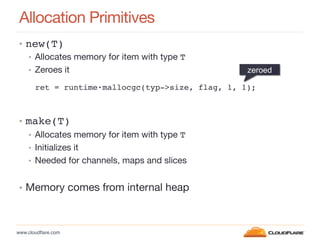
Allocation Primitives
•  new(T)!
•  Allocates memory for item with type T!
•  Zeroes it

!
•  make(T)!
•  Allocates memory for item with type T!
•  Initializes it
•  Needed for channels, maps and slices
•  Memory comes from internal heap
ret = runtime·mallocgc(typ->size, flag, 1, 1);!
zeroed
www.cloudflare.com!
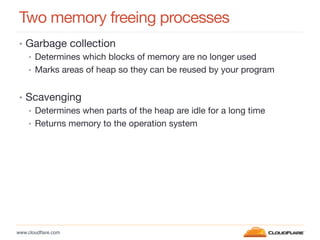
Two memory freeing processes 

•  Garbage collection
•  Determines which blocks of memory are no longer used
•  Marks areas of heap so they can be reused by your program

•  Scavenging
•  Determines when parts of the heap are idle for a long time
•  Returns memory to the operation system
www.cloudflare.com!
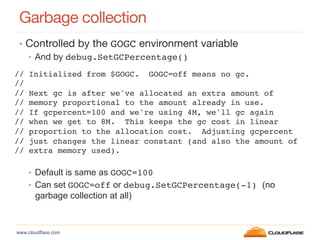
Garbage collection
•  Controlled by the GOGC environment variable
•  And by debug.SetGCPercentage()!
•  Default is same as GOGC=100!
•  Can set GOGC=off or debug.SetGCPercentage(-1) (no
garbage collection at all)
// Initialized from $GOGC. GOGC=off means no gc.!
//!
// Next gc is after we've allocated an extra amount of!
// memory proportional to the amount already in use.!
// If gcpercent=100 and we're using 4M, we'll gc again!
// when we get to 8M. This keeps the gc cost in linear!
// proportion to the allocation cost. Adjusting gcpercent!
// just changes the linear constant (and also the amount of!
// extra memory used).!
www.cloudflare.com!
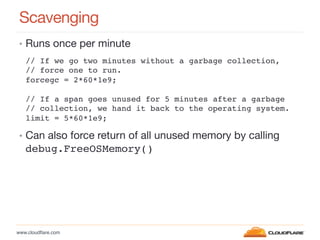
Scavenging
•  Runs once per minute
•  Can also force return of all unused memory by calling
debug.FreeOSMemory()!
// If we go two minutes without a garbage collection, !
// force one to run.!
forcegc = 2*60*1e9;!
!
// If a span goes unused for 5 minutes after a garbage!
// collection, we hand it back to the operating system.!
limit = 5*60*1e9;!
www.cloudflare.com!
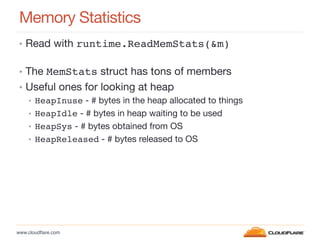
Memory Statistics
•  Read with runtime.ReadMemStats(&m)

!
•  The MemStats struct has tons of members
•  Useful ones for looking at heap
•  HeapInuse - # bytes in the heap allocated to things
•  HeapIdle - # bytes in heap waiting to be used
•  HeapSys - # bytes obtained from OS
•  HeapReleased - # bytes released to OS
www.cloudflare.com!
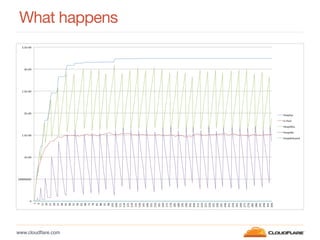
Test garbage making program
func makeBuffer() []byte { !
return make([]byte, rand.Intn(5000000)+5000000) !
}!
!
func main() { !
pool := make([][]byte, 20)!
!
makes := 0 !
for { !
b := makeBuffer()

makes += 1!
!
i := rand.Intn(len(pool))!
pool[i] = b!
!
time.Sleep(time.Second)!
}!
}!
www.cloudflare.com!
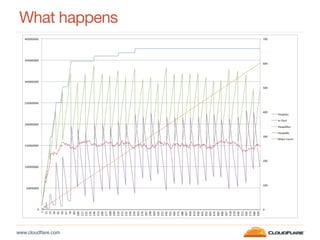
What happens
www.cloudflare.com!
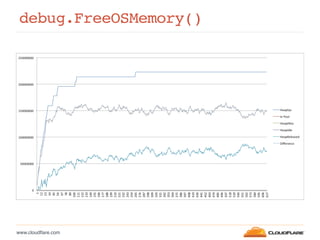
debug.FreeOSMemory()!
www.cloudflare.com!
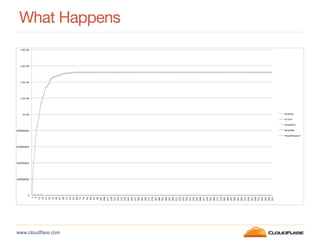
Use a buffered channel
func main() {!
pool := make([][]byte, 20)!
idle:= make(chan []byte, 5)!
!
makes := 0!
for {!
var b []byte!
select {!
case b = <-idle:!
default:!
makes += 1!
b = makeBuffer()!
}!
!
!
i := rand.Intn(len(pool))!
if pool[i] != nil {!
select {!
case idle<- pool[i]:!
pool[i] = nil!
default:!
}!
}!
!
pool[i] = b!
!
time.Sleep(time.Second)!
}!
}
www.cloudflare.com!
select for non-blocking receive
idle:= make(chan []byte, 5)!
!
select {!
case b = <-idle:

!
default:!
makes += 1!
b = makeBuffer()!
}!
Try to get from the
idle queue
Idle queue
empty? Make a
new buffer
A buffered
channel makes a
simple queue
www.cloudflare.com!
select for non-blocking send
idle:= make(chan []byte, 5)!
!
select {!
case buffer <- pool[i]:!
pool[i] = nil!
!
default:!
}!
A buffered
channel makes a
simple queue
Try to return buffer
to the idle queue
Idle queue full?
GC will have to
deal with the
buffer
www.cloudflare.com!
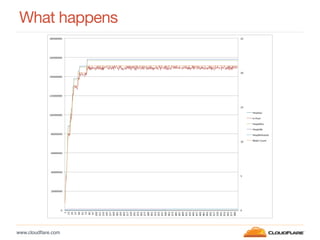
What happens
www.cloudflare.com!
More realistic: 20 goroutines
func main() {!
pool := make([][]byte, 200)!
!
for i := 0; i < 10; i++ {!
go func(offset int) {!
for {!
b := makeBuffer()!
j := offset+rand.Intn(20)!
pool[j] = b!
!
time.Sleep(time.Millisecond * time.Duration(rand.Intn(1000))!
}!
}(i*20)!
}!
}!
www.cloudflare.com!
What happens
www.cloudflare.com!
Shared across goroutines
func main() {!
buffer := make(chan []byte, 5)!
!
pool := make([][]byte, 200)!
for i := 0; i < 10; i++ {!
go func(offset int) {!
for {!
var b []byte!
select {!
case b = <-buffer:!
default: b = makeBuffer()!
}!
j := offset+rand.Intn(20)!
if pool[j] != nil {!
select {!
case buffer <- pool[j]: pool[j] = nil!
default:!
}!
}!
pool[j] = b!
time.Sleep(time.Millisecond * time.Duration(rand.Intn(1000))!
}!
}(i*20)!
}!
!
www.cloudflare.com!
What Happens
www.cloudflare.com!
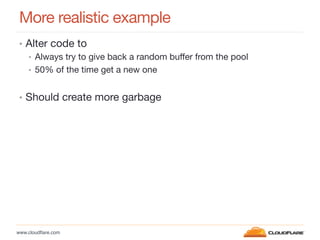
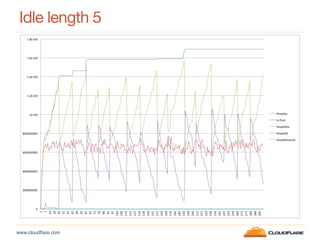
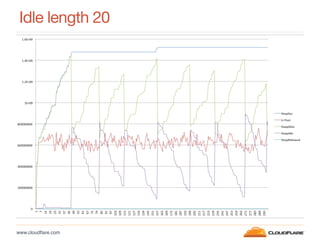
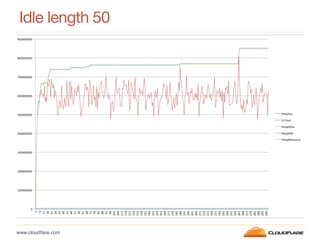
More realistic example
•  Alter code to
•  Always try to give back a random buffer from the pool
•  50% of the time get a new one
•  Should create more garbage
www.cloudflare.com!
Idle length 5
www.cloudflare.com!
Idle length 20
www.cloudflare.com!
Idle length 50
www.cloudflare.com!
Also
•  This works for things other than []byte
•  Can be done with arbitrary types
•  Just need some way to reset
•  There’s a proposal to add something like this to the Go
package library
•  sync.Cache
•  Follow TODO

Go memory

  • 1.
  • 2.
    www.cloudflare.com! Allocation Primitives •  new(T)! • Allocates memory for item with type T! •  Zeroes it ! •  make(T)! •  Allocates memory for item with type T! •  Initializes it •  Needed for channels, maps and slices •  Memory comes from internal heap ret = runtime·mallocgc(typ->size, flag, 1, 1);! zeroed
  • 3.
    www.cloudflare.com! Two memory freeingprocesses •  Garbage collection •  Determines which blocks of memory are no longer used •  Marks areas of heap so they can be reused by your program •  Scavenging •  Determines when parts of the heap are idle for a long time •  Returns memory to the operation system
  • 4.
    www.cloudflare.com! Garbage collection •  Controlledby the GOGC environment variable •  And by debug.SetGCPercentage()! •  Default is same as GOGC=100! •  Can set GOGC=off or debug.SetGCPercentage(-1) (no garbage collection at all) // Initialized from $GOGC. GOGC=off means no gc.! //! // Next gc is after we've allocated an extra amount of! // memory proportional to the amount already in use.! // If gcpercent=100 and we're using 4M, we'll gc again! // when we get to 8M. This keeps the gc cost in linear! // proportion to the allocation cost. Adjusting gcpercent! // just changes the linear constant (and also the amount of! // extra memory used).!
  • 5.
    www.cloudflare.com! Scavenging •  Runs onceper minute •  Can also force return of all unused memory by calling debug.FreeOSMemory()! // If we go two minutes without a garbage collection, ! // force one to run.! forcegc = 2*60*1e9;! ! // If a span goes unused for 5 minutes after a garbage! // collection, we hand it back to the operating system.! limit = 5*60*1e9;!
  • 6.
    www.cloudflare.com! Memory Statistics •  Readwith runtime.ReadMemStats(&m)
 ! •  The MemStats struct has tons of members •  Useful ones for looking at heap •  HeapInuse - # bytes in the heap allocated to things •  HeapIdle - # bytes in heap waiting to be used •  HeapSys - # bytes obtained from OS •  HeapReleased - # bytes released to OS
  • 7.
    www.cloudflare.com! Test garbage makingprogram func makeBuffer() []byte { ! return make([]byte, rand.Intn(5000000)+5000000) ! }! ! func main() { ! pool := make([][]byte, 20)! ! makes := 0 ! for { ! b := makeBuffer()
 makes += 1! ! i := rand.Intn(len(pool))! pool[i] = b! ! time.Sleep(time.Second)! }! }!
  • 8.
  • 9.
  • 10.
    www.cloudflare.com! Use a bufferedchannel func main() {! pool := make([][]byte, 20)! idle:= make(chan []byte, 5)! ! makes := 0! for {! var b []byte! select {! case b = <-idle:! default:! makes += 1! b = makeBuffer()! }! ! ! i := rand.Intn(len(pool))! if pool[i] != nil {! select {! case idle<- pool[i]:! pool[i] = nil! default:! }! }! ! pool[i] = b! ! time.Sleep(time.Second)! }! }
  • 11.
    www.cloudflare.com! select for non-blockingreceive idle:= make(chan []byte, 5)! ! select {! case b = <-idle:
 ! default:! makes += 1! b = makeBuffer()! }! Try to get from the idle queue Idle queue empty? Make a new buffer A buffered channel makes a simple queue
  • 12.
    www.cloudflare.com! select for non-blockingsend idle:= make(chan []byte, 5)! ! select {! case buffer <- pool[i]:! pool[i] = nil! ! default:! }! A buffered channel makes a simple queue Try to return buffer to the idle queue Idle queue full? GC will have to deal with the buffer
  • 13.
  • 14.
    www.cloudflare.com! More realistic: 20goroutines func main() {! pool := make([][]byte, 200)! ! for i := 0; i < 10; i++ {! go func(offset int) {! for {! b := makeBuffer()! j := offset+rand.Intn(20)! pool[j] = b! ! time.Sleep(time.Millisecond * time.Duration(rand.Intn(1000))! }! }(i*20)! }! }!
  • 15.
  • 16.
    www.cloudflare.com! Shared across goroutines funcmain() {! buffer := make(chan []byte, 5)! ! pool := make([][]byte, 200)! for i := 0; i < 10; i++ {! go func(offset int) {! for {! var b []byte! select {! case b = <-buffer:! default: b = makeBuffer()! }! j := offset+rand.Intn(20)! if pool[j] != nil {! select {! case buffer <- pool[j]: pool[j] = nil! default:! }! }! pool[j] = b! time.Sleep(time.Millisecond * time.Duration(rand.Intn(1000))! }! }(i*20)! }! !
  • 17.
  • 18.
    www.cloudflare.com! More realistic example • Alter code to •  Always try to give back a random buffer from the pool •  50% of the time get a new one •  Should create more garbage
  • 19.
  • 20.
  • 21.
  • 22.
    www.cloudflare.com! Also •  This worksfor things other than []byte •  Can be done with arbitrary types •  Just need some way to reset •  There’s a proposal to add something like this to the Go package library •  sync.Cache •  Follow TODO