GOROUTINESAND
CHANNELSIN
PRACTICE
GUILHERMEGARNIER
We're hiring!https://blog.guilhermegarnier.com
@gpgarnier https://talentos.globo.com
CONCURRENCYIS
HARD
Threads are expensive
Hard to share state
Hard to manage threads lifecycle
WHYISGODIFFERENT?
simple concurrency model
embraces concurrency with
goroutines
easy to share state with
channels
WHAT'SA
GOROUTINE?
Abstraction above OS threads
Don't have an identity like thread IDs
Not suspended unless sleeping, blocked or on a function call
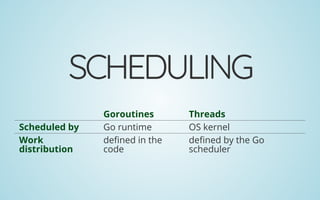
SCHEDULING
Goroutines Threads
Scheduled by Go runtime OS kernel
Work
distribution
de ned in the
code
de ned by the Go
scheduler
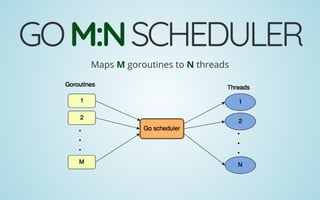
GOM:NSCHEDULER
Maps M goroutines to N threads
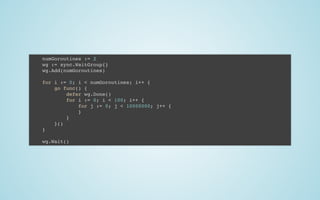
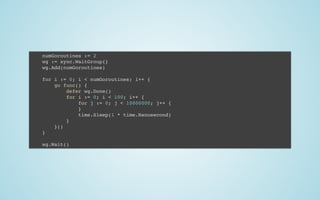
numGoroutines := 2
wg := sync.WaitGroup{}
wg.Add(numGoroutines)
 
for i := 0; i < numGoroutines; i++ {
go func() {
defer wg.Done()
for i := 0; i < 100; i++ {
for j := 0; j < 10000000; j++ {
}
}
}()
}
 
wg.Wait()
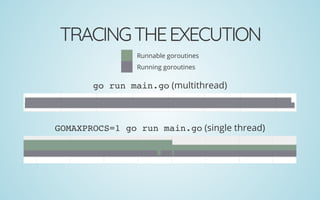
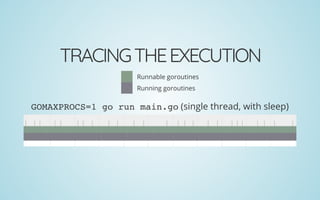
TRACINGTHEEXECUTION
Runnable goroutines
Running goroutines
go run main.go (multithread)
GOMAXPROCS=1 go run main.go (single thread)
numGoroutines := 2
wg := sync.WaitGroup{}
wg.Add(numGoroutines)
 
for i := 0; i < numGoroutines; i++ {
go func() {
defer wg.Done()
for i := 0; i < 100; i++ {
for j := 0; j < 10000000; j++ {
}
time.Sleep(1 * time.Nanosecond)
}
}()
}
 
wg.Wait()
TRACINGTHEEXECUTION
Runnable goroutines
Running goroutines
GOMAXPROCS=1 go run main.go (single thread, with sleep)
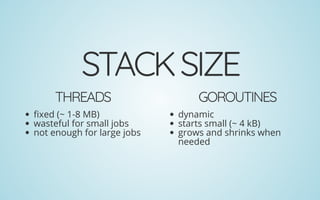
STACKSIZE
THREADS
xed (~ 1-8 MB)
wasteful for small jobs
not enough for large jobs
GOROUTINES
dynamic
starts small (~ 4 kB)
grows and shrinks when
needed
GOROUTINESMEMORYUSAGE
source: Concurrency in Go, page 44
memConsumed := func() uint64 {...}
var ch <-chan interface{}
var wg sync.WaitGroup
 
const numGoroutines = 100000
wg.Add(numGoroutines)
 
before := memConsumed()
for i := 0; i < numGoroutines; i++ {
go func() { wg.Done(); <-ch }()
}
wg.Wait()
after := memConsumed()
 
fmt.Printf("%.3f bytes", float64(after-before)/numGoroutines)
GOROUTINESMEMORYUSAGE
Mem (GB) Goroutines
1 370 k
2 740 k
4 1.5 M
8 2.9 M
16 5.9 M
32 11.8 M
64 23.7 M
source: Concurrency in Go, page 44
STATESHARING
Do not communicate by sharing memory; instead,
share memory by communicating
https://blog.golang.org/share-memory-by-communicating
EXAMPLE:HEALTHCHECKSINJAVA
public class Main {
public static void main(String args[]) {
String[] urls = {"url1", "url2", ...};
Thread[] threads = new Thread[urls.length];
for (int i = 0; i < urls.length; i++) {
threads[i] = new Thread(new Healthcheck(urls[i]));
threads[i].start();
}
 
try {
for (Thread t : threads) {
t.join();
}
} catch (Exception e) {}
 
System.out.println(Healthcheck.getOkCount() + " ok, " +
Healthcheck.getErrCount() + " errors");
}
}
EXAMPLE:HEALTHCHECKSINJAVA
class Healthcheck implements Runnable {
private static int okCount = 0;
private static int errCount = 0;
 
public static synchronized void addOk() { Healthcheck.okCount++; }
public static synchronized void addErr() { Healthcheck.errCount++; }
public static int getOkCount() { return Healthcheck.okCount; }
public static int getErrCount() { return Healthcheck.errCount; }
 
public void run() {
try {
if (getStatusCode(this.url) == 200) {
Healthcheck.addOk();
} else {
Healthcheck.addErr();
}
} catch(Exception e) {
Healthcheck.addErr();
}
}
 
private int getStatusCode(String url) throws Exception {
...
}
}
EXAMPLE:HEALTHCHECKSINGO
type Results struct {
okCount int
errCount int
}
 
func main() {
urls := []string{"url1", "url2", ...}
 
r := runChecks(urls)
fmt.Printf("%d ok, %d errorsn", r.okCount, r.errCount)
}
VERSION1:SEQUENTIALCODE
func runChecks(urls []string) Results {
r := Results{}
for _, url := range urls {
resp, err := http.Head(url)
if err != nil || resp.StatusCode != http.StatusOK {
r.errCount++
} else {
r.okCount++
}
}
 
return r
}
VERSION2:USINGGOROUTINES
func runChecks(urls []string) Results {
r := Results{}
lock := sync.Mutex{}
for _, url := range urls {
go func(url string) {
resp, err := http.Head(url)
if err != nil || resp.StatusCode != http.StatusOK {
lock.Lock()
r.errCount++
lock.Unlock()
} else {
lock.Lock()
r.okCount++
lock.Unlock()
}
}(url)
}
 
// Wrong way to wait for goroutines to finish
time.Sleep(2 * time.Second)
 
return r
}
VERSION3:USINGCHANNELS
func runChecks(urls []string) Results {
r := Results{}
responses := make(chan bool, len(urls))
for _, url := range urls {
go func(url string) {
resp, err := http.Head(url)
success := err == nil && resp.StatusCode == http.StatusOK
responses <- success
}(url)
}
 
for i := 0; i < len(urls); i++ {
success := <-responses
if success {
r.okCount++
} else {
r.errCount++
}
}
 
return r
}
WHAT'SA
CHANNEL?
a conduit for streaming information
concurrency-safe
allows decoupling between sender and receiver
UNBUFFEREDCHANNELS
sender and receiver block each other
provide guarantee of delivery
stream := make(chan int)
go func() {
stream <- 1
}()
go func() {
<-stream
}()
BUFFEREDCHANNELS
created with a maximum capacity
sender and receiver block each other when it's full
no guarantee of delivery
stream := make(chan int, 1)
go func() {
stream <- 1
stream <- 2 // blocks until the first receiver
}()
go func() {
<-stream // blocks until the first sender
<-stream
}()
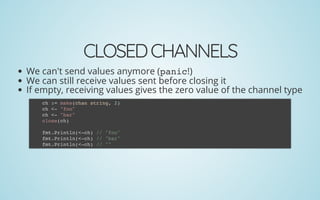
CLOSEDCHANNELS
We can't send values anymore (panic!)
We can still receive values sent before closing it
If empty, receiving values gives the zero value of the channel type
ch := make(chan string, 2)
ch <- "foo"
ch <- "bar"
close(ch)
 
fmt.Println(<-ch) // "foo"
fmt.Println(<-ch) // "bar"
fmt.Println(<-ch) // ""
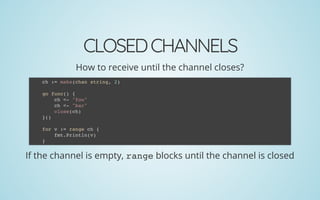
CLOSEDCHANNELS
How to receive until the channel closes?
If the channel is empty, range blocks until the channel is closed
ch := make(chan string, 2)
 
go func() {
ch <- "foo"
ch <- "bar"
close(ch)
}()
 
for v := range ch {
fmt.Println(v)
}
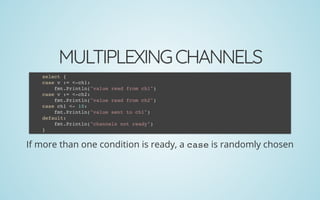
MULTIPLEXINGCHANNELS
If more than one condition is ready, a case is randomly chosen
select {
case v := <-ch1:
fmt.Println("value read from ch1")
case v := <-ch2:
fmt.Println("value read from ch2")
case ch1 <- 10:
fmt.Println("value sent to ch1")
default:
fmt.Println("channels not ready")
}
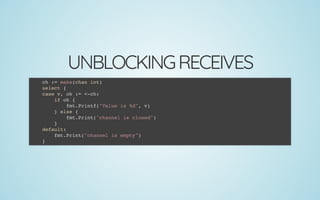
UNBLOCKINGRECEIVES
ch := make(chan int)
select {
case v, ok := <-ch:
if ok {
fmt.Printf("Value is %d", v)
} else {
fmt.Print("channel is closed")
}
default:
fmt.Print("channel is empty")
}
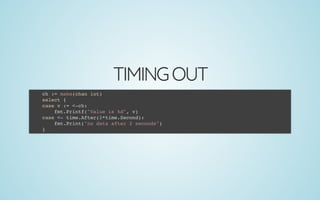
TIMINGOUT
ch := make(chan int)
select {
case v := <-ch:
fmt.Printf("Value is %d", v)
case <- time.After(2*time.Second):
fmt.Print("no data after 2 seconds")
}
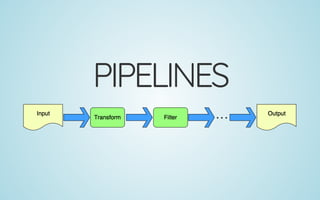
PIPELINES
PIPELINES
// Inputs an infinite stream
randomNumbers := func() <-chan int {
stream := make(chan int)
go func() {
defer close(stream) // This will never run
for {
stream <- rand.Intn(100)
}
}()
return stream
}
 
// Transforms
double := func(input <-chan int) <-chan int {
stream := make(chan int)
go func() {
defer close(stream)
for i := range input {
stream <- i * 2
}
}()
return stream
}
PIPELINES
// Filters
onlyMultiplesOf10 := func(input <-chan int) <-chan int {
stream := make(chan int)
go func() {
defer close(stream)
for i := range input {
if i%10 == 0 {
stream <- i
}
}
}()
return stream
}
 
pipeline := onlyMultiplesOf10(double(randomNumbers()))
for i := range pipeline { // Infinite loop
fmt.Println(i)
}
MANAGING
GOROUTINES
LIFECYCLE
LIMITINGTHENUMBEROFRUNNINGGOROUTINES
max := 3 // Max simultaneous goroutines
running := make(chan struct{}, max)
 
for url := range urls {
running <- struct{}{} // waits for a free slot
go func(url string) {
defer func() {
<-running // releases slot
}()
// do work
}(url)
}
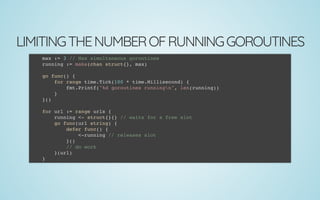
LIMITINGTHENUMBEROFRUNNINGGOROUTINES
max := 3 // Max simultaneous goroutines
running := make(chan struct{}, max)
 
go func() {
for range time.Tick(100 * time.Millisecond) {
fmt.Printf("%d goroutines runningn", len(running))
}
}()
 
for url := range urls {
running <- struct{}{} // waits for a free slot
go func(url string) {
defer func() {
<-running // releases slot
}()
// do work
}(url)
}
FORCINGGOROUTINESTOSTOP
Using a done channel
done := make(chan struct{})
go func() {
defer func() {
done <- struct{}{}
}()
bufio.NewReader(os.Stdin).ReadByte() // read input from stdin
}()
 
randomNumbers := func() <-chan int {
stream := make(chan int)
go func() {
defer close(stream)
for {
select {
case <-done:
return
default:
stream <- rand.Intn(100)
}
}
}()
return stream
}
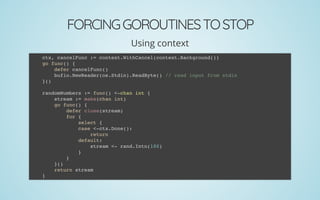
FORCINGGOROUTINESTOSTOP
Using context
ctx, cancelFunc := context.WithCancel(context.Background())
go func() {
defer cancelFunc()
bufio.NewReader(os.Stdin).ReadByte() // read input from stdin
}()
 
randomNumbers := func() <-chan int {
stream := make(chan int)
go func() {
defer close(stream)
for {
select {
case <-ctx.Done():
return
default:
stream <- rand.Intn(100)
}
}
}()
return stream
}
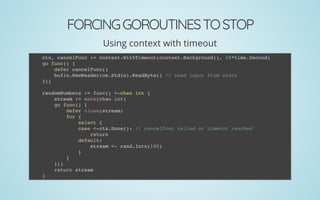
FORCINGGOROUTINESTOSTOP
Using context with timeout
ctx, cancelFunc := context.WithTimeout(context.Background(), 10*time.Second)
go func() {
defer cancelFunc()
bufio.NewReader(os.Stdin).ReadByte() // read input from stdin
}()
 
randomNumbers := func() <-chan int {
stream := make(chan int)
go func() {
defer close(stream)
for {
select {
case <-ctx.Done(): // cancelFunc called or timeout reached
return
default:
stream <- rand.Intn(100)
}
}
}()
return stream
}
COMMON
CONCURRENCY
PROBLEMS
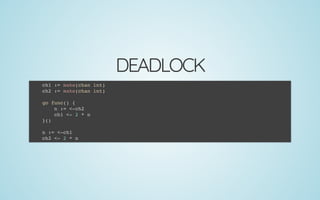
DEADLOCK
ch1 := make(chan int)
ch2 := make(chan int)
 
go func() {
n := <-ch2
ch1 <- 2 * n
}()
 
n := <-ch1
ch2 <- 2 * n
DEADLOCK
$ go run main.go
fatal error: all goroutines are asleep - deadlock!
 
goroutine 1 [chan receive]:
main.main()
main.go:12 +0xaa
 
goroutine 17 [chan receive]:
main.main.func1(0xc4200720c0, 0xc420072060)
main.go:8 +0x3e
created by main.main
main.go:7 +0x89
exit status 2
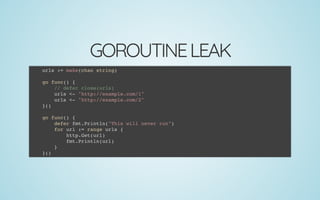
GOROUTINELEAK
urls := make(chan string)
 
go func() {
// defer close(urls)
urls <- "http://example.com/1"
urls <- "http://example.com/2"
}()
 
go func() {
defer fmt.Println("This will never run")
for url := range urls {
http.Get(url)
fmt.Println(url)
}
}()
RACEDETECTORTOOL
func runChecks(urls []string) Results {
r := Results{}
lock := sync.Mutex{}
for _, url := range urls {
go func(url string) {
resp, err := http.Head(url)
if err != nil || resp.StatusCode != http.StatusOK {
lock.Lock()
r.errCount++
lock.Unlock()
} else {
lock.Lock()
r.okCount++
lock.Unlock()
}
}(url)
}
 
// Wrong way to wait for goroutines to finish
time.Sleep(2 * time.Second)
 
return r
}
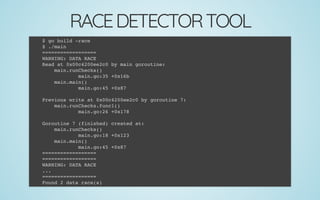
RACEDETECTORTOOL
$ go build -race
$ ./main
==================
WARNING: DATA RACE
Read at 0x00c4200ee2c0 by main goroutine:
main.runChecks()
main.go:35 +0x16b
main.main()
main.go:45 +0x87
 
Previous write at 0x00c4200ee2c0 by goroutine 7:
main.runChecks.func1()
main.go:26 +0x178
 
Goroutine 7 (finished) created at:
main.runChecks()
main.go:18 +0x123
main.main()
main.go:45 +0x87
==================
==================
WARNING: DATA RACE
...
==================
Found 2 data race(s)
RACEDETECTORTOOL
func runChecks(urls []string) Results {
r := Results{lock: &sync.Mutex{}}
var wg sync.WaitGroup
for _, url := range urls {
wg.Add(1)
go func(url string) {
defer wg.Done()
resp, err := http.Head(url)
if err != nil || resp.StatusCode != http.StatusOK {
r.lock.Lock()
r.errCount++
r.lock.Unlock()
} else {
r.lock.Lock()
r.okCount++
r.lock.Unlock()
}
}(url)
}
 
wg.Wait() // Blocks until all `wg.Done()` calls
return r
}
CONCLUSIONS
Go treats concurrency as rst-class citizen
Goroutines make it easier to handle concurrent code
Channels make it easier to share state and handle goroutines
lifecycle
Concurrency problems are still possible
Do not abuse concurrency
REFERENCES
THANKYOU!
Slides:
https://blog.guilhermegarnier.com
@gpgarnier
https://blog.guilhermegarnier.com/talk-goroutines/

Goroutines and Channels in practice

  • 1.
  • 2.
  • 5.
    CONCURRENCYIS HARD Threads are expensive Hardto share state Hard to manage threads lifecycle
  • 6.
    WHYISGODIFFERENT? simple concurrency model embracesconcurrency with goroutines easy to share state with channels
  • 7.
    WHAT'SA GOROUTINE? Abstraction above OSthreads Don't have an identity like thread IDs Not suspended unless sleeping, blocked or on a function call
  • 8.
    SCHEDULING Goroutines Threads Scheduled byGo runtime OS kernel Work distribution de ned in the code de ned by the Go scheduler
  • 9.
  • 10.
    numGoroutines := 2 wg:= sync.WaitGroup{} wg.Add(numGoroutines)   for i := 0; i < numGoroutines; i++ { go func() { defer wg.Done() for i := 0; i < 100; i++ { for j := 0; j < 10000000; j++ { } } }() }   wg.Wait()
  • 11.
    TRACINGTHEEXECUTION Runnable goroutines Running goroutines gorun main.go (multithread) GOMAXPROCS=1 go run main.go (single thread)
  • 12.
    numGoroutines := 2 wg:= sync.WaitGroup{} wg.Add(numGoroutines)   for i := 0; i < numGoroutines; i++ { go func() { defer wg.Done() for i := 0; i < 100; i++ { for j := 0; j < 10000000; j++ { } time.Sleep(1 * time.Nanosecond) } }() }   wg.Wait()
  • 13.
  • 14.
    STACKSIZE THREADS xed (~ 1-8MB) wasteful for small jobs not enough for large jobs GOROUTINES dynamic starts small (~ 4 kB) grows and shrinks when needed
  • 15.
    GOROUTINESMEMORYUSAGE source: Concurrency inGo, page 44 memConsumed := func() uint64 {...} var ch <-chan interface{} var wg sync.WaitGroup   const numGoroutines = 100000 wg.Add(numGoroutines)   before := memConsumed() for i := 0; i < numGoroutines; i++ { go func() { wg.Done(); <-ch }() } wg.Wait() after := memConsumed()   fmt.Printf("%.3f bytes", float64(after-before)/numGoroutines)
  • 16.
    GOROUTINESMEMORYUSAGE Mem (GB) Goroutines 1370 k 2 740 k 4 1.5 M 8 2.9 M 16 5.9 M 32 11.8 M 64 23.7 M source: Concurrency in Go, page 44
  • 17.
    STATESHARING Do not communicateby sharing memory; instead, share memory by communicating https://blog.golang.org/share-memory-by-communicating
  • 18.
    EXAMPLE:HEALTHCHECKSINJAVA public class Main{ public static void main(String args[]) { String[] urls = {"url1", "url2", ...}; Thread[] threads = new Thread[urls.length]; for (int i = 0; i < urls.length; i++) { threads[i] = new Thread(new Healthcheck(urls[i])); threads[i].start(); }   try { for (Thread t : threads) { t.join(); } } catch (Exception e) {}   System.out.println(Healthcheck.getOkCount() + " ok, " + Healthcheck.getErrCount() + " errors"); } }
  • 19.
    EXAMPLE:HEALTHCHECKSINJAVA class Healthcheck implementsRunnable { private static int okCount = 0; private static int errCount = 0;   public static synchronized void addOk() { Healthcheck.okCount++; } public static synchronized void addErr() { Healthcheck.errCount++; } public static int getOkCount() { return Healthcheck.okCount; } public static int getErrCount() { return Healthcheck.errCount; }   public void run() { try { if (getStatusCode(this.url) == 200) { Healthcheck.addOk(); } else { Healthcheck.addErr(); } } catch(Exception e) { Healthcheck.addErr(); } }   private int getStatusCode(String url) throws Exception { ... } }
  • 20.
    EXAMPLE:HEALTHCHECKSINGO type Results struct{ okCount int errCount int }   func main() { urls := []string{"url1", "url2", ...}   r := runChecks(urls) fmt.Printf("%d ok, %d errorsn", r.okCount, r.errCount) }
  • 21.
    VERSION1:SEQUENTIALCODE func runChecks(urls []string)Results { r := Results{} for _, url := range urls { resp, err := http.Head(url) if err != nil || resp.StatusCode != http.StatusOK { r.errCount++ } else { r.okCount++ } }   return r }
  • 22.
    VERSION2:USINGGOROUTINES func runChecks(urls []string)Results { r := Results{} lock := sync.Mutex{} for _, url := range urls { go func(url string) { resp, err := http.Head(url) if err != nil || resp.StatusCode != http.StatusOK { lock.Lock() r.errCount++ lock.Unlock() } else { lock.Lock() r.okCount++ lock.Unlock() } }(url) }   // Wrong way to wait for goroutines to finish time.Sleep(2 * time.Second)   return r }
  • 23.
    VERSION3:USINGCHANNELS func runChecks(urls []string)Results { r := Results{} responses := make(chan bool, len(urls)) for _, url := range urls { go func(url string) { resp, err := http.Head(url) success := err == nil && resp.StatusCode == http.StatusOK responses <- success }(url) }   for i := 0; i < len(urls); i++ { success := <-responses if success { r.okCount++ } else { r.errCount++ } }   return r }
  • 24.
    WHAT'SA CHANNEL? a conduit forstreaming information concurrency-safe allows decoupling between sender and receiver
  • 25.
    UNBUFFEREDCHANNELS sender and receiverblock each other provide guarantee of delivery stream := make(chan int) go func() { stream <- 1 }() go func() { <-stream }()
  • 26.
    BUFFEREDCHANNELS created with amaximum capacity sender and receiver block each other when it's full no guarantee of delivery stream := make(chan int, 1) go func() { stream <- 1 stream <- 2 // blocks until the first receiver }() go func() { <-stream // blocks until the first sender <-stream }()
  • 27.
    CLOSEDCHANNELS We can't sendvalues anymore (panic!) We can still receive values sent before closing it If empty, receiving values gives the zero value of the channel type ch := make(chan string, 2) ch <- "foo" ch <- "bar" close(ch)   fmt.Println(<-ch) // "foo" fmt.Println(<-ch) // "bar" fmt.Println(<-ch) // ""
  • 28.
    CLOSEDCHANNELS How to receiveuntil the channel closes? If the channel is empty, range blocks until the channel is closed ch := make(chan string, 2)   go func() { ch <- "foo" ch <- "bar" close(ch) }()   for v := range ch { fmt.Println(v) }
  • 29.
    MULTIPLEXINGCHANNELS If more thanone condition is ready, a case is randomly chosen select { case v := <-ch1: fmt.Println("value read from ch1") case v := <-ch2: fmt.Println("value read from ch2") case ch1 <- 10: fmt.Println("value sent to ch1") default: fmt.Println("channels not ready") }
  • 30.
    UNBLOCKINGRECEIVES ch := make(chanint) select { case v, ok := <-ch: if ok { fmt.Printf("Value is %d", v) } else { fmt.Print("channel is closed") } default: fmt.Print("channel is empty") }
  • 31.
    TIMINGOUT ch := make(chanint) select { case v := <-ch: fmt.Printf("Value is %d", v) case <- time.After(2*time.Second): fmt.Print("no data after 2 seconds") }
  • 32.
  • 33.
    PIPELINES // Inputs aninfinite stream randomNumbers := func() <-chan int { stream := make(chan int) go func() { defer close(stream) // This will never run for { stream <- rand.Intn(100) } }() return stream }   // Transforms double := func(input <-chan int) <-chan int { stream := make(chan int) go func() { defer close(stream) for i := range input { stream <- i * 2 } }() return stream }
  • 34.
    PIPELINES // Filters onlyMultiplesOf10 :=func(input <-chan int) <-chan int { stream := make(chan int) go func() { defer close(stream) for i := range input { if i%10 == 0 { stream <- i } } }() return stream }   pipeline := onlyMultiplesOf10(double(randomNumbers())) for i := range pipeline { // Infinite loop fmt.Println(i) }
  • 35.
  • 36.
    LIMITINGTHENUMBEROFRUNNINGGOROUTINES max := 3// Max simultaneous goroutines running := make(chan struct{}, max)   for url := range urls { running <- struct{}{} // waits for a free slot go func(url string) { defer func() { <-running // releases slot }() // do work }(url) }
  • 37.
    LIMITINGTHENUMBEROFRUNNINGGOROUTINES max := 3// Max simultaneous goroutines running := make(chan struct{}, max)   go func() { for range time.Tick(100 * time.Millisecond) { fmt.Printf("%d goroutines runningn", len(running)) } }()   for url := range urls { running <- struct{}{} // waits for a free slot go func(url string) { defer func() { <-running // releases slot }() // do work }(url) }
  • 38.
    FORCINGGOROUTINESTOSTOP Using a donechannel done := make(chan struct{}) go func() { defer func() { done <- struct{}{} }() bufio.NewReader(os.Stdin).ReadByte() // read input from stdin }()   randomNumbers := func() <-chan int { stream := make(chan int) go func() { defer close(stream) for { select { case <-done: return default: stream <- rand.Intn(100) } } }() return stream }
  • 39.
    FORCINGGOROUTINESTOSTOP Using context ctx, cancelFunc:= context.WithCancel(context.Background()) go func() { defer cancelFunc() bufio.NewReader(os.Stdin).ReadByte() // read input from stdin }()   randomNumbers := func() <-chan int { stream := make(chan int) go func() { defer close(stream) for { select { case <-ctx.Done(): return default: stream <- rand.Intn(100) } } }() return stream }
  • 40.
    FORCINGGOROUTINESTOSTOP Using context withtimeout ctx, cancelFunc := context.WithTimeout(context.Background(), 10*time.Second) go func() { defer cancelFunc() bufio.NewReader(os.Stdin).ReadByte() // read input from stdin }()   randomNumbers := func() <-chan int { stream := make(chan int) go func() { defer close(stream) for { select { case <-ctx.Done(): // cancelFunc called or timeout reached return default: stream <- rand.Intn(100) } } }() return stream }
  • 41.
  • 42.
    DEADLOCK ch1 := make(chanint) ch2 := make(chan int)   go func() { n := <-ch2 ch1 <- 2 * n }()   n := <-ch1 ch2 <- 2 * n
  • 43.
    DEADLOCK $ go runmain.go fatal error: all goroutines are asleep - deadlock!   goroutine 1 [chan receive]: main.main() main.go:12 +0xaa   goroutine 17 [chan receive]: main.main.func1(0xc4200720c0, 0xc420072060) main.go:8 +0x3e created by main.main main.go:7 +0x89 exit status 2
  • 44.
    GOROUTINELEAK urls := make(chanstring)   go func() { // defer close(urls) urls <- "http://example.com/1" urls <- "http://example.com/2" }()   go func() { defer fmt.Println("This will never run") for url := range urls { http.Get(url) fmt.Println(url) } }()
  • 45.
    RACEDETECTORTOOL func runChecks(urls []string)Results { r := Results{} lock := sync.Mutex{} for _, url := range urls { go func(url string) { resp, err := http.Head(url) if err != nil || resp.StatusCode != http.StatusOK { lock.Lock() r.errCount++ lock.Unlock() } else { lock.Lock() r.okCount++ lock.Unlock() } }(url) }   // Wrong way to wait for goroutines to finish time.Sleep(2 * time.Second)   return r }
  • 46.
    RACEDETECTORTOOL $ go build-race $ ./main ================== WARNING: DATA RACE Read at 0x00c4200ee2c0 by main goroutine: main.runChecks() main.go:35 +0x16b main.main() main.go:45 +0x87   Previous write at 0x00c4200ee2c0 by goroutine 7: main.runChecks.func1() main.go:26 +0x178   Goroutine 7 (finished) created at: main.runChecks() main.go:18 +0x123 main.main() main.go:45 +0x87 ================== ================== WARNING: DATA RACE ... ================== Found 2 data race(s)
  • 47.
    RACEDETECTORTOOL func runChecks(urls []string)Results { r := Results{lock: &sync.Mutex{}} var wg sync.WaitGroup for _, url := range urls { wg.Add(1) go func(url string) { defer wg.Done() resp, err := http.Head(url) if err != nil || resp.StatusCode != http.StatusOK { r.lock.Lock() r.errCount++ r.lock.Unlock() } else { r.lock.Lock() r.okCount++ r.lock.Unlock() } }(url) }   wg.Wait() // Blocks until all `wg.Done()` calls return r }
  • 48.
    CONCLUSIONS Go treats concurrencyas rst-class citizen Goroutines make it easier to handle concurrent code Channels make it easier to share state and handle goroutines lifecycle Concurrency problems are still possible Do not abuse concurrency
  • 49.
  • 50.