Concurrency in Go (or, Erlang done right)
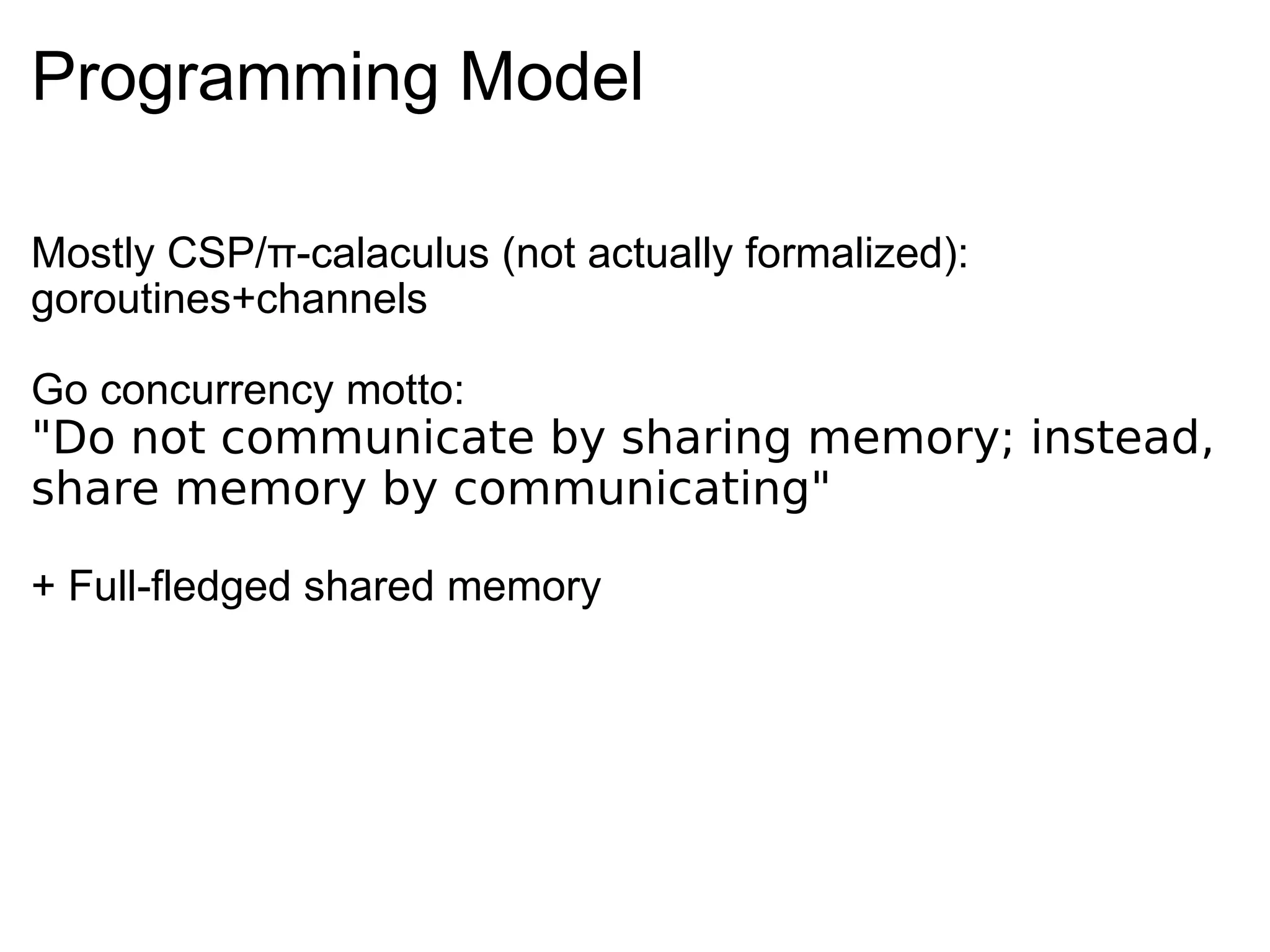
Programming Model Mostly CSP/π-calaculus (not actually formalized): goroutines+channels Go concurrency motto: "Do not communicate by sharing memory; instead, share memory by communicating" + Full-fledged shared memory
Goroutines Think  threads  (however no  join  operation) go  foo() go  logger.Printf("Hello, %s!", who) go  func() {      logger.Printf("Hello, %s!", who)      ... }()
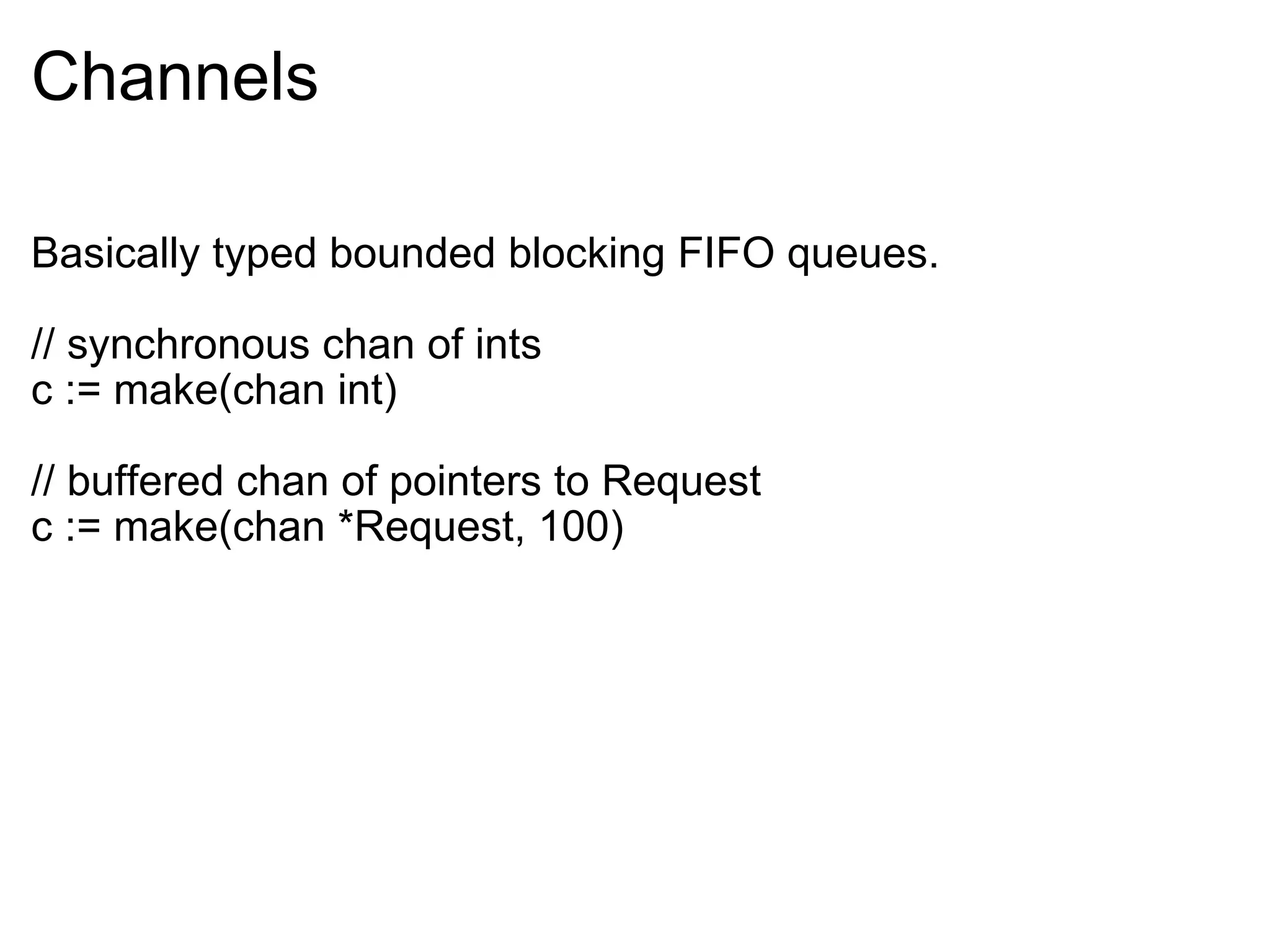
Channels Basically typed bounded blocking FIFO queues. // synchronous chan of ints c := make(chan int) // buffered chan of pointers to Request c := make(chan *Request, 100) 
Channels: First-class citizens You can pass them as function arguments, store in containers, pass via channels, etc. Moreover, channels are not tied to goroutines. Several goroutines can send/recv from a single channel.
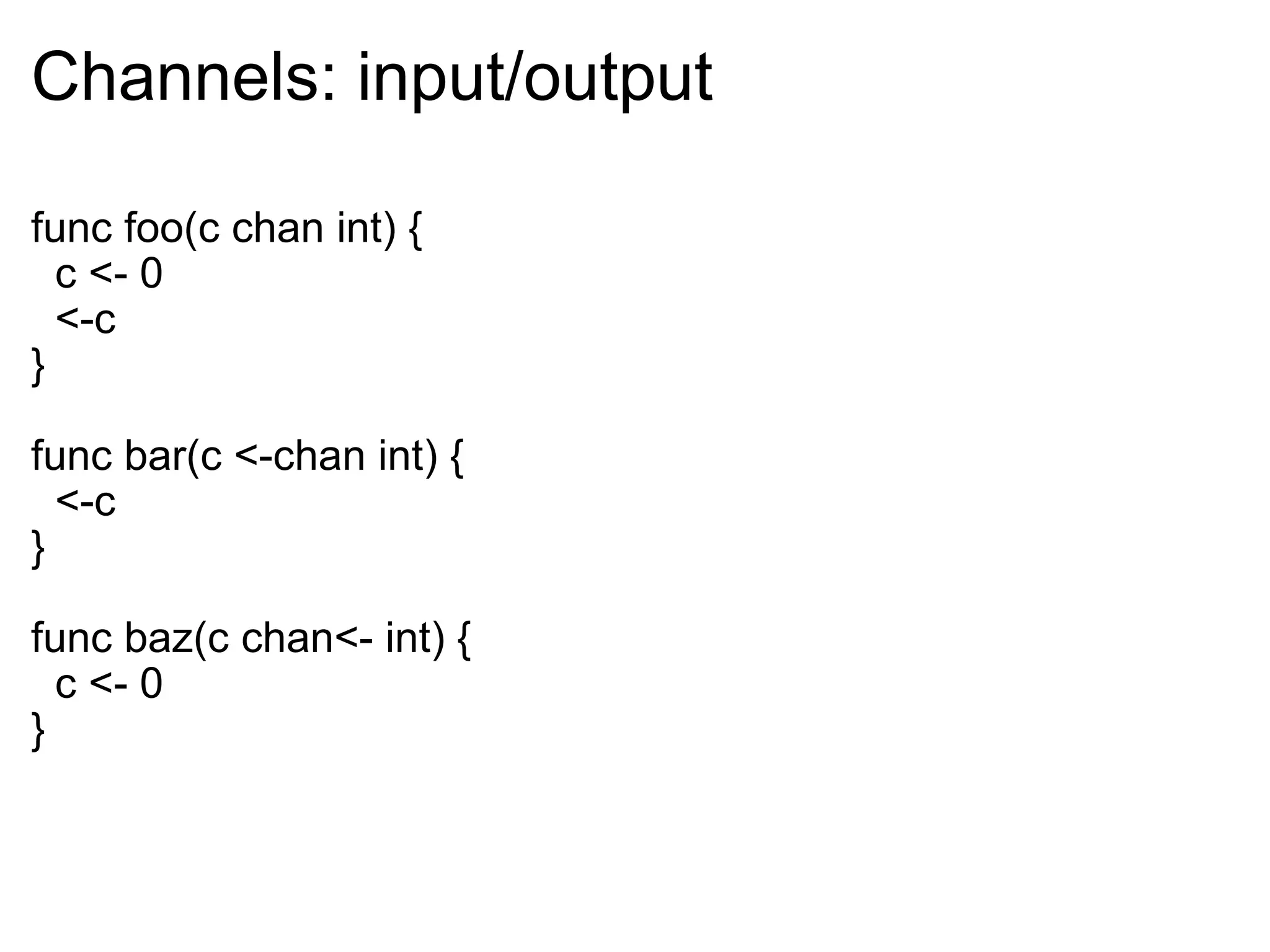
Channels: input/output func foo(c chan int) {    c <- 0    <-c } func bar(c <-chan int) {    <-c } func baz(c chan<- int) {    c <- 0 }
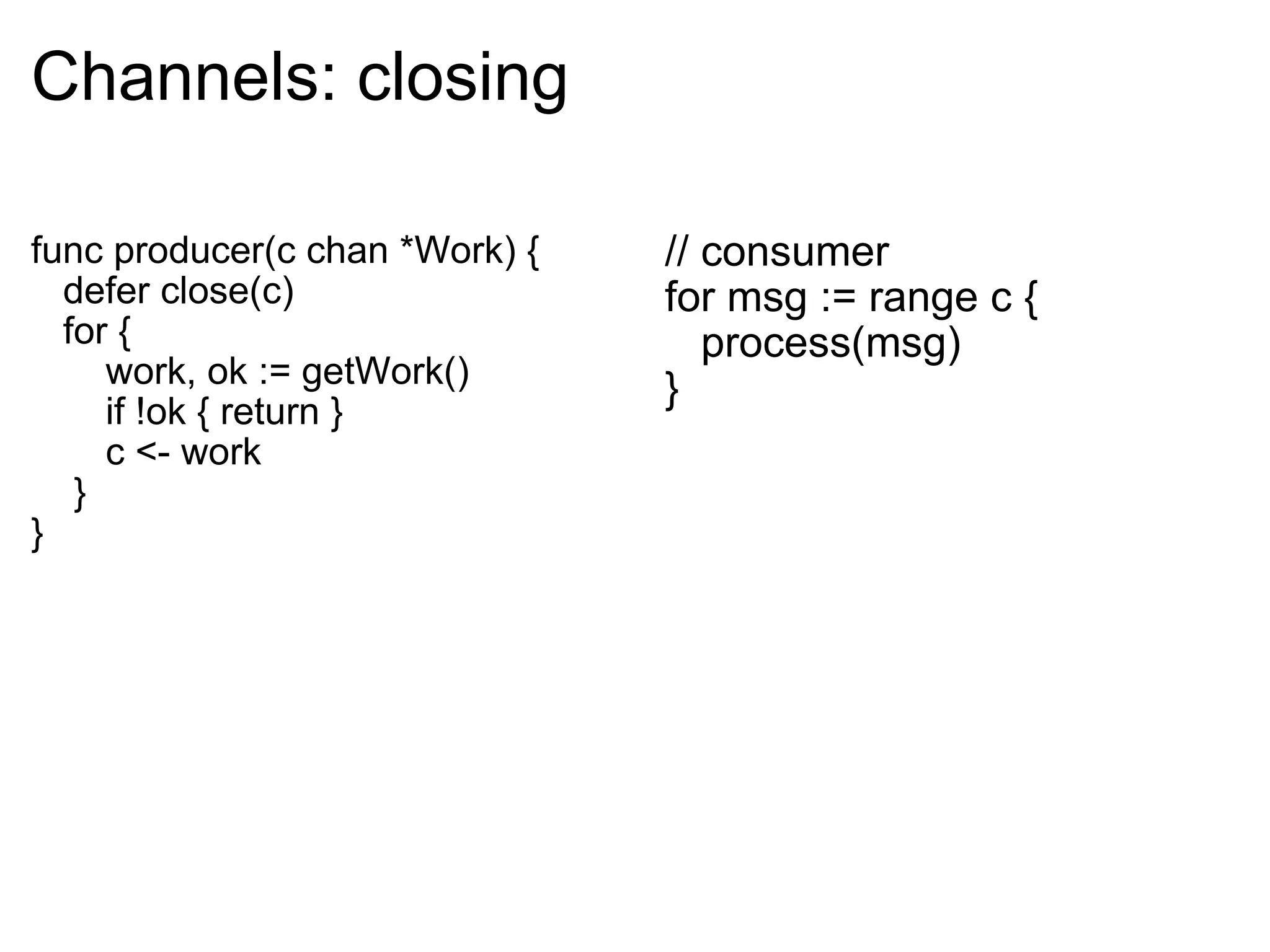
Channels: closing func producer(c chan *Work) {     defer close(c)     for {         work, ok := getWork()         if !ok { return }         c <- work      } } // consumer for msg := range c {     process(msg) }
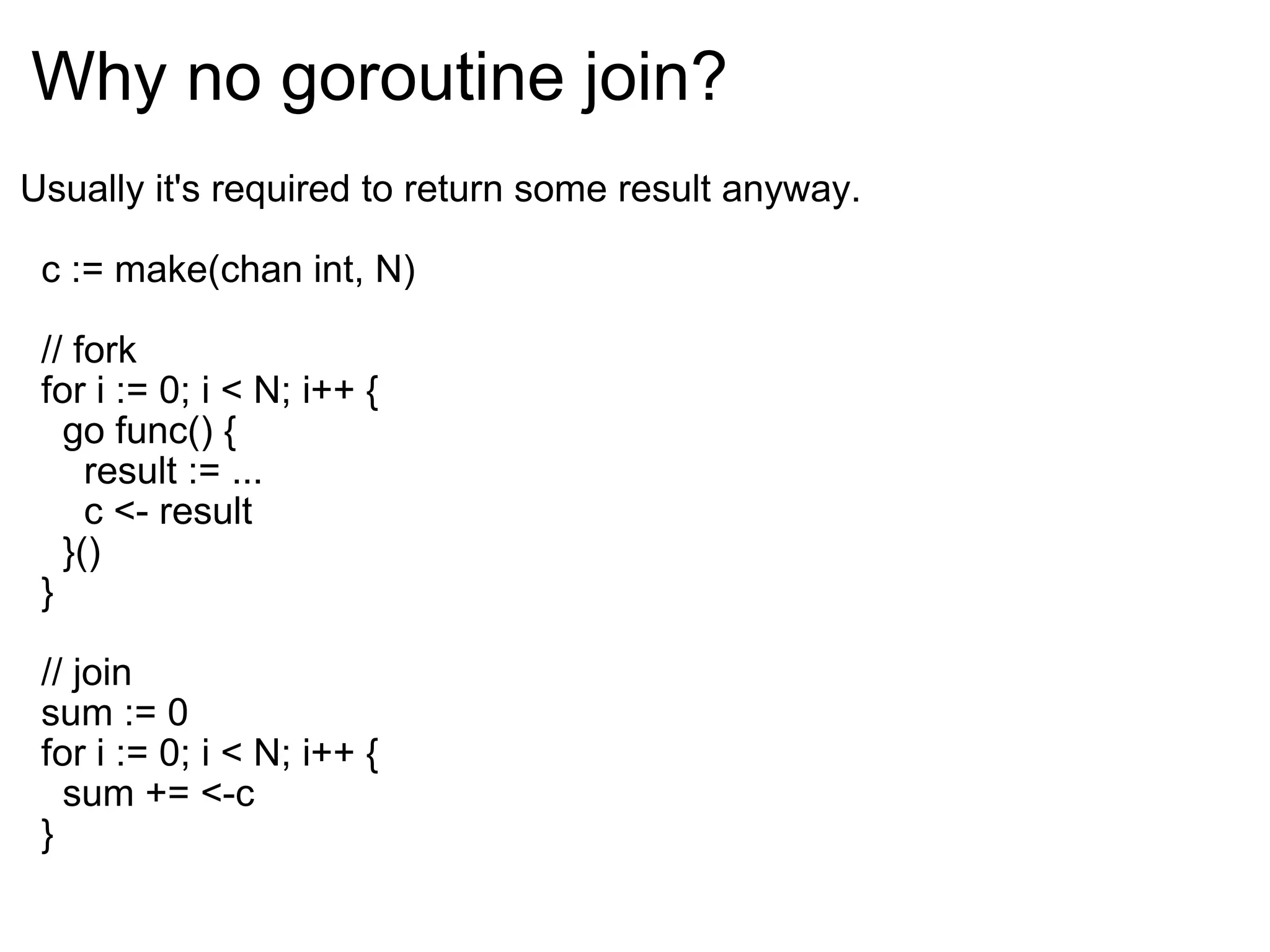
Why no goroutine join? Usually it's required to return some result anyway.    c := make(chan int, N)    // fork    for i := 0; i < N; i++ {      go func() {        result := ...        c <- result      }()    }    // join    sum := 0    for i := 0; i < N; i++ {      sum += <-c    }
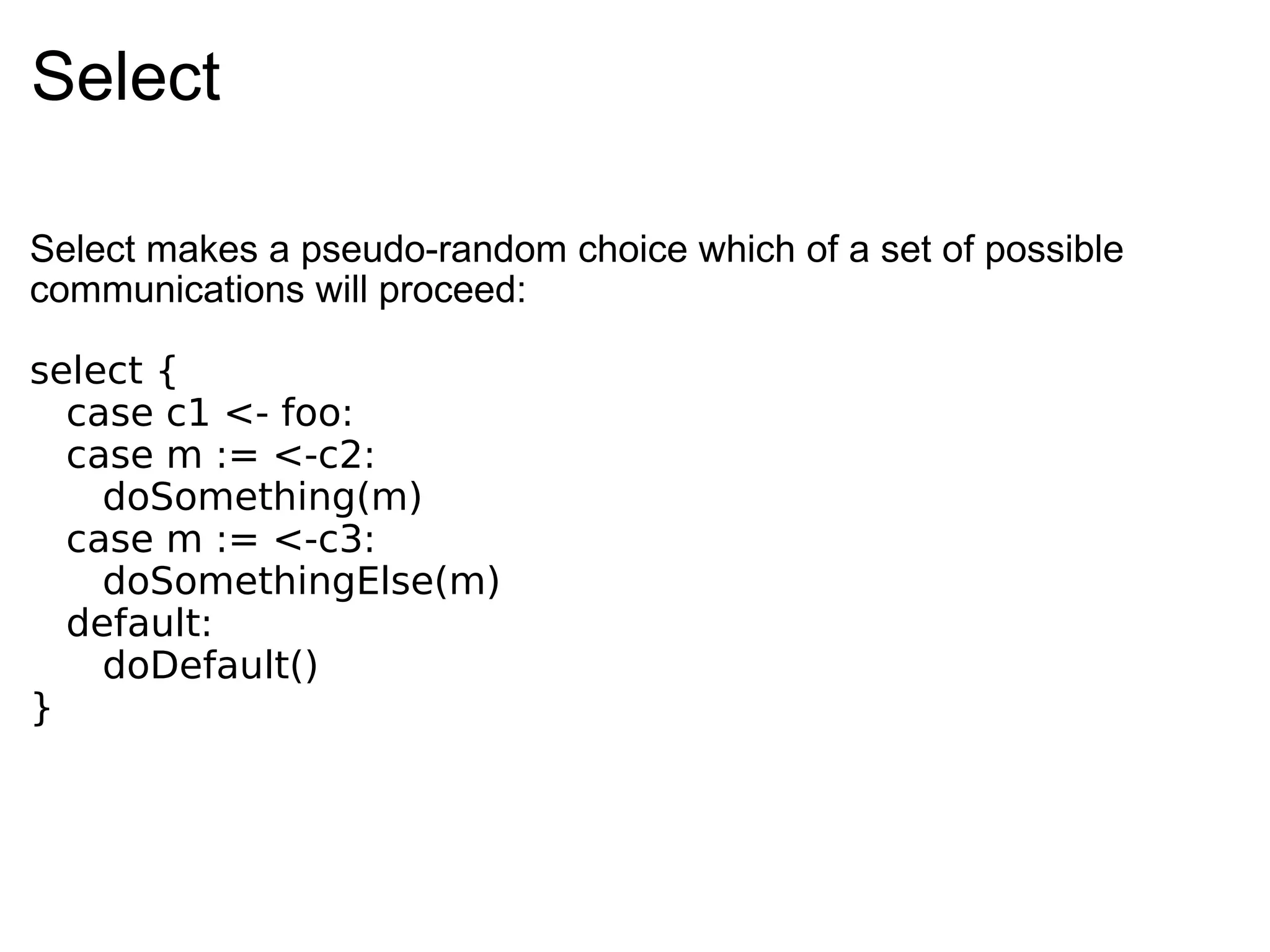
Select Select makes a pseudo-random choice which of a set of possible communications will proceed: select {   case c1 <- foo:    case m := <-c2:      doSomething(m)    case m := <-c3:      doSomethingElse(m)    default:      doDefault() }
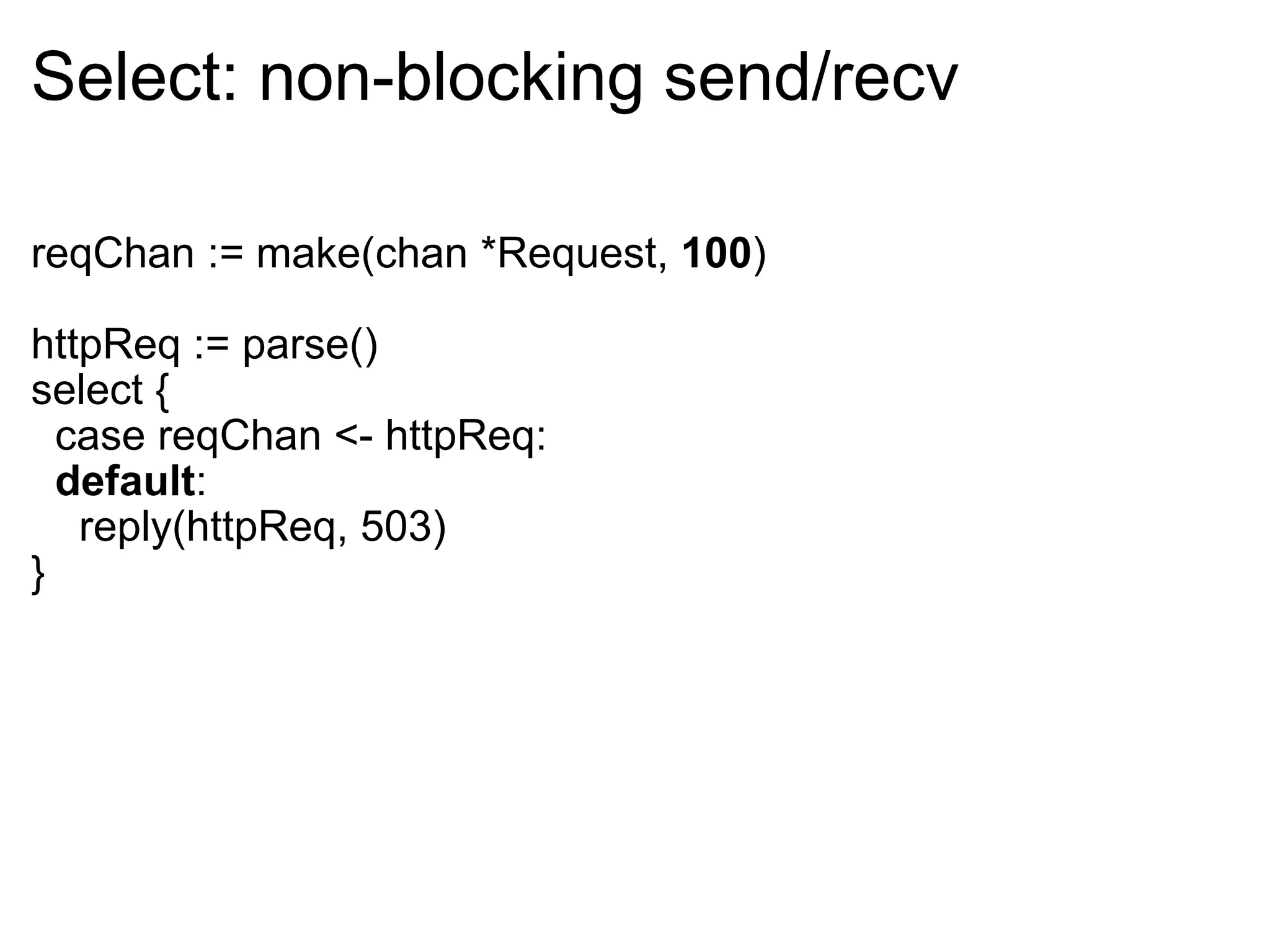
Select: non-blocking send/recv reqChan := make(chan *Request,  100 ) httpReq := parse() select {    case reqChan <- httpReq:    default :      reply(httpReq, 503) }
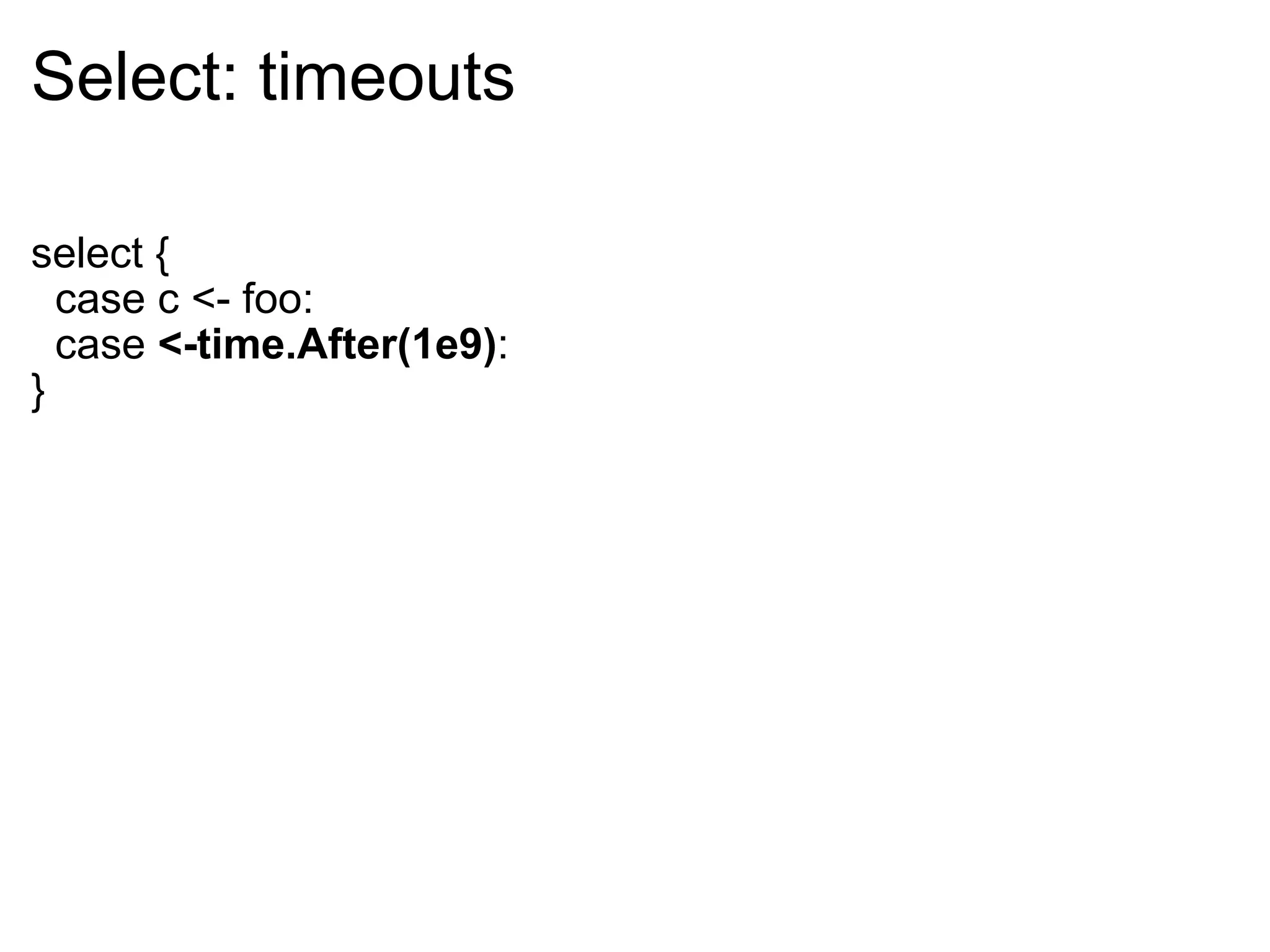
Select: timeouts select {    case c <- foo:    case  <-time.After(1e9) : }
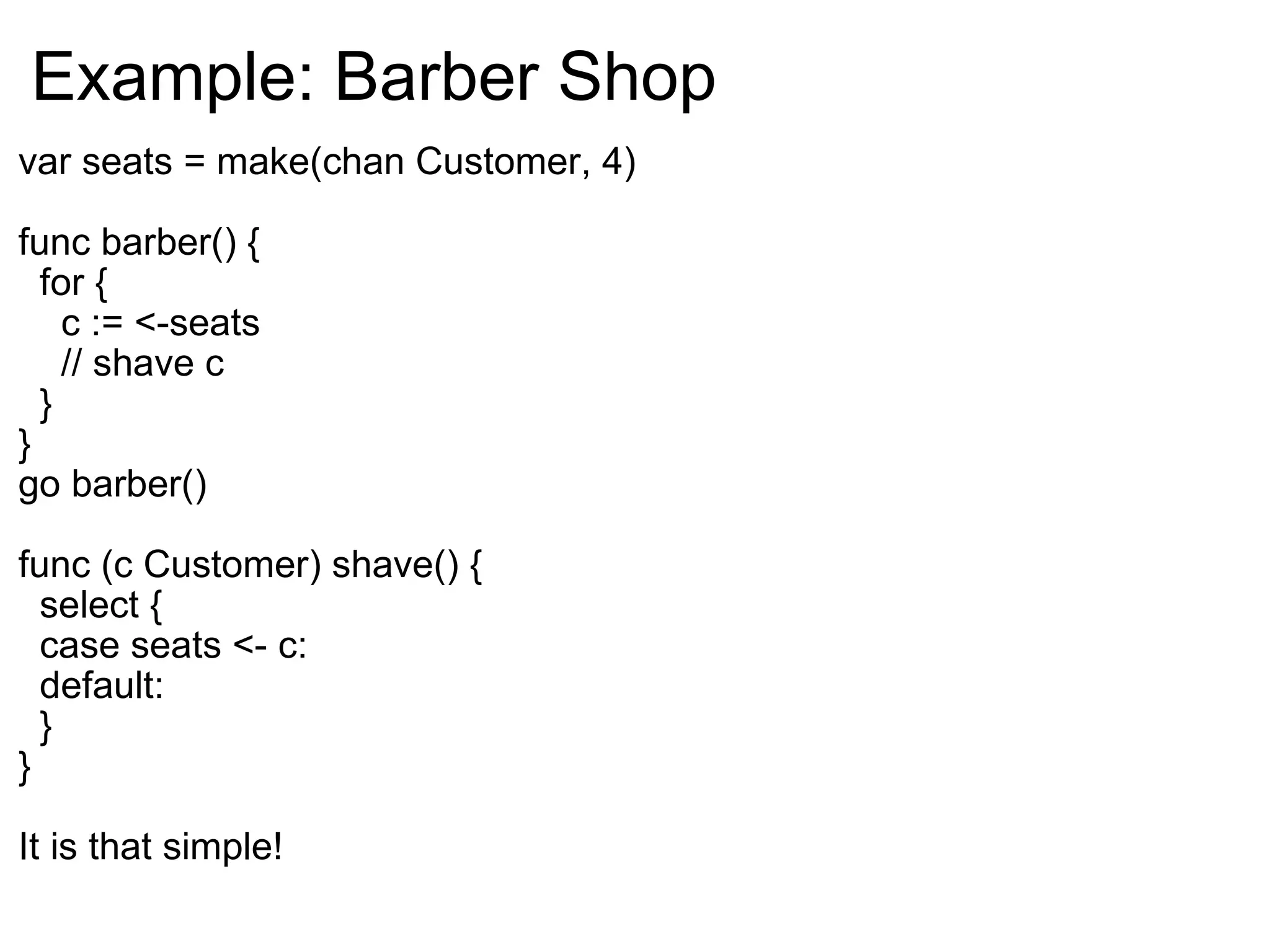
Example: Barber Shop var seats = make(chan Customer, 4) func barber() {    for {      c := <-seats      // shave c    } } go barber() func (c Customer) shave() {    select {    case seats <- c:    default:    } } It is that simple!
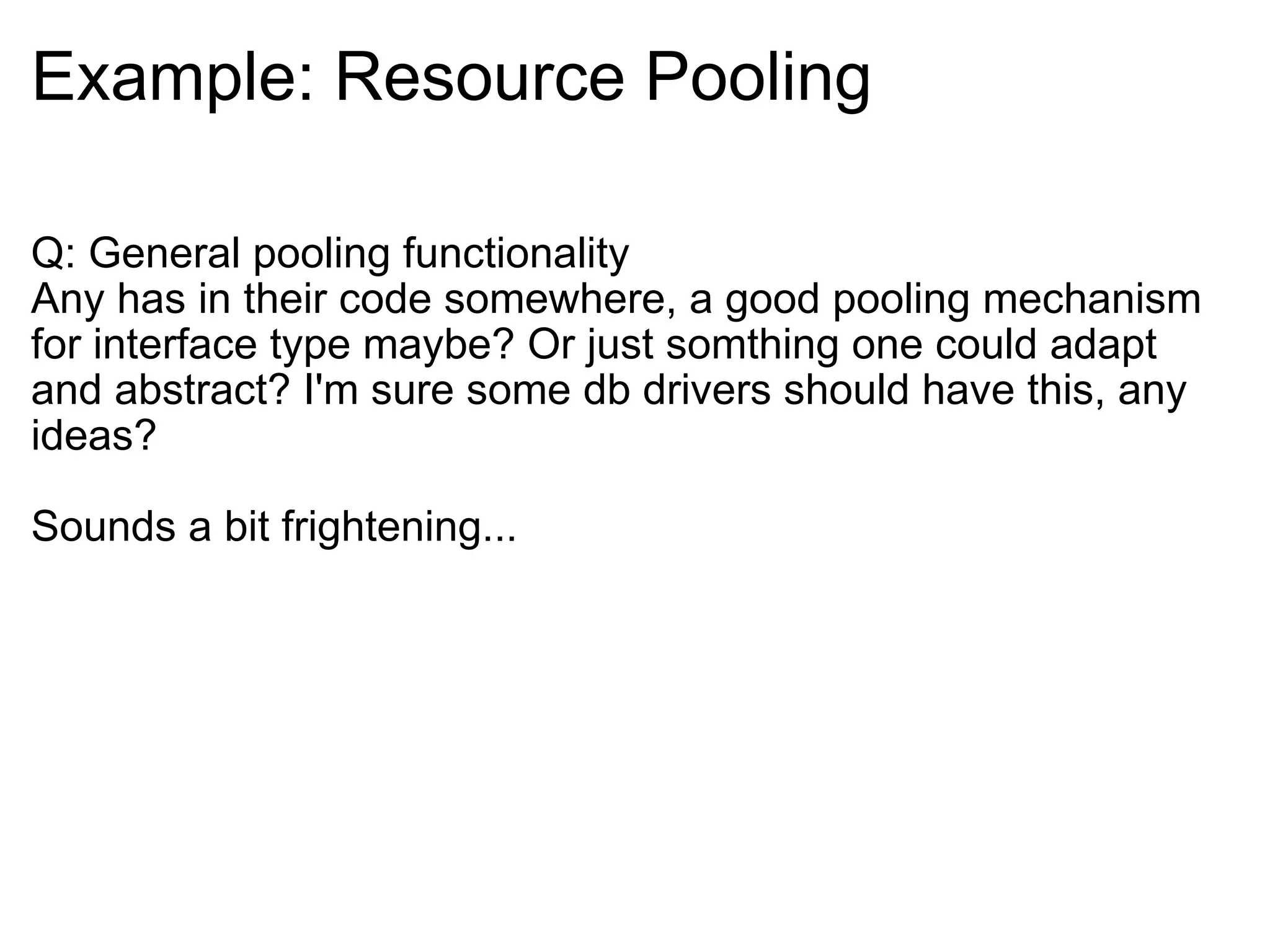
Example: Resource Pooling Q: General pooling functionality Any has in their code somewhere, a good pooling mechanism for interface type maybe? Or just somthing one could adapt and abstract? I'm sure some db drivers should have this, any ideas? Sounds a bit frightening...
Example: Resource Pooling (cont) The solution is just pool := make(chan *Resource, 100) Put  with [nonblocking] send. Get  with [nonblocking] recv. It is  that  simple! Haa, works like a charm. Go  makes things so nice and simple, yet so powerful! Thanks
Example: Actor-oriented programming type ReadReq struct {    key string    ack chan<- string } type WriteReq struct {    key, val string } c := make(chan  interface{} ) go func() {    m := make(map[string]string)    for {      switch r := (<-c).(type)  {      case ReadReq:        r.ack <- m[r.key]      case WriteReq:        m[r.key] = r.val      }    } }()
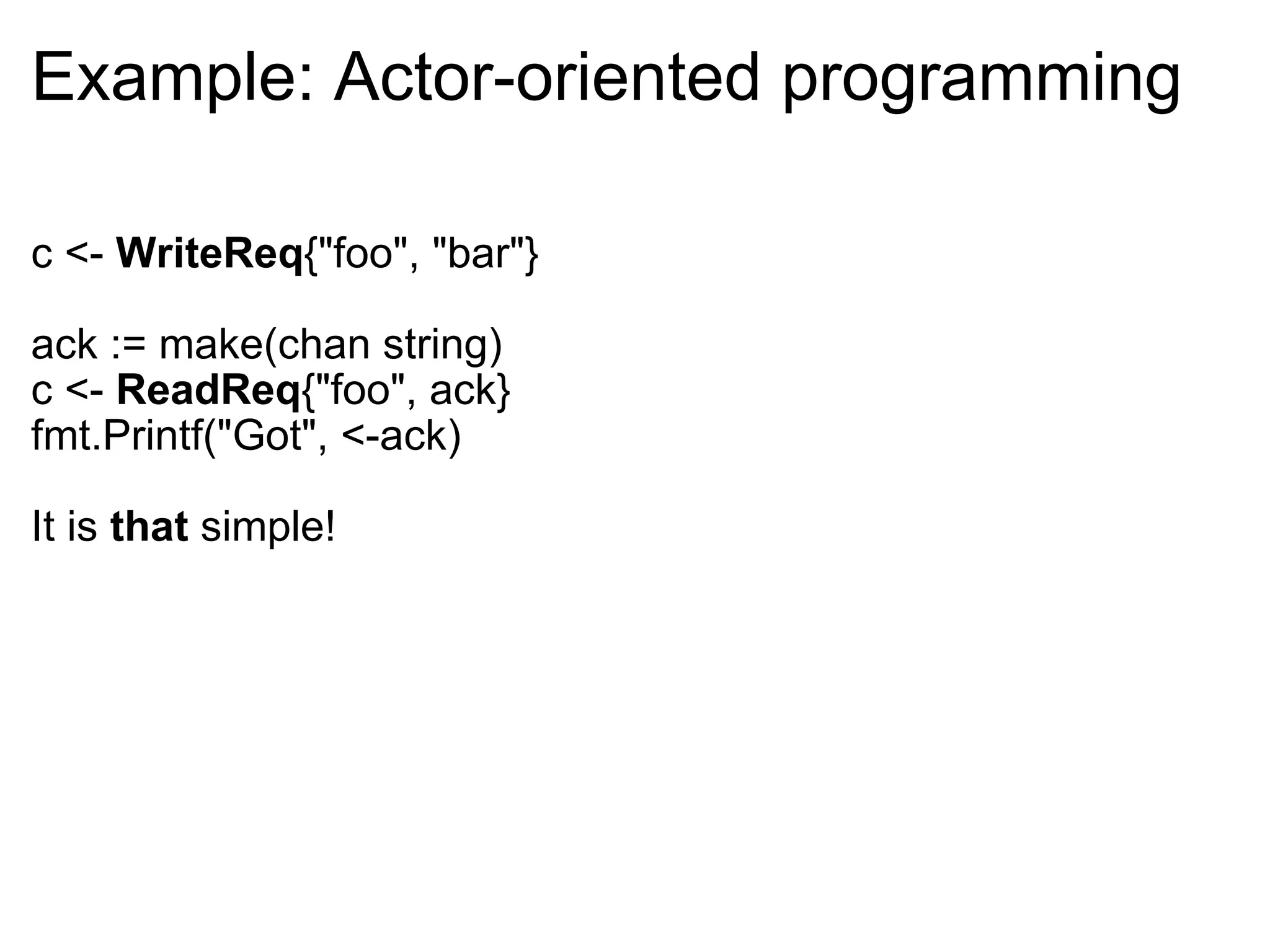
Example: Actor-oriented programming c <-  WriteReq {&quot;foo&quot;, &quot;bar&quot;} ack := make(chan string) c <-  ReadReq {&quot;foo&quot;, ack} fmt.Printf(&quot;Got&quot;, <-ack) It is  that  simple!
Example: Thread Pool [This page intentionally left blank]
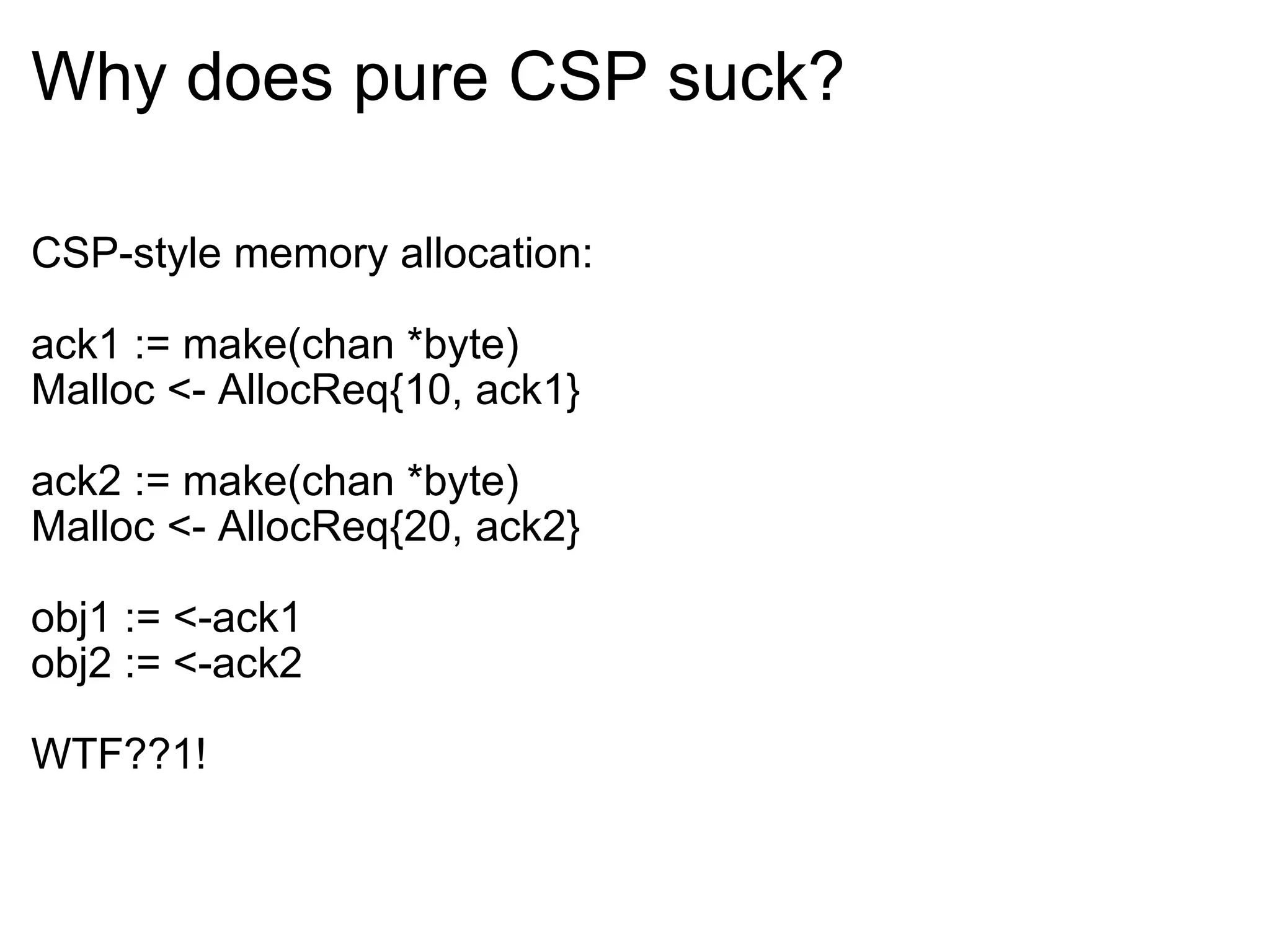
Why does pure CSP suck? CSP-style memory allocation: ack1 := make(chan *byte) Malloc <- AllocReq{10, ack1} ack2 := make(chan *byte) Malloc <- AllocReq{20, ack2} obj1 := <-ack1 obj2 := <-ack2 WTF??1!
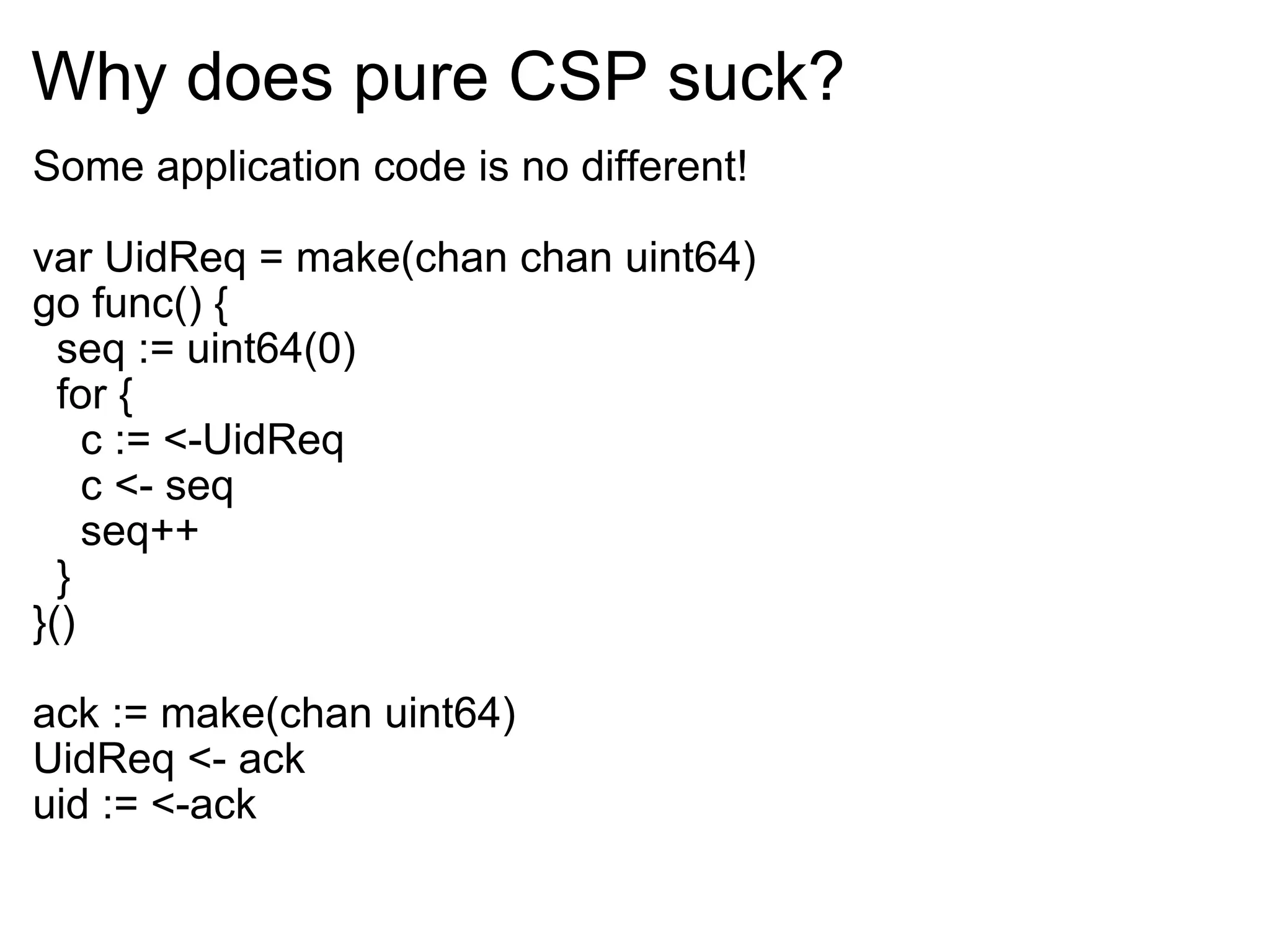
Why does pure CSP suck? Some application code is no different! var UidReq = make(chan chan uint64) go func() {    seq := uint64(0)    for {      c := <-UidReq      c <- seq      seq++    } }() ack := make(chan uint64) UidReq <- ack uid := <-ack
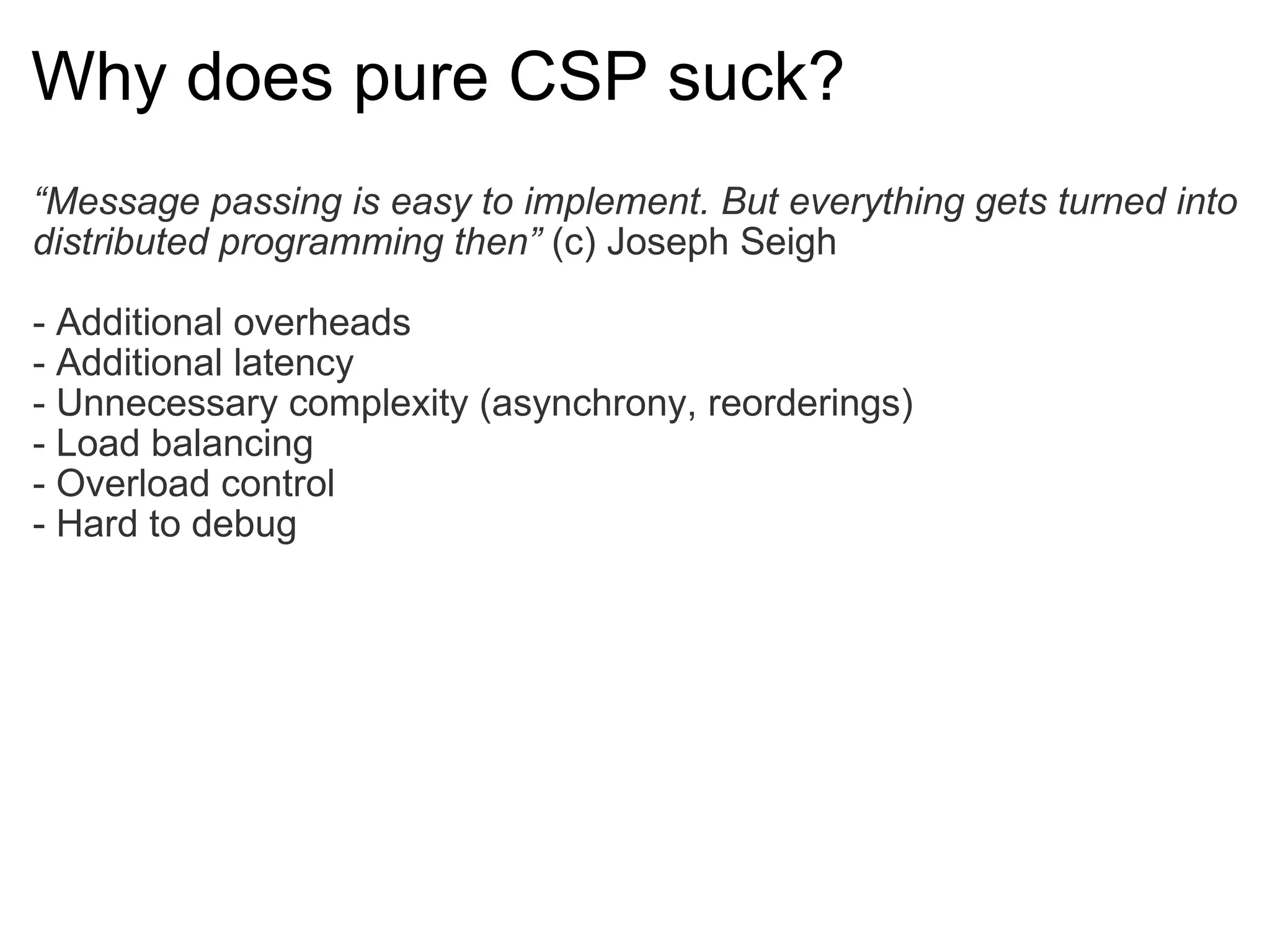
Why does pure CSP suck? “ Message passing is easy to implement. But everything gets turned into distributed programming then”  (c) Joseph Seigh - Additional overheads - Additional latency - Unnecessary complexity (asynchrony, reorderings) - Load balancing - Overload control - Hard to debug
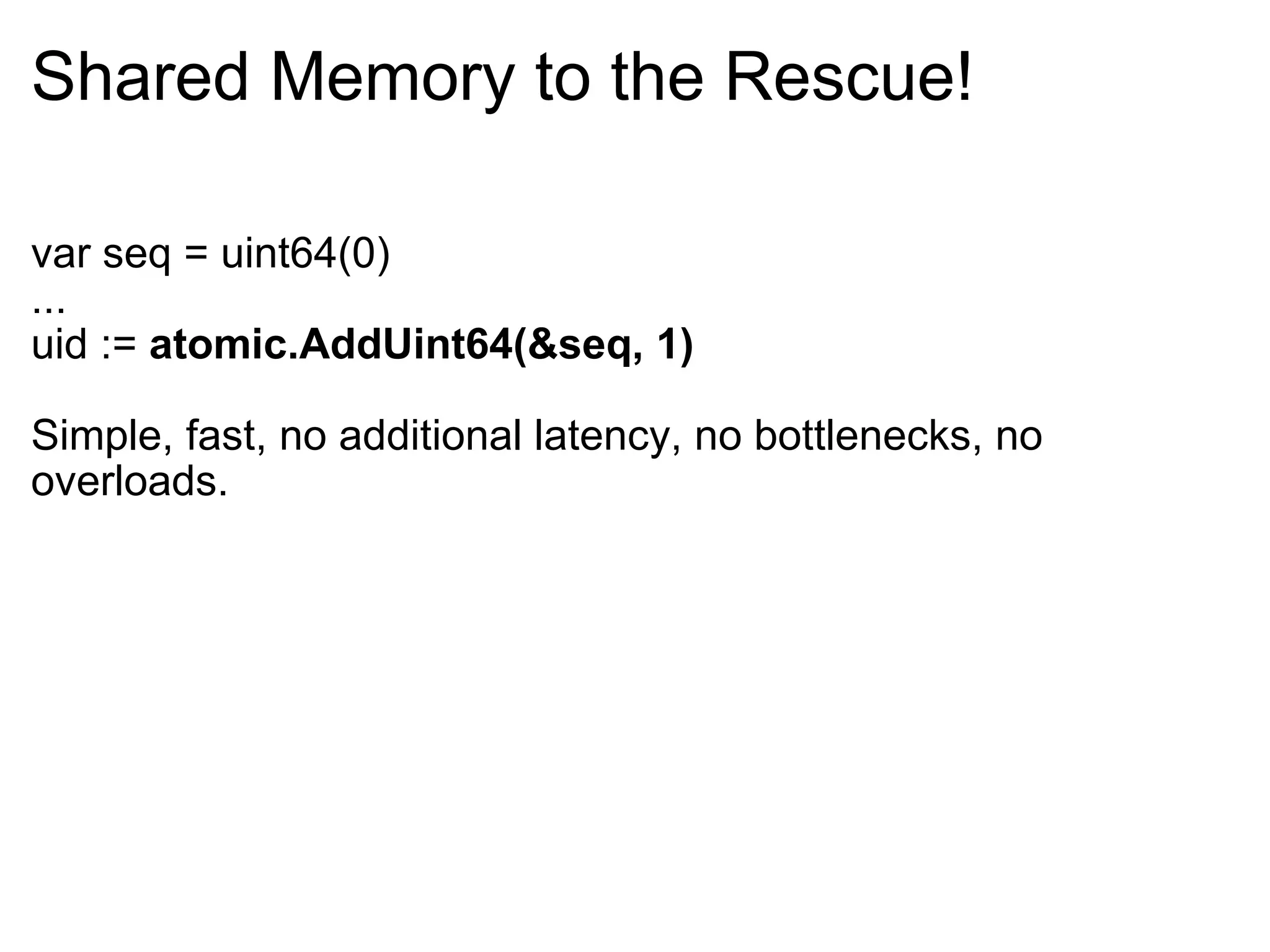
Shared Memory to the Rescue! var seq = uint64(0) ... uid :=  atomic.AddUint64(&seq, 1) Simple, fast, no additional latency, no bottlenecks, no overloads.
Shared Memory Primitives sync.Mutex sync.RWMutex sync.Cond sync.Once sync.WaitGroup runtime.Semacquire/Semrelease atomic.CompareAndSwap/Add/Load
Mutexes sync.Mutex is actually a cooperative binary semaphore - no ownership, no recursion. mtx. Lock () go  func() {      ...      mtx. Unlock () } mtx. Lock () func foo() {    mtx.Lock()    defer  mtx.Unlock()    ... }
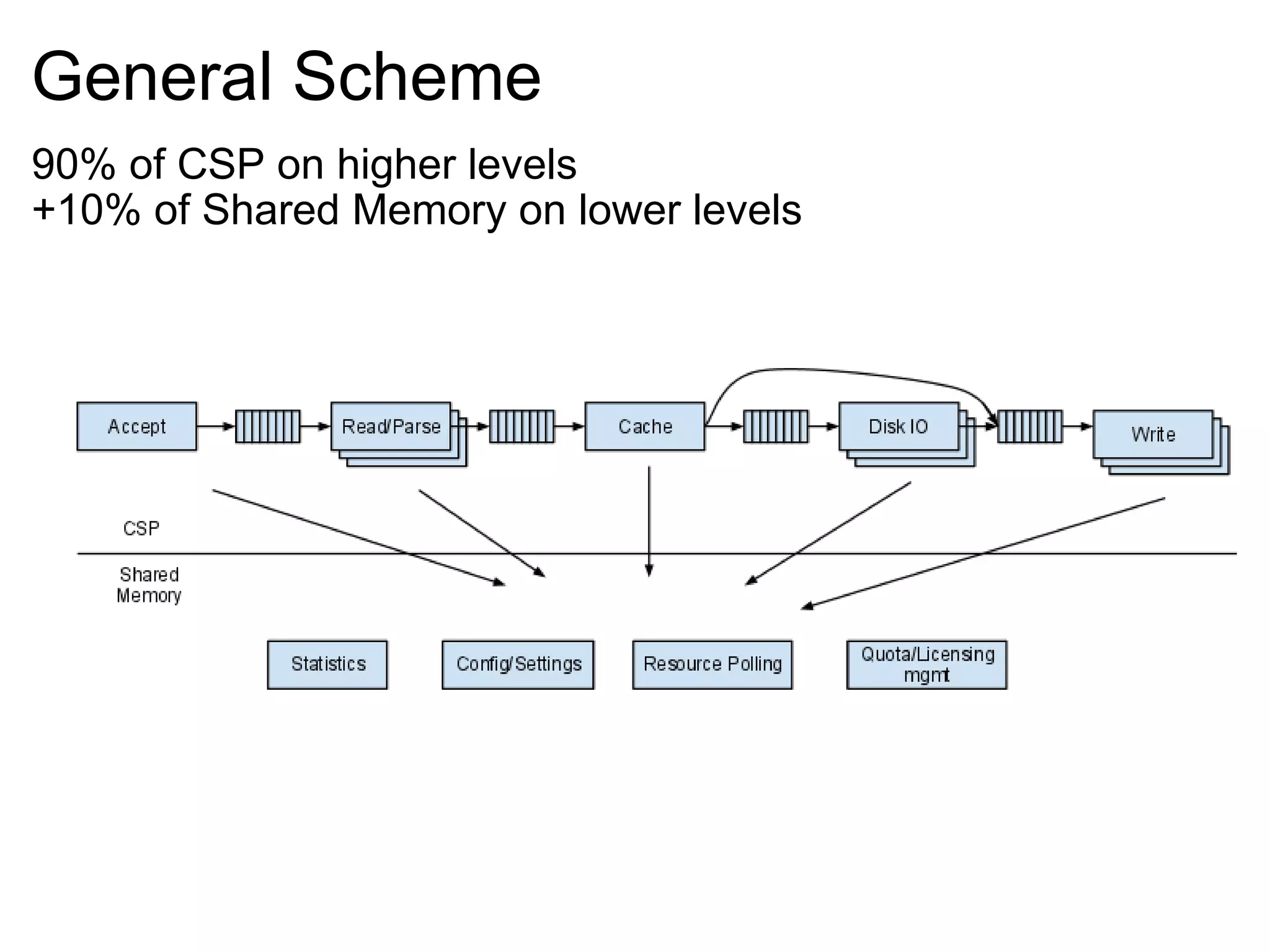
General Scheme 90% of CSP on higher levels +10% of Shared Memory on lower levels  
Race Detector for Go Currently under development in Google MSK (no obligations to deliver at this stage). The idea is to provide general support for dynamic analysis tools in Go compiler/runtime/libraries. And then attach almighty ThreadSanitizer technology to it. If/when committed to main branch, user just specifies a single compiler flag to enable it.
Scalability The goal of Go is to support scalable fine-grained concurrency. But it is [was] not yet there. Submitted about 50 scalability-related CLs. Rewrote all sync primitives (mutex, semaphore, once, etc), improve scalability of chan/select, memory allocation, stack mgmt, etc. &quot;I've just run a real world benchmark provided by someone using mgo with the r59 release, and it took about 5 seconds out of 20, without any changes in the code.&quot; Still to improve goroutine scheduler.
  Thanks!

Concurrency in go

  • 1.
    Concurrency in Go(or, Erlang done right)
  • 2.
    Programming Model MostlyCSP/π-calaculus (not actually formalized): goroutines+channels Go concurrency motto: &quot;Do not communicate by sharing memory; instead, share memory by communicating&quot; + Full-fledged shared memory
  • 3.
    Goroutines Think threads (however no join operation) go foo() go logger.Printf(&quot;Hello, %s!&quot;, who) go func() {      logger.Printf(&quot;Hello, %s!&quot;, who)     ... }()
  • 4.
    Channels Basically typedbounded blocking FIFO queues. // synchronous chan of ints c := make(chan int) // buffered chan of pointers to Request c := make(chan *Request, 100) 
  • 5.
    Channels: First-class citizensYou can pass them as function arguments, store in containers, pass via channels, etc. Moreover, channels are not tied to goroutines. Several goroutines can send/recv from a single channel.
  • 6.
    Channels: input/output funcfoo(c chan int) {   c <- 0   <-c } func bar(c <-chan int) {   <-c } func baz(c chan<- int) {   c <- 0 }
  • 7.
    Channels: closing funcproducer(c chan *Work) {     defer close(c)     for {         work, ok := getWork()         if !ok { return }         c <- work     } } // consumer for msg := range c {     process(msg) }
  • 8.
    Why no goroutinejoin? Usually it's required to return some result anyway.   c := make(chan int, N)   // fork   for i := 0; i < N; i++ {     go func() {       result := ...       c <- result     }()   }   // join   sum := 0   for i := 0; i < N; i++ {     sum += <-c   }
  • 9.
    Select Select makesa pseudo-random choice which of a set of possible communications will proceed: select {   case c1 <- foo:   case m := <-c2:     doSomething(m)   case m := <-c3:     doSomethingElse(m)   default:     doDefault() }
  • 10.
    Select: non-blocking send/recvreqChan := make(chan *Request, 100 ) httpReq := parse() select {   case reqChan <- httpReq:   default :     reply(httpReq, 503) }
  • 11.
    Select: timeouts select{   case c <- foo:   case <-time.After(1e9) : }
  • 12.
    Example: Barber Shopvar seats = make(chan Customer, 4) func barber() {   for {     c := <-seats     // shave c   } } go barber() func (c Customer) shave() {   select {   case seats <- c:   default:   } } It is that simple!
  • 13.
    Example: Resource PoolingQ: General pooling functionality Any has in their code somewhere, a good pooling mechanism for interface type maybe? Or just somthing one could adapt and abstract? I'm sure some db drivers should have this, any ideas? Sounds a bit frightening...
  • 14.
    Example: Resource Pooling(cont) The solution is just pool := make(chan *Resource, 100) Put with [nonblocking] send. Get with [nonblocking] recv. It is that simple! Haa, works like a charm. Go  makes things so nice and simple, yet so powerful! Thanks
  • 15.
    Example: Actor-oriented programmingtype ReadReq struct {   key string   ack chan<- string } type WriteReq struct {   key, val string } c := make(chan interface{} ) go func() {   m := make(map[string]string)   for {     switch r := (<-c).(type) {     case ReadReq:       r.ack <- m[r.key]     case WriteReq:       m[r.key] = r.val     }   } }()
  • 16.
    Example: Actor-oriented programmingc <- WriteReq {&quot;foo&quot;, &quot;bar&quot;} ack := make(chan string) c <- ReadReq {&quot;foo&quot;, ack} fmt.Printf(&quot;Got&quot;, <-ack) It is that simple!
  • 17.
    Example: Thread Pool[This page intentionally left blank]
  • 18.
    Why does pureCSP suck? CSP-style memory allocation: ack1 := make(chan *byte) Malloc <- AllocReq{10, ack1} ack2 := make(chan *byte) Malloc <- AllocReq{20, ack2} obj1 := <-ack1 obj2 := <-ack2 WTF??1!
  • 19.
    Why does pureCSP suck? Some application code is no different! var UidReq = make(chan chan uint64) go func() {   seq := uint64(0)   for {     c := <-UidReq     c <- seq     seq++   } }() ack := make(chan uint64) UidReq <- ack uid := <-ack
  • 20.
    Why does pureCSP suck? “ Message passing is easy to implement. But everything gets turned into distributed programming then” (c) Joseph Seigh - Additional overheads - Additional latency - Unnecessary complexity (asynchrony, reorderings) - Load balancing - Overload control - Hard to debug
  • 21.
    Shared Memory tothe Rescue! var seq = uint64(0) ... uid := atomic.AddUint64(&seq, 1) Simple, fast, no additional latency, no bottlenecks, no overloads.
  • 22.
    Shared Memory Primitivessync.Mutex sync.RWMutex sync.Cond sync.Once sync.WaitGroup runtime.Semacquire/Semrelease atomic.CompareAndSwap/Add/Load
  • 23.
    Mutexes sync.Mutex isactually a cooperative binary semaphore - no ownership, no recursion. mtx. Lock () go func() {     ...     mtx. Unlock () } mtx. Lock () func foo() {   mtx.Lock()   defer mtx.Unlock()   ... }
  • 24.
    General Scheme 90%of CSP on higher levels +10% of Shared Memory on lower levels  
  • 25.
    Race Detector forGo Currently under development in Google MSK (no obligations to deliver at this stage). The idea is to provide general support for dynamic analysis tools in Go compiler/runtime/libraries. And then attach almighty ThreadSanitizer technology to it. If/when committed to main branch, user just specifies a single compiler flag to enable it.
  • 26.
    Scalability The goalof Go is to support scalable fine-grained concurrency. But it is [was] not yet there. Submitted about 50 scalability-related CLs. Rewrote all sync primitives (mutex, semaphore, once, etc), improve scalability of chan/select, memory allocation, stack mgmt, etc. &quot;I've just run a real world benchmark provided by someone using mgo with the r59 release, and it took about 5 seconds out of 20, without any changes in the code.&quot; Still to improve goroutine scheduler.
  • 27.

Editor's Notes

  • #10 Like switch with all cases referring to communication.
  • #18 Why no thread pool? 1. Too many examples 2. It&apos;s trivial in Go (chan func() + N goroutines) 3. You don&apos;t really need it: go func()