Go 1.8 Release Party
Golang Brno meetup
28 February 2017
Rodolfo Carvalho
Red Hat
License and Materials
This presentation is licensed under the Creative Commons Attribution-ShareAlike 4.0
International licence.
The materials for this presentation are available on GitHub:
github.com/davecheney/go-1.8-release-party
You are encouraged to remix, transform, or build upon the material, providing you distribute
your contributions under the same license.
If you have suggestions or corrections to this presentation, please raise an issue on the
GitHub project.
Go 1.8
Go 1.8 is released!
Go 1.8 Announcement
Go 1.8 is the 9th release in the Go 1 series. It follows from the previous version, Go 1.7,
released on the 16th of August, 2016
Go 1.8 Release Notes
What's changed?
So, what's happened in the last six months?
Performance
Compiler changes
Tool changes
Runtime changes
Changes to the standard library
Performance
Performance
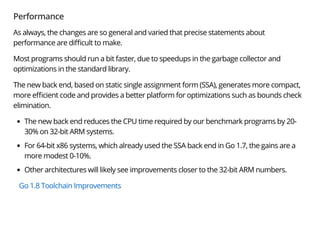
As always, the changes are so general and varied that precise statements about
performance are di cult to make.
Most programs should run a bit faster, due to speedups in the garbage collector and
optimizations in the standard library.
The new back end, based on static single assignment form (SSA), generates more compact,
more e cient code and provides a better platform for optimizations such as bounds check
elimination.
The new back end reduces the CPU time required by our benchmark programs by 20-
30% on 32-bit ARM systems.
For 64-bit x86 systems, which already used the SSA back end in Go 1.7, the gains are a
more modest 0-10%.
Other architectures will likely see improvements closer to the 32-bit ARM numbers.
Go 1.8 Toolchain Improvements
Garbage Collector
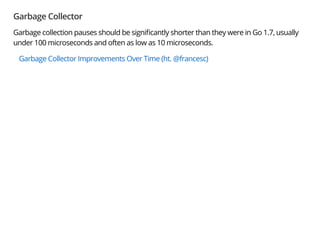
Garbage collection pauses should be signi cantly shorter than they were in Go 1.7, usually
under 100 microseconds and often as low as 10 microseconds.
Garbage Collector Improvements Over Time (ht. @francesc)
Defer
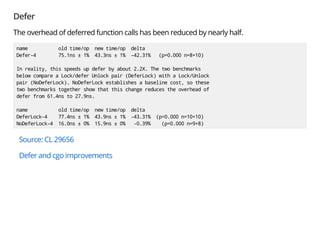
The overhead of deferred function calls has been reduced by nearly half.
name old time/op new time/op delta
Defer-4 75.1ns ± 1% 43.3ns ± 1% -42.31% (p=0.000 n=8+10)
In reality, this speeds up defer by about 2.2X. The two benchmarks
below compare a Lock/defer Unlock pair (DeferLock) with a Lock/Unlock
pair (NoDeferLock). NoDeferLock establishes a baseline cost, so these
two benchmarks together show that this change reduces the overhead of
defer from 61.4ns to 27.9ns.
name old time/op new time/op delta
DeferLock-4 77.4ns ± 1% 43.9ns ± 1% -43.31% (p=0.000 n=10+10)
NoDeferLock-4 16.0ns ± 0% 15.9ns ± 0% -0.39% (p=0.000 n=9+8)
Source: CL 29656
Defer and cgo improvements
Cgo
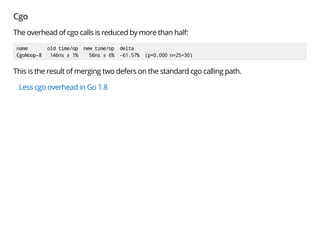
The overhead of cgo calls is reduced by more than half:
name old time/op new time/op delta
CgoNoop-8 146ns ± 1% 56ns ± 6% -61.57% (p=0.000 n=25+30)
This is the result of merging two defers on the standard cgo calling path.
Less cgo overhead in Go 1.8
Miscellaneous performance improvements
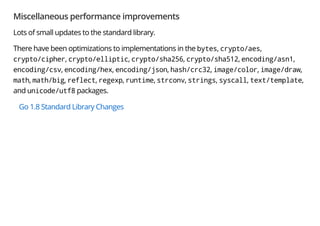
Lots of small updates to the standard library.
There have been optimizations to implementations in the bytes, crypto/aes,
crypto/cipher, crypto/elliptic, crypto/sha256, crypto/sha512, encoding/asn1,
encoding/csv, encoding/hex, encoding/json, hash/crc32, image/color, image/draw,
math, math/big, reflect, regexp, runtime, strconv, strings, syscall, text/template,
and unicode/utf8 packages.
Go 1.8 Standard Library Changes
Compiler changes
SSA backend
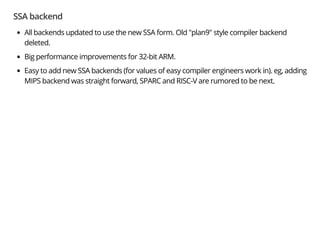
All backends updated to use the new SSA form. Old "plan9" style compiler backend
deleted.
Big performance improvements for 32-bit ARM.
Easy to add new SSA backends (for values of easy compiler engineers work in). eg, adding
MIPS backend was straight forward, SPARC and RISC-V are rumored to be next.
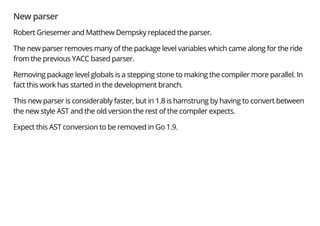
New parser
Robert Griesemer and Matthew Dempsky replaced the parser.
The new parser removes many of the package level variables which came along for the ride
from the previous YACC based parser.
Removing package level globals is a stepping stone to making the compiler more parallel. In
fact this work has started in the development branch.
This new parser is considerably faster, but in 1.8 is hamstrung by having to convert between
the new style AST and the old version the rest of the compiler expects.
Expect this AST conversion to be removed in Go 1.9.
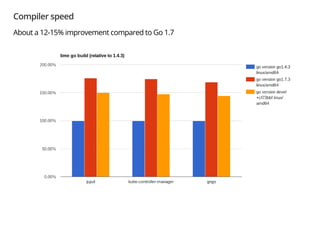
Compiler speed
About a 12-15% improvement compared to Go 1.7
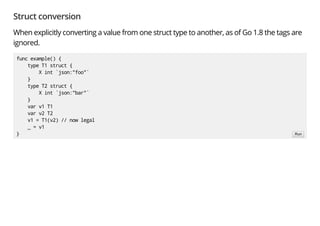
Struct conversion
When explicitly converting a value from one struct type to another, as of Go 1.8 the tags are
ignored.
func example() {
type T1 struct {
X int `json:"foo"`
}
type T2 struct {
X int `json:"bar"`
}
var v1 T1
var v2 T2
v1 = T1(v2) // now legal
_ = v1
} Run
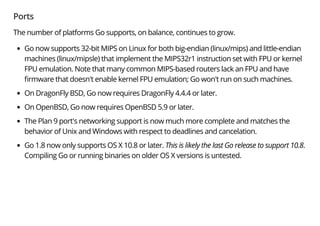
Ports
The number of platforms Go supports, on balance, continues to grow.
Go now supports 32-bit MIPS on Linux for both big-endian (linux/mips) and little-endian
machines (linux/mipsle) that implement the MIPS32r1 instruction set with FPU or kernel
FPU emulation. Note that many common MIPS-based routers lack an FPU and have
rmware that doesn't enable kernel FPU emulation; Go won't run on such machines.
On DragonFly BSD, Go now requires DragonFly 4.4.4 or later.
On OpenBSD, Go now requires OpenBSD 5.9 or later.
The Plan 9 port's networking support is now much more complete and matches the
behavior of Unix and Windows with respect to deadlines and cancelation.
Go 1.8 now only supports OS X 10.8 or later. This is likely the last Go release to support 10.8.
Compiling Go or running binaries on older OS X versions is untested.
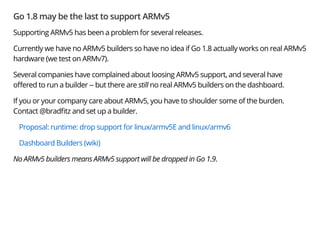
Go 1.8 may be the last to support ARMv5
Supporting ARMv5 has been a problem for several releases.
Currently we have no ARMv5 builders so have no idea if Go 1.8 actually works on real ARMv5
hardware (we test on ARMv7).
Several companies have complained about loosing ARMv5 support, and several have
o ered to run a builder -- but there are still no real ARMv5 builders on the dashboard.
If you or your company care about ARMv5, you have to shoulder some of the burden.
Contact @brad tz and set up a builder.
Proposal: runtime: drop support for linux/armv5E and linux/armv6
Dashboard Builders (wiki)
No ARMv5 builders means ARMv5 support will be dropped in Go 1.9.
Tool changes
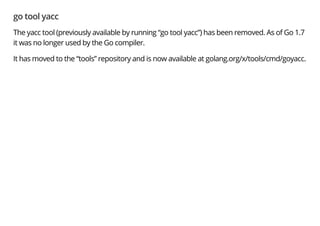
go tool yacc
The yacc tool (previously available by running “go tool yacc”) has been removed. As of Go 1.7
it was no longer used by the Go compiler.
It has moved to the “tools” repository and is now available at golang.org/x/tools/cmd/goyacc.
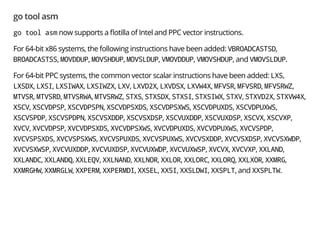
go tool asm
go tool asm now supports a otilla of Intel and PPC vector instructions.
For 64-bit x86 systems, the following instructions have been added: VBROADCASTSD,
BROADCASTSS, MOVDDUP, MOVSHDUP, MOVSLDUP, VMOVDDUP, VMOVSHDUP, and VMOVSLDUP.
For 64-bit PPC systems, the common vector scalar instructions have been added: LXS,
LXSDX, LXSI, LXSIWAX, LXSIWZX, LXV, LXVD2X, LXVDSX, LXVW4X, MFVSR, MFVSRD, MFVSRWZ,
MTVSR, MTVSRD, MTVSRWA, MTVSRWZ, STXS, STXSDX, STXSI, STXSIWX, STXV, STXVD2X, STXVW4X,
XSCV, XSCVDPSP, XSCVDPSPN, XSCVDPSXDS, XSCVDPSXWS, XSCVDPUXDS, XSCVDPUXWS,
XSCVSPDP, XSCVSPDPN, XSCVSXDDP, XSCVSXDSP, XSCVUXDDP, XSCVUXDSP, XSCVX, XSCVXP,
XVCV, XVCVDPSP, XVCVDPSXDS, XVCVDPSXWS, XVCVDPUXDS, XVCVDPUXWS, XVCVSPDP,
XVCVSPSXDS, XVCVSPSXWS, XVCVSPUXDS, XVCVSPUXWS, XVCVSXDDP, XVCVSXDSP, XVCVSXWDP,
XVCVSXWSP, XVCVUXDDP, XVCVUXDSP, XVCVUXWDP, XVCVUXWSP, XVCVX, XVCVXP, XXLAND,
XXLANDC, XXLANDQ, XXLEQV, XXLNAND, XXLNOR, XXLOR, XXLORC, XXLORQ, XXLXOR, XXMRG,
XXMRGHW, XXMRGLW, XXPERM, XXPERMDI, XXSEL, XXSI, XXSLDWI, XXSPLT, and XXSPLTW.
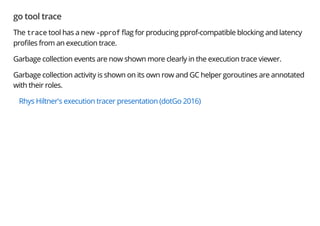
go tool trace
The trace tool has a new -pprof ag for producing pprof-compatible blocking and latency
pro les from an execution trace.
Garbage collection events are now shown more clearly in the execution trace viewer.
Garbage collection activity is shown on its own row and GC helper goroutines are annotated
with their roles.
Rhys Hiltner's execution tracer presentation (dotGo 2016)
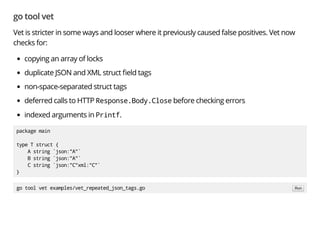
go tool vet
Vet is stricter in some ways and looser where it previously caused false positives. Vet now
checks for:
copying an array of locks
duplicate JSON and XML struct eld tags
non-space-separated struct tags
deferred calls to HTTP Response.Body.Close before checking errors
indexed arguments in Printf.
package main
type T struct {
A string `json:"A"`
B string `json:"A"`
C string `json:"C"xml:"C"`
}
go tool vet examples/vet_repeated_json_tags.go Run
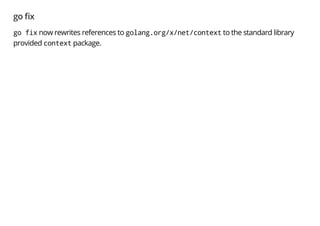
go x
go fix now rewrites references to golang.org/x/net/context to the standard library
provided context package.
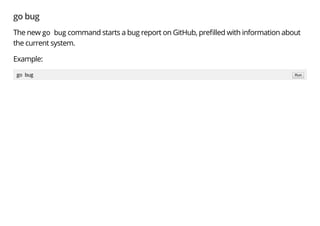
go bug
The new go bug command starts a bug report on GitHub, pre lled with information about
the current system.
Example:
go bug Run
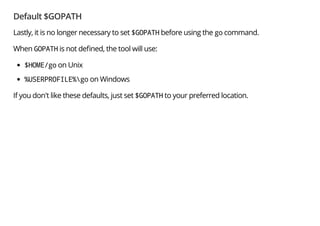
Default $GOPATH
Lastly, it is no longer necessary to set $GOPATH before using the go command.
When GOPATH is not de ned, the tool will use:
$HOME/go on Unix
%USERPROFILE%go on Windows
If you don't like these defaults, just set $GOPATH to your preferred location.
Runtime changes
Mutex contention pro le
Peter Wienberger has added a new pprof pro le, mutex contention.
func BenchmarkMutex(b *testing.B) {
const N = 16
for n := 0; n < b.N; n++ {
var done sync.WaitGroup
done.Add(N)
m := Map{m: make(map[string]int)}
for i := 0; i < N; i++ {
go func(i int) {
defer done.Done()
m.Put("foo", i)
}(i)
}
done.Wait()
}
}
note: Due to an oversight this only works with sync.Mutex, not sync.RWMutex, this
oversight will be addressed early in Go 1.9.
runtime: contended mutex pro ling doesn't work for sync.RWMutex
Mutex contention pro le
% go test examples/mutex_test.go -bench=. -mutexprofile=mutex.out
% go tool pprof mutex.test mutex.out
(pprof) list
Total: 290.81ms
ROUTINE ======================== command-line-arguments.(*Map).Put in /Users/dfc/devel/go-1.8-release-party/e
0 290.81ms (flat, cum) 100% of Total
. . 9:}
. . 10:
. . 11:func (m *Map) Put(key string, val int) {
. . 12: m.Lock()
. . 13: m.m[key] = val
. 290.81ms 14: m.Unlock()
. . 15:}
. . 16:
. . 17:func BenchmarkMutex(b *testing.B) {
. . 18: const N = 16
. . 19: for n := 0; n < b.N; n++ {
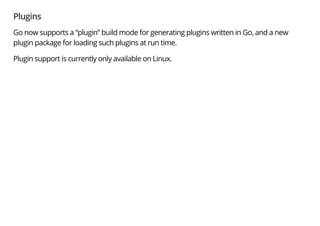
Plugins
Go now supports a “plugin” build mode for generating plugins written in Go, and a new
plugin package for loading such plugins at run time.
Plugin support is currently only available on Linux.
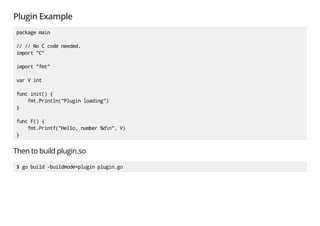
Plugin Example
package main
// // No C code needed.
import "C"
import "fmt"
var V int
func init() {
fmt.Println("Plugin loading")
}
func F() {
fmt.Printf("Hello, number %dn", V)
}
Then to build plugin.so
$ go build -buildmode=plugin plugin.go
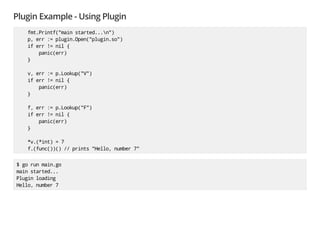
Plugin Example - Using Plugin
fmt.Printf("main started...n")
p, err := plugin.Open("plugin.so")
if err != nil {
panic(err)
}
v, err := p.Lookup("V")
if err != nil {
panic(err)
}
f, err := p.Lookup("F")
if err != nil {
panic(err)
}
*v.(*int) = 7
f.(func())() // prints "Hello, number 7"
$ go run main.go
main started...
Plugin loading
Hello, number 7
Plugins demo
Demo video: twitter.com/francesc
Source code: github.com/campoy/golang-plugins
os.Executable
os.Executable returns an absolute path to the currently running program.
Executable returns the path name for the executable that started the current process.
There is no guarantee that the path is still pointing to the correct executable.
If a symlink was used to start the process, depending on the operating system, the result
might be the symlink or the path it pointed to. If a stable result is needed,
path/ lepath.EvalSymlinks might help.
os.Executable (godoc.org)
fmt.Printf("os.Args[0]: %qn", os.Args[0])
exec, _ := os.Executable()
fmt.Printf("os.Executable(): %qn", exec) Run
Detection of concurrent map accesses
In Go 1.6, the runtime added lightweight, best-e ort detection of concurrent misuse of
maps. Go 1.8 improves that detector with support for detecting programs that concurrently
write to and iterate over a map.
If the runtime detects this condition, it prints a diagnosis and crashes the program.
func main() {
m := map[int]int{4: 4, 8: 8, 15: 15, 16: 16, 23: 23, 42: 42}
go func() {
for {
for _, v := range m {
_ = v
}
}
}()
for {
for k, _ := range m {
m[k]++
}
}
} Run
Changes to the standard library
sort.Slice
The sort package has a new convenice method sort.Slice
switch strings.ToLower(field) {
case "updated":
sort.Slice(subs, func(i, j int) bool { return subs[i].Updated.After(subs[j].Updated) })
case "trust":
sort.Slice(subs, func(i, j int) bool { return subs[i].Trust > subs[j].Trust })
case "stddev":
sort.Slice(subs, func(i, j int) bool {
var s1, s2 stats.Sample
for _, r := range subs[i].Ratings {
s1.Xs = append(s1.Xs, float64(r.Value))
}
for _, r := range subs[j].Ratings {
s2.Xs = append(s2.Xs, float64(r.Value))
}
return s1.StdDev() < s2.StdDev()
})
case "rating":
fallthrough
default:
sort.Slice(subs, func(i, j int) bool { return subs[i].Rating > subs[j].Rating })
}
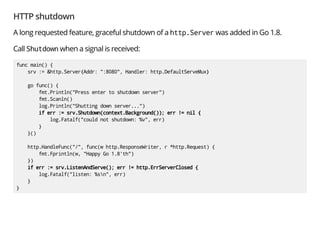
HTTP shutdown
A long requested feature, graceful shutdown of a http.Server was added in Go 1.8.
Call Shutdown when a signal is received:
func main() {
srv := &http.Server{Addr: ":8080", Handler: http.DefaultServeMux}
go func() {
fmt.Println("Press enter to shutdown server")
fmt.Scanln()
log.Println("Shutting down server...")
if err := srv.Shutdown(context.Background()); err != nil {
log.Fatalf("could not shutdown: %v", err)
}
}()
http.HandleFunc("/", func(w http.ResponseWriter, r *http.Request) {
fmt.Fprintln(w, "Happy Go 1.8'th")
})
if err := srv.ListenAndServe(); err != http.ErrServerClosed {
log.Fatalf("listen: %sn", err)
}
}
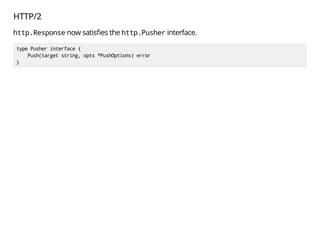
HTTP/2
http.Response now satis es the http.Pusher interface.
type Pusher interface {
Push(target string, opts *PushOptions) error
}
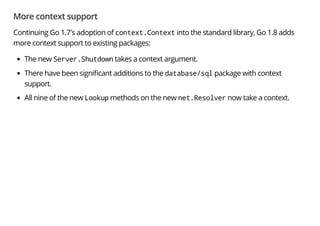
More context support
Continuing Go 1.7's adoption of context.Context into the standard library, Go 1.8 adds
more context support to existing packages:
The new Server.Shutdown takes a context argument.
There have been signi cant additions to the database/sql package with context
support.
All nine of the new Lookup methods on the new net.Resolver now take a context.
Minor changes
Minor library changes
What's coming up in Go 1.9
Before we close, let's quickly touch on some of the things coming up in Go 1.9
note: All of these are speculation, nothing is set in stone until code hits the repo.
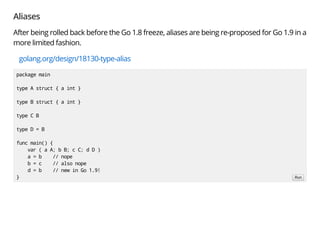
Aliases
After being rolled back before the Go 1.8 freeze, aliases are being re-proposed for Go 1.9 in a
more limited fashion.
golang.org/design/18130-type-alias
package main
type A struct { a int }
type B struct { a int }
type C B
type D = B
func main() {
var ( a A; b B; c C; d D )
a = b // nope
b = c // also nope
d = b // new in Go 1.9!
} Run
Faster / cheaper runtime.MemStats
The cost of calling runtime.MemStats is propotional to the size of the heap; Austin recently
timed it at ~1.7ms per Gb.
There is a CL ready to land that reduces it to 20 us per proc (thread servicing a goroutine)
which is a much smaller upper bound.
golang.org/issue/13613
Improvements to the inliner
Inlining has historically been limited to leaf functions because of the concern of agressive
inlining on the call graph.
In support of this Robert Griesemer and Matthew Dempsky have been improving the line
number tracking in Go 1.9 to make it exible enough to lift the restriction on non-leaf
functions.
An unnamed intern has been hired to work on the inliner for 1.9.
Josh Bleecher-Snyder has also suggest that the cost model for inlining should be revised to
make sure inlining is paying for itself.
Issue 17566
A user level poller
Go has used epoll/kqueue/poll/select for network sockets for years.
Reads/Writes to other le descriptors have traditionally consumed an OS thread during
operation
Recently Ian Lance Taylor landed a refactor that broken our the runtime polling subsystem
and extended to work for the rest of the os package.
net: refactor poller into new internal/poll package
os: use poller for le I/O
There is no sign of a programmer accessible poller, yet.
O cial dependency management tool
Finally!
Peter Bourgon, Edward Muller, Sam Boyer, Jess Frazelle, and Steve Francia have been
working on an o cial dependency management tool, dep.
If you're used to Glide or govendor, you won't be too surprised.
Mailing List Announcement
It's described as pre alpha at the moment, but you should check it out, and let them know
what you think.
github.com/golang/dep
Conclusion
Upgrade to Go 1.8, now!
It's literally the best version of Go, ever.
Thank you
Rodolfo Carvalho
Red Hat
rhcarvalho@gmail.com
http://rodolfocarvalho.net
https://dojo-brno.github.io

Go 1.8 Release Party

  • 1.
    Go 1.8 ReleaseParty Golang Brno meetup 28 February 2017 Rodolfo Carvalho Red Hat
  • 2.
    License and Materials Thispresentation is licensed under the Creative Commons Attribution-ShareAlike 4.0 International licence. The materials for this presentation are available on GitHub: github.com/davecheney/go-1.8-release-party You are encouraged to remix, transform, or build upon the material, providing you distribute your contributions under the same license. If you have suggestions or corrections to this presentation, please raise an issue on the GitHub project.
  • 3.
    Go 1.8 Go 1.8is released! Go 1.8 Announcement Go 1.8 is the 9th release in the Go 1 series. It follows from the previous version, Go 1.7, released on the 16th of August, 2016 Go 1.8 Release Notes
  • 4.
    What's changed? So, what'shappened in the last six months? Performance Compiler changes Tool changes Runtime changes Changes to the standard library
  • 5.
  • 6.
    Performance As always, thechanges are so general and varied that precise statements about performance are di cult to make. Most programs should run a bit faster, due to speedups in the garbage collector and optimizations in the standard library. The new back end, based on static single assignment form (SSA), generates more compact, more e cient code and provides a better platform for optimizations such as bounds check elimination. The new back end reduces the CPU time required by our benchmark programs by 20- 30% on 32-bit ARM systems. For 64-bit x86 systems, which already used the SSA back end in Go 1.7, the gains are a more modest 0-10%. Other architectures will likely see improvements closer to the 32-bit ARM numbers. Go 1.8 Toolchain Improvements
  • 7.
    Garbage Collector Garbage collectionpauses should be signi cantly shorter than they were in Go 1.7, usually under 100 microseconds and often as low as 10 microseconds. Garbage Collector Improvements Over Time (ht. @francesc)
  • 8.
    Defer The overhead ofdeferred function calls has been reduced by nearly half. name old time/op new time/op delta Defer-4 75.1ns ± 1% 43.3ns ± 1% -42.31% (p=0.000 n=8+10) In reality, this speeds up defer by about 2.2X. The two benchmarks below compare a Lock/defer Unlock pair (DeferLock) with a Lock/Unlock pair (NoDeferLock). NoDeferLock establishes a baseline cost, so these two benchmarks together show that this change reduces the overhead of defer from 61.4ns to 27.9ns. name old time/op new time/op delta DeferLock-4 77.4ns ± 1% 43.9ns ± 1% -43.31% (p=0.000 n=10+10) NoDeferLock-4 16.0ns ± 0% 15.9ns ± 0% -0.39% (p=0.000 n=9+8) Source: CL 29656 Defer and cgo improvements
  • 9.
    Cgo The overhead ofcgo calls is reduced by more than half: name old time/op new time/op delta CgoNoop-8 146ns ± 1% 56ns ± 6% -61.57% (p=0.000 n=25+30) This is the result of merging two defers on the standard cgo calling path. Less cgo overhead in Go 1.8
  • 10.
    Miscellaneous performance improvements Lotsof small updates to the standard library. There have been optimizations to implementations in the bytes, crypto/aes, crypto/cipher, crypto/elliptic, crypto/sha256, crypto/sha512, encoding/asn1, encoding/csv, encoding/hex, encoding/json, hash/crc32, image/color, image/draw, math, math/big, reflect, regexp, runtime, strconv, strings, syscall, text/template, and unicode/utf8 packages. Go 1.8 Standard Library Changes
  • 11.
  • 12.
    SSA backend All backendsupdated to use the new SSA form. Old "plan9" style compiler backend deleted. Big performance improvements for 32-bit ARM. Easy to add new SSA backends (for values of easy compiler engineers work in). eg, adding MIPS backend was straight forward, SPARC and RISC-V are rumored to be next.
  • 13.
    New parser Robert Griesemerand Matthew Dempsky replaced the parser. The new parser removes many of the package level variables which came along for the ride from the previous YACC based parser. Removing package level globals is a stepping stone to making the compiler more parallel. In fact this work has started in the development branch. This new parser is considerably faster, but in 1.8 is hamstrung by having to convert between the new style AST and the old version the rest of the compiler expects. Expect this AST conversion to be removed in Go 1.9.
  • 14.
    Compiler speed About a12-15% improvement compared to Go 1.7
  • 15.
    Struct conversion When explicitlyconverting a value from one struct type to another, as of Go 1.8 the tags are ignored. func example() { type T1 struct { X int `json:"foo"` } type T2 struct { X int `json:"bar"` } var v1 T1 var v2 T2 v1 = T1(v2) // now legal _ = v1 } Run
  • 16.
    Ports The number ofplatforms Go supports, on balance, continues to grow. Go now supports 32-bit MIPS on Linux for both big-endian (linux/mips) and little-endian machines (linux/mipsle) that implement the MIPS32r1 instruction set with FPU or kernel FPU emulation. Note that many common MIPS-based routers lack an FPU and have rmware that doesn't enable kernel FPU emulation; Go won't run on such machines. On DragonFly BSD, Go now requires DragonFly 4.4.4 or later. On OpenBSD, Go now requires OpenBSD 5.9 or later. The Plan 9 port's networking support is now much more complete and matches the behavior of Unix and Windows with respect to deadlines and cancelation. Go 1.8 now only supports OS X 10.8 or later. This is likely the last Go release to support 10.8. Compiling Go or running binaries on older OS X versions is untested.
  • 17.
    Go 1.8 maybe the last to support ARMv5 Supporting ARMv5 has been a problem for several releases. Currently we have no ARMv5 builders so have no idea if Go 1.8 actually works on real ARMv5 hardware (we test on ARMv7). Several companies have complained about loosing ARMv5 support, and several have o ered to run a builder -- but there are still no real ARMv5 builders on the dashboard. If you or your company care about ARMv5, you have to shoulder some of the burden. Contact @brad tz and set up a builder. Proposal: runtime: drop support for linux/armv5E and linux/armv6 Dashboard Builders (wiki) No ARMv5 builders means ARMv5 support will be dropped in Go 1.9.
  • 18.
  • 19.
    go tool yacc Theyacc tool (previously available by running “go tool yacc”) has been removed. As of Go 1.7 it was no longer used by the Go compiler. It has moved to the “tools” repository and is now available at golang.org/x/tools/cmd/goyacc.
  • 20.
    go tool asm gotool asm now supports a otilla of Intel and PPC vector instructions. For 64-bit x86 systems, the following instructions have been added: VBROADCASTSD, BROADCASTSS, MOVDDUP, MOVSHDUP, MOVSLDUP, VMOVDDUP, VMOVSHDUP, and VMOVSLDUP. For 64-bit PPC systems, the common vector scalar instructions have been added: LXS, LXSDX, LXSI, LXSIWAX, LXSIWZX, LXV, LXVD2X, LXVDSX, LXVW4X, MFVSR, MFVSRD, MFVSRWZ, MTVSR, MTVSRD, MTVSRWA, MTVSRWZ, STXS, STXSDX, STXSI, STXSIWX, STXV, STXVD2X, STXVW4X, XSCV, XSCVDPSP, XSCVDPSPN, XSCVDPSXDS, XSCVDPSXWS, XSCVDPUXDS, XSCVDPUXWS, XSCVSPDP, XSCVSPDPN, XSCVSXDDP, XSCVSXDSP, XSCVUXDDP, XSCVUXDSP, XSCVX, XSCVXP, XVCV, XVCVDPSP, XVCVDPSXDS, XVCVDPSXWS, XVCVDPUXDS, XVCVDPUXWS, XVCVSPDP, XVCVSPSXDS, XVCVSPSXWS, XVCVSPUXDS, XVCVSPUXWS, XVCVSXDDP, XVCVSXDSP, XVCVSXWDP, XVCVSXWSP, XVCVUXDDP, XVCVUXDSP, XVCVUXWDP, XVCVUXWSP, XVCVX, XVCVXP, XXLAND, XXLANDC, XXLANDQ, XXLEQV, XXLNAND, XXLNOR, XXLOR, XXLORC, XXLORQ, XXLXOR, XXMRG, XXMRGHW, XXMRGLW, XXPERM, XXPERMDI, XXSEL, XXSI, XXSLDWI, XXSPLT, and XXSPLTW.
  • 21.
    go tool trace Thetrace tool has a new -pprof ag for producing pprof-compatible blocking and latency pro les from an execution trace. Garbage collection events are now shown more clearly in the execution trace viewer. Garbage collection activity is shown on its own row and GC helper goroutines are annotated with their roles. Rhys Hiltner's execution tracer presentation (dotGo 2016)
  • 22.
    go tool vet Vetis stricter in some ways and looser where it previously caused false positives. Vet now checks for: copying an array of locks duplicate JSON and XML struct eld tags non-space-separated struct tags deferred calls to HTTP Response.Body.Close before checking errors indexed arguments in Printf. package main type T struct { A string `json:"A"` B string `json:"A"` C string `json:"C"xml:"C"` } go tool vet examples/vet_repeated_json_tags.go Run
  • 23.
    go x go fixnow rewrites references to golang.org/x/net/context to the standard library provided context package.
  • 24.
    go bug The newgo bug command starts a bug report on GitHub, pre lled with information about the current system. Example: go bug Run
  • 25.
    Default $GOPATH Lastly, itis no longer necessary to set $GOPATH before using the go command. When GOPATH is not de ned, the tool will use: $HOME/go on Unix %USERPROFILE%go on Windows If you don't like these defaults, just set $GOPATH to your preferred location.
  • 26.
  • 27.
    Mutex contention prole Peter Wienberger has added a new pprof pro le, mutex contention. func BenchmarkMutex(b *testing.B) { const N = 16 for n := 0; n < b.N; n++ { var done sync.WaitGroup done.Add(N) m := Map{m: make(map[string]int)} for i := 0; i < N; i++ { go func(i int) { defer done.Done() m.Put("foo", i) }(i) } done.Wait() } } note: Due to an oversight this only works with sync.Mutex, not sync.RWMutex, this oversight will be addressed early in Go 1.9. runtime: contended mutex pro ling doesn't work for sync.RWMutex
  • 28.
    Mutex contention prole % go test examples/mutex_test.go -bench=. -mutexprofile=mutex.out % go tool pprof mutex.test mutex.out (pprof) list Total: 290.81ms ROUTINE ======================== command-line-arguments.(*Map).Put in /Users/dfc/devel/go-1.8-release-party/e 0 290.81ms (flat, cum) 100% of Total . . 9:} . . 10: . . 11:func (m *Map) Put(key string, val int) { . . 12: m.Lock() . . 13: m.m[key] = val . 290.81ms 14: m.Unlock() . . 15:} . . 16: . . 17:func BenchmarkMutex(b *testing.B) { . . 18: const N = 16 . . 19: for n := 0; n < b.N; n++ {
  • 29.
    Plugins Go now supportsa “plugin” build mode for generating plugins written in Go, and a new plugin package for loading such plugins at run time. Plugin support is currently only available on Linux.
  • 30.
    Plugin Example package main //// No C code needed. import "C" import "fmt" var V int func init() { fmt.Println("Plugin loading") } func F() { fmt.Printf("Hello, number %dn", V) } Then to build plugin.so $ go build -buildmode=plugin plugin.go
  • 31.
    Plugin Example -Using Plugin fmt.Printf("main started...n") p, err := plugin.Open("plugin.so") if err != nil { panic(err) } v, err := p.Lookup("V") if err != nil { panic(err) } f, err := p.Lookup("F") if err != nil { panic(err) } *v.(*int) = 7 f.(func())() // prints "Hello, number 7" $ go run main.go main started... Plugin loading Hello, number 7
  • 32.
    Plugins demo Demo video:twitter.com/francesc Source code: github.com/campoy/golang-plugins
  • 33.
    os.Executable os.Executable returns anabsolute path to the currently running program. Executable returns the path name for the executable that started the current process. There is no guarantee that the path is still pointing to the correct executable. If a symlink was used to start the process, depending on the operating system, the result might be the symlink or the path it pointed to. If a stable result is needed, path/ lepath.EvalSymlinks might help. os.Executable (godoc.org) fmt.Printf("os.Args[0]: %qn", os.Args[0]) exec, _ := os.Executable() fmt.Printf("os.Executable(): %qn", exec) Run
  • 34.
    Detection of concurrentmap accesses In Go 1.6, the runtime added lightweight, best-e ort detection of concurrent misuse of maps. Go 1.8 improves that detector with support for detecting programs that concurrently write to and iterate over a map. If the runtime detects this condition, it prints a diagnosis and crashes the program. func main() { m := map[int]int{4: 4, 8: 8, 15: 15, 16: 16, 23: 23, 42: 42} go func() { for { for _, v := range m { _ = v } } }() for { for k, _ := range m { m[k]++ } } } Run
  • 35.
    Changes to thestandard library
  • 36.
    sort.Slice The sort packagehas a new convenice method sort.Slice switch strings.ToLower(field) { case "updated": sort.Slice(subs, func(i, j int) bool { return subs[i].Updated.After(subs[j].Updated) }) case "trust": sort.Slice(subs, func(i, j int) bool { return subs[i].Trust > subs[j].Trust }) case "stddev": sort.Slice(subs, func(i, j int) bool { var s1, s2 stats.Sample for _, r := range subs[i].Ratings { s1.Xs = append(s1.Xs, float64(r.Value)) } for _, r := range subs[j].Ratings { s2.Xs = append(s2.Xs, float64(r.Value)) } return s1.StdDev() < s2.StdDev() }) case "rating": fallthrough default: sort.Slice(subs, func(i, j int) bool { return subs[i].Rating > subs[j].Rating }) }
  • 37.
    HTTP shutdown A longrequested feature, graceful shutdown of a http.Server was added in Go 1.8. Call Shutdown when a signal is received: func main() { srv := &http.Server{Addr: ":8080", Handler: http.DefaultServeMux} go func() { fmt.Println("Press enter to shutdown server") fmt.Scanln() log.Println("Shutting down server...") if err := srv.Shutdown(context.Background()); err != nil { log.Fatalf("could not shutdown: %v", err) } }() http.HandleFunc("/", func(w http.ResponseWriter, r *http.Request) { fmt.Fprintln(w, "Happy Go 1.8'th") }) if err := srv.ListenAndServe(); err != http.ErrServerClosed { log.Fatalf("listen: %sn", err) } }
  • 38.
    HTTP/2 http.Response now satises the http.Pusher interface. type Pusher interface { Push(target string, opts *PushOptions) error }
  • 39.
    More context support ContinuingGo 1.7's adoption of context.Context into the standard library, Go 1.8 adds more context support to existing packages: The new Server.Shutdown takes a context argument. There have been signi cant additions to the database/sql package with context support. All nine of the new Lookup methods on the new net.Resolver now take a context.
  • 40.
  • 41.
  • 42.
    What's coming upin Go 1.9 Before we close, let's quickly touch on some of the things coming up in Go 1.9 note: All of these are speculation, nothing is set in stone until code hits the repo.
  • 43.
    Aliases After being rolledback before the Go 1.8 freeze, aliases are being re-proposed for Go 1.9 in a more limited fashion. golang.org/design/18130-type-alias package main type A struct { a int } type B struct { a int } type C B type D = B func main() { var ( a A; b B; c C; d D ) a = b // nope b = c // also nope d = b // new in Go 1.9! } Run
  • 44.
    Faster / cheaperruntime.MemStats The cost of calling runtime.MemStats is propotional to the size of the heap; Austin recently timed it at ~1.7ms per Gb. There is a CL ready to land that reduces it to 20 us per proc (thread servicing a goroutine) which is a much smaller upper bound. golang.org/issue/13613
  • 45.
    Improvements to theinliner Inlining has historically been limited to leaf functions because of the concern of agressive inlining on the call graph. In support of this Robert Griesemer and Matthew Dempsky have been improving the line number tracking in Go 1.9 to make it exible enough to lift the restriction on non-leaf functions. An unnamed intern has been hired to work on the inliner for 1.9. Josh Bleecher-Snyder has also suggest that the cost model for inlining should be revised to make sure inlining is paying for itself. Issue 17566
  • 46.
    A user levelpoller Go has used epoll/kqueue/poll/select for network sockets for years. Reads/Writes to other le descriptors have traditionally consumed an OS thread during operation Recently Ian Lance Taylor landed a refactor that broken our the runtime polling subsystem and extended to work for the rest of the os package. net: refactor poller into new internal/poll package os: use poller for le I/O There is no sign of a programmer accessible poller, yet.
  • 47.
    O cial dependencymanagement tool Finally! Peter Bourgon, Edward Muller, Sam Boyer, Jess Frazelle, and Steve Francia have been working on an o cial dependency management tool, dep. If you're used to Glide or govendor, you won't be too surprised. Mailing List Announcement It's described as pre alpha at the moment, but you should check it out, and let them know what you think. github.com/golang/dep
  • 48.
    Conclusion Upgrade to Go1.8, now! It's literally the best version of Go, ever.
  • 49.
    Thank you Rodolfo Carvalho RedHat rhcarvalho@gmail.com http://rodolfocarvalho.net https://dojo-brno.github.io