SCALING APPLICATIONS
WITH GO
-Vimlesh Sharma
 Introduction
 What does Go offer?
 Where go can be used?
 Go in Production
 Go in comparison to other language
 Case studies
TABLE OF CONTENTS
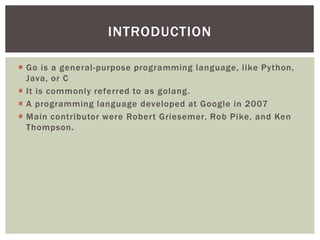
 Go is a general-purpose programming language, like Python,
Java, or C
 It is commonly referred to as golang.
 A programming language developed at Google in 2007
 Main contributor were Robert Griesemer, Rob Pike, and Ken
Thompson.
INTRODUCTION
WHAT DOES GO OFFER ?
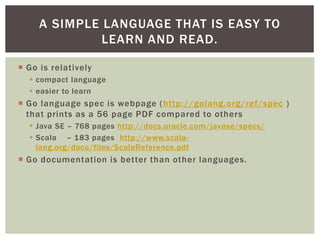
 Go is relatively
 compact language
 easier to learn
 Go language spec is webpage (http://golang.org/ref/spec )
that prints as a 56 page PDF compared to others
 Java SE – 768 pages http://docs.oracle.com/javase/specs/
 Scala – 183 pages http://www.scala-
lang.org/docu/files/ScalaReference.pdf
 Go documentation is better than other languages.
A SIMPLE LANGUAGE THAT IS EASY TO
LEARN AND READ.
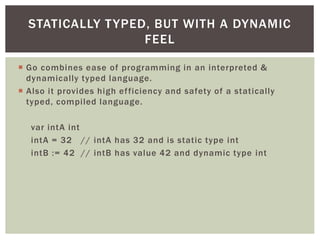
 Go combines ease of programming in an interpreted &
dynamically typed language.
 Also it provides high efficiency and safety of a statically
typed, compiled language.
var intA int
intA = 32 // intA has 32 and is static type int
intB := 42 // intB has value 42 and dynamic type int
STATICALLY TYPED, BUT WITH A DYNAMIC
FEEL
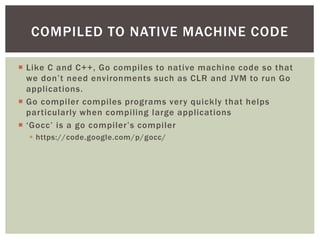
 Like C and C++, Go compiles to native machine code so that
we don’t need environments such as CLR and JVM to run Go
applications.
 Go compiler compiles programs very quickly that helps
particularly when compiling large applications
 ‘Gocc’ is a go compiler’s compiler
 https://code.google.com/p/gocc/
COMPILED TO NATIVE MACHINE CODE
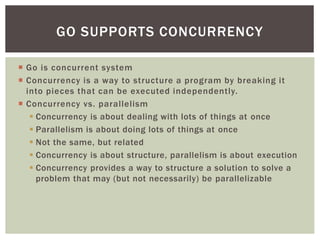
 Go is concurrent system
 Concurrency is a way to structure a program by breaking it
into pieces that can be executed independently.
 Concurrency vs. parallelism
 Concurrency is about dealing with lots of things at once
 Parallelism is about doing lots of things at once
 Not the same, but related
 Concurrency is about structure, parallelism is about execution
 Concurrency provides a way to structure a solution to solve a
problem that may (but not necessarily) be parallelizable
GO SUPPORTS CONCURRENCY
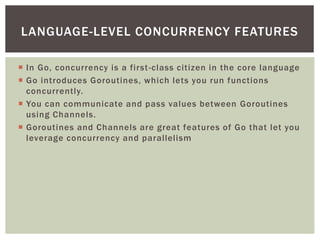
 In Go, concurrency is a first-class citizen in the core language
 Go introduces Goroutines, which lets you run functions
concurrently.
 You can communicate and pass values between Goroutines
using Channels.
 Goroutines and Channels are great features of Go that let you
leverage concurrency and parallelism
LANGUAGE-LEVEL CONCURRENCY FEATURES
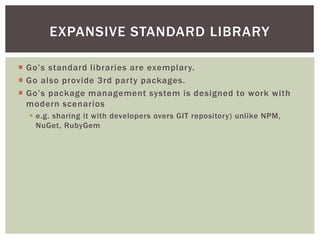
 Go’s standard libraries are exemplary.
 Go also provide 3rd party packages.
 Go’s package management system is designed to work with
modern scenarios
 e.g. sharing it with developers overs GIT repository) unlike NPM,
NuGet, RubyGem
EXPANSIVE STANDARD LIBRARY
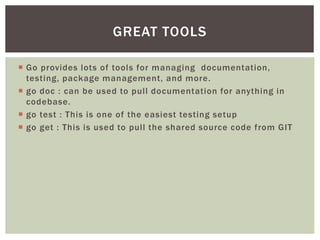
 Go provides lots of tools for managing documentation,
testing, package management, and more.
 go doc : can be used to pull documentation for anything in
codebase.
 go test : This is one of the easiest testing setup
 go get : This is used to pull the shared source code from GIT
GREAT TOOLS
WHERE CAN GO CAN BE
USED?
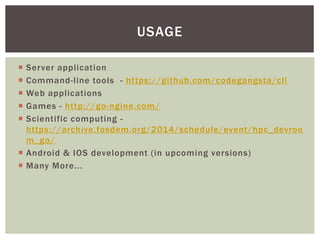
 Server application
 Command-line tools - https://github.com/codegangsta/cli
 Web applications
 Games - http://go-ngine.com/
 Scientific computing -
https://archive.fosdem.org/2014/schedule/event/hpc_devroo
m_go/
 Android & IOS development (in upcoming versions)
 Many More...
USAGE
USING GO IN
PRODUCTION
 Go produces statically linked binaries that are self sufficient.
 Single binary makes deployment super-easy.
 This is great when compared to other dependency setup that
is required for most other application.
SINGLE BINARY
 Go has excellent support for cross compilation.
 gonative is a simple tool which creates a build of Go that can
cross compile to all platforms. –
http://github.com/inconshreveable/gonative
 http://dave.cheney.net/2013/07/09/an-introduction-to-cross-
compilation-with-go-1-1
CROSS COMPILATION
 There is excellent support for
 Live profiling capability for CPU
 Memory
 Goroutines
 OS threads
 Lock contention etc
 Read more at http://blog.golang.org/profiling-go-programs
 Use go toolchain and profile the application on-demand.
BUILT-IN PROFILING
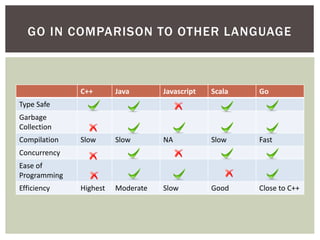
C++ Java Javascript Scala Go
Type Safe
Garbage
Collection
Compilation Slow Slow NA Slow Fast
Concurrency
Ease of
Programming
Efficiency Highest Moderate Slow Good Close to C++
GO IN COMPARISON TO OTHER LANGUAGE
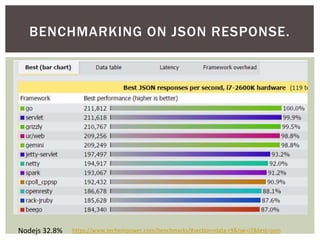
BENCHMARKING ON JSON RESPONSE.
Nodejs 32.8% https://www.techempower.com/benchmarks/#section=data-r9&hw=i7&test=json
CASE STUDY FROM
GOPHERCONINDIA 15
 Ruby is a complex language
 Memory consumption and speed
 Lot of caching data in memory for speed, GC in Ruby consumed a lot
of time ultimately hindering performance.
 Concurrency
 The safest way to do concurrency in Ruby is through the use of
multiple processes, so app uses many workers and hence memory
consumption.
FROM A RUBY MONOLITH TO MICROSERVICES
IN GO
 Instead of refactoring the entire application, moving selected
component to a micro services architecture in go increased
the efficiency.
 Main Application + Go Micro services boost application
performance.
 https://sourcegraph.com/blog/live/gopherconindia/1126565
68167
SOLUTION/OBSERVATION
 N1QL pronounced as “nickel”.
 N1QL is a query language developed in Go for Couchbase, a
distributed NoSQL database.
 With N1QL scalable application can be developed quickly
N1QL: A QUERY LANGUAGE IN GO
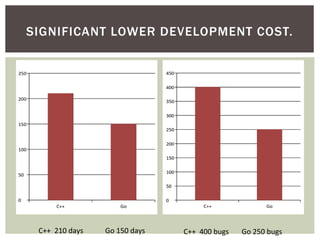
SIGNIFICANT LOWER DEVELOPMENT COST.
C++ 210 days Go 150 days C++ 400 bugs Go 250 bugs
 Benchmarks show that Go compares favorably with C++ and
Java
 In C++, they had to experiment with a bunch of different
libraries
 In Java, they had to fiddle around with a bunch of parameters
like the min heap size
 Go worked well out of the box -
https://sourcegraph.com/blog/live/gopherconindia/1116380
91937
SOLUTION/OBSERVATION
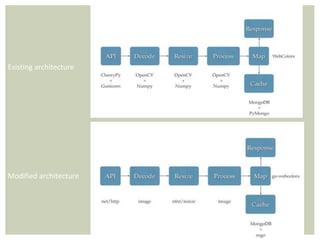
 Extract dominant color from images.
 Generate Insight based on product color
 Pain Point:
 They were having high system usage.
 Avg mem. consumption was more than 70%
PROCESSING IMAGES WITH GO
Existing architecture
Modified architecture
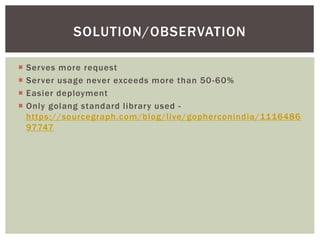
 Serves more request
 Server usage never exceeds more than 50-60%
 Easier deployment
 Only golang standard library used -
https://sourcegraph.com/blog/live/gopherconindia/1116486
97747
SOLUTION/OBSERVATION
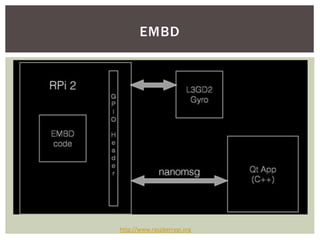
EMBD
http://www.raspberrypi.org
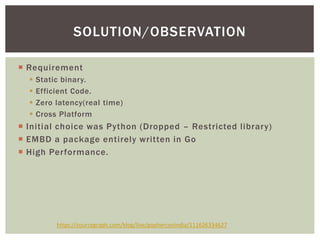
 Requirement
 Static binary.
 Efficient Code.
 Zero latency(real time)
 Cross Platform
 Initial choice was Python (Dropped – Restricted library)
 EMBD a package entirely written in Go
 High Performance.
SOLUTION/OBSERVATION
https://sourcegraph.com/blog/live/gopherconindia/111626334627
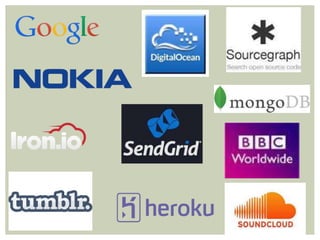
LIST OF COMPANIES USING GO IN
PRODUCTION
 Golang’s 3 hours online jumpstart course
 http://tour.golang.org/welcome/1
 Testimonials
 https://sendgrid.com/blog/convince-company-go-golang/
 http://www.scriptrock.com/blog/our-experience-with-golang
 Further reading
 http://golang.org/doc/
 https://talks.golang.org/
 http://thenewstack.io/a-closer-look-at-golang-from-an-architects-
perspective/
QUICK LINKS
THANKS

Scaling applications with go

  • 1.
  • 2.
     Introduction  Whatdoes Go offer?  Where go can be used?  Go in Production  Go in comparison to other language  Case studies TABLE OF CONTENTS
  • 3.
     Go isa general-purpose programming language, like Python, Java, or C  It is commonly referred to as golang.  A programming language developed at Google in 2007  Main contributor were Robert Griesemer, Rob Pike, and Ken Thompson. INTRODUCTION
  • 4.
    WHAT DOES GOOFFER ?
  • 5.
     Go isrelatively  compact language  easier to learn  Go language spec is webpage (http://golang.org/ref/spec ) that prints as a 56 page PDF compared to others  Java SE – 768 pages http://docs.oracle.com/javase/specs/  Scala – 183 pages http://www.scala- lang.org/docu/files/ScalaReference.pdf  Go documentation is better than other languages. A SIMPLE LANGUAGE THAT IS EASY TO LEARN AND READ.
  • 6.
     Go combinesease of programming in an interpreted & dynamically typed language.  Also it provides high efficiency and safety of a statically typed, compiled language. var intA int intA = 32 // intA has 32 and is static type int intB := 42 // intB has value 42 and dynamic type int STATICALLY TYPED, BUT WITH A DYNAMIC FEEL
  • 7.
     Like Cand C++, Go compiles to native machine code so that we don’t need environments such as CLR and JVM to run Go applications.  Go compiler compiles programs very quickly that helps particularly when compiling large applications  ‘Gocc’ is a go compiler’s compiler  https://code.google.com/p/gocc/ COMPILED TO NATIVE MACHINE CODE
  • 8.
     Go isconcurrent system  Concurrency is a way to structure a program by breaking it into pieces that can be executed independently.  Concurrency vs. parallelism  Concurrency is about dealing with lots of things at once  Parallelism is about doing lots of things at once  Not the same, but related  Concurrency is about structure, parallelism is about execution  Concurrency provides a way to structure a solution to solve a problem that may (but not necessarily) be parallelizable GO SUPPORTS CONCURRENCY
  • 9.
     In Go,concurrency is a first-class citizen in the core language  Go introduces Goroutines, which lets you run functions concurrently.  You can communicate and pass values between Goroutines using Channels.  Goroutines and Channels are great features of Go that let you leverage concurrency and parallelism LANGUAGE-LEVEL CONCURRENCY FEATURES
  • 10.
     Go’s standardlibraries are exemplary.  Go also provide 3rd party packages.  Go’s package management system is designed to work with modern scenarios  e.g. sharing it with developers overs GIT repository) unlike NPM, NuGet, RubyGem EXPANSIVE STANDARD LIBRARY
  • 11.
     Go provideslots of tools for managing documentation, testing, package management, and more.  go doc : can be used to pull documentation for anything in codebase.  go test : This is one of the easiest testing setup  go get : This is used to pull the shared source code from GIT GREAT TOOLS
  • 12.
    WHERE CAN GOCAN BE USED?
  • 13.
     Server application Command-line tools - https://github.com/codegangsta/cli  Web applications  Games - http://go-ngine.com/  Scientific computing - https://archive.fosdem.org/2014/schedule/event/hpc_devroo m_go/  Android & IOS development (in upcoming versions)  Many More... USAGE
  • 14.
  • 15.
     Go producesstatically linked binaries that are self sufficient.  Single binary makes deployment super-easy.  This is great when compared to other dependency setup that is required for most other application. SINGLE BINARY
  • 16.
     Go hasexcellent support for cross compilation.  gonative is a simple tool which creates a build of Go that can cross compile to all platforms. – http://github.com/inconshreveable/gonative  http://dave.cheney.net/2013/07/09/an-introduction-to-cross- compilation-with-go-1-1 CROSS COMPILATION
  • 17.
     There isexcellent support for  Live profiling capability for CPU  Memory  Goroutines  OS threads  Lock contention etc  Read more at http://blog.golang.org/profiling-go-programs  Use go toolchain and profile the application on-demand. BUILT-IN PROFILING
  • 18.
    C++ Java JavascriptScala Go Type Safe Garbage Collection Compilation Slow Slow NA Slow Fast Concurrency Ease of Programming Efficiency Highest Moderate Slow Good Close to C++ GO IN COMPARISON TO OTHER LANGUAGE
  • 19.
    BENCHMARKING ON JSONRESPONSE. Nodejs 32.8% https://www.techempower.com/benchmarks/#section=data-r9&hw=i7&test=json
  • 20.
  • 21.
     Ruby isa complex language  Memory consumption and speed  Lot of caching data in memory for speed, GC in Ruby consumed a lot of time ultimately hindering performance.  Concurrency  The safest way to do concurrency in Ruby is through the use of multiple processes, so app uses many workers and hence memory consumption. FROM A RUBY MONOLITH TO MICROSERVICES IN GO
  • 22.
     Instead ofrefactoring the entire application, moving selected component to a micro services architecture in go increased the efficiency.  Main Application + Go Micro services boost application performance.  https://sourcegraph.com/blog/live/gopherconindia/1126565 68167 SOLUTION/OBSERVATION
  • 23.
     N1QL pronouncedas “nickel”.  N1QL is a query language developed in Go for Couchbase, a distributed NoSQL database.  With N1QL scalable application can be developed quickly N1QL: A QUERY LANGUAGE IN GO
  • 24.
    SIGNIFICANT LOWER DEVELOPMENTCOST. C++ 210 days Go 150 days C++ 400 bugs Go 250 bugs
  • 25.
     Benchmarks showthat Go compares favorably with C++ and Java  In C++, they had to experiment with a bunch of different libraries  In Java, they had to fiddle around with a bunch of parameters like the min heap size  Go worked well out of the box - https://sourcegraph.com/blog/live/gopherconindia/1116380 91937 SOLUTION/OBSERVATION
  • 26.
     Extract dominantcolor from images.  Generate Insight based on product color  Pain Point:  They were having high system usage.  Avg mem. consumption was more than 70% PROCESSING IMAGES WITH GO
  • 27.
  • 28.
     Serves morerequest  Server usage never exceeds more than 50-60%  Easier deployment  Only golang standard library used - https://sourcegraph.com/blog/live/gopherconindia/1116486 97747 SOLUTION/OBSERVATION
  • 29.
  • 30.
     Requirement  Staticbinary.  Efficient Code.  Zero latency(real time)  Cross Platform  Initial choice was Python (Dropped – Restricted library)  EMBD a package entirely written in Go  High Performance. SOLUTION/OBSERVATION https://sourcegraph.com/blog/live/gopherconindia/111626334627
  • 31.
    LIST OF COMPANIESUSING GO IN PRODUCTION
  • 33.
     Golang’s 3hours online jumpstart course  http://tour.golang.org/welcome/1  Testimonials  https://sendgrid.com/blog/convince-company-go-golang/  http://www.scriptrock.com/blog/our-experience-with-golang  Further reading  http://golang.org/doc/  https://talks.golang.org/  http://thenewstack.io/a-closer-look-at-golang-from-an-architects- perspective/ QUICK LINKS
  • 34.