Glycolysis (Glyco-lysis) Glucose-
breakdown
Glycolysis is the process of enzymatic break down of a glucose
molecule into two pyruvate molecule. Pyruvate is a 3-carbon
compound.
During glycolysis some of the free energy is released and conserved
in the form of ATP and NADH.
Glycolytic breakdown of glucose is the sole source of metabolic
energy in some mammalian tissues and cells (RBCs, Brain, Renal
medulla and Sperm cell).
Anaerobic microorganisms are entirely dependent on glycolysis.
3.
Glycolysis occurs inten steps
Glycolysis consists of series of 10 enzyme catalyzed reactions which
are divided into two phases i.e.
Preparatory phases
Payoff phase
Preparatory phases
In preparatory phase glucose molecule is activated for breakdown
and energy is invested in the process of phosphorylation of glucose.
The first five reactions constitute the preparatory phase.
4.
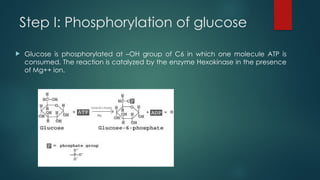
Step I: Phosphorylationof glucose
Glucose is phosphorylated at –OH group of C6 in which one molecule ATP is
consumed. The reaction is catalyzed by the enzyme Hexokinase in the presence
of Mg++ ion.
5.
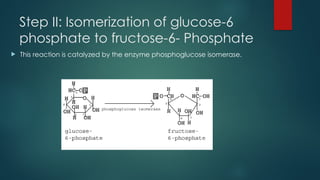
Step II: Isomerizationof glucose-6
phosphate to fructose-6- Phosphate
This reaction is catalyzed by the enzyme phosphoglucose isomerase.
6.
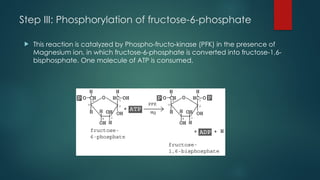
Step III: Phosphorylationof fructose-6-phosphate
This reaction is catalyzed by Phospho-fructo-kinase (PFK) in the presence of
Magnesium ion, in which fructose-6-phosphate is converted into fructose-1,6-
bisphosphate. One molecule of ATP is consumed.
7.
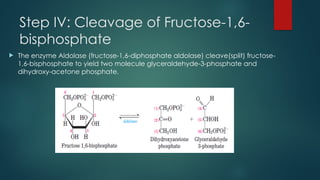
Step IV: Cleavageof Fructose-1,6-
bisphosphate
The enzyme Aldolase (fructose-1,6-diphosphate aldolase) cleave(split) fructose-
1,6-bisphosphate to yield two molecule glyceraldehyde-3-phosphate and
dihydroxy-acetone phosphate.
8.
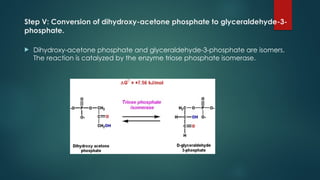
Step V: Conversionof dihydroxy-acetone phosphate to glyceraldehyde-3-
phosphate.
Dihydroxy-acetone phosphate and glyceraldehyde-3-phosphate are isomers.
The reaction is catalyzed by the enzyme triose phosphate isomerase.
9.
2. Payoff phase:
In payoff phase oxidation of glucose releases energy in the form of ATP and
NADH. The remaining five reactions constitutes payoff phase
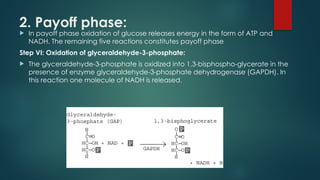
Step VI: Oxidation of glyceraldehyde-3-phosphate:
The glyceraldehyde-3-phosphate is oxidized into 1,3-bisphospho-glycerate in the
presence of enzyme glyceraldehyde-3-phosphate dehydrogenase (GAPDH). In
this reaction one molecule of NADH is released.
10.
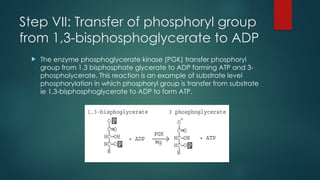
Step VII: Transferof phosphoryl group
from 1,3-bisphosphoglycerate to ADP
The enzyme phosphoglycerate kinase (PGK) transfer phosphoryl
group from 1,3 bisphosphate glycerate to ADP forming ATP and 3-
phospholycerate. This reaction is an example of substrate level
phosphorylation in which phosphoryl group is transfer from substrate
ie 1,3-bisphosphoglycerate to ADP to form ATP.
11.
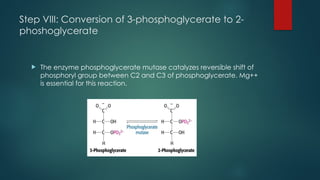
Step VIII: Conversionof 3-phosphoglycerate to 2-
phoshoglycerate
The enzyme phosphoglycerate mutase catalyzes reversible shift of
phosphoryl group between C2 and C3 of phosphoglycerate. Mg++
is essential for this reaction.
12.
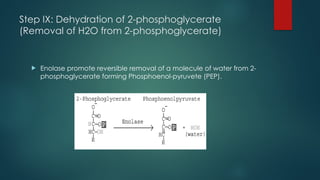
Step IX: Dehydrationof 2-phosphoglycerate
(Removal of H2O from 2-phosphoglycerate)
Enolase promote reversible removal of a molecule of water from 2-
phosphoglycerate forming Phosphoenol-pyruvete (PEP).
13.
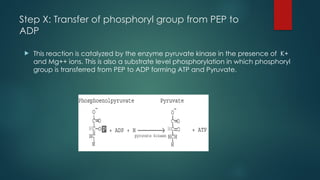
Step X: Transferof phosphoryl group from PEP to
ADP
This reaction is catalyzed by the enzyme pyruvate kinase in the presence of K+
and Mg++ ions. This is also a substrate level phosphorylation in which phosphoryl
group is transferred from PEP to ADP forming ATP and Pyruvate.
14.
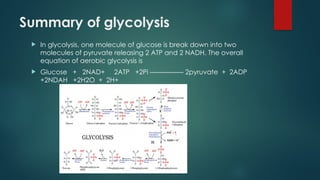
Summary of glycolysis
In glycolysis, one molecule of glucose is break down into two
molecules of pyruvate releasing 2 ATP and 2 NADH. The overall
equation of aerobic glycolysis is
Glucose + 2NAD+ 2ATP +2Pi ————— 2pyruvate + 2ADP
+2NDAH +2H2O + 2H+


![World food program's School Meals] school feeding](https://cdn.slidesharecdn.com/ss_thumbnails/wfpschoolmeals-250305114658-0d1da029-thumbnail.jpg?width=640&height=640&fit=bounds)


![谷歌留痕技术 [ 𝙩𝙤𝙥 𝟮𝟯𝟯. 𝙘 𝙤𝙢 ]](https://cdn.slidesharecdn.com/ss_thumbnails/top233-260130174328-3833018c-thumbnail.jpg?width=640&height=640&fit=bounds)

