Nutritional Sensitive Agriculture
 Based on the studies of Ruel Etal in the paper titled “Nutrition-
sensitive agriculture: What have we learned so far?”
 I,
 Explain any five Nutrition Sensitive Agriculture (NSA)
interventions in this study.
 What NSA program interventions have a potential to combat
malnutrition?
…Nutritional Sensitive Agriculture
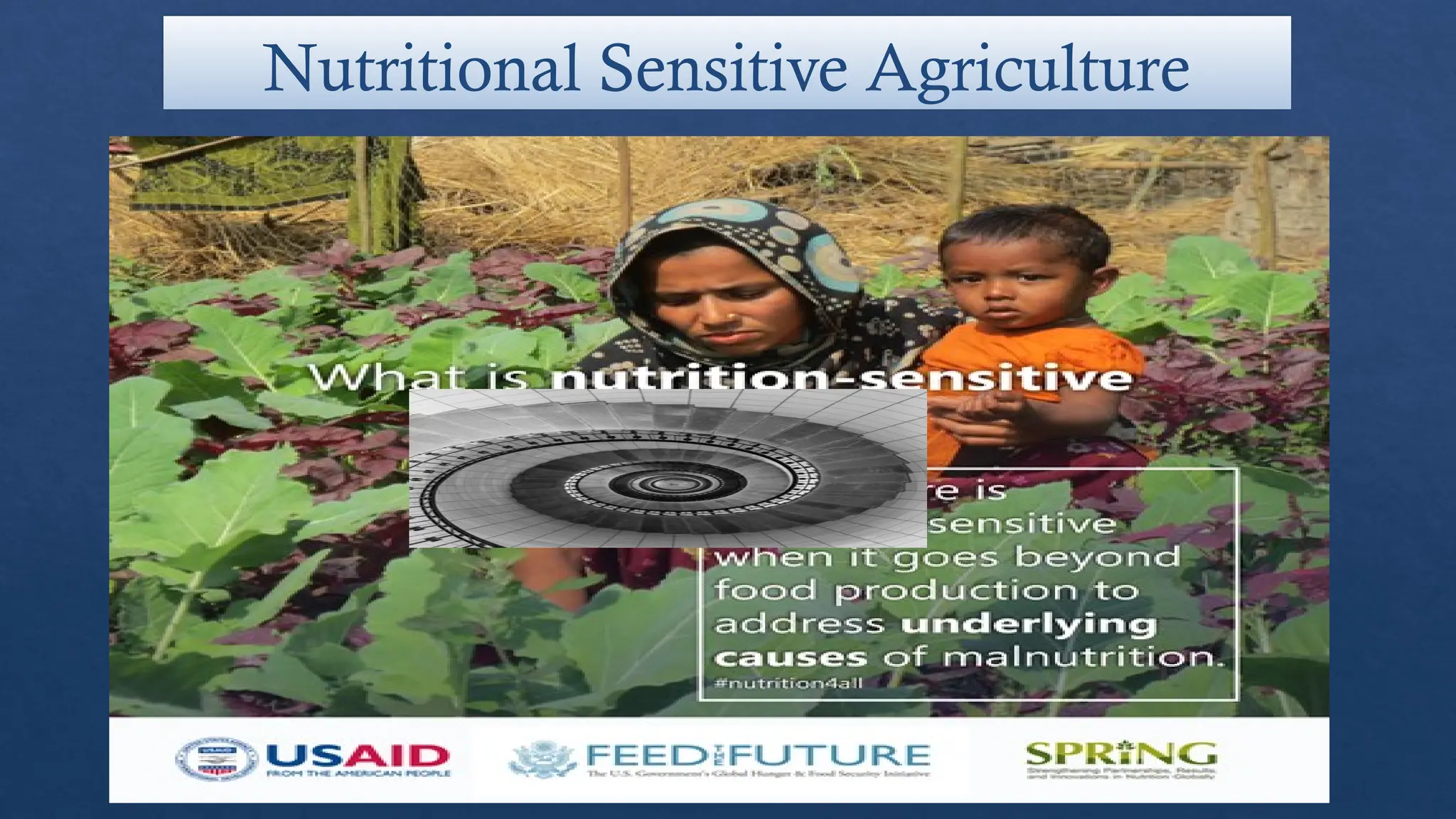
 According to the study, nutrition sensitive agriculture is the
special agricultural practices that aim at stopping malnutrition
problems that result from nutrient deficiencies and food insecurity
as found in specific groups of people.
 The study found that, Nutrition specific interventions alone, even
if implemented at scale, will not meet global targets for improving
nutrition unless other sectors particularly agriculture are put in
consideration. This was clearly stated in the introductory part of
the study script.
Nutrition Sensitive Agriculture (NSA) interventions
in this study
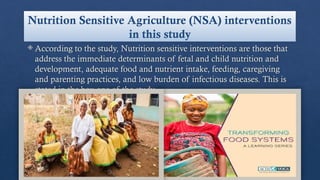
 According to the study, Nutrition sensitive interventions are those that
address the immediate determinants of fetal and child nutrition and
development, adequate food and nutrient intake, feeding, caregiving
and parenting practices, and low burden of infectious diseases. This is
stated in the box one of the study.
…Nutrition Sensitive Agriculture (NSA)
interventions in this study
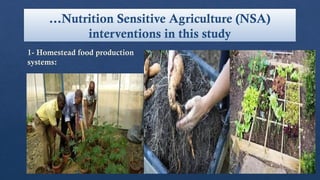
1- Homestead food production
systems:
…Nutrition Sensitive Agriculture (NSA)
interventions in this study
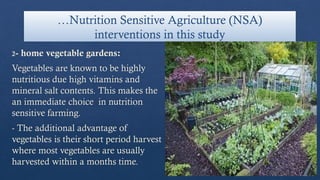
2- home vegetable gardens:
Vegetables are known to be highly
nutritious due high vitamins and
mineral salt contents. This makes the
an immediate choice in nutrition
sensitive farming.
- The additional advantage of
vegetables is their short period harvest
where most vegetables are usually
harvested within a months time.
…Nutrition Sensitive Agriculture (NSA)
interventions in this study
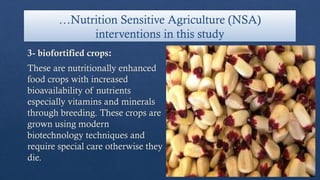
3- biofortified crops:
These are nutritionally enhanced
food crops with increased
bioavailability of nutrients
especially vitamins and minerals
through breeding. These crops are
grown using modern
biotechnology techniques and
require special care otherwise they
die.
…Nutrition Sensitive Agriculture (NSA)
interventions in this study
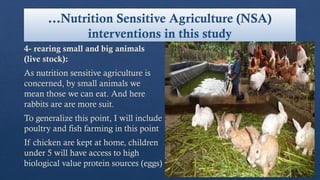
4- rearing small and big animals
(live stock):
As nutrition sensitive agriculture is
concerned, by small animals we
mean those we can eat. And here
rabbits are are more suit.
To generalize this point, I will include
poultry and fish farming in this point
If chicken are kept at home, children
under 5 will have access to high
biological value protein sources (eggs)
…Nutrition Sensitive Agriculture (NSA)
interventions in this study
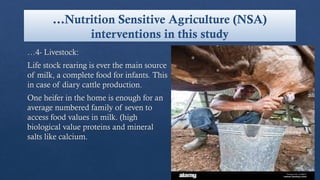
…4- Livestock:
Life stock rearing is ever the main source
of milk, a complete food for infants. This
in case of diary cattle production.
One heifer in the home is enough for an
average numbered family of seven to
access food values in milk. (high
biological value proteins and mineral
salts like calcium.
…Nutrition Sensitive Agriculture (NSA)
interventions in this study
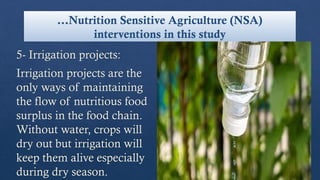
5- Irrigation projects:
Irrigation projects are the
only ways of maintaining
the flow of nutritious food
surplus in the food chain.
Without water, crops will
dry out but irrigation will
keep them alive especially
during dry season.
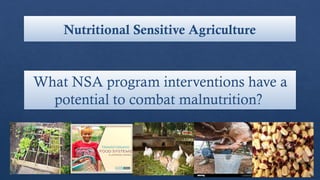
Nutritional Sensitive Agriculture
What NSA program interventions have a
potential to combat malnutrition?
Nutritional Sensitive Agriculture
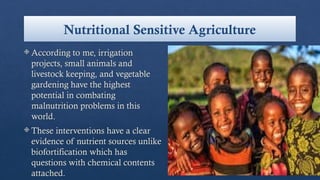
 According to me, irrigation
projects, small animals and
livestock keeping, and vegetable
gardening have the highest
potential in combating
malnutrition problems in this
world.
 These interventions have a clear
evidence of nutrient sources unlike
biofortification which has
questions with chemical contents
attached.

Nutritional Sensitive Farming (Agriculture)

  • 1.
  • 2.
    Nutritional Sensitive Agriculture Based on the studies of Ruel Etal in the paper titled “Nutrition- sensitive agriculture: What have we learned so far?”  I,  Explain any five Nutrition Sensitive Agriculture (NSA) interventions in this study.  What NSA program interventions have a potential to combat malnutrition?
  • 3.
    …Nutritional Sensitive Agriculture According to the study, nutrition sensitive agriculture is the special agricultural practices that aim at stopping malnutrition problems that result from nutrient deficiencies and food insecurity as found in specific groups of people.  The study found that, Nutrition specific interventions alone, even if implemented at scale, will not meet global targets for improving nutrition unless other sectors particularly agriculture are put in consideration. This was clearly stated in the introductory part of the study script.
  • 4.
    Nutrition Sensitive Agriculture(NSA) interventions in this study  According to the study, Nutrition sensitive interventions are those that address the immediate determinants of fetal and child nutrition and development, adequate food and nutrient intake, feeding, caregiving and parenting practices, and low burden of infectious diseases. This is stated in the box one of the study.
  • 5.
    …Nutrition Sensitive Agriculture(NSA) interventions in this study 1- Homestead food production systems:
  • 6.
    …Nutrition Sensitive Agriculture(NSA) interventions in this study 2- home vegetable gardens: Vegetables are known to be highly nutritious due high vitamins and mineral salt contents. This makes the an immediate choice in nutrition sensitive farming. - The additional advantage of vegetables is their short period harvest where most vegetables are usually harvested within a months time.
  • 7.
    …Nutrition Sensitive Agriculture(NSA) interventions in this study 3- biofortified crops: These are nutritionally enhanced food crops with increased bioavailability of nutrients especially vitamins and minerals through breeding. These crops are grown using modern biotechnology techniques and require special care otherwise they die.
  • 8.
    …Nutrition Sensitive Agriculture(NSA) interventions in this study 4- rearing small and big animals (live stock): As nutrition sensitive agriculture is concerned, by small animals we mean those we can eat. And here rabbits are are more suit. To generalize this point, I will include poultry and fish farming in this point If chicken are kept at home, children under 5 will have access to high biological value protein sources (eggs)
  • 9.
    …Nutrition Sensitive Agriculture(NSA) interventions in this study …4- Livestock: Life stock rearing is ever the main source of milk, a complete food for infants. This in case of diary cattle production. One heifer in the home is enough for an average numbered family of seven to access food values in milk. (high biological value proteins and mineral salts like calcium.
  • 10.
    …Nutrition Sensitive Agriculture(NSA) interventions in this study 5- Irrigation projects: Irrigation projects are the only ways of maintaining the flow of nutritious food surplus in the food chain. Without water, crops will dry out but irrigation will keep them alive especially during dry season.
  • 11.
    Nutritional Sensitive Agriculture WhatNSA program interventions have a potential to combat malnutrition?
  • 12.
    Nutritional Sensitive Agriculture According to me, irrigation projects, small animals and livestock keeping, and vegetable gardening have the highest potential in combating malnutrition problems in this world.  These interventions have a clear evidence of nutrient sources unlike biofortification which has questions with chemical contents attached.