A Novel Form of Glycogen Storage
Disease (GSD) III Caused by a Variant
Gene
Patient JC - 62 year old female
 JC is a 62 year old female referred for a 15 pound
weight gain after chemotherapy for breast cancer.
 She reported exercise induced muscle cramps and
severe exhaustion.
Workup
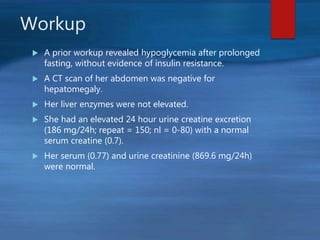
 A prior workup revealed hypoglycemia after prolonged
fasting, without evidence of insulin resistance.
 A CT scan of her abdomen was negative for
hepatomegaly.
 Her liver enzymes were not elevated.
 She had an elevated 24 hour urine creatine excretion
(186 mg/24h; repeat = 150; nl = 0-80) with a normal
serum creatine (0.7).
 Her serum (0.77) and urine creatinine (869.6 mg/24h)
were normal.
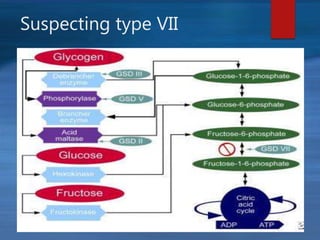
Suspecting type VII
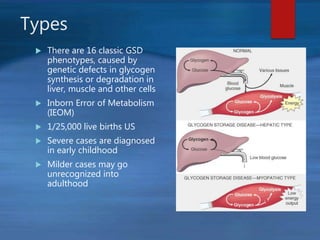
Types
 There are 16 classic GSD
phenotypes, caused by
genetic defects in glycogen
synthesis or degradation in
liver, muscle and other cells
 Inborn Error of Metabolism
(IEOM)
 1/25,000 live births US
 Severe cases are diagnosed
in early childhood
 Milder cases may go
unrecognized into
adulthood
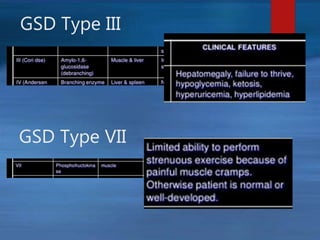
GSD Type III
GSD Type VII
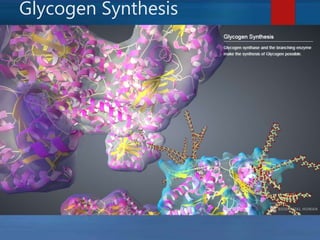
Glycogen Synthesis
Glycogen Synthesis
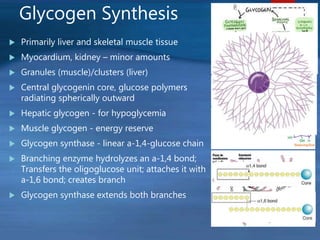
 Primarily liver and skeletal muscle tissue
 Myocardium, kidney – minor amounts
 Granules (muscle)/clusters (liver)
 Central glycogenin core, glucose polymers
radiating spherically outward
 Hepatic glycogen - for hypoglycemia
 Muscle glycogen - energy reserve
 Glycogen synthase - linear a-1,4-glucose chain
 Branching enzyme hydrolyzes an a-1,4 bond;
Transfers the oligoglucose unit; attaches it with
a-1,6 bond; creates branch
 Glycogen synthase extends both branches
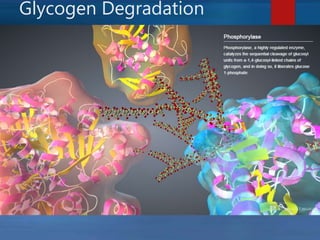
Glycogen Degradation
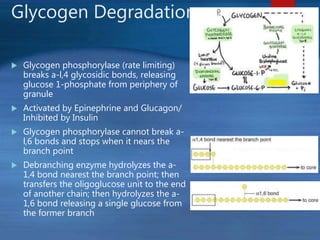
 Glycogen phosphorylase (rate limiting)
breaks a-l,4 glycosidic bonds, releasing
glucose 1-phosphate from periphery of
granule
 Activated by Epinephrine and Glucagon/
Inhibited by Insulin
 Glycogen phosphorylase cannot break a-
l,6 bonds and stops when it nears the
branch point
 Debranching enzyme hydrolyzes the a-
1,4 bond nearest the branch point; then
transfers the oligoglucose unit to the end
of another chain; then hydrolyzes the a-
1,6 bond releasing a single glucose from
the former branch
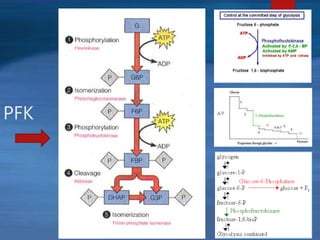
PFK
Case JC- Assessment/Approach
 62 yo female with profound muscle weakness/cramps
on exercise
 Elevated urine creatine
 Normal liver imaging and labs
 Suspect mild, GSD - type VII because of hypoglycemia,
exercise-induced muscle cramps, abnormal muscle
biochemistry and the absence of liver abnormalities.
 Responded to complex carbohydrate, high protein diet
and carnitine supplementation.
 Symptoms of exhaustion, exercise-induced muscle
cramps and excess weight improved
GSD Genetic Screening Panel
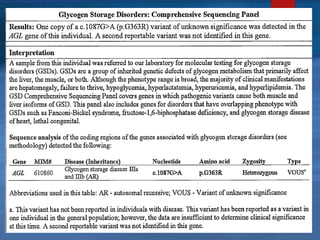
 A genetic sequencing screening panel for 21 GSD associated
genes was negative for the 16 classical GSDs
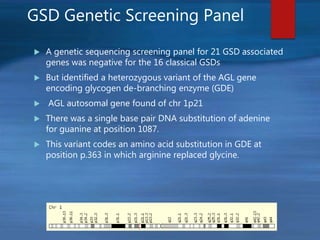
 But identified a heterozygous variant of the AGL gene
encoding glycogen de-branching enzyme (GDE)
 AGL autosomal gene found of chr 1p21
 There was a single base pair DNA substitution of adenine
for guanine at position 1087.
 This variant codes an amino acid substitution in GDE at
position p.363 in which arginine replaced glycine.
Glycogen Debranching
Enzyme
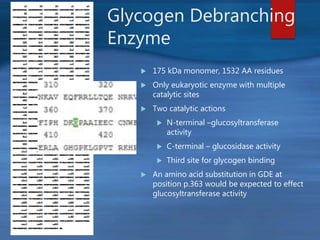
 175 kDa monomer, 1532 AA residues
 Only eukaryotic enzyme with multiple
catalytic sites
 Two catalytic actions
 N-terminal –glucosyltransferase
activity
 C-terminal – glucosidase activity
 Third site for glycogen binding
 An amino acid substitution in GDE at
position p.363 would be expected to effect
glucosyltransferase activity
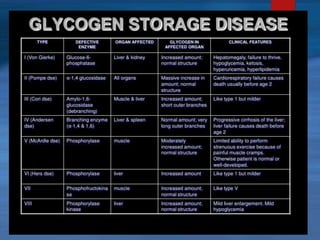
Type III Glycogen Storage Disease
 AKA: Debrancher Deficiency, Cori Disease, Forbes Disease,
Limit Dextrinosis
 GSD IIIa involves both liver and muscle (~85%)
 GSD IIIb only liver (~15%)
 GSD IIIc only muscle glucosidase (very rare)
 GSD IIId liver and muscle glucosyltransferase (very rare)
Novel GSD IIId?
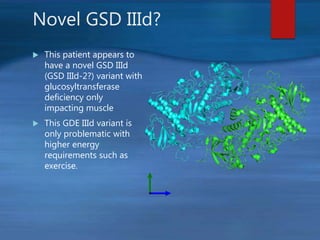
 This patient appears to
have a novel GSD IIId
(GSD IIId-2?) variant with
glucosyltransferase
deficiency only
impacting muscle
 This GDE IIId variant is
only problematic with
higher energy
requirements such as
exercise.
Thank You for Your Kind
Attention!

GSD III var mmr2 11-3

  • 1.
    A Novel Formof Glycogen Storage Disease (GSD) III Caused by a Variant Gene
  • 2.
    Patient JC -62 year old female  JC is a 62 year old female referred for a 15 pound weight gain after chemotherapy for breast cancer.  She reported exercise induced muscle cramps and severe exhaustion.
  • 3.
    Workup  A priorworkup revealed hypoglycemia after prolonged fasting, without evidence of insulin resistance.  A CT scan of her abdomen was negative for hepatomegaly.  Her liver enzymes were not elevated.  She had an elevated 24 hour urine creatine excretion (186 mg/24h; repeat = 150; nl = 0-80) with a normal serum creatine (0.7).  Her serum (0.77) and urine creatinine (869.6 mg/24h) were normal.
  • 4.
  • 5.
    Types  There are16 classic GSD phenotypes, caused by genetic defects in glycogen synthesis or degradation in liver, muscle and other cells  Inborn Error of Metabolism (IEOM)  1/25,000 live births US  Severe cases are diagnosed in early childhood  Milder cases may go unrecognized into adulthood
  • 7.
  • 8.
  • 9.
    Glycogen Synthesis  Primarilyliver and skeletal muscle tissue  Myocardium, kidney – minor amounts  Granules (muscle)/clusters (liver)  Central glycogenin core, glucose polymers radiating spherically outward  Hepatic glycogen - for hypoglycemia  Muscle glycogen - energy reserve  Glycogen synthase - linear a-1,4-glucose chain  Branching enzyme hydrolyzes an a-1,4 bond; Transfers the oligoglucose unit; attaches it with a-1,6 bond; creates branch  Glycogen synthase extends both branches
  • 10.
  • 11.
    Glycogen Degradation  Glycogenphosphorylase (rate limiting) breaks a-l,4 glycosidic bonds, releasing glucose 1-phosphate from periphery of granule  Activated by Epinephrine and Glucagon/ Inhibited by Insulin  Glycogen phosphorylase cannot break a- l,6 bonds and stops when it nears the branch point  Debranching enzyme hydrolyzes the a- 1,4 bond nearest the branch point; then transfers the oligoglucose unit to the end of another chain; then hydrolyzes the a- 1,6 bond releasing a single glucose from the former branch
  • 12.
  • 13.
    Case JC- Assessment/Approach 62 yo female with profound muscle weakness/cramps on exercise  Elevated urine creatine  Normal liver imaging and labs  Suspect mild, GSD - type VII because of hypoglycemia, exercise-induced muscle cramps, abnormal muscle biochemistry and the absence of liver abnormalities.  Responded to complex carbohydrate, high protein diet and carnitine supplementation.  Symptoms of exhaustion, exercise-induced muscle cramps and excess weight improved
  • 14.
    GSD Genetic ScreeningPanel  A genetic sequencing screening panel for 21 GSD associated genes was negative for the 16 classical GSDs  But identified a heterozygous variant of the AGL gene encoding glycogen de-branching enzyme (GDE)  AGL autosomal gene found of chr 1p21  There was a single base pair DNA substitution of adenine for guanine at position 1087.  This variant codes an amino acid substitution in GDE at position p.363 in which arginine replaced glycine.
  • 16.
    Glycogen Debranching Enzyme  175kDa monomer, 1532 AA residues  Only eukaryotic enzyme with multiple catalytic sites  Two catalytic actions  N-terminal –glucosyltransferase activity  C-terminal – glucosidase activity  Third site for glycogen binding  An amino acid substitution in GDE at position p.363 would be expected to effect glucosyltransferase activity
  • 17.
    Type III GlycogenStorage Disease  AKA: Debrancher Deficiency, Cori Disease, Forbes Disease, Limit Dextrinosis  GSD IIIa involves both liver and muscle (~85%)  GSD IIIb only liver (~15%)  GSD IIIc only muscle glucosidase (very rare)  GSD IIId liver and muscle glucosyltransferase (very rare)
  • 18.
    Novel GSD IIId? This patient appears to have a novel GSD IIId (GSD IIId-2?) variant with glucosyltransferase deficiency only impacting muscle  This GDE IIId variant is only problematic with higher energy requirements such as exercise.
  • 19.
    Thank You forYour Kind Attention!

Editor's Notes

  • #6 MBBS Medicine (Humanity First): Genetic diseases