Globalization And Its Effects On The
World
GLOBALIZATION
INTRODUCTION TO GLOBALIZATION !
Globalization is the word used to
describe the growing interdependence
of the world’s economies, cultures, and
populations, brought about by cross-
border trade in goods and services,
technology, and flows of investment,
people, and information. Countries
have built economic partnerships to
facilitate these movements over many
centuries.
2
TO WHAT EXTENT GLOBALIZATION AFFECTS OUR IDENTITY
TO WHAT EXTENT GLOBALIZATION AFFECTED OUR IDENTITY?
3
DIMENSIONS OF GLOBALIZATION
● CULTURE : Cultural Interchanges,a one world culture,homogenization.
● SOCIAL : Agricultural modernization, removal of direct support from the
state.
● POLITICS : An imposition of global governance/financial institutions.
● ECONOMY : Free trade or liberalization,privatization.
● TECHNOLOGY : Advancement in information communication
technology(ICT),technology and transportation.
4
ASPECTS OF GLOBALIZATION
● FREE TRADE : Globalisation has helped improve trade volumes between
nations with minimal interference. The Gross Domestic Product (GDP) of
countries that have accepted globalisation has also increased
significantly,thus bringing in better cooperation between governments.
● INCREASE IN EMPLOYMENT : Every industry is responsible for generating
both direct and indirect jobs. And when Production increases,it has a
positive effect on employment.
● INTERDEPENDENCE : With the advent of globalisation,countries have
become more reliant on each other.It has helped to reduce trading barriers
and build overall economic prosperity
5
● URBANIZATION : When many foreign/local companies set up businesses in a
particular area,it becomes a region of economic activity.It leads to the
building of urban centres in and around industrial areas.
● STANDARD OF LIVING : With increased economic activity and opportunities
for employment,people have more money. They also have more options to
choose from because of improved job opportunities.
6
Positive & Negative Impacts Of Globalization
NEGATIVE IMPACTS
1.Causes Environmental Damages
2.Causes fluctuation of Prices
3. Job Insecurity
4.Terrorism
Positive Impacts
1.Increase in World Trade
2.Rise in Employment
3.Innovation
4.Quality Improvement of products
5.Promotes World Peace & Unity
7
The Impacts of Internet on the Globalization
Positive Impacts
1.Buisness Prospects
2.Mass Media Revolution
3.Interpersonal Interaction
4.Worldwide Culture
Negative Impacts
1. Inconsistent Global Access
2.Security Issues
8
Reasons For
Globalization.
● Improvements in transportation
● Freedom of trade
● Improvements of communications
● Labour availability and skills
9
The reasons for globalization are:
● Improvements in transportation - larger cargo ships, Goods
trains, aircrafts and other high tier vehicles mean that the cost of
transporting goods between countries has decreased.
Economies of scale mean the cost per item can reduce when
operating on a larger scale. Transport improvements also mean
that goods and people can travel more quickly.
● Freedom of trade - organisations like the World Trade
Organisation (WTO) promote free trade between countries, which
help to remove barriers between countries.
10
The reasons for globalization are:
● Improvements of communications - the internet and mobile
technology have allowed greater communication between people
in different countries.
● Labour availability and skills - countries such as India have
lower labour costs (about a third of that of the UK) and also high
skill levels. Labour intensive industries such as clothing can take
advantage of cheaper labour costs and reduced legal restrictions
in LEDCs.
11
STATISTICS BASED ON
SURVEYS OF
GLOBALIZATION
13
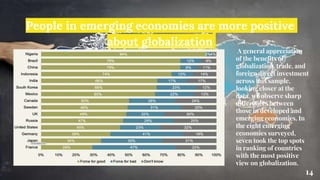
People in emerging economies are more positive
about globalization
15
A general appreciation
of the benefits of
globalization, trade, and
foreign direct investment
across this sample,
looking closer at the
data, we observe sharp
differences between
those in developed and
emerging economies. In
the eight emerging
economies surveyed,
seven took the top spots
in ranking of countries
with the most positive
view on globalization.
14
Attitudes to the World Trade Organization
The World Trade Organization
(WTO) is currently in a tight spot.
Negotiations about the latest major
round of trade moderation have
been constant for more than
decade. Reform efforts have
stalled, and its arguably most
important member state – the US –
has been taking a very negative
stance toward the organization
under the current administration.
However, the survey paints a rather
positive picture for the WTO. It
finds that 62 percent of
respondents in this 15 country
sample consider the WTO to be an
important institution, with only 14
percent believing it is irrelevant.
While comparing to 2018, the
overall positive perception about
the WTO has increased by six
percentage points – up from 56 to
62 percent within two years.
15
The need for solutions and strategies
to face the environmental crisis has
become more and more relevant in
the last couple of years. According to
the survey results, people see
globalization as damaging for the
environment through different
mechanisms such as energy
consumption, depletion of important
resources, air pollution,
deforestation, and water
contamination. However, when asked
whether they would accept forgoing
some of the benefits of globalization
for the sake of the environment, more
than half of interviewees stated that
they are willing to give up benefits
such as product variety, cheaper
goods, and international travel to
contribute to the fight against climate
The environment is an important issue in
thinking about globalization
16
The role of MNCs in
Globalization process
17
1. MNCs establish control over production by placing orders with small
businesses in emerging countries.
2. MNCs establish production offices and factories in areas with inexpensive
labor and other resources.
3. They help in the transfer of capital from nations where it is plenty to those
where it is lacking.
4. They contribute to the creation of large-scale job possibilities by establishing
branches and affiliates.
5. They contribute to the expansion of knowledge and the development of
human resources.
18
Economic Globalization
19
What is Economic Globalization?
Economic globalization refers to the widespread international
movement of goods, capital, services, technology and information.
It is the increasing economic integration and interdependence of
national, regional, and local economies across the world through
an intensification of cross-border movement of goods, services,
technologies and capital.
20
The rapid growing significance of information in all types of productive activities and
marketization are the two major driving forces for economic globalization.
The advancement of science and technologies has greatly reduced the cost of transportation
and communication, making economic globalization possible.
The dominant role of developed countries in the process of economic globalization is also
reflected in the fact that it is they that determine the rules for international economic exchanges.
Economic globalization is a thriving phenomenon of the past century and has greatly
influenced the world’s economy. Indeed, an aspect of economic globalization is the development
of firms into multinational companies.
Nowadays, it has been observed that more and more companies aim in exporting their products
and augmenting their customer database either by establishing an Internet Encarta or
franchising, firms aim to increase their profits while at the same time they contribute in the
construction of a global marketplace and the increase of the world’s GDP.
21
GLOBALIZATION EFFECT ON STOCK
MARKET
1. Globalization decreases the cost of manufacturing.
2. Globalization also gives organizations the opportunity to
take advantage of lower labor costs in developing countries.
3. Globalization increases international investing.
4. Maintaing Competitiveness
22
Globalization effect on trade
Globalisation has been taking place for hundreds of years
but has rapidly increased over the last 30 years or so.
Globalisation has resulted in:
• increased international trade
• the same company operating in more than one country
• a greater dependence on the global economy
23
Analysis
Globalization Is Here to Stay !
Globalization does have problems and
negative effects, but it is not going to
disappear. So...
We need to learn how to reap its
benefits, and minimize its costs. To do
that, we must:
Understand its impacts
Work to remedy the problems
Work to spread the benefits as widely as possible
24
25
27
Impact of Globalisation on
India
29
While Primary aim was to promote business opportunities in this country, generate
employment, and attract global investments the impact went beyond and above..
● The introduction of globalisation changed Indian society drastically.
● The Indian economy became integrated into the global economy, and next
economic policies displayed a direct influence of this change.
● Government shaped administrative policies w.r.t Globalisation.
30
31
Effects of Globalisation on
Indian Economy
32
1. More Employment Opportunities
Globalisation brought an influx of foreign investments which alongside policies of the
Indian government resulted in new employment opportunities.
2. Increase in per-capita Income
As a direct effect of more employment opportunities, the per-capita income of Indian
households also increased after globalisation.
33
3. More Choices for Consumers
Increase in competition, owing to Globalisation prompted manufacturers to create
better products at a much lower price point.
4. Access to untapped markets
A noticeable benefit of globalisation is that it provides access to many untapped
markets with huge potential. The globalisation of the Indian economy means it
allowed foreign companies to operate in the Indian market. Indian businesses also
got an opportunity to operate on a global scale as such, the import-export sector in
India saw an astonishing rise after 1991.
34
Globalisation & World Wide
Web
Effects & Impact
35
● Without technology, globalization would probably not be a
topic for discussion. In particular, communications technology,
in which the Internet plays a major role, has revolutionized the
ways of the world like never before.
● A world without Internet is unimaginable today, so is the case
for Globalisation at its current state
● Globalisation & Internet: What gave way to whom is impossible
to devise, such is their closeness in terms of Interrelation.
36
Effects & Impacts
❏ Effects on Business
❏ Effects on Mass Media
❏ Negative Impact of the Internet
37
CONCLUSION
● Globalisation had increased the trade of products,ideas,technologies etc.
and created the world without boundaries but it also had some negative
impact on the developing countries.
● Flowing with globalisation, India is shining in nearly every Prospects. India
is getting a global recognition and slowly moving towards to become a
major economic and political strength.
● Though the development is progressing rapidly, still many basic problems
like rural poverty, corruption and political instability remained unsolved.
PEOPLE INVOLVED (Group F):
● Priyanjana Mandal : 22052136
● Priyank Patel : 22052137
● Puja Ghosh : 22052138
● Pushpa Sharon : 22052139
● Ranit Mukherjee : 22052140
● Rishi Raj Dutta : 22052141
● Rohit Mahatha : 22052142
● Rohit Sarkar : 22052143
● Rounak Sharaff : 22052144
● Rudrabikram Roy : 22052145

Globalization And It's Effects.pptx

  • 1.
    Globalization And ItsEffects On The World
  • 2.
  • 3.
    INTRODUCTION TO GLOBALIZATION! Globalization is the word used to describe the growing interdependence of the world’s economies, cultures, and populations, brought about by cross- border trade in goods and services, technology, and flows of investment, people, and information. Countries have built economic partnerships to facilitate these movements over many centuries. 2
  • 4.
    TO WHAT EXTENTGLOBALIZATION AFFECTS OUR IDENTITY TO WHAT EXTENT GLOBALIZATION AFFECTED OUR IDENTITY? 3
  • 5.
    DIMENSIONS OF GLOBALIZATION ●CULTURE : Cultural Interchanges,a one world culture,homogenization. ● SOCIAL : Agricultural modernization, removal of direct support from the state. ● POLITICS : An imposition of global governance/financial institutions. ● ECONOMY : Free trade or liberalization,privatization. ● TECHNOLOGY : Advancement in information communication technology(ICT),technology and transportation. 4
  • 6.
    ASPECTS OF GLOBALIZATION ●FREE TRADE : Globalisation has helped improve trade volumes between nations with minimal interference. The Gross Domestic Product (GDP) of countries that have accepted globalisation has also increased significantly,thus bringing in better cooperation between governments. ● INCREASE IN EMPLOYMENT : Every industry is responsible for generating both direct and indirect jobs. And when Production increases,it has a positive effect on employment. ● INTERDEPENDENCE : With the advent of globalisation,countries have become more reliant on each other.It has helped to reduce trading barriers and build overall economic prosperity 5
  • 7.
    ● URBANIZATION :When many foreign/local companies set up businesses in a particular area,it becomes a region of economic activity.It leads to the building of urban centres in and around industrial areas. ● STANDARD OF LIVING : With increased economic activity and opportunities for employment,people have more money. They also have more options to choose from because of improved job opportunities. 6
  • 8.
    Positive & NegativeImpacts Of Globalization NEGATIVE IMPACTS 1.Causes Environmental Damages 2.Causes fluctuation of Prices 3. Job Insecurity 4.Terrorism Positive Impacts 1.Increase in World Trade 2.Rise in Employment 3.Innovation 4.Quality Improvement of products 5.Promotes World Peace & Unity 7
  • 9.
    The Impacts ofInternet on the Globalization Positive Impacts 1.Buisness Prospects 2.Mass Media Revolution 3.Interpersonal Interaction 4.Worldwide Culture Negative Impacts 1. Inconsistent Global Access 2.Security Issues 8
  • 10.
    Reasons For Globalization. ● Improvementsin transportation ● Freedom of trade ● Improvements of communications ● Labour availability and skills 9
  • 11.
    The reasons forglobalization are: ● Improvements in transportation - larger cargo ships, Goods trains, aircrafts and other high tier vehicles mean that the cost of transporting goods between countries has decreased. Economies of scale mean the cost per item can reduce when operating on a larger scale. Transport improvements also mean that goods and people can travel more quickly. ● Freedom of trade - organisations like the World Trade Organisation (WTO) promote free trade between countries, which help to remove barriers between countries. 10
  • 12.
    The reasons forglobalization are: ● Improvements of communications - the internet and mobile technology have allowed greater communication between people in different countries. ● Labour availability and skills - countries such as India have lower labour costs (about a third of that of the UK) and also high skill levels. Labour intensive industries such as clothing can take advantage of cheaper labour costs and reduced legal restrictions in LEDCs. 11
  • 13.
    STATISTICS BASED ON SURVEYSOF GLOBALIZATION 13
  • 14.
    People in emergingeconomies are more positive about globalization 15 A general appreciation of the benefits of globalization, trade, and foreign direct investment across this sample, looking closer at the data, we observe sharp differences between those in developed and emerging economies. In the eight emerging economies surveyed, seven took the top spots in ranking of countries with the most positive view on globalization. 14
  • 15.
    Attitudes to theWorld Trade Organization The World Trade Organization (WTO) is currently in a tight spot. Negotiations about the latest major round of trade moderation have been constant for more than decade. Reform efforts have stalled, and its arguably most important member state – the US – has been taking a very negative stance toward the organization under the current administration. However, the survey paints a rather positive picture for the WTO. It finds that 62 percent of respondents in this 15 country sample consider the WTO to be an important institution, with only 14 percent believing it is irrelevant. While comparing to 2018, the overall positive perception about the WTO has increased by six percentage points – up from 56 to 62 percent within two years. 15
  • 16.
    The need forsolutions and strategies to face the environmental crisis has become more and more relevant in the last couple of years. According to the survey results, people see globalization as damaging for the environment through different mechanisms such as energy consumption, depletion of important resources, air pollution, deforestation, and water contamination. However, when asked whether they would accept forgoing some of the benefits of globalization for the sake of the environment, more than half of interviewees stated that they are willing to give up benefits such as product variety, cheaper goods, and international travel to contribute to the fight against climate The environment is an important issue in thinking about globalization 16
  • 17.
    The role ofMNCs in Globalization process 17
  • 18.
    1. MNCs establishcontrol over production by placing orders with small businesses in emerging countries. 2. MNCs establish production offices and factories in areas with inexpensive labor and other resources. 3. They help in the transfer of capital from nations where it is plenty to those where it is lacking. 4. They contribute to the creation of large-scale job possibilities by establishing branches and affiliates. 5. They contribute to the expansion of knowledge and the development of human resources. 18
  • 19.
  • 20.
    What is EconomicGlobalization? Economic globalization refers to the widespread international movement of goods, capital, services, technology and information. It is the increasing economic integration and interdependence of national, regional, and local economies across the world through an intensification of cross-border movement of goods, services, technologies and capital. 20
  • 21.
    The rapid growingsignificance of information in all types of productive activities and marketization are the two major driving forces for economic globalization. The advancement of science and technologies has greatly reduced the cost of transportation and communication, making economic globalization possible. The dominant role of developed countries in the process of economic globalization is also reflected in the fact that it is they that determine the rules for international economic exchanges. Economic globalization is a thriving phenomenon of the past century and has greatly influenced the world’s economy. Indeed, an aspect of economic globalization is the development of firms into multinational companies. Nowadays, it has been observed that more and more companies aim in exporting their products and augmenting their customer database either by establishing an Internet Encarta or franchising, firms aim to increase their profits while at the same time they contribute in the construction of a global marketplace and the increase of the world’s GDP. 21
  • 22.
    GLOBALIZATION EFFECT ONSTOCK MARKET 1. Globalization decreases the cost of manufacturing. 2. Globalization also gives organizations the opportunity to take advantage of lower labor costs in developing countries. 3. Globalization increases international investing. 4. Maintaing Competitiveness 22
  • 23.
    Globalization effect ontrade Globalisation has been taking place for hundreds of years but has rapidly increased over the last 30 years or so. Globalisation has resulted in: • increased international trade • the same company operating in more than one country • a greater dependence on the global economy 23
  • 24.
    Analysis Globalization Is Hereto Stay ! Globalization does have problems and negative effects, but it is not going to disappear. So... We need to learn how to reap its benefits, and minimize its costs. To do that, we must: Understand its impacts Work to remedy the problems Work to spread the benefits as widely as possible 24
  • 25.
  • 27.
  • 29.
  • 30.
    While Primary aimwas to promote business opportunities in this country, generate employment, and attract global investments the impact went beyond and above.. ● The introduction of globalisation changed Indian society drastically. ● The Indian economy became integrated into the global economy, and next economic policies displayed a direct influence of this change. ● Government shaped administrative policies w.r.t Globalisation. 30
  • 31.
  • 32.
    Effects of Globalisationon Indian Economy 32
  • 33.
    1. More EmploymentOpportunities Globalisation brought an influx of foreign investments which alongside policies of the Indian government resulted in new employment opportunities. 2. Increase in per-capita Income As a direct effect of more employment opportunities, the per-capita income of Indian households also increased after globalisation. 33
  • 34.
    3. More Choicesfor Consumers Increase in competition, owing to Globalisation prompted manufacturers to create better products at a much lower price point. 4. Access to untapped markets A noticeable benefit of globalisation is that it provides access to many untapped markets with huge potential. The globalisation of the Indian economy means it allowed foreign companies to operate in the Indian market. Indian businesses also got an opportunity to operate on a global scale as such, the import-export sector in India saw an astonishing rise after 1991. 34
  • 35.
    Globalisation & WorldWide Web Effects & Impact 35
  • 36.
    ● Without technology,globalization would probably not be a topic for discussion. In particular, communications technology, in which the Internet plays a major role, has revolutionized the ways of the world like never before. ● A world without Internet is unimaginable today, so is the case for Globalisation at its current state ● Globalisation & Internet: What gave way to whom is impossible to devise, such is their closeness in terms of Interrelation. 36
  • 37.
    Effects & Impacts ❏Effects on Business ❏ Effects on Mass Media ❏ Negative Impact of the Internet 37
  • 38.
    CONCLUSION ● Globalisation hadincreased the trade of products,ideas,technologies etc. and created the world without boundaries but it also had some negative impact on the developing countries. ● Flowing with globalisation, India is shining in nearly every Prospects. India is getting a global recognition and slowly moving towards to become a major economic and political strength. ● Though the development is progressing rapidly, still many basic problems like rural poverty, corruption and political instability remained unsolved.
  • 41.
    PEOPLE INVOLVED (GroupF): ● Priyanjana Mandal : 22052136 ● Priyank Patel : 22052137 ● Puja Ghosh : 22052138 ● Pushpa Sharon : 22052139 ● Ranit Mukherjee : 22052140 ● Rishi Raj Dutta : 22052141 ● Rohit Mahatha : 22052142 ● Rohit Sarkar : 22052143 ● Rounak Sharaff : 22052144 ● Rudrabikram Roy : 22052145