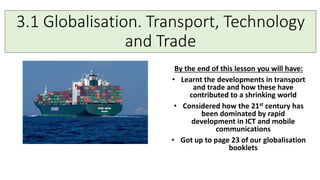
3.1 Globalisation. Transport, Technology
and Trade
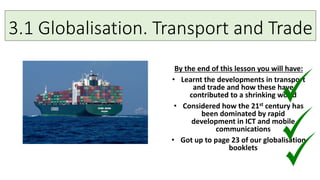
By the end of this lesson you will have:
• Learnt the developments in transport
and trade and how these have
contributed to a shrinking world
• Considered how the 21st century has
been dominated by rapid
development in ICT and mobile
communications
• Got up to page 23 of our globalisation
booklets
Globalisation – Enquiry Question 1
•What are the causes of Globalisation and why has it
accelerated in recent decades?
3.1 Globalisation is a longstanding
process which has accelerated
because of rapid developments in
transport, communications and
business
a. Globalisation involves widening and deepening global
connections, interdependence and flows (commodities,
capital, information, migrants and tourists).
b. Developments in transport and trade in the 19th
century (railways, telegraph, steam-ships) accelerated in
the 20th century (jet aircraft, containerisation),
contributing to a ‘shrinking world’.
c. The 21st century has been dominated by rapid
development in ICT and mobile communication (mobile
phones, internet, social networking, electronic banking,
fibre optics), lowering communication costs and
contributing to time-space compression.
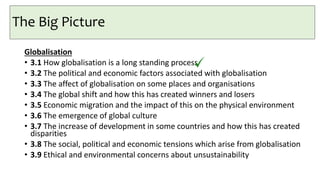
The Big Picture
Globalisation
• 3.1 How globalisation is a long standing process
• 3.2 The political and economic factors associated with globalisation
• 3.3 The affect of globalisation on some places and organisations
• 3.4 The global shift and how this has created winners and losers
• 3.5 Economic migration and the impact of this on the physical environment
• 3.6 The emergence of global culture
• 3.7 The increase of development in some countries and how this has created
disparities
• 3.8 The social, political and economic tensions which arise from globalisation
• 3.9 Ethical and environmental concerns about unsustainability
Guestimate quiz
• 1. Which countries might try to maintain their competitive edge through
continues transport innovation?
• 2. What is spatial division of labour?
• 3. What are the four main innovations in transport in the last 200 years?
• 4. What is time-space compression?
• 5. State two ways in which the world has ‘shrunk’ in the last 100 years
• 6. Approximately how many passengers do EasyJet have each year?
• 7. What are intermodal containers?
• 8. What is the M-Pesa system?
• 9. What is the most watched video on youtube of all time?
• 10. How can social networks be used for a political end?
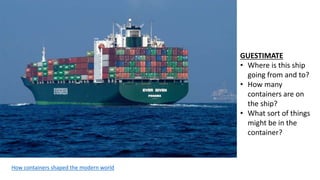
GUESTIMATE
• Where is this ship
going from and to?
• How many
containers are on
the ship?
• What sort of things
might be in the
container?
How containers shaped the modern world
Transport and Trade
• Individually use page 163&164 of your textbook
• Make notes on the innovations in transport
• The world started to become more connected during the 19th century
and the industrialisation of Britain.
• Companies realised that the more effective their transport, the more
effective their trade, which then created money to improve transport
technology. Trade and transport therefore are interlinked.
Transport and Trade
• The following improvements in transport have encouraged trade
• Steam power
• Railways
• Jet Aircraft
• Container Shipping
• Transport is essential for TNCs to establish spatial division of labour
Shrinking World
• By a shrinking world, we simply mean that connections made across
the globe are getting quicker and easier, otherwise known as time-
space compression
• Things which seemed once at a distance, are now near. Things that
would take a long time, now take a little.
• Can you think of any examples of how the world has shrunk for you?
• Shrinking World
Easy Jet Case Study
• As a class we will read the case study of Easy Jet as an example of
how TRANSPORT has increased GLOBALISATION and that the two are
inextricably linked
• TASK: Gimme’ 5
• Write up the case study of easy jet in 5 key points in your booklets
• Along with transport improvements, several significant improvements in
technology have accelerated globalisation:
• Telephone and the Telegraph
• Broadband and FibreOptics
• GIS and GPS
• The Internet and Social Networks
• As a pair, pick 2 of the above and make notes of it using table 12.2 on page 165 of
the textbook
ICT and Mobile Phones – Growth of Globalisation
• Telephone and the Telegraph – revolutionised how business could work (trading
goods)
• Broadband and FibreOptics – More than 1million KM of undersea cables carry
the world’s searches and tweets. These are owned by governments or TNCs.
• GIS and GPS – there are currently 24 satellites which broadcast time and position
to people on earth. We can now track deliveries and use SatNav
• The Internet and Social Networks – Connectivity between people and places has
grown exponentially. 5 billion facebook likes are registered every day.
Technology and Globalisation
• Key players use technology in a variety of different ways to contribute to
globalisation.
• Technology is used to contribute to:
• Economic globalisation
• Social globalisation
• Cultural globalisation
• Political globalisation
• TASK: Can you think of examples of how technology is used to accelerate
the different strands of globalisation above?
Mobile Phones and Developing Countries
• Make a spider diagram in your notes with ‘mobile phones and
developing countries’ and add as much information as you can and
make sure you get what ‘M-Pesa’ is using page 166 of the textbook
Guestimate quiz – you should now get 10/10 
• 1. Which countries might try to maintain their competitive edge through
continues transport innovation?
• 2. What is spatial division of labour?
• 3. What are the four main innovations in transport in the last 200 years?
• 4. What is time-space compression?
• 5. State two ways in which the world has ‘shrunk’ in the last 100 years
• 6. Approximately how many passengers do EasyJet have each year?
• 7. What are intermodal containers?
• 8. What is the M-Pesa system?
• 9. What is the most watched video on youtube of all time?
• 10. How can social networks be used for a political end?
3.1 Globalisation. Transport and Trade
By the end of this lesson you will have:
• Learnt the developments in transport
and trade and how these have
contributed to a shrinking world
• Considered how the 21st century has
been dominated by rapid
development in ICT and mobile
communications
• Got up to page 23 of our globalisation
booklets
The Big Picture
Globalisation
• 3.1 How globalisation is a long standing process
• 3.2 The political and economic factors associated with globalisation
• 3.3 The affect of globalisation on some places and organisations
• 3.4 The global shift and how this has created winners and losers
• 3.5 Economic migration and the impact of this on the physical environment
• 3.6 The emergence of global culture
• 3.7 The increase of development in some countries and how this has created
disparities
• 3.8 The social, political and economic tensions which arise from globalisation
• 3.9 Ethical and environmental concerns about unsustainability

Globalisation - transport and trade

  • 1.
    3.1 Globalisation. Transport,Technology and Trade By the end of this lesson you will have: • Learnt the developments in transport and trade and how these have contributed to a shrinking world • Considered how the 21st century has been dominated by rapid development in ICT and mobile communications • Got up to page 23 of our globalisation booklets
  • 2.
    Globalisation – EnquiryQuestion 1 •What are the causes of Globalisation and why has it accelerated in recent decades? 3.1 Globalisation is a longstanding process which has accelerated because of rapid developments in transport, communications and business a. Globalisation involves widening and deepening global connections, interdependence and flows (commodities, capital, information, migrants and tourists). b. Developments in transport and trade in the 19th century (railways, telegraph, steam-ships) accelerated in the 20th century (jet aircraft, containerisation), contributing to a ‘shrinking world’. c. The 21st century has been dominated by rapid development in ICT and mobile communication (mobile phones, internet, social networking, electronic banking, fibre optics), lowering communication costs and contributing to time-space compression.
  • 3.
    The Big Picture Globalisation •3.1 How globalisation is a long standing process • 3.2 The political and economic factors associated with globalisation • 3.3 The affect of globalisation on some places and organisations • 3.4 The global shift and how this has created winners and losers • 3.5 Economic migration and the impact of this on the physical environment • 3.6 The emergence of global culture • 3.7 The increase of development in some countries and how this has created disparities • 3.8 The social, political and economic tensions which arise from globalisation • 3.9 Ethical and environmental concerns about unsustainability
  • 4.
    Guestimate quiz • 1.Which countries might try to maintain their competitive edge through continues transport innovation? • 2. What is spatial division of labour? • 3. What are the four main innovations in transport in the last 200 years? • 4. What is time-space compression? • 5. State two ways in which the world has ‘shrunk’ in the last 100 years • 6. Approximately how many passengers do EasyJet have each year? • 7. What are intermodal containers? • 8. What is the M-Pesa system? • 9. What is the most watched video on youtube of all time? • 10. How can social networks be used for a political end?
  • 5.
    GUESTIMATE • Where isthis ship going from and to? • How many containers are on the ship? • What sort of things might be in the container? How containers shaped the modern world
  • 6.
    Transport and Trade •Individually use page 163&164 of your textbook • Make notes on the innovations in transport • The world started to become more connected during the 19th century and the industrialisation of Britain. • Companies realised that the more effective their transport, the more effective their trade, which then created money to improve transport technology. Trade and transport therefore are interlinked.
  • 7.
    Transport and Trade •The following improvements in transport have encouraged trade • Steam power • Railways • Jet Aircraft • Container Shipping • Transport is essential for TNCs to establish spatial division of labour
  • 8.
    Shrinking World • Bya shrinking world, we simply mean that connections made across the globe are getting quicker and easier, otherwise known as time- space compression • Things which seemed once at a distance, are now near. Things that would take a long time, now take a little. • Can you think of any examples of how the world has shrunk for you? • Shrinking World
  • 9.
    Easy Jet CaseStudy • As a class we will read the case study of Easy Jet as an example of how TRANSPORT has increased GLOBALISATION and that the two are inextricably linked • TASK: Gimme’ 5 • Write up the case study of easy jet in 5 key points in your booklets
  • 10.
    • Along withtransport improvements, several significant improvements in technology have accelerated globalisation: • Telephone and the Telegraph • Broadband and FibreOptics • GIS and GPS • The Internet and Social Networks • As a pair, pick 2 of the above and make notes of it using table 12.2 on page 165 of the textbook ICT and Mobile Phones – Growth of Globalisation
  • 11.
    ICT and MobilePhones – Growth of Globalisation • Telephone and the Telegraph – revolutionised how business could work (trading goods) • Broadband and FibreOptics – More than 1million KM of undersea cables carry the world’s searches and tweets. These are owned by governments or TNCs. • GIS and GPS – there are currently 24 satellites which broadcast time and position to people on earth. We can now track deliveries and use SatNav • The Internet and Social Networks – Connectivity between people and places has grown exponentially. 5 billion facebook likes are registered every day.
  • 12.
    Technology and Globalisation •Key players use technology in a variety of different ways to contribute to globalisation. • Technology is used to contribute to: • Economic globalisation • Social globalisation • Cultural globalisation • Political globalisation • TASK: Can you think of examples of how technology is used to accelerate the different strands of globalisation above?
  • 13.
    Mobile Phones andDeveloping Countries • Make a spider diagram in your notes with ‘mobile phones and developing countries’ and add as much information as you can and make sure you get what ‘M-Pesa’ is using page 166 of the textbook
  • 14.
    Guestimate quiz –you should now get 10/10  • 1. Which countries might try to maintain their competitive edge through continues transport innovation? • 2. What is spatial division of labour? • 3. What are the four main innovations in transport in the last 200 years? • 4. What is time-space compression? • 5. State two ways in which the world has ‘shrunk’ in the last 100 years • 6. Approximately how many passengers do EasyJet have each year? • 7. What are intermodal containers? • 8. What is the M-Pesa system? • 9. What is the most watched video on youtube of all time? • 10. How can social networks be used for a political end?
  • 15.
    3.1 Globalisation. Transportand Trade By the end of this lesson you will have: • Learnt the developments in transport and trade and how these have contributed to a shrinking world • Considered how the 21st century has been dominated by rapid development in ICT and mobile communications • Got up to page 23 of our globalisation booklets
  • 16.
    The Big Picture Globalisation •3.1 How globalisation is a long standing process • 3.2 The political and economic factors associated with globalisation • 3.3 The affect of globalisation on some places and organisations • 3.4 The global shift and how this has created winners and losers • 3.5 Economic migration and the impact of this on the physical environment • 3.6 The emergence of global culture • 3.7 The increase of development in some countries and how this has created disparities • 3.8 The social, political and economic tensions which arise from globalisation • 3.9 Ethical and environmental concerns about unsustainability