GLOBALISATION
BY:- MAHWESH JAWAID
B.ED 1ST SEMESTER
ROLL NO:- 31
GUIDED BY:- RAVI SIR
ABSTRACTS
Globalisation means different things to different people’s a
general definition is the increasing movement of
information, material & people across borders. It is used to
describe how trade& technology have made the world into a
more connected and interdependent place. Globalisation
also captures in its scope the economic and social changes
that have come about as a result. It is magnified by the
increase in interaction between peoples around the world
that involves sharing of ideas, cultures, goods, services and
investment. In shorts it is the way people all over the earth
interact with one another in terms of economics, politics,
INTRODUCTION
Although globalization is generally understood to mean
integration of the economy of the country with the world
economy, it is a complete phenomenon. It is an outcome of the set
of various policies that are aimed at transforming the world
towards greater independence and integration. It involves creation
of network and activites transeeding economics social and
geographical boundaries. Globalisation attempts to establish link
in such a way that the happening in India can be influenced by
events happening miles away. It is turning the world into one
whole or creating a borderless world.
OBJECTIVES:-
To promote economic growth and development by expanding
markets, increasing trade and attracting foreign direct
investment
To enable countries to access new markets, technologies and
resources landing to increased productivity and higher living
standards.
To promote free trade by reducing barrier such as tariffs,
quotas and trade restriction.
To promote environmental sustainability and to promote
responsible and sustainable practices.
To promote the efficient allocation of resources globally.
To encourage countries to specialize in producing good and
services in which they have a comparative advantage.
-:GLOBALISATION OF INDIAN
ECONOMY:-
Indian economy adopted the policy of
restriction after the independence.
But in 1991 due to the economic crises
the government of India decided to
open it’s market for the foreign
investment.
The new economic policies adopted
had impact on every sector oof the
Indian economy.
However, economic unification is the
main factor that contributes maximum
to a country’s economy into an
international economy.
 It has significantly changed several
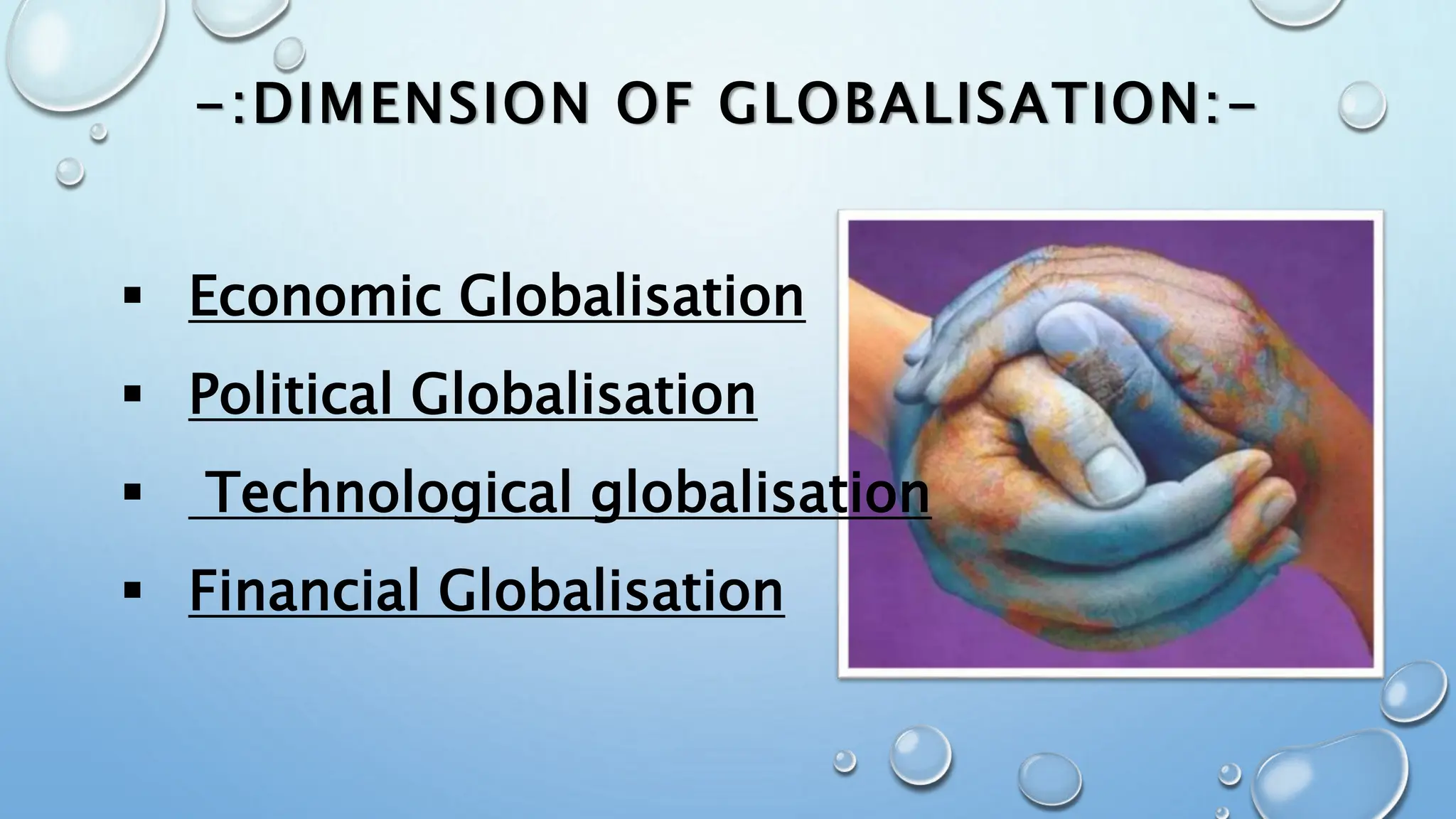
-:DIMENSION OF GLOBALISATION:-
 Economic Globalisation
 Political Globalisation
 Technological globalisation
 Financial Globalisation
METHODOLOGY
Descriptive
RESULT AND DISCUSSION
Positive Impact:-
 Economic liberalisation
 Technological Advancement
 Trade Liberalisation
 Outsourcing
 Cultural Exchange
Negative Impact:-
 Unequal economic
 Job displacement
 Vulnerability to Global economic
shocks
 Adverse Impact on domestic
 Environmental degradation
CONCLUSION
Globalisation has led to a sharp increase in
trade and economic exchanges, but also to a
multiplication of financial exchanges. In the
1970’s world economics opened up and
development of free trade policies accelerated
the globalisation phenomenon. Socially,
globalisation has facilitated the exchange of
ideas and cultures, contributing to a world
view in which people are more and tolerant of
REFERENCE
THANK YOU

globalisation project report displayed overview

  • 1.
    GLOBALISATION BY:- MAHWESH JAWAID B.ED1ST SEMESTER ROLL NO:- 31 GUIDED BY:- RAVI SIR
  • 2.
    ABSTRACTS Globalisation means differentthings to different people’s a general definition is the increasing movement of information, material & people across borders. It is used to describe how trade& technology have made the world into a more connected and interdependent place. Globalisation also captures in its scope the economic and social changes that have come about as a result. It is magnified by the increase in interaction between peoples around the world that involves sharing of ideas, cultures, goods, services and investment. In shorts it is the way people all over the earth interact with one another in terms of economics, politics,
  • 3.
    INTRODUCTION Although globalization isgenerally understood to mean integration of the economy of the country with the world economy, it is a complete phenomenon. It is an outcome of the set of various policies that are aimed at transforming the world towards greater independence and integration. It involves creation of network and activites transeeding economics social and geographical boundaries. Globalisation attempts to establish link in such a way that the happening in India can be influenced by events happening miles away. It is turning the world into one whole or creating a borderless world.
  • 4.
    OBJECTIVES:- To promote economicgrowth and development by expanding markets, increasing trade and attracting foreign direct investment To enable countries to access new markets, technologies and resources landing to increased productivity and higher living standards. To promote free trade by reducing barrier such as tariffs, quotas and trade restriction. To promote environmental sustainability and to promote responsible and sustainable practices. To promote the efficient allocation of resources globally. To encourage countries to specialize in producing good and services in which they have a comparative advantage.
  • 5.
    -:GLOBALISATION OF INDIAN ECONOMY:- Indianeconomy adopted the policy of restriction after the independence. But in 1991 due to the economic crises the government of India decided to open it’s market for the foreign investment. The new economic policies adopted had impact on every sector oof the Indian economy. However, economic unification is the main factor that contributes maximum to a country’s economy into an international economy.  It has significantly changed several
  • 6.
    -:DIMENSION OF GLOBALISATION:- Economic Globalisation  Political Globalisation  Technological globalisation  Financial Globalisation
  • 7.
  • 8.
    RESULT AND DISCUSSION PositiveImpact:-  Economic liberalisation  Technological Advancement  Trade Liberalisation  Outsourcing  Cultural Exchange
  • 9.
    Negative Impact:-  Unequaleconomic  Job displacement  Vulnerability to Global economic shocks  Adverse Impact on domestic  Environmental degradation
  • 10.
    CONCLUSION Globalisation has ledto a sharp increase in trade and economic exchanges, but also to a multiplication of financial exchanges. In the 1970’s world economics opened up and development of free trade policies accelerated the globalisation phenomenon. Socially, globalisation has facilitated the exchange of ideas and cultures, contributing to a world view in which people are more and tolerant of
  • 11.
  • 12.