BY- Mohit Verma
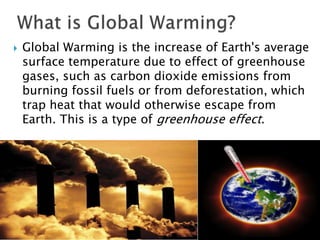
 Global Warming is the increase of Earth's average
surface temperature due to effect of greenhouse
gases, such as carbon dioxide emissions from
burning fossil fuels or from deforestation, which
trap heat that would otherwise escape from
Earth. This is a type of greenhouse effect.
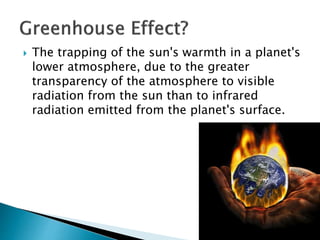
 The trapping of the sun's warmth in a planet's
lower atmosphere, due to the greater
transparency of the atmosphere to visible
radiation from the sun than to infrared
radiation emitted from the planet's surface.
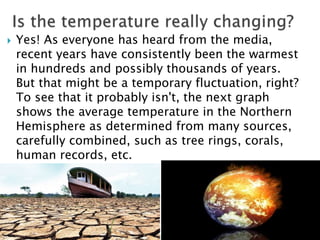
 Yes! As everyone has heard from the media,
recent years have consistently been the warmest
in hundreds and possibly thousands of years.
But that might be a temporary fluctuation, right?
To see that it probably isn't, the next graph
shows the average temperature in the Northern
Hemisphere as determined from many sources,
carefully combined, such as tree rings, corals,
human records, etc.
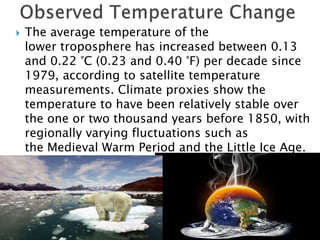
 The average temperature of the
lower troposphere has increased between 0.13
and 0.22 °C (0.23 and 0.40 °F) per decade since
1979, according to satellite temperature
measurements. Climate proxies show the
temperature to have been relatively stable over
the one or two thousand years before 1850, with
regionally varying fluctuations such as
the Medieval Warm Period and the Little Ice Age.
 At the outset of the talks, the expected key result was an
agreement to set a goal of limiting global warming to less
than 2 degrees Celsius (°C) compared to pre-industrial
levels. The agreement calls for zero net
anthropogenic greenhouse gas emissions to be reached
during the second half of the 21st century. In the adopted
version of the Paris Agreement,
 The parties will also "pursue efforts to" limit the
temperature increase to 1.5 °C. The 1.5 °C goal will
require zero emissions sometime between 2030 and 2050,
according to some scientists.
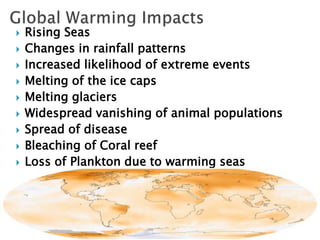
 Rising Seas
 Changes in rainfall patterns
 Increased likelihood of extreme events
 Melting of the ice caps
 Melting glaciers
 Widespread vanishing of animal populations
 Spread of disease
 Bleaching of Coral reef
 Loss of Plankton due to warming seas
 Plant a Tree
 Conserve Water
 Spread the Awareness
 Drive Less or Carpool
 Reduce, Reuse, Recycle
 Use Solar energy
 Buy Energy-Efficient Appliances
 Reduce Waste
 Use Less Hot Water
 Use Clean Fuel
 Replace Incandescent Light with CFL & LED

Global warming

  • 1.
  • 2.
     Global Warmingis the increase of Earth's average surface temperature due to effect of greenhouse gases, such as carbon dioxide emissions from burning fossil fuels or from deforestation, which trap heat that would otherwise escape from Earth. This is a type of greenhouse effect.
  • 3.
     The trappingof the sun's warmth in a planet's lower atmosphere, due to the greater transparency of the atmosphere to visible radiation from the sun than to infrared radiation emitted from the planet's surface.
  • 4.
     Yes! Aseveryone has heard from the media, recent years have consistently been the warmest in hundreds and possibly thousands of years. But that might be a temporary fluctuation, right? To see that it probably isn't, the next graph shows the average temperature in the Northern Hemisphere as determined from many sources, carefully combined, such as tree rings, corals, human records, etc.
  • 5.
     The averagetemperature of the lower troposphere has increased between 0.13 and 0.22 °C (0.23 and 0.40 °F) per decade since 1979, according to satellite temperature measurements. Climate proxies show the temperature to have been relatively stable over the one or two thousand years before 1850, with regionally varying fluctuations such as the Medieval Warm Period and the Little Ice Age.
  • 6.
     At theoutset of the talks, the expected key result was an agreement to set a goal of limiting global warming to less than 2 degrees Celsius (°C) compared to pre-industrial levels. The agreement calls for zero net anthropogenic greenhouse gas emissions to be reached during the second half of the 21st century. In the adopted version of the Paris Agreement,  The parties will also "pursue efforts to" limit the temperature increase to 1.5 °C. The 1.5 °C goal will require zero emissions sometime between 2030 and 2050, according to some scientists.
  • 7.
     Rising Seas Changes in rainfall patterns  Increased likelihood of extreme events  Melting of the ice caps  Melting glaciers  Widespread vanishing of animal populations  Spread of disease  Bleaching of Coral reef  Loss of Plankton due to warming seas
  • 8.
     Plant aTree  Conserve Water  Spread the Awareness  Drive Less or Carpool  Reduce, Reuse, Recycle  Use Solar energy  Buy Energy-Efficient Appliances  Reduce Waste  Use Less Hot Water  Use Clean Fuel  Replace Incandescent Light with CFL & LED