Presented By
RANJIT BISWAS
Bangabandhu Sheikh Mujibur Rahman
Science & Technology University.
Department of MANAGEMENT
ID:20111105029
Email:ranojt@gmail.com
www.Facebook.com/Rano Jit Biswas
Blogspot:http://ranobsmrstu.blogspot.com/
Mob: +8801737873393/+8801683046628
WELCOME
2
PRESENTATION
ON
1. International Marketing
&
2.Marketing Ethics
3
International marketing
Marketing that is concerned to
integrating or standardizing marketing
actions across different geographic
markets……………..
4
RISKS IN INTERNATIONAL
MARKETING
5
International trade is characteristically very complex.
There are many risks in international marketing.
Risks are………….
Economic Risk
Political Risk
Social Risk
Other Risk
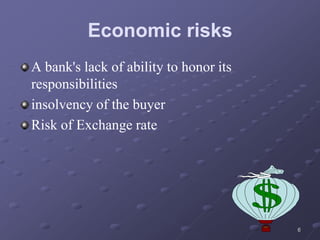
Economic risks
A bank's lack of ability to honor its
responsibilities
insolvency of the buyer
Risk of Exchange rate
6
Political risks
import and exports licenses
Risk of the imposition of an import ban after the
delivery of the goods
Changes in the policies of the government
Lack of foreign currency
Risks due to war
7
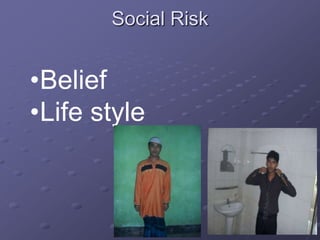
Social Risk
8
•Belief
•Life style
Others Risks
Lack of knowledge of overseas
markets
Language barriers
Inclination to corrupt business
associates
Risk of the various kinds natural
catastrophes, which cannot be 9
Indicators of market potential
Demographic characteristics
.Size of population
. Rate of population growth
. Degree of urbanization
. Population density
. Age structure and composition of
the population
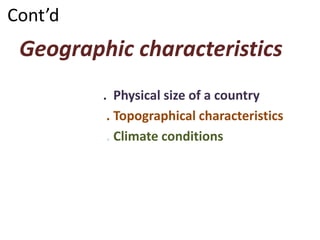
Cont’d
Geographic characteristics
. Physical size of a country
. Topographical characteristics
. Climate conditions
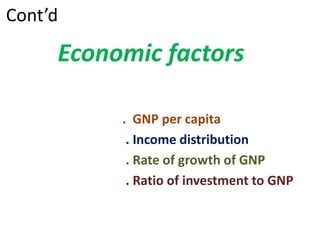
Cont’d
Economic factors
. GNP per capita
. Income distribution
. Rate of growth of GNP
. Ratio of investment to GNP
 Distribution refers to the way in which
consumers find out about product and the
channels they use to research it and make
bookings.
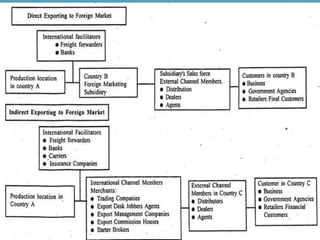
 The options available to international marketer
in organizing direct distribution include
sending missionary skies representatives
abroad from the headquarter, setting up of
local sales/branch office in the foreign country
or for a region, establishing a subsidiary
abroad, entering into a joint venture or
franchising agreement.
 Indirect channels are further classified based
on whether the international marketer makes
use of domestic intermediaries. An
international marketer therefore, can make use
of the following types of intermediaries for
distribution in foreign markets.
 Wholesalers provide retail travel agents with
brochured travel packages, usually offering
transport, accommodation and activities. Most
wholesalers are based outside of New Zealand.
Some own retail agencies or sell directly to the
public.
 Selling directly to the public, retail travel agents
are the face of the travel industry consumers see
everyday. They will either deal direct with
operators (particularly for short-break holidays) or
sell products out of wholesaler brochures.
Marketing ethics address principles that define acceptable
conduct in the market place . Marketing usually occurs on the
context of develop from the pressure to meet performance
objectives .Same obvious ethical issues in marketing involves
clear cut attempts to take advantages of a situation .
The American marketing Association has its own code of
ethics . This code covers ethical issues on promotions,
distribution, pricing and marketing research .
It is our belief that good marketing is ethical marketing.
Good marketing is about satisfying and developing a long term
relationship with any customer. Caring about any customer
not only results in profit , It is ethical thing to do.
Deceiving customers may help a firms profits in the short
run, but it is not the way to build a successful business . The
same goes social responsibility. A firm has to care about all
stakeholders, customers, employees , suppliers, distributors in
which they do business society and environment.
There are many reasons to understand and develop the
most effective approaches to manage marketing ethics. All
organizations face significant threats from ethical
misconduct and illegal behavior. If we want to achieve a
long term objectives, we must follow marketing ethics.
Without marketing ethics, we can not run any business
permanently. So marketing ethics is the most important
component in business world an ultra modern age.
ETHICS
Ethics, also known as moral philosophy, is a branch of philosophy
that involves systematizing defending and recommending concept
of…….
Business ethics
 ………is a form of applied ethics or
professional ethics that examines ethical
principles and moral.
Impact of ethics on marketing
Ethics create a great impact on international
marketing.
Such as cultural, religion, environmental,
political etc.
Ex:
Code of ethics
 The American Marketing association commits
itself to promoting the highest standard of
professional ethical norms and values.
GENARAL norms
 1. Marketers must do no harm.
2. Marketers must foster trust in the
marketing system.
3.Marketers must embrace, communicate
and practice the fundamental ethical values
that will improve consumer relationship.
Ethical values
 1. Honesty……………....
2. Responsibility……………
3. Fairness……………………….
4. Respect…………………………..
5. Openness……………………………
6. Citizenship………………………………
So at last we can say that
without considering these
things no international
marketing Business can
success.
Thanks everybody.
Do you have any
question all of you are
fell free to ask?

Global marketing

  • 1.
    Presented By RANJIT BISWAS BangabandhuSheikh Mujibur Rahman Science & Technology University. Department of MANAGEMENT ID:20111105029 Email:ranojt@gmail.com www.Facebook.com/Rano Jit Biswas Blogspot:http://ranobsmrstu.blogspot.com/ Mob: +8801737873393/+8801683046628
  • 2.
  • 3.
  • 4.
    International marketing Marketing thatis concerned to integrating or standardizing marketing actions across different geographic markets…………….. 4
  • 5.
    RISKS IN INTERNATIONAL MARKETING 5 Internationaltrade is characteristically very complex. There are many risks in international marketing. Risks are…………. Economic Risk Political Risk Social Risk Other Risk
  • 6.
    Economic risks A bank'slack of ability to honor its responsibilities insolvency of the buyer Risk of Exchange rate 6
  • 7.
    Political risks import andexports licenses Risk of the imposition of an import ban after the delivery of the goods Changes in the policies of the government Lack of foreign currency Risks due to war 7
  • 8.
  • 9.
    Others Risks Lack ofknowledge of overseas markets Language barriers Inclination to corrupt business associates Risk of the various kinds natural catastrophes, which cannot be 9
  • 10.
    Indicators of marketpotential Demographic characteristics .Size of population . Rate of population growth . Degree of urbanization . Population density . Age structure and composition of the population
  • 11.
    Cont’d Geographic characteristics . Physicalsize of a country . Topographical characteristics . Climate conditions
  • 12.
    Cont’d Economic factors . GNPper capita . Income distribution . Rate of growth of GNP . Ratio of investment to GNP
  • 13.
     Distribution refersto the way in which consumers find out about product and the channels they use to research it and make bookings.
  • 15.
     The optionsavailable to international marketer in organizing direct distribution include sending missionary skies representatives abroad from the headquarter, setting up of local sales/branch office in the foreign country or for a region, establishing a subsidiary abroad, entering into a joint venture or franchising agreement.
  • 16.
     Indirect channelsare further classified based on whether the international marketer makes use of domestic intermediaries. An international marketer therefore, can make use of the following types of intermediaries for distribution in foreign markets.
  • 17.
     Wholesalers provideretail travel agents with brochured travel packages, usually offering transport, accommodation and activities. Most wholesalers are based outside of New Zealand. Some own retail agencies or sell directly to the public.  Selling directly to the public, retail travel agents are the face of the travel industry consumers see everyday. They will either deal direct with operators (particularly for short-break holidays) or sell products out of wholesaler brochures.
  • 18.
    Marketing ethics addressprinciples that define acceptable conduct in the market place . Marketing usually occurs on the context of develop from the pressure to meet performance objectives .Same obvious ethical issues in marketing involves clear cut attempts to take advantages of a situation . The American marketing Association has its own code of ethics . This code covers ethical issues on promotions, distribution, pricing and marketing research .
  • 19.
    It is ourbelief that good marketing is ethical marketing. Good marketing is about satisfying and developing a long term relationship with any customer. Caring about any customer not only results in profit , It is ethical thing to do. Deceiving customers may help a firms profits in the short run, but it is not the way to build a successful business . The same goes social responsibility. A firm has to care about all stakeholders, customers, employees , suppliers, distributors in which they do business society and environment.
  • 20.
    There are manyreasons to understand and develop the most effective approaches to manage marketing ethics. All organizations face significant threats from ethical misconduct and illegal behavior. If we want to achieve a long term objectives, we must follow marketing ethics. Without marketing ethics, we can not run any business permanently. So marketing ethics is the most important component in business world an ultra modern age.
  • 21.
    ETHICS Ethics, also knownas moral philosophy, is a branch of philosophy that involves systematizing defending and recommending concept of…….
  • 22.
    Business ethics  ………isa form of applied ethics or professional ethics that examines ethical principles and moral.
  • 23.
    Impact of ethicson marketing Ethics create a great impact on international marketing. Such as cultural, religion, environmental, political etc. Ex:
  • 24.
    Code of ethics The American Marketing association commits itself to promoting the highest standard of professional ethical norms and values.
  • 25.
    GENARAL norms  1.Marketers must do no harm. 2. Marketers must foster trust in the marketing system. 3.Marketers must embrace, communicate and practice the fundamental ethical values that will improve consumer relationship.
  • 26.
    Ethical values  1.Honesty…………….... 2. Responsibility…………… 3. Fairness………………………. 4. Respect………………………….. 5. Openness…………………………… 6. Citizenship………………………………
  • 27.
    So at lastwe can say that without considering these things no international marketing Business can success.
  • 28.
  • 29.
    Do you haveany question all of you are fell free to ask?