• “Marketing isa societal process by
which individuals and groups obtain
what they need and want through
creating, offering and freely
exchanging products and services of
value with others”
Philip Kotler
3.
Introduction
Marketing isimportant in any business
The purpose of business is to create and keep a
customer
Businesses must develop products and services that
customers want at prices they are willing to pay
Marketing includes making decisions about
what products or services to put on the market,
who are potential customers for these goods
How to reach the target markets & induce them to buy
How to price the product or service to make it attractive to these
customers
How to deliver the goods physically to the ultimate consumers
4.
• An areaof study that deals with ideas about what
is good and bad behavior and with moral duty and
obligation
• The rules and principles that define right and
wrong conduct
• It refers to well-founded standards of right and
wrong that prescribe what humans ought to do.
5.
• Honesty
• Loyalty
•Integrity
• Keeping your
promises
• Fair
• Caring
• Respect
• Obeying the law
• Excellence
• Being a leader
• Morale
6.
• Marketing ethicsaddresses principles and standards
that define acceptable conduct in the market place.
Marketing usually occurs in the context of an
organization, and unethical activities usually develop
from the pressure to meet performance objectives. Some
obvious ethical issues in marketing involves clear cut
attempts to deceive or take advantage of a situation
7.
Introduction
Marketing Mix– 4 Ps
The decisions that marketing managers must make about
each of these Ps involve numerous ethical issues
Product
raises obvious concerns about product safety,
alcohol and tobacco,
unhealthy foods,
gas-guzzling SUVs
8.
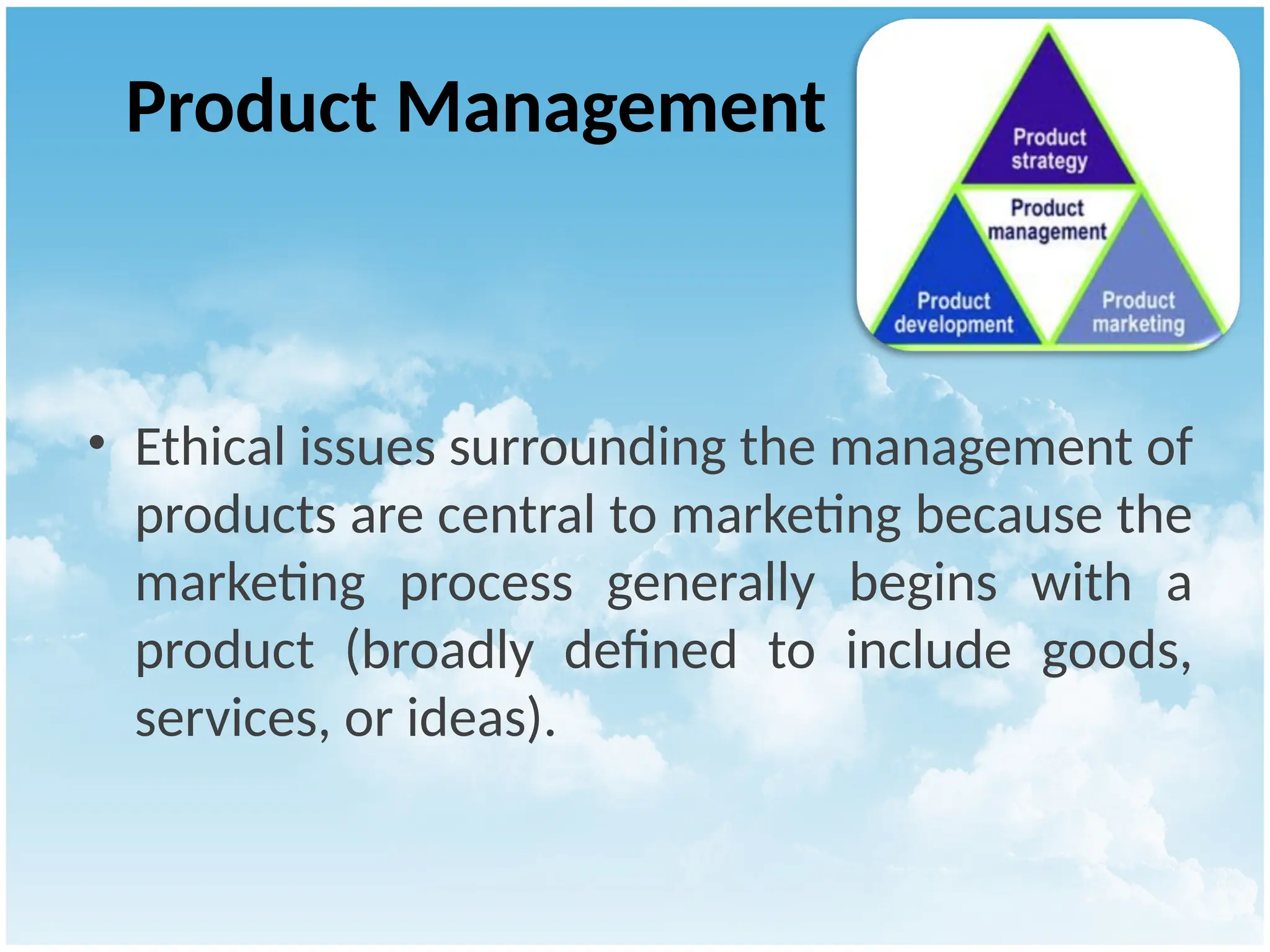
Product Management
• Ethicalissues surrounding the management of
products are central to marketing because the
marketing process generally begins with a
product (broadly defined to include goods,
services, or ideas).
9.
Product Management
• Themost common ethical concerns in this
area pertain to the safety of products are safe
"for their use as intended" is a basic consumer
expectation.
10.
Product Management
• Anothergrowing area of concern is product
counterfeiting(copy of original). Product
counterfeiting involves the unauthorized copy of
patented products, inventions, and trademarks or
the violation of registered copyrights (often for
the purposes of making a particular product look
like a more popular branded leader).
• Common examples of product counterfeiting
include fake Rolex watches, knockoff Levi jeans,
and illegally pirated video and audio tapes of
popular movies and music.
11.
Introduction
Price
Predatorypricing (which undercuts the
competition unfairly)
Price discrimination (charging more to some
customers than others)
Misleading prices
Price fixing (with other competitors)
12.
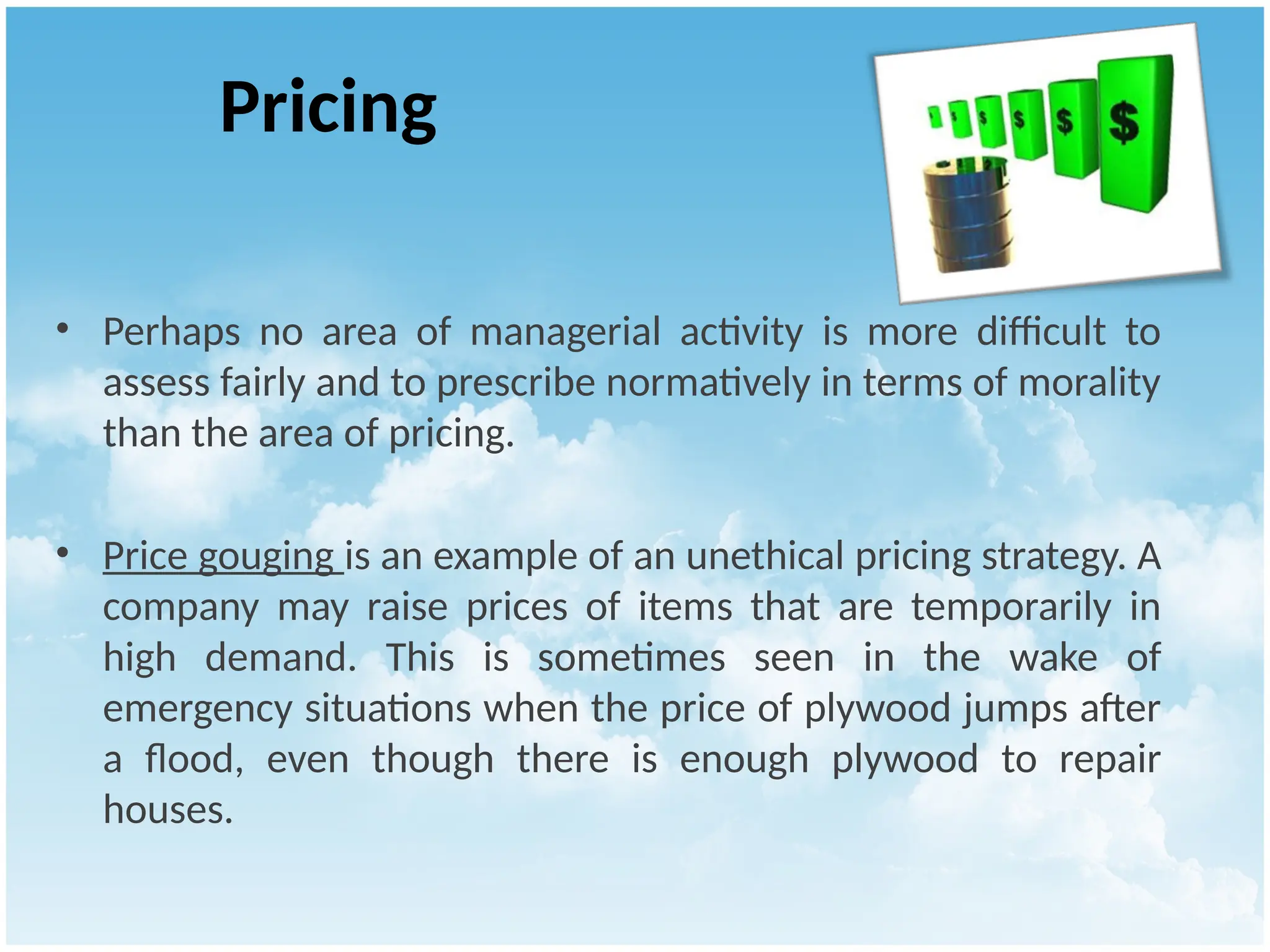
Pricing
• Perhaps noarea of managerial activity is more difficult to
assess fairly and to prescribe normatively in terms of morality
than the area of pricing.
• Price gouging is an example of an unethical pricing strategy. A
company may raise prices of items that are temporarily in
high demand. This is sometimes seen in the wake of
emergency situations when the price of plywood jumps after
a flood, even though there is enough plywood to repair
houses.
13.
Pricing
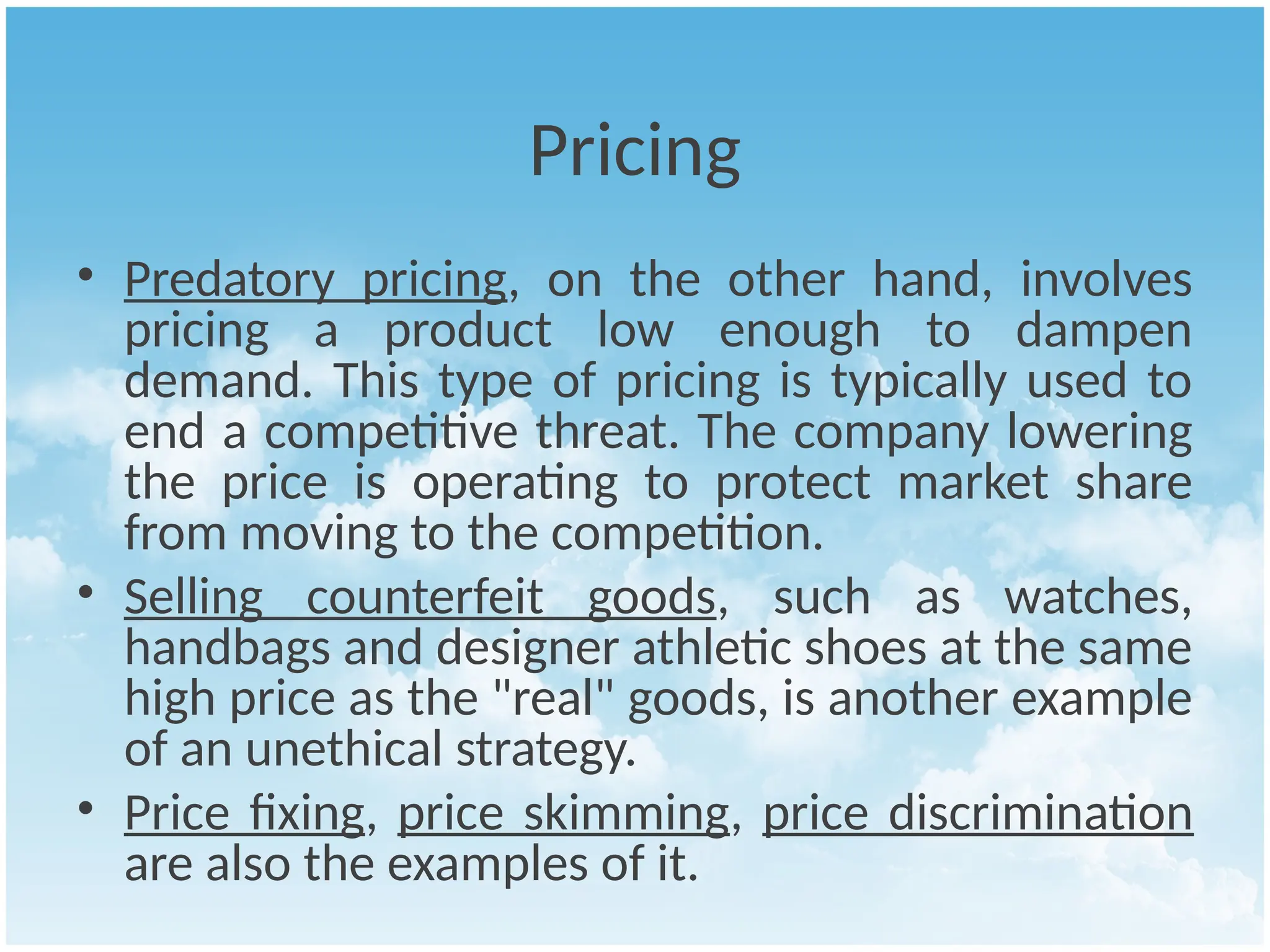
• Predatory pricing,on the other hand, involves
pricing a product low enough to dampen
demand. This type of pricing is typically used to
end a competitive threat. The company lowering
the price is operating to protect market share
from moving to the competition.
• Selling counterfeit goods, such as watches,
handbags and designer athletic shoes at the same
high price as the "real" goods, is another example
of an unethical strategy.
• Price fixing, price skimming, price discrimination
are also the examples of it.
15.
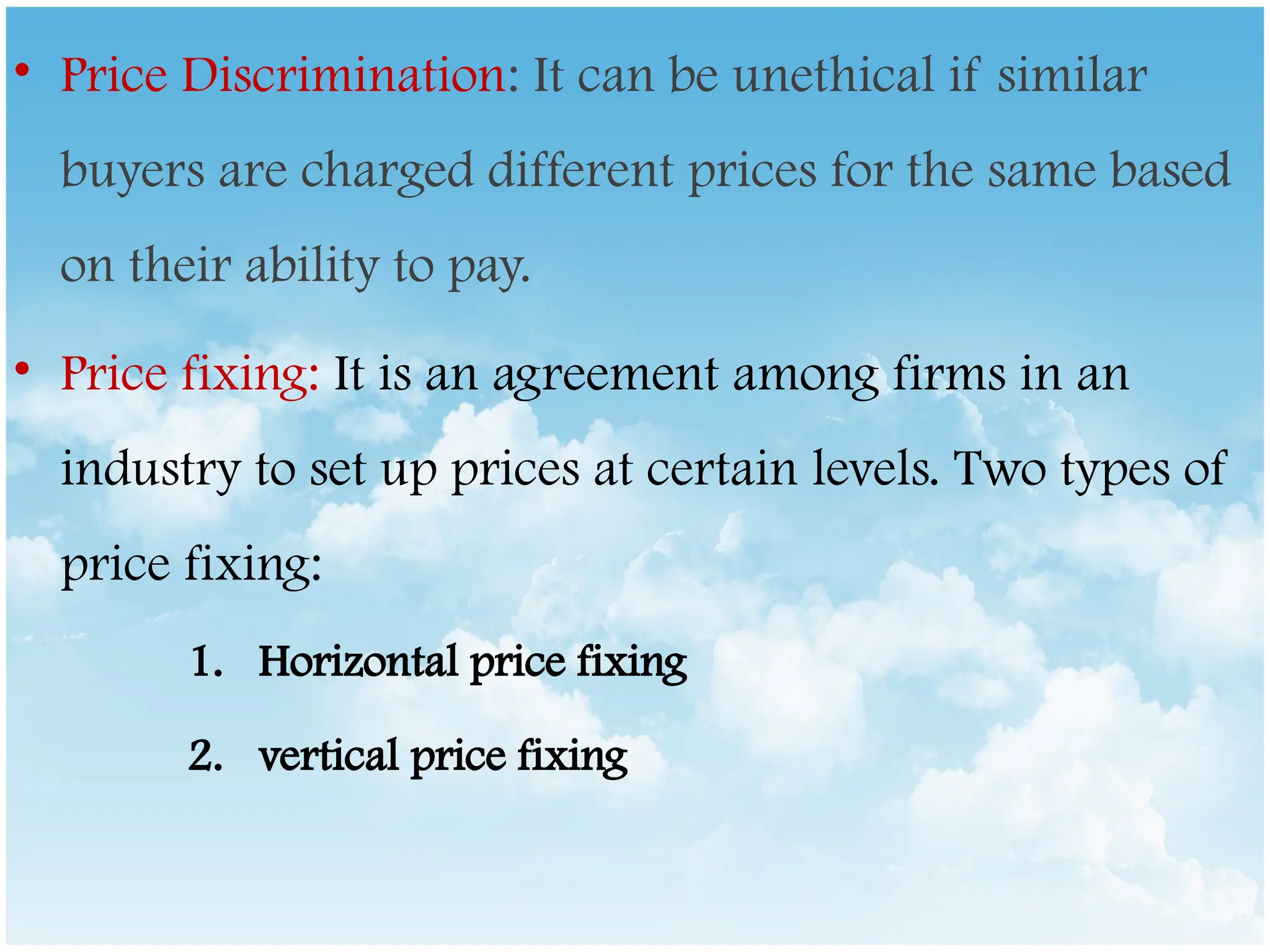
• Price Discrimination:It can be unethical if similar
buyers are charged different prices for the same based
on their ability to pay.
• Price fixing: It is an agreement among firms in an
industry to set up prices at certain levels. Two types of
price fixing:
1. Horizontal price fixing
2. vertical price fixing
16.
Introduction
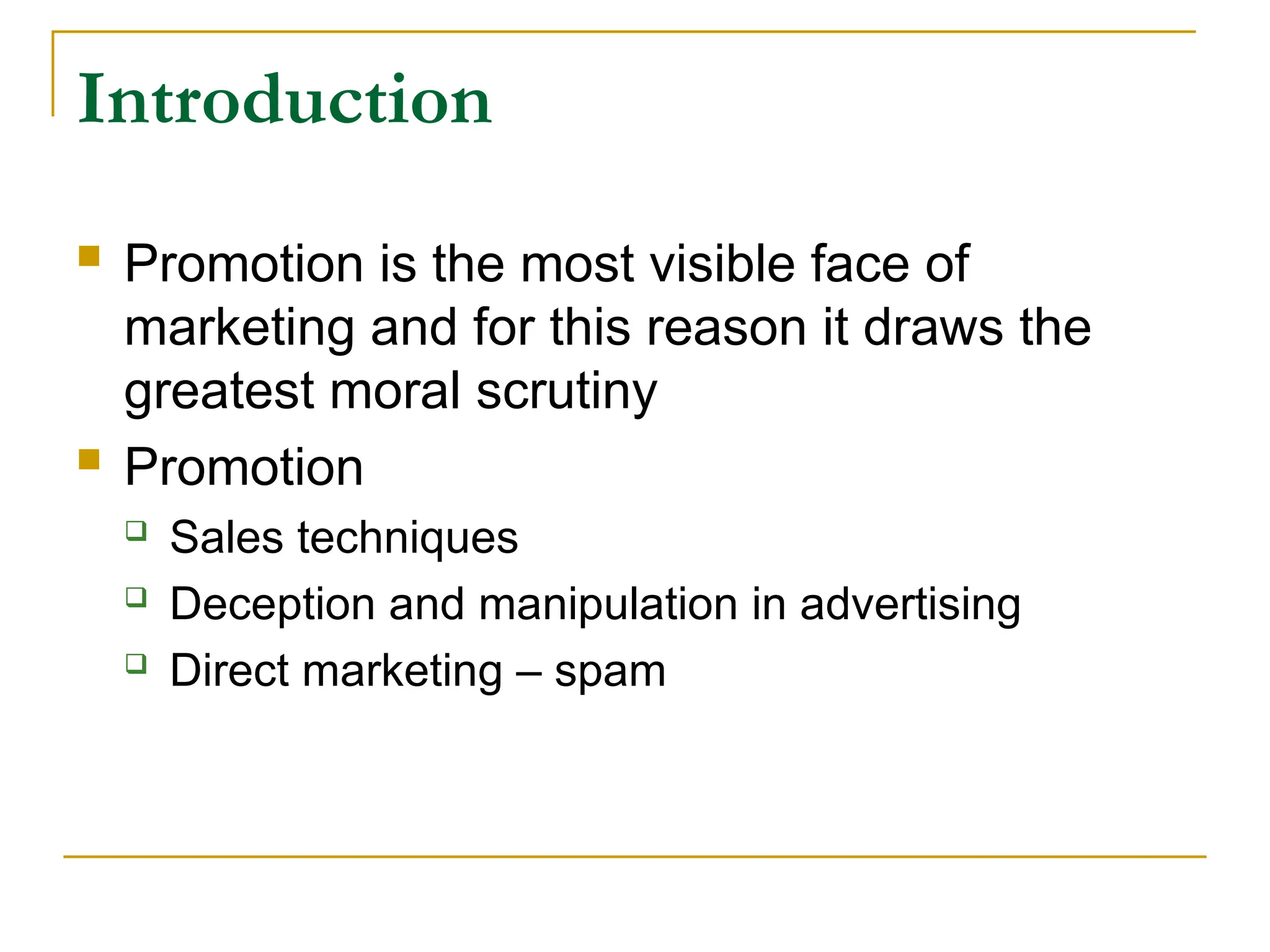
Promotion isthe most visible face of
marketing and for this reason it draws the
greatest moral scrutiny
Promotion
Sales techniques
Deception and manipulation in advertising
Direct marketing – spam
Marketing
Marketing affectseveryone
Marketers have strong incentive to sell products and
services
Despite the doctrine of consumer sovereignty – the
notion that consumers are ‘kings’ in the economy
because they ultimately decide whether to buy a
company’s products – individual consumers are still
vulnerable given the vast power of companies to
determine what goods are offered and through
advertising, what consumers want
19.
Marketing
Because sellingis so important for business
and such powerful means are available,
ethical problems are inevitable
20.
A Framework forMarketing Ethics
Most of the ethical problems in marketing
involve three ethical concepts: -
Fairness (or justice)
Freedom
Well-being
21.
A Framework forMarketing Ethics
Fairness is a central concern because it is a
basic moral requirement for any market
transaction – and the result of successful
marketing is always a market transaction
In a market transaction, each party gives up
something of value in return for something they
value more
And such exchanges are fair (and mutually
beneficial) as long as each party acts freely and
has adequate information
22.
A Framework forMarketing Ethics
The requirement of acting freely rules out
exchanges in which there is coercion or
manipulation or when one party lacks
competence (children or elderly) and the
adequate information requirement excludes
the making of false or deceptive statements
23.
A Framework forMarketing Ethics
The need for information in a fair market
transaction is problematic
A seller does not have an obligation to
provide ALL relevant information to a buyer,
and a buyer has some obligation to become
informed about what is being bought
A Framework forMarketing Ethics
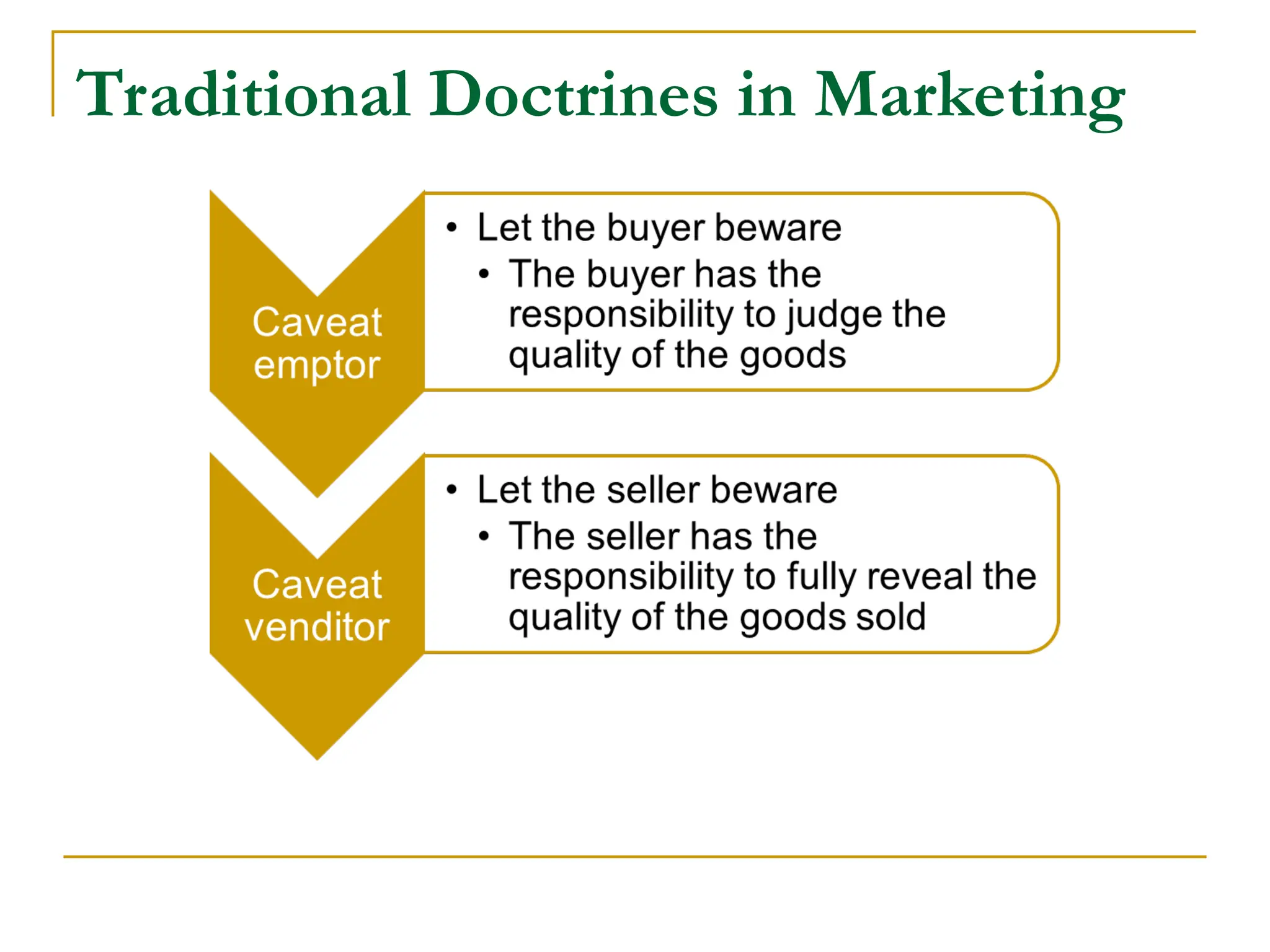
In practice, the responsibility is divided
between buyers and sellers
Buyers have good economic reasons to be
informed (to protect themselves)
Sellers – to provide information to attract the
buyers
26.
A Framework forMarketing Ethics
Generally, consumer laws require only the
disclosure of information that buyers need to
make rational purchasing decisions
27.
A Framework forMarketing Ethics
Freedom is at issue in marketing with respect to having a
range of consumer options
Freedom is denied when marketers engage in deceptive
or manipulative practices and take advantage of
vulnerable populations such as children, the poor and
the elderly
Large retailers have been accused of using their power
to force small suppliers into accepting unfavourable
agreements
Larger suppliers can similarly take advantage of size to
disadvantage small retailers
28.
A Framework forMarketing Ethics
These 3 principles of FAIRNESS, FREEDOM
and WELL-BEING can be expressed in the
four-point bill of rights for consumers that
President JF Kennedy proclaimed in 1962: -
(a) The right to safe products,
(b) The right to be informed about all relevant aspects
of a product,
(c) The right to be heard in the event of a complaint,
and
(d) The right of consumers to choose what they buy.
29.
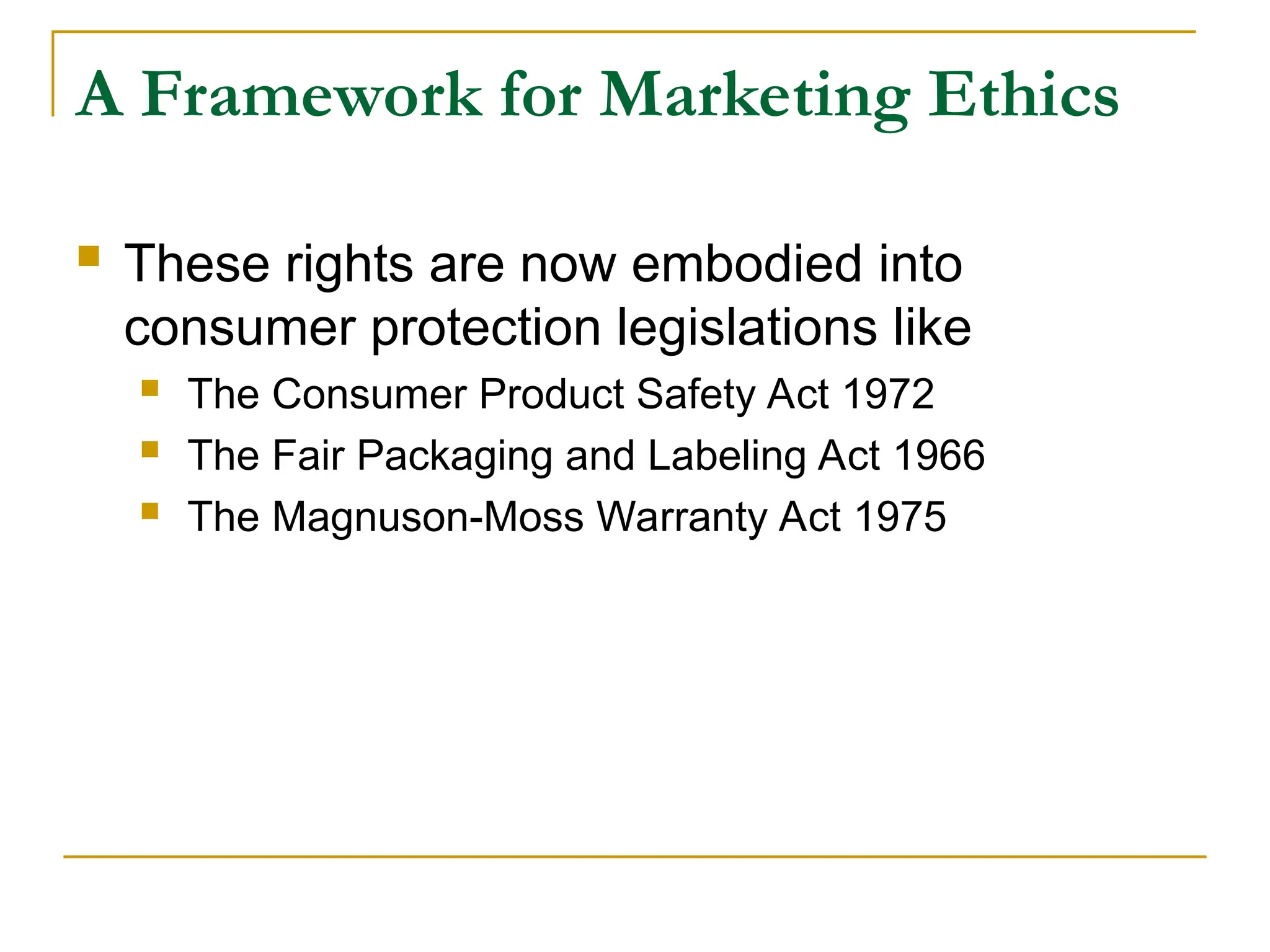
A Framework forMarketing Ethics
These rights are now embodied into
consumer protection legislations like
The Consumer Product Safety Act 1972
The Fair Packaging and Labeling Act 1966
The Magnuson-Moss Warranty Act 1975
30.
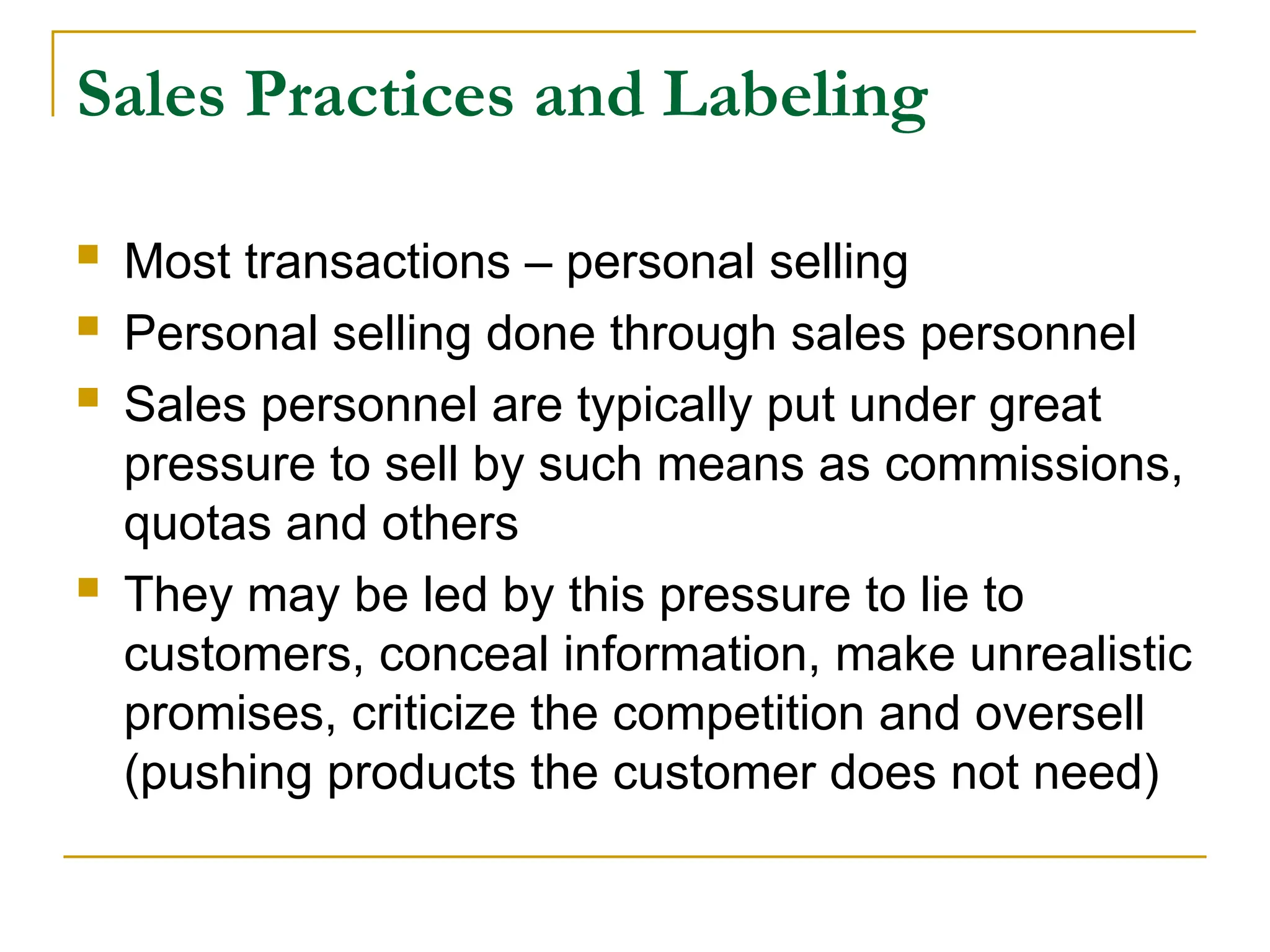
Sales Practices andLabeling
Most transactions – personal selling
Personal selling done through sales personnel
Sales personnel are typically put under great
pressure to sell by such means as commissions,
quotas and others
They may be led by this pressure to lie to
customers, conceal information, make unrealistic
promises, criticize the competition and oversell
(pushing products the customer does not need)
31.
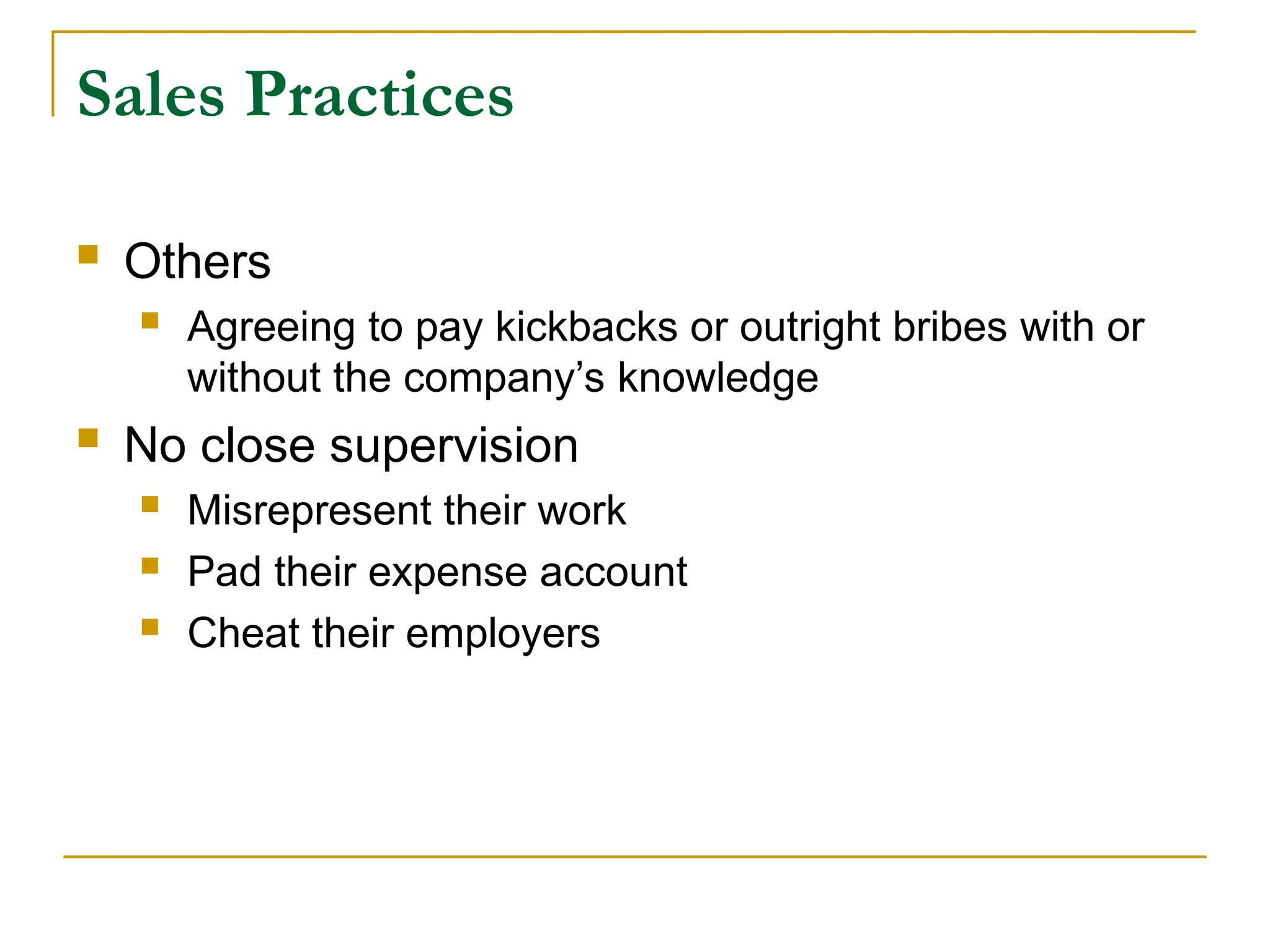
Sales Practices
Others
Agreeing to pay kickbacks or outright bribes with or
without the company’s knowledge
No close supervision
Misrepresent their work
Pad their expense account
Cheat their employers
32.
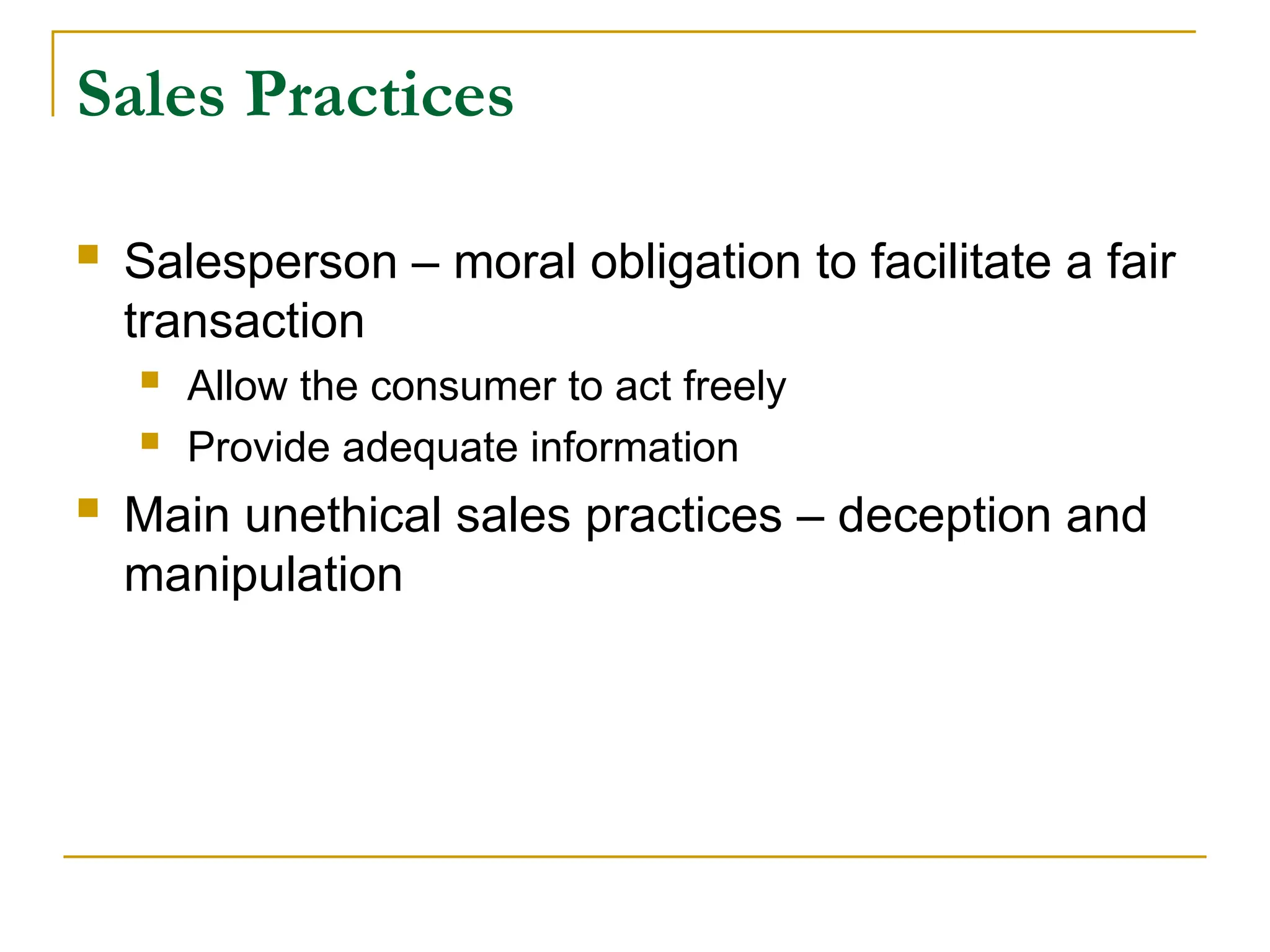
Sales Practices
Salesperson– moral obligation to facilitate a fair
transaction
Allow the consumer to act freely
Provide adequate information
Main unethical sales practices – deception and
manipulation
33.
Sales Practices
Deception:-
Consumers are led to hold false beliefs about
a product
Knowingly make a false statements
34.
Sales Practices
Examples:-
‘Special sale’ ends today but fail to add that another ‘special
sale’ will begin the next day
Markdowns from ‘suggested retail price’ that is never charged
Introductory offers
Bogus clearance sales in which inferior goods are brought in for
the ‘sale’
Packaging and labeling - size or shape of a container, a picture
or description
‘Economy size’
‘new and improved’
Warranties that cannot be easily be understood by the average
consumer
Sales Practices
Examples:-
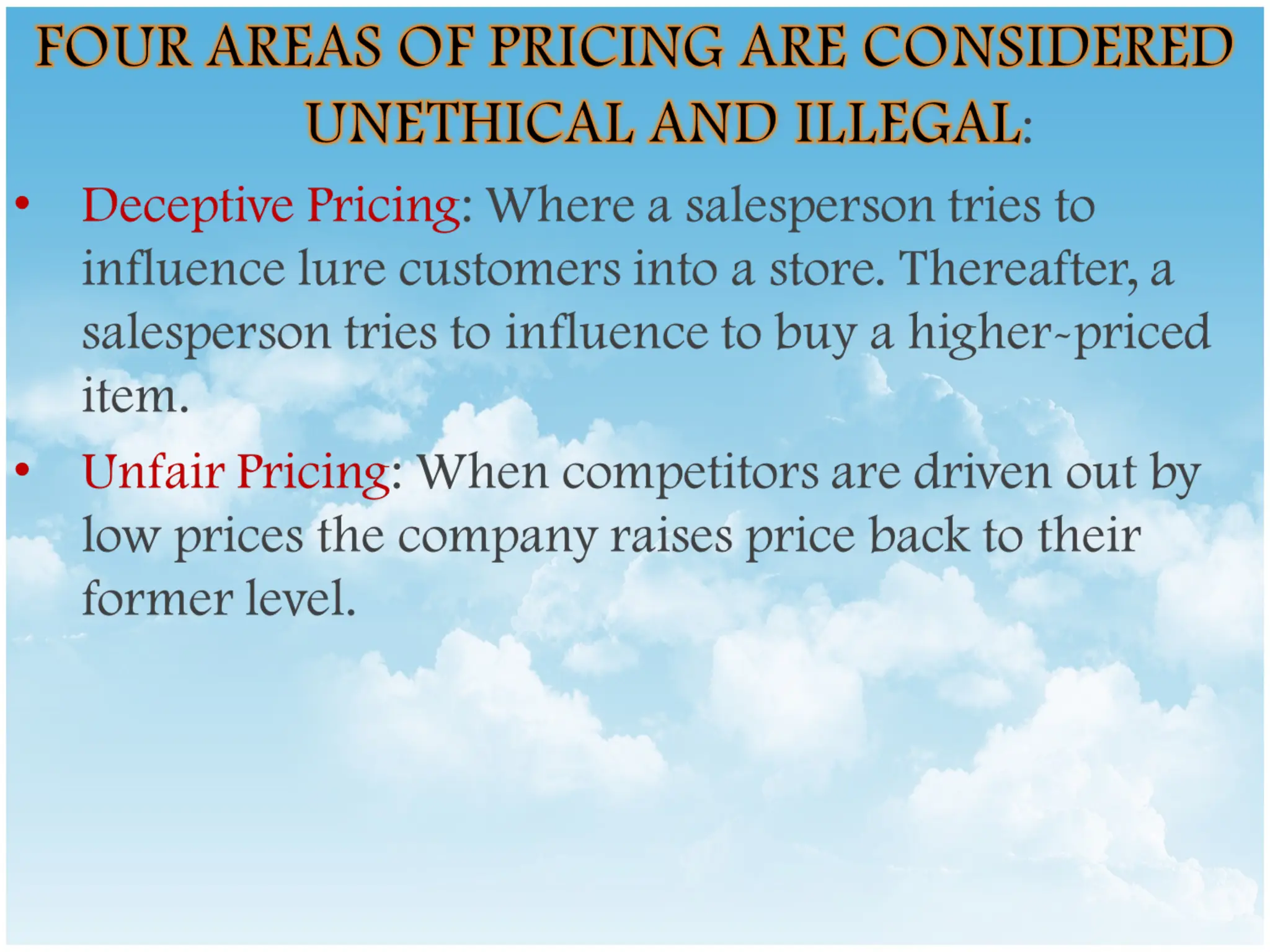
“bait and switch”
A consumer is lured into a store by an advertisement for a
low-cost item and then sold a higher-priced version
Often the low-cost item is not available
37.
Sales Practices
Manipulationtakes place when salesperson use
high-pressure tactics
Deception to gain entry to the homes of prospects by
claiming to be conducting advertising research
38.
Labeling
Many consumerpurchasers occur without any
contact with a salesperson
When a consumer merely takes a product off a
shelf, the main contact between that consumer
and the manufacturer is the print on the package
The label becomes a means not only for selling
a product but also informing the consumer
Label - important
39.
Labeling
If noinformation on a box, a consumer has no
practical means for determining the size,
ingredients used, the nutritional content or the
length of time the product has been sitting in the
self
Health-conscious consumers are especially
disadvantages by claims about low fat and salt
content and the unregulated use of words such
as ‘light’ and ‘healthy’
40.
Labeling
The moreinformation consumers have, the
better they can protect themselves in the
marketplace
The ethical questions are: -
How much information is a manufacturer obliged to
provide?
To what extent are consumers responsible for
informing themselves about the products for sale?
41.
Labeling
Thus, legislationplays an important role here in
ensuring that the manufacturers provide the
necessary information about the product to the
consumers
42.
Labeling
Reasons givenby manufacturer for not proving
information: -
Secret recipe
Unnecessary cause consumers to panic
Misunderstood by consumers
Reject older goods which are still good
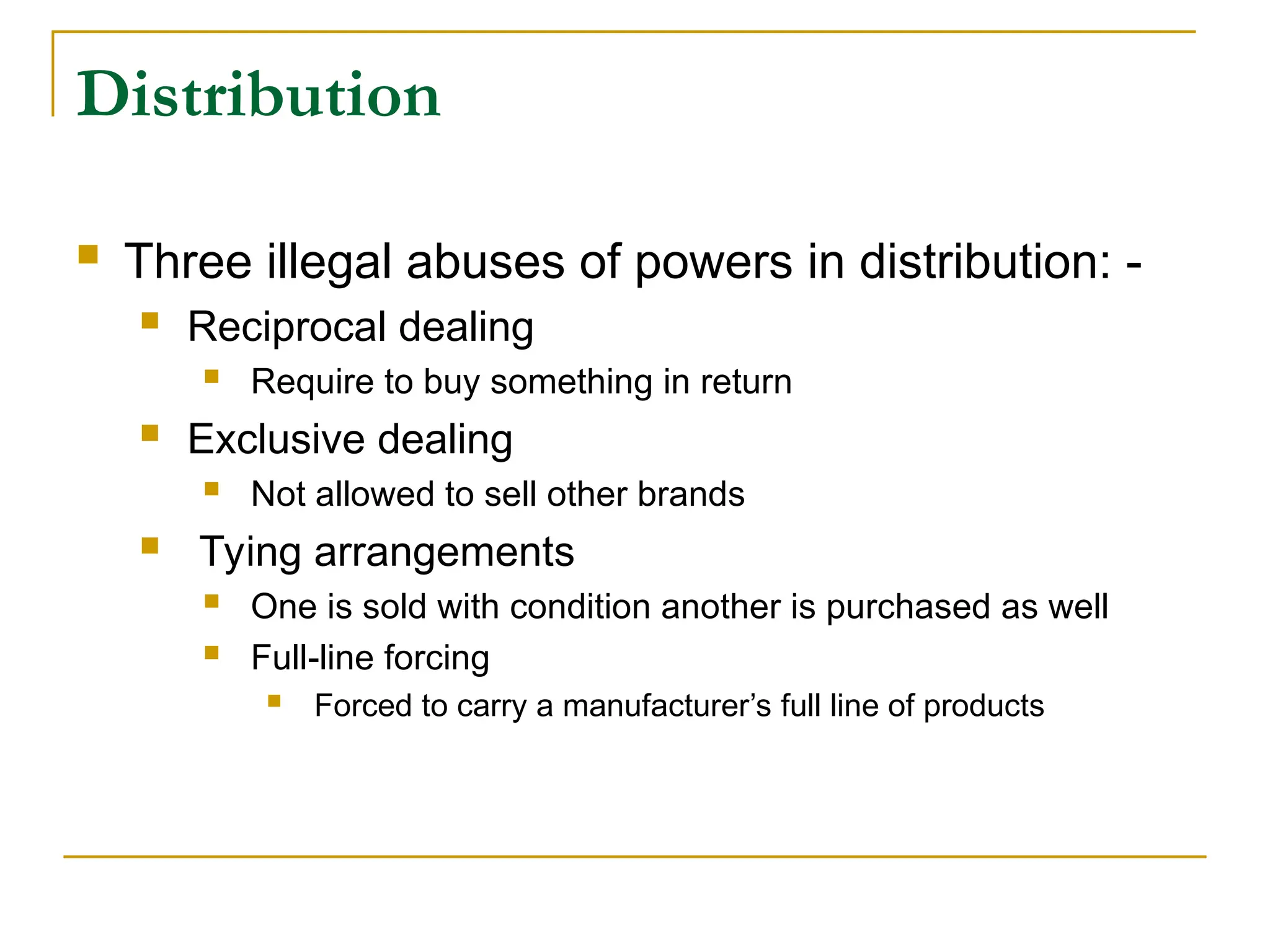
Distribution
Three illegalabuses of powers in distribution: -
Reciprocal dealing
Require to buy something in return
Exclusive dealing
Not allowed to sell other brands
Tying arrangements
One is sold with condition another is purchased as well
Full-line forcing
Forced to carry a manufacturer’s full line of products


![Lecture 4 - The Marketing Environment, Ethics & CSR (1) [Autosaved].pptx](https://cdn.slidesharecdn.com/ss_thumbnails/lecture4-themarketingenvironmentethicscsr1autosaved-230428083033-8892c277-thumbnail.jpg?width=640&height=640&fit=bounds)


